IJIRT 148809
INTERNATIONAL JOURNAL OF INNOVATIVE RESEARCH IN TECHNOLOGY169
Resource Allocation Strategy for Multi-User Cognitive
Radio Systems: Location-Aware Spectrum Access
Bhogaraju N A V A R Rao
1, S.Saidarao
2 1Pursuing M.Tech (CS), Dept. of ECE, Newton’s Institute of Engineering College, Alugurajupally,
Macherla, Guntur Dist., Ap, India
2
Assistant Professor Dept. of ECE, Newton’s Institute of Engineering College, Alugurajupally, Macherla,
Guntur Dist., Ap, India
Abstract- In this proposal, asset distribution and different access in intellectual radio (CR) and packed detecting (CS)- based remote systems are considered. Vitality effectiveness arranged outline turns out to be increasingly critical in remote frameworks, which propels us to propose an area mindful power technique for single client and various clients in CR frameworks and a CS-based preparing in remote sensor systems (WSNs) which decreases the quantity of information transmissions and vitality utilization by using sparsity of the transmitted information because of spatial relationship and transient connection. Specifically, the work on area mindful power portion in CR framework gives a short diagram of the current power allotment plan in the writing and brings together them into a general power distribution system. The effect of the system topology iv on the framework execution is featured, which spurs us to propose a novel area mindful methodology that keenly uses recurrence and space openings and limits the general power utilization while keeping up the nature of administration (QoS) of the essential framework. This work demonstrates that notwithstanding investigating the range gaps in time and recurrence areas, spatial open doors can be used to additionally upgrade vitality productivity for CR frameworks.
INTRODUCTION
As of late, the plan idea of remote interchanges is moving towards vitality productivity other than limit and rates, basically planning to determine the heightening by and large vitality utilization anticipated soon. Such an idea is the center part of green interchanges. Intellectual Radio (CR), because of its sensors, is an empowering innovation for green correspondences which upgrades the range proficiency and lessens the electromagnetic radiation levels. Compacted detecting (CS), a novel numerical hypothesis, can likewise be connected in remote
correspondence frameworks to execute green interchanges. CS secures a flag of intrigue in a roundabout way by gathering a generally modest number of perceptions instead of equally testing it at the Nyquist rate which on a very basic level changes the customary advanced flag handling in remote correspondences and improves the vitality effectiveness. Propelled by the advantages of these specified innovations, my examination work is centered around the detecting and power portion methodology of CR frameworks and CS-based remote sensor systems (WSNs) to hold the guarantee of green correspondences. In this part, we quickly audit the foundation of CR and vitality proficient WSNs, trailed by a synopsis of the commitment of the theory.
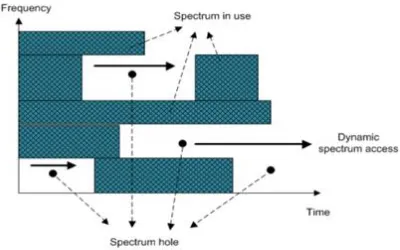
Figure 1: Spectrum hole and dynamic spectrum access
LITERATURE SURVEY
IJIRT 148809
INTERNATIONAL JOURNAL OF INNOVATIVE RESEARCH IN TECHNOLOGY170
and pull-based plan [17]. By presenting a different access class, ACB enables the eNodeB to control the entrance of UEs independently. Two crucial parameters in the ACB technique are the excepting factor which speaks to the likelihood of notwithstanding and the backoff factor which shows the backoff time before retrying arbitrary process if the UE fizzles the ACB check. Numerous researchers have chipped away at the dynamic change of the notwithstanding factor. In [10], a joint asset distribution and access excepting plan is proposed to accomplish uplink planning and arbitrary access organize (RAN) over-burden control, in which the entrance notwithstanding parameter is adaptively changed in view of the measure of accessible RBs and the activity stack. In [11], two unique ACB calculations for settled and dynamic preface designation plans are proposed to decide the notwithstanding factors without priori learning of the quantity of MTC gadgets. [9] defines an enhancement issue to decide the ideal notwithstanding parameter which boosts the normal number of MTC gadgets effectively served in every RA space. [12] Proposes a two-organize ACB plan to expand get to progress likelihood. In the principal organize, the UEs utilize the accepting factor communicated by the eNodeB. The UEs which pass the ACB check are seen as essential UEs and permitted to choose non-uncommon preludes haphazardly, while the UEs which come up short are dealt with as optional UEs and select the exceptional introductions. In the second stage, every auxiliary UE ascertains its notwithstanding likelihood freely in light of the normal number of optional UEs. As far as the backoff factor, [13] analyzes the execution of uniform backoff (UB) and twofold exponential backoff (BEB) calculations and proposes another calculation to adaptively change the backoff window estimate under unsaturated activity conditions.
3. Location-Aware Resource Allocation Strategies in Cognitive Radio Systems
Motivation
Truth be told, when range sharing is a choice, considerably higher throughput can be accomplished by enabling the SUs to underlay with the PUs,
performing simultaneous transmissions
minimalistically to such an extent that impedance created to the essential framework is kept underneath
an endorsed limit. Two sharing-based methodologies are proposed in this work: A sharing-based PPA approach and a detecting free power designation (SFPA) approach. Not at all like customary PPA, has sharing-based PPA additionally used those possessed sub-channels with extra security to the PU. SFPA is roused from the detecting free power control depicted in [24], which dependably expect that all the sub-channels are possessed by the essential framework, yet still transmits all in all range with appropriate power control. The execution of the previously mentioned approaches exceptionally rely upon the system topology, and specifically, the separation between the SU transmitter and the PU beneficiary. For instance, when the SU is near the PU, range detecting turns out to be critical in accurately identifying channel availabilities, subsequently detecting based methodologies ought to be utilized. Then again, when the SU is at a separation to the PU, one would expect the likelihood of sharing the range without performing range detecting. In view of these perceptions, in the second piece of this work, we propose an area mindful plan that fuses area data to accomplish enhanced vitality productivity.
A General Problem Formulation
IJIRT 148809
INTERNATIONAL JOURNAL OF INNOVATIVE RESEARCH IN TECHNOLOGY171
scope of the CR framework is additionally separated into Region 2 and Region 3.
Figure 2.1: A CR framework existing together with an essential framework (uplink situation for the CR framework). Three locales are featured for the CR
framework to work diverse power designation procedures
As we will appear, contingent upon the area of the SU, control designation configuration should show a versatile structure, applying assorted techniques when the SU falls into various administration regions1. Rather than the well known "most extreme outline" that augments the framework information rate over restricted power asset [26], we define here a reciprocal nature of administration (QoS) issue [27] with the goal of limiting the general power utilization subject to a base information rate requirement2 . This definition is more in concurrence with the vision of green correspondence. Numerically, the QoS issue for various intellectual power portion techniques can be figured by a general structure as3
where the parameters are clarified in Table 3.1, the capacity C(x) = ln(1+x) signifies the Shannon rate, and Pp, pf , pm, and pd are thought to be known. The normal power gains from framework A to framework B, L AB, are gotten in light of way misfortune constriction demonstrate d −r for a separation d with
example r, i.e, L AB = d −r AB, where dAB signifies the separation between the transmitter in framework A to the beneficiary in framework B. The overlay-based methodologies use just abandoned sub-channels in light of detecting results and in this manner the range sharing pointer α = 0. To utilize the HDPA approach, which overlooks detecting flaws, we can set pf = pm = 0 and take care of issue P1. PPA considers detecting blunders with pf and pm dictated by detecting exactness. The underlay-based methodologies permit range sharing and therefore we have α = 1. Specifically, we propose the methodology of sharing-based PPA in this section. Not at all like customary PPA, sharing-based PPA additionally uses those involved sub-channels with extra security to the PU. To utilize this plan, we have to unravel P1 with the likelihood data pf , pm, and pd. Note that for PPA and sharing-based PPA, the impedance requirement in P1 ensures security
IJIRT 148809
INTERNATIONAL JOURNAL OF INNOVATIVE RESEARCH IN TECHNOLOGY172
framework. Numerically, this is identical to unraveling P1 utilizing SFPA without the obstruction limitations (2.3) and (2.4). In view of the ideal power assignment results got, the measure of obstruction created to the PU on each sub-channel is figured locally and contrasted with the relating QoS limit. Those sub-channels that can bolster essential framework's QoS establish the sub-channel aggregate that works the detecting free system, SFPA, though for the sub channels that do damage the obstruction limitations, we apply sharing-based PPA. This sharing-based PPA approach enables the SU to work PPA on the abandoned channels and to impart the range to the PU on the involved channels, accomplishing higher ghastly use.
RESULTS
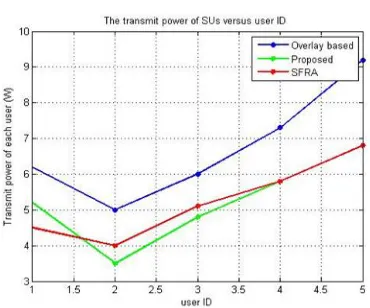
Figure 4: The transmit intensity of SUs versus client ID with various asset assignment procedures
Figure 5: The energy efficiency of SUs versus user ID with different resource allocation strategies
Figure 6: The transmit intensity of all SUs versus the base information rate necessity for each SU with
various asset assignment systems
Figure 7: The transmit intensity of SUs versus client ID with various asset assignment systems
Figure : The likelihood thickness elements of vitality productivity with various asset portion methodologies.
IJIRT 148809
INTERNATIONAL JOURNAL OF INNOVATIVE RESEARCH IN TECHNOLOGY173
This task has expounded the job of versatile asset assignment in CR arranges as far as vitality proficiency since vitality productivity situated outline is increasingly critical for remote correspondences. In view of the current research on asset 44 portion for OFDM-based CR organizes, this part proposes a versatile half and half asset designation procedure to upgrade the vitality productivity by using range and spatial chances. A novel versatile power and channel portion calculation has been proposed to satisfy the proposed asset assignment methodology in view of the impedance infringement test. In correlation between the current plan and the proposed asset distribution plot, we have discovered that asset allotment by considering spatial data improves the vitality effectiveness and keeps away from superfluous range detecting.
REFERENCES
[1] M. U. Celik, G. Sharma, A. M. Tekalp, and E. Saber, "Lossless summed up LSB information implanting," IEEE Trans. Picture Process., vol. 14, no. 2, pp. 253– 266, Feb. 2005.
[2] M. U. Celik, G. Sharma, and A. M. Tekalp, "Lossless watermarking for picture confirmation: another system and an execution," IEEE Trans. Picture Process., vol. 15, no. 4, pp. 1042– 1049, Apr. 2006.
[3] Z. Ni, Y.- Q. Shi, N. Ansari, and W. Su, "Reversible information concealing," IEEE Trans. Circuits Syst. Video Technol., vol. 16, no. 3, pp. 354– 362, Mar. 2006.
[4] X. Li, W. Zhang, X. Gui, and B. Yang, "A novel reversible information concealing plan in view of two-dimensional contrast histogram change," IEEE Trans. Inf. Crime scene investigation Security, vol. 8, no. 7, pp. 1091– 1100, Jul. 2013. [5] C. Qin, C.- C.Chang, Y.- H.Huang, and L.- T.