65
MEDICAL EDUCATION ORIGINAL ARTICLE
Journal of Patan Academy of Health Sciences. 2017 Dec;4(2):65-72. Correspondence
Dr. Shambhu Kumar Upadhyay Department of Community Health Sciences, Patan Academy of Health Sciences, Lalitpur, Nepal
Email:
Validating a problem-based learning process
assessment tool in a Nepalese medical
school
Shambhu Kumar Upadhyay,1 Shital Bhandary,2 Satish Raj Ghimire,3 Babu Raja
Maharjan,4 Ira Shrestha,5 Mili Joshi,6 Sujan Vaidya7
1, 2Associate Professor, Dept. of Community Medicine; 3Assistant Professor, Dept.
of Anatomy; 4 Assistant Professor, Dept. of Biochemistry; 5Assistant Professor,
Dept. of Physiology; 6Assistant Professor, Dept. of Pharmacology; 7Assistant
Professor, Dept. of Medical Education; Patan Academy of Health Sciences, Lalitpur, Nepal
ABSTRACT
Introductions: The newly established Patan Academy of Health Sciences (PAHS) has incorporated the measurement of non-cognitive skills and behaviors into the summative assessment in the setting of problem based learning (PBL). This study was conducted to validate a PBL process assessment tool for PAHS.
Methods: A list of 72 items of student behaviors observable in PBL tutorials was compiled from literature review. They were categorized under ten broad dimensions consistent with predefined PAHS Graduate Attributes. A series of PBL project committee meetings and expert inputs refined the list of 72 items to 47 and categorized them under eight dimensions. These 47 items, each with a 4-point rating scale, formed the Tutor Assessment of Student Tool (TAS-Tool). Twenty-four trained faculty members used the TAS-Tool to evaluate the performance of 41 senior high school students in PBL tutorials.
Results: The internal-consistency of the TAS-Tool was very high
(Cronbach’s α = 0.954). Removal of two inconsistent items further
increased it to 0.975. Principal components analysis with varimax rotation applied to the remaining 45 items gave seven components and explained 69.47% of the variation between the components. These seven components (% variation) were: Immersed in the Tutorial Process (20.16%); Professional (12.71%); Communicator and Team Leader (11.25%); Critical Thinker (8.77%); Reflector (6.22%); Creative (5.95%), and Sensitive (4.41%).
Conclusions: TAS-Tool was found to be reliable and valid instrument deemed applicable in formative PBL process assessment at PAHS starting with the pioneer cohort of medical students. Further validation of TAS-Tool through longitudinal study with PAHS students is required for summative purpose.
Keywords: factor analysis, problem based learning, summative assessment, tool validation, Nepal
ISSN: 2091-2749 (Print) 2091-2757 (Online)
2091-2757 (Online)
Peer Reviewers
Samita Acharya
Patan Academy of Health Sciences
Jay N Shah
66
Shambhu K Upadhyay: Validation of problem-based learning assessment
Journal of Patan Academy of Health Sciences. 2017 Dec;4(2):65-72. INTRODUCTIONS
Patan Academy of Health Sciences (PAHS), Nepal, has adopted problem-based learning (PBL) as the principal pedagogic strategy for fostering important generic skills (non-cognitive behaviours) such as self-directed learning, good communication, team leadership, and critical and reflective thinking.1-4 These generic skills are consistent
with the predefined PAHS Graduate Attributes.5 PAHS decided to incorporate their
measurement into formative assessment but, most importantly, into a summative assessment too in the setting of PBL.6
Implementation of PBL varies with the setting7,8 and PBL process assessment is largely
confined only to formative purposes.9,10
Moreover, no locally validated PBL assessment tool was available. Thus, the need for such a tool became evident for PAHS before enrolling the pioneer cohort of medical students in June 2010.
The primary aim of this study was to develop and validate a PBL process assessment tool for evaluating non-cognitive skills and behaviours of medical students in PBL settings at PAHS.
METHODS
A PBL project committee was formed comprised of the authors who had previous experience with PBL in other medical school11
in Nepal. The committee conducted extensive literature review and obtained a preliminary list of 72 items of student behaviours considered observable in PBL tutorial sessions.8-10,12-18 The items were categorized
into ten broad dimensions, namely: Preparation, Participation, Self-Directed Learning, Critical Thinking, Professionalism, Communication Skills, Group Skills, Respect for Colleagues, Scientific Communication, and Reflectiveness. These dimensions were in line with the predefined PAHS Graduate Attributes.5
A series of the PBL project committee meetings refined the list of 72 items to 47 categorized under eight dimensions through consensus of the group. After input from one internal and two external experts, the list was finalized. These 47 items formed the Tutor Assessment of Student Tool (TAS-Tool). The individual items were evaluated using a 4-point rating scale distributed as 'Unacceptable (0)’, ‘Needs improvement (1)’, ‘Good (2)’, and ‘Excellent (3)'. An overall subjective rating scale distributed as 'Below expectation (0)’, ‘Borderline (1)’, and ‘Meets expectation (2)' was added on TAS-Tool. The subjective rating scale was incorporated to calculate the pass-mark using criterion-referenced “borderline” method along with space for open-ended comments from tutors for further research purpose. PBL tutorial sessions with higher secondary school students pursuing science courses were conducted in April 2010 to assess the relevance and usefulness of the TAS-Tool using a PBL case written for real-time use for incoming pioneer cohort of PAHS medical students. These school students were eligible applicants for undergraduate medical education in Nepal according to the Nepal Medical Council.19
Three PBL tutorial sessions, each of two-hour duration, were conducted using a PBL case that progressively unfolded over a week with a day in between two tutorials for self-directed learning by the students. These sessions were conducted in six groups each comprising four faculty members and 7-8 students. A total of 24 faculty members trained a priori in PBL facilitation process and 45 volunteer students participated in all three tutorial sessions and a one-hour wrap-up session that concluded the PBL case. A one-day orientation program on PBL, its process, and assessment was organized separately for students as well as faculty with emphasis on evaluation of TAS-Tool a week before conducting PBL tutorial sessions. Faculty tutors were briefed on and provided with the PBL case and a tutor-guide for further reading and preparation.
67
Shambhu K Upadhyay: Validation of problem-based learning assessment
Journal of Patan Academy of Health Sciences. 2017 Dec;4(2):65-72. facilitated all three tutorial sessions while the
other three faculty members silently observed the process but all four evaluated the students upon completion of all three sessions (i.e., at the end of 3rd session) using the TAS-Tool. A
reflection meeting was held separately for faculty and students to share their insights and experiences about the overall PBL process, which was attended by the PAHS authorities including the founding Dean of School of Medicine.
TAS-Tool data were entered in Microsoft Excel 2007 spreadsheet and analyzed using the SPSS for Windows Version 15.0. Internal-consistency reliability of the TAS-Tool was assessed using Cronbach’s alpha whereas the internal-construct structure of the TAS-Tool was assessed through Principal Component Analysis (PCA) with varimax rotation to validate it at the local context. Applicability of the PCA was assessed using Kaiser-Meyer-Olkin (KMO) and Barlett’s Sphericity Tests. Factor loading of 0.4 was used as the cut-off to determine the emerging factors (n numbers) and dimensions (n numbers) on exploratory factor analysis.
Written consent was taken from the students and verbal consent was taken from faculty for their participation in the PBL tutorial sessions conducted for this study.
RESULTS
Using the TAS-Tool, a group of 24 faculty members comprising of nine each from basic and clinical sciences, four from general science and two from community health science evaluated 41 out of 45 students, who participated in all three tutorials as well as case wrap-up sessions. Of these 41 students, 21 were females and 20 males with the mean age 18.44 (SD 1.25) years and age range 16-20 years.
The TAS-Tool for PBL process assessment was highly reliable with internal consistency (Cronbach’s alpha of 0.954) of the 47-item questionnaire. Removal of the two
inconsistent (negative correlation/uniform scoring) items raised the value of Cronbach’s alpha to 0.975 with no further improvement possible.
Out of 188 samples (47 items x 4-point rating scale = 188 samples) to validate TAS-Tool, four students (4 items x 4-point rating scale = 16 samples) dropped out in the last tutorial session, and 162 samples could be administered. Data in one or more items were missing in seven out of 162, and thus, the tool was validated with final 155 completed samples. This number was more than the minimum sample size of 100 required to ensure the relative stability of component pattern in a factorial analysis.20
The Kaiser-Meyer-Olkin (KMO) test measuring the sampling adequacy was 0.938, which was above the recommended value of 0.900 for conducting exploratory factor analysis. The Barlett’s Test for Sphericity for the applicability of exploratory factor analysis was highly significant (χ2 = 5798, p < 0.001). Both of these tests indicated that PCA was suitable in terms of sample size and assumption of Sphericity for the data obtained by administering the TAS-Tool.
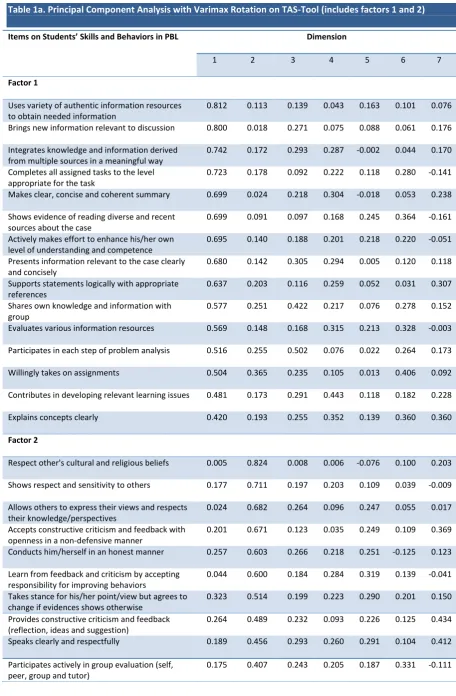
Application of the PCA with varimax rotation revealed seven dimensions from the sample (N = 155) explaining 69.47% of variance (σ2)
among the 45-items, Table 1a and 1b.
68
Shambhu K Upadhyay: Validation of problem-based learning assessment
Journal of Patan Academy of Health Sciences. 2017 Dec;4(2):65-72. Table 1a. Principal Component Analysis with Varimax Rotation on TAS-Tool (includes factors 1 and 2)
Items on Students’ Skills and Behaviors in PBL Dimension
1 2 3 4 5 6 7
Factor 1
Uses variety of authentic information resources to obtain needed information
0.812 0.113 0.139 0.043 0.163 0.101 0.076
Brings new information relevant to discussion 0.800 0.018 0.271 0.075 0.088 0.061 0.176
Integrates knowledge and information derived from multiple sources in a meaningful way
0.742 0.172 0.293 0.287 -0.002 0.044 0.170
Completes all assigned tasks to the level appropriate for the task
0.723 0.178 0.092 0.222 0.118 0.280 -0.141
Makes clear, concise and coherent summary 0.699 0.024 0.218 0.304 -0.018 0.053 0.238
Shows evidence of reading diverse and recent sources about the case
0.699 0.091 0.097 0.168 0.245 0.364 -0.161
Actively makes effort to enhance his/her own level of understanding and competence
0.695 0.140 0.188 0.201 0.218 0.220 -0.051
Presents information relevant to the case clearly and concisely
0.680 0.142 0.305 0.294 0.005 0.120 0.118
Supports statements logically with appropriate references
0.637 0.203 0.116 0.259 0.052 0.031 0.307
Shares own knowledge and information with group
0.577 0.251 0.422 0.217 0.076 0.278 0.152
Evaluates various information resources 0.569 0.148 0.168 0.315 0.213 0.328 -0.003
Participates in each step of problem analysis 0.516 0.255 0.502 0.076 0.022 0.264 0.173
Willingly takes on assignments 0.504 0.365 0.235 0.105 0.013 0.406 0.092
Contributes in developing relevant learning issues 0.481 0.173 0.291 0.443 0.118 0.182 0.228
Explains concepts clearly 0.420 0.193 0.255 0.352 0.139 0.360 0.360
Factor 2
Respect other's cultural and religious beliefs 0.005 0.824 0.008 0.006 -0.076 0.100 0.203
Shows respect and sensitivity to others 0.177 0.711 0.197 0.203 0.109 0.039 -0.009
Allows others to express their views and respects their knowledge/perspectives
0.024 0.682 0.264 0.096 0.247 0.055 0.017
Accepts constructive criticism and feedback with openness in a non-defensive manner
0.201 0.671 0.123 0.035 0.249 0.109 0.369
Conducts him/herself in an honest manner 0.257 0.603 0.266 0.218 0.251 -0.125 0.123
Learn from feedback and criticism by accepting responsibility for improving behaviors
0.044 0.600 0.184 0.284 0.319 0.139 -0.041
Takes stance for his/her point/view but agrees to change if evidences shows otherwise
0.323 0.514 0.199 0.223 0.290 0.201 0.150
Provides constructive criticism and feedback (reflection, ideas and suggestion)
0.264 0.489 0.232 0.093 0.226 0.125 0.434
Speaks clearly and respectfully 0.189 0.456 0.293 0.260 0.291 0.104 0.412
Participates actively in group evaluation (self, peer, group and tutor)
69
Shambhu K Upadhyay: Validation of problem-based learning assessment
Journal of Patan Academy of Health Sciences. 2017 Dec;4(2):65-72. Table 1b. Principal Component Analysis with Varimax Rotation on TAS-Tool (includes factors 3-7)
Items on Students’ Skills and Behaviors in PBL Dimension
1 2 3 4 5 6 7
Factor 3
Encourages participation of others in group discussion 0.158 0.420 0.673 0.050 0.113 0.116 0.063
Helps to resolve misunderstanding and conflicts 0.258 0.324 0.618 0.339 0.006 0.165 0.122
Helps peers to clarify ideas 0.409 0.130 0.613 0.283 0.303 0.181 0.016
Takes the lead or intervenes appropriately to foster group process and learning
0.403 0.174 0.575 0.231 0.213 0.339 0.056
Actively contributes towards achieving group's learning goals
0.436 0.243 0.565 0.344 0.093 0.263 0.041
Supports and/or counters statement with reasoning and evidences
0.365 0.218 0.554 0.396 0.210 0.137 0.006
Makes comments that promotes better understandings of the subject by the group
0.426 0.203 0.531 0.250 0.304 0.189 0.075
Asks appropriate questions to clarify obscure points, enhance understanding, or stimulate discussion
0.475 0.204 0.483 0.124 0.016 -0.242
0.311
Seeks consensus 0.279 0.325 0.468 0.076 0.277 0.302 0.199
Listens actively as indicated by contribution to discussions, seeking clarification from others and summarizing discussions
0.314 0.320 0.402 0.254 0.219 0.167 0.371
Factor 4
Approaches the problem in a systematic and logical manner
0.417 0.230 0.211 0.698 -0.042
0.110 0.082
Discriminates important information from non-important ones
0.323 0.286 0.229 0.690 0.032 0.202 0.119
Demonstrates ability to interpret the information given in the problem in a logical manner
0.433 0.183 0.179 0.686 0.209 0.043 0.100
Shows ability to generate explanatory hypotheses 0.330 0.071 0.350 0.538 0.282 0.101 0.265
Factor 5
Identifies areas in need of improvement 0.175 0.316 0.170 0.014 0.763 0.102 0.219
Recognizes limits of own knowledge and ability 0.034 0.397 0.124 0.129 0.758 0.043 0.134
Takes positive step towards improving his/her weaknesses
0.284 0.483 0.182 0.155 0.490 0.043 -0.147
Factor 6
Uses diagrams, flow charts, tables etc to facilitate communication
0.379 0.099 0.292 0.178 0.131 0.703 0.183
Draws diagrams, flow charts, and tables to explain and summarize concepts
0.479 0.123 0.256 0.146 0.005 0.683 0.157
Factor 7
Responds to a nonverbal and emotional messages 0.117 0.294 0.056 0.414 0.185 0.191 0.571
Variance Explained 20.156 12.705 11.246 8.772 6.224 5.952 4.412
70
Shambhu K Upadhyay: Validation of problem-based learning assessment
Journal of Patan Academy of Health Sciences. 2017 Dec;4(2):65-72. DISCUSSIONS
Adoption of PBL strategy should align with the assessment measures that reflect the learning process and outcomes so as to foster desired attributes in learners as well as achieve the intended educational goals. Although plenty of literature describes the assessment of process and outcomes of PBL, there is paucity of standardized/validated tools.8,12,15,21 One
reason for this may be that each particular PBL environment is unique and, hence, often requires a PBL assessment strategy adapted to the specific setting and intended program objectives.8,22 The development and validation
of the TAS-Tool was driven by such a need of monitoring and evaluating the progress made by students in non-cognitive areas (independent of cognitive areas) in PBL settings at PAHS.
The internal consistency reliability of the 47 items TAS-Tool was found to be very high (Cronbach’s alpha = 0.954). However, two items namely ‘shows meaningful participation relevant to case discussion’ and ‘arrives in time and attends tutorial regularly’ were found to be inconsistent i.e. negatively correlated and uniformly scored respectively. The negative correlation for the item- ‘meaningful participation in the PBL tutorial process’- might have been due to students not giving high importance as it was not academically valuable to them. The negative correlation could have also arisen due to tutor’s variability to judge this item. Uniform scoring on item- ‘arrives on time and attends tutorial regularly’ (punctuality) might have been due to less strict scoring of the voluntary participation of the students by faculty tutors to allow for maximum student participation in the process. This led to the removal of these two items, which further increased the internal consistency reliability (Cronbach’s alpha to 0.975) of TAS-Tool.
The internal construct structure i.e. construct validity of TAS-Tool was tested by PCA with varimax rotation. The seven dimensions obtained from PCA and identified as Immersed in Tutorial Process, Professional,
Communicator and Team Leader, Critical Thinker, Reflector, Creative, and Sensitive were found closer to the previously agreed upon eight dimensions. This shows that TAS-Tool is able to capture more than 2/3rd of the
variability in the formative PBL process assessment in the local context of PAHS and is suitable for further study based on longitudinal data obtained from its application for summative purpose.
Tutor’s assessment of students has been reported as being highly supportive of the learning process as well as good assessment practice in PBL settings.23 TAS-Tool is, thus,
believed to enable tutors to make comprehensive evaluation of students’ progress in non-cognitive areas: both formative and summative. The formative measure is expected to help students get relevant feedback and encourage them in adopting desired cognitive as well as non-cognitive behaviors. However, the value of summative measure has been debated in the literatures citing the dual roles of the tutor as mentor and judge being incompatible.24 Most
PBL schools have limited its use for formative purpose only.23,25 Despite contradictory
arguments, tutor ratings in PBL have been acknowledged to have positive contribution towards the composite assessment of students if reliability and validity of tools are acceptable when used summatively.23
Drop out of four students in the last tutorial sessions and missing data on one or more items on filled samples led to the reduction in the number of intended sample. This may be due to lack of interest and uniform adaptability to the small-group-learning environment of all students. During the reflection sessions held at the end of tutorials, students expressed that they found the PBL process very participatory and interactive whereas faculty felt they had received important hands-on experiences and gained enhanced confidence in facilitating and assessing PBL tutorials albeit rating 47 item TAS-Tool was tedious.
71
Shambhu K Upadhyay: Validation of problem-based learning assessment
Journal of Patan Academy of Health Sciences. 2017 Dec;4(2):65-72. address this, more work is necessary to
improve the TAS-Tool with fewer and smarter items without losing its reliability and validity. Moreover, voluntary participation of students may have obscured the reflection of students’ learning behaviours accurately. Hence, the generalizability of TAS-Tool in other PBL settings needs careful consideration and further validation through a longitudinal study on PAHS medical students and with larger sample sizes.
CONCLUSIONS
Since the internal consistency reliability along with face-, content- and construct-validity of the TAS-Tool were found to be highly acceptable, this tool is applicable in PBL settings. Most importantly, TAS-Tool may provide added value as reference to other medical schools implementing PBL in Nepal and elsewhere.
ACKNOWLEDGEMENTS
The authors would like to thank the students and teachers of Adarsha Vidhya Mandir Higher Secondary School, Lalitpur, Nepal for their cooperation and participation in the study; the founding vice chancellor of PAHS and Medical Education Unit of PAHS for their continued guidance; PAHS faculty and administration; PAHS International Advisory Board members as well as GSMC FAIMER Regional Institute faculty and fellows in Mumbai, India for their support.
REFERENCES
1. Wood DF. Problem based learning. BMJ. 2003;326(7384):328-30.DOI:
https://doi.org/10.1136/bmj.326.7384.328 2. Schmidt HG, Vermeulen L, Van Der Molen HT.
Longterm effects of problem‐based learning: a
comparison of competencies acquired by
graduates of a problem‐based and a
conventional medical school. Medical Education. 2006;40(6):562-7. DOI: 10.1111/j.1365-2929.2006.02483.x
3. Tiwari A, Lai P, So M, Yuen K. A comparison of the effect of Problem Based Learning and lecturing on the development of students’
critical thinking. Med Edu. 2006; 40(6):547-554. DOI:
https://doi.org/10.1111/j.1365-2929.2006.02481.x
4. Koh GCH, Khoo HE, Wong ML, Koh D. The effects of problem-based learning during medical school on physician competency: a systematic review. Canadian Medical Association Journal. 2008;178(1):34-41. DOI: 10.1503/cmaj.070565
5. Morgan JHC. Designing an assessment tool for professional attributes of medical graduates from a new medical school in Nepal. South-East Asian Journal of Medical Education.
2009;3(1):2-7. Available from:
http://imsear.li.mahidol.ac.th/bitstream/12345 6789/166013/1/seajme2009v3n1p2.pdf 6. Upadhyay SK, Bhandary S, Ghimire SR.
Validating a problem-based learning process assessment tool. Medical Education. 2011; 45(11):1151-2.DOI: 10.1111/j.1365-2923.2011.04123.x
7. Maudsley G. Do we all mean the same thing by problem-based learning? A review of the concepts and a formulation of the ground rules. Academic Medicine. 1999;74(2):178-85. DOI: 10.1097/00001888-199902000-00016 8. Leung KK, Wang WD. Validation of the Tutotest
in a hybrid problem-based learning curriculum. Advances in Health Science Education.
2008;13(4):469-77. DOI: 10.1007/s10459-007-9059-1
9. Eva KW. Assessing tutorial-based assessment. Advances in Health Sciences Education. 2001; 6(3):243-57. Available from: http://www.rug-
netwerk.nl/new/wordpress/wp-content/uploads/Eva_Assessing...assessment2 001.pdf
10. Elizondo-Montemayor LL. Formative and summative assessment of the problem-based learning tutorial session using a criterion-referenced system. Journal of the International Association of Medical Science Educators. 2004;14(1):8-14. Available from:
http://www.iamse.org/mse-article/formative- and-summative-assessment-of-the-problem- based-learning-tutorial-session-using-a-criterion-referenced-system/
11. Dixit H, Sharma SC. The MBBS Program in Nepal. Journal of Nepal Medical Association. 2002;41(142):341-55. Available from:
http://jnma.com.np/jnma/index.php/jnma/arti cle/view/768/1468
72
Shambhu K Upadhyay: Validation of problem-based learning assessment
Journal of Patan Academy of Health Sciences. 2017 Dec;4(2):65-72. students in tutorials. Academic Medicine.
1996;71(5):488-94. Available from:
http://journals.lww.com/academicmedicine/A bstract/1996/05000/Development_and_validat ion_of_an_evaluation.20.aspx
13. Des Marchais JE, Vu NV. Developing and evaluating the student assessment system in the pre-clinical problem-based curriculum at Sherbrooke. Academic Medicine.
1996;71(3):274-83. Available from:
http://journals.lww.com/academicmedicine/A bstract/1996/03000/Developing_and_evaluati ng_the_student_assessment.21.aspx
14. Das M, Mpofu D, Dunn E, Lanphear J H. Self and tutor evaluations in problem-based learning tutorials: is there a relationship? Medical Education. 1998;32(4):411-18. DOI: 10.1046/j.1365-2923.1998.00217.x
15. Valle R, Petra I, Martinez-Gonzalez A, Rojas-Ramirez JA, Morales-Lopez S, Pina-Garza B. Assessment of student performance in problem-based learning tutorial sessions. Medical Education. 1999;33(11):818-22. DOI: 10.1046/j.1365-2923.1999.00526.x
16. Ladouceur MG, Rideout EM, Black ME, Crooks
DL, O’Mara LM, Schmuck ML. Development of an instrument to assess individual student performance in small group tutorials. Journal of Nursing Education. 2004;43(10):447-55.DOI: 10.3928/01484834-20041001-01
17. Sim SM, Azila NM, Lian LH, Tan CP, Tan NH. A simple instrument for the assessment of student performance in problem-based learning tutorials. Annals of Academic Medicine Singapore. 2006;35(9):634-41. Available from:
http://www.annals.edu.sg/PDF/35VolNo9Sep2 006/V35N9p634.pdf
18. Papinczak T, Young L, Groves M, Haynes M. An analysis of peer, self, and tutor assessment in problem-based learning tutorials. Medical Teacher. 2007;29(5):e122-e132.
DOI:http://dx.doi.org/10.1080/0142159070129 4323
19. Nepal Medical Council: Accreditation Standards for the MBBS Degree Program. Bansbari,
Kathmandu, Nepal. Nepal Medical Council published. 2013;1-28.
20. Guadagnoli E, Velicer WF. Relation to sample size to the stability of component
patterns. Psychological Bulletin. 1988; 103(2): 265-275. DOI: http://dx.doi.org/10.1037/0033-2909.103.2.265
21. The Higher Education Academy, Health
Sciences and Practices. Problem-based learning evaluation toolkit. PBL Special Interest Group, The Health Sciences and Practice Subject Center of Higher Education Academy. September 2009.UK. Available from:
www.pbldirectory.com/toolkit/strands/effectiv eness
22. Major CH, Palmer B. Assessing the
effectiveness of problem-based learning in higher education: Lessons from the literature. In: The Higher Education Academy, Health Sciences and Practices. Problem-based learning evaluation toolkit. PBL Special Interest Group, The Health Sciences and Practice Subject Center of Higher Education Academy. September 2009. UK. Available from:
www.pbldirectory.com/toolkit/strands/effectiv eness
23. Rothman A, Page G. Problem-based learning. In: Norman GR, Van der Vleuten CPM, Newble DI, editors. International Handbook of Research in Medical Education. Great Britain: Dordrecht: Kluwer Academic Publishers. 2002;613-41.
24. Blake JM, Norman GR, Smith EKM. Report card from McMaster: student evaluation at a problem-based medical school. The Lancet. 1995;345(8954):899-902. DOI:
https://doi.org/10.1016/S0140-6736(95)90014-4
25. Nendaz MR, Tekian A. Assessment in problem-based learning medical schools: A literature review. Teaching and Learning in Medicine. 1999;11(4):232-43. DOI: