Volume 11, Issue 08 (August 2015), PP.72-80
Content Based Video Retrieval Using Integrated Feature
Extraction and Personalization of Results
Mr. Pradeep Chivadshetti
1, Mr. Kishor Sadafale
2,Mrs. Kalpana Thakare
3Student, Department of IT, Sinhgad College of Engineering, Pune, Maharashtra, India 1 Assistant Professor, Department of IT, Sinhgad College of Engineering, Pune, Maharashtra, India 2 Associate Professor, Department of IT, Sinhgad College of Engineering, Pune, Maharashtra, India 3
Abstract:- Traditional video retrieval methods fail to meet technical challenges due to large and rapid growth of multimedia data, demanding effective retrieval systems. In the last decade Content Based Video Retrieval (CBVR) has become more and more popular. The amount of lecture video data on the Worldwide Web (WWW) is growing rapidly. Therefore, a more efficient method for video retrieval in WWW or within large lecture video archives is urgently needed. This paper presents an implementation of automated video indexing and video search in large videodatabase. First of all, we apply automatic video segmentation and key-frame detection to extract the frames from video. At next, we extract textual keywords by applying on video i.e. Optical Character Recognition (OCR) technology on key-frames and Automatic Speech Recognition (ASR) on audio tracks of that video. At next, we also extractingcolour, texture and edge detector features from different method. At last, we integrate all the keywords and features which has extracted from above techniques for searching purpose.Finallysearch similarity measure is applied to retrieve the best matchingcorresponding videos are presented as output from database. Additionally we are providing Re-ranking of results as per users interest in original result.
Keywords:- CBVR, Feature Extraction, Video Retrieval, Video Segmentation, OCR, ASR tool, Re-ranking
I.
INTRODUCTIONContent based Video Retrieval (CBVR), in the application of video retrieval, is the issue of searching for digital videos in large databases with less input keywords. “Content-based” is the search which analyse the actual content of the video. The term „Content‟ in this context might refer colour, texture keywords, and audios. Without the ability to examine video content, searches must rely on images provided by the user. Explosive growth of digital content including image, audio and video on internet as well as on desktop has demanded development of new technologies and methods for representation, storage and retrieval of multimedia systems. Rapid development of digital libraries and repositories are attempting to achieve the same. CBVR system works more effectively as these deals with content of video rather than video metadata.[10]
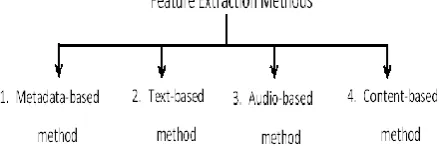
Videos are mainly Consist of Text, Audio and Images. Generally, Content Based Video Retrieval System extracts the features by using different methods. First is Metadata-based method which extracts the title, type, modified date, etc. At second, Text based method which extracts the subtitles, extracted text from OCR. At third, Audio-based methods in which different speech recognition and speech to keyword extraction techniques are used. At last, Content-based method which is integration of all methods mentioned above (shown in Fig. 1) [1], [2].
Fig. 1: Various Feature Extraction Methods A. Video Parsing
Content Based Video Retrieval Using Integrated Feature Extraction and Personalization of Results
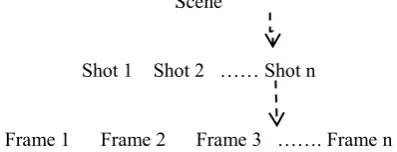
there is a very minute change of content information between the two consecutive frames of same shot. Selection of frames from single shot may be done to identify the key frame or frames which represent complete shot. These key frames are then used for indexing, content processing and representing video shot/video.
Scene
Shot 1 Shot 2 …… Shot n
Frame 1 Frame 2 Frame 3 ……. Frame n
Fig. 2: Video Segmentation
B. Video Indexing
This process is retrieving the information about the frame for indexing in a database. Video indexing is a process of tagging videos and organizing them in an effective manner for fast access and retrieval. Automation of indexing can significantly reduce processing cost while eliminating tedious work. The conventional features used in most of the existing video retrieval systems are the features such as colour, texture, shape, motion, object, face, audio, etc. It is obvious that more the number of features used to represent the data, better the retrieval accuracy. [10]
C. Video Retrieval and Browsing
Where users can access the database through queries based on text and/or visual examples or browses it through interaction with displays of meaningful icons. Users can also browse the result of query retrieval. It is meaningful that both retrieval and browsing appeal to the user‟s visual intuition. [12]
II.
RELATED WORK
Despite many research efforts, the existing low-level features are still not powerful enough to represent index frame content. Some features can achieve relatively good performance, but their feature dimensions are usually too high, or the implementation of the algorithm is difficult. Feature extraction is very crucial step in retrieval system to describe the video with minimum number of descriptors [10].
Table I: Basic Video Search Challenges
Several content-based video search systems have used different features or techniques for video retrieval as follows:
A. Metadata
The basic feature extraction was extraction of metadata and textual information of video. Video was retrieved by using that features like title, subtitle, properties (extension, modified date, size, etc.).
B. Colour and Texture
Proficient detection and segmentation of text characters from the background is necessary to fill the gapbetween image documents and the input of standard OCR systems [2].The basic visual features of index frame include colour and texture. Research in content based video retrieval today is a lively disciplined, expanding in breadth Representative features extracted from index frames are stored in feature database and used for object-based video retrieval. Texture is another important property of index frames. Various texture representations have been investigated in pattern recognition and computer vision. [11]
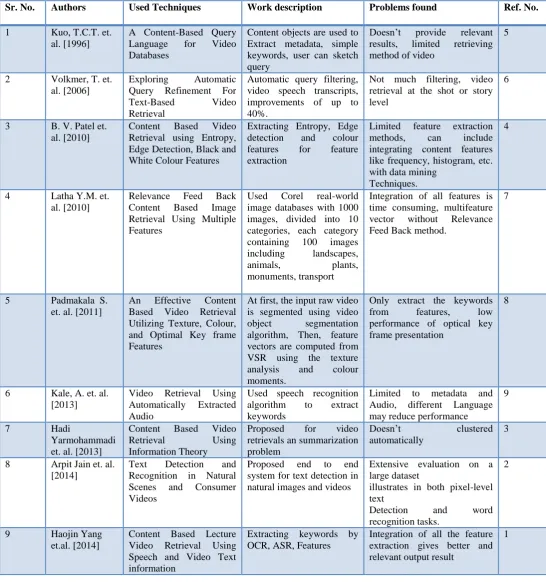
In this section, the overall comparisons of all the techniques are discussed. Different content based video retrieval techniques are discussed like feature extraction using colour, shape, texture, etc. and keyword extraction using Metadata, OCR and ASR. It is represented in the tabular form below:
Sr. No. Issues Text Search Video Search
1 File Format HTML/HTTP, PDF, DOC MPEG 1,2,4, MOV, WMV, Real/HTTP, UDP 2 Summarization Easy to extract relevant segment. Requires video parsing first.
TABLE II: Comparison between Different Techniques for Video Retrieval
C. Edge detection, Colour, Shape, Shot boundary etc.
Explosive growth of digital content including image, audio and video on internet as well as on desktop has demanded development of new technologies and methods for representation, storage and retrieval of multimedia systems. Rapid development of digital libraries and repositories are attempting to achieve the same.
Sr. No. Authors Used Techniques Work description Problems found Ref. No.
1 Kuo, T.C.T. et. al. [1996]
A Content-Based Query Language for Video Databases
Content objects are used to Extract metadata, simple keywords, user can sketch query
Doesn‟t provide relevant results, limited retrieving method of video
5
2 Volkmer, T. et. al. [2006]
Exploring Automatic Query Refinement For Text-Based Video Retrieval
Automatic query filtering, video speech transcripts, improvements of up to 40%.
Not much filtering, video retrieval at the shot or story level
6
3 B. V. Patel et. al. [2010]
Content Based Video Retrieval using Entropy, Edge Detection, Black and White Colour Features
Extracting Entropy, Edge detection and colour features for feature extraction
Limited feature extraction methods, can include integrating content features like frequency, histogram, etc. with data mining
Techniques.
4
4 Latha Y.M. et. al. [2010]
Relevance Feed Back Content Based Image Retrieval Using Multiple Features
Used Corel real-world image databases with 1000 images, divided into 10 categories, each category containing 100 images including landscapes, animals, plants, monuments, transport
Integration of all features is time consuming, multifeature vector without Relevance Feed Back method.
7
5 Padmakala S. et. al. [2011]
An Effective Content Based Video Retrieval Utilizing Texture, Colour, and Optimal Key frame Features
At first, the input raw video is segmented using video object segmentation algorithm, Then, feature vectors are computed from VSR using the texture analysis and colour moments.
Only extract the keywords from features, low performance of optical key frame presentation
8
6 Kale, A. et. al. [2013]
Video Retrieval Using Automatically Extracted Audio
Used speech recognition algorithm to extract keywords
Limited to metadata and Audio, different Language may reduce performance
9
7 Hadi
Yarmohammadi et. al. [2013]
Content Based Video Retrieval Using Information Theory
Proposed for video retrievals an summarization problem
Doesn‟t clustered automatically
3
8 Arpit Jain et. al. [2014]
Text Detection and Recognition in Natural Scenes and Consumer Videos
Proposed end to end system for text detection in natural images and videos
Extensive evaluation on a large dataset
illustrates in both pixel-level text
Detection and word recognition tasks.
2
9 Haojin Yang et.al. [2014]
Content Based Lecture Video Retrieval Using Speech and Video Text information
Extracting keywords by OCR, ASR, Features
Integration of all the feature extraction gives better and relevant output result
Content Based Video Retrieval Using Integrated Feature Extraction and Personalization of Results
D. ASR (Automatic Speech Recognition)
In addition to video ASR can provide speech-to-text information from different videos, which offers the chance to improve the quantity of automatically generated metadata dramatically. However, as mentioned, most video speech recognition systems cannot achieve a sufficient recognition rate. [1]
E. OCR (Optical Character Recognition)
An end-to-end system for text detection and recognition is important in multiple domains such as content based retrieval systems, video event detection, human computer interaction, autonomous robot or vehicle navigation and vehicle license plate recognition. Text detection in natural scenes is a challenging problem and has gained a lot of attention recently. Such texts presents low contrast with background, large variation in font, colour, scale and orientation combined with background clutter.
There have been numerous research efforts on Text Detection and Recognition by using OCR applications. Number of approaches for text detection in images has been proposed into the past. Automatic detection and translation of text in images done using different techniques proposed. These methods aim to detect the characters based on general properties of character pixels. The distribution of edges, colour is used in many text detection methods also for low resolution document are processed by particular method. Text detection and recognition in images and video frames, process is combination of advanced optical character recognition (OCR) and text-based searching technologies. Unfortunately, text characters contained in images can be any grey-scale value (not always white), variable size, low-resolution and embedded in complex backgrounds. Texture is commonly used feature for text segmentation. Many researchers working on text detection and thresholding algorithm with various approaches achieved good performance depends on some constraints.
III.
PROPOSED SYSTEM
Fig. 3: Proposed Video Retrieval System
A. Frame Segmentation and selection Technique
If the video contains structure, i.e. several shots, then the standard techniques for video summarization involve:
1. Calculate the video Length
2. Divide the frame by particular time slot.
However, let us assume you wish to find an interesting frame in a single continuous stream of frames taken from a single camera source. I.e. a shot.
A mean colour histogram is computed for all frames and the key-frame is that with the closest histogram i.e. system selects the best frame in terms of its colour distribution.
System assumes that camera stillness is an indicator of frame importance. As suggested by Beds, above. Then pick the still frames using optic-flow and use that.
Each frame is projected into some high dimensional content space; system find those frames at the corners of the space and use them to represent the video.
Frames are evaluated for importance using their length and novelty in content space.
B. Optical Character Recognition(OCR)
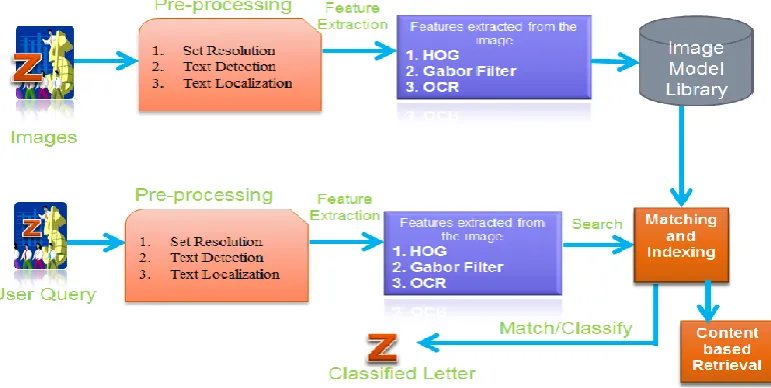
Optical character recognition (OCR) is an important research area in pattern recognition. The objective of an OCR system is to recognize alphabetic letters, numbers, or other characters, which are in the form of digital images, without any human intervention. This is accomplished by searching a match between the features extracted from the given characters image and the library of image models. Ideally, they would like the features to be distinct for different character images so that the computer can extract the correct model from the library without any confusion. At the same time, the features should be robust enough so that they will not be affected by viewing transformations, noises, resolution variations and other factors. Figure 4 illustrates the basic processes of an OCR system.
Fig. 4: Proposed Optical Character Recognition System
C. Automatic Speech Recognition
Content Based Video Retrieval Using Integrated Feature Extraction and Personalization of Results
(e.g. a radiology report), speech-to-text processing (e.g., word processors or emails), and aircraft (usually termed Direct Voice Input). The term voice Recognition or speaker identification refers to identifying the speaker, rather than what they are saying. Recognizing the speaker can simplify the task of translating speech in systems that have been trained on a specific person's voice or it can be used to authenticate or verify the identity of a speaker as part of a security process.
D. Search and Personalization of the Results
Re-ranking of video results with user interest profile by personalizing the result. User Interest model contains the user detail; user searched previous video URL link, related keywords and score of that video for that particular user.
IV.
RESULTS AND ANALYSIS
There were 15 videos stored in database from admin of the CBVR system. Some users take part in the experiment. User sends out some video queries. For each video query, they obtained near about 9-10 result items from the database. At first, user search video by using OCR only and results shown in table 9.1 and Precision-Recall graph is shown in figure 9.1. At next, user search video by using ASR only and results shown in table 9.2 and Precision-Recall graph is shown in figure 9.2. At last, as per our proposed system user search the videos by the combination of OCR and ASR system and the result is recorded and shown in table 9.3 and the Precision-Recall graph is shown in figure 9.3.
These results actually provided by database. Then the search results were reordered and presented to the user. The user evaluated the result items and visits to favourite snippet according to their own judgment.
RECALL & PRECISION
Precision: The actual retrieval set may not perfectly match the set of relevant records.
Recall: The ratio of the number of relevant records retrieved to the total number of relevant records in the database. It is usually expressed as a percentage.
Precision and Recall is mostly used in Information Retrieval domains such as Search Engines. A simple Formula for Precision and Recall:
Assume the following,
A database contains 15 video records on each particular topic.
A search was conducted on that topic and 12 records were retrieved of the 12 records retrieved, 9 were relevant.
The Precision and Recall could be calculated as follows:
Using the designations above:
1. A = the number of relevant records retrieved,
2. B = the number of relevant records not retrieved, and 3. C = the number of irrelevant records retrieved.
In this example A = 9, B = 6 (15-9) and C = 3 (12-9). Recall = (9 / (9 + 6)) * 100.0 => 9/15 * 100.0 = 60% Precision = (9 / (9 + 3)) * 100.0 => 9/12 * 100.0 = 75%
According to the table 9.1, the OCR system gives the results to the video queries like different videos of presentation and Fig. 9.1 shows the OCR Precision Recall graph. User also requires less time to find the personal relevant snippet in search result. This is happened because this system keeps track of user interests while browsing & put the user interested snippets at the top position.
Table III: OCR Precision Recall Evaluation Video
Metric
Video 1
Video 2
Video 3
Video 4
Video 5
Fig. 5: OCR Precision Recall Graph
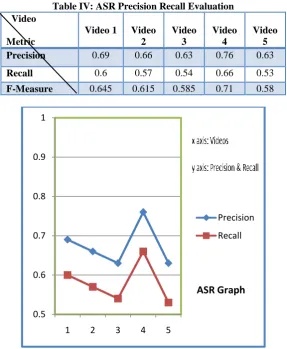
According to the table III, the ASR system gives the results to the video queries like different videos of presentation and Fig. 5 shows the ASR Precision Recall graph. User also requires less time to find the personal relevant snippet in search result. This is happened because this system keeps track of user interests while browsing & put the user interested snippets at the top position.
Table IV: ASR Precision Recall Evaluation Video
Metric
Video 1 Video 2
Video 3
Video 4
Video 5 Precision 0.69 0.66 0.63 0.76 0.63
Recall 0.6 0.57 0.54 0.66 0.53
F-Measure 0.645 0.615 0.585 0.71 0.58
Fig. 6: OCR Precision Recall Graph
According to the table IV, the ASR system gives the results to the video queries like different videos of presentation and Fig. 6 shows the ASR Precision Recall graph. User also requires less time to find the personal
0.5 0.6 0.7 0.8 0.9 1
1 2 3 4 5
Precision
Recall
OCR Graph
0.5 0.6 0.7 0.8 0.9 1
1 2 3 4 5
Precision
Recall
Content Based Video Retrieval Using Integrated Feature Extraction and Personalization of Results
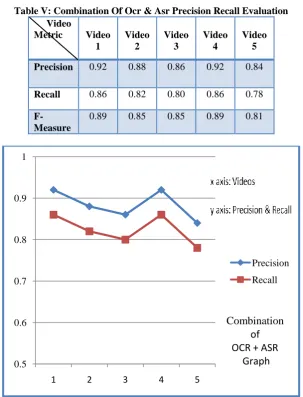
Table V: Combination Of Ocr & Asr Precision Recall Evaluation Video
Metric Video 1
Video 2
Video 3
Video 4
Video 5
Precision 0.92 0.88 0.86 0.92 0.84
Recall 0.86 0.82 0.80 0.86 0.78
F- Measure
0.89 0.85 0.85 0.89 0.81
Fig. 7: Combination of the OCR & ASR Precision Recall Graph
Finally, form the Table V, it is conclude that, video retrieval with combination of OCR and ASR comparing with the separate system, our approach can do some improving by doing combination of OCR and ASR as the value of precision and recall of Figure 7 For Personalized results video results sequence should change according to that user profile interest.
V.
CONCLUSION
In this paper, we implement an approach for content-based video retrieval using combination of different approach in large video archives. In order to apply visual as well as audio resource of videos for extracting content-based metadata automatically. Wepropose an end-to-end text detection and recognition system as OCR and also applying ASR. The text detection component uses HOG based on rich shape descriptors such as HOG, Gabor and edge features for improved performance, and leverages PLS technique for dimensionality reduction, leading to SVM speed improvement. We proposed a merging scheme which overcomes the mistakes of SVM classification step and preserves word boundaries. Extensive evaluation on a large dataset illustrates the efficacy of our approach in both pixel-level text detection and word recognition tasks. At last, we integrating all the features extracted by OCR, ASR, Metadata and search each keywords with all the features and keywords extracted by OCR, ASR and metadata. At last display the personalized results to produce efficient and relevant result to users as per there interest.
0.5 0.6 0.7 0.8 0.9 1
1 2 3 4 5
Precision
Recall
Combination
of
OCR + ASR
ACKNOWLEDGMENT
The authors thank Haojin Yang and Christoph Meinel, Arpit Jain and Pradeep Natarajan. Turnoff their valuable comments and edits in refining ideas for the paper. The research was supported by the information technology department of Sinhgad College of Engineering, Pune.
REFERENCES
[1]. Pradeep C., Kishor Sadafale, Kalpana Thakare. "A Survey on Content Based Video Retrieval Using Different Feature Extraction" in National Conference on Technical Revolution (NCTR-2015), Page No.127, On 9th-10th Jan 2015.
[2]. Chivadshetti Pradeep, Mr Kishor Sadafale, and Mrs Kalpana Thakare.. “Content Based Video Retrieval Using Integrated Feature Extraction” in IPGCON 2015 at AVCOE, Sangmner on March 2015.
[3]. Haojin Yang and Christoph Meinel, “Content Based Lecture Video Retrieval Using Speech and Video Text Information”, in proc. IEEE transactions On Learning Technologies, Vol. 7, No. 2, April-June 2014.
[4]. Arpit Jain‡, Xujun Peng, Xiaodan Zhuang, Pradeep Natarajan, and Huaigu Cao, “Text Detection and Recognition in Natural Scenes and Consumer Videos”, in proc. IEEE International Conference on Acoustic, Speech and Signal Processing (ICASSP) INSPEC Accession Number: 14448982, 4-9 May 2014.
[5]. Hadi Yarmohammadi and Mohammad Rahmati, “Content Based Video Retrieval using Information Theory”, in proc. IEEE Iran Conf. ,Machine vision and Image Processing, pp. 214-218, 2013.
[6]. B. V. Patel and A.V. Deorankar, “Content Based Video Retrieval using Entropy, Edge Detection, Black and White colour Features”, in proc. IEEE Computer Engineering and Technology (ICCET), 2nd International Conference on Vol. No. 6 Page(s): 272 –276, 2010.
[7]. Hadi Yarmohammadi and Mohammad Rahmati, “Content Based Video Retrieval using Information Theory”, in proc. IEEE Iran Conf. ,Machine vision and Image Processing, pp. 214-218, 2013.
[8]. B. V. Patel and A.V. Deorankar, “Content Based Video Retrieval using Entropy, Edge Detection, Black and White colour Features”, in proc. IEEE Computer Engineering and Technology (ICCET), 2nd International Conference on Vol. No. 6 Page(s): 272 –276, 2010.
[9]. Kuo, T.C.T.; Dept. of Comput. Sci., Nat. TsingHua Univ. and Hsinchu, Taiwan ; Chen, A.L.P., “A Content-Based Query Language for Video Databases”, in proc. Third IEEE International Conference on Multimedia Computing and Systems, Page(s): 209 – 214, 17-23 Jun 1996.
[10]. Volkmer, T. andNatsev, A., “Exploring Automatic Query Refinement For Text-Based Video Retrieval”, in proc. IEEE Multimedia and Expo, DOI: 10.1109/ICME.2006.262951, Page(s): 765 - 768, 2006.
[11]. Jyothi, B., Latha, Y.M. and Reddy, V.S.K., “Relevance Feed Back Content Based Image Retrieval Using Multiple Features”, in proc. IEEE International Conference on Computational Intelligence and Computing Research (ICCIC), DOI: 10.1109/ICCIC.2010.5705883, Page(s): 1 – 5, 2010
[12]. Padmakala, S., AnandhaMala, G.S. and Shalini, M, “An Effective Content Based Video Retrieval Utilizing Texture, Color, and Optimal Key frame Features”, in IEEE International Conference on Image Information Processing (ICIIP), DOI: 10.1109/ICIIP.2011.6108864, Page(s): 1 – 6, 2011
[13]. Kale, A. and Wakde, D.G., “Video Retrieval Using Automatically Extracted Audio”, in proc. IEEE International Conference on Cloud & Ubiquitous Computing & Emerging Technologies (CUBE), DOI: 10.1109/CUBE.2013.32, Page(s): 133 - 136, 2013
[14]. B. V. Patel and B. B. Meshram., “Content Based Video Retrieval Systems”, in proc. IJU Vol.3, No.2, April 2012.
[15]. M. Petcovic, Centre for Telematics and Information Technology, University of Twente, “Content-based video retrieval”.