Internet access and usage by secondary school students
in a Nigerian Municipality
Wole Michael Olatokun
IAfrica Regional Centre for Information Science, University of Ibadan, Nigeria.
[email protected]
Received:9th December 2007 Accepted: loth September 2008
The study investigated the use and patterns ofuseofthe Internet among secondary school students in Ibadan, a Nigerian municipality, with a view to determining how widespread Internet use was and to examine the activities the students adopt the Internet for. It also aimed at determining possible misuse with a view to proffering solutions. A survey research design was adopted. Questionnaire was the instrument for data collection and analysis was done using descriptive statistics. Findings revealed that the majority
of
the respondents use the Internet for leisure rather than for educational purposes, though some respondents affirmed improved reading habits and academic performances occasioned by Internet use. The greatest barrierto the full exploitation ofthe Internet was inadequate access. Some inherent risks and problems occasioned by Internet use - namely pornography, scams, etc. - were also identified. The study recommends that there is a need for school authorities and parentsto not only provide Internet facilities for students, but also to adopt strategies to monitor use soastoguard against misuse.Keywords: Access, Internet, secondary school, Ibadan, Nigeria, use, misuse.
I. Introduction
The Internet is a global network of computers linked together over large distances. It was created by the American military as a means of communication and has be'en in existence since the I 950s (Osunade, 2003). Up until the mid- to late eighties mainly commercial organisations and educational institutions used the Internet. This was due to high costs. The rapid development of technology has seen improvement in communication links and a lowering of costs. The implication is that the Internet is now more widely availableto more people. The availability and the process by which an effort to use the Internet through an electronic communications system is carried out is referred to as Internet access. The Internet promises to have a far larger and more serious impact on our society than the introduction of television; possibly as great an influence on history as the industrial revolution or the printing press (The UCLA Internet Report, 1999). According to Ojedokun (200 I), it has broken down barriers of communication and information access from anywhere in the world. It is fast, reliable and does not have restrictions on content or format. It also has a limitless range of facilities, which assistusers to accessalmost infinite amounts of information. It offers the opportunity for accessto up-to-date research reports and knowledge globally. It has thus become an important component of electronic services in academic institutions (Ojedokun, 200 I).
Globally, the Internet has opened countless new opportunities for students. In fact, it hasgiven a very open approach to education where students are no longer dependent on their teachers or textbooks as their only sources of information. With the Internet in vogue, students are no longer limited to what is in the school library, nor do they have to wait for books to come into the school library. According to the Pew Internet
&
American Life Project (2005), Internet use is a staple of college students' educational experience as they use it to communicate with professors and classmates, to do research and to accesslibrary materials. For most of them it is a functional tool, one that has greatly changed the way they interact with others and with information as they go about their studies. Thus, the Internet broadens students' horizons beyond their local boundaries (of home and neighbourhood school) and provides an environment in which its impact may be immeasurable.But in spite of the numerous privileges the Internet has ushered into the students' world, several studies (Li and Chung, 2006; Griffiths, Rogers and Sparrow, 1998; Suhail and Barges, 2006) have established that there are some materials available on the Internet that may be offensive to some students. This might make the Internet be regarded as a strange place just becauseit is unregulated and unmonitored; its users can be somewhat anarchic and outspoken, to put it mildly. Although it is possible to create network servers that obstruct the avenuesto these materials, motivated students quickly identify alternative paths. Thus, despite the numerous benefits of the Internet, there are also many drawbacks. The fact that the Internet is not owned by anyone leavesno room for checks or censorship of available information. The
I. Olatokun, M. Wole,PhD, is a Senior Lecturer at the Africa Regional Centre for Information Science (ARCIS), University of Ibadan,
Nigeria
upside to this is that information is freely available to everyone without restriction, but the downside is that valued information can be placed into the wrong hands, and school children can be unduly exposed to morally damaging information (e.g. pornography). The reason is not far-fetched; it is simply that there are no checks on the information on the net (Osunade, 2003).
Nigeria is a multi-ethnic, multi-cultural, and multi-religious country. There are over 250 different ethnic groups and associated languages (Esiet, et al., 200 I). In terms of demographic composition, the country's population is said to be essentially a youthful one (Akinsola, 2005). According to the Nigerian Demographic and Health Survey of 2005 (Federal Ministry of Health, 2005), the total population is made up of 40-45% children aged 0-15. Further, 6% are under 20 years old, about 63% are under 25 years old, and 30% are 10-24 years old. Given the proportion of young people relative to middle-aged and older people in Nigeria, coupled with the reported increased Internet penetration rate in the country (Miniwatts Marketing Group, 2008; Chiemeke
&
Longe, 2007), the well-being of the youth cannot but be a matter of concern and object of investigation. The objective of this study was to determine the adequacy of access to, and the usage (in terms of use and misuse) of the Internet by selected secondary school students in Ibadan, a Nigerian municipality. The study also aimed at examining the extent of use, online activities of the students, benefits of Internet use to them as well as identifying the limitations and barriers against Internet exploitation by the students.Africa Top 10 Internet Countries
Decem ber 2007
8.0
I
---j
8 9
7 6 5 3
2
o
1 I I I I I I I I
-f
i
r
I
I
I
6.1
r
T
I
II6.0
I
T -
I
I
II
5.1
I
I
I
I
I
I3.5
I
I
"r
12.8
I
jI
I!
T
1I
2.5
I
I
116
I
I
Ii
I
1.2
I
I~IO.8
I
+--,~~
1
----I----
IIIigeria
U
Keny.l
E
Sudan
Egypt
Algeria
U
Tunisia
lEI
Uganda Morocco
Zimbabwe -+'
South Africa
Millions of Users Source: """""W.internelv'iorldstats.com
Copyright@ 2008, Miniwatts Marketing Group
Figure 1 Africa's top 10 Internet countries
•
2. Previous studies
Internet use among secondary school pupils is widespread and growing. According to the Pew Internet
&
American Life Project (2005) report, 22.2% of the 76 million American computer users aged 3 and above use the Internet and one fifth of children with home computers use them to access the Internet. It was also reported that 55 million enrolled children used a computer at school, and the school was the most common place for children to access the Internet. With these staggering numbers, there is little doubt as to the proliferation and popularity of Internet use. A national survey conducted by the Annenberg Public Policy Center (1999) in Washington found that a majority of parents in households with computers fear the Internet's influence on children, due particularly to its wide-open nature and interactivity. However, they still believe that their children need the Internet. They cited as benefits the ability to discover useful things and the advantages for schoolwork. Thus, the Internet is an important element in the overall educational experience of many teenagers. Schools are a common location where online teens access the web, although very few teenagers rely exclusively on their school for that web access. Further, there is widespread agreement among teens and their parents that the Internet can be a useful tool for school (Pew Internet&
American Life Project (2004).A review of literature reveals that teachers and students are the most frequent users of the Internet, using it mainly for educational purposes rather than for entertainment. Several studies Oagboro, 2003; Panda and Sahu, 2003; Hanauer 2004) have established a high degree of access and use of the Internet among college students. Hanauer's (2004) report showed that 83% of Internet users had access at their homes and 51% at their colleges or libraries. Eighty-one percent of the students access the Internet mostly for college work and 80% for e-mail/chat. Mishra, Yadav and Bisht (2005) conducted a research study on the Internet usage patterns of undergraduate students at the G B Pant University of Agriculture and Technology, Pantnagar.Their findings indicated that a majority of the students (85.7%) used the Internet, and 61 .5% of the males and 51.6% of the females used it for preparing assignments. A majority of the respondents, 83.1 % male and 61.3% female, indicated the slow functioning of Internet connections as a major challenge. Robinson
(2005) examined Internet use among African-American college students and concluded that the use of the Internet for most of the students occurred at school or in the workplace. In 2002, the Corporation for Public Broadcasting conducted a research on children's Internet use in the United States. Findings revealed that children experienced the equivalent of an adolescent growth in their use of the Internet between 2000 and 2002. 65% of American children ages 2-17 were observed to use the Internet from home, school, or some other location - a 59 percent growth rate since 2000, when 41 percent of children went online from any location (CTF, 2002).
However, despite the usefulness of the Internet to students, several studies have examined the negative effects it could have on teens. For instance, immoral contents can be viewed in the closet, on a laptop, on a palmtop, etc. without the reservation that any other person will know about the content being consumed. According to Longe, et
01. (2007),
the Internet has also served as the platform for pedophiles who take undue advantage of the innocence of children and teenagers to engage them in sex chat rooms and eventually invite them for sexual escapades. Hertlein
&
Piercy (2006) are of the opinion that people are using the Internet more frequently to form friendships and romances and to initiate inordinate affairs. They provided a critical review of the literature on Internet infidelity. Cheryl (2007) revealed that the average age of a child when first exposed to Internet pornography is I I years old, with the largest consumers of pornography in America being the 12-to-17-year old group. Almost 90 percent of eight to 16-year-olds have viewed pornography online, most while doing homework. This study aims at examining the use and mis-use of the Internet by secondary school students in Ibadan - a Nigerian municipality ..3.
MethodResearch design, location and population of the study
The research design adopted was the survey. The study location was Ibadan, a Nigerian municipality. Ibadan was chosen as the location because of proliferation of cybercafes in the city leading to increased access and use of Internet among the youth, which calls for investigation. The study population comprised secondary school students at the junior and senior levels. Purposive sampling technique was used for selecting the respondents in twenty cybercafes The population being indeterminate, the researcher decided to calculate by multiplying the exact figure of the study locations with that of the exact figure of the copies of the research instrument (questionnaire) used for the study. In all, a total of 300 respondents was sampled using randomised sampling.
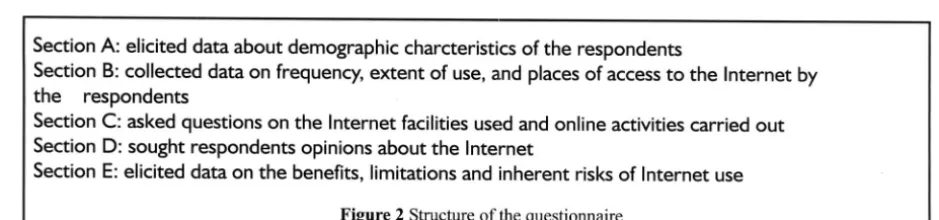
The data collection instrument used was the questionnaire. It was well structured to clearly identify the important variables to be measured. This included access to the Internet, usage patterns in terms of use and misuse, and the limitations the students encountered in the use of the Internet. It was further designed to elicit some personal information and other views relevant to the study (See Figure I). The questionnaire was examined by experts in Internet research and their comments were used to arrive at the final version. The Cronbach alpha reliability co-efficient of =0.71 was achieved
Section A: elicited data about demographic charcteristics of the respondents
Section B: collected data on frequency, extent of use, and places of access to the Internet by the respondents
Section C: asked questions on the Internet facilities used and online activities carried out Section D: sought respondents opinions about the Internet
Section E: elicited data on the benefits, limitations and inherent risks of Internet use Figure 2 Structure of the questionnaire
Data were collected in the months of May and June 2007. The researcher visited each of the cybercafes that were chosen as the study location personally to explain the purpose of the study to the management of the cybercafes and to solicit their assistance in administering the questionnaire. In the process, the researcher handed copies of the questionnaire to be administered to them and instructed them on how to briefly interview the respondents before giving out the
questionnaire so that they could be sure the questionnaire was given to secondary school students. Collected data were
structured into grouped frequency distributions using the Statistical Package for the Social Sciences (SPSS)software. Of
the 300 copies of the questionnaire administered (fifteen copies per cybercafe), the return rate was 261, representing
87%. Of the total respondents, 190 (72.8%) were male while 70 (26.8%) were female and I (0.4%) did not indicate the
gender. The mean age of the respondents was 16 years.
4. Results and discussion
In this section, we present the results of data analysis followed by a discussion of the findings.
4.1 Frequency of Internet use
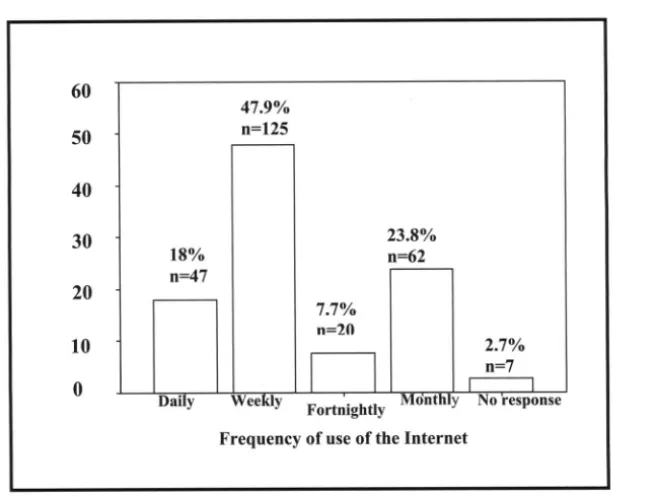
Figure 3 shows that 125 (47.9%) of the respondents use the Internet weekly. A considerable percentage (23.8%) use it
monthly, while only 47 of the respondents use it daily.A small percentage (7.7%) indicate using it forthnightly, while 7 did
not give a response as to their frequency of use of the Internet.
60
47.9%
50
n=12540
30
23.8%18% n=62
n=47
20
7.7% "=20
10
2.7%I
I
n=70
Daily Weekly
Fortnightly Monthly No response
Frequency of use of the Internet
Figure 3 Frequency and use of the Internet (Source: Field Survey: May 2007)
4.2 Places where students learnt Internet browsing and average time spent daily
Percent Frequency
Table I: Frequency distribution of the place where students learnt to browse the Internet
Cumulative Valid Percent Percent
Valid At home
At school
At a cybercafe
Others Total
48
16
184
13 261
18.4 6.1
70.5
5.0
100
18.4
6.1
70.5
5.0
100
18.4
24.5
95.0
100
Source: Field Survey: May 2007
•
It was of interest to find out how students who used the Internet came to learn its use. The majority 184 (70.5%)
indicated that they learnt how to browse the Internet in the cybercafes showing the importance of the cybercafe in
increasing access to Internet facilities. Forty-eight (18.4%) of them learnt it at
home
while 16 (6.1%) of them learnt it in
school).
Thirteen (5.0%) indicated that they learnt to use it in other places, e.g. their father's, an uncle's or aunt's office.
4.3 Average time spent on the Internet by the students
Table 2 Frequency distribution of average time spent on the Internet
Cumulative Frequency Percent Valid Percent percent
Valid Less than 30 min 17 6.5 6.5
6.5
30 min - 1 hour 97 37.2 37.2 43.7
I - 2 hours III 42.5 42.5 86.2
More than 2 hours 30 I 1.5 I 1.5 97.7
No response 6 2.3 2.3 100.0
Total 261 100.0 100.0
Source: Field Survey: May 2007
On daily usage of the Internet, I I I (42.5%) spend an average of 1-2 hours, a considerable number 97 (37.2%) spend be-tween 30minutes and I hour and 30 (11.5%) spend more than 2 hours on the Internet daily. Six (2.3%) respondents gave no response.
4.4 Internet facilities used by the respondents
The study sought to know the facilities frequently used on the Internet. The results are presented in Table 3.
Table 3 Percentage of use of Internet facilities
Internet Facilities Frequently used Not used at all
E-mail 92.3% (241) 7.6% (20)
Internet Relay Chat Room 69.4% (181) 30.6% (80)
World Wide Web 55.5% (145) 44.5% (116)
Instant Messaging (1M) 48.3% (126) 51.7% (135)
News and travel information 37.6% (98) 62.5% (163)
Discussion groups &Newsgroups 32.5% (85) 67.5% (176)
Electronic commerce facilities 29.1% (76) 70.9% (185)
Wide Area Information Server (WAIS) 27.5% (72) 72.4% (94)
Archie 25.3% (66) 74.7% (195)
File transfer protocol 23% (60) 77.0% (201)
Telnet connections 22.2% (58) 77.8% (203)
Gopher 16.8% (44) 83.2% (121)
Source: Field Survey, May 2007
Table 3 shows that 92.3% (241) of the respondents indicated that they make use of the electronic mail frequently. Only 7.6% (20) of them affirmed that they had never used the e-mail. Internet Relay Chat Room was the next facility frequent-ly used with 181 (69.4%) respondents while 30.6% (80) of them said they had never used the facility. The WWW was next in the hierarchy with 145 (55.5%) indicating that they used it and 116 (44.5%) indicating that they do not use it. The least significant facilities used by the majority of the respondents were Gopher 121 (83.2%), Telnet 203 (77.8%), File Transfer Protocol 20 I (77.0%), Archie 195 (74.7%) and Wide Area Information Server (WAIS) 94 (72.4%) in that order.
4.5 Activities carried out by the students online
Table 4 Online activitiescarried out by the students
Online Activities Significantly done Not done at all
Reading&Sending e- mail 84.3% (220) 15.7% (41)
Online chatting with old&new friends 77% (201) 23% (60)
Playing&downloading music 62.5% ( 163) 37.6% (98)
Browsing for fun 57.5% (150) 42.6% (III)
Playing&downloading games 45.9% (120) 54% (141)
Homework 46.4% (121) 53.6% (140)
Instant Messaging (1M) 52.4% (137) 47.5% (124)
Visitingwebsites 55.4% (194) 25.6% (67)
Reading newspapers 46% (120) 54% (141)
Searching for information 70.9% (185) 29.1 % (76)
Source: Field Survey, May 2007
The results in Table 4 showed the following distribution: reading & sending e-mail (84.3%); online chatting with old &
new friends (77%); searching for information (70.9%); playing
&downloading
music (62.5%); browsing for fun
(57.5%); visiting websites (55.4%) and Instant Messaging (1M)(52.4%). Few of them indicated they use the Internet for
homework (46.4%); reading newspapers (46%), playing and downloading games (45.9%). These findings showed that
the majority of the respondents were not using the Internet for academic matters as one would have expected since
"reading
&sending e-mails"
and
"online chatting with old and new friends"
ranked highest and the use for
"homework"
is one
of the lowest.
4.6 Factors responsible for widespread
Internet usage among the students
For further investigation on the use of the Internet by the respondents, they were asked to indicate the factors that are
responsible for widespread Internet usage among them. A large percentage of 83.5% of the respondents believed that
ease of use is part of the factors responsible for widespead Internet usage. This was followed by 78.2% who believed the
major factor was because
"it is in vogue".
About sixty-eight per cent indicated that the reason for the widespread use was
"to
source for information"
The least reason that accounted for Internet use, according to the respondents was
"parents
encouragement" .
4.7 Respondents'
perception and opinions about the Internet
Table 5 Respondents' opinions about the Internet
•
Opinions
It is a waste of time
It helps to improve my academic performances
It keeps users away from families and friends
The quality of information on it is poor
It is difficult to browse the Internet It is a resource for general knowledge
It exposes children to offensive materials e.g. pornography
It will be good if my school is connected to the Internet.
Internet is used among all secondary school students
The Internet is addictive
My school library is still far better and more convenient to get information and easily accessible than the Internet.
The Internet has some inherent risks
Total Disagree Total Agree No Response
63.7% (/66) 17.2% (45) 19.1% (50)
37.9 % (99) 45.2% (I 18) 16.8% (44)
60.5% (158) 18% (47) 21.5% (56)
73.2 % (191) 5.7% (15) 21.1 % (55)
65.9 % (172) I 1.1% (29) 22.9% 60) 20.6% (54) 60.9 % (159) 18.4% (48)
23.8% (62) 52.5% (137) 23.8% (62)
10.5% (27) 68.6% (179) 21.1 % (55)
34.5% (90) 33.3% (87) 32.2% (84)
20.7% (54) 41.7% (109) 37.6% (98)
55.2% (144) 16.5% (43) 28.4% (74)
32.2% (84) 31.5 % (82) 33.4% (95)
Source: Field Survey: May 2007
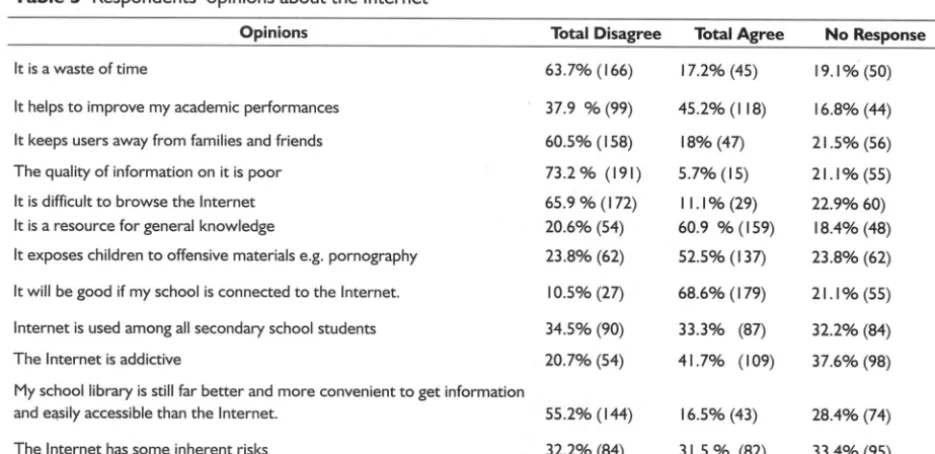
Table 5 presents the varied view and perception of the Internet by the respondents. More than half of the respondents
(172) reported that they have no difficulty in browsing the Internet because it is user friendly. 166 (63.7%) indicated that
they do not see the Internet as a time waster because they enjoy the great exposure it has brought to them. Majority of them said though their schools are not connected to the Internet, yet they see it as far better and convenient to use than their school libraries. Therefore they considered every time they browse the Internet an opportunity to add to their knowledge, which invariably over time has helped to improve their academic performances.
4.8 Benefits of Internet use
Table 6 Frequency distribution of the benefits derived from Internet use
Benefits Yes No No Response
Keeping in touch 82.8% (216) 16.5% (43) 0.7% (2)
Getting current information 82.4%(215) 17.6% (46) 0% (0)
Information for homework 60.2% (157) 39.1% (102) 0.7% (2)
Exposure to global issues 75.5%( 197) 24.5% (64) 0%(0)
Improved Reading Habits 55.6% (145) 44.1% (115) 0.3% (I)
Making friends 28.0% (73) 0%(0)
Source: Field Survey: May 2007
Table 6 shows that a large percentage (82.8%) indicates that
"keeping in touch"
is one of the benefits derived from the use of the Internet, 82.4% believed it is good for"getting current information"
while 75.5% indicated that"exposure
toglobal
issues"
is one of the benefits of the use of the Internet. A considerable proportion (55.6%) indicated"improved reading
habits", "getting information for homework"
(60.2%) as the benefits derived.4.9 Limitations to Internet usage
Table 7 presents the findings on the limitations of Internet use.
Table 7 Extent of limitation to Internet usage
High Extent Low Extent
23.7% (63) 52.8% (138)) Limitations
Too expensive
Inaccessibility
No guidance/training on how to use the Internet
Discouragement from parents
Lack of adequate time to use the Internet
Inherent health risks/hazards
Inability to get required information
Boredom
Source: Field Survey: May 2007
24.2% (58)
19.2% (50)
13.0% (34)
27.6% (72)
18.0% (47)
20.3% (53)
12.2% (3 I)
52.8% (I 35)
54.4% (142)
52.1% (136)
46.4% (121)
52.9% (138)
48.6% (127)
57.5% (150)
No Response
26.0% (60)
22.9% (68)
26.4% (69)
34.8% (91)
36.0% (68)
29.2% (76)
31.0% (81)
20.6% (80)
Findings presented in Table 7 showed that lack of adequate time to use the facility, inaccessibility, high cost and inability to get the required information have very great extent in limiting the respondents' Internet usage. The results also revealed that a large proportion of them (57.5%) believed that boredom limits their Internet usage but at a low extent. In addition, factors such as
"no guidiance/training on how
touse the Internet", "discouragement from parents"
and"inherent health risks/
hazards"
were indicated as limiting factors but to a low extent.5.0 Discussion
offindings
In the past five years, the use of the Internet has become widespread in Nigeria. This is confirmed from a study report by Internet World Stats (2008) which says that as at the year 2000, the total number of Internet users in Nigeria was just 200,000 but at present the number has drastically increased to 10 million. The fact still remains that young people are always excited and full of enthusiasm to explore whatever is new in the society, therefore it will not be an understatement to say that they constitute a larger proportion of Internet users in Nigeria. The findings revealed that a large proportion of the secondary school students in Nigeria had been involved to some extent in using the Internet in their everyday lives for about four to five years now. They use the Internet for between 1-2 hours daily. This is in line with reported findings from
SAJnl Libs
&Info Sci
2008, 74(2)•
the Pew Internet
&
American Life Project (2005) that many American teenagers are heavy, enthusiastic users of the Inter-net with about 62% of them going online every day. It equally corroborates the Environics Research Groups for the Media Awareness Network (2005) report that Canadian youths are no strangers to the Internet. Almost 8 in 10 (79%) of them say they have Internet access at home, (48%) say they use the Internet from home at least an hour every day.However, findings from this study revealed the cybercafe as the one major place of access to Internet facilities which contrasts with the Pew Internet
&
American Life Project survey report (2004) which found that 87% (21 million) of all American youth between the ages of 12 and 17 use the Internet. Of these 21 million online teens, 78% (or about 16 million students) say they use the Internet at school, meaning that 68% of all teenagers have used the Internet at school. This contrast is largely due to the fact that most of the secondary schools in Nigeria (those in the study area inclusive) are ill-equipped with Internet facilities if at they have them.Findings also revealed that male respondents constitute 72.8% of total population of Internet users, while female constitute 26.8%. This result could be linked to established facts in the literature that technology is a male sphere, and research has also shown that boys have greater interest in technology than the females (Enochsson, 2005). This result also reflected the outcome of earlier statistics where the male use the Internet more than the female gender (Noguchi, 2005). But it is contrary to more recent statistics which shows that girls and women are as frequent Internet users as men (Fallows, 2007 and Enochsson, 2005). This finding equally corroborates the notion that majority of Internet users in cybercafes in developing countries are males and are students Uagboro, 2003; Wahid, Furuholt and Kristainsen, 2006; and Sairosse, 2003).
Another salient finding in the study is that which relates to the main purposes why students use the Internet. One would have expected that surfing, retrieving and using information especially for educational purposes would rank very high in the respondents' use of the Internet but this turned out to be the contrary as their primary use of the Internet was for communication, entertainment, and leisure (e.g., reading and sending e-mail, online chatting, instant messaging, playing and downloading music and games and reading newspapers) (Hoag, 2003; Jones
&
Madden, 2002, Pew Internet&
American Life Project, 2005, Environics Research Groups for the Media Awareness Network, 2005), and only secondarily used for homework. The social interactions allowed by the Internet, particularly the synchronic (e.g., chat) rather than the asynchronic communication forms (e.g., fora), seem to meet significant needs of the respondents. This is in line with the findings of the Pew Internet
&
American Life Project, (2005). The finding of course has come as no surprise, since it mirrors experiences of Internet usage in countries like America, Canada, Australia (Fleming and Rickwood, 2004; Environics Research Groups for the Media Awareness Network (2005); Pew Internet &American Life Project, 2005).Moreover, this study reveals that Internet usage among students is widespread, given that it is commonly available in the diversely established cybercafes that are set up mostly as one-man businesses in every nook and cranny of Nigeria. Also, majority of them perceived that using the Internet is a modern thing to do, and that at present, on a global view, it is in vogue. For these students, the cost of using the Internet is not expensive and besides they see the Internet as a source of all information that allows them to check global trends of events and news stories. Furthermore, the respondents affirmed that they receive a lot of encouragement from their schoolteachers to use the Internet. This could be said to be in line with the interview granted to some teachers by Gibson and Oberg's (1997) case study of Internet use which reported that the predominant student uses of the Internet in schools were exploring Web sites and visiting sites identified by their teachers. Besides that, majority of the students established that their parents encourage them to use the Internet. This contrasts the findings of the Pew Internet
&
American Life Project (2005) that reported parents having many concerns about the Internet and struggle to protect their children from the worst elements online - dreadful peo-ple and ugly information - without keeping children from its benefits. For instance, parents of girls are more concerned than parents of boys that their children will be victimized online - that they will be stalked, harassed, and that they will be susceptible to advertising. This clearly carries over to the Internet the concerns that girls' parents have about all kinds of experiences and threats. Wired parents were generally much less worried about the impact of the Internet on their chil-dren than parents who did not have Internet access. Online parents tend to be more vigilant in monitoring what their chil-dren do on the Internet, but also seem more confident that they could avoid trouble. Parents with considerable online experience express even less concern than those who have recently come online. For their part, online teens as a group were generally much less concerned than parents about online content and do not feel as strongly that they need to be protected (Pew Internet&
American Life Project 2005).On the benefits of Internet usage, the respondents reported that they appreciate the speed of the Internet, the variety of information it contains in one spot, and the ease of access to it, and they believe that information on the Web is more up-to-date than those in books (Fidel et aI., 1999; Parr, 1998). High school students told researchers that they thought it was easier and more interesting to find information on the Web than in the library, and that they did not plan their
Most of them believe the Internet is far better and convenient than their school libraries, they saw it as a source for general knowledge; hence they established that it has really helped them to improve their reading habits and their academic performances. They saw it as a technology that has brought them opportunity to accesscountless documents and send information to all parts of the globe. In addition, a large proportion indicated that the Internet has brought quite a lot of benefits to them such as making new friends, getting current information, exposure to the global view of any topical issue. Some see the Internet as a means of keeping in touch with friends and relatives. Despite the motivational factors identified as the cause of widespread use of the Internet among the secondary school students, factors such as uneasyaccess,lack of good guidance, time consumption, inability to get the required information, attached health risk and boredom has been identified to be responsible for the limited use of the Internet, though at a low extent. Other problems acknowledged by the students were the inherent risks, offensive materials (e.g. pornography, scam, etc) and its addictive influence. This is consistent with Griffiths (2003), Mitchel et al (2005), Li and Chung (2006), Suhail and Barges (2006), and Environics ResearchGroups for the Media Awareness Network (2005). Similarly, as reported in the findings of the Pew Internet
&
American Life Project (2005), the addictive influence and exposure to offensive materials form major concerns of American parents, especially those with considerable online experience. They were concerned with what their children might see or read online and about half (45%) of parents are worried that the Internet leads some young people to do dangerous or harmful things. Such parents have devised means of controlling their children's access such as carrying out on-the-spot checks, surfing together with their children, fixing computers in the open place where they could keep an eye on their children's online activities, or usingfilters (Pew Internet & American Life Project 2005).6. Conclusions and recommendations
The Internet could be likened to a giant growing archive accessibleto all literate being of any age range. The use of the Internet grants its users great awareness of the importance of the world around them and it will continue to grow as long as its users are not denied of easy access.Knowledge is power and knowledgeable youths are the leaders and builders of better and greater tomorrow. The Internet stands to be a source of knowledge and any country that severe her youth from it by failing to provide adequate facilities for easy accessis unseating the country from her throne of dignity among other dignitaries. Governments of countries such as the United States of America, Canada, United Kingdom, and Australia have realised this and hence have incorporated Internet connectivity at all levels of education in their countries. This study established the popularity of the Internet among secondary school students and that it is a source of all information for them and is far better, more convenient and reachable than their school libraries. However, some of the students are yet to have enhanced access to the Internet in their schools. In this connection, the following recommendations are made:
First, the Nigerian government should better fund the public secondary schools with a view to providing quality education at this level. Better funding will also lead to better facilities in the schools including the Internet. This will no doubt increase accessand use of the Internet in the schools and will assistthem in their academic endevours. Second, judging from the findings of this study, the cybercafe turned out to be a major point of accessto Internet facilities by the students. In line with this, it is recommended that the government should embark on the creation of telecentres in the nook and cranny of the country, particularly in the major cities. This will further increase accessand use of the Internet among the students. Also, where it is found that students merely want to use Internet facilities for communication and entertainment purposes only, teachers in the respective schools should promote meaningful Internet use by referring them to search for information on subject topics and present written details of what they have learnt. In other words, schoolteachers should refer students to websites for additional information that will help to improve them academically. The additional information will complement the classroom teaching and widen the student's concept of the topic they have learnt. They should also encourage the students to visit specific websites in advance preparation for topics that will be taught later in class. Finally,cybercafes should be encouraged to partition their services to adult, youth and children/ teen sections in order to take advantageof technologies for content channeling/selection (Longe, et al 2007). While some computer terminals can be dedicated to accessall forms of contents others for children/teenagers usagecan be enabled to access contents that are purely healthy for children/teenagers' age group consumption. The responsibility of monitoring Internet contents being consumed by children and youths at home rests with parents and guardians. Content channeling/selection technologies and filters could be used asan aid to moderating contents viewed by children/teenagers at all Internet accesspoints. In schools, students can be allocated user and password IDs. These passwords and IDs can then be configured and made usable only on systems that have been conditioned using filters and content selection technology for web contents that are healthy for the consumption of children and teenagers (Longe, et ai, 2007).
•
References
Affonso, B. (1999).
Is the Internet affecting our children?
(Internet)http://www.wes.org/ewenr/04Sept/Practical.htm.
January 22, 2007.Akinsola, E.F. (2005). Comments on empowering youths through sexuality education: the challenges and opportunities. Retrieved on 13th September 2006, from:
www.arsrc.org/downloads/akinsola.pd(.
Cheryl, T. (2007).
Keep Your Child Safe from Internet Porn.
Retrieved February 13,2007 from online atwww.cbn.com
Chiemeke, e. S,& Longe, O. B. (2007). Information and Communication Penetration in Nigeria: Prospects, Challenges and Metrics.
Asian journal
of
Information Technology,
6(3), 280-287.CTF (2002).
Connected
toThe Future
A
Report on Children's Internet Use.
Retrieved from The Corporation for Public Broadcasting Retrieved on 16 May 2008 from:cpb.org/ed/resources/connected
Enochsson, A. (2005). Gender Perspective on Internet Use: Consequences for Information Seeking, (Internet). Retrieved on 2ndJuly 2007 from
http://informationr.net/ir/index.html
Environics Research Groups for the Media Awareness Network (2005). "Young Canadians in a Wired world: Key Findings" Retrieved on 24th September 2007 from:
http://www.media-awareness.ca/english/resources/special_initiatives/survey
_resources/
students_survey/key Jindings/kids _online_key Jindings.cfm.
Esiet, U.E., Bello, M.V., Adebayo, e.O., Booth, R., (200 I). Sexuality in Nigeria, in the International Encyclopaedia of Sexuality, Retrieved on 17th May, 2008 from:
http.www.2.hu-berlin.de/sexology.IES/Nigeria.
Fallows, D. (2005). How Women and men use the Internet.
Pew Internet and American life project,
Retrieved on lOth January 2007 from:http://www.pewinternet.org
Federal Ministry of Health. (2005).
Nigeria demographic and health survey reports.
Nigeria: Federal Ministry of Health.Fidel, R. D., Rachel, K., Douglass, M. H., Holder, J. K., Hopkins, e. J., Kushner, E. J., (1999). A visit to the information mall: Web searching behavior of high school students.
journal
of
the American Society for Information Science. 50(
I), 24-37.Fleming, M. and Rickwood, D.
(2004):'Teens in cyberspace: Do they encounter friend
orfoe?' Youth Studies Australia,
vo1.23, no.3, pp.46-52. Retrieved on 05th March 2007 from:http://www.youthfacts.com.au/index.
php?option=
displaypage<emid=
262&op= page.
Gibson, S.,&Oberg, D. (1997). Case studies of Internet use in Alberta schools: Emerging issues.
Canadian journal
of
Educational
Communication,
26, pp.145-164.Griffiths M. (2003): Internet abuse in the workplace: issues and concerns for employers and employment counsellors.
journal
of
employment Counselling
40.87-96Griffiths M.D, Rogers M.E., and Sparrow, P.(1998) Crime and IT (Part II): Stalking the Net.
Probation journal
45: 138-141 Hanauer, D. (2004). Internet Use among Community College Students: Implications in Designing Healthcare Interventions.journal
of
American College Health,
52 (5), pp 197-202.Hertlein, K. M.& Piercy, F. P. (2006) "Internet Infidelity: A Critical Review of the Literature"
The Family journal,
Vol. 14, No.4, 366-371.Hoag, J. e. (2003).
Residential Perceptions
of
Internet Service Quality: Result
of
a Survey
Retrieved on 30th August 200 from:http:/
/www.nrri.ohio-state.edu/dspace/bitstream/2068/205/
I/03-0 I.pdf
Jagboro, K.O (2003). A study of internet usage in Nigerian Universities: A case study of Obafemi Awolowo University, lIe-lfe, Nigeria. Retrieved 6th August 2008 from:
http://www.First:Monday.dk/issues8-2/jagboro
Jones S and Madden M. (2002): The internet goes to college: how students are living in the future with today's technology. . Washington, D.C: Pew internet &American life project. Retrieved I Ith September 2006 from:
www.pewinternet.org/reports/
pd/s/pip-college-report. pdf.
Li; S and Chung; T. (2006): Internet function and internet addictive behaviour.
Computer in Human Behaviour
22(6) 1067-1071. Longe, O. B.; Chiemeke, S. e.; Onifade, O. F.W; Balogun, F. M.; Longe, F.A,&Otti, V. U. (2007) "Exposure of Children andTeenagers to Internet Pornography in South Western Nigeria: Concerns, Trends & Implications"
Journal
of
Information
Technology Impact
Vol. 7, No.3, pp. 195-212.Miniwatts Marketing Group (2008) Africa Top 10 Internet Countries. Retrieved on 12 May 2008 from:
http://
www.internetworldstats.com/stats/.htm
Mishra, O.P., Neelam, Y.& Kamini, B.(2005). Internet Utilization Pattern of Undergraduate Students.
University News
43, 13, pp8-12.Mitchel K.J, Finkelhor D and Wolak J (2005): The internet and family and acquaintance sexual abuse.
Child Maltreatment
IO(I) 49-60. Retrieved 16th February 2006 fromhttp://www.innovatioinlaw.org/pages/child-docs/cv93.pdf.
Noguchi, Y. (2005).Women Narrow the Internet Gender Gap, survey
finds ..Washington Post. Thursday, Dec.
29. Retrieved on 13 April 2008 from:http://www.washingtonpost.com/?nav=pf
Ojedokun, A. A. (200 I). Internet Access and Usage by Students of the University of Botswana.
African journal
of
Library.Archives
and Information Science,
Vol. II, NO.2, 97-107.Osunade,
o.
(2003).An evaluation
of
the impact
of
Internet browsing on students' academic performance at the tertiary level
of
education in Nigeria.
Retrieved on 15th March 2007 from:http://www.rocare.org/smallgrant_nigeria2003.pdf.
Panda, K. e., and Sahu, N. K. (2003). Use of Internet in the Engineering Colleges of Orissa: An Analysis. Conference,
Mapping
Technology on Libraries and People.
Ahemdabad, India: Proceedings of the Ist International Conference on MappingTechnology on Libraries and People. pp 619-63 I.
Pew Internet &American Life Project (2004) The Internet Goes to College: How students are living in the future with today's technology" Retrieved on 16th May 2008 from:
http://www.pewinternet.org/pdfs/PIP_College_Report.pdf
Pew Internet & American Life Project (2005) "Protecting Teens Online" Retrieved on 28th June 2008 from:
http://
www.pewinternet.org/pdfs/PIPJilters_Report.pdf.
Robinson, J. W. (2005). Internet Use among African-American College Students: An Exploratory Study. Retrieved 9 February, 2007, from
http://wwwlib.umi.com/dissertations/fullcit/3156015.
Sairosse, M.T. (2003): Economic and social impact of the internet: study of cybercafes in Gaborone, Botswana. MUS. Dissertation, dept. of Library and Information studies, University of Botswana.
Suhaul K. and Barges, Z. (2006): Effects of excessive internet use in undergraduate students in Pakistan.
Cyber psychology and
Behaviour.
9(3) 297-307.The UCLA Internet Report (1999)
Surveying the digital future: How the PC and Internet are changing the world.
Los Angeles, CA: UCLA Center for Communication Policy. Retrieved on 5th March, 2007 from:http://ccp.ucla.edu/oneyage.htm.
U.s. Census Bureau. (1997).
Computer use in the United States<
Washington, DC. Retrieved on 26th May 2007 from:http://
www.census.gov/prod/99pubs/p20-522.pdf.
Wahid, F; Furuholt, B. and Kristiansen, S. (2006): "Internet for development? Patterns of use among internet cafe customers in Indonesia"
Information Development
22(4) 27S. Retrieved IS December, 2006 from:http://idv.sagepub.com/cgi/content/
abstract/22/4/278.
•
Appendix
Biodata of the author
Olatokun, Wole Michael
Dr. Wole Michael Olatokun obtained his Master and PhD degrees in Information Science from the University of Ibadan . He is currently a Senior Lecturer at the Africa Regional Centre for Information Science (ARCIS), University of Ibadan, Nigeria. He can be contacted bye-mail at: