Performance Analysis of AODV and DSR Routing
Protocols in MANETs
1
Pali Kumari; 2 Shiv Kumar
1
Department of Computer Science & Engineering, Mewar University, Chittorgarh
2
Department of Computer Science & Engineering, Mewar University, Chittorgarh
Abstract – Mobile ad hoc network (MANET) is an autonomous system of mobile nodes connected by wireless links. Each node operates not only as an end system, but also as a router to forward packets. The nodes are free to move about and organize themselves into a network. These nodes change position frequently. The main classes of routing protocols are Proactive, Reactive and Hybrid. A Reactive (on-demand) routing strategy is a popular routing category for wireless ad hoc routing. It is a relatively new routing philosophy that provides a scalable solution to relatively large network topologies. The design follows the idea that each node tries to reduce routing overhead by sending routing packets whenever a communication is requested. In this paper an attempt has been made to compare the performance of two prominent on demand reactive routing protocols for MANETs: Ad hoc On Demand Distance Vector (AODV), Dynamic Source Routing (DSR) protocols. DSR and AODV are reactive gateway discovery algorithms where a mobile device of MANET connects by gateway only when it is needed. As per our findings the differences in the protocol mechanics lead to significant performance differentials for both of these protocols. The performance differentials are analyzed rising varying simulation time. These simulations are carried out using the ns-2 network simulator. The results presented in this work illustrate the importance in carefully evaluating and implementing routing protocols in an ad hoc environment.
Keywords - DSR, AODV, DSDV, MAC, Simulation
1. Introduction
he tremendous growth of personal computers and the handy usage of mobile computers necessitate the need to sharing of information between computers. At present this sharing of information is difficult, as the users need to perform administrative tasks and set up static, bi-directional links between the computers. This motivates the construction of temporary networks with no wires and no communication infrastructure and no administrative intervention required. Such an interconnection between mobile computers is called an Ad Hoc network. In such an environment, it may be necessary for the mobile computers to take help of other computers in forwarding a packet to the destination due to the limited range of each Mobile host’s wireless transmission.
A wireless ad-hoc network is a collection of mobile/semi-mobile nodes with no pre- established infrastructure, forming a temporary network. Each of the nodes has a wireless interface and communicate with each other over either radio or infrared. Laptop computers and personal digital assistants that
communicate directly with each other are some examples of nodes in an ad-hoc network. Nodes in the ad-hoc network are often mobile, but can also consist of stationary nodes, such as access points to the Internet. Semi mobile nodes can be used to deploy relay points in areas where relay points might be needed temporarily. Wireless networking is an emerging technology that allows users to access information and services electronically, regardless of their geographic position.
Wireless networks can be classified in two types: - 1. Infrastructured networks
2. Infrastructureless (Ad hoc) networks
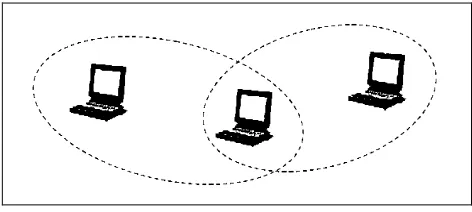
Figure 1.1: Example of a simple ad-hoc network with three participating nodes
Wireless ad-hoc networks take advantage of the nature of the wireless communication medium. In other words, in a wired network the physical cabling is done a priori restricting the connection topology of the nodes. This restriction is not present in the wireless domain and, provided that two nodes are within transmitter range of each other, an instantaneous link between them may form.
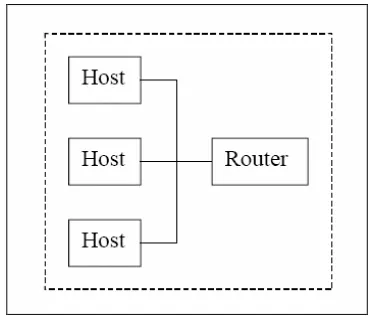
Figure 1.2: Block diagram of a mobile node acting both as hosts and as router
2. Literature Review
R. Al-Ani et al. [01], OPNET 14.5 was used for simulation. The simulation study for MANET network under five routing protocols AODV, DSR, OLSR, TORA and GRP were deployed using FTP traffic analyzing. These protocols were tested with three QOS parameters. From their analysis, the OLSR outperforms others in both delay and throughput.
Khan et al. [02] conclude that when the MANET setup for a small amount of time, then AODV is better because of low initial packet loss. DSR is not prefers because of its packet loss. On the other hand, if we have to use the MANET for a longer duration so we can use both protocols, because after sometimes both have the same behavior. AODV have very good packet receiving ratio in comparison to DSR. At the end, they concluded that the combined performance of both AODV and DSR routing protocol could be the best solution for routing in MANET.
Bindra et al. [03], evaluate the performance of AODV and DSR routing protocol for a scenario of Group Mobility Model such as military battlefield. They used Reference Point Group Mobility (RPGM) Model for
their scenario. They concluded that in Group mobility model with CBR traffic sources, AODV is better than DSR but when TCP traffic used, DSR perform better in stressful situation like high load or high mobility. DSR routing load is always less than AODV in all type of traffic. Average end-to-end delay of AODV is less than DSR in both type of traffic. Over all the performance of AODV is better than DSR in CBR traffic and real time delivery of data. But DSR perform better in TCP traffic under limitation of bandwidth.
Barakovic et al. [04], compared performances of three routing protocols: DSDV, AODV and DSR. They analyzed these routings with different load and mobility scenarios with Network Simulator version 2 (NS-2). They concluded that in low mobility and low load scenarios, all three protocols react in a similar way, but when mobility or load is increasing, DSR outperforms AODV and DSDV.
Karthikeyan Bhagavan and Carl A Gunter [05] demonstrated the simulation analysis of Ad hoc On-demand Distance Vector (AODV) routing protocols for packet radio networks. The integrated system version consisting of a network simulator and logic based – checker for traces of events which corrects the network simulation properties has been demonstrated and showed its flexibility to improve the turn-around time in debugging.
Srdjankrco, marjnadupcinor [06] overcomed the problem of affecting the neighbor detection algorithm of the AODV protocol by significantly deteriorates network performance. All routes are established over good quality links as good neighbors only are kept in routing tables. This improves the parameters such as data throughput, decrease delays and overall user performance.
Vincent W.S.Wong [07] compared the performance of Load Balancing (LB) AODV protocol with both the original AODV and gossip based routing protocols. LB AODV delivers more data packets to the gateway and decreases the end to end delay of packets. Vincent W.S. Wong considered a mobile Ad hoc wireless access network in which the mobile nodes can access the Internet via one or more stationary gateway nodes and controlled the on-demand routing overhead by Load Balancing(LB) AODV routing protocol.
traditional adhoc routing protocols. The Medium Access Control (MAC) delay protocol is a very useful metric to identify congestion hot spots and measure the link interference in an adhoc network. This MAC delay protocol outperforms the old protocol mainly in low mobility scenarios. The significance of the routing protocol is to find the least cost path from the source to the destination.
Nianjun Zhou and Huaming Wu [09] presented a mathematical and simulative framework for quantifying the overhead of reactive routing protocols such as dynamic source routing and ad hoc on-demand distance vector routing in wireless topology networks. The effect of traffic on routing has been studied and the result is possible to design infinite reactive routing protocol for variable.
L. Raja et al [10] presented in their paper work a comparison of four Reactive (on-demand) routing protocols for MANETs: - Ad hoc On Demand Distance Vector (AODV), Dynamic Source Routing (DSR) protocols, Temporally Ordered Routing Algorithm (TORA) and Associativity Based Routing (ABR) protocol. They provided descriptions of several routing scheme proposed for mobile ad hoc networks, classification of these schemes according the routing strategy i.e. table driven and on demand and presented a comparisons of these categories of routing protocols. Reactive protocols were introduced and their core architecture was described.
Ashok N. Kanthe [11] that throughput of AODV protocol is better than DSR protocol as the nodes are increasing/adding to network. Packet drop rate and end-to end delay of AODV proend-tocol is less than DSR protocol as the nodes are increasing. Efficiency achieved by the AODV protocol is higher than DSR protocol in mobile ad hoc networks. These routing protocols are compared in terms of throughput, packet drop rate and end- to-end delay. AODV performs better for 80 nodes and DSR performs better for 20 nodes. Hence the AODV protocol is scalable than DSR.
Salujaritu and Nisha[12]compared AODV and DSR on basis of four performance metrics- packet delivery ratio, throughput, routing load and end-to-end delay by varying number of nodes, pause time and simulation time and analyzed that AODV performs better than DSR. In DSR, packet delivery ratio is high only when the nodes are less but when nodes increase, the packet delivery ratio goes down. the pause time was varied
from 2 sec to 10 sec where mobility is also described as high mobility (the nodes have less or zero pause time) and low mobility ( higher pause time that is nodes are holding a position for more time).
Satveer Kaur[13] had studied the impact of mobility by changing the path in random direction, packet loss, Packet Delivery Ratio. In the first metric: packet loss, both protocols gives same performance. In metric Packet Delivery Ratio, DSR gives the better performance than AODV. In metric throughput, DSR gives better performance instead of AODV. In metric Aggregate good put, DSR successfully submit the more number of bits into the network. If we consider the above -mentioned metrics, then we analyze that DSR gives better performance than AODV.
Amit N. Thakare [14] gave a comparative analysis on his paper for two prominent on demand reactive routing protocols (AODV, DSR). The performance differentials were analyzed using varying simulation time. These simulations were carried out using the ns-2 network simulator. The results presented in this work illustrated the importance in carefully evaluating and implementing routing protocols in an ad hoc environment. AODV have very good packet receiving ratio in comparison to DSR. This paper concluded that AODV and DSR are very similar, but AODV mechanisms are easier to implement and to integrate with other mechanisms using other different routing protocols.
Vinaykumar Sharma [15] provided an overview of AODV & DSR reactive routing protocols explained in his literature. He also provided a performance comparison between them and suggest which protocol may perform best in varying number of nodes, and concluded that AODV performs well with varying network size.
Asad Amir Pirzada [16] analyzed, the performance of these protocols in a hybrid wireless mesh network, where static mesh routers and mobile clients collaborate to implement network functionality such as routing and packet forwarding. Based on extensive simulations, we present a comparative analysis covering performance metrics such as packet loss, latency and path optimality.
3. Problem Statement
• what routing information is replaced, • when and how routes are computed
• when and how the routing information is
exchanged,
• and others
AODV protocol is a combination of DSR and DSDV protocol. It makes use of utilization of the essential on-request system of Route Discovery and Route Maintenance from DSR, in addition to the utilization of jump by-bounce routing, arrangement numbers, and intermittent guides from DSDV.
DSR is a routing protocol for wireless work arranges and depends on a strategy known as source directing. It is like AODV in that it frames a course on-request when a transmitting PC asks for one. But that each middle hub that communicates a course asks for bundle adds its own particular deliver identifier to a rundown conveyed in the parcel. So, it is necessary to compare both protocols on different-different parameters
4. Objectives
The objectives are:
The goal of this thesis is to:
• Get understanding of ad -hoc networks. • Generate a simulation environment • Implement of AODV & DSR protocol • Analyze theoretically and experimentally.
• Measure the performance of the network based on most important attributes
• Throughput
The better your paper looks, the better the Journal looks. Thanks for your cooperation and contribution.
5. Theoretical Background
The key distinguishing feature of DSR is the use of source routing[25]. That is, the sender knows the complete hop-by-hop route to the destination. These routes are stored in a route cache[25]. The data packets carry the source route in the packet header. When a node in the ad hoc network attempts to send a data packet to a destination for which it does not already know the route, it uses a route discovery[25][26] process to dynamically determine such a route. Route discovery works by flooding the network with route request (RREQ)[25] packets. Each node receiving an RREQ rebroadcasts it, unless it is the destination or it has a route to the destination in its route cache. Such a node
replies to the RREQ with a route reply (RREP)[25] packet that is routed back to the original source. RREQ and RREP packets are also source routed. The RREQ builds up the path traversed across the network. The RREP routes itself back to the source by traversing this path backward. The route carried back by the RREP packet is cached at the source for future use shares DSR’s on-demand characteristics in that it also discovers routes on an as needed basis via a similar route discovery process. However, AODV adopts a very different mechanism to maintain routing information. It uses traditional routing tables, one entry per destination. This is in contrast to DSR, which can maintain multiple route cache entries for each destination. Without source routing, AODV relies on routing table entries to propagate an RREP back to the source and, subsequently, to route data packets to the destination. AODV uses sequence numbers maintained at each destination to determine freshness of routing information and to prevent routing loops. All routing packets carry these sequence numbers.
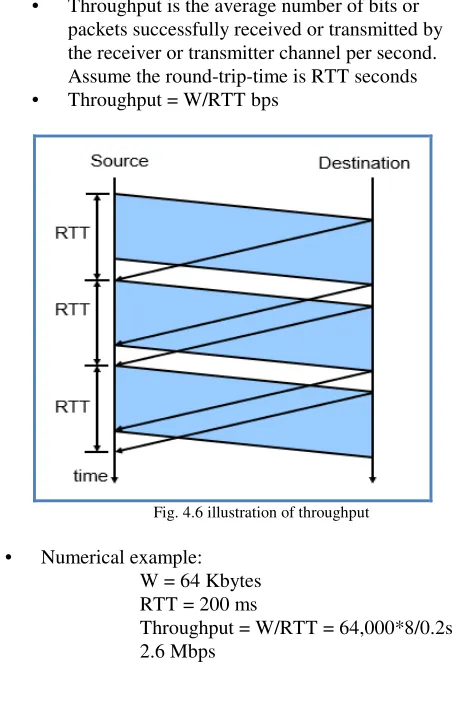
• Throughput is the average number of bits or packets successfully received or transmitted by the receiver or transmitter channel per second. Assume the round-trip-time is RTT seconds • Throughput = W/RTT bps
Fig. 4.6 illustration of throughput
• Numerical example: W = 64 Kbytes RTT = 200 ms
Average occupancy = S/T
S = S(1) + S(2) + … + S(N) = P*(d(1) + d(2) + … + d(N))
Average occupancy = (average arrival rate) x (average delay)
Where:
((P*N)/T)= average arrival rate
((d(1) + d(2) + … + d(N))/N= average delay
6. Simulation Model
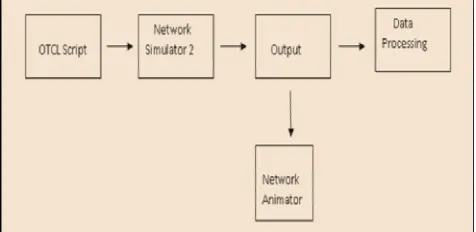
Ns2 is a discrete event simulator targeted at networking research. It provides substantial support for simulation of TCP, routing and multicast protocols over wired and wireless networks. It consists of two simulation tools. The network simulator (ns) contains all commonly used IP protocols. The network animator (nam) is use to visualize the simulations. Ns2 fully simulates a layered network from the physical radio transmission channel to high-level applications. Ns2 is an object-oriented simulator written in C++ and OTcl. The simulator supports a class hierarchy in C++ and a similar class hierarchy within the OTcl interpreter. There is a one-to-one correspondence between a class in the interpreted hierarchy and one in the compile hierarchy. The reason to use two different programming languages is that OTcl is suitable for the programs and configurations that demand frequent and fast change while C++ is suitable for the programs that have high demand in speed.
Ns2 is highly extensible. It not only supports most commonly used IP protocols but also allows the users to extend or implement their own protocols. The latest ns2 version supports the four ad hoc routing protocols, including DSR. It also provides powerful trace functionalities, which are very important in our project
since various information need to be logged for analysis. The full source code of ns2 can be downloaded and compiled for multiple platforms such as Unix, Windows and Cygwin.
Fig 5.1: Ns2 simulator
6.1 Implementation of AODV Protocol
Implementation of DSR Protocol
S/T = (P*(d(1) + d(2) + … + d(N)))/T
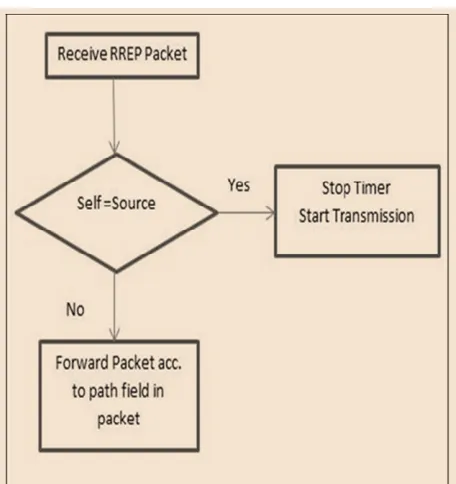
Figure 4.1: Flow chart of receiving RREP packet
Figure 4.2: Flow chart of sending data packet
7. Result & Analysis
7.1.1 High Level Design (HLD)
Structure Chart: -
Fig.6.1 Structure Chart
6.1.2 Low Level Design (LLD)
Before the compilation for 25 nodes using DSR
protocol:
After the compilation for 25 nodes using DSR protocol
:
Fig.6.3 After the Compilation
Before the compilation for 25 nodes using AODV protocol: -
Fig.6.4 before the Compilation
After the compilation for 25 nodes using AODV protocol:
-
Fig.6.5 After the Compilation
6.1.3 Throughput & End to End Delay for DSR
Throughput Output: -
Througthput[Kbps]=567.97 Kbps
Start time=2.56
Stop time=499.99
End to End Delay Output: -
End to end Delay= 19.579
6.1.4 Throughput & End to End Delay for AODV
Throughput Output:
-
Througthput [Kbps]=566.25 Kbps
Start time=2.56
Stop time=499.99
End to End Delay Output:
-
End to end Delay= 20.4289ms
6.2 Comparison
Fig.6.6 DSR
7. Conclusion
This project review and compare the two protocols. The conclusion that if the MANET has to be setup for a small amount of time then AODV should be prefer due to low initial packet loss and DSR should not be prefer to setup a MANET for a small amount of time because initially there is packet loss is very high. AODV and DSR are very similar, but AODV mechanisms are easier to implement and to integrate with other mechanisms using other different routing protocol. However, AODV maintains only one route per destination. This is one of the major problems in AODV, since every time a route is broken; a route discovery has to be initiated. This leads to more overhead, higher delays and high packet lost. On the other hand, DSR seems to be more stable and has less overhead than AODV.DSR can make use of multiple paths and does not send a periodic packet as AODV. Moreover, it stores all usable routing information extracted from overhearing packets. However, these overheard route information could lead to inconsistencies. The two protocols Ad hoc On-Demand Distance Vector Routing (AODV) and Dynamic Source Routing (DSR) have been compared using simulation, it would be interesting to note the behaviour of these protocols on a real life test bed
Acknowledgments
Insert acknowledgment, if any. The preferred spelling of the word “acknowledgment” in American English is without an “e” after the “g.” Use the singular heading even if you have many acknowledgments. Avoid expressions such as “One of us (S.B.A.) would like to thank ... .” Instead, write “F. A. Author thanks ... .” Sponsor and financial support acknowledgments are also placed here.
References
[1] R. Al-Ani, “Simulation and performance analysis evaluation for variant MANET routing protocols”, International Journal of Advancements in Computing Technology, Volume 3, Number 1, February 2011. [2] J. khan, s. I. Hyder and S. M. Fakar “Modeling and
simulation of dynamic intermediate nodes nnd performance analysis in MANETS reactive routing protocols”, International Journal of Grid and Distributed Computing Vol. 4, No.1, March 2011.
[3] H. S. Bindra1, S. K. Maakar, A. L. Sangal, “Performance evaluation of two reactive routing protocols of MANET using group mobility model”, IJCSI International Journal of Computer Science Issues, Vol. 7, Issue 3, No 10, May 2010 ISSN (Online): 1694-0784.
[4] S. Barakovic, S. Kasapovic, and J. Barakovic, “Comparison of MANET routing protocols in different traffic and mobility models”, Telfor Journal, Vol. 2, No. 1, 2010.
[5] Karthikeyan Bhargavan, Carl A. Gunter, Moonjoo Kim, VERISIM: “Formal Analysis Of Network Simulations”, IEEE Transactions On Software Engineering”, vol.28, no.2, 2002.
[6] SrdjanKrco and Marina Dupcinov,” Improved Neighbor
Detection Algorithm For AODV Routing Protocol”, “IEEE Communications Letters”, vol. 7, no. 12, 2003. [7] HanSong,VincentW.S.Wong,VictorC.M.Leung,”Efficient
On-Demand Routing For Mobile Ad Hoc Wireless Access Networks”, IEEE Journal on Selected Areas in Communications”, vol. 22 no. 7, 2004.
[8] Z.Fan,”High Throughput Reactive Routing In Multi-rate Ad Hoc Networks”, Electronic Letters”, vol. 40, no.25, 2004. [20] Nianjun Zhou, Huaming Wu and Alhussein A. Abouzeid,” The Impact Of Traffic Patterns On The Overhead Of Reactive Routing Protocols”, ”IEEE Journal On Selected Areas In Communications”, vol. 23, no. 3,2005.
[9] K. Fall and K. Varadhan. ns Notes and Documentation. Technical report, UC Berkeley, LBL, USC/ISI, and Xerox PARC, June 2003. Available at http://www.isi.edu/nsnam/ns/nsdocumentation. Html. [10] L. Raja and s. santhosh Baboo International Journal of
Engineering and Computer Science ISSN: 2319-7242Volume 2 Issue 3 March 2013 Page No. 707-718. [11] Ashok M.Kanthe, Dina Simunic and Ramjee Prasad
“Comparison of AODV and DSR On-Demand Routing Protocols in Mobile Ad hoc Networks” IEEE journal on Selected Areas in communications, 2012.
[12] Saluja Ritu and Kumari Nisha “SIMULATION BASED STUDY OF TWO REACTIVE ROUTING PROTOCOLS”International Journal of Engineering and Computer Science ISSN: 2319-7242 Volume 2 Issue 6 June, 2013.
[13] Satveer Kaur “Performance Comparison of DSR and AODV Routing Protocols with Efficient Mobility Model in Mobile Ad-Hoc Network” IJCST Vol. 2, Issue 2, June 2011.
[14] Amit N.Thakre “Performance Analysis of AODV & DSR Routing Protocol in Mobile Ad hoc Networks” IJCA Special Issue on “Mobile Ad-hoc Networks “MANETs, 2010.
[15] Rajiv Misra “Performance comparison of AODV/DSR Routing protocols in constrained situation” IEEE journal 2005.
[16] Vinaykumarsharma “AODV & DSR Reactive Routing Protocols with a Comparative Study” Volume 3, Issue 4, April 2013 ISSN: 2277 128X International Journal of Advanced Research in Computer Science and Software Engineering.