Volume 8, Issue 2 [February 2019] PP: 55-60
Development of a Low Cost Solar Dryer for Fish in Adamawa
State Nigeria
Y. I. Tashiwa; A. J. Abubakar; H. U. Kabri and D. B. Zoaka
Department of Agricultural and Environmental Engineering, School of Engineering and Engineering Technology. Modibbo Adama University of Technology, Yola. Nigeria
Corresponding Author: Y. I. Tashiwa
ABSTRACT: A low cost solar dryer for fish was designed and constructed using locally available materials like woods, glass, rods and wire mesh, which makes it affordable to fish farmers and processors. It was found to be suitable for household drying of fish and other perishable agricultural produce in less time than the traditional method and under a hygienic condition. The constructed solar dryer reduced the drying time of fish by 33% to reach the required moisture content for storage.
Key Words: Solar Dryer, Fish, Affordable, Fish Farmers, Hygienic
--- --- Date of Submission: 07-08-2019 Date of acceptance:23-08-2019 --- ---
I.
INTRODUCTION
Globally fish is considered a very important component of human diet that supplies essential nutrients like protein, lipids, vitamins and minerals,which are vital in improving human health (Ladu, 2001 and Tsadoet al., 2012). It contributes significantly to the survival and wellbeing of a large number of people around the world. Fish is an efficient converter of food for human consumption it hashelped in saving children from kwashiorkor and there is little or no religious restriction on its consumption (FAO, 1989).
Akinbode and Dipeolu, (2012) stated that fish is relatively cheaper and readily available to poor people in most developing countries of the world including Nigeria, therefore making quality protein available to them. Almost half of the total animal protein consumed in Nigeria is from fish which makes itoccupies a unique position as the cheapest source of animal protein (FDF, 2009).
Fish production has contributed immensely to the economy as it employs 70% of the active labour force in the agricultural sector. Fish is considered a staple food in the tropical Forest regions of the West African coastal areas;it is a critical source of protein and the dried form is a common condiment for households in the coastal areas. Over 5oo,ooo,ooo people in developing countries depend directly or indirectly on fisheries and aquaculture for their livelihood (keith,2010).
In Nigeria, the annual demand for fish prior to year 2000 is 1.5 million tonnes, while local production stood at about 0.4 million tonnes with an import of over 1 million tonnes. However, deliberate government effort towards improving local aquaculture production and an increased awareness in fish farming especially in catfish and tilapia production using flow through and water re-circulatory culture systems, local fish production increased geometrically from the year 2000, in 2004 Nigeria’s total fish supply was 1.16 million tonnes (Ibeun, 2005).
Fish is a highly perishable food product which inmost cases according to Clucas (1982) becomesinedible within twelve hours at tropicaltemperature. Spoilage therefore begins as soonas the fish dies and processing shouldtherefore be done quickly to prevent the growthof spoilage bacteria. It can be stored only by proper refrigeration, smoking or drying. Sengaret. al. (2009) reported that most fishermen are living in the coastal belt, live below the poverty line therefore refrigeration is distinct dream to them. The alternative storage methods available to them is drying or smoking.
Komolafeet. al. (2011) quoted Peter and Ann (1992) that fish is a low acidfood and is therefore very susceptible to thegrowth of food poisoning bacteria which makes itanother reason why it should be processedquickly. Clucas(1982) affirmed that the moisturecontent of fish is 80%; if this is reduce toaround 25%, bacteria cannot survive andautolytic activity will be greatly reduced. He further stated that at moisture content of 15 per cent or lessmould will cease to grow; well dried fish if stored under right conditions can be kept for several monthswithout spoilage.
contaminants.
In view of the above stated importance of fish, it’s processing and storage condition has to be improved. This work is aimed at developing a fish solar dryer which enhances the drying process by reducing the drying time in a very hygienic condition using locally available materials which will make it cheap and affordable for the local fish farmers.
II.
MATERIALS AND METHOD
The fish solar dryer was been designed to improve the drying rate of fish for fish farmers in Adamawa state Nigeria. The dryer was constructed from cheap and available materials likewood, glass, chicken wire mesh etc., which were obtained from the timber market in Yola, Adamawa State Nigeria to ensure that the fish dryer will be affordable to the local fish farmers and fish merchants.
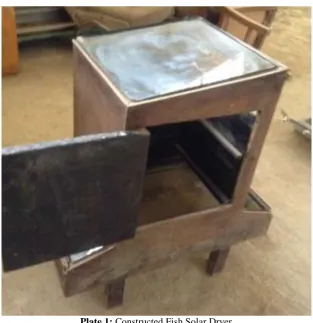
The fish solar dryer as shown in Figure 1 has a size of 914 mm x 457 mm x 750 mm consisting of the following parts: a drying chamberconstructed from wooden plank, three drying trays made of chicken wire mesh, a loading door, three sun receptors made from glass andthree air circulation openings.
Construction of the dual mode fish dryer
The fish solar dryer was constructed by first cutting 2 x 3 inches wood into the required length which were used to form the frame of the dryer by holding them together using 3 inches nails, then a plank of wood was cut out and attached to the frame at the proper locations using 3 inches nails to form the drying chamber, then the drying trays were formed from a 5 mm rod and placed within the drying chamber and finally the glass and wire mesh were cut out and attached to the frame at their proper locations forming the sun receptors and air openings respectively
Operational description of the dual mode fish dryer
The dual mode fish dryer is designed to be a batch dryer which can dry 20 kg of fish per batch. It operates by the solar receptors receiving solar radiation from the sun which increases the intensity and temperature of the sun on the fish which increases the rate of water removal from the fish,at the same time air flows in and out of the dryer through the vents removing the vaporised water out of the drying chamber.
Performance Evaluation of the dryer
After construction of the solar dryer,weighed quantity of clarias Catfish were placed on the drying trays inside the dryer which was placed in the open where the sun radiation can reach it. The temperature of inside and outside the dying chamber were measured at the start of the drying process and afterevery three (3) hoursincluding the weight of the fish, ambient and inside temperatures until when there is no further change in weight or constant weight were obtained repeatedly for the same fish samples.
Measurements
100
(%)
1 2
1
w
w
w
MC
db 1100
2 2 1
(%)
w
w
w
MC
wb 2Where: MCwb = moisture content wet basis, % MCdb = moisture content dry basis, % W1 = weight of sample before drying, (g) W2 = weight of sample after drying, (g)
Drying Rate of the fishwas calculated using equation 3 (Sengar et. al., 2009)
Drying Rate D. R. =∆W
∆T 3
Where ∆W = Loss in weight per hour, (g)
∆T = Time Difference, (hr)
III.
RESULTS AND DISCUSSIONS
The constructed fish solar dryer is shown on Plate 1. It was constructed at the Centre for Equipment Maintenance and Industrial training (CEMIT) of the Modibbo Adama University of Technology, Yola Adamawa State Nigeria using locally available materials.
Plate 1: Constructed Fish Solar Dryer
Time of the Day (h)
Surrounding
(Degree)
Inside the drying Chamber (Degree)
8:00 30.72 34.34
11:00 37.76 43
14:00 39.74 44.1
17:00 37.06 38.96
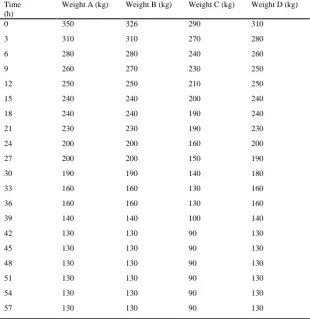
Table 2: Weight of fish samples at 3 hours interval
Time (h)
Weight A (kg) Weight B (kg) Weight C (kg) Weight D (kg)
0 350 326 290 310
3 310 310 270 280
6 280 280 240 260
9 260 270 230 250
12 250 250 210 250
15 240 240 200 240
18 240 240 190 240
21 230 230 190 230
24 200 200 160 200
27 200 200 150 190
30 190 190 140 180
33 160 160 130 160
36 160 160 130 160
39 140 140 100 140
42 130 130 90 130
45 130 130 90 130
48 130 130 90 130
51 130 130 90 130
54 130 130 90 130
57 130 130 90 130
The Temperature profile inside and outside the drying chamber shown in Figure 3 indicated that the solar dryer assisted in raising the temperature of the surrounding by 11% from 39.740 of the surrounding to 44.100 which is the maximum temperature reached inside the drying chamber at 14:00 pm this in turn increases the drying rate of the fish.
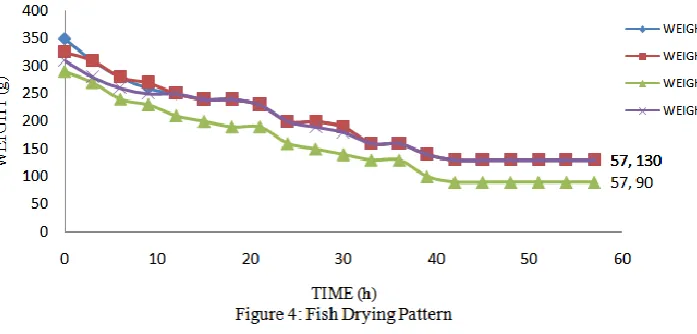
The moisture content of the fish was measured during the drying process at intervals of 3 hours and used to show the drying pattern of the fish, the fish drying pattern is presented in Figure 4. It shows that all the 4 samples of fish placed inside the dying chamber reached a minimum reduction of weight after drying for 42 hours.
Figure 3: Temperature Profile inside the drying chamber and the surrounding
IV. CONCLUSIONS
A fish solar dyer was designed and constructed using locally available materials which include woods, rods, glass and chicken wire mesh which makes it affordable to the local fish farmers and suitable for drying fish in a hygienic condition and faster than the traditional method of drying by 33%. The quality of the finished product is very good since taste, smell, colour and other hedonic properties of the fish were not affected in any way by this method of drying.
[1]. Akinbode S.O. and Dipeolu A.O. (2012). Double-Hurdle Model of Fresh Fish Consumption among Urban Households in South-West Nigeria. Current Research Journal of Social Sciences. 4(6): 431-439
[2]. Anonymous (2019). Construction and maintenance of Solar Fish Drier. Practical Action (formerly ITDG) Retrieved from https://answers.practicalaction.org/our-resources/item/construction-and-maintenance-of-solar-fish-drier-technical-brief on 01 July, 2019.
[3]. Clucas JJ (1982). Fish handling processing and preservation in the tropics. Part 2. Report of the London Tropical Products Institute, London U.K. G 144, vii + 145 pp
[4]. FAO (1989). Aquaculture Production (1984-1986). Fisheries and its Importance in Green Revolution Programme. Proceedings of the Annual Conference of Fishery Society of Nigeria. Vol. 2 pp. 91-96
[5]. FDF. (2009). Nigeria National Aquaculture Strategy. Assisted by FAO. Formally approved by Government. 18 p.
[6]. Ibeun, M. O. (2005). Information For Fisheries Management In Nigeria: The RoleOf Libraries And Networking. proceedings of the 31st Annual Conference: Rome, Italy, October 10 – 14, 2005. Fort Pierce, FL: International Association of Aquatic and Marine Science Libraries and Information Centers.
[7]. Keith Brander (2010). Impact of Climate Change on Fisheries. Journal of MarineSystems, 79; 389-402.
[8]. Komolafe C. A., Ogunleye I. O. and Adejumo A. O. D. (2011). Design and Fabrication of a Convective Fish Dryer. The Pacific Journal of Science and Technology. Volume 12. Number 1..Pp 89 – 97
[9]. Ladu, B.M.B. and Ovie, S.I. (2001). An analysis of fisheries policy development in Nigeria: a fourth phase report on the project “sustainable development of African continental fisheries: a regional study of policy options and policy formation mechanisms for the Lake Chad Basin. European Commission ProjectNo. ERB 1C18-CT98 9331
[10]. Peter, F. and Ann, H. 1992. Small Scale FoodProcessing. Intermediate Technology Publication, 103 – 105 Southampton Row, London WciB4HH, UK. Pp 60 - 64.
[11]. Sengar S. H., Khandetod Y. P. and Mohod A. G. (2009). Low cost solar dryer for fish. African Journal of Environmental Science and Technology Vol. 3 (9), pp. 265-271, Retrieved from http://www.academicjournals.org/AJEST
[12]. Sengar SH, Khandetod YP, Mohod AG (2009). Low cost solar dryer for fish. Afr. J. Environ. Sci. Technol. 3:265-271.
[13]. Tsado, J. H, Adeniji , O. B., Ojo, M. A., C. O adebayo, and R. Abdulazzeez (2012). Perception of women knowledge on the nutritive value of fish in kaduna north local government area of kaduna state, Nigeria. Journal of Agriculture and Social Research Vol. 12(1): 162-169.