Page 269 www.ijiras.com | Email: [email protected]
Regulated Electronic Order Processing Practices On The
Implementation Of Preference Regulations In Kenyan State
Corporations
Nurwin Fozia Rajab
UMMA University, Kenya
I. INTRODUCTION
Government procurement offers an exceptional and matchless route that is fast and direct to empower women, youth and the disabled and combat poverty. Public procurement accounts for over 30% of GDP in developing countries and some 10-15% of GDP in developed countries. (UNDP, 2014). Marginal groups’ economic empowerment is a critical element for the business community and policymakers (Thevenon, Allan, Oliver, & Hovart). In addition to contributing to stronger and more inclusive societies, there is a compelling case for reducing poverty by engaging women, youth and the disabled in public procurement and empowering them economically. (Government of Kenya, 2010).
The Jubilee manifesto of 2012 was categorical on giving opportunities to the youth, women and the disabled. (Jubilee, 2012). This was put to paper through the presidential directive no 114 of 2013 and later entrenched in a treasury circular number 14 of 2013 which directed that 30% of all government procurement be reserved for women, youth and persons with disabilities. The public procurement and asset disposal act of
2015 sec 157 subsection 4 (a) entrenched the subject of preference regulations into law giving preference to disadvantaged members of society.
According to the GIZ report, in 2000, e-procurement was pioneered in conjunction with e-auctions and e-sourcing with measures at cost cutting. This led to a number of Commonwealth countries revamping their procurement systems and Canada adopted the system in 2003, Australia in 2004, New Zealand in 2009, South Africa in 2002 and Kenya in 2005 among other countries. (African Development Bank, 2014).
Women, youth and the disabled have traditionally faced discrimination in Kenya because, like most countries, society is structured along patriarchal lines according to a United Nations Women Report in 2014 (UN Women, 2014). A reliance on customary as opposed to civil law also means that when legislation is adopted it is most likely to be ineffective. Compared to men, the economic role of women youth and disabled in Kenya has grown. This is evidenced by the fact that poverty levels for male and female-headed households in rural areas are almost at equal levels. (UN, Women, 2014).
Abstract: This study sought to find the effect of Regulated Electronic Order Processing practices on the implementations of preference regulations in Kenya State corporations. The hypothesis of the study is Ho1: Electronic order processing has no significant effect on the implementation of the preference regulations. The theories informing this study are, technology acceptance theory, Innovation diffusion theory, Systems Theory, Affirmative action theory and Impact dimensional model. Mixed research design was used in the study. The targeted population was 292 state corporations. A sample was taken of state corporations consisting of 127 of the population arrived at using Nassiuma model. Data was collected using questionnaires. The questionnaires were administered to the procurement staff of the government agencies. A pilot study was done to test the questionnaire and the finding was a Cronbach’s alpha of 0.735 for regulated electronic order processing. It was found out that employees electronically order for receipt and payment of goods and services.
Keywords: Regulated Electronic Order Processing, preference regulations
Page 270 www.ijiras.com | Email: [email protected]
From a decision-making standpoint, gross inequity is apparent. (UN Women, 2014). Although women, youth and disabled make up more than half of Kenya’s population, as of the 2007 election, only 21 parliamentarians (10%) are female (African Development Bank ABD, 2007b).
The Public Procurement system in Kenya has grown from a rudimentary stage during the colonial and post-colonial period to a vibrant regulated system that compares well with the international standards (Mokaya, 2014). In 2006, Kenya committed itself to be one of 22 countries participating in pilot testing of the new methodology for assessment of national procurement systems developed by OECD-DAC (OECD – Organization for economic cooperation and development - DAC- Development Assistance committee) which was in line with the countries agenda for procurement reforms. This meant that PPOA and all state corporations were to ensure compliance to the four pillars of the OECD which were legislative and regulatory framework, institutional framework and management capacity, procurement operations and market practices, and integrity and transparency in the procurement system (Government of Kenya. , 2007). A number of issues were raised which included that the legal framework was quite strong but weaknesses were there on issues of transparency and ethical aspects. This then started the birth of affirmative action. (PPOA, 2008)
STATEMENT OF THE PROBLEM
The Kenya Government in its quest to ensure costs reduction in its activities, efficiency, effectiveness, transparency and accountability, has developed the procurement system and the public procurement act 2005 to the current public procurement and asset disposal act of 2015. (Government of Kenya, 2015)
Procurement is an area of great importance and cries out for reforms due to corruption, tenderpreneurs and cartels is the procurement section and financial management in public institutions. However, there are challenges of implementing the procurement regulations and also the electronic procurement practices which have been broken into tendering practices, supplier management practices, e-ordering practices and integrated financial management information systems in this study. In his study, (Muraguri, 2014), said it is evident that public procurement preference and reservations policy among the marginalized group in public procurement had not been effectively implemented. Noor, (2014) said that implementing-procurement will enhance transparency and costs reduction but public institutions had not fully adopted the E-procurement practices. There is a need to contribute to literature gap on the link between e-procurement and disadvantaged groups’ empowerment as the current uptake is just 3% against an available resource of 30% of the government procurement expenditure before full implementation of the e-tendering system (PPOA, 2008). Noor, (2014) stated that e-procurement adoption in Kenyan state corporations stood at only 3% regardless of it being introduced from 2005 with the public procurement act.
RESEARCH QUESTION
How does electronic order processing practices affect the implementation of preference regulations in Kenyan state corporations?
RESEARCH HYPOTHESIS
Ho1: Regulated Electronic Order processing practices has no significant effect on the implementation of preference regulations in Kenyan state corporations.
II. LITERATURE REVIEW
This study drew from the Technology Acceptance by Davis, (1989). The main premise explains the computer usage and acceptance of information technology. It is argued that it will help in understanding adoption of new technology in public sector setting (Aboelmaged, 2010). Although the theory suggests perceived usefulness and perceived ease of use as critical antecedents to users' technology adoption process, those models are not specific on the implementation of a new technology such as e-procurement system. Innovation diffusion theory by Everret Rodgers (Rogers, 1995) is a model grounded in business study. Since 1940’s the social scientists coined the terms diffusion and diffusion theory (Dean, 2004). This theory provides a framework with which we can make predictions for the time period that is necessary for a technology to be accepted. Constructs for the theory are the characteristics of the new technology, the communication networks and the characteristics of the adopters. We can see innovation diffusion as a set of four basic elements: the innovation, the time, the communication process and the social system. The term affirmative action was first used in the United States in 1961 by President J.F Kennedy in the presidential executive order no 10925 which stated that government contractors “take affirmative action to ensure that applicants are employed, and employees are treated during employment, without regard to their race, creed, colour or national origin.” (Irvin, 2015). In 1965 President L.B Johnson issues order no 11246, which required the government to take “affirmative action to hire without regard to race, religion or national origin”. This prevented employers from discriminating against members of disadvantaged groups (Irvin, 2015).
Page 271 www.ijiras.com | Email: [email protected]
used to strengthen stakeholder accountability of both contracting authorities and e-procurement service providers.
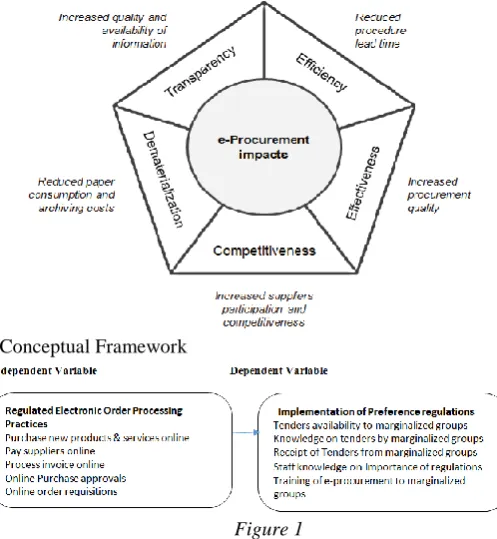
Conceptual Framework
Figure 1
Kim & Shunk, (2004) argues that E-ordering is the process of creating and approving purchasing requisition, placing purchase orders as well as receiving goods and services ordered, by using a software system based on internet technology which greatly improves the supply chain.
The supporting software system is an ordering catalogue system that is usually used by employees of an organization. In case of enterprise resources planning (ERP) the goods and services ordered are product related. It may be noted that ordering of direct goods and services usually is plan-based. (Kim & Shunk, 2004). According to Bello, Osmonbekov, & Gilliad, (2002), Electronic data interchange (EDI) electronic ordering is ideal for customers wishing to develop an automated purchasing system for orders. By eradicating repetitive manual processes and removing the need for paperwork, ordering processing enables the business to reduce costs, increase productivity and improve customer service thus improved supply chain performance. (Bello et al, 2002).
Peterson, Behfar, Mannix, & Trochim, (2008) assert that online ordering processing system allows customers to order products or services via their website. Relying on paper, fax, email and phone based ordering means that there is a dependency on manual intervention which in itself can be slow but is proven to be liable to rekeying errors hence could decrease the performance of the supply chain (Peterson, Behfar, Mannix, & Trochim, 2008). Kim & Schunk, (2004) argues that E-order processing is the process of creating and approving purchasing requisition, placing purchase orders as well as receiving goods and services ordered, by using a software system based on internet technology which greatly improves the supply chain performance.
In the case of e-ordering, the goods and services ordered are indirect goods and services i.e., non-product related goods and services, EDI electronic ordering is ideal for suppliers
wishing to develop an automated purchasing system for orders. (Kim and Schunk, 2004). By eradicating repetitive manual processes and removing the need for paperwork, EDI electronic ordering solution enables the business to reduce costs, increase productivity and improve customer service thus improved supply chain performance (Bailey, 2008). Raheem & As-Sabeer, (2014) asserts that online ordering system is an e-commerce function where a company allows customers to order products or services via their website.
Since the Internet is booming, having an online ordering system can boost sales to some extent as it eases customers to place an order for the company's services. (Raheem & As-Sabeer, 2014). People can place orders from their home as long as they have a computer/laptop with Internet connection thus improved supply chain performance. Electronic controlled substance orders are placed using a software program that has been approved by management.
Typically, this software is available through a wholesaler and may be implemented into their ordering Web site. (Sabiiti & Muhumuza, 2013). This supports our third hypothesis Ho1 Electronic order processing has no significant effect on the implementation of preference regulations.
III. RESEARCH METHODOLOGY
The study used a mixed research design that is both descriptive and explanatory research designs. Descriptive research can be either quantitative or qualitative. It involves collections of quantitative information that can be tabulated along a continuum in numerical form. This provided a better understanding of the research problem than the use of one method alone in a study. This is argued to be one, if not, the most of the central premise of the positivism philosophical reasoning in research today (Tashakori & Teddlie, 2001). On the other hand, according to Cooper & Schindler, (2006) an explanatory study uses theories or hypotheses to account for the forces that caused a certain phenomenon to occur. They further said it goes beyond description and attempts to explain the reasons for the phenomenon. Orodho, (2003) explained that an explanatory study analyses the cause-effect relationship between two or more variables. The explanations argue that phenomenon Y (absorption of preference regulations) is affected by variable X (E-procurement). This design was chosen because it applied closely to the research objectives of this study and was practical in testing the study. TARGET POPULATION
The proposed study target population comprised of all the 292 state corporations that implement the preference regulations in Kenya according to PPOA records. (PPOA 2015). This is because state corporations in Kenya must implement the preference regulations and are also in the early stages of implementing the electronic procurement in their procurement activities
Page 272 www.ijiras.com | Email: [email protected]
Where, n=Sample size, N=Population, c=covariance, e=standard error
Nassiuma, (2000) asserts that in most surveys, a coefficient of variation in the range of 21%≤ C≤ 30% and a standard error in the range 2%≤ e ≤ 5% is usually acceptable. Therefore a coefficient variation of 30% and a standard error of 2% were used.
The higher limit for coefficient of variation and standard error was selected so as to ensure low variability in the sample and minimize the degree or error
= 127 state corporations
Using this formula a sample of 127 state corporations were selected.
Population Total targeted Sample size State corporations
(That report to PPOA)
292 127
Total 127
Table 1
Reliability of research instruments Electronic order processing Reliability Statistics
Cronbach's Alpha Cronbach's Alpha Based on Standardized
Items
N of Items
.756, .735 10
Table 2
This means the research instrument was reliable and valid as it surpassed the recommended Cronbach’s alpha of 0.6-0.9 (Cooper & Schindler, 2006; Malhotra & Birks, 2006).
RESEARCH INSTRUMENTS Electronic
Order Processing
Table 3
Electronically purchase for our product and services
Conduct online order requisitions
Electronically process suppliers invoice
Electronically process payment to our supplier
Electronically purchase approval are done
Electronically order for receipt for payment
Harink, 2003; Reunis, Santema & Harink, 2006)
IV. RESULTS DISCUSSIONS AND FINDINGS From the data collected, out of the 127 questionnaires administered, 122 were filled and returned, which represents 96% response rate. This response rate is considered satisfactory to make conclusions for the study. This collaborates with Kothari, (2007) assertion that a response rate
of 50% is adequate, while a response rate greater than 70% is very good. This implies that based on this assertion, the response rate in this case of 96% is therefore very good.
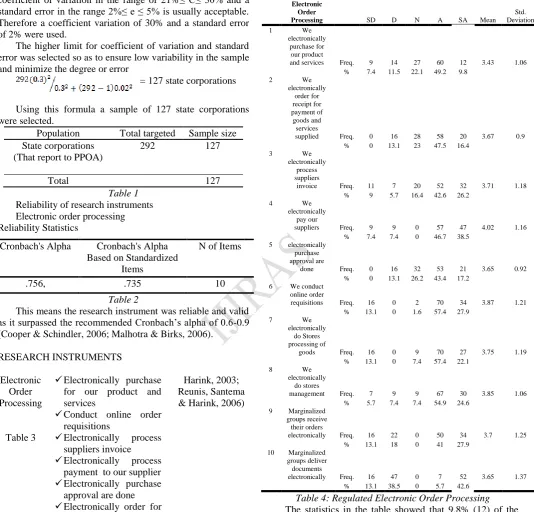
The researcher deemed it important to establish electronic order processing. The results are as presented in table 4.5.
Electronic Order
Processing SD D N A SA Mean
Std. Deviation 1 We
electronically purchase for our product
and services Freq. 9 14 27 60 12 3.43 1.06 % 7.4 11.5 22.1 49.2 9.8
2 We electronically
order for receipt for payment of goods and
services
supplied Freq. 0 16 28 58 20 3.67 0.9 % 0 13.1 23 47.5 16.4
3 We electronically
process suppliers
invoice Freq. 11 7 20 52 32 3.71 1.18 % 9 5.7 16.4 42.6 26.2
4 We electronically
pay our
suppliers Freq. 9 9 0 57 47 4.02 1.16 % 7.4 7.4 0 46.7 38.5
5 electronically purchase approval are
done Freq. 0 16 32 53 21 3.65 0.92 % 0 13.1 26.2 43.4 17.2
6 We conduct online order
requisitions Freq. 16 0 2 70 34 3.87 1.21 % 13.1 0 1.6 57.4 27.9
7 We electronically
do Stores processing of
goods Freq. 16 0 9 70 27 3.75 1.19 % 13.1 0 7.4 57.4 22.1
8 We electronically
do stores
management Freq. 7 9 9 67 30 3.85 1.06 % 5.7 7.4 7.4 54.9 24.6
9 Marginalized groups receive
their orders
electronically Freq. 16 22 0 50 34 3.7 1.25 % 13.1 18 0 41 27.9
10 Marginalized groups deliver
documents
electronically Freq. 16 47 0 7 52 3.65 1.37 % 13.1 38.5 0 5.7 42.6
Table 4: Regulated Electronic Order Processing
Page 273 www.ijiras.com | Email: [email protected]
services applied,16.4% (20) of the respondents strongly agreed,47.5% (58) of them agreed,23% (28) of the respondents were neutral while 13.1% (16) of the respondents disagreed. The item revealed a mean of 3.67 and standard deviation of 0.9 an indication that there is electronic order for payment of goods and services.
Findings on whether the respondents electronically process suppliers invoice revealed that 26.2% (32) of the respondents strongly agreed that they electronically process suppliers invoice, 42.6% (52) of the respondents agreed, 16.4% (20) of them were neutral while 5.7% (7) of the respondents disagreed and 9% (11) of them strongly disagreed. The results summed up to a mean of 3.71 and standard deviation of 1.18 implying that employees electronically process suppliers invoice. Additionally, 38.5% (47) of the respondents strongly agreed that they electronically pay their suppliers, 46.7% (57) of the respondents agreed while 7.4% (9) of them disagreed. The results summed up to a mean of 4.02 and standard deviation of 1.16 an indication that the respondents were in agreement that they electronically pay their suppliers. The respondents were also asked whether electronically purchase approvals are done. The results were such that 17.2% (21) of the respondents strongly agreed, 43.4% (53) of them agreed though 26.2% (32) of the respondents were neutral and 13.1% (16) of the respondents disagreed.
The results summed up to a mean of 3.65 and standard deviation of 0.92.It can therefore be deduced that purchase approvals are done electronically. Besides, 27.9% (34) of the respondents agreed that they conduct online order requisitions, 57.4% (70) of the respondents agreed while 13.1% (16) of the respondents strongly disagreed. The results summed up to a mean of 3.87 and a standard deviation of 1.21 inferring that there are online order requisitions.
In a related item on whether the respondents electronically do stores processing of goods, findings revealed that 22.1% (27) of the respondents strongly agreed,57.4% (70) of them agreed,7.4% (9) were undecided while 13.1% (16) of the respondents strongly disagreed, The results summed up to a mean of 119 indicating that the respondents electronically do stores processing of goods. Moreover, 24.6% (30) of the respondents strongly agreed that they electronically do stores management, 54.9% (67) of them agreed, 7.4% (9) were neutral while 5.7% (7) of the respondents strongly disagreed that they electronically do stores management. The item revealed a mean of 3.85 and standard deviation of 1.06 an indication that stores management is done electronically.
Furthermore, 27.9% (34) of the respondents strongly agreed that the marginalized groups receive their orders electronically, 41% (50) of them agreed, 18% (22) of the respondents disagreed while 13.1% (16) of the respondents strongly disagreed. The results summed up to a mean of 3.7 and standard deviation of 1.25 meaning that the marginalized groups are able to receive their orders electronically. To sum up, 42.6% (52) of the respondents strongly agreed that the marginalized groups deliver documents electronically, 5.7% (7) agreed while 38.5% (47) of the respondents disagreed and 13.1% (16) of them strongly disagreed. The item revealed a mean of 3.65 and standard deviation of 1.37. Based on the
extant literature, the relationship between electronic order processing and supply chain performance has been evidenced. A direct link between electronic order processing has not been shown by prior literature. For instance, Bello et al,
(2002) noted that electronic ordering eradicates repetitive manual processes and removes the need for paperwork hence reducing costs, improving customer service and the overall supply chain performance. This implies that electronic ordering reduces the dependency on manual intervention by making it possible for customers to order products or services via their website. A study by Christensen & Duncan, (2007) said that though most countries have implemented e-procurement incertain nodes, they have not implemented contract management and e-odering losing out on potential benefits that the process generates to governemnts.
The study therefore fills the gap in the literature by establishing the relationship between electronic order processing and the implementation of preference regulations. This is also corroborating what Bello et al (2002) stated that EDI electronic ordering is ideal for customers wishing to develop an automated purchasing system for orders.
By eradicating repetitive manual processes and removing the need for paperwork, ordering processing enables the business to reduce costs, increase productivity and improve customer service thus improved supply chain performance.
V. FACTOR ANALYSIS
ELECTRONIC ORDER PROCESSING KMO AND
BARTLETT’S TEST
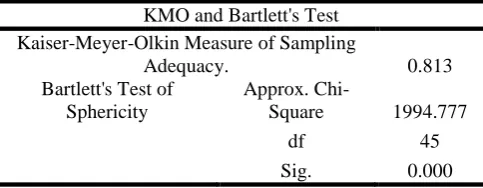
The KMO Measure is an index for comparing the magnitude of the observed correlation coefficients to the magnitude of the partial correlation coefficients. As shown in table 5, KMO was greater than 0.5, and Bartlett’s Test was significant.
KMO and Bartlett's Test Kaiser-Meyer-Olkin Measure of Sampling
Adequacy. 0.813
Bartlett's Test of Sphericity
Approx.
Chi-Square 1994.777
df 45
Sig. 0.000
Total variance explained
Table 5: Regulated Electronic Order Processing
Page 274 www.ijiras.com | Email: [email protected]
Total Variance Explained
Component Initial Eigen
values
Extraction Sums of Squared Loadings
Total % of
Variance
Cumulative %
Total % of
Variance
Cumulative %
1 7.555 75.545 75.545 7.555 75.545 75.545
Table 6: Total variance explained
ROTATED COMPONENT MATRIX FOR ELECTRONIC ORDER PROCESSING
Factor analysis is conducted in order to make sure that the items belong to the same construct (Ngacho, 2014).
Table 7 illustrates the factor analysis for electronic order processing. As shown in the table, there were no exceptions, as all variables scored above the threshold of 0.5. The criterion for communality was fulfilled as shown in the table.
1 2
We electronically purchase for our product and
services 0.778
We electronically order for receipt for
payment of goods and services supplied 0.85
We electronically process suppliers invoice 0.861 We electronically pay our suppliers 0.827
electronically purchase approval are done 0.776
We conduct online order requisitions 0.852 We electronically do Stores processing of
goods 0.696 0.665
We electronically do stores management 0.619 0.618 Marginalized groups receive their orders
electronically 0.796
Marginalized groups deliver documents
electronically 0.876
Extraction Method: Principal Component Analysis. Rotation Method: Varimax with Kaiser Normalization. a Rotation converged in 3 iterations.
Table 7: Rotated Component Matrixa for Electronic Order Processing
Variables constructions
Mean Std.
Deviation
Skewness Kurtosis
Electronic Order Processing
3.7303 0.98559 -1.652 1.611
Table 8: Variables constructions
Hypothesis testing
Hypothesis Beta p -
Values
Comments Decisions
Ho1: Electronic
Order processing practices has no significant effect
on the implementation of
preference regulations in
Kenyan state corporations.
0.144 0.751 Significant Reject
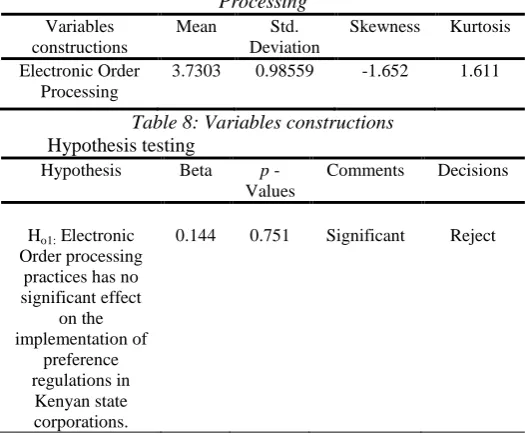
H01 stated that electronic order management practices have no effect on the implementation of preference regulations in Kenyan state corporations. From Table 4.27, above, the results state that we have reject the hypothesis and accept the alternate hypothesis Ha1 Which is electronic order
management practices have an effect on the implementation of preference regulations in Kenya. With a 0.144 increase in electronic supplier management practices there is a unit increase in implementation of preference regulations.
PUBLIC E-PROCUREMENT IMPACT DIMENSIONAL REPRESENTATION MODEL
Figure 2
VI. CONCLUSION
In relation to electronic order processing, employees electronically order for receipt for payment of goods and services applied.
They also electronically process suppliers invoice and pay them electronically. Purchase approvals, processing of goods and stores management are done electronically. Furthermore, online order requisitions are done electronically though there is doubt whether there is electronic purchase of products and services. To sum up, the marginalized groups receive their orders electronically and deliver their documents electronically. Electronic order processing has exhibited a positive and significant effect on the implementation of preference regulations. Not only does it contribute to the implementation of preference regulation but it also enhances supply chain performance. This is made possible by use of electronic intervention in issues such as processing of goods and payment of goods and services applied. The process is less prone to errors compared to dependence on manual intervention which has its share of challenges. It is therefore easier for the marginalized groups to deliver their documents electronically and receive orders
VII. AREAS FOR FURTHER RESEARCH
Page 275 www.ijiras.com | Email: [email protected]
regulations and economic empowerment. Preference regulations and social empowerment.
REFERENCES
[1] Aboelmaged, M. (2010). Predicting e-procurement adoption in a developing country; an empirical intergration of technology acceptance model and theory of planned behaviour. Industrial Management and Data systems, Iss 3 Vol 110.
[2] African Development Bank. (2014). Repport on Innovativeness of Public Procurement. ADB. Retrieved from African Development Bank.
[3] African Development Bank ABD. (2007b). Demand for ADF assistance. ADB.
[4] Bailey, P. (2008). Procurement Principles and Management. Harlow: Prentice Hall.
[5] Bello, D., Osmonbekov, T., & Gilliad, D. (2002). adoption of Electronic commerce tools in business procurement; Enhanced buying center structure and processes. Journal of Businessand Industrial Marketing, Iss 3 Vol 17.
[6] Christensen, S., & Duncan, W. (2007). Maintaining the Integrity of Electronic tendering by Government - refelectionsof the capaciti of Australian legal framework meet this challenge. Sydney: Queensland University. [7] Cooper, D., & Schindler, P. (2006). Business Research
Methods; Empirical Investigations. Journal of Service Research, Iss 1 Vol 2.
[8] Davis, F. (1989). Percieved usefullness, percieved ease of use, and user acceptance of information technology. MIS Quaterly, Iss 3 Vol 13.
[9] Dean, D. (2004). Consumer PErceptions of corporate donations; Effects of company reputaion for social responsibility and type of donation. Journal of advertising, Iss 32 Vol 4.
[10] Gardenal, F. (2013). A model to measureE-Procurement Impacts on organizational Perfromance. Jounal of Public Procurement, Iss 2 Vol 13.
[11] Government of Kenya. (2010). Constitution of Kenya. Nairobi: Government Printers.
[12] Government of Kenya. (2015). Public Procurement and Asset Disposal Act 2015. Nairobi: Government Printers. [13] Government of Kenya. . (2007). Public Procurement
Amendments Regulations. Nairobi: Government Printers. [14] Irvin, A. (2015). A brief History of Affirmative action.
Los Angeles: University of Carlifornia.
[15] Jubilee. (2012). Jubilee Manifesto. Nairobi: Government Printers.
[16] Kim, J., & Shunk, D. (2004). Matching Indirect procurement process with different B2B E-procurement systems. Computers in Industry, Vol 53.
[17] Kothari, C. (2007). Research Methodology. New Delhi: New Age Publishers.
[18] Malhotra, N., & Birks, F. (2007). Marketing research: An applied Approach. New Delhi: Prentice Hall.
[19] Mokaya, R. (2014). Determinants of E-Procurement Challenges in Kenya, A case of Moi Teaching and Reffreal Hospital. Unpublished Thesis. Moi University. [20] Muraguri, J. (2014). Effect of Liquidity returns on
Investment Saccos in Nairobi. Unpublished Thesis. University of Nairobi.
[21] Murray, G. (2001). E-procurement: Targets, Myths, Legends & reality. Retrieved from www.ipf.co.uk/procurement/pac/members/documentation /eProcurement.pdf.
[22] Naissuma, D. (2000). Survey and sampling methods. Nairobi: University of Nairobi Press.
[23] Ngacho, C. (2014). Critical success factors influencing the performance of constituency development fund construction projects in Kenya. A confirmatory factor analysis. Prime Journal of Business administration and management, Iss 5 Vol 4.
[24] Noor, I. (2014). Role of E-procurement strategy of performanceof state corporations in Kenya. Unpublished Thesis. Jomo Kenyatta University of Agriculture and Technology.
[25] Orodho, J. (2003). Essentials of Educational and Social Sciences research methods. Nairobi: Masola Publications. [26] peterson, R., Behfar, K., Mannix, E., & Trochim, W. (2008). Critical role of conflict resolution in teams; A close look at the conflict types, Conflict management Strategies an dteam outcomes. Journal of applied Psychology, Iss1 Vol 93.
[27] PPOA. (2008). Report on Implementation of Preference regulations. Nairobi: Government Printers.
[28] PPOA Public procurement Oversight Authority. (2015). Annual status of public procurement in Kenya. Nairobi: Government Printers.
[29] Raheem, M., & As-Sabeer, S. (2014). E-Procurement & Adoption Process, an Ardous Journey for Australian City Council. International Journal of Electronic Finance, Vol 1.
[30] Rogers, E. (1995). Diffusion of Innovations. New York: Free Press.
[31] Sabiiti, C., & Muhumuza, E. (2013). Second generation procurement; Moving from compliance to results in public procurement.trends, Challenges and Opportunites from Uganda experience. Kampala: IPPA.
[32] Tashakori, A., & Teddlie, C. (2001). Handbook of mixed research methods in social and behavioural research. New York: Sage Publications Thousand Oaks.
[33] Thevenon, O., Allan, E., Oliver, N., & Hovart, H. (n.d.). OECD.
[34] UNDP. (2014). report o Public procurement in LDC's. Nairobi: UN.