Framework Implementation on Managing Visitors
with Smart Card Authentication at Malaysia National
Park
M. Kassim,
Member, IEEE, IACSIT
, S.Yahya, A.Y.Dak
Abstract— Smart card applications are not widelyimplemented for auto identification of customers in leisure and entertainment industry in Malaysia. Lack of technological knowledge on the capability of the smart card utility for managing identification system and unclear of the right architecture used to support the applications can be the factors for this. This study has examined the disciplinary approaches and the characterization of devices on the smart card implementations, to develop a rubric for risks and benefits of the full deployment of smart card to humans and the organizations. This study designs a feasible process model for smart card applications deployment for Malaysia National Park or the official name is ‘Taman Negara’. The dynamic innovation process using the contactless smart card has been examined on the smart card applications focusing more on the pervasiveness of smart card implementation supporting tour environment. The findings of this study are crystallized into frameworks for the full deployment guidelines of smart card utilization for individuals and organizations. The framework can help illuminate the current underutilization of the smart card usage for identification and tracking of customers in one of the biggest open park operations in Malaysia that is Taman Negara.
Index Term-- contactless card, framework, Access Control Systems (ACSs), smartcard application, Location dependent services.
I. NATIONAL PARK CHALLENGERS IN MANAGING VISITORS RECORD
There exist the challengers of tourist management at the rainforests cause of the geographical features and with huge number of tourist entrance to its surrounding locations. Collection data that has been done by Perhilitan [1] is the evidence that the number of tourists is increasing year by year as shown in Figure 1.Taman Negara is still managing its visitors’ information manually. There is no standard operation procedure and lack of technological means to process visitors entering Taman Negara. This research looks into the feasibility on dependent services of implementing smart card applications for managing visitors. It is also a location management where visitors are monitored for any entrance of facing any difficulties in the open park area. An approaches need to be done to anticipate Taman Negara to manage and identify its visitors when they got loss or gone missing in the forest.
Fig. 1. Number of Tourist Visiting Taman Negara
There is no deployment of smart card application yet at Taman Negara due to its uncertainty of the appropriate smart card technologies for recording and monitoring its potential communities. Taman Negara is also uncertain of the possible significant contributions and feasibilities of the smart card to managing its visitors. The potential risks and benefits of smart card utilization are still vague too.
II. INTRODUCTION TO SMARTCARD AUTHENTICATION Smartcard identification has been elaborated in many ways in the prior research. It is a quick growing technology and application in the digital arena. The smartcard is capable to store an encrypted detail of digital certificate together with any other required information pertain the card holder [2], [3], [4]. A smart card, chip card, or integrated circuit card (ICC), is defined as any pocket-sized card with embedded integrated circuits which can process information [5]. This implies that it can receive input which is processed by the ICC applications method and delivered as an output. Smartcard is a standard sized plastic card that contains an integrated circuit or chip which gives the card the ability to store and process data [6]. The data stored on a smartcard are secured against beingread or write by enabling code example like personal identification number (PIN) or encryption key held by the card owner and the authorized reader system. Smart cards are secured tokens
that have provided security services to a wide range of applications for over thirty years [7]. Along with other technology advances, smart card technology has changed dramatically as well. A smart card includes an embedded integrated circuit chip that can be either a microcontroller with
0 20000 40000 60000 80000 100000
2005 2006 2007
67731
79758 81774
internal memory or a memory chip alone [8]. With an embedded microcontroller, smart cards have the unique ability to store large amounts of data, perform on card functions such as encryption and digital signatures. It can also interact intelligently with a smart card reader.
III. NATIONAL PARK IN BRIEF
The National Park is located in the state of Pahang Malaysia as shown in figure 2, map of Taman Negara, National Park, Malaysia [9]. It lays 4 and 5 north of the equator within the headwaters of three river system which are the Tembeling River in the south, the Terengganu River in the east and the Relai-Aring-Labir River in the north. The national place received rain throughout the year around 2,200mm (lowland) and 3,800mm (mountain). The temperature during the day is average at 26 and at night 22 Celsius. The national park is one of the oldest tropical rain forests in the world. Its flourishing tropical forest dates as far back as 130 million years. In 1925, an area of 9,240 hectares surrounding Tahan Mountain was gazette as a Tahan Mountain Game Reserve by the British authority. Then in 1939, it was declared a National Park, through the states of Kelantan, Pahang and Terengganu under an enactment in 1938/9. It was named King George V National Park, named after the King of England. After independence in 1957, it was named Taman Negara [10].
It is being said that cause of the abundance and diversity of nature is phenomenal in Taman Negara, thus it is one of the world's most complex and rich ecosystems. The Rainforest Taman Negara conjures images of giant green garden filled with exotic flowers and creatures [1]. The word 'Taman' means both 'park' and 'garden' in Malay while 'Negara' means 'nations'-together which it is translated to 'National Park'. Even though there are certainly many other national parks elsewhere in Malaysia, Taman Negara remains the patriarch of them all.
Fig. 2. Map of Taman Negara, National Park, Malaysia
IV. RESEARCH DESIGN
This research involves four phase of activities. Each phase comprises the research approaches, the activities, the source of data and lastly the research deliverables. The study is a qualitative research and based on analysis of data collected via questionnaires and interviews.
A. Study Process
The first three objectives of the research present in the methodology framework focus in studying the process. There are about two to three activities to accomplish each objective. The detail activities will be discussed further in the operational instrument.
B. Development Process
The development process is the last process to undertake after the finding of results at the study process. In each research approach, activities were conducted in their related areas. Data collected from the survey are analyzed and presented to the next step.
C. Operational Definitions
D. Identify the Process and Frequency of Tourists Visiting Taman Negara
In this stage detail statistics on tourists entering Taman Negara were collected from the Perhilitan office. Some questions that relate to the procedure of handling tourists are presented in Appendix A. These questions are to be asked to the Perhilitan’s officers. The extraction of visitors’ statistic by country on February 2005 recorded at Kuala Tembeling is presented in Appendix E.
Procedures of tourists’ entrance to Taman Negara. Statistics of tourist entrance for three years since
2005.
Type of tourist entering Taman Negara.
V. GATHERED VISITORS DATA
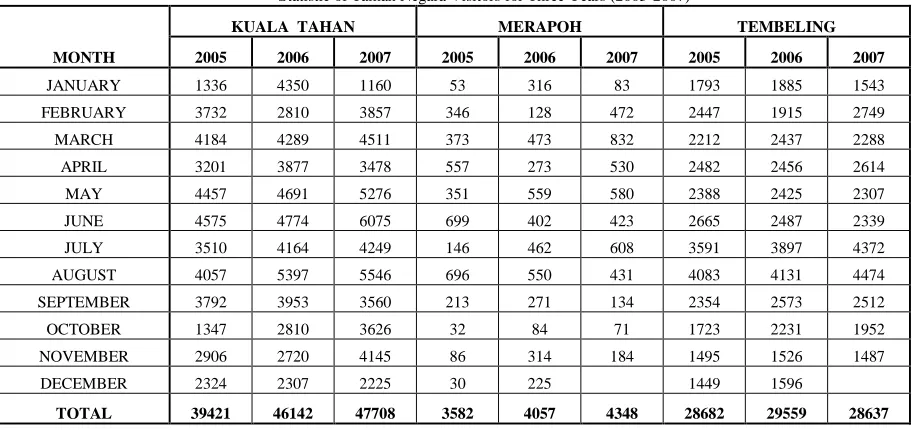
The feasibility study was conducted and the existing process of tourist entering and exiting Taman Negara were reviewed. Taman Negara Pahang can be accessed via three entrances namely Kuala Tahan, Kuala Tembeling and Merapoh. This research involves research approaches, the activities, the source of data and the research deliverables. The study is a qualitative research and based on analysis of data collected via questionnaires and interviews. Three main processes were done which comprises of study, development and identify the localization environment dependent services and management. Detail statistics on tourists entering Taman Negara were collected from the Perhilitan office. Statistics of tourists visiting Taman Negara were collected from year 2005 until 2007 as shown in Table 1. Data is presented as a guided implementation of smartcard technologies based on the analyzed report, assumptions and recommendations. The document is detailed out in the listed section:
Total of Malaysian tourist. Total of Foreign Tourist.
The Need to deploy smart card applications. Case Study on the Smart Card Framework.
All data, factors, assumptions and recommendations from the stakeholder were studied, determined and analyzed according to the approaches activities. Comparison, idea, factors were taken into consideration and plotted in reports. Table II and Figure III tabulate the total number of tourist entrance from all stations recorded in the range of year 2005 up to year 2007.
Table II
Total Statistic of Tourist Entrance for Three Years
MONTH 2005 2006 2007
January 3182 6551 2786
February 6525 4853 7078
March 6769 7199 7631
April 6186 6606 6622
May 7196 7675 8163
June 7939 7663 8837
July 7247 8523 9229
August 8836 10078 10451
September 6359 6797 6206
October 3102 5125 5649
November 4487 4560 5816
December 3803 4128 3506
TOTAL 71631 79758 81974
Fig. 3. Graphs of the Difference Statistics between Malaysian and Foreigners
VI. DEPENDENT SERVICES ON USING SMART CARD TECHNOLOGY IN TAMAN NEGARA
The dependent service by using the smartcard is by identifying the key element that shapes to the deployment of smart cards in the location. It reviews the readiness or ability of the implementations of smart card applications in the Taman Negara environment. Some factors on the existing implementations and recommendations to the current implementations are as derived.
A. Identify the Business Needs
B. Identify the Success Factor to Implement the Smart Card System
The success of a project is determined by meeting the identified business needs. At the completion of this task, the business case should have a number of defined success criteria for each business need that the smart card implementation is aiming to meet. The success criteria must be both achievable and measurable. The specific business which has been identified then is mapped to example success criteria. The success factors which justify a smart card implementation are as below:
Reduced costs and/or increased efficiencies.
Provides users with convenient access and enhanced services.
Improved security and risk management.
Meets the legislative requirements or government policies or guidelines.
C. The Used Of Contactless Card As The Dependent Services
A survey on the use of contactless smart cards in the market that suits Taman Negara smart card implementations was conducted. The functional benefits of a contactless card are also presented to determination the feasible deployment of contactless smartcard. The driven information convinced that the contactless card is best used and implemented for smart card system. The functional benefits of the contactless card are discussed in the analysis as derived.
It is easy to carry and secured
Mobile and can be reused at any entrance
Automatically recorded system without physically aware by guards
Fast transactions of data management Cost effective
D. Examination of the Smart Card Framework
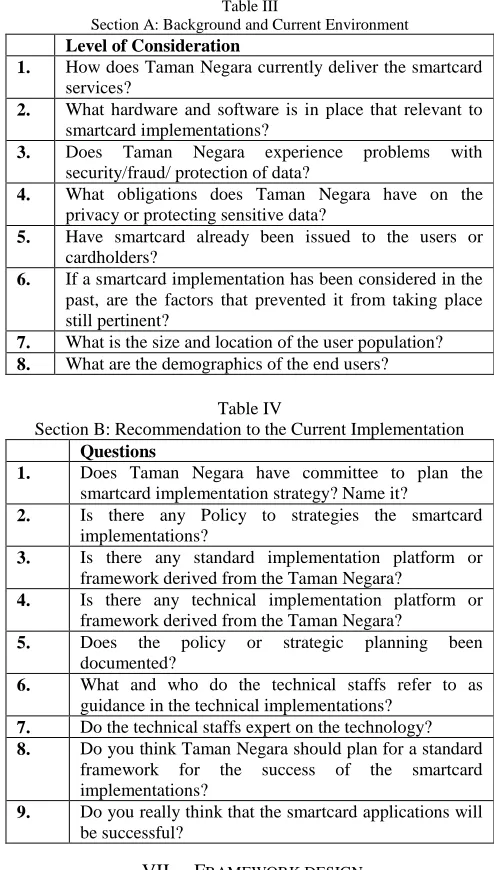
The fourth phase is to construct the framework of a smart card. The framework was considered as a basis foundation to implement smart card applications. Interview sessions were carried out to collect information from the management personal and the IT experts of Taman Negara. The information collected was used in the design of smart card framework. The interview questions used in the study are listed in Table 3 and 4. It has been divided into two sections that are the background and current environment and secondly refers to recommendation to the current implementation. Factors of the smart card implementations at the Taman Negara related to existing implementations, and the recommendations from the Taman Negara management staffs were also considered in the framework design. However, the design of the smart card implementations framework was only focused on the surface design. This is because assumptions of broad factors were needed to build the framework. Some case studies on the smart card framework at various organizations were also reviewed as a reference to design the framework. Anyhow, this framework is a broader conceptualized
framework to the organization management for successful process of smart card implementations.
Table III
Section A: Background and Current Environment Level of Consideration
1. How does Taman Negara currently deliver the smartcard services?
2. What hardware and software is in place that relevant to smartcard implementations?
3. Does Taman Negara experience problems with security/fraud/ protection of data?
4. What obligations does Taman Negara have on the privacy or protecting sensitive data?
5. Have smartcard already been issued to the users or cardholders?
6. If a smartcard implementation has been considered in the past, are the factors that prevented it from taking place still pertinent?
7. What is the size and location of the user population? 8. What are the demographics of the end users?
Table IV
Section B: Recommendation to the Current Implementation Questions
1. Does Taman Negara have committee to plan the smartcard implementation strategy? Name it?
2. Is there any Policy to strategies the smartcard implementations?
3. Is there any standard implementation platform or framework derived from the Taman Negara?
4. Is there any technical implementation platform or framework derived from the Taman Negara?
5. Does the policy or strategic planning been documented?
6. What and who do the technical staffs refer to as guidance in the technical implementations?
7. Do the technical staffs expert on the technology? 8. Do you think Taman Negara should plan for a standard
framework for the success of the smartcard implementations?
9. Do you really think that the smartcard applications will be successful?
VII. FRAMEWORK DESIGN
A. Framework Overview
The deployment of smart card applications represents a significant investment and therefore, it is critical that this technology is applied efficiently and effectively at Taman Negara. The framework benefits are listed as the following;
Assist Taman Negara to strategize the smart card implementation.
Adds convenience and functionality to smart card delivery.
Improves service delivery of existing smart card technology to smart card owner department.
Allows Taman Negara to efficiently deliver services to the community by following the guidelines and policies.
Creates security environment using smartcard with efficient support, services and maintenance.
B. Audience Framework
The framework is aimed for any management of the government institutions and departments which deploy smart cards technology and applications. It also guides the vendors who deliver smart card solutions to Taman Negara. The personal audiences include:
Business and information system managers who are required to implement or acquire smart card enabled services.
Policy makers responsible for introducing smart cards for delivery of services.
Technical architects involved in implementing new forms of information technology service delivery.
C. Smartcard Framework Structure
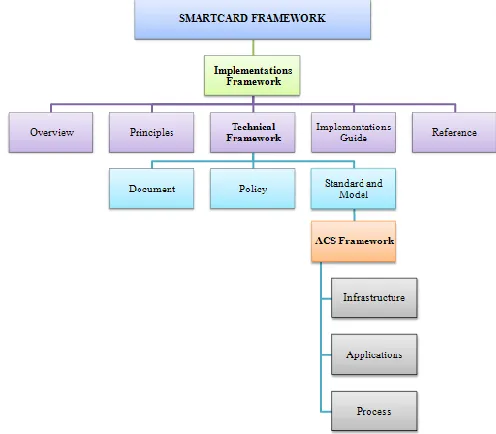
The smart card framework comprises of two main frameworks which are the Implementation Framework and the Technical Framework. In the technical framework sits the Access Control framework for the smart card application implementations. This research deeply focuses on verifying the ACS Framework structure that includes document, infrastructure, applications and its process. Only some basic ideas and information are designed for the basis of the Implementations and Technical Framework. Figure 4 indicates the organization of the overall framework. Under the smart card framework domain, there are two most important frameworks identified. It comprises of Smart Card Implementation Framework and Smart Card Technical Framework which is the Access Control system framework
Fig. 4. Structure of the Smart Card Framework
D. Smart Card Implementation Framework Structure
The framework contains five main modules as depicted in Figure 5. The main structure modules include the overview, principles, implementation guide, references and technical framework which provide information on smart card technologies, standards and model specification. This framework would guide the various smartcard technologies in the future. It depends on the organization principles and implementations. In spite of that, the framework would need necessary update with the current smartcard technologies applied. The five (5) modules covered are illustrated below:
Fig. 5. Implementation Framework Structure
The important community in the implementation framework is the Community of Interest (COI). This group is responsible for the success of the smart card implementations project. COI are identified as the main carter that would help, advise and forecast the organization demand towards smart card technologies implementations. Purposes of the community of interest are:
To plan the implementation of the smartcard technology and its implementations.
To determine the policy and business drivers.
To establish the management requirement policy and rules across department.
To determine and share benefits from the deployment to all department and faculties.
To project the usage of smart cards. Implementations
Framework
E. Technical Framework Structure
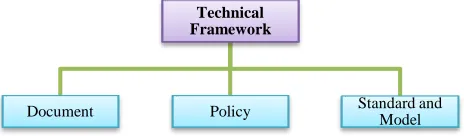
Figure 6 depicts Technical Framework structure to provide guidance on the high level policy, standardization and model for business and technical requirements and the process of the implementation in an organization to plan the smart card system. It defines the specifications necessary to allow government smart card implementations to be interoperable. The scope of the framework covers the document, policy and standard and model. Any technical implementations would need to follow the benchmark. Prototype for the technical framework is the ACS framework. The Technical Framework is based on the use of standardization of MIFARE contactless card which meets the ISO 14443 standards.
Fig. 6. Technical Framework Structure
VIII. FRAMEWORK BENEFIT
Benefits of the framework are derived from the capability building. Organization is capable to deliver new technology by developing skills on technical and business environment. This factor has also been support by the IT Manager in the interview.
A. Community of Interest
Community of Interest (COI) is the group that is responsible for the success of the smart card implementations project. They would ensure that organization smart card deployments are satisfactory and successful. A COI would be the main operational committee or groups of smart card technologies implementations. They would agree to issue smart cards technologies according to a defined policy and standard in the framework. Taman Negara’s COI would be the major management personal that looks into the requirement and planning of the smart card application implementations. The COI consists of the main functional department of smart card implementations such as the management, human resource, treasurer, visitor’s department, security and facilities. They are the groups that are transparent to the project developer and smart card issuer.
COI are identified as the main carter that would help, advise and forecast the organization demand towards smart card technologies implementations. Purposes of the community of interest are:
To plan the implementation of the smartcard technology and its implementations.
To determine the policy and business drivers.
To establish the management requirement policy and rules across department.
To determine and share benefits from the deployment to all departments.
To project the usage of smart cards.
B. Faster Rollout
Organizations would benefits by gaining faster rollout of each new smartcard project. The framework would derive ideas and guidance on planning the smartcard implementation. IT Managers and experts on smart card technology relatively described and sustain these factors during the interviews.
C. Set Benchmark
The framework will guide the selection of smart cards and certain other system components standards or criteria. Any proposal has to meet the component requirement in the framework. During the interview, the IT managers did support and suggested these important factors as benefits from the framework if it is designed. Throughout the framework development, certain functional benchmarks, standards and principles should be followed. Thus, the framework would help organization make best use of the implementations and the standards identified.
IX. CONCLUSION
The research on determining the feasibility on deploying smart card technology and applications has presented that the smart card implementations is worthy to deploy. The data collections has presented and reviewed the statistic of tourist entrance to Taman Negara. Thus, analyzed data also have presented the existing process of tourist entrance and the difficulty on controlling the tourist at Taman Negara. Data collection on business needs and success criteria of the smart card application implementations were analyzed and presented. The second objective of this project is met when report analysis shown the readiness of Taman Negara organization. The third objective of this project met when report analysis shown the benefits of using contactless card for smart card applications implementations. Contactless smart card is best used in the smart card applications due to its low cost. Moreover, convenient and of ease of use of contactless cards has also contribute to the decision. The results also described that the contactless smart card technologies offer security and professionals features that would enhanced the systems designed to control physical or logical access. The use of contactless technologies is particularly attractive for secure physical access that convenience and suit to the users in the Taman Negara environment. Several factors have been determined on the existing smart card platform and guidance towards building the smart card framework. The level of consideration on the smart card implementations which identified the factor to consider and the smart card impact has supported the design of the framework. Thus a smart card framework has been designed which consists of the implementations framework, technical framework and the framework application module for the ACS implementations. The report and design framework has accomplished the last objective of the research.
Technical Framework
ACKNOWLEDGMENT
M Kassim, S. Yahya and A.Y. Dak would like to thank all the respondents and the officer of the management of the National Park, Malaysia for their supports and contributions while this research is being done. Special thank also to all the IT staffs at the Smartcard Management Unit, Department of Planning and ICT Collaboration, Pusat Sistem Maklumat Bersepadu (PSMB), Universiti Teknologi MARA. Their opinions, willingness to help, cooperation and valuable information were seemed to be very helpful in the technical finding and analysis. Their opinions, expertise, experiences have brought knowledge and facilitate sincerely in the research.
REFERENCES
[1] Perhilitan WEB page, “Taman Negara Malaysia”, www.wildlife.gov.my, retrieved on August 2010.
[2] M. Kassim, S. Yahya “A case study: reliability of smartcard applications and implementation in university environment, malaysia”, in PROC 2009 International Semiconductor Device Research Symposium, ISDRS 2009, article number 5378021 College Park, MD; 9-11 December 2009. [3] Smartcard Alliance Group, “Contactless technology for secure physical
access: technology and standards choices”, A Smart Card Alliance Report Publication, 2002
[4] K. Michael,“The applications of the system of innovation framework for the characterization and prediction of the auto ID industry”, School of Information technology and computer Science, 2003.
[5] F. L. Hakim, “Using smart card in e-business applications: an e-business model CIS Lab”, in PROC Prince Sultan, Riyadh, Saudi Arabia 18th National Computer Conference. Saudi Computer Society, 2006. [6] European Research Group, “Smartcard roadmap”, Roadmap for
European Research on Smartcard related technologies Version 5, www.ercim.org/reset/., 2003.
[7] M. Walters, “An argument for smart financial transaction cards in the australian payments system. managing information technology's organizational impact”, II North-Holland/Elsevier, Amsterdam, 1992. [8] Q. Hong, L. Karen, “Computer Networks”, The International Journal of
Computer and Telecommunications Networking archive Volume 51, Issue 9, 2007.
[9] Woodland Resort Information, http://www.tamannegararesorts.net/, Woodland resort taman negara WEB Page 2006 retrieved 2010. [10] Rainforest Resort Malaysia RRM, RRM WEB Page,
http://www.rainforestresort.net/about.html, retrived on Oct 2010. [11] M. Kassim, S. Yahya, A.K Dak, "Managing Visitors with Smart card
Authentication: Dependent Services at Malaysia National Park", To be published in the 2010 International Conference on Computer and Software Modeling (ICCSM 2010) Manila, Philippines. December, 2010. [12] R. J. Anderson,“A security policy model for clinical information systems” in PROC 1996 IEEE Symposium on Security and Privacy. IEEE Computer Society, 1996.
[13] Australian Consultation Group, “The Australian government smartcard framework”, Smartcard implementation Guide (Working Draft Version 2.0) Submission to Australian Government Information Management Office, 2007.
[14] R. Clarke, J. Cameron,“Smartcard financial system. managing information technology's organizational impact”, II North-Holland/Elsevier, Amsterdam, 2000.
[15] B. David, “Smartcard Framework Debuts for Windows Vista, Windows XP and Windows Server 2003 Technology Weblog”, Technology News & Reviews, 2003
[16] I.B. Schaumüller, “New concepts for multifunctional/multiplication smart cards”, in PROC IFIP WG 11.6 International Conference on Smart Card 2000: The future of IC cards, Oxford, North-Holland, pp. 149-157, 2000.
[17] S.M. Thomas, A.D. Ezzy, “Investigations of Power Analysis Attacks on Smartcards”, the Advanced Computing Systems Association. USENIX Workshop on Smartcard Technology Chicago, Illinois, USA, 1999.
AUHTOR’S INFORMATION
M. Kassim is a lecturer at Faculty of Electrical Engineering, Universiti Teknologi MARA. M. Kassim was born in 1970 in the state of Kedah, Malaysia. M. Kassim received her Diploma in Computer Science in 1992, BSc (Hons) in Data Communications and Networking in 2003 and MSc in Information Technology in 2007 from the Faculty of Mathematics and Computer Science, Universiti Teknologi MARA (UiTM), Malaysia.
She has experienced in the technical and project management during her services in the Centre for Integrated Information System CIIS, the core IT centre for UiTM for 15 years. She work in the network project implementations and management for 13 years, as project manager in development the university smartcard applications and system for three years and database design and structure for a year. She has join the academic since January 2009 and has published 12 (4 main author and 8 co-author) refereed international proceedings in the area of computer networking and engineering. She is actively doing research in the area of computer engineering and currently has completed 3 researches. Her research interest includes Network Traffic Management, Network Security, Contactless Smartcard Applications, MIFARE Technology Applications, Protective Management System, E-Content Management and Development and WEB-Based applications development.
Ms. Kassim is now holds the position as Head of Operation Unit of Technology and Development division, Chair for the WEB Development Committee and WEB Master for Faculty of Electrical Engineering, Universiti Teknologi MARA. Ms. Kassim also recently has been certified as International Journal of Computer Theory and Engineering (IJCTE) editor which is an international academic journal which gains a foothold in Singapore, Asia and opens to the world. Ms. Kassim currently is the instructor for CISCO Academy Malaysia, member of IEEE Computer Section Malaysia and member of the International Association of Computer Science and Information Technology
(IACSIT) organization.
S. Yahya is a Professor of Computer Sciences at MARA University of Technology, Malaysia. S. Yahya was born at Kuala Lumpur Malaysia in 1956. S. Yahya has graduated with Bachelor of Science with Education (Hon) double majoring in Chemistry and Mathematic 1982 from University of Science Malaysia. S. Yahya later earned a post graduate Diploma in Microprocessor & Applications and Master of Computer Studies from University of Essex UK respectively in 1986 and 1987. S. Yahya finally received her PhD in Computer Science specializing on computer networking from Putra University Malaysia in 1989.
She has been lecturing in the University for 27 years in the area of networking, Information Technology security, and Information Technology management. Before that, she has taught mathematics and chemistry at La Salle High School of Klang, Malaysia for about a year. She has published 10 (7 main author and 3 co-author) academic books in the area of computer sciences and IT , written 10 refereed journal and 64 refereed international proceedings in the area of computer networking. She is actively doing research in the area of computer networking and IT and currently has completed 17 researches. Seven of those researches has participated in innovation, invention, and design competition at university and international level and won numerous medals (1 gold, 5, silver, 4 bronze and a Special Award: best presenter).
Malaysian Board of Higher School of Examination, University of Selangor, Islamic College University of Selangor, and OUM. Prof Dr S. Yahya is committee member of Internet Security Malaysia. Prof Dr S. Yahya is married and a mother of four grown children.
A.Y.Dak is a lecturer at Faculty of Computer and Mathematical Sciences, Universiti Teknologi MARA, Malaysia. A.Y.Dak was born in 1972 in the state of Kedah, Malaysia. A.Y.Dak receiced her Diploma in Electrical Engineering in 1994, B.Eng(Hons)Electrical in 1997 and MSc in Information Technology in 2003 from Universiti Teknologi MARA(UiTM) Malaysia.
He has experienced in technical and project management with a few companies e.g. Asteria Telecommunication Sdn Bhd., Celcom (M) Berhad, Kumpulan ERA Sdn Berhad and Universiti Teknologi MARA for 12 years. He involved in electronic circuit design for 2
years and network project development and implementations for 10 years. He has published 6(4 main author and 2 co-author) refereed international proceedings in the area of computer networking and engineering He actively doing research in an area of Wireless Local Area Network(WLAN), Computer Security and Computer Networking. His researches include Mobile Security, Network Security. Radio Frequency Identification System (RFID) and Network Traffic Management and currently has completed 6 researches. 5 of those researches has participated in innovation, invention, and design competition at university and international level and won numerous medals (1 gold, 3, silver and 2 bronze).
Mr. Dak is now a senior lecturer for Faculty of Computer and Mathematical Sciences, Malaysia and an advisor for Networking student’s union society at the faculty. Mr. Dak currently is the instructor for CISCO Academy Malaysia and Malaysia Qualification Agency (MQA) evaluator panel for private and public universities.
Table I
Statistic of Taman Negara Visitors for Three Years (2005-2007)
MONTH
KUALA TAHAN MERAPOH TEMBELING
2005 2006 2007 2005 2006 2007 2005 2006 2007
JANUARY 1336 4350 1160 53 316 83 1793 1885 1543
FEBRUARY 3732 2810 3857 346 128 472 2447 1915 2749
MARCH 4184 4289 4511 373 473 832 2212 2437 2288
APRIL 3201 3877 3478 557 273 530 2482 2456 2614
MAY 4457 4691 5276 351 559 580 2388 2425 2307
JUNE 4575 4774 6075 699 402 423 2665 2487 2339
JULY 3510 4164 4249 146 462 608 3591 3897 4372
AUGUST 4057 5397 5546 696 550 431 4083 4131 4474
SEPTEMBER 3792 3953 3560 213 271 134 2354 2573 2512
OCTOBER 1347 2810 3626 32 84 71 1723 2231 1952
NOVEMBER 2906 2720 4145 86 314 184 1495 1526 1487
DECEMBER 2324 2307 2225 30 225 1449 1596