IJIRT 143252 INTERNATIONAL JOURNAL OF INNOVATIVE RESEARCH IN TECHNOLOGY 26
STABILIZATION OF EXPANSIVE SOIL USING
CRUMB RUBBER POWDER AND CEMENT
B. Sri Vasavi1, Dr.D.S.V.Prasad2, A.C.S.V. Prasad3
1
Civil Engineering Department, B.V.C. Engineering College, Amalapuram, A.P,India.
2
Civil Engineering Department, B.V.C. Engineering College, Amalapuram, A.P,India.
3
Civil Engineering Department, S.R.K.R.E.C, Bhimavaram, A.P,India.
Abstract- The volume of used vehicle tyres in the world is increasing every year and their disposals have therefore become a major environmental problem worldwide. Utilization of scrap tyres should minimize environmental impact and maximize conservation of natural resources. This paper presents the stabilization of expansive soil using crumb rubber powder (CRP) and cement at varying percentages (2%, 5%, 7% and 9% and 2%, 4% and 6% respectively). The soil properties, compaction, California bearing ratio (CBR) and direct shear test were used to gauge the behavior and performance of the stabilized soil. When soil blended with CRP, it was observed that maximum dry density and optimum moisture content decreases with increase in percentage of crumb rubber on soil. Blending has minimal impact on bearing capacity and shear strength. However the values remained within acceptable limits. In second case, cement added to the soil rubber mix in the percentages 2, 4 and 6% by weight of soil. In this case CBR and Direct Shear Tests were conducted. The CBR and shear strength were increased when the optimum mix (B.C soil +7% of CRP) was blended with cement.
Index Terms— Black cotton soil, CRP, Compaction, CBR, Direct shear test
I. INTRODUCTION
As per Indian scenario the output of waste material are more than 1.3 billion tons, third in all over the world. The scrap tyre per each year is 65million tons and increasing steadily year by year. Tyre recycling or rubber recycling is the process of recycling vehicles' tyres that are no longer suitable for use on
vehicles due to wear or irreparable damage (such as punctures). These tyres are among the largest and most problematic sources of waste, due to the large volume produced, their durability, and the fact they contain a number of components that are ecologically problematic. It is estimated that 259 million tyres are discarded annually. The same characteristics that make waste tyres problematic, their cheap availability, bulk, and resilience, also make them attractive targets for recycling. Material recovered from waste tyres, known as "crumb," is generally only a cheap "filler" material and is rarely used in high volumes. They are made to be highly durable and weatherproof, which causes mass landfill space to be used up, as tyres are non-biodegradable.
Soil stabilization is a way of improving the weight bearing capabilities and performance of in situ sub soils, sands, and other waste materials in order to strengthen road surfaces. The prime objective of soil stabilization is to improve the California Bearing Ratio of in situ soils. The other prime objective of soil stabilization is to improve onsite materials to create a solid and strong sub base and base courses. A new geo-environmental approach was proposed to use waste tires in certain engineering applications and thereby reduce the potential impact on the environment. This paper presents a laboratory study on the effect of Crumb rubber powder and cement on the engineering properties of black cotton soil. Crumb rubber powder was passed through sieve sizes 440 μm and 4 mm. It was blended with four different percentages of black cotton soil i.e.2%, 5%.7%, 9%.
IJIRT 143252 INTERNATIONAL JOURNAL OF INNOVATIVE RESEARCH IN TECHNOLOGY 27 reinforcing material on the mechanical properties of
cement-stabilized black cotton soil, in terms of strength and stiffness. A series of laboratory experiments are carried out on cement-stabilized black cotton soil mixed with several percentages of crumb rubber powder. An attempt is being done to stabilize the black cotton soil by mixing the Crumb rubber powder in percentages of each 2%, 5%, 7%, and 9% by weight of soil and cement in percentages of 2%, 4%, 6%, and 8% by weight of soil. The object of the work is to study the performance of crumb rubber powder and cement with the black cotton soil.
II. MATERIALS AND METHODOLOGY
A. Black cotton soil
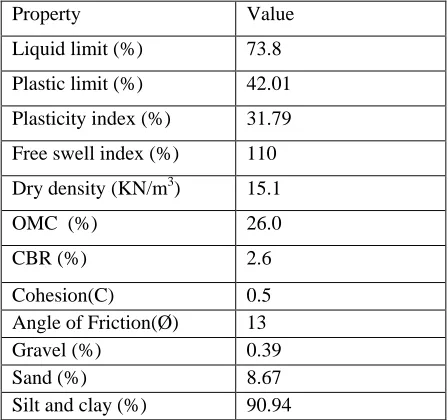
Black cotton soilis the soil which exhibits swelling in rainy season and shrinkage in summer season. This kind of abnormal behavior is due to the presence of montmorillonite mineral. The investigations contained in this work have been carried out on the black cotton soils obtained from Narakodur village near Guntur city, Andhra Pradesh state. The engineering properties of clay samples collected from the sites for the investigations are given in table 1.
Table 1: Physical Properties of Expansive soil
Property Value
Liquid limit (%) 73.8
Plastic limit (%) 42.01
Plasticity index (%) 31.79
Free swell index (%) 110
Dry density (KN/m3) 15.1
OMC (%) 26.0
CBR (%) 2.6
Cohesion(C) 0.5
Angle of Friction(Ø) 13
Gravel (%) 0.39
Sand (%) 8.67
Silt and clay (%) 90.94
B. Crumb rubber powder (CRP)
For improving the engineering properties of the problem clay, crumb rubber powder was chosen as an additive. Crumb rubber is a term usually applied to recycled rubber from automotive and truck scrap
tires. During the recycling process steel and fluff is removed leaving tire rubber with a granular consistency. Continued processing with a granulator and/or cracker mill, possibly with the aid of mechanical means, reduces the size of the particles further. Now a day‟s Crumb rubber is often used as an additive in bituminous concrete mixes. Currently urban India is facing a massive rubber waste disposal. Rubber waste, when untreated, leads to various environmental concerns and wastage of natural resources which stresses the need to recycle rubber. Apart from environmental benefits recycling waste rubber also has tremendous potential of generating wealth. To address the above concerns CRP is used as an additive to improve the engineering properties of black cotton soil. The CRP which is used in the study are of 1.18 mm down size (IS sieve) (Figure 1). In the present investigation, CRP is used as an additive in the present investigation to get desired engineering properties.
Fig.1 crumb rubber powder
C. Cement
Cement used for the experimental investigation was 43 grade, Ordinary Portland Cement has been used in small percentages (2%, 4% and 6%)
III. METHODOLOGY
IJIRT 143252 INTERNATIONAL JOURNAL OF INNOVATIVE RESEARCH IN TECHNOLOGY 28 soil in proportions of 2, 5, 7 and 9 in terms of
percentage by weight of the soil. Index properties of soil- CRP mix were determined and also compaction tests were carried out to determine their optimum moisture contents at the respective tyre contents. Direct shear tests were performed on soil- CRP mix at the water contents corresponding to the tyre contents to obtain the optimum percentage of Ground tyre that can be included in the soil-CRP mix based on shear strength. CBR tests were also performed on soil-CRP mix with given percentages of Ground tyre in soaked and unsoaked condition. Standard proctor compaction was adopted in the preparation of specimens for CBR tests. In the second phase of the test on soil-CRP mix, cement was considered as a stabilizing material. CBR and Direct shear tests were performed on the samples which contained in proportions of 2, 4 and 6 in terms of percentage by weight of the soil to determine the optimum cement content in soaked and unsoaked condition. Since the cement was considered as a stabilizing material, all the samples were compacted at optimum moisture content of the corresponding soil-CRP mix respectively. Standard proctor compaction was adopted in the preparation of specimens for CBR tests.
All the following tests were performed using procedures described in code book of Indian standard.
IV. RESULTS AND DISCUSSIONS
Fig.2 shows the variation in liquid limit with CRP content. In this graph, the liquid limit of the soil decreases with increase in CRP content up to 5% after that it goes on increasing with increase in CRP content. Thus the optimum CRP content is at 5% for maximum effect on liquid limit.
Fig.2 Variation of Liquid limit with CRP content
Fig.3 Variation of Plastic limit with CRP content Fig.3 shows the plastic limit variation with CRP content. In this graph the plastic limit did not change distinctly (range between 33.42% and 42.01%) with increase in CRP content, the lowest value was reached at a CRP content of about 9%. The plastic limit of untreated soil was determined to be 42.01%.
Fig.4 Variation of Plasticity index with CRP content In fig.4, the plasticity index varies from 32.88% to about 29.05%. This shows that the plastic nature of the soil decreases and the stiffness of the soil increases as the CRP content increases up to 5%. After that the plastic nature of the soil increases and the stiffness of the soil decrease as the CRP content increases from 5% up to 9%.
From fi5.5, it can be observed that for both the soils, the maximum dry density of soil-crumb rubber mixtures decreases significantly with an increase of percentage of crumb rubber. This is due to the light weight nature of crumb rubber in comparison with soil. Similarly the OMC also decreases with the increase in percentage crumb rubber in the soil. This may be due to the negligible water absorption capacity of the crumb rubber.
0, 73.8
2, 66.6 5, 66.1 7, 66.6 9, 66.3
64 66 68 70 72 74 76
0 5 10
CRP %
Li
quid
li
mi
t
0, 42.01
2, 36.03 5, 37.05 7, 35.31
9, 33.42
0 10 20 30 40 50
0 5 10
CRP %
plast
ic
li
mi
t
0, 31.79
2, 30.57
5, 29.05 7, 31.29
9, 32.88
28.5 29 29.5 30 30.5 31 31.5 32 32.5 33 33.5
0 5 10
CRP%
plast
ic
ity
IJIRT 143252 INTERNATIONAL JOURNAL OF INNOVATIVE RESEARCH IN TECHNOLOGY 29 Figure.5 Compaction curves for BC soil with varying
percentage of CRP
Figure.6 Variation of CBR with CRP % Initially the soaked CBR values are zero for untreated black cotton soil and the black cotton soil blended with CRP content, due high FSI (110). From fig.6, the unsoaked CBR values lies between 2.6-7.5% with increasing tendency of CRP content. So addition of CRP did not improve the soaked CBR values of the soil under investigation.
Figure.7 Variation of cohesion and angle of internal friction with CRP %
Figure.8 Variation of CBR of BC soil-CRP mix with varying percentage of cement
From fig.8, we can observe that CBR value increases with increasing the percentage of cement.
12.5 13 13.5 14 14.5 15 15.5
15 20 25 30
M
a
x
im
um
Dry
Density
(K
N/m
3
)
Optimum moisture content (%)
only soil
BC soil+2%CR P
BC soil+ 5%CRP
BC soil+7% CRP
BC soil+9% CRP
0, 2.6
2, 3.1
5, 5.2 7, 6
9, 7.5
0 2 4 6 8
0 5 10
% of CRP
un
so
ak
ed
CBR
(
%
)
49.05
39.24
34.34 34.34 39.24
13
12 12 10 11 0
10 20 30 40 50 60
0 5 10
C
(KN
/m
2 )a
nd
Ø(˚
)
CRP %
cohesion (C)
Angle of internal friction
7.84
10.9
13.74
9.16
16.11 16.58
9.8
16.8 17.4
7.5 9.5 11.5 13.5 15.5 17.5
2 3 4 5 6
CBR
unso
ak
ed
va
lue(%
)
Cement %
IJIRT 143252 INTERNATIONAL JOURNAL OF INNOVATIVE RESEARCH IN TECHNOLOGY 30 Figure.9 Variation of CBR of BC soil-CRP mix with
varying percentage of cement
2% cement 4% cement 6% cement CB
R%
Unso aked
Soa ked
Unso aked
Soa ked
Unso aked
Soa ked 2%
CRP
7.84 0.95 10.9 6.63 13.74 11.0 5 5%
CRP
9.16 0.98 16.11 6.9 16.58 10.0 7 7%
CRP
9.5 0.8 16.58 7.2 17.6 11.1
9% CRP
9.8 0.94 16.8 6.8 17.4 10.9
Table.2 CBR values of soil-CRP mix blended with varying percentage of cement
Figure.10 Variation of cohesion of BC soil-CRP mix with Cement %
Figure.11 Variation of Angle of internal friction of BC soil-CRP mix with varying cement %
V. CONCLUSION
1. From the Standard Proctor Compaction test, it was observed that the maximum dry density reduced with the increase in percentage of crumb rubber and optimum MDD is 1.48KN/m3. This could be due to light weight nature of crumb rubber waste. 2. The soaked CBR values are zero for varying
CRP% whereas unsoaked CBR values lies between 2.6-7.5% with increasing CRP. Addition of CRP did not improve the CBR values.
3. Cohesion(C) decrease with increase in CRP up to 7% and then increases with further increase in 9% of CRP. Angle of internal friction decrease with increase CRP up to 7% and then increases with further increase in 9% percentage of CRP.
4. The unsoaked CBR values were increases with increasing cement content. The soaked CBR values were increases with increasing cement content. The soaked CBR values lies between 0.95- 11.05%. Hence we observe that cement is a good stabilizer than CRP alone.
5. Soil+CRP+cement mixture showed an improvement in direct shear value up to 9% of CRP at 4% cement. Further the addition
0 2 4 6 8 10
2 4 6
So
ak
ed
CBR(
%
)
Cement %
soil+2%CRP
soil+5%CRP
soil+7%CRP
soil+9%CRP
29.43
19.62 19.62 49.05 49.05 49.05 53.95
49.05
19.62 49.05
34.33
39.24
18.5 23.5 28.5 33.5 38.5 43.5 48.5 53.5
2 4 6
cohesion
(KN
/m
2)
Cement %
soil+2%CRP
soil+5%CRP
soil+7%CRP
soil+9%CRP
28
37
20 15
10
19
12
15
22 19
25
21
8 13 18 23 28 33 38
2 4 6
An
gle
of
iner
na
l friction
(Ø˚
)
Cement %
soil+2%CRP
soil+5%CRP
soil+7%CRP
IJIRT 143252 INTERNATIONAL JOURNAL OF INNOVATIVE RESEARCH IN TECHNOLOGY 31 of cement to soil+ CRP mix lead to a
decrease in direct shear values.
6. The investigation demonstrates that treated crumb rubber waste can be made used in Cement stabilized soil without unduly affecting its performance, to some extent solving the environmental problem of waste tire disposal.
REFERENCES
1. In 2012 Purushotham G. Sarvade and Prashant R Shet had done their
experiments on “Geotechnical Properties of Problem Clay Stabilized with Crumb Rubber Powder”. Bonfring International Journal of Industrial Engineering and Management Science, Vol. 2, No. 4, December 2012.
2. In 2010 Nadgouda, K.A. and Hegde, R.A. had done their experiments on The “Effect of Lime Stabilization on Properties of Black Cotton Soil”. Indian Geotechnical Conference – 2010, GEOtrendz December 16–18, 2010
3. In 2013 K.V. Madurwar, P.P. Dahale, A.N.Burile “Comparative Study of Black Cotton Soil Stabilization with RBI Grade 81 and Sodium Silicate”. International Journal of Innovative Research in Science, Engineering and Technology Vol. 2, Issue 2, February 2013.
4. In 2014 Shiva Prasad.A, P.T.Ravichandran, R.Annadurai, P.R.Kannan Rajkumar “Study on Effect of Crumb Rubber on Behavior of Soil”. INTERNATIONAL JOURNAL OF GEOMATICS AND GEOSCIENCES Volume 4, No 3, 2014.
5. In 2015 B.R.K. Sai Ganesh Kumar, R.V.L. Sai Sumedha, U. Pradeep, K. Gowtham Kumar, P. Padmanabha
Reddy “ SUBGRADE
STRENGTHENING OF ROADS ON BLACK COTTON SOIL USING QUARRY DUST”.International Journal of Research in Engineering and Technology eISSN: 2319-1163 | pISSN: 2321-7308.
6. Mohamed A. Shahin and Liao S. Hong “Utilization of Shredded Rubber Tires for Cement-Stabilized Soft Clays”.
7. In 2014 Shiva Prasad.A, P.T.Ravichandran, R.Annadurai, P.R.Kannan Rajkumar “ Study on Effect of Crumb Rubber on Behavior of Soil” INTERNATIONAL JOURNAL OF GEOMATICS AND GEOSCIENCES Volume 4, No 3, 2014.
8. In 2014 Ghatge Sandeep Hambirao,Dr.P.G.Rakaraddi “Soil Stabilization Using Waste Shredded Rubber Tyre Chips”. IOSR Journal of Mechanical and Civil Engineering (IOSR-JMCE) e-ISSN: 2278-1684,p-ISSN: 2320-334X, Volume 11, Issue 1 Ver. V (Feb. 2014)
9. In 2014 Kavish S. Mehta, Rutvij J. Sonecha, Parth D. Daxini, Parth B. Ratanpara, Miss Kapilani S. Gaikwad “Analysis of Engineering Properties of Black Cotton Soil & Stabilization Using By Lime.” Miss K S. Gaikwad et al Int. Journal of Engineering Research and Applications,ISSN : 2248-9622, Vol. 4, Issue 5( Version 3), May 2014.