AN APPROACH OF SPEECH RECOGNITION
SYSTEM FOR DESKTOP APPLICATION
Prof.Shivashankar M.Rampur1 and Kavita S.Rampur2
I. INTRODUCTION
Speech recognition is nothing but recognizing persons from their speech. Generally, any two individual’s voice will not be identical because of their larynx sizes, vocal tract shapes and other parts of their voice production organs are different. State-of-the-art speaker recognition system utilizes a number of features to reach highest accurate recognition. One of the important applications of speaker recognition is voice based interactive security system in which an individual's voice is used for authentication. Voice/speech recognition is very simple, robust and secure technology. To recognize the speaker’s speech command efficiently different parameters of speech are used like pitch, amplitude pattern or power/energy. When an individual person speaks, their voice contains many levels of information. Speech recognition technique includes extracting unique features from their voice samples and makes these features as knowledge base and finally test individual person’s voice by matching knowledge base and predict about voice whether matched or unmatched.
1
Department of Computer Science and Engineering Malik sandal polytechnic, Vijaypur, Karnataka, India
2
Department of Electrical and Electronics Engineering BLDEA’s Engineering college ,Vijaypur, Karnataka, India DOI: http://dx.doi.org/10.21172/1.81.014 e-ISSN:2278-621X
Abstract-Speech Recognition for desktop application is a system that allows the computer to identify and understand the commands spoken by a particular speaker based on individual information included in speech waves. The ultimate goal of work is to be able to produce a system that can recognize with expected accuracy, all commands that are spoken by particular person so that each operation of the application (power point) is accessed by corresponding commands. In the proposed work, Linear Predictive Coding (LPC) and Artificial Neural Network (ANN) are the techniques used for speech recognition system. Speech signals are taken and sampled directly from microphone and then they are processed using LPC method for extracting the features of speech signal. These features are used to construct the database to train the Artificial Neural Network using Back propagation method. Further the testing is conducted for the particular person by giving the voice command and if command is match/found then corresponding operation of application(power point) get enabled. The overall recognition accuracy of the proposed system with static or standard database is about 91.75% when tested with minimum 100 voice sample commands of a particular speaker. But, for real-time system, the accuracy is depending on the environmental situation and it will gives around 85-86% accuracy in worth.
II.PROPOSED ALGORITHM
A. Feature Extraction Using Linear Predictive Coding
The feature extraction is the method or technique that is used to extract the relevant information from speech signal which is discriminative and more constant than original speech signal. Linear predictive coding (LPC) is also called as Autoregressive model. This method is used to compress the speech signal for efficient transmission and storage. For efficient speech signal features Linear Predictive Cepstral Coefficients (LPCC) are generally used and it is widely used in various areas such as extraction of speech features, speech analysis and user recognition.
Prediction of linear is a method or technique which is used for estimation of spectral and it provides the estimate of the poles (formants) of the vocal tract transfer function. The LPC encodes the speech signal by calculating the formants and removing their unwanted sound from the speech signal and finally calculating the frequency and intensity of remaining buzz. Every speech sample can be approximated as a linear combination of a few past speech signals through LPC coding. The linear prediction technique provides reliable, robust and accurate method for calculating the parameters. The LPC algorithm is shown in figure 2.
Fig.2 the block diagram of LPC algorithm
Calculating Autocorrelation Features
If we assume x(a, b) is the additive noise, v(a, b) is the speech signal of sound-free, h(n) indicates impulse response of the channel, and then the noised speech signal y(a, b) will be written as
y(a, b) = v(a, b) * h(n) + x(a, b) 0 ≤ a ≤ M−1, 0 ≤ b ≤ N−1,
Where * indicates the convolution operation, b indicates discrete time index of the frame, N shows frame length of speech, a indicates the index of frame. Number of frames is denoted by M. If x(a, b), v(a, b) and h(n) will be treated as uncorrelated. Feature of the autocorrelation of noised speech sample is given as:
cyy (b, k) = cxx(a, k)*h(k) *h(k) + cvv(a, k) 0 ≤ a ≤ M −1, 0 ≤ k ≤ N −1,
Figure 3 represents the speech signal sample and magnitude of autocorrelation spectrum and magnitude of differentiated autocorrelation spectrum for the same signal
Fig.3 Representation of a speech signal sample and magnitude of the autocorrelation spectrum.
The basic effects of autocorrelation feature of noise on transparent (no disturbance) voice signal of autocorrelation are on its lower lags. So that removing the lower lags of the autocorrelation of disturb speech signal must gives to removing of components of main disturb speech signal. Autocorrelation’s maximum index to be removed and that is found experimentally.
Once the calculation of autocorrelation features has done then next is description of speech signal and its feature values are explained. A speech signal is given as input to Autoregressive model from which 228 features are extracted from each command. The trained network is loaded and simulates the extracted features. This gives the match of command and activation of operations of power point applications. At very first step, speech sample acquisition is performed and given as input for preprocessing step, further for each command 228 autocorrelation features using LPC coefficients are extracted. For each user, all four commands are used for training phase. The following table describes the speech signal of particular command and their features. The sample input command and their associated autocorrelation features are depicted in table 1.
From each speaker, take the 100 voice commands as input and perform the preprocess step, further extract the 22800 autocorrelation features using LPC method and train on those samples using BPNN and stored into database. Later, start to give voice command for testing so that if command is matched or found then it’s considered to be recognized and operations of power point application get activated.
In the proposed system, there are four commands like One, Two, Three and Four and One corresponds to open power point, two corresponds to add slide, three corresponds to Add image and Four corresponds to quit ppt.
B. Recognition Using Artificial Neural Network
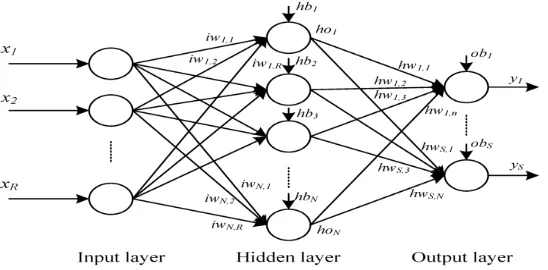
The Artificial Neural Network is the biologically scoped classification algorithm. It is made up of a large number of highly interconnected processing elements i.e. neurons. In this paper, Back propagation neural network method is used for recognition of speech command.
Fig. 4 General Neural Network
The basic Back propagation algorithm consists of 3 steps:
1. Input layer is given by input pattern which are propagated through the network, till those pattern reach the output units. Predicted output pattern will be produced from forward pass.
2. The preferred outputs are fed as a part of training vector. The error signal is produced by subtracting the outputs of actual network from desired outputs.
3. An error signal is origin in back propagation step and those are passed back through the neural networks. The weights of connection are adjusted and neural network has now “learned” from an experience.
For the proposed neural network, total of 228 nodes in an input layer (I), It estimates number of features fed as input to train the network, number of nodes in output layer (O) is 4,it determines a matching of certified speakers command.
The number of nodes in hidden layer (n) will be calculated by input and output layer as shown in below equation.
From gradient descent method, the algorithm of back propagation provides the minimum of the error function in weight space. The combination of weights which will minimize the error function that is considered as a solution for learning problem. So that this method requires estimation of gradient of the error function at each and every iteration step, it should give the guarantee that continuity and differentiability of error function, the composite function produced by interconnected perceptrons are discontinuous. One of the more popular activation functions for back propagation networks are the sigmoid, a real function Sc: IR (0, 1), it is defined by following expression
Sc(x) = 1/1+e-cx
Proposed Speech Recognition System
In the Proposed speech recognition system, It is preprocesses all the speech samples and extracts the 5700 autocorrelation features (25*228) from each command using LPC coefficients. Further from these unique features, ANN is trained using BPNN.
For each person, total of 22800 features (100 samples * 228 features) obtained and trained using Back propagation neural network. The developed system is tested from speaker by giving input commands to analyze the accuracy result with each person. The following figure 5. Shows the proposed speech recognized system for desktop application.
Fig.5 Flowchart for the proposed Voice recognized system for desktop application
III.EXPERIMENT AND RESULT
Initially MFCC method has considered developing speech recognition system but there were some issues such as less accuracy, it was difficult to face removal of voice and silence so on. Therefore finally LPC method is selected In the proposed system, there are three speech/voice sample databases, each database is composed of 100 commands from a particular speaker uttering the commands like “ONE’,”TWO”,”THREE” and ”FOUR”, for each command 25 times in English language. When speaker says command “ONE”, then power point application will open with named test.pptx (filename),when says command “TWO” then new slide is added in same application, when command “THREE” is said then new image is added and finally when speaker says command “FOUR” then quit the power point application. These commands characterize unique features which then allow the Artificial Neural Network to differentiate individual commands with maximum accuracy.
A. Performance measure of speech recogniyion system
The performance measure of speech recognition system can be determined by two parameters: The Rate of Correct Recognition (CRR) and Rate of False Acceptance (FAR).
The Rate of Correct Recognition (CRR) is the ratio of number of correctly recognized command from the speaker to the total number of authorized speaker’s commands.
CRR= *100%
The Rate of False Acceptance (FAR) is the ratio of number of incorrectly recognized authorized speaker to total number of speaker’s commands.
FAR= *100%
The experimental results for each command wise accuracy for static speaker using speech recognition system for desktop application are tabulated and depicted below in Table 2.
Table 2 Performance of Speaker in terms of accuracy of each command in static
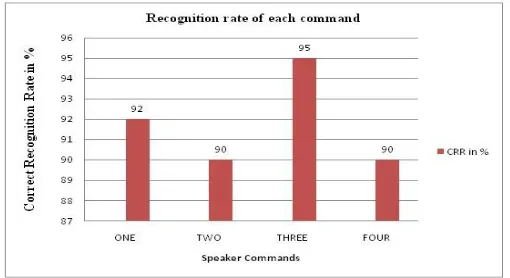
The overall recognition accuracy of the proposed system with static or standard database is about 91.75% when tested with minimum 100 voice sample commands of a particular speaker. But, for real-time system, the accuracy is depending on the environmental situation and it will gives around 85-86% accuracy in worth. Recognition rate of each command from particular speaker is drawn that gives the accuracy of each command and command “ONE” shows 92% accuracy, ”TWO” shows 90% accuracy, ”THREE” shows 95% and “FOUR” shows 90% accuracy that is shown in figure 6.
Fig.6 Recognition rate of commands from user.
IV.CONCLUSION
commonly faced issues from speech recognition system. In the proposed work, autocorrelation features using LPC coefficients are extracted from each command given by particular speaker. Later Back propagation neural network is used as classifier and for each command corresponding operation of power point application will activated and achieved the recognition accuracy is around 91.75%. In future, operations on any Desktop applications must work with effective and accurate and need to use this speech recognition system for more security, robustness and enabling different operations on real time applications. Since the proposed system work is on focusing only on authorized speaker can access the application and for each speaker, separate database is created for secure purpose using LPC coefficients. In future, other unique features are extracted from speech sample using different speech analyzer and increase the accuracy and robustness of the system.
REFERENCES
[1] D R Rakesh, K Jayasiman, 2013, “Speaker Recognition and Authentication”, International Journal of Mobile computing and Computer science, Vol 2, Issue. 5, 2013.
[2] N Praveen, Tessamma Thomas, 2013, “Text dependent speaker recognition using MFCC features and BPANN” International Journal of computer applications, Vol 74,pp.5,2013.
[3] Amitava Das, Tapaswi Makarand, 2010, “Direct modeling of spoken passwords for speaker recognition by compressed time-features representations”, IEEE International Conference on audio, voice &signal processing, pp.4510-4513, 2010.
[4] S.S Wali, S M. Hatture and Nandyal S,2014,”MFCC Based Text-dependent Speaker Identification Using Back propagation neural network”, International journal of signal processing systems Vol.3,pp.1-8,June 2014.
[5] Vimala C, Dr. V.Radha “A review on speech recognition challenges and approaches”, The world of computer science and Information Technology journal.
[6] Nitin Trivedi, Sachin Ahuja, Dr. Vikesh kumar Ramanchand, Sourabh singh,2011, “Speech recognition by Wavelet Analysis”,International journalof computer applications, Vol. 15 No.8.
[7] Aju Joseph, Anish Babu K, Karthik Selven,2013,”Speaker recognition system for security applications”
,IEEE Recent advances in intelligent Computational systems, pp.26-30,2013.
[8] Shruti Gujrat, Varindar Singh Baidwan,2014,”Comparitive analysis of prosodic features and Linear prediction Coefficients for speaker Recognition using Machine Learning Technique”, IEEE international conference on Devices, Circuits and communications,pp.1-8,2014.
[9] M Hanuma Teja, Chaitra N, 2011, “Computationally efficient speaker identification system using AMDF
and LPC”, IEEE international conference on Electronics computer Technology,Vol.3,pp.288-289,2011.
[10] Md. Fayzur Rahman, Md. Rabiul Islam,2009,”Improvement of Text dependent Speaker identification system
using Neuro-Genetic Hybrid algorithm in office Environmental conditions”, IJCSI international journal of computer science Issues,Vol.1,2009.
[11] Sonam kumara, Komal saxena,2012,”Controlling of device through voice recognition using Matlab”, International Journal of Advance Technology and Engg. Research, Vol. 2, Issue 2, march, 2012.
[12] Thiang, suryo wijoyo,2011,”Speech recognition using LPC and Artificial Neural Network for controlling movement of mobile Robot”, Indonesia international conference on information and Electronics Engg. IPCSIT Vol.6(2011).
[13] Kalid saeed and Mohammad kheir, 2007, “A speech and speaker identification system: Feature extraction”, IEEE transactions on industrial electronics, Vol 54,No 2 april 2007-887.