e-ISSN: 2278-7461, p-ISSN: 2319-6491
Volume 6, Issue 11 [November. 2017] PP: 01-09
An Overview of Methodologies for Evaluating Global
Performance of Supply Chains
A. HADDACH
1,2,L. BEN ALLAL
1,2,M. AMMARI
1,21
Abdelmalek Essaâdi University, Faculty of Sciences and Techniques, Tangier, Morocco. 2Research team: materials, environment and sustainable development.
corresponding author: A. HADDACH
Abstract:
Adoption of supply chains to sustainable development concept combining performance and responsibility. Thus, economic performance is no longer sufficient to assess global performance of a supply chain. Sustainable development indicators are gaining more importance and increasingly recognized as a powerful tool for policy making and public communication in providing information on global performance of supply chain in domains such as economic, environment, social or technological improvement. Now, there are number of initiatives exist on indicators and frameworks for the measure of global performance of supply chains. How can we measure this global performance? Are there any tools for global performance measurement? Otherwise how to approach this measure? This paper presents an overview of available tools to measure global performance of supply chains. The article also compiles the information related to dissemination of sustainable development in supply chains.Key-words:
supply chain,global performance,referential,sustainable development, company, model, economic, environmental, social, management, responsibility.--- ---
Date of Submission: 07-11-2017 Date of acceptance: 23-11-2017
---
---I.
INTRODUCTION
In addition to economic stakes, companies and supply chains must take into account sustainable issues in design, procurement, production of products, storage and distribution, as well as in the management of return flows, this is referred to as global performance, including economic, environmental and social performances. It is therefore necessary to evaluate these performances qualitatively and quantitatively.Global performance,
defined as "the aggregation of economic, environmental and social performance" [1], is a multidimensional
concept that is difficult to measure technically. Indeed, the evaluation devices currently used by companies to measure the progress achieved through their CSR approaches do not provide satisfactory answers. Not being able to assess the progress made prevents companies from knowing where to focus their improvement efforts. Today, the difficulty for companies is to measure interactions between different dimensions (economic, environmental and social) of global performance.
II.
GLOBAL PERFORMANCE PRESENTATION
Financial dimension was for a long time the sole determinant of supply chain performance. This performance has based on the achievement of profitability requested by shareholders in order to sustain supply chain and its profit. Today and for decades, supply chain performance has shifted from financial representation to more comprehensive approaches including environmental and social dimensions. Currently, sustainability of supply chain no longer depends solely on the financial aspect of their activities, but also on the way in which it is managed. Responsibility of supply chains is expanding to include other stakeholders (syndicates, non-governmental organizations,…) plus shareholders.Thus, and under these circumstances, the notion of "global performance" was appeared.
2.1 Financial approach to performance
limited to knowledge of a result" [5]. For Bouquin, (2004) [9], we evaluate achieved results by comparing them with desired or standard results.
Financial approach to performance is called into question, which invites companies to complete the management issues exclusively financial and economic by measures describing other aspects of their functioning such as environmental and social aspects.
2.2 Global Approach To Performance
Financial performance is no longer sufficient to reflect the global performance of supply chain. In the course of 20th century that the performance is broadened to take into account the social/ societal responsibility of company vis-a-vis its stakeholders.Global performance emerges in Europe with the emergence of sustainable development, but its origins lie in older concepts such as societal responsibility (a concept that first appeared in United States and then in Europe).Sustainable development principle is based on the balancing of economic, environmental and social dimensions to avoid the pursuit of an objective being at the expense of the other two. It is in this context that the notion of global performance was emerged.Important contributions in this domain go back to the working group of the General Commissionership of Plan [7] in 1997. For Capron and Quairel, (2005) [7], "the relationships that companies maintain, not only with their natural environment but also with their societal environment, must be taken into account and evaluated." In the current managerial literature, "global performance is mobilized to evaluate the implementation by companies of sustainable development concept " [7]. This global performance of companiesis defined as "the aggregation of economics, socials and environmentals performances" [1], [10] or is formed "by the combination of financial performance, social performance and societal performance" [11] .For Capron and Quairel, (2005) [7], global performance of companies refers to "a holistic conception seeking to design an integration of performances in a synthetic approach ... this integration may imply a coherence between the three dimensions with causal models linking different factors from different dimensions ". Thus, and according to Capron and Quairel, (2005) [7], "the evaluation devices used by companies at present do not allow to integrate, in a balanced way, to traditional economics and financials dimensions, environmentals and socials dimensions and to cover a wider perimeter of impacts ".
III.
MEASUREMENT APPROACHES OF GLOBAL PERFORMANCE
Most approaches to global performance measurement are qualitative (literature reviews, conceptual models and case studies), while those of quantitative type (mathematical models) are minorities.
3.1 Literature reviews
We present in the table below some examples of literature reviews related to measurement of global performance:
Table 1: examples of literature reviews related to measurement of global performance
Author Interest of review Framework
(Carroll and Shabana, 2010) [12]
Gains generated by implementation of a CSR policy in a company;
Company
(Peloza and Shang, 2010) [13]
Creating the value for consumers through implementation of a CSR policy;
(Wood, 2010) [14] Identification of variables for the measurement of social performance;
(Singh et al., 2009) [15] Overview of the various indices of sustainable development measurement;
(Seuring and Müller, 2008) [16]
The motivation to put in place a social responsibility policy;
Risks and performance management; Sustainable products management;
supply chain
(Teuteberg and Wittstruck, 2010)
[17]
Motivation of organizations;
The field of study and methods applied; Evaluation of the overall performance of supply chains;
(Linton et al., 2007) [18] Interaction between supply chain and sustainability (Gold et al., 2010) [19] Value creation in sustainable development
framework;
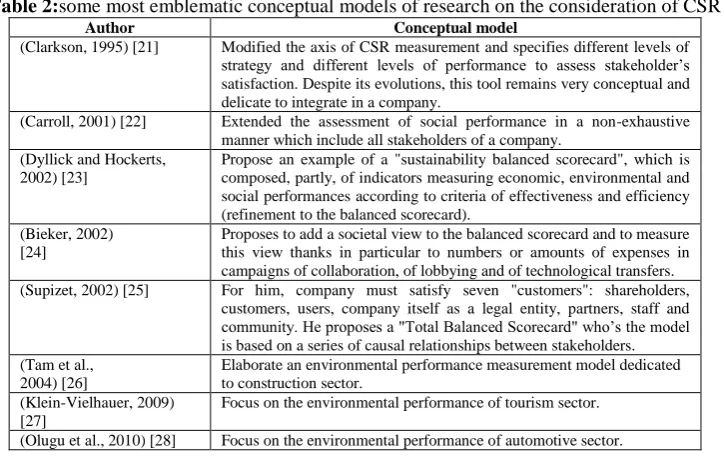
3.2 Conceptual models
Most of conceptual models found in literature focus on methodologies and frameworks to adopt for selecting and implementing indicators for measuring global performance.
Table 2:some most emblematic conceptual models of research on the consideration of CSR
Author Conceptual model
(Clarkson, 1995) [21] Modified the axis of CSR measurement and specifies different levels of strategy and different levels of performance to assess stakeholder’s satisfaction. Despite its evolutions, this tool remains very conceptual and delicate to integrate in a company.
(Carroll, 2001) [22] Extended the assessment of social performance in a non-exhaustive manner which include all stakeholders of a company.
(Dyllick and Hockerts, 2002) [23]
Propose an example of a "sustainability balanced scorecard", which is composed, partly, of indicators measuring economic, environmental and social performances according to criteria of effectiveness and efficiency (refinement to the balanced scorecard).
(Bieker, 2002) [24]
Proposes to add a societal view to the balanced scorecard and to measure this view thanks in particular to numbers or amounts of expenses in campaigns of collaboration, of lobbying and of technological transfers. (Supizet, 2002) [25] For him, company must satisfy seven "customers": shareholders,
customers, users, company itself as a legal entity, partners, staff and community. He proposes a "Total Balanced Scorecard" who’s the model is based on a series of causal relationships between stakeholders. (Tam et al.,
2004) [26]
Elaborate an environmental performance measurement model dedicated to construction sector.
(Klein-Vielhauer, 2009) [27]
Focus on the environmental performance of tourism sector.
(Olugu et al., 2010) [28] Focus on the environmental performance of automotive sector.
3.3 Case studies dedicated to the sphere of supply chains
Based their analyzes on 89 industries of automotive sector, Zhu et al., (2007a)[29] argue that the main motivations for companies to embark on a CSR strategy are regulatory pressures, market pressures and internal factors within the company. Moreover, they point to a slight correlation between the implementation of CSR practices and environmental and economic performances but an absence of link with financial performances. From their side Zhu et al., (2007b)[30] who base their study on 171 Chinese companies and Lindgreen et al., (2009)[31]who base theirs on 401 US firms find similar results. They argue that the CSR practices most commonly implemented are those related to employees, consumers, suppliers and financial investors, far from philanthropic and environmental practices. (Tate et al., 2010)[32] made a case study that focuses on the CSR relationships of 100 companies. While the 100 companies agree that the creation of these reports has the main objective to responding to demands of stakeholders, some disparities appear between nationalities and sizes. At time when US companies are communicating about their CSR policy in the framework of risk management, European and Japanese companies do so in a more communal framework. Moreover, while US firms are more focused on measuring sustainability in strategic decisions such as globalization, European and Japanese firms measure more targeted issues both upstream and downstream of supply chains. While small companies undergo this institutional pressure, the large ones are using it to improve their image.
3.4 Mathematical models
We present here some models which propose methods for evaluating global performance in companies and in supply chains following three main categories:
Table 2: some models for assessing global performance in companies and in supply chains
Category Mathematical model proposed Author
Amount of CO2 emitted
Provide a model to quantify CO2 emissions between different nodes of a supply chain. This model allows companies to build or modify their logistics network by mastering the amount of CO2 emission generated.
(Tate et al., 2010) [32]
Are interested in the distribution of wine and propose 14 distribution and storage scenarios, which they evaluate according to three criteria: distance/time, necessary energy and emissions of CO2.
(Cholette and Venkat, 2009) [33]
Multicriteria methods of decision-making
Integrate in their performance only environmental criteria depending on the activity (production, packaging, recycling, ...).
(Tsoulfas and Pappis, 2008) [34]
Integrate in their performance only environmental criteria depending on their characteristics (managerial indicators such as investments, training or operational type water
pollution, air). Models of
indicators aggregation
present a methodology for the development of a composite index of global performance (CIGP) in steel sector, based on the three sustainable performances. Their model is based on the use of the AHP method.
(Singh et al., 2007) [35]
Lead a broad review of the main sustainable indices. But they point out that despite international research efforts on global performance evaluation, only a very few approaches consider the three dimensions of social responsibility in companies.
(Singh et al., 2009) [15]
At present, there are very few models that integrate the global evaluation at supply chain management level. Seuring and Müller, (2008)[16] point out that there is a very clear deficit in the literature on social issues in supply chain management and on the combination of the three sustainable dimensions. Only Krajnc and Glavic (2005)[36], Singh et al., (2007)[35],Haddach et al., (2017a)[37] and Haddach et al., (2017b)[38]propose a assessment (with limits) of the three dimensions by aggregating three sub-indices representing the three sustainable performances.
4Evaluation referentials of global performance
The absence of standards and fundamentals makes the assessing of global performance of supply chains (new issues) very delicate. Below are the main referentials for evaluating global performance in supply chains.
4.1 Referentialsof performance evaluation in supply chains
These referentials have all evolved and are now integrating the three considerations of sustainable development (economics, environmentals and socials).
Logistics guide ASLOG
ASLOG (French Association of Supply Chain and Logistics) is a neutral, independent and multi-sectoral organization. It covers all activities within the global supply chain. ASLOG has built a logistics referential based on the one developed by Volvo in 1990s. The latter has been improved and, to date, constitutes an interesting reference base for judging the relevance of a logistics system. The referential of logistics performance of ASLOG (ASLOG, 2006) is a catalog of measures and actions of progress. Supply chain concept was introduced in 2002, with the 3rd version, which is still enriched in its version of 2005.This referential allows to determine the current situation of supply chain as well as the evaluation of its performance through 200 questions according to 10 axes:
1) Management, strategy and planning2) Products conception 3) Supplies 4) Production 5) Deliveries 6) Storage 7) Sales 8) Returns and after-sales service 9) Steering indicators 10) Continuous progress.
The measurement of these performances is based on a rating scale ranging from 0 to 3 (0: in the absence of the minimum necessary to achieve level 1; 1, 2 and 3; 3: being the best level).Based on these characterization elements, ASLOG's auditors analyze company situation within its supply chain and prepare a number of recommendations for future improvement.
EVALOG referential
In 2007, GALIA (groupement for improvement of liaisons in the automotive industry) proposed the EVALOG (EVAluation LOGistics) referential which was developed by automotive manufacturers and suppliers. It is a common assessment guide for suppliers and customers in the sector, but can be used in other industries. Its goal is to identify areas where companies have to improve to reliable their physical and logistical flows. It bases its analysis on 6 themes, four of which are of the process type: customer relationship, supplier relationship, production and product development and the other two concern company’s strategy and its organization. It is a question of evaluating in binary way (0 not implementation, 1 implementation) a sixty practices. The latest version of the referential proposes some recommendations related to social responsibility enrolling in the following six axis: 1) strategy and improvement 2) work organization 3) capacity and planning of production 4) customers interfaces 5) mastery of products/process 6) suppliers interface.
SCOR referential
electronics, mass distribution, logistics services, etc.). Given its complete structure, this model has become a realistic standard on the market. Its only limit is the creativity of companies. The objective of SCC is to support companies in the domain of supply chain management through the dissemination of best practices. SCOR model resulting from this desire is now in its 11th version.
The model replaces internal supply chain of company within the extended supply chain with customers and suppliers and identifies five process of level 1: plan, source, make, deliver and return.SCOR model introduced an additional process: "Enable" which represents the support activities for supply chain management and the various tasks and informations useful for the realization of "operationals" processes. This process is divided into several "Enable" sub-processes: planning, sourcing, manufacturing, distributing and returning. SCOR version (SCC, 2008) presents GREEN SCOR which highlights a number of good practices related to CSR that it associates with the five SCOR processes and environmentals indicators.SCOR is the world's principal reference for supply chain. It is a reference for evaluating how the supply chain is positioned, how it is structured, and according to what type of functionment it works.
Figure 1: schematic representation of SCOR management processes (Adapted from SCC, 2010)
4.2 Global evaluation referentials
Given the importance of evaluating global performance in company and in supply chain, many private and public organizations attached great importance to it. This is why we find a lot of social responsibility assessment referentials. Below, we describe the six most, currently, recognized referentials according to three groups:
4.2.1 Commitment referentials
The United Nations and OECD (Organisation for Economic Co-operation and Development) especially were developed commitmentreferentialsto guide companies wishing to engage in a social responsibility approach. Some referentialsask companies to commit themselves by signing a text (Global Compact of the United Nations), others are simple principles to be followed by companies. Two of these commitment referentials are the most common in the literature:
Global Compact
Guiding principles of OECD
In June 2000, the OECD emphasized corporate social responsibility (OECD, 2000). As these principles apply to all subsidiaries of a multinational company, they are international in scope. These are recommendations that governments are sending to multinational enterprises. They set out voluntary principles and policies of corporate behavior, especially the application of fundamental social norms. Governments subscribing to the Guiding Principles encourage companies operating in their territories to respect them.
These referentials highlight certain principles that companies must respect but they do not present an approach to putting in place and evaluating these principles.
4.2.2 Reporting referentials
Companies disseminate informations about their CSR policy, but in very differents contexts. This new type of reporting, which emerged at the end of the 1990s, has gradually been structured and standardized around a few referentials such as the Global Reporting Initiative (GRI), which is gradually being imposed as the unavoidable international referential.GRI is the most advanced reporting standard for sustainable development, providing an approach that encompasses the various dimensions of sustainable development across the company. Created in 1997 by collaboration between the Coalition for Environmentally Responsible Economies (CERES) and the United Nations Environment Program (UNEP), GRI brings together NGOs, consulting and audit cabinets, academies, consumer associations and, of course, companies.GRI performance indicators are classified according to the three dimensions of sustainable development: economic, environmental and social. Economic indicators measure the impacts of an enterprise on the economic situation of its stakeholders and on economic systems at local, national and global levels. Environmental indicators assess impacts on natural systems, whether living or not, especially ecosystems, soil, air and water. These indicators are of general application (valid for all companies) or specific to a company or a sector. Finally, social indicators measure the impacts of an organization on the social systems in which it operates. Although these are subject to a low consensus due to cultural differences, scope and diversity of possible impacts, GRI proposes to indicate informations concerning staff, clients, local population, supply chain, business partners, respect of labor law in company and among suppliers, human rights, etc., but GRI does not allow for integrating the three dimensions of sustainable development and providing the measure of global performance.GRI faces an obstacle to integrating economic, environmental and social performances. Its measurement proposal provides a partial (dual) view of the performance.
4.2.3 Certification referentials and guidelines
Some referentials define guidelines or norms to be respected for certification. Among these certification referentials /guidelines, three are the most commonly used:
ISO 26000
Prepared by International Organization for Standardization, ISO 26000 is an international standard of voluntary application built on international consensus. The term "standard" can be confusing, whereas ISO 26000 only contains guidelines: it is therefore not a text for the development of a ready-made management system. This is one of the reasons why this "standard" does not allow a certification by a specialized organism (third party). ISO 26000 provides common terminology, arguments and suggestions for the implementation of a social responsibility policy in organizations of all types, particularly SMEs, which are too often absent from the sustainable development agenda. It is therefore not a disguised constraint imagined to be added to the already long list of regulatory obligations cumbersome on organizations.An ISO working group was set up to develop the future ISO 26000 (ISO, 2010) standard in 2004. This working group brings together 54 countries and 33 organizations, and the main stakeholder groups are represented with a geographical balance and between mens and womens. The future standard will provide guidelines for social responsibility. This is not a requirement and will not be used for certification as the standards ISO 9001: (ISO, 2000) and ISO 14001: (ISO, 2004).
The content of the future standard proposes especially guidelines on the central issues of social responsibility.
SA 8000 referential
organizations such as Amnesty International. It is designed to apply to all countries and industries and is open to third-party verification, provided that the control organism is approved by SAI.
SAI's mission is to promote the human rights of workers throughout the world. SA 8000 covers child labor and forced labor, hygiene and safety, freedom of association and the right to collective bargaining, prohibition of discrimination in pay, training, dismissal and retirement, working time, remuneration and management system.
SD 21000 guide
From a professional point of view, a particularly interesting initiative has emerged in France to serve as an aid to the piloting of global performance in organizations. This is the SD 21000 guide.
The SD 21000 is a methodological guide, a reference and not a managerial norm standard such as ISO 9001. In this sense, it is not established for certification purposes. Rather, it is intended to highlight the risks and opportunities of the company so that it can determine a sustainable development strategy, objectives and action plans to be implemented. It also provides recommendations on environmental protection and CSR.Which is interesting in this guide is that its methodology was built on a dual approach. An approach based on relations with stakeholder, and an approach that identifies the organization's main future issues. This double reflection has the advantage of giving a dynamic aspect to this guide because it facilitates the projection of the leaders towards the future by more easily integrating the sustainable development to the policy of development of their company. In order to achieve its objectives, this self-diagnostic tool has three steps: self-diagnosis of issues, identification of stakeholders and prioritization of these issues themselves.SD 21000 guide, drawn from the group's work, is aimed at managers and decision-makers in large and small companies, whether public or private, in any sector of activity in France, in Europe or in the world. Its objective is to assist them in their initial reflection in order to take into account the principle of sustainable development in the formulation of their policies and strategies, in particular by promoting continuous improvement of company’s global performance (in its three dimensions: economic, environmental and social).
For this end, it sets out:
1. The history of the birth and development of sustainable development concept;
2. Its incontestable reason for being for those who wish the survival of humanity and the planet;
3. The most likely global consequences on the life and functioning of companies; in particular, in terms of their responsibility towards society and the future of the planet: their "societal" responsibility;
4. The major issues for these companies, the foreseeable opportunities and risks;
5. The inevitable but necessarily progressive consideration of sustainable development in policy and strategies development;
European norm EMAS
EMAS (Eco-Management and Audit Scheme) is a European certification awarded to companies that go beyond mere legal compliance and continuously improve their environmental performance. This certification was created by a European regulation in 1993. Regulation (EC) No 1221/2009 of 25 November 2009 defines currently the modalities for voluntary participation.
This certification is open to all organisms who want to undertake a voluntary process of continuous improvement of their environmental performances. In January 2012, 4532 organizations (8114 sites) of all sizes and economic sectors were registered at European level.
EMAS imposes a principle of transparency on organizations. In this approach, the communication of the fixed objectives and obtained results is mandatory and must be carried out in accordance with a procedure described in the annex to the regulation.
An annual environmental statement must be produced by the certified organism. It must be transparent and not technical to be accessible to the public, in paper format or on the Internet.
In short, EMAS certification involves:
A verification of the company's compliance with environmental regulation;
Implementation of an Environmental Management System (EMS) according to ISO 14001;
Publication of an annual environmental statement concerning the balance sheet of the company's environmental actions;
EMAS certification correspond to a recognized, standardized and credible environmental management system. This certification aims to reduce direct or indirect environmental impact of purchases, work done by subcontractors and suppliers, transport and company's products or services.
2.Conducting an environmental analysis (full assessment of impacts and results achieved in a number of domains);
3.Development of an environmental program;
4.Establishment of an environmental management system;
5.Conducting an external audit by an independent certification organism; 6.Drafting of an environmental statement;
7.Verification of the environmental statement by an independent certification organism; 8.Obtaining agreement of EMAS Committee;
IV.
Conclusion
In this paper, we present the global performance from several angles of view. We also mention the difficulties related to the measurement of global performance, a fuzzy concept, presented by many authors as the aggregation of economic, environmental and social performances of a company. The analysis of the different measurement tools, used by companies to apprehend their performance, shows that no tool is able to measure the interactions between different segments of the performance.The tools currently available (Balanced Score Card, Triple Bottom Line, etc.) provide a segmented view of the global performance in three dimensions: economic, environmental and social. They measure these three dimensions separately and then compile them without considering the correlations between them. At best, some tools (such as GRI) evaluate the interactions between two dimensions: economic/social or economic/environmental, but they do not allow to integrate at the same time and in a significate way the three dimensions of global performance.
References
[1]. Baret P. (2006)‘L’évaluation contingente de la Performance Globale des Entreprises : Une méthode pour fonder un management sociétalement responsable?’,2ème journée de recherche du CEROS, pp.1-24.
[2]. Bouquin H. (1986) ‘Le contrôle de gestion’, Presses Universitaires de France.
[3]. Bescos P. Dobler P., Mendoza C. and Naulleau G. (1993) ‘Contrôle de gestion et management’,Montchrestien, 2ème édition. [4]. Bourguignon A. (1995) ‘Peut-on définir la performance?’, Revue Française de Comptabilité, juillet- août, pp. 61-66. [5]. Lebas M. (1995) ‘Oui, il faut définir la performance’, Revue Française de Comptabilité, juillet- août, pp.66-71. [6]. Bessire D. (1999) ‘Définir la performance’, Comptabilité-Contrôle-Audit, septembre, pp.127-150.
[7]. Capron M. and Quairel-Lanoizelee F. (2005) ‘Evaluer les stratégies de développement durable des entreprises : l’utopie mobilisatrice de la performance globale’ Journée Développement Durable- AIMS – IAE d’Aix-en-Provence, pp.1-22.
[8]. Bourguignon A. (2000) ‘Performance et contrôle de gestion’, Encyclopédie de Comptabilité, Contrôle de gestion et Audit, Ed. Economica, pp. 931-941.
[9]. Bouquin H. (2004) ‘Le contrôle de gestion’ Presses Universitaires de France, Collection Gestion, 6ème édition, Paris, 508 p. [10]. Reynaud E. (2003) ‘Développement durable et entreprise : vers une relation symbiotique’ Journée AIMS, Atelier développement
durable, ESSCA Angers, pp.1-15.
[11]. Germain C. and Trébucq S. (2004) ‘La performance globale de l’entreprise et son pilotage: quelques réflexions’ Semaine sociale Lamy, pp. 35-41.
[12]. Carroll, A.B. and Shabana, K.M. (2010) ‘The Business Case for Corporate Social Responsibility: A Review of Concepts, Research and Practice’, Internattional Journal of Management Reviews, 12(1), pp.85-105.
[13]. Peloza J. and Shang J. (2010) ‘How can corporate social responsibility activities create value for stakeholders? A systematic review’, Journal of the Academy of Marketing Science, 39 (1), pp.117-135.
[14]. Wood D.A., 2010. Measuring Corporate Social Performance: A Review. Internattional Journal of Management Reviews, 12(1), 50-84.
[15]. Singh R.K., Murty H. and Dikshit A. (2009) ‘An overview of sustainability assessment methodologies’, Ecological Indicators, 9 (2), pp.189-212.
[16]. Seuring S. and Müller M. (2008) ‘From a literature review to a conceptual framework for sustainable supply chain management’, Journal of Cleaner Production, 16 (15), pp.1699-1710.
[17]. Teuteberg F. and Wittstruck D. (2010) ‘A Systematic Review of Sustainable Supply Chain Management Research’, MKWI 2010– Betriebliches Umwelt-und Nachhaltigkeitsmanagement. Goettingen, Allemagne, pp.1001-1015.
[18]. Linton J.D., Klassen R. and Jayaraman V. (2007) ‘Sustainable supply chains: An introduction’, Journal of Operations Management, 25(6), pp.1075-1082.
[19]. Gold S., Seuring S. and Beske P. (2010) ‘Sustainable Supply Chain Management and Inter-Organizational Resources: A Literature Review’, Corporate social responsibility and environmental management, 17(4), pp.230-245.
[20]. Sarkis J., Zhu Q. and Lai K. (2011) ‘An organizational theoretic review of green supply chain management literature’, International Journal of Production Economics, 130(1), pp.1-15.
[21]. Clarkson, M.B.E. (1995) ‘A Stakeholder Framework for Analyzing and Evaluating Corporate Social Performance’, Academy of Management Review, 20, pp.42-56.
[22]. Carroll, A.B. (2001) ‘A Commentary and an Overview of Key Questions on Corporate Social Performance Measurement’ Business & Society, 39, pp.466-480.
[23]. Dyllick T. and Hockerts K. (2002) ‘Beyond the Business Case for Corporate Sustainability’, Business Strategy and the Environment, 11, pp.130-141.
[24]. Bieker T. (2002) ‘Managing corporate sustainability with the Balanced Scorecard: Developing a Balanced Scorecard for Integrity Management’,5th International Summer Academy on Technology Studies, Deutschlandsberg, Austria, pp.17-34.
[25]. Supizet J. (2002) ‘Total Balanced Scorecard, un pilotage aux instruments’, L’Informatique Professionnelle, 209, pp.15-20. [26]. Tam C.M., Tam V.W. et Tsui W.S. (2004) ‘Green construction assessment for environmental management in the construction
industry of Hong Kong’, International Journal of Project Management, 22(7), pp.563-571.
www.ijeijournal.com
Page | 9 [28]. Olugu E.U., Wong K.Y. and Shaharoun A.M. (2010) ‘Development of key performance measures for the automobile green supply
chain’, Resources, Conservation and Recycling, In Press, Corrected Proof.
[29]. Zhu Q., Sarkis J. and Lai K. (2007a) ‘Green supply chain management: pressures, practices and performance within the Chinese automobile industry’, Journal of Cleaner Production, 15(11-12), pp.1041-1052.
[30]. Zhu Q., Sarkis J. and Lai K. (2007b) ‘Initiatives and outcomes of green supply chain management implementation by Chinese manufacturers’, Journal of Environmental Management, 85(1), pp.179-189.
[31]. Lindgreen A., Antioco M., Harness D. and Sloot R.V.D., (2009) ‘Purchasing and Marketing of Social and Environmental Sustainability for High-Tech Medical Equipment’, Journal of Business Ethics, 85 (2), pp.445-462.
[32]. Tate W., Ellram L. and Kirchoff J. (2010) ‘Corporate social responsibility reports: a thematic analysis related to supply chain management’, Journal of Supply Chain Management, 46(1), pp.19-44.
[33]. Cholette, S. and Venkat, K. (2009) ‘The energy and carbon intensity of wine distribution: A study of logistical options for delivering wine to consumers’, Journal of Cleaner Production, 17 (16), pp.1401-1413.
[34]. Tsoulfas G.T. and Pappis C.P. (2008) ‘A model for supply chains environmental performance analysis and decision making’, Journal of Cleaner Production, 16(15), pp.1647-1657.
[35]. Singh R.K., Murty H.R., Gupta S.K. and Dikshit A.K. (2007) ‘Development of composite sustainability performance index for steel industry’, Ecological Indicators.7(3), pp.565-588.
[36]. Krajnc D. and Glavic P. (2005) ‘A model for integrated assessment of sustainable development’, Resources, Conservation and Recycling, 43 (2), pp.189-208.
[37]. Haddach A., Ammari M., Ben allal L. and LaglaouiA. (2017a) ‘How to measure sustainability of supply chain’, International Journal of Advanced Research, 5(5), pp.40-418.
[38]. Haddach A., Ammari M., Ben allal L. and Laglaoui A. (2017b) ‘Assessment of Firm’s Global Performance: Available Tools and Proposal of a New Module’,International Journal of Business and Management Invention, 6(7), pp.06-17.