e-ISSN: 2278-7461, p-ISSN: 2319-6491
Volume 5, Issue 2 [November 2015] PP: 01-06
A Study on Effective Utilization of Wastes from Construction
Industry in Road Construction
Brajesh Mishra
1, Ravi Shanker Mishra
2 1M. Tech. U.P. Cane Development department, Lucknow, India, 2Prof & Head, Department of Civil Engineering, AIMT, Lucknow, India
Abstract:Due to rapid growth of population and rapid urbanization the development of infrastructure and other construction activities is always on the cards. The scarcity in the availability of aggregate is a great problem for construction industry. A large quantum of aggregate is consumed in the construction of roads and plays a significant effect on cost of the work. Due to fast degradation and depletion of virgin aggregates and other raw materials, use of waste generated from construction industry will be an alternative option for use. Therefore in present scenario the management of waste materials and its effective utilization becomes an important task. It becomes important to recycle and reuse them so that disposal problem of the same may be solved as well. Experimental investigations of recycled aggregates were carried out to determine the engineering properties and the comparison was made with conventional aggregates. It was observed that recycled aggregate except brick aggregate can be used as road aggregate as it meets the criteria of MORTH (ministry of road transport & highways) specifications. Brick aggregate was found relatively softer in comparison to other recycled aggregates so it can be better utilized in sub-base of pavement.
Keywords: MORTH, Pavement, recycled aggregates, Sub-base, waste materials.
I.
INTRODUCTION
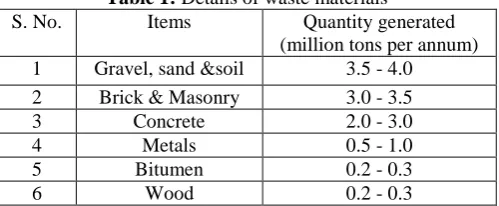
Solid wastes generated in the form of sand, gravel, concrete, stone, bricks, wood, metal, glass, plastic, paper etc. due to various construction activities. Management of these waste materials is a great concern for the authorities of localities as it is increasing day by day and it is a threat to pollution and environmental deterioration. In India approximately current quantum of solid waste generation is approximately 48 million tons per annum as per central pollution control board. Out of this wastes 25% is from construction industry. Disposal of such huge quantity is a great problem and it requires a vast area of land. Recycling or reusing the same is a suitable solution for management of the same. The total quantum of such waste from construction industry is estimated to be 10 to 12 million tons per annum. Details are given in table below-
Table 1: Details of waste materials
S. No. Items Quantity generated
(million tons per annum) 1 Gravel, sand &soil 3.5 - 4.0 2 Brick & Masonry 3.0 - 3.5
3 Concrete 2.0 - 3.0
4 Metals 0.5 - 1.0
5 Bitumen 0.2 - 0.3
6 Wood 0.2 - 0.3
Every year a huge quantity of stone aggregate is used in concreting in construction industry. When the structure is outlived its life then its demolition causes problem in disposing the demolished concrete and other materials. As a result of natural calamity and disaster like earthquake a huge quantity of demolition waste is dumped in the concerned locality. Due to limitation of availability of dump sites there is increase in cost of dumping of waste materials in recent years.
II.
LITERATURE
REVIEW
The aim of successful waste management plan is to maximize the re-use of recovered materials and minimize the volume of wastes for ultimate disposal.
Fig-1 Stacked cleaned bricks for re-use Fig-2 Primary screening removal of soil fraction
Fig-3 Sorts finer material from over size concrete Fig-4 Recycled crushed aggregate of required grading
2.2. Waste Crushing: Crusher generally crush glass, bricks, granite, asphalt and reinforced concrete. Depending upon location of site and purpose of work a variety of crushers are available. The crushers are available in different capacities ranging from 45 tons to 500 tons per hour. Mobile crushers are also available which can be used according to need and suitability of the site.
III.
MATERIALS
AND
METHOD
3.1. Materials: In the present research work use of recycled aggregates from waste produced from construction industry to be utilized in the pavement layers were studied. This will reduce the material transportation and disposal costs as well. Different type of waste from construction industry which were used are listed below- Crushed concrete (fresh)
Crushed concrete (15 years old) Stone masonry (fresh)
Stone masonry (15 years old) Brick masonry
Other fine materials (stone dust) Conventional aggregates
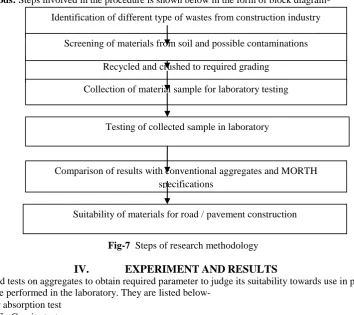
3.2. Methods: Steps involved in the procedure is shown below in the form of block diagram-
Fig-7 Steps of research methodology
IV.
EXPERIMENT
AND
RESULTS
Test related tests on aggregates to obtain required parameter to judge its suitability towards use in pavement layers were performed in the laboratory. They are listed below-
Water absorption test Specific Gravity test
Aggregate crushing value test Aggregates Impact value test
Aggregates Los Angeles Abrasion value test
The results obtained of various parameters are shown in the table-2 below-
Table 2: Details of Aggregate test results
Type of Material Water
absorption (%)
Specific Gravity(G)
Aggregate Crushing value (%)
Aggregate Impact value (%)
Los Angeles Abrasion value (%)
Brick masonry 10.42 2.15 63.80 59.52 73.20
Stone masonry (fresh) 5.10 2.40 37.20 30.50 35.80
Stone masonry (15 Yrs old) 6.95 2.25 39.40 32.40 37.62
Crushed concrete (fresh) 2.82 2.60 33.40 26.20 27.82
Crushed concrete(15yrs old) 4.62 2.50 34.20 28.92 29.82
Conventional aggregates 0.45 2.75 23.50 19.82 18.56
MORTH specification
Surface course Max. 1.0 2.5-3.0 Max. 40 Max. 30 Max. 40 Base course Max. 2.0 2.5-3.0 Max. 40 Max. 30 Max. 40
Fig-8 Results for Brick masonry
Identification of different type of wastes from construction industry
Recycled and crushed to required grading
Collection of material sample for laboratory testing
Testing of collected sample in laboratory
Comparison of results with conventional aggregates and MORTH specifications
The results of recycled brick aggregates are not encouraging as its being softer hence it can only be used in sub-base layer of pavement. The test results of various parameters are shown in figure- 7.
Fig-9 Results for Stone masonry (fresh)
The results of recycled stone masonry aggregates which are almost satisfying MORTH requirements as shown in figure-9 and figure- 10 shows that it can be used in all layer of pavements. However moisture absorption is on higher side.
Fig-10 Results for Stone masonry (15 yrs. old)
The results of recycled concrete aggregates which are satisfying MORTH requirements as shown in figure-10 and figure-11 shows that it can be used in all layer of pavements. However moisture absorption is slightly on higher side.
Fig-11 Results for Crushed concrete (fresh) Water absorption (%) Specific Gravity(G) Aggregate Crushing value (%) Aggregate Impact value (%) Los Angeles Abrasion value (%)
Series1 5.1 2.4 37.2 30.5 35.8
5.1 2.4 37.2 30.5 35.8 0 5 10 15 20 25 30 35 40 Valu es
Stone masonry (fresh)
Water absorption (%) Specific Gravity(G) Aggregate Crushing value (%) Aggregate Impact value (%) Los Angeles Abrasion value (%)
Series1 2.82 2.6 33.4 26.2 27.82
2.82 2.6 33.4 26.2 27.82 0 5 10 15 20 25 30 35 40 Valu es
Fig-12 Results for Crushed concrete (15 yrs. old)
The results of conventional aggregates as shown in figure-13 are well with in the range of MORTH requirements as shown in figure-13.
Fig-13 Results for Conventional Aggregate
V.
CONCLUSION
Based on the study and experimental investigations the following conclusion were drawn-
1.Crushed concrete can be effectively utilized almost in all layers of pavements as the test results are with in the range specified by MORTH.
2.Results indicated that brick masonry aggregates are relatively softer in comparison to other recycled aggregates, hence they can only be used in sub-base course of pavement.
3.Water absorption of all recycled aggregates were higher as compared to conventional aggregates. 4.All recycled aggregates are satisfying the specific gravity criteria except brick masonry aggregates.
5.Los Angeles abrasion values of all the recycled aggregates except brick aggregates were found to be with in the range prescribed by MORTH.
6.Last but not least, by utilizing wastes from construction industry in pavement construction it will provide a solution to the problem of disposal, cost effective pavement construction and minimization of environmental pollution.
REFERENCES
[1] Annette R. Hill, Andrew R. Dawson and Michael Mundy (2001) Utilization of aggregate materials in road construction and bulk fill. Res. Cons. Recycling.32(3), 305-320.
[2] Berendsen T (1997) Reuse of secondary building materials in road constructions. Studies Environ. Sci. 71(1), 831-840. Water absorption (%) Specific Gravity(G) Aggregate Crushing value (%) Aggregate Impact value (%) Los Angeles Abrasion value (%)
Series1 4.62 2.5 34.2 28.92 29.82
4.62 2.5 34.2 28.92 29.82 0 5 10 15 20 25 30 35 40 Valu es
Crushed concrete(15yrs old)
Water absorption (%) Specific Gravity(G) Aggregate Crushing value (%) Aggregate Impact value (%) Los Angeles Abrasion value (%)
Series1 0.45 2.75 23.5 19.82 18.56
[3] Ministry of Road Transport and Highways (MORTH) (2002) Specification for roads and bridges. Indian roads congress publication
[4] Pasetto M (2000) The re-utilization of discarded building materials in cement-stabilized layers of road and airfield pavements. Waste Management Series.1(1), 548-566
[5] Singh, S. K. and P. C. Sharma (1998)"Recycling and Reuse of Building Waste in Constructions- A Review," All India Seminar on Concrete for Infrastructural Development, Roorkee, pp 317-329.
[6] Hendricks, Ch.F. (1996), "Recycling and Reuse as a Basis of Sustainable Development in Construction Industry," Concrete for Environment, Enhancement and Protection, E&FN Spon, pp. 43-54.
[7] Ramammurthy, K. & Gumaste, K.S.(1998), "Properties of Recycled Aggregate Concrete," Indian Concrete Journal, pp. 49-53.