(Full length research article)
Study of Integrated Renewable Energies for Developing Countries - Scope and
Challenges
Ravindra Kumara and Bharat Bhushana* Shruti Mishrab
aDepartment of Mechanical Engineering, Gurgaon Institute of Technology, Gurgaon-122413, India b
Department Computer Engineering, Gurgaon Institute of Technology, Gurgaon-122413, India
Received 8 Feb. 2011; accepted 2 May 2012, Available online 1June 2012
Abstract
This paper focused on the integrated renewable energies for developing countries and also highlights on its scopes and challenging in developing countries such as India. A worldwide research and development in the field of renewable energy sources (RES) and systems is carried out during the last two decades. At the end of 2001 the total installed capacity of renewable energy systems was equivalent to 9% of the total electricity generation. By applying a renewable energy intensive scenario the global consumption of renewable sources by 2050 would reach 318 exajoules (1exajoule=1018 J) .Renewable energy projects in many developing countries have demonstrated that renewable energy can directly contribute to poverty alleviation by providing the energy needed for creating businesses and employment. Renewable energy technologies can also make indirect contributions to alleviating poverty by providing energy for cooking, space heating, and lighting. Renewable energy can also contribute to education, by providing electricity to schools.
Keywords: Renewable energies, development, education, electricity.
1. Introduction
1
Integrated renewable systems utilize two or
more renewable energy resources and end-use technologies to supply a variety of energy needs, often in a stand-alone mode. A knowledge-based design approach that minimizes the total capital cost at a preselected reliability level is presented. The reliability level is quantified by the loss of power supply probability. The role of renewable energy systems in meeting the energy needs of developing countries is examined in the context of the burgeoning fuel prices and the associated geopolitical realities and economic burdens. The acute energy needs and the unavailability of commercial fuels in the rural areas offer a rewarding opportunity for the utilization of locally available renewable energy sources. Small-scale decentralized integrated system concepts for harnessing renewable energy sources are discussed. The basic economic factors involved in the introduction of renewable energy sources in the rural areas of developing countries are outlined to assist the designer in the selection of appropriate components and system concepts. Today about 14% of the worldwide primary energy supply is provided by biomass resources — equivalent toCorresponding author’s email: [email protected]
1000 million tons oil each year. Most of this biomass use occurs in rural areas of developing countries where half the world’s population lives. For example Kenya derives about 75%, India 50%, China 33% and Brazil 25% of their total energy from biomass.
2. Renewable energy for developing countries
Most developing countries have abundant renewable energy resources, including solar energy, wind power, geothermal energy, wind energy and biomass, as well as the ability to manufacture the relatively labour-intensive systems that harness these. By developing such energy sources developing countries can reduce their dependence on oil and natural gas, creating energy portfolios that are less vulnerable to price rises. In many circumstances, these investments can be less expensive than fossil fuel energy systems [1].
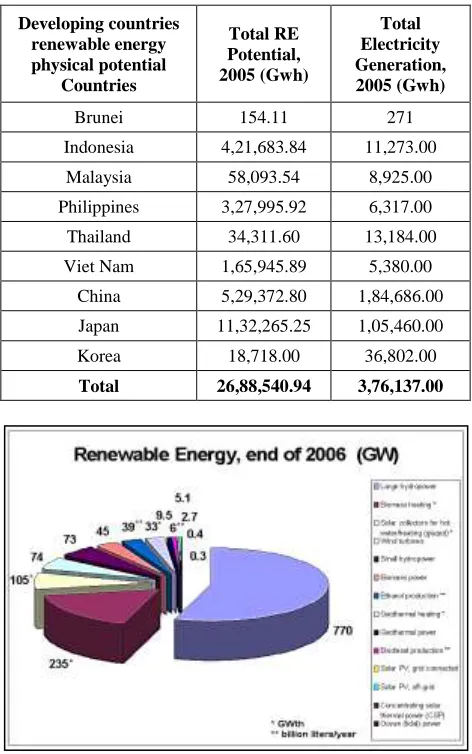
Developing countries have abundant renewable energy resources which can be used on a large scale. Table 1 shows the total physical potential, although it is not clear how much of this would be economically feasible.Figure1 shows the distributed part of renewable energy (GWth) of the end of 2006.
Table 1 Country wise production
Developing countries renewable energy physical potential
Countries
Total RE Potential, 2005 (Gwh)
Total Electricity Generation, 2005 (Gwh)
Brunei 154.11 271
Indonesia 4,21,683.84 11,273.00
Malaysia 58,093.54 8,925.00
Philippines 3,27,995.92 6,317.00
Thailand 34,311.60 13,184.00
Viet Nam 1,65,945.89 5,380.00
China 5,29,372.80 1,84,686.00
Japan 11,32,265.25 1,05,460.00
Korea 18,718.00 36,802.00
Total 26,88,540.94 3,76,137.00
Fig.1 Distribution of renewable energy source
3. The principle types of renewable energies available today are:
1. Solar Energy 2. Hydro power 3. Biomass Energy 4. Wind Energy 5. Other energies
3.1 Solar Energy for developing country (India):
3.1.1 Introduction: Solar energy is the radiant light and heat from the Sun that has been harnessed by humans since ancient times using a range of ever-evolving technologies. Solar power technologies provide electrical generation by means of heat engines or photovoltaic’s. Once converted its uses are only limited by human ingenuity. A partial list of solar applications includes space heating and cooling through solar architecture,
lighting, hot water, thermal energy for cooking, and high temperature process heat for industrial purposes.
3.1.2 Status of solar power: India's power sector has a total installed capacity of approximately 1, 46,753 Megawatt (MW) of which 54% is coal-based, 25% hydro, 8% is renewable and the balance is the gas and nuclear-based. Power shortages are estimated at about 11% of total energy and 15% of peak capacity requirements and are likely to increase in the coming years. In the next 10 years, another 10,000 MW of capacity and investment of about Rs. 24 lakh crore are required
.
3.1.3 Scopes and Challenges of solar Energy:
3.1.3.1 Major Scopes are:
Some large projects have been proposed, and a 35,000 km² area of the Thar Desert has been set aside for solar power projects, sufficient to generate 700 to 2,100 gigawatts. The major component of any solar system is the solar collector. Solar energy collectors are special kind of heat exchangers that transform solar radiation energy to internal energy of the transport medium [2]. Solar energy systems are solar home system, solar photovoltaic (SPV) systems, solar water heating (SWH) systems, solar dryers, and solar cookers. These systems are installed and managed by a household or a small community. A solar home system is a PV system with a maximum capacity of 40 W. These systems are installed and managed by a household or a small community.
3.1.3.2 The major challenges are:
1. High Capital Cost: The average cost of Solar PV modules was around Rs. 2 lakhs per kW.
2. Manufacturing Process: Solar PV cell manufacturing is a technology-intensive process requiring high expertise and know-how. Besides, the technology landscape in the Solar industry PV space is changing quite rapidly with innovations and R&D. It is challenging for new entrants to replicate the success of companies having a long standing in the Solar PV market.
3.Raw Material and Waste Products : Some of the materials (like Cadmium) used for producing Solar PV cells are hazardous and other raw materials like plastics used for the packaging of the cells are non-biodegradable, thereby impacting the environment.
4. Land scarcity: The amount of land required for utility-scale solar power plants - currently approximately 1 sq km for every 20-60 megawatts (MW).
7th place worldwide in Solar Photovoltaic (PV) Cell production and 9th place in Solar Thermal Systems with nations like Japan, Europe, China, and the US currently ranked far ahead. Globally, solar is the fastest growing source of energy (though from a small base) with an annual average growth of 35%, as seen during the past few years [3].
3.2 Hydro power for developing countries:
3.2.1 Introduction: The water in rivers and streams can be captured and turned into hydropower, also called hydroelectric power. Large scale hydro power provides about one-quarter of the world's total electricity supply, virtually all of Norway's electricity and more than 40% of the electricity used in developing countries. There are two small-scale hydropower systems: micro hydropower systems (MHP) with capacities below 100 kW and small hydropower systems (SHP) with capacity between 101 kW and 1 MW. Large-scale hydropower supplies 20% of global electricity. In the developing countries, considerable potential still exists, but large hydropower projects may face financial, environmental, and social constraints.
3.2.2 Status of hydro power: Developing country such as India has an estimated SHP potential of about 15 000 MW. So far, from 495 SHP projects, an aggregate installed capacity of 1693 MW has been installed. Besides these, 170 SHP projects with an installed capacity of 479 MW are under implementation. The database for SHP projects created by the Ministry of Non-Conventional Energy Sources (MNES) now includes 4233 potential sites, with a total capacity of 10 324 MW. 3.2.3 Scopes and Challenges of Hydropower:
While hydropower plays an important role in the energy and development strategies of India, such natural resource projects are inherently challenging. Environmental and social impacts are inevitable but they can be mitigated. Hydropower development in India has seen significant strides in understanding and addressing these impacts and the lessons learned from past engagements are now being incorporated in project selection and design.
There are several major challenges of hydroelectric systems. These include: dislocation of people living where the reservoirs are planned, release of significant amounts of carbon dioxide at construction and flooding of the reservoir, disruption of aquatic ecosystems and birdlife, adverse impacts on the river environment, potential risks of sabotage and terrorism, and in rare cases catastrophic failure of the dam wall.
3.3. Biomass Energy for developing countries:
3.3.1 Introduction: Biomass power, also called bio power, is electricity produced from biomass fuels. Biomass consists of plant materials and animal products. Biomass fuels include residues from the wood and paper products industries, residues from food production and processing, trees and grasses grown specifically as energy crops, and gaseous fuels produced from solid biomass, animal wastes, and landfills.
3.3.2 Status of biomass: Biomass energy currently represents approximately 14% of world final energy consumption, a higher share than that of coal (12%) and comparable to those of gas (15%) and electricity (14%). Biomass is the main source of energy for many developing countries and most of it is non-commercial. Biomass is the name given all the earth's living matter. 3.3.3 Scopes and Challenges of Biomass Energy:
3.3.3.1 The major Scopes are:
1. Modular bio power systems are a good choice for developing countries that have limited central power grids. Many of the more than 2.5 billion people who live without reliable electricity inhabit areas where large amounts of biomass are available for fuel. Small bio power systems can power villages and local industries. 2. The use of biomass can reduce dependence on foreign oil [4].
3. Biomass can be used for fuels, power production and products that would otherwise be made from fossil fuels. 3.3.3.2 The major Challenges are:
1. Collecting sufficient quantities of waste can be difficult.
2. Burning the fuel creates greenhouse gases, although only a very little.
3. Certain materials aren't always available.
4. Today’s bio power plants have generation costs higher than those of fossil fuel generation.
5. Biomass fuels contain less concentrated energy, are less economic to transport over long distances, and require more preparation and handling than fossil fuels. These factors contribute to higher costs.
3.4 Wind power for developing countries:
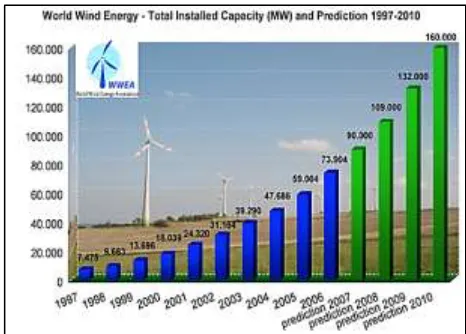
Fig.2 World wind energy-total installed capacity (MW) and prediction 1997-2010
3.4.2 Status of wind power: The Indian wind energy sector has an installed capacity of 9587 MW (as on November 30, 2008). In terms of wind power installed capacity, India is ranked 4th in the World. Today India is a major player in the global wind energy market. Although wind produces only about 1.5% of worldwide electricity use, it is growing rapidly, having doubled in the three years between 2005 and 2008. In several countries it has achieved relatively high levels of penetration, accounting for approximately 19% of electricity production in Denmark, 10% in Spain and Portugal, and 7% in Germany and the Republic of Ireland in 2008.
3.4.3 Scopes and challenges of wind power:
3.4.3.1 The major Scopes are:
1. Most of the energy stored in these wind movements can be found at high altitudes where continuous wind speeds of over 160 km/h (100 mph) occur. Eventually, the wind energy is converted through friction into diffuse heat throughout the Earth's surface and the atmosphere. 2. Although wind turbines can be very tall each takes up only a small plot of land. This means that the land below can still be used. This is especially the case in agricultural areas as farming can still continue.
3. Remote areas that are not connected to the electricity power grid can use wind turbines to produce their own supply.
4. Wind turbines have a role to play in both the developed and third world.
3.4.4.1 The major Challenges are:
1. Very diffuse source means low energy productionlarge numbers of wind generators (and thus productionlarge land
-areas) are required to produce useful amounts of heat or electricity .
2. Only areas of the world with lots of wind are suitable for wind power generation
3. Relatively expensive to maintain
4. The strength of the wind is not constant and it varies from zero to storm force. This means that wind turbines do not produce the same amount of electricity all the time [5].
4. Other energies
Geo thermal energy, Marine energy, biogas from animal wastes, landfill gas, hydrogen and peat energy are the other RES. Marine energy sources are current, tidal, ocean thermal energy conversion (OTEC) and wave technologies. The world wave resource is between 200 and 5000 GW mostly found in offshore locations.
5. Developing country market
Renewable energy can be particularly suitable for developing countries. In rural and remote areas, transmission and distribution of energy generated from fossil fuels can be difficult and expensive. Producing renewable energy locally can offer a viable alternative. Kenya is the world leader in the number of solar power systems installed per capita (but not the number of watts added). More than 30,000 very small solar panels, each producing 12 to 30 watts, are sold in Kenya annually. For an investment of as little as $100 for the panel and wiring, the PV system can be used to charge a car battery, which can then provide power to run a fluorescent lamp or a small television for a few hours a day. More Kenyans adopt solar power every year than make connections to the country’s electric grid.
6. Main renewable energy sources and their usage forms
Table 2 Energy conversion and usage options
Energy
source Energy conversion and usage options
Hydropower Power generation
Modern biomass
Heat and power generation, pyrolysis, gasification, digestion
Geothermal Urban heating, power generation, hydrothermal, hot dry rock
Solar Solar home system, solar dryers, solar cookers
Conclusion
The main conclusion of this paper the demand will increase in the coming years due to economic globalization. The estimated power shortage in India in the next five years is about 43,000 MW. Though India boasts of generating eco-friendly energy sources during the coming millennium, the present power generated through non-conventional sources is far less than the installed capacity of the power plants. At a time when renewable comprise just 11.5% of energy source in the United States, India stands tall with renewable accounting for 32% of total electricity generation capacity. Even China and Japan trail behind India at 21 and 20 per cent respectively. Recent reports suggest the share of renewable in the Indian electricity basket is expected to rise to 15 per cent by 2030 from less than five per cent currently. For developing countries like India, the global slowdown is an avenue for replacing archaic infrastructures and upgrading and building transportation, communication, energy and water systems in a sustainable manner.
References
1. S A Abbasi and Naseema Abbasi (1999), Renewable energy sources and their environmental impact
2. A. Demirbas (2000), Recent advances in biomass conversion technologies, Energy Edu Sci Technol 3. Economic Times ( 1999). Times of India Publication. dated
8 June 1999. 4. www.wikepedia.org.