A Novel Classifier for Gender Classification from Iris
Code used for Recognition
1 Anupama B.L; 2 Sanaj M.S; 3 Asha Paul; 4 Dr. D. Loganathan
1 Student, Final Year M. Tech - Cyber Security, MET’S School of Engineering,
Mala, Thrissur, Kerala, India
2 Associate Professor, Department of CSE,MET’S School of Engineering,
Mala, Thrissur, Kerala, India
3 Assistant Professor, Department of CSE, MET’S School of Engineering,
Mala, Thrissur, Kerala, India
4 Professor, Department of CSE, MET’S School of Engineering,
Mala, Thrissur, Kerala, India
Abstract -Biometric is the measurement and statistical analysis of human body characteristics. Biometric recognition is the use of biological measurements of an individual for identification purposes. Iris recognition system include image acquisition, Segmentation, normalization, features extraction, encoding and classification. Iris images are downloaded from CASIA Iris V1.0 database. Canny edge detection is used to detect the edges of the eye image. Hough Transform is used to separate the iris region from the eye image. Also to localize circular iris and pupil region of eye image, a circular Hough transform is used. Normalization technique convert the polar coordinated into Cartesian coordinates. These Normalized image is used for feature extraction. Feature extraction is performed by convolving the normalized iris region with Gabor wavelet, GLCM, etc. Depend on different features selection methods, find the feature set. Finally to classify the eye images using SVM and ANN classifiers depends on features extracted from the database images.
Keywords - CASIA, GLCM, SVM, ANN.
1. Introduction
iometric is the measurement and statistical analysis of human body characteristics. Biometric recognition is the use of biological measurements of an individual for identification purposes. Biometrics can be stored in two classes (1) Physiological (2) Behavioral. Physiological characteristics include the biometric authentication such as face, fingerprint, hand geometry and iris recognition. Behavioral characteristics are related to the pattern of the behavior of person such as signature and voice. Gender classification is an important problem of computer view. Gender recognition is useful in the area of forensics Science, security system. Most work on gender classification has involved the analysis of face image. Iris recognition an accurate and reliable biometric authentication system. A colored ring around the pupil of the eye is known as iris, and it is a thin circular diaphragm, which lies between the cornea and the lens of the human eye. The iris is perforated close to its center by a circular aperture known as the pupil. The function of the iris is to control the amount of light entering through the pupil. The high security application uses iris method. The concept of iris recognition was first
roposed by Dr.Frank Burch in 1939. It was first implemented in 1990 when Dr.John Daugman created the algorithm for it.
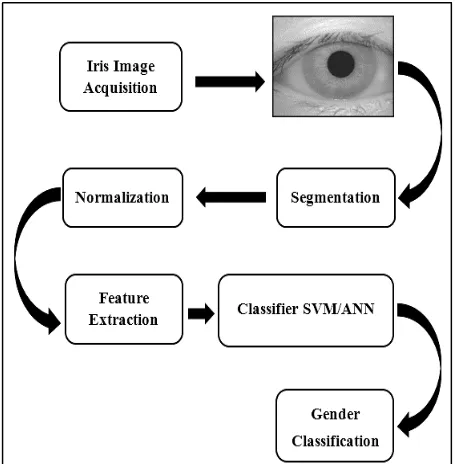
Fig 1: The Architecture of Iris Recognition System
These algorithms employ methods of pattern recognition and some mathematical calculation for iris recognition. The Architecture of Iris Recognition shown in Fig.1: Iris Image acquisition, segmentation, Normalization, Feature extraction and classification are the different stages in iris recognition.
2. Iris Image Acquisition
To capture the image of human’s eye is called as iris image acquisition. The captured image must be of high quality to work for iris recognition. The acquired image of eye must have good resolution and clarity for supporting the better recognition. The illumination in the image must be removed because illumination will results in poor quality images with lots of reflection.
For capturing good quality images with high resolution and low illumination, infrared camera should be used.For the purposes of implementing and testing our application we were supplied with the Chinese Academy of Sciences Institute of Automation (CASIA) iris database. The first task was therefore to implement the functionality of loading images into the application from this database.
2.1 CASIA
The CASIA database includes 756 iris images from 108 eyes, hence 108 classes.
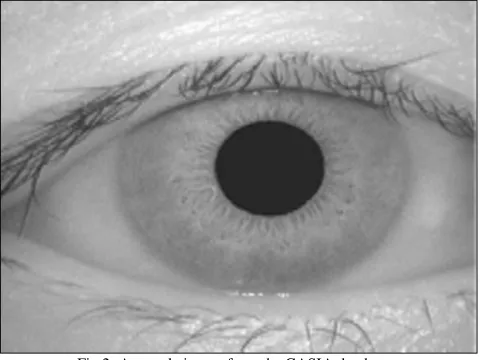
Fig 2: A sample image from the CASIA database
For each eye, 7 images are captured in two sessions, where three samples are collected in the first session and four in the second session. The images are stored as bitmaps in a hierarchical directory structure. An example image from CASIA is shown in figure 2.
3. Segmentation
Once an image has been loaded into the recognition system it is necessary to be able to specify to the feature extraction algorithm where the iris texture information is located in the image. This can be done manually by the user, or automatically by the software. In iris recognition system, finding the pupil and iris area are important. The following steps are used to find the boundary of iris
3.1 Canny Edge Detection
It is used to detect the iris edges. It gives the major edges of the eye from which iris boundary can easily be localized. For the elimination of noise and obtain the smooth images, this method is used. It uses probability for finding errors. It has complex computations. But it consumes less time and less memory complexity. It is very simple method. Canny edge detection perform Gaussian filtering, for that we have to set the size of x and y, also the σ² as the kernel is described as follows.
1 2
2 1 Convolute the kernel obtained as per the above equation (1) and the image. Find the gradient in the x and y direction and hence the
2 When x is the gradient in x direction and y is the gradient in the y direction. Find the orientation of the edge by equation (3) and convert them all to degree.
3
3.2 Gamma correction
Hence we enhance the image through the formula ᵞ (4) Here C=1
V=image γ=gamma
If γ is less than one, it enhances the light region. Whereas if
γ is greater than one it enhance the content in dark region.
3.3 Non-maximum suppression
Eliminate the weak edges that are parallel to strong edge.
3.4 Perform Thresholding
T22T1 (5)
3.5 Hough Transform
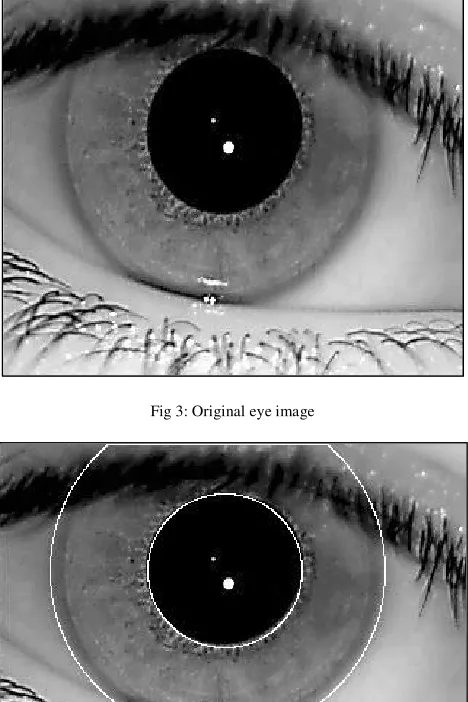
It is expressed as in the term of angle and radius. Hough Transform is a standard computer version algorithm that can be used to determine the parameter of the sample geometric objects. From the edge map obtained from the above steps votes are east in Hough space for the parameter of circles passing through each edge point.
x r cos( y r sin ( 6 Repeat the same steps for pupil. Find the top eyelid and bottom eyelid .Draw the circle exempting the eyelids.
Fig 3: Original eye image
Fig 4: Segmented eye image
4. Normalization
Normalization refers to preparing a segmented iris image for the feature extraction process in iris recognition system. In Cartesian coordinates, iris images are highly affected by their distance and angular position with respect to the camera. Moreover, illumination has a direct impact on pupil size and causes non-linear variations of the iris patterns. A proper normalization technique is expected to transform the iris image to compensate these variations. Once the limbic and pupillary boundaries are detected, during the normalization, the iris is converted to a standard (predefined, fixed) size, and then encoded in an iris template for matching between the iris templates.
Typically, the process is a conversion from Cartesian to non-concentric polar representation. The polar coordinate grid is not always concentric, because in most eyes pupil is not central to the iris. Daugman et al. [4] derived the formula:
I X r,θ,Y r,θ----I r,θ 7 With
X r,θ 1-rXp θrX1 θ 8
Y r,θ 1-rYp θrYl θ 9
The coordinates of the pupil and iris boundaries along the θ
direction are Xp, Yp, Xl, Yl. In different eye images from
the same subject, changes in the iris pattern occur due to pupil dilation or constriction. The conversion to a dimensionless form also ensures the iris pattern is not influenced by magnification and image distance acquisition factors. John Daugman's rubber sheet model [9] ensures the proper handling of the matter due to the specifics of the iris. Figure 5 shows an image of an iris with detected pupillary and iris boundaries and the normalized region. Figure 6 shows normalized eye image.
Fig 5: Rubber Sheet Unwrapping
be eliminated at the matching stage with simple bit-shifting of the encoded iris template.
Fig 6: Normalized image of Iris
5. Methods
5.1 Feature Extraction
The iris has various structures which provide texture information. To authentic the individuals, the most distinguishing features that present in the region is extracted. Various methods for feature extraction are Wavelet Transform, Gabor filter, GLCM, and Tamura is used.
5.1.1Wavelet transform
Wavelet can be used to decompose the data in the iris region into component that after at different resolution. Wavelet have the advantage over Fourier transform in the frequency data is localized, allowing features which occur at the name position and resolution to be matched up.
5.1.2 Gabor wavelet
Gabor filter are able to provide conjoint representation of signal in spatial frequency and space. It is constructed by modulating a sin/cosine wave with arguments. This is done a sine wave is perfectly localized in frequency but not in space. Decomposition of a signal is accomplished using quadrate pair of Gabor filter, with real part specified by cosine modulated by a Gaussian and the imaginary part specified by a modulated by Gaussian. The real and imaginary filter are also known as even symmetric and odd symmetric respectively.
The disadvantage of the Gabor filter is that the even symmetric filter will have a DC component whenever the bandwidth is larger than one octave. Zero component can be obtained for any bandwidth by using a Gabor filter which is Gaussian on a logarithmic scale.
5.1.3 GLCM
The Grey Level Co-occurrence Matrix (also called the Grey Tone Spatial Dependency Matrix).The GLCM is a tabulation of how often different combinations of pixel brightness values (grey levels) occur in an image. The GLCM is usually defined for a series of "second order" texture calculations. Second order means they consider the
relationship between groups of two pixels in the original image.
First order texture measures are statistics calculated from the original image values, like variance, and do not consider pixel relationships. Third and higher order textures are theoretically possible but not implemented due to calculation time and interpretation difficulty.
GLCM texture considers the relation between two pixels at a time, called the reference and the neighbour pixel. Let, the neighbour pixel is chosen to be the one to the east (right) of each reference pixel. This can also be expressed as a (1, 0) relation : i, j -> i1, j. Pixel within the window becomes the reference pixel in turn, starting in the upper left corner and proceeding to the lower right.
5.1.4. Tamura
Tamura’s features are based on physiological studies of the characterizing element that are perceived in texture by humans,
• Contrast • Directionality • Coarseness • Linelikness • Regularity • Roughness.
5.2. Mutual information
One of the way for the data driven creation for ranking features according to their influences in distinguishing classes is mutual information. Maximum mutual information criteria defined as,
A set of classes G = {g1, g2………., gk}
A m-dimensional finite valued featured vector
Fm =V1× V2×…………..Vm Where Vm are all finite sets.
A set of n data points of the form (X, g) Where X ∈ F and g ∈ G.
We want to determine the component of X that are most useful in distinguishing between the different classes. A reasonable metric for the degree to which a particular component can predict a class is the mutual information between the value of that component and the value of the class in the data.
To calculate this quantity, define two random variable 1) Xi, the ith component of X in a given data point.
The mutual information between Xi and C for a data points.
I Xi,CH C-H C/Xi 10
Since H(C) is the same for all value of i, for the purpose of determining the ordering if it is sufficient to calculate H(C/Xi)
H C/Xi - Σ ΣP C, Xi log P C/Xi, C ∈ G X ∈ Ui 11 Here P C, Xi is the joint probability of seeing a data point
of class C with ith component X.
P C/Xi is the probability of seeing a point of class C given that the ith component is X. The most discriminative
component will be the value of above equation. Which has the largest, the next most discriminative component will be the value with the second largest value.
6. Classification
Classification is the problem of identifying which of the set of categories a new observation belongs, on the basis of a training set of data containing observations whose category membership is known. For the purpose of matching or classification, various methods are used. Hamming Distance, Weighted Euclidean Distance, Normalized Correlation, Support Vector Machine (SVM) and Artificial Neural Network (ANN). In this paper, SVM and ANN are used as a classifier for pattern classification to identify individual’s identity based on Iris code.
6.1 Support Vector Machines.
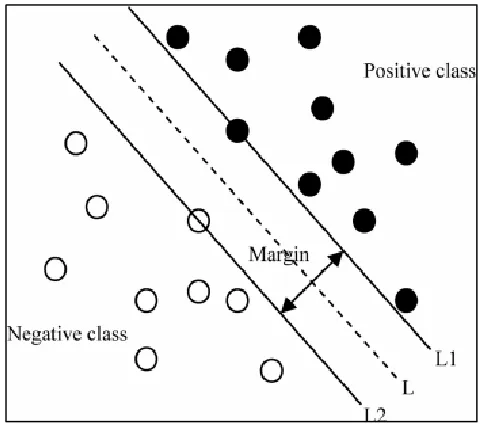
SVM works on principle of structural risk minimization as shown in fig 4. SVM is a binary classifier that separates two classes.
Two important aspects for developing SVM as a classifier are determination of the optimal hyper plane which will optimally separate the two classes and the other is transformation of non-linearly separable classification problem [7][8][10] into linearly separable problem. Linearly separable binary classification problem with no possibility of miss-classification data is shown in Fig. 7. Let a set of input feature vector and the class label are X and Y. The input feature vectors and the class label can be represented as {Xi, Yi} where i =1, 2,…,N and X =±1. The separating hyper-plane is,
W. X + b = 0 (12) Which implies,
Yi (W. Xi . b) > = 1 , i= 1, 2,…N
Fig 7.SVM with linear separable data.
Basically, there are numerous possible values of {W,b} that create separating hyper-plane. In SVM only hyper-plane that maximizes the margin between two sets is used. The optimal hyper-plane maximizes the sum of the distances to the closet positive and negative training patterns. The sum is called as margin [3][1][2].
For non-linear case, training patterns are constructed onto a high dimensional space using kernel functions. Most commonly used kernel functions are polynomial, sigmoid and Gaussian radial basis function.
The SVM in general makes four possible decision in iris recognition; the authorized person is accepted, the authorized person is rejected, the unauthorized person (impostor) is accepted and the unauthorized person (impostor) is rejected.
6.2. Artificial Neural Network.
Fig 8. Structure of BP neural network
In this paper, a feed forward neural network using back propagation (FFBP) algorithm is used for iris pattern classification. The structure of back propagation neural network is shown in Fig. 8. The error back-propagation training algorithm is used to adjust the internal neural network weights. After activation of neural network, the back propagation learning algorithm is applied for training [11].
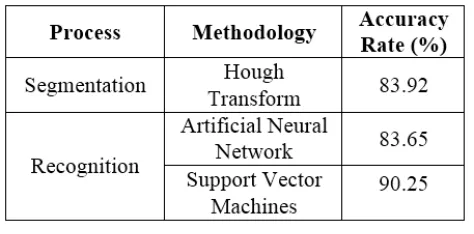
Table 1: Accuracy rate of iris segmentation and recognition.
7. Results
The Chinese Academy of Sciences Institute of Automation (CASIA) version 1 eye image database is used in the experiment. CASIA v1 eye image database contains 756 eye images from 108 individuals. All images are stored in BMP format with resolution of 320*280 pixels. Experiments are performing in two steps: iris segmentation and iris recognition. All experiments were performed by using MATLAB version R2014a on core- i3 processor.
8. Conclusion
An efficient classifier using iris code for gender prediction is performed. CASIA version 1 eye image database is used in the experiment. CASIA v1 eye image database contains 756 eye images from 108 individuals. Iris recognition system consists of image acquisition, Segmentation, normalization, features extraction, encoding and classification. Canny edge detection is used to detect the edges of the eye image. Hough Transform is used to separate the iris region from the eye image. SVM gives the classification rate of 90.25%. On other hand, ANN use back propagation neural network for classification of iris patterns. The training data for ANN is same as SVM and the target has to give to the ANN. ANN gives the accuracy rate of 83.65% for classification.
References
[1] J. E. Tapia and C. A. Perez, Kevin W. Bowyer “Gender Classification From the Same Iris Code Used for Recognition,” IEEE Transactions On Information Forensics And Security, Vol. 11, No. 8, August 2016 . [2] J. E. Tapia, C. A. Perez, and K. W. Bowyer, “Gender
classification from iris images using fusion of uniform local binary patterns,” in Proc. Eur. Conf. Computing. Vis., Soft Biometrics Workshop (ECCV), 2014, pp. 751–763. [3] B. Son, H. Won, G. Kee and Y. Lee, „„Discriminant Iris
Feature and Support Vector Machines for Iris Recognition‟‟, International Conference on Image Processing, 2004.
[4] John Daugman. How iris recognition works. In Image Processing. 2002. Proceedings.2002 International Conference on, volume 1, pages I36, 2002.
[5] Zeng J, Liu ZQ. Type-2 fuzzy hidden Markov models to phoneme recognition, Proceedings of the International Conference on Pattern Recognition (ICRP), Cambridge 2004: 192-195.
[6] Hideyuki Tamura, Shunji Mori, and Takashi Yamawaki,” Textural Features Corresponding to Visual Perception” IEE transactions on systems. Man, and cybernetics, vol. Smc-8, no. 6 June 1978.
[7] N. Cristianini, T. D. Shawe, “An Introduction to Support Vector Machines and other Kernel-based Learning Methods”, Cambridge University press, Cambridge (2000).
[8] Namitha Shajan & Dr.D.Loganathan 2016, ‘Edge Preserving Decomposition-Based Haze Removal in Video Sequence Using Koschmiedars Law’ International Journal of Computer Science and Information Technologies, Vol. 7 (3) , pp 1263-1266
[9] J. Daugman, “High confidence visual recognition of persons by a test f statistical independence”, IEEE Trans. Pattern Analysis and Machine Intelligence, vol. 15, pp. 1148- 1161, 1993.
[11] Rahib H. Abiyev and Koray Altunkaya, “Personal Iris Recognition Using Neural Network” ,International Journal of Security and its Applications, vol. 2, no. 2, April, 2008.
Authors -
Anupama B.L received the B.Tech degree in Computer Science
and Engineering from Calicut University, Kerala, India, in 2015, and currently doing M.Tech in Cyber Security in MET’S School of Engineering,Mala - Abdul Kalam Technological University , Kerala, India.
Sanaj M.S is an Associate Professor in MET’S School of
Engineering Mala, Thrissur, Kerala. Received B.Tech degree from CUSAT .and M.Tech from MS University Tirunelveli, Tamil Nadu. He has more than 4 years of teaching experience. He has presented paper on International Conferences.
Asha Paul is an Assistant Professor in MET’S School of
Engineering Mala, Thrissur, Kerala. Received B.Tech degree in Information Technology from East Pont College of Engineering, Bangalore and M.Tech from Karunya University, Coimbatore. She has more than 3 years of teaching experience. Subject of interest are Data Structures, \computer Organization and Design, Object Oriented Programming, C Programming and Digital Data Communication. She has presented paper on International Conferences.
Dr. D. Loganathan is a Professor and Head of Computer Science