EVALUATION OF ORAL HEALTH AWARENESS, PRACTICES
HEALTH EDUCATIONAL PROGRAMAMONG ELEMENTARY SCHOOLS
Bader AlShammari*, Adel Alshammari, Mohammed Alquraishi, Hamoud
Khalid Alshammari
A R T I C L E I N F O
INTRODUCTION
Dental health is considered one of the aspects which contribute to general health either medically, physically
socially and not merely the absence of disease or infirmity 26). There are progressing levels of dental diseases in developing countries where the community based
oral care programs are not structured(27)
problems have invaded Saudi populations and it is still occurring. Al-Sekait and Al-Nasser reported that the prevalence of dental caries was 52% among 6
children in 1988 (28).Whilst another study by Akpata that 64%-74% of dental caries was found in 12
children in 1997 (29). Furthermore, Al-shammery reported that urban population has a 74% dental caries for urban and 67% for rural population in 1999 (30).While in 2006, there was an increasing in prevalence in dental caries, 93.7% was found in 12-14 years old children(31). However, dental is
occurring in KSA only, several studies have encountered dental diseases in children. AnandHiremath
the overall caries prevalence was 78.9% , mean dmft was 2.97±2.62 and mean DMFT was 0.17±0.53 in india CristianFunieru et al said that the mean DMFT value for the entire sample was 2.8, and its highest component was decayed teeth (mean DT 2)(Romania 2012)(33).
International Journal of Current Advanced Research
ISSN: O: 2319-6475, ISSN: P: 2319-6505,
Available Online at www.journalijcar.org
Volume 8; Issue 09 (E); September 2019
DOI: http://dx.doi.org/10.24327/ijcar.2019
Copyright© 2019 Bader AlShammari et al. This is an open access article distributed under the Creative Commons Attribution License, which permits unrestricted use, distribution, and reproduction in any medium, provided the original work is properly cited.
Article History: Received 10th June, 2019
Received in revised form 2nd July, 2019
Accepted 26th July, 2019
Published online 28thSeptember, 2019
Key words:
Oral Awareness, Educational Program, children, Dental, Health, Hail
*Corresponding author: Bader AlShammari
OF ORAL HEALTH AWARENESS, PRACTICES AND EFFECTIVENESS OF ORAL
HEALTH EDUCATIONAL PROGRAMAMONG ELEMENTARY SCHOOLS CHILDREN
KINGDOM OF SAUDI ARABIA
, Adel Alshammari, Mohammed Alquraishi, Hamoud
Khalid Alshammari and Hatem Alshammari
A B S T R A C T
Background: Disciplinary efforts by health workers along with parents and
program can help school children to expand knowledge and to establish positive attitudes and behaviors toward dental health. Aim & objectives: The primary objective of the study is to evaluate how much
after 6 months and one year after oral health educational program. Second objective is to improve children awareness, practices and attitude toward dental health and to recognize the etiology
diseases in Saudi children even after the beginning of oral educational programs and establish a baseline further explorations.
Materials & Methods: It was an observational study with a comparative design sampling technique. Sample size was 529 participants with age ranging between 8 selected based on geographic criteria. Study tools were 3 sets of self-admitted
concerning oral health knowledge and practices. First set of the questionnaires represented the base line data. The second set of questionnaires were given after 6 months period and the
was displayed and analyzed on Statistical Package of Social Sciences, SPSS version 20. Data was displayed as number and percentage.
Results: At base line, 34% of children brush twice daily and increased up
the role of dental plaque increased by 41.6% after 6 months. Gingival disease awareness improved by 21.3% at follow up. Conclusion: oral health programs proved that can be beneficial to improve
attitudes toward oral health. Because of the limited evidence based in the kingdom of such regard, it is advisable to do more studies in this topic. Due to the deficient knowledge of school children in
to provide more efforts to correct this issue
Dental health is considered one of the aspects which contribute general health either medically, physically, mentally and and not merely the absence of disease or infirmity (1-. There are progressing levels of dental diseases in developing countries where the community based-preventive (27). Dental health problems have invaded Saudi populations and it is still Nasser reported that the prevalence of dental caries was 52% among 6-15 years school .Whilst another study by Akpata et al said 74% of dental caries was found in 12-15 years shammery reported that urban population has a 74% dental caries for urban and 67% .While in 2006, there was an increasing in prevalence in dental caries, 93.7% was found in . However, dental issues are not occurring in KSA only, several studies have encountered dental diseases in children. AnandHiremath et al reported that the overall caries prevalence was 78.9% , mean dmft was 2.97±2.62 and mean DMFT was 0.17±0.53 in india(32). said that the mean DMFT value for the entire sample was 2.8, and its highest component was decayed
While, in Senegal the prevalence of dental cari 1989 and 52.7% in 1994 (34)
preventable when the oral health education was provided in schools (35).
In addition to Parental education level which will reflect mostly on the caries scores by extending knowledge, attitude and practice towards oral health
preventive programmes consisting of dental health education lectures are effective in changing the knowledge, attitude and practice about oral health of the children as well as in preventing and controlling the common dental diseases
In Saudi Arabia, caries prevelance was 52% in 1986 While the oral heath preventive programs started in 1993 caries prevelance was increasing upto 92% in 2002
Indian study showed that the prevalence of dental caries was an approximately 60% in 2005
study for preventive programs showed that there are improvements in oral health knowl
reductions in plaque and gingival scores DMFT of the study population in 2016 was 0.36
below than that of children aged 12 years in Senegal, which was 2.6 in 1999 according to Sembène
observed an improving of oral
caries prevalence in 2007 decreased by 16.7% in 6 year children and 24.8% in 12 year
values registered in 1992 (42,43)
International Journal of Current Advanced Research
6505, Impact Factor: 6.614
www.journalijcar.org
September 2019; Page No.20022-20026
//dx.doi.org/10.24327/ijcar.2019.3898.20026
This is an open access article distributed under the Creative Commons Attribution License, which permits unrestricted use, distribution, and reproduction in any medium, provided the original work is properly cited.
ammari
AND EFFECTIVENESS OF ORAL
CHILDREN IN HAIL CITY,
, Adel Alshammari, Mohammed Alquraishi, Hamoud Alanizy,
Disciplinary efforts by health workers along with parents and teachers through organized educational expand knowledge and to establish positive attitudes and behaviors toward The primary objective of the study is to evaluate how much information were left educational program. Second objective is to improve children awareness, ize the etiology behind the increased progression of dental after the beginning of oral educational programs and establish a baseline data for
omparative design having a systematic random participants with age ranging between 8-11 years old. Schools were admitted questionnaires having the same items practices. First set of the questionnaires represented the base line data. The second set of questionnaires were given after 6 months period and the third set was giving after 1 year. The data Statistical Package of Social Sciences, SPSS version 20. Data was displayed
twice daily and increased up to 54.8% after six months. Understanding by 41.6% after 6 months. Gingival disease awareness improved by 21.3% at 1year Conclusion: oral health programs proved that can be beneficial to improve children awareness and evidence based in the kingdom of such regard, it is advisable to studies in this topic. Due to the deficient knowledge of school children in the base line data, we recommend
While, in Senegal the prevalence of dental caries was 52.1% in (34). Luckly, dental diseases are preventable when the oral health education was provided in
In addition to Parental education level which will reflect mostly on the caries scores by extending knowledge, attitude e towards oral health (33). The community based preventive programmes consisting of dental health education lectures are effective in changing the knowledge, attitude and practice about oral health of the children as well as in preventing and controlling the common dental diseases (36).
In Saudi Arabia, caries prevelance was 52% in 1986 (28). While the oral heath preventive programs started in 1993 (37), was increasing upto 92% in 2002 (38). An prevalence of dental caries was an approximately 60% in 2005 (39) , but in 2010 there was study for preventive programs showed that there are improvements in oral health knowledge, practices and reductions in plaque and gingival scores (40). The mean DMFT of the study population in 2016 was 0.36 (41) well below than that of children aged 12 years in Senegal, which was 2.6 in 1999 according to Sembène(34). A Romanian study observed an improving of oral health of schoolchildren, as caries prevalence in 2007 decreased by 16.7% in 6 year-old children and 24.8% in 12 year-old children, compared to the (42,43). Since children are much
Research Article
more adaptable than adults to modulate a proper dental health practices and make it as habit in a young age and for the life time. Disciplinary effort must be provided by health care workers through organized oral health programs in equal with a cooperation of parents at homes. To the best of our knowledge, there is a limited studies in the kingdom with such regard.
The primary objective of this study is to evaluate how much information were left after 6 months and one year after oral health educational program. Secondary objective is to improve children awareness, practices and attitude toward dental health and establish a baseline data for further explorations.
MATERIALS & METHODS
Since the study target was children, five urban schools were chosen in different locations to have a sufficient study sample. Schools were divided based on a geographic criteria into north, south, west, east and centre. Inclusion criteria were: 1-governmental schools with learning resources. 2-age group was 8-11 years old. 3-only male students were chosen. Exclusion criteria were:1-students who are older than 11 or younger than7 years old. 2-students who did not answer all questions.3-students who chose more than one answer. A written informed consent was taking from schools prior conducting the study.
It was an observational study with a comparative design having a systematic random sampling technique. Sample size was529 participants. The study tools were 3 sets of self admitted questionnaires having the same items concerning oral health knowledge and practices. First set of the questionnaires were giving to students which represent the base line data.
Followed by oral health lecture presented on a power point show in Arabic language and a video show of proper teeth brushing technique. practical demonstration of a proper teeth brushing on a brushing models was done by one dental intern and two senior dental students. Each student practiced it under the supervision. At the end, every student received a moral present containing a tooth paste and tooth brush and a written instructions of maintaining oral health according to American Dental Association (ADA). The second set of questionnaires were given to the students after 6 months period and the third set was giving after 1 year to evaluate the changes in knowledge and practices. Data were displayed and analyzed on Statistical Package of Social Sciences, SPSS version 20. Data were displayed as number and percentage.
RESULTS
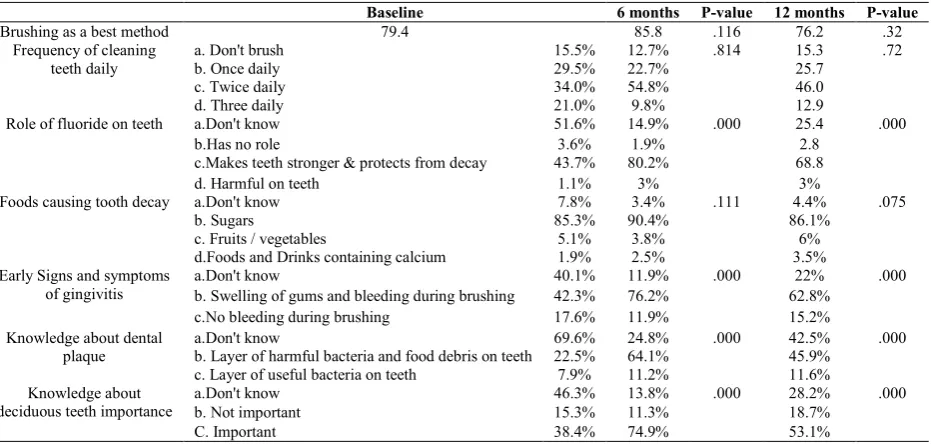
A total of 529 of schools children who completed participation in the study. Collected data was statistically analyzed regarding knowledge (Table1) and practices (Table 2).
Table 1 Knowledge and attitude of the children at the start of the study (baseline) and changes observed following oral health education after 6 monthsand 1 year
P-value 12 months
P-value 6 months
Baseline
.32 76.2
.116 85.8
79.4 Brushing as a best method
.72 15.3
.814
12.7%
15.5%
a. Don't brush Frequency of cleaning
teeth daily b. Once daily 29.5% 22.7% 25.7 46.0 54.8%
34.0%
c. Twice daily
12.9 9.8%
21.0%
d. Three daily
.000 25.4
.000 14.9%
51.6%
a.Don't know Role of fluoride on teeth
2.8 1.9%
3.6%
b.Has no role
68.8 80.2%
43.7%
c.Makes teeth stronger & protects from decay
3% 3%
1.1%
d. Harmful on teeth
.075 4.4%
.111 3.4%
7.8%
a.Don't know Foods causing tooth decay
86.1% 90.4%
85.3%
b. Sugars
6% 3.8%
5.1%
c. Fruits / vegetables
3.5% 2.5%
1.9%
d.Foods and Drinks containing calcium
.000 22%
.000 11.9%
40.1%
a.Don't know Early Signs and symptoms
of gingivitis b. Swelling of gums and bleeding during brushing 42.3% 76.2% 62.8%
15.2% 11.9%
17.6%
c.No bleeding during brushing
.000 42.5%
.000 24.8%
69.6%
a.Don't know Knowledge about dental
plaque b. Layer of harmful bacteria and food debris on teeth 22.5% 64.1% 45.9% 11.6% 11.2%
7.9% c. Layer of useful bacteria on teeth
.000 28.2%
.000 13.8%
46.3%
a.Don't know Knowledge about
deciduous teeth importance b. Not important 15.3% 11.3% 18.7%
53.1% 74.9%
38.4%
C. Important
Table 2 Oral health practices at the start of the study (baseline) and changes observed following oral health education after 6 months and 1 year
Baseline 6 Months P Value 12 months P Value
Children Using Tooth Brush To Clean
Their Teeth 84.5% 87.3% .814 84.7% .72
Frequency Of Brushing Practice Daily
a.Once 29.5% 22.7%
.814
25.7%
.72
b.Twice 34% 54.8% 46.1% c.Thrise 21% 9.8% 12.9%
Type Of Paste Used For Brushing
a. Don't Know 45.4% 17.2%
.000
25.0%
.000 b. Fluoridated Toothpaste 30.4% 65% 50.7%
c. Non-Fluoridated Toothpaste 8.7% 5.1% 9.0%
Frequency Of Sugar Intake By The Children Daily
a. Thrise 54.1% 62.9%
.000
42.7%
.000 b.Four times 5.3% 7.4% 6.7%
Schools Children In Hail City, Kingdom of Saudi Arabia
The main significant difference regarding knowledge was concerning dental plaque in which 41.6% of school children became believers that dental plaque is harmful for dental tissues (Table1). Also, there was perceptible improvement toward the role of fluoride as a protective element for teeth by which 36.5% (Table1).Also, the main improvement of children practices were toward using a fluoridated toothpaste in 34.6%(Table2).Unexpected finding which had been encountered that 0.6% of children thought foods and drinks containing calcium could cause caries (Table1).
Regarding deciduous teeth, lacking of knowledge about the importance of them was receded by 36.5%(Table1).
DISCUSSION
The study aimed to evaluate children knowledge after oral health education program. We observed that almost half of the schools children at the baseline knew the correct information about the signs and symptoms of gum diseases but the horrifying matter is that almost three fourth of schools children don't know that dental plaque is the major cause of bleeding gum and periodontal diseases. This defect of knowledge might because of the limited community dental health programs, which might be a factor accompanied with poor educated parents who do not get such information. These finding were comparable to a study done in India by Punitha et al(44)and Shenoy et al(40)in which at baseline only 1.23% and 19% of school children respectively were knew about gum diseases. Additionally, limited knowledge regarding dental plaque among children stated by Al Ansari et al(45)and Whye et al(46)where in both studies showed that 85.6% children did not know about dental plaque. These findings were in opposite to the study done by Al .Omiri et al(47) and Humagain et al(48) in which only 36.3% and26.2% of school children respectively did not know about dental plaque. Regarding the significant of fluoride, the correct knowledge is almost doubled as well as the use of fluoridated tooth paste. The significant turnover is simply because of lacking community dental health educational programs. In contrast, Peterson et al(49) showed that 74.9% of school children were aware of fluoridated tooth paste and were practicing with it that provides an impression of an adequate baseline. Also, JensenO
et al(50), Smyth E et al(51)and Whye C et al(46) reported that the appreciable knowledge and attitude towards fluoride tooth paste in the school going children. The baseline evaluation of oral hygiene practice stated that 84.5% of school children were already using dental brushes to clean their teeth. VasundharaPathania et al(36)showed that 95.8% of school children are using dental brushes to clean their teeth while, Humagain M et al (48) and Walsh M.M et al(52) showed 100% and 96% of school children respectively used dental brushes for cleaning their teeth. In the present study, though 84.5% of school children were using dental brushes to clean their teeth but only 79.4% of school children considered dental brushes to be the most effective method of maintaining the oral hygiene. Further more, Linn E L et al(53) said that 99% children were using dental brushes but only 93% had the correct knowledge about dental brushes as the best effective tool for cleaning the teeth. We found that when school children were instructed about the importance of oral brushing, knowledge among children about oral brushing being the best method increased by 6.4%. These findings were comparable with the studies done by VasundharaPathania et al(36)in which
similarly there was an increase in the knowledge of brushing method as was observed after the oral health education. Sugar consumption was significantly increase. This might be due to the lecture content which informed the children about the risks of sugars that are not only about the quantities but also about the attitudes to maintain the good oral health in between meals in valuable ways such as mouth rinsing, chewing a sugarless chewing gum, eating raw vegtables and fruits and eating cheddar cheese (54-58). These findings agreed with similar studies done by VasundharaPathania et al Shenoy et al (40)and Alomiri et al(47)in which significant improvement in knowledge towards the sugar consumption was seen from 84.9% to 98.2% and 87.4%. Finally, in the present study regarding deciduous teeth, it was observed that knowledge had a huge increase from 38.4% to 74.9 which was statistically significant. A noticeable defect of knowledge in the base line might be a result of the shortage of information of the parents,teachers and children themselves who believe that primary teeth don't have an impact on the health of the permanent ones. Szatko et al(59)reported that two-thirds of the mothers agreed that care of primary dentition was unnecessary. The limitations of the study are: 1-only male students were selected. 2-evaluation of practices were not based on clinical criteria. Based on these findings.
CONCLUSION
It can be concluded that oral health programs have the potential to improve children awareness and attitudes toward oral health. As the results stated, lectures proved that can be benificail in such improvements. However, it should be given in a frequent basis (preferable every 6 months) otherwise most of the students will not be able to retain such information. Because of the limited evidence based in the kingdom of such regard, it is advisable to do more studies in this topic. Due to the deficient knowledge of school children in the base line data, we recommend to provide more efforts to correct this issue through frequent community preventive dental programs toward children, parents and teachers. Also, cooardination from ministiry of education should be done to create a position for dentists in elementary schools who are responsible to guide students to the correct dental attitudes. Furthermore, activation of smart phone applications to be a reference for childrenin how they can keep their teeth clean is important since information in this way are more easier to retain and can provide an interesting way to learn.
References
1. Dahiya P, Gupta R, Kamal R. Obesity, periodontal and general health: Relationship and management. Indian J Endocrinol Metab. 2012;16(1):88.
2. World Health Organization. Preamble to the Constitution of the World Health Organization as adopted by the International Health Conference [Internet]. Vol. 2, Official Records of the World Health Organization. 1946. p. 100.
3. Thorstensson H, Johansson B. Does oral health say anything about survival in later life? Findings in a Swedish cohort of 80+ years at baseline. Community Dent Oral Epidemiol. 2009;37(4):325-32.
2017;2203451770877.
5. Ahmed ZU, Shafiq K, Wali A, Usman A. Knowledge , Attitude and Practices of Oral Health. 2016;36(4):628-33.
6. Dholam KP, Gurav S, Dugad J, Banavli S. Correlation of oral health of children with acute leukemia during the induction phase. Indian J Med Paediatr Oncol [Internet]. 2014;35(1):36-9.
7. Katz J, Bimstein E. Pediatric obesity and periodontal disease: a systematic review of the literature. Quintessence Int [Internet]. 2011;42(7):595-9.
8. Ayo-Yusuf IJ, Naidoo S. Social gradient in the cost of oral pain and related dental service utilisation among South African adults. BMC Oral Health [Internet]. 2016;16(1):117.
9. Basno A, Maxim A, Savin C, Balcoş C, Tatarciuc MS. Prevalence of Edentulism And Related Social-Behavioural Factors Among Young Adults Of Iaşi , RomanIA. 2016;6(3).
10. Castro RDAL, Portela MC, Leão AT, De Vasconcellos MTL. Oral health-related quality of life of 11- and 12-year-old public school children in Rio de Janeiro. Community Dent Oral Epidemiol. 2011;39(4):336-44. 11. Jokovic A, Locker D, Stephens M, Guyatt G.
Agreement between mothers and children aged 11-14 years in rating child oral health-related quality of life. Community Dent Oral Epidemiol. 2003;31(5):335-43. 12. Ylöstalo P, Ek E, Knuuttila M. Coping and optimism in
relation to dental health behaviour--a study among Finnish young adults. Eur J Oral Sci [Internet]. 2003;111(6):477-82.
13. Vettore M V, Leão ATT, Monteiro Da Silva AM, Quintanilha RS, Lamarca GA. The relationship of stress and anxiety with chronic periodontitis. J Clin Periodontol [Internet]. 2003;30(5):394-402.
14. Roberts A, Matthews JB, Socransky SS, Freestone PPE, Williams PH, Chapple ILC. Stress and the periodontal diseases: Growth responses of periodontal bacteria to Escherichia coli stress-associated autoinducer and exogenous Fe. Oral Microbiol Immunol. 2005;20(3):147-53.
15. Merchant AT, Pitiphat W, Ahmed B, Kawachi I, Joshipura K. A prospective study of social support, anger expression and risk of periodontitis in men. J Am Dent Assoc [Internet]. 2003;134(12):1591-6.
16. Ng SK, Leung WK. A community study on the relationship of dental anxiety with oral health status and oral health-related quality of life. Community Dent Oral Epidemiol. 2008;36(4):347-56.
17. Borrell LN, Burt B a, Gillespie BW, Lynch J, Neighbors H. Periodontitis in the United States: beyond black and white. J Public Health Dent [Internet]. 2002;62(2):92-101.
18. Genco RJ, Ho a W, Grossi SG, Dunford RG, Tedesco L a. Relationship of stress, distress and inadequate coping behaviors to periodontal disease. J Periodontol [Internet]. 1999;70(7):711-23.
19. Kawabata Y, Ekuni D, Miyai H, Kataoka K, Yamane M, Mizutani S, et al. Relationship Between Prehypertension/Hypertension and Periodontal Disease: A Prospective Cohort Study. Am J Hypertens [Internet]. 2015;29(March):hpv117.
20. Lloyd-Williams F, Dowrick C, Hillon D, Humphris G,
Moulding G, Ireland R. A preliminary communication on whether general dental practitioners have a role in identifying dental patients with mental health problems. Br Dent J [Internet]. 2001;191(11):625-9.
21. Hilgert JB, Hugo FN, Bandeira DR, Bozzetti MC. Stress, Cortisol, and Periodontitis in a Population Aged 50 Years and Over. J Dent Res. 2006;85(4):324-8. 22. P. Kolte A, A. Kolte R, N. Lathiya V. Association
between anxiety, obesity and periodontal disease in smokers and non-smokers: A cross-sectional study. J Dent Res Dent Clin Dent Prospects [Internet]. 2016;10(4):234-40.
23. Teng HC, Lee CH, Hung HC, Tsai CC, Chang YY, Yang YH, et al. Lifestyle and psychosocial factors associated with chronic periodontitis in Taiwanese adults. J Periodontol [Internet]. 2003;74(8):1169-75. 24. Peruzzo DC, Benatti BB, Ambrosano GMB,
Nogueira-Filho GR, Sallum EA, Casati MZ, et al. A systematic review of stress and psychological factors as possible risk factors for periodontal disease. J Periodontol. 2007;78(8):1491-504.
25. Nogo-Zivanovic D, Krunic J, Kulic L, Eric J, Stojanovic N. Oral health and specific impact of caries on the quality of life of middle-aged people. Stomatol Glas Srb [Internet]. 2013;60(4):218-25.
26. Al-Sudani FYH, Vehkalahti MM, Suominen AL. The association between current unemployment and clinically determined poor oral health. Community Dent Oral Epidemiol. 2015;43(4):325-37.
27. Petersen PE. The World Oral Health Report 2003 WHO Global Oral Health Programme. Community Dent Oral Epidemiol [Internet]. 2003;31 Suppl 1:3-23.
28. Al-Sekait MA A-NA. Dental caries prevalence in primary Saudi schoolchildren in Riyadh district. Saudi Med J. 1988;606-609.
29. Akpata ES, Fakiha Z, Khan N. Dental fluorosis in 12-15-yearold rural children exposed to fluorides from well drinking water in Hail region of Saudi Arabia. . Community Dent Oral Epidemiol [Internet]. 1997;25((4)):324-327.
30. Al-Shammery AR. Caries experience of urban and rural children in Saudi Arabia. J Public Health Dent. 1999;59(1):60-4.
31. Al-sadhan S a. Dental caries prevalence among 12-14 year-old schoolchildren in Riyadh : A 14 year follow-up study of the Oral Health Survey of Saudi Arabia Phase I. Saudi Dent J. 2006;18(1):14-9.
32. Hiremath A, Murugaboopathy V, Ankola A V, Hebbal M, Mohandoss S, Pastay P. Prevalence of Dental Caries Among Primary School Children of India - A Cross-Sectional Study. J Clin Diagn Res [Internet]. 2016;10(10):ZC47-ZC50. Available from: http://ovidsp.ovid.com/ovidweb.cgi?T=JS&PAGE=refe rence&D=prem&NEWS=N&AN=27891457
33. Funieru C, Twetman S, Funieru E, Dumitrache AM, Sfeatcu RI, Baicus C. Caries experience in schoolchildren in Bucharest, Romania: The PAROGIM study. J Public Health Dent. 2014;74(2):153-8.
34. Sembene M, Kane AW, Bourgeois D. I Caries prevalence in 12-year-old schoolchildren in Senegal in 1989 and 1994. 1999;1(1 999):73-5.
Schools Children In Hail City, Kingdom of Saudi Arabia
behavioral intervention on oral hygiene. J Clin Periodontol [Internet]. 1991;18(4):219-22. Available from:
http://onlinelibrary.wiley.com/o/cochrane/clcentral/artic les/977/CN-00076977/frame.html
36. Pathania V, V S, BC K, H.S J, Mahajan A, Sharma AK. Assessment Of Changes In Knowledge, Attitude And Practices In Oral Health, Following Oral Health Education Amongst School Children In Sundernagar, Himachal Pradesh, India. Indian J Dent Sci. 2014;4(4):123-6.
37. Dr. Mohammed AL-Rafee DRAT. Oral Health Programmes , Kingdom of Saudi Arabia. 2007.
38. Wyne AH, Al-Ghannam NA, Al-Shammery AR, Khan NB. Caries prevalence, severity and pattern in pre-school children. Saudi Med J. 2002;23(5):580-4. 39. David J, Wang NJ, Åstrøm AN, Kuriakose S. Dental
caries and associated factors in 12-year-old schoolchildren in Thiruvananthapuram, Kerala, India. Int J Paediatr Dent. 2005;15(6):420-8.
40. Shenoy R, Sequeira P. Effectiveness of a school dental education program in improving oral health knowledge and oral hygiene practices and status of 12- to 13-year-old school children. Indian J Dent Res [Internet].
2010;21(2):253. Available from:
http://www.ijdr.in/text.asp?2010/21/2/253/66652 41. Daouda F, Aida K, Mbacke LC, Mamadou M.
Assessment of dental caries prevention program applied to a cohort of elementary school children of Kebemer, a city in Senegal. J Int Soc Prev Community Dent. 2016;6(Suppl 2):S105-10.
42. Petersen PE, Danila I, Delean A, Grivu O, Ionita G, Pop M, et al. Oral health status among schoolchildren in Romania, 1992. Community Dent Oral Epidemiol. 1994;22(2):90-3.
43. Bobu L, Balcoş C, Bălan A. The Dynamic Evolution Of Oral Health Status Of Schoolchildren In Iasi Under The Impact Of The National Prevention Program. 2015;5(3). 44. Punitha. Oral hygiene status, knowledge, attitude and
practices of oral health among rural children of Kanchipuram District [Internet]. Vol. 1, Indian Journal of Multidisciplinary Dentistry. 2011. p. 115.
45. Al-Ansari J, Honkala E, Honkala S. Oral health knowledge and behavior among male health sciences college students in Kuwait. BMC Oral Health [Internet]. 2003;3:1.
46. Whye Lian C, Siow Phing T, Shiun Chat C, Cheong Shin B, Hakim Baharuddin L, Bainun Jalil Che Z. Oral health knowledge, attitude and practice among secondary school students in Kuching, Sarawak. Arch Orofac Sci. 2010;5(1):9-16.
47. Al-Omiri MK, Al-Wahadni AM, Saeed KN. Oral Health Attitudes, Knowledge, and Behavior Among School Children in North Jordan. J Dent Educ [Internet]. 2006;70(2):179-87.
48. Humagain M. Evaluation of Knowledge, Attitude and Practice (KAP) About Oral Health Among Secondary Level Students of Rural Nepal. A Quest Stud Webmed Cent Dent. 2011;2(3).
49. Petersen PE, Peng B, Tai B, Bian Z, Fan M. Effect of a school-based oral health education programme in Wuhan City, Peoples Republic of China. Int Dent J. 2004;54(1):33-41.
50. Jensen O, Gabre P, Sköld UM, Birkhed D. Is the use of fluoride toothpaste optimal? Knowledge, attitudes and behaviour concerning fluoride toothpaste and toothbrushing in different age groups in Sweden. Community Dent Oral Epidemiol. 2012;40(2):175-84. 51. Smyth E, Caamano F, Fernández-Riveiro P. Oral health
knowledge, attitudes and practice in 12-year-old schoolchildren. Med Oral Patol Oral Cir Bucal. 2007;12(8):E614-20.
52. Walsh M. Effects of school-based dental health education on knowledge, attitudes and behavior of adolescents in San Francisco [Internet]. Vol. 13, Community dentistry and oral epidemiology. 1985. p. 143-7.
53. Linn E. Teenagers’ attitudes, knowledge, and behaviours related to oral health. J Am Dent Assoc. 1976;92:946-51.
54. Pietsch D. Dairy and Dental Health : What is the Connection ? 2008;(December).
55. Sandhu K, Gupta N, Gupta P, Arora V, Mehta N. Caries Protective Foods: A Futurist Perspective. Int J od Adv Heal Sci. 2014;1(6):21-5.
56. Touger-Decker R, Van Loveren C. Sugars and dental caries 1-4. Am J Clin Nutr. 2003;78:881-92.
57. Kashket S, DePaola DP. Cheese consumption and the development and progression of dental caries. Nutr Rev [Internet]. 2002;60(4):97-103.
58. Mobley CC. Nutrition and dental caries. Vol. 47, Dental Clinics of North America. 2003. p. 319-36.
59. Szatko F, Wierzbicka M, Dybizbanska E, Struzycka I, Iwanicka-Frankowska E. Oral health of Polish three-year-olds and mothers’ oral health-related knowledge. Vol. 21, Community Dental Health. 2004. p. 175-80.
How to cite this article:
Bader AlShammari et al (2019) 'Evaluation of Oral Health Awareness, Practices And Effectiveness of Oral Health Educational Programamong Elementary Schools Children In Hail City, Kingdom of Saudi Arabia', International Journal of Current Advanced Research, 08(09), pp.20022-20026. DOI: http://dx.doi.org/10.24327/ijcar.2019.3898.20026