EMERGING INFOMATION AND
COMMNUICATION TECHNOLOGY (ICT)
SKILLS AMONG THE FACULTY MEMBERS IN
PHARMACY COLLEGES IN KARNATAKA
(South India): A STUDY
Dr. B. Mahadevan, Dr. K. Vijayakumar.
UGC Post-Doctoral Fellow, Associate ProfessorDepartment of library & information Science, Annamalai university, Annamalai Nagar, Tamilnadu, India.
ABSTRACT - Library and information centre are of perennial importance to professional education institutions through all ages. Success of any library system depends on its workforce. Skills and abilities of library professionals plays vital role in serving their users to make them successful in their academic endeavors. Emerging technology Skills among the faculty members Pharmacy College of Karnataka are analyzed to find the status of their skills and to make further recommendations. It is found that library professionals are having better skills in handling emerging technologies. Recommendations are made to improve skills further through various suggested ways.
Keywords: Emerging Technology, Skills, Competencies, Libraries, faculty members pharmacy Colleges, Analysis, Knowledge.
INTRODUCTION
A library plays an important role in the academic institution providing access to world-class information resources
and services and stimulates academic research in the country. Hence, the success of any educational institution depends upon
its library, as library services are fundamental, which affect the whole educational system. National Knowledge Commission
report mentions that libraries play a pivotal role in the dissemination of knowledge. They are an extremely important element
of the foundation of a knowledge economy. Higher educational libraries are experiencing a massive change in the way they
function (National Knowledge Commission Report, 2006-2009). University libraries being part of higher education are no
exception. University libraries support learning, teaching, research and other educational functions appropriate to their parent
institutions. The special collections cater to the needs, not only for teaching and learning but also for research, publication,
conservation of ideas and knowledge. The new technologies especially electronic technologies have contributed to the radical
changes in LIS and practice.
Information and Communication Technology (ICT) have changed the library and information services globally.
Digital media has revolutionized the information society and advances in ICT have dramatically changed the information
provisions. The internet has provided universal access to information. Technological innovation has changed the rate of
conversion of knowledge, information, and data into electronic or digital format. Development in the software has generated
powerful knowledge management software which has transformed the way; knowledge is organized, stored, accessed and
retrieved. The digital revolution driven by ICT’s innovation has transformed University libraries fundamentally. It has
impacted on every sphere of pharmacy college library activity. The pharmacy college libraries traditional role of information
CONCEPT AND MEANING OF INFORMATION AND COMMUNICATION TECHNOLOGY (ICT)
Information and Communication Technologies (ICTs) are often associated with the most sophisticated and expensive
computer-based technologies. ICTs are basically information-handling tools- a varied set of goods, applications and services
that are used to produce, store, process, distribute and exchange information. ICT-Information and Communication
Technology is a varied collection technological gear and resources which are made use of to communicate. They make use
of to generate, distribute, collect & administer information. According to Anyakoha (1991), information technology is “the
use of manmade tools for the collection, generation, communication, recording, re-management and exploitation of
information. It includes those applications and commodities, by which information is transferred, recorded, edited, stored, manipulated or disseminated”. ICT is a mean that has changed many aspects of the way we live. Hawkridge (1983) describes
information technology as a revolution which has penetrated almost all fields of human activity, thus transforming economic
and social life.
REVIEW OF LITERATURE
International Federation of Library Associations and Institutions (2016) reported the results of study
undertaken by it since 2013. In 2013 IFLA identified 5 important trends and future of libraries. They hold
discussion and conducted case studies on the identified trends at various countries world over and confirmed the
results of discussions. Some of the highlights of the trends reported are Libraries need to adapt new and innovative
procedures and services based on user preferences, trust, neutrality, free and equal access to information, and
freedom of expression are key features of the library services are increasingly digitalized and remotely accessed
Librarians need to indulge in continuous learning and continuous up-gradation of skills and embrace new
Coordinated and collaborative working environment. Innovative and maker spaces should be part of present
libraries Letnikova and Xu (2017).
OBJECTIVES OF THE STUDY
1.
To identify important emerging technologies applicable for pharmacy libraries at present.
2.
To identify the set skills required for library professionals to handle identified emerging technologies.
3.
To analyze the level of emerging technologies skills possessed by library professionals of faculty members
pharmacy College Libraries in Karnataka.
4.
To compare level of skills among different designations of library professionals
5.
To draw recommendations for improving emerging technologies skills of library professionals.
METHODOLOGY
In order to collect the comprehensive and relevant data from the faculty members of 30 pharmacy
collection of data. The questionnaire was formulated keeping in view, the objective and various forcers of the study
and data was collected personally, 400 questionnaire were distributed to the pharmacy faculty, out of that 350 were
received back, The remaining 50 were either not received nor incomplete. The overall response rate is 87.5%.The
data collected through the questionnaires and it was analyzed with average, simple percentages,
T-Test,TWO WAY
ANOVA models is worked out with the excel package.
DATA COLLECTION
The researcher employed a well structured questionnaire for collecting the data from the respondents. The
researcher sent questionnaires to the pharmacy faculty members of the concerned 30 pharmacy colleges in
Karnataka. The questionnaire was prepared in such a way that the respondents could easily understand and simply
indicate the answers that they wished to respond from among multiple answers.
LIMITATIONS
The findings of this study are mainly applicable to pharmacy colleges faculty members in Karnataka and
not applicable to other college faculty members, Only 30 institutions are selected for this study since studying of
all institutions would be not possible for an individual researcher, owing to constraints of money, time, energy and
efforts.
ANALYSIS AND INTERPRETATION OF DATA
Table - 1
Gender wise Respondents
S. No.
Gender
Respondents
Percentage
1.
Male
210
59.46
2.
Female
140
40.54
Total
350
100.00
Table – 1 indicates the Gender wise distribution of respondents. Among the 350 respondents surveyed, 210
(59.46%) are male and 140 (40.54%) are Female. It can be observed the at male faculty members dominates the
Table – 2
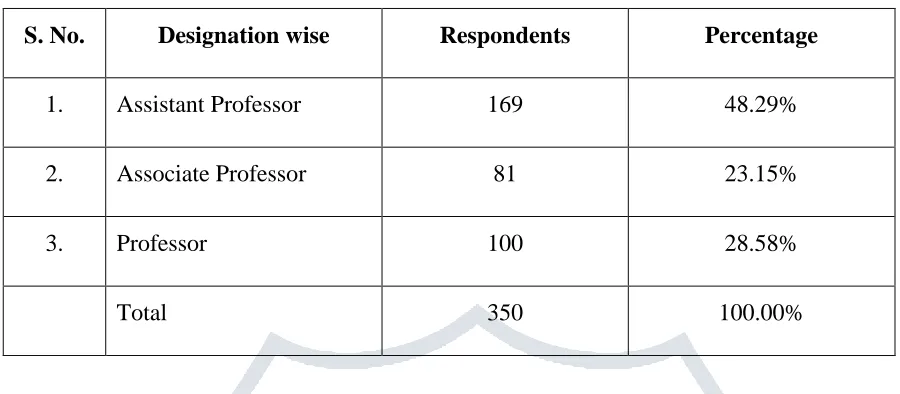
Designation wise Respondents
S. No.
Designation wise
Respondents
Percentage
1.
Assistant Professor
169
48.29%
2.
Associate Professor
81
23.15%
3.
Professor
100
28.58%
Total
350
100.00%
Table – 2 indicates the designation wise distribution of Respondents. 350 Respondents surveyed. Among them169
(48.29%) are Assistant Professors, 100 (28.58%) Respondents are Professors and about 81 (23.15%) Respondents
are Associate Professors. It can be observed that Assistant Professors in Pharmacy colleges dominates the study.
Table-3 Awareness of ICT Based Application
Technology Extremely
Poor
Below
average
Average Above
average
Excellent Total
Operating system windows
22(6.28%) 35(10.0%) 65(18.57%) 103(29.42%) 125(35.71%) 350(100%)
Ms Office package 20(5.71%) 62(17.71%) 50(14.28%) 91(26.0%) 127(36.28%) 350(100%)
Operating system Linux
28(8.0%) 45(12.85%) 65(18.57%) 75(21.42%) 138(39.42%) 350(100%)
Web pages Design 28(8.0%) 45(12.85%) 77(22.0%) 70(20.0%) 130(37.14%) 350(100%)
Create Metadata/tag 35(10.0%) 38(10.85%) 47(13.42%) 90(25.71%) 140(40.0%) 350(100%)
Installation and customization software
18(5.14%) 40(11.42%) 150(42.85%) 85(24.28%) 57(16.28%) 350(100%)
RFID technology 22(6.28%) 30(8.57%) 120(34.28%) 65(18.57%) 113(32.28%) 350(100%)
Barcode Technology 15(4.28%) 25(7.14%) 125(35.71%) 45(12.85%) 140(40.0%) 350(100%)
Data Base
Management System
20(5.71%) 20(5.71%) 105(30.0%) 55(15.71%) 150(42.87%) 350(100%)
Awareness of ICT based application, Table-2 presents the respondents level of Knowledge in ICT based application. From the table it is found that the respondents relatively possess a higher level of awareness in using data base Management system are 150 (42.87%) Photoshop in 145 (41.42%) and 140(40.0%).Create Metadata/ tag & Barcode Technology.
Table 3: Before Average and After Average (Paired T-Test)
Paired Samples Statistics
Mean N Std. Deviation Std. Error Mean
Pair 1 Before Average 36.0000 10 13.02988 4.12041
After Average 78.6000 10 20.23309 6.39826
Paired Samples Test
Paired Differences
t df Sig. (2-tailed) Mean
Std.
Deviation
Std. Error
Mean
95% Confidence
Interval of the
Difference
Lower Upper
Pair 1 Before Average -
After Average -4.26000E1 21.05654 6.65866
-57.66294 -27.53706 -6.398 9 .000
Table 3:ANOVA
ANOVA
Sum of Squares df Mean Square F Sig.
Before Average Between Groups 1478.000 8 184.750 3.695 .383
Within Groups 50.000 1 50.000
Total 1528.000 9
After Average Between Groups 3292.400 8 411.550 1.050 .642
Within Groups 392.000 1 392.000
Total 3684.400 9
Extremely Poor Between Groups 308.400 8 38.550 2.142 .486
Within Groups 18.000 1 18.000
Total 326.400 9
Excellent Between Groups 6334.000 8 791.750 9.370 .248
Within Groups 84.500 1 84.500
Table-4 Awareness of Pharmacy Automation Database
Data base Awareness % Not Aware % Total
PUBMED 328 93.71% 22 6.28% 350(100%)
SCIENCE DIRECT 325 92.85% 25 7.14% 350(100%)
MEDLINE 321 91.71% 29 8.28% 350(100%)
NLM 317 90.57% 33 9.42% 350(100%)
BIO-PHRMA 315 90.00% 35 10.0% 350(100%)
APIDATA 302 86.28% 48 13.71% 350(100%)
IPN 298 85.14% 52 14.85% 350(100%)
OCLN 292 83.42% 58 16.57% 350(100%)
MLN 285 81.42% 65 18.57% 350(100%)
INPLN 278 79.42% 72 20.57% 350(100%)
TOXLINE 270 77.14% 80 22.85% 350(100%)
HSDS 258 73.71% 92 26.28% 350(100%)
INLN 241 68.85% 109 31.14% 350(100%)
MESH 225 64.28% 125 35.71% 350(100%)
UMLS 212 60.57% 138 39.42% 350(100%)
LACTMED 190 54.28% 160 45.71% 350(100%)
Table-4 shows the awareness of pharmacy automation database among the faculty members to familiar more with Pub Med (93.71%), followed by Science Direct (92.85%), Medline (91.71 %), NLM (90.57 %), Bio-Pharma (90.0 %) API Data (86.28 %), IPN (85.14%), OCLN (83.42 %), MLN (81.42 %), INPLN (79.42 %), TOX LINE (77.14%) HSDS (73.71 %). The professional expressed their skills as poor in the Data base such as INLN (68.85 %), MESH (64.28%), UMLS (60.57 %) and LACTMED (54.28%).
Table 4:
Awareness of Pharmacy Automation DatabasePaired Samples Statistics
Mean N Std. Deviation Std. Error Mean
Pair 1 Before Average 24.7778 9 4.79004 1.59668
Paired Samples Test
Paired Differences
t df Sig. (2-tailed) Mean
Std.
Deviation
Std. Error
Mean
95% Confidence Interval of
the Difference
Lower Upper
Pair 1 Before Average -
After Average -7.70000E1 14.24781 4.74927 -87.95183 -66.04817 -16.213 8 .000
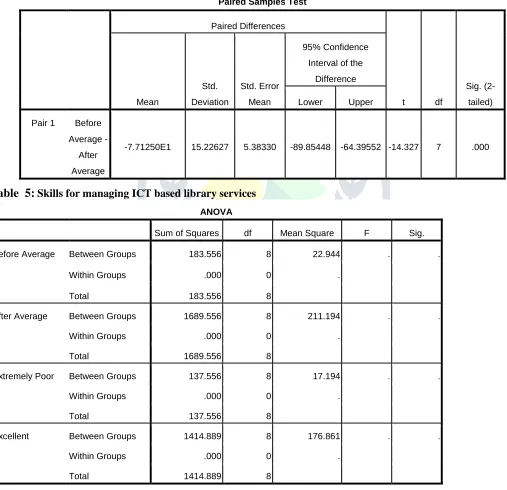
Table-5 Skills for managing ICT based library services
Technology Extremely
Poor
Below
average
Average Above
average
Excellent Total
Electronic document delivery system 18 (5.14%) 20 (5.71%) 72 (20.57%) 105 (30.0%) 135 (38.57%) 350 (100.0%)
Online indexing and abstracting services 22 (6.28%) 20 (5.71%) 48 (13.71%) 110 (31.42%) 150 (42.85%) 350 (100.0%)
Digital reference services 26 (7.42%) 24 (6.85%) 73 (20.85%) 100 (28.57%) 127 (36.28%) 350 (100.0%)
Inter library loan through networking 25 (7.14%) 32 (9.14%) 75 (21.42%) 100 (28.57%) 118 (33.71%) 350 (100.0%)
Online bibliographic services 20 (5.71%) 30 (8.57%) 60 (17.14%) 100 (28.57%) 140 (40.0%) 350 (100.0%)
Development of institutional repository 22 (6.28%) 30 (8.57%) 70 (20.0%) 108 (30.85%) 120 (34.25%) 350 (100.0%)
CAS 17 (4.87%) 25 (7.14%) 65 (18.57%) 125 (35.71%) 118 (33.71%) 350 (100.0%)
SDI Services 30 (8.57%) 20 (5.71%) 80 (22.85%) 70 (20.0%) 150 (42.85%) 350 (100.0%)
Circulation of new additional list 25 (7.14%) 22 (6.28%) 85 (24.28%) 98 (28.0%) 120 (34.28%) 350 (100.0 %)
delivery system 135(38.57%),current arrangement services 118(33.71%), online indexing and abstracting services and development of institutional repository 150(42.85%) etc.
Table-5 Skills for managing ICT based library services
Paired Samples Statistics
Mean N Std. Deviation Std. Error Mean
Pair 1 Before Average 25.1250 8 4.99821 1.76714
After Average 1.0225E2 8 15.46193 5.46662
Paired Samples Test
Paired Differences
t df
Sig.
(2-tailed) Mean
Std.
Deviation
Std. Error
Mean
95% Confidence
Interval of the
Difference
Lower Upper
Pair 1 Before
Average -
After
Average
-7.71250E1 15.22627 5.38330 -89.85448 -64.39552 -14.327 7 .000
Table 5:
Skills for managing ICT based library services ANOVASum of Squares df Mean Square F Sig.
Before Average Between Groups 183.556 8 22.944 . .
Within Groups .000 0 .
Total 183.556 8
After Average Between Groups 1689.556 8 211.194 . .
Within Groups .000 0 .
Total 1689.556 8
Extremely Poor Between Groups 137.556 8 17.194 . .
Within Groups .000 0 .
Total 137.556 8
Excellent Between Groups 1414.889 8 176.861 . .
Within Groups .000 0 .
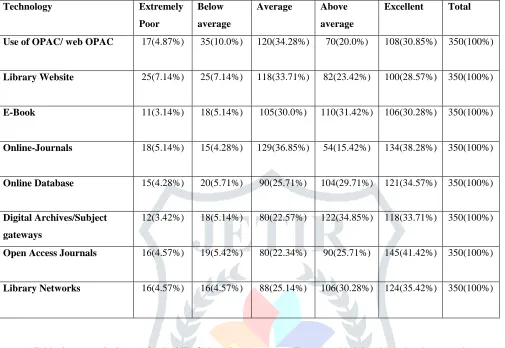
Table-6 Skills for managing Electronic resources
Technology Extremely
Poor
Below
average
Average Above
average
Excellent Total
Use of OPAC/ web OPAC 17(4.87%) 35(10.0%) 120(34.28%) 70(20.0%) 108(30.85%) 350(100%)
Library Website 25(7.14%) 25(7.14%) 118(33.71%) 82(23.42%) 100(28.57%) 350(100%)
E-Book 11(3.14%) 18(5.14%) 105(30.0%) 110(31.42%) 106(30.28%) 350(100%)
Online-Journals 18(5.14%) 15(4.28%) 129(36.85%) 54(15.42%) 134(38.28%) 350(100%)
Online Database 15(4.28%) 20(5.71%) 90(25.71%) 104(29.71%) 121(34.57%) 350(100%)
Digital Archives/Subject
gateways
12(3.42%) 18(5.14%) 80(22.57%) 122(34.85%) 118(33.71%) 350(100%)
Open Access Journals 16(4.57%) 19(5.42%) 80(22.34%) 90(25.71%) 145(41.42%) 350(100%)
Library Networks 16(4.57%) 16(4.57%) 88(25.14%) 106(30.28%) 124(35.42%) 350(100%)
Table-6 presents the Respondent’s skill of Managing e-resources. From the table it is evident that the respondents posses a higher level of skills in the use of e-resources the analysis of data shows that the faculty members usage of Open Access Journal (41.42%), Online Journals (38.28%), Library Networks (35.42%) Online Database (34.57 %) and use of OPAC/Web OPAC- (30.85 %) the faculty members have average skills in use of almost all the e-resources.
ANOVA
Sum of Squares df Mean Square F Sig.
Before Average Between Groups 295.000 6 49.167 98.333 .077
Within Groups .500 1 .500
Total 295.500 7
After Average Between Groups 3083.500 6 513.917 1.004 .643
Within Groups 512.000 1 512.000
Total 3595.500 7
Extremely Poor Between Groups 119.500 6 19.917 2.490 .450
Within Groups 8.000 1 8.000
Total 127.500 7
Excellent Between Groups 1215.500 6 202.583 .556 .772
Within Groups 364.500 1 364.500
Total 1580.000 7
CONCLUSION
Present volatile technology world is threshold for numerous technologies, intensely influencing libraries and their users. It is not an exaggeration to say basic framework of library system is altered by technologies. Modified library system and tech-cultured users prompted library professionals to upgrade their skills and competencies and become bridge between new library resources, services and users. It is concluded from the study that library professionals working in Pharmacy College in Karnataka are having better skills to handle emerging technologies. They are also well off in terms of educational qualification. Library staff should be proactive in learning new skills to handle technologies emerging from time to time. Libraries have to make use of their workforce by motivating and preparing them to handle present and future technologies.
REFERENCES
1. Abram, S., Ave, P., & Mp T.,(2007) Preparing for the 2 . 0 World. Conf. Proc. ASP Conf. Ser., 377, 161–167,. 2. Arora J., (2009). Library 2.0 : Innovative Technologies for Building Libraries of Tomorrow. Open Access to Textual
and Multimedia Content: Bridging the Digital Divide, 49–65,.
3. Scale M. E., (2009). Cloud computing and collaboration. Libr. Hi Tech News, 26(9),10–13.
4. Cervone. H. F., (2010). Emerging technology, innovation, and the digital library. OCLC Syst. Serv. Int. Digit. Libr. Perspect., 26(4), 239–242.
5. Salgar S. M.. (2004). Emerging Technology: Road Map to New Generation of Libraries Using Emerging Technology” proceedings of Second International CALIBER held on February 11-13, T .A. V. Murthy; editor, 351-57, New Delhi,. ISBN 81- 900825-8-2.
7. Anbu, K., & S. Kataria., (2015). Access to Library Resources through Portable Devices A pre-design Prototype for Creating Library Websites. Proc. 4th IEEE Int. Symp. Emerg. Trends Technol. Libr. Inf. Serv., pp. 1–5.
8. Sandhu, G., (2015). Re-Envisioning Library and Information Services in the wake of Emerging Trends and Technologies. Proc. 2015 4th Int. Symp. Emerg. Trends Technol. Libr. Inf. Serv., 153–160.
9. Hayman, R., & Smith E. E. (2015). Sustainable decision making for emerging educational technologies in libraries. Ref. Serv. Rev.,43(1), 7–18.
10. Sethi. R., (2015). Emerging Technique in Libraries : Cloud Computing. Proc. 4th Int. Symp. Emerg. Trends Technol. Libr. Inf. Serv., 2–4.
11. Johnson, E. D. M., (2016). The Right Place at the Right Time : Creative Spaces in Libraries. The Future of Library Space: Advances in Library Administration and Organization, 36(1), 351.
12. International Federation of Library Associations and Institutions (IFLA)(2016). IFLA Trend Report, 34.
13. Letnikova G. and Xu., N. (2017). Academic library innovation through 3D printing services. Libr. Manag., 38(4/5),208–218,.
14. Mazumdar N. R., (2007). Skills for Library and Information Professionals Working in Borderless Library. Proc. 5th Conv. Plan. 2007, Gauhati Univ. held on December 7-8, Guwahati, 421–429.
15. American Library Association (ALA). (2009). Core Competences of Librarianship. 1–5.
16. Canadian Association of Research Libraries (CARL). (2010), Core Competencies for 21st Century CARL librarians.10.
17. Corrall. S., (2010). Educating the academic librarian as a blended professional: A review and case study. Libr. Manag., 31(8/9),567– 593.
18. Hui-fang, Q., (2010). The Discussion about the Best Structural Model of Knowledge-based Librarians under Network Environment. Proceedings of 2010 IEEE International Conference on Networking and Digital Society, 640–643. 19. Partridge J. M., Helen M., and Menzies L., (2010). Victoria and Lee and Carrie. The contemporary librarian : skills,
knowledge and attributes required in a world of emerging technologies. Libr. Inf. Sci. Res., 32(4),265–271.
20. Sharma, P. L., (2011). Changing role of librarians in digital library era and need of professional skills, efficiency & competency. Indian Streams Reserach J., 1(Xii), 1–4.
21. Tzoc, E., & Millard, J., (2011), Technical skills for new digital librarians. Libr. Hi Tech News, 28(8), 11–15. 22. Satpathy, S. K., (2011). ICT Skills of LIS Professionals in Engineering Institutions of Orissa, India : A Case Study.
Libr. Philos. Pract., 627.