(UDC: 624.042.7)
Damping identification for building structures subjected to earthquakes: A
review
G. Papagiannopoulos1, D. Beskos2*
1Department of Civil Engineering
University of Patras, GR 26504, Rio, Patras, Greece [email protected]
2Department of Civil Engineering
University of Patras, GR 26504, Rio, Patras, Greece [email protected]
*Corresponding author
Abstract
This paper reviews existing methods employed for the identification of damping in building structures and the properties, practical application and problems commonly associated with the most important of those methods. Some characteristic examples are presented to demonstrate the capabilities of these methods. Emphasis is given to the application of these methods to identify damping when a seismically excited building structure vibrates in the non-linear region. Further needs on damping identification are also addressed.
Keywords: damping, identification, buildings, seismic motions, linear response, non-linear response.
1. Introduction
During the last five decades or so, the application of system identification methods in building structures has significantly contributed to the successful investigation of several problems in earthquake engineering. The crucial point for these methods was to treat correctly two major issues: a) the determination of a mathematical model having a finite set of parameters. This model should be able to represent the behavior of the structure within an acceptable tolerance; b) the identification of these parameters based on the observed behavior of the structure. In general, system identification methods can be separated into two categories according to the kind of parameters identified: a) methods for identifying modal parameters and b) methods for identifying physical parameters. The methods belonging to the former category are computationally simple, make use of a small number of measured data and aim to identify the general dynamic properties of the structure, i.e., modes, natural frequencies, modal damping ratios. On the other hand, the methods of the latter category are computationally more complex, need a great number of measured data and aim at the identification of the mass, stiffness and damping matrices of the structure.
in a structure is a very difficult process as one should take into account various mechanisms like friction, heat, plasticity, damage etc. Due to the complexity inherent in these mechanisms, the representation of damping in a building structure has been commonly assumed to be that of a linear viscous type or of a Rayleigh type. Under the condition that the damping matrix of the structure is a linear combination of its mass and stiffness matrices, one has the widely known classical damping model (Clough and Penzien 1975). On the other hand, in cases where the damping matrix does not obey the aforementioned requirement, e.g., a soil-structure system, then one has to adopt the non-classical damping model (Clough and Penzien 1975). It should be noted that the viscous damping consideration although convenient may be a cause of error when estimating the response of a structure even in the elastic range. This error has been examined by Val and Segal (2005). On the other hand, the equivalent viscous damping approach (Jacobsen 1930) has been used by several researchers to model the work performed due to inelastic deformations of seismically excited structures (Jennings 1968, Gülkan and Sozen 1974, Shibata and Sozen 1976, Takewaki 1997, Blandon and Priestley 2005).
The purpose of this review paper is to present the up-to-date efforts to the problem of damping identification in building structures subjected to earthquakes. Firstly, a brief description of the modeling and estimation of damping in structures is given. Then, the most important methods are mentioned and the properties, practical application and problems commonly associated with them are discussed. Some characteristic examples are presented to demonstrate the capabilities of these methods. The damping identification methods presented herein cover both the linear and non-linear seismic response of structures. However, emphasis is given to the application of these methods to identify damping when a seismically excited building structure vibrates in the non-linear region. Finally, further needs on damping identification are also addressed.
2. Modeling and estimation of damping in building structures
Finite element procedures for constructing mass and stiffness matrices for the individual members of a structure and the global mass and stiffness matrices of that structure through appropriate assemblage are well established. However, similar procedures for damping representation are very few (e.g., Feriani and Perotti 1996) as one would have to construct the damping matrix of the structure using the damping properties of its individual members (Hart et al. 1974). To find the seismic response of an elastic structure in the context of modal synthesis, damping is prescribed at the level of modes. Alternatively, if a classical damping matrix is assumed, then by application of the orthogonality conditions (Clough and Penzien 1975) one can find the initially prescribed modal damping ratios. The selection of this diagonal damping matrix can be done following Caughey and O‘Kelly (1965), Wilson and Penzien (1972), Luco (2008a and 2008b) and Kausel (2008). On the other hand, to find the seismic response of an inelastic structure, one considers a damping matrix of the classical form (Rayleigh damping proportional to mass and stiffness matrices) in order to provide realistic levels of damping at small vibration amplitudes or to guarantee numerical stability (Kausel 2008). In this case, one selects damping ratios for two modes (the first and a higher one) and determines the constants of proportionality in the Rayleigh damping expression as well as the damping ratios for the rest of the modes (Clough and Penzien 1975). In passing, it should be noted that Caughey series (Caughey and O‘Kelly 1965), that can be also used to assemble a classical damping matrix, may lead to several drawbacks (Luco 2008b).
in its various members, e.g., the cases of a soil-structure system, a base-isolated structure or a structure having added dampers. In these cases the damping matrix is considered to be of non-classical form although the individual damping matrices of the elements of the structure or its substructures can be of a classical form. The response of a seismically excited elastic or inelastic structure having non-classical damping can be exactly found by time integration of its equations of motion. Nevertheless, classical damping can be approximately considered for these structures instead of a non-classical one (e.g. Thomson et al 1974), hoping that the errors introduced by this approximation are small (e.g. Warburton and Soni 1978). Alternatively, the response of a seismically excited elastic or inelastic structure having non-classical damping can be obtained by an iterative procedure as in Udwadia and Esfandiari (1990). More advanced damping models capable of describing the dynamic response of non-classically damped structures need to be developed (Wang 2009).
At this point an important deficiency that several researchers have pointed out regarding the use of classical damping matrix to obtain the inelastic response of a structure should be mentioned. This deficiency mainly has to do with the consideration of the initial stiffness of the structure and not its tangent stiffness for the construction of the classical damping matrix (Mohraz et al. 1991, Léger and Dussault 1992, Bernal 1994, Priestley and Grant 2005, Hall 2006, Charney 2008, Zareian and Medina 2010, Erduran 2012). However, the use of tangent stiffness in modeling the classical damping matrix lacks sufficient experimental evidence (Petrini et al. 2008, Smyrou et al. 2011) and can be avoided if a more physical approach is adopted, i.e., controlling the damping forces of the members of a structure against excessive and unjustifiable values (Bernal 1994, Hall 2006, Charney 2008).
Damping properties of a building structure are not well-established and cannot take into account various important mechanisms like friction in steel connections, opening and closing of micro-cracks in reinforced concrete and friction among structural and non-structural elements. The reason is that each one of these mechanisms cannot be effectively isolated and quantified. Thus, one uses either empirical damping estimates coming from full-scale experimental measurements on buildings or, as described in the next section, employs damping identification techniques.
Engineers often assign a constant value for the damping ratio of the first mode or even of all significant modes using judgment, e.g., 2% for steel and 5% for reinforced concrete structures. These values as well as other ones for different materials can be used in spectral analysis in conjunction with modal synthesis or in linear time history analysis with the aid of Rayleigh type of damping (Newmark and Hall 1982). More advanced empirical modal damping expressions for the linear range of dynamic response based on relatively small data sets have been given by Tanaka et al. (1969), Haviland (1976), Davenport and Hill-Carroll (1986), Jeary (1986), Lagomarsino (1993) and Satake et al. (2003). These empirical expressions are attractive because of their simplicity but present several limitations e.g., the few data considered and the inherent variability of the estimates.
almost the same frequency, to the value of damping (Kareem and Gurley 1996) has not been considered in any of the aforementioned empirical models.
3. Identification of damping in building structures
One of the main problems in structural analysis for design is the availability of reliable dynamic structural properties (e.g. mass, stiffness, damping) for a successful modeling and response determination. Of particular interest is the identification of damping which has also originally received attention under the so-called dynamic testing. Estimates of damping ratio from dynamic testing have been originally given by Nielsen (1968), Rea et al. (1969), Jennings et al. (1972), Wood (1976) etc. However, most of these damping estimates should be viewed with caution because of the frequency resolution of the data used and the signal processing techniques conducted on those data (Hamming 1998).
Damping identification constitutes part of structure (system) identification for which detailed and comprehensive reviews can be found in the works of Hart and Yao (1977), Kozin and Natke (1986), Imai et al. (1989), Ghanem and Shinozuka (1995) and Shinozuka and Ghanem (1995) and Kerschen et al. (2006). Taking into account the complexity of the damping mechanism in structures, its identification usually leads to a classical or a non-classical viscous damping matrix. Although objections have been raised regarding the use of viscous damping, it appears doubtful that the use of more refined and sophisticated damping models can be justified yet in view of the considerable more information needed to define their parameters (Adhikari and Woodhouse 2001 and Adhikari 2002).
The first complete works on damping identification came from the field of mechanical and aerospace engineering. More specifically, identification of damping in a general dynamic system involved perturbational (Hasselman 1972), sub-structuring (Hasselman 1976, Jezequel 1980) and optimization techniques (Caravani and Thomson 1974). Up-to-date they are many methods to identify damping (in a matrix form or in terms of modal damping ratios) both in time and frequency domains (Huang et al. 2007, Phani and Woodhouse 2007, Li and Law 2009 and references therein). But, the most promising methods seem to be the recently developed ones that make use of the wavelet transform (Ruzzene et al. 1997, Staszewski 1998, Hans et al. 2000, Slavič et al. (2003), Boltežar and Slavič (2004), Ceravolo 2004, Yin et al. (2004), Chen et al. 2009, Slavič and Boltežar 2011). In passing, it should be noted that many researchers have been dealt with the identification of the damping matrix but not in conjunction with a building structure. Therefore, these identification methods are not considered herein.
The first efforts of civil engineers to identify damping in building structure (shear type ones) were conducted by Béliveau (1976) and Udwadia et al. (1978). These two damping identification approaches were applied to a linear structure. Hart and Vasudevan (1975) were the first who attempted to identify modal damping ratios from measurements of seismically excited real buildings. However, in spite of the importance of damping in seismic design of buildings, its identification techniques have not been sufficiently developed, especially when damping in the non-linear range of seismic response is sought. In the following, the most important damping identification methods are briefly described taking into account the linearity or non-linearity of the structure, the domain where identification is employed as well as torsional coupling and soil-structure interaction effects.
al. (1999), Luş et al. (2002), Yang et al. (2003a & 2003b), Takewaki and Nakamura (2005) and Ulusoy et al. (2011). Identification of time-varying damping ratios from the linear seismic responses of structures has been studied by Loh and Tou (1995), Shinozuka and Ghanem (1995), Loh and Lin (1996), Yang and Lin (2005) and Wang and Chen (2012). Frequency domain identification resulting in time-invariant damping ratios for linear structures has been proposed by McVerry (1980), Zhao et al. (1995), Brincker et al. (2001), Kim et al. (2005), Papagiannopoulos and Beskos (2006), Mahmoudabadi et al. (2007) and Papagiannopoulos and Beskos (2009). Identification of time-varying damping ratios from the non-linear seismic responses of buildings has been studied by Marmarelis and Udwadia (1976), Beck and Jennings (1980), Loh and Tsaur (1988), Şafak (1989), Loh and Tou (1995), Shinozuka and Ghanem (1995), Loh and Lin (1996), Loh et al. (2000),Yang and Lin (2005), Moaveni and Asgarieh (2012) and Shi and Chang (2012). The majority of the latter works belong to the so-called damage identification (detection) methods. Finally, Papagiannopoulos and Beskos (2010) developed a seismic design method on the basis of the identification of time-invariant damping ratios from the non-linear seismic responses of structures.
Damping identification for torsionally coupled buildings has been performed by Lin and Papageorgiou (1989), Li and Mau (1991), Ueng et al. (2000), Lin et al. (2005). The effect of soil-structure interaction to the damping identification of symmetrical and un-symmetrical buildings has been taken into account in the works of Şafak (1989), Papageorgiou and Lin (1991), Şafak (1991), Şafak and Çelebi (1991), Stewart and Fenves (1998), Stewart et al. (1999a & 1999b), Lin et al. (2008) and Hong et al. (2009). Finally, one should mention the works of Nagarajaiah and Li (2004) and Kampas and Makris (2012) on damping identification of base isolated buildings and Ji et al. (2012) on damping identification of buildings equipped with dampers.
4. Discussion on some damping identification methods for building structures
In this section the properties, practical application and problems commonly associated with the most important damping identification methods are mentioned. Some characteristic examples are presented to demonstrate the capabilities of these methods. The ability of these methods to identify damping when a seismically excited building structure vibrates in the non-linear region is also discussed.
4.1 Damping identification using wavelets
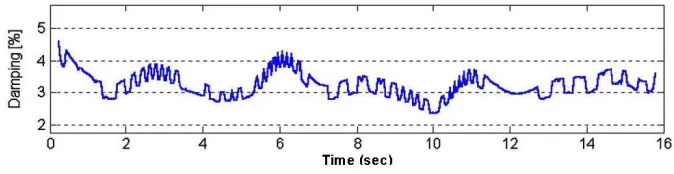
Damping identification by using wavelets essentially operates in the joint time-frequency domain. Thus, instantaneous estimates for damping can be obtained. The accuracy of these estimates depends on the time segments where the mode, and, thus, the modal damping, to be identified are predominant and it is not affected by the presence of other modes. Consequently, one has to either work with time weighted averages or to select time segments to improve estimation of the other modes. On the other hand, damping estimates depend on the type of window to be used in the transforms, the time length of the window as well as on the damping level of the structure. Figure 1 shows the variation of damping in time of the third mode of the Luciani Hospital of Caracas, Venezuela, after applying time-frequency instantaneous estimators (Ceravolo 2004).
resolution of a wavelet transform can be tuned sufficiently small to separate two signals with close frequency contents. This property is very useful for damping identification of structures having closely spaced frequencies (modes). Furthermore, very light and very heavy damping can be identified using the wavelet transform. However, more work needs to be done towards the identification of damping using the wavelet transform for buildings subjected to severe strong ground motion and, thus, exhibit strong non-linear behavior. The effects of closely spaced modes in unsymmetrical buildings in conjunction with their non-linear seismic response may constitute a challenge to the performance of wavelet-based damping identification methods, which up-to-now have been involved with only simple structures and mild levels of non-linearity.
Fig. 1. Instantaneous damping ratio (after Ceravolo 2004)
4.2 Damping identification using the modal minimization method
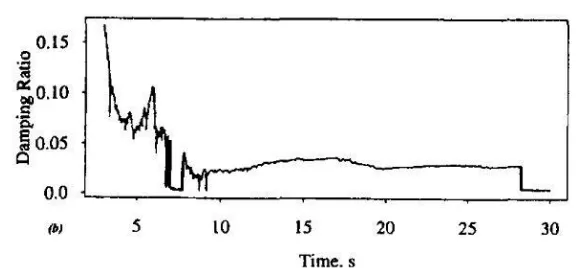
Fig. 2. Optimal estimates from Union Bank Building (after Beck and Jennings 1980)
The modal minimization method is simple and practical and has been used by Lin and Papageorgiou (1989), Li and Mau (1991) and Papageorgiou and Lin (1991) to the identification of torsional modes, a topic that was not included in its original version by Beck and Jennings (1980). According to the opinion of the authors, this method can adequately reproduce the seismic response of buildings that exhibit linear or mildly non-linear behavior. However, the identification of damping using the modal minimization method depends on the level of noise in the recorded responses, the sensitivity between the individual values of damping ratios and participation factors and the presence of coupled modes.
4.3 Damping identification using recursive least-squares method
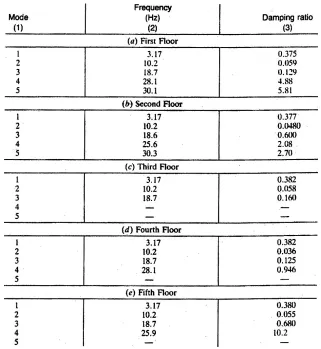
Fig. 3. Damping ratio of a five-story steel building using the recursive least-squares method (after Shinozuka and Ghanem 1995)
4.4 Damping identification using the extended Kalman filter method
Fig. 4. Damping ratio of a five-story steel building using the extended Kalman filter method (after Shinozuka and Ghanem 1995)
4.5 Damping identification using a frequency domain transfer function
value of 100%). More details are given in Papagiannopoulos and Beskos (2010). The method of Papagiannopoulos and Beskos (2010) cannot be easily verified experimentally. However, it is believed that this method can be extended to cover the case of un-symmetrical structures although the effect of closely spaced modes in conjunction with very high damping might render its reliability questionable.
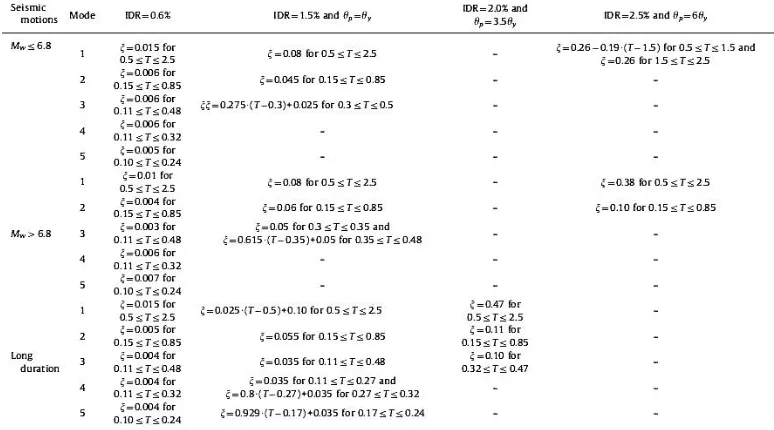
Fig. 5. Design equations for equivalent modal damping ratios as function of seismic deformation and damage (after Papagiannopoulos and Beskos 2010)
Fig. 6. Modal damping ratios for a seven-story reinforced concrete structure having a flexible base (after Hong et al. 2009)
4.6 Damping identification of a soil-structure system
ERA/OKID is minimized. This bias has been successfully treated by the authors who in their study obtained modal damping ratios of a seven-story reinforced concrete structure using acceleration records of ground motion and floors response induced by ten aftershocks of the 1999, Chi-Chi Taiwan earthquake. The record of the main-shock of that earthquake was not included in the linear identification process employed by the authors because the response of the building under study during the main-shock was highly non-linear. Figure 6 provides modal damping ratios for the six mode shapes shown in Figure 7 for nine data sets, i.e., seismic motions considering a flexible base.
Fig. 7. Identified mode shapes for a seven-story reinforced concrete structure having a flexible base (after Hong et al. 2009)
The method of Hong et al. (2009) requires some computational effort but highlights the importance of including soil-structure interaction to the determination of damping ratios for an actual structure. However, it seems that even one of the most refined identification techniques as the one used by Hong et al. (2009) cannot account for the effect of missing modes during the identification process of a complex system such as a soil-structure one. The problem will be even more pronounced if severe non-linear behavior in the soil-structure system is exhibited where this method falls short off the mark. The simple linear identification method presented by Stewart et al. (1999a), with proper considerations for time delay between input and output, number of modes used and non-linearity, is believed to be more reliable for evaluating modal damping ratios in soil-structure systems. Figure 8 shows the time variation of the damping ratio for the first mode of a six-story office building in Los Angeles, considering a fixed and a flexible base, using its seismic response induced by the 1994 Northridge earthquake.
5. Conclusions - Further needs on damping identification
The last section of this review paper attempts as conclusions to address future needs in damping identification for building structures, an issue that according to the opinion of the authors has not gain up to now the importance it deserves and has not been systematically studied. What has to be stressed is the need for robust and simple damping identification methods although the following paragraphs may imply the opposite.
Identification in building structures is by definition an ill-conditioned inverse problem. It requires substantial knowledge from the theory of system identification, which is the inverse procedure of structural dynamics, and makes use of a small number of available measurements, e.g., response recordings at specific floors of a building, while aims at reproducing as accurate as possible the response of all floors of a building. In this sense, all damping identification methods presented above are approximate and a unique solution cannot be provided excluding the idealized case where a building structure can be considered as a single-degree-of freedom system. On the other hand, the presence of noise in measurements, that essentially has to be removed using signal processing techniques, complicates the identification of damping as the sensitivity of the aforementioned noise-removal procedure with respect to damping seems to be case-dependent.
Due to the complexity of the damping mechanism, simplified models have been developed with the modal damping one to be the most widely used during the identification process. This consideration leads to the inevitable step of accounting damping at a global scale whereas under specific conditions the damping ratio of an element could be found. However, this requires a sub-structuring technique to be applied to the structure under identification. This obviously increases the computational effort and does not guarantee more reliable global damping results. Damping ratios of various elements need to be combined somehow in order to be expressed in terms of modes; otherwise one should use the element damping ratios and construct a damping matrix in the context of the finite element method.
The sub-structuring identification techniques may reveal the time-varying behavior of damping ratios that could help towards the correlation between damping and restoring forces during the seismic response of a structure. On the other hand, most of the existing damping identification techniques provide estimates of damping ratios for the few lower modes. Although this is acceptable in seismic design since a few lower modes are usually needed to represent the seismic response of a structure, the identified results fail to detect structural damage. This is an additional reason of supporting sub-structuring identification methods as damping coefficients in local parts of the structure can be identified.
For the majority of the methods mentioned in the previous section, identification is performed on the basis of the assumption that the structure under study is linear and classically damped. When the outcome of the identification process indicates failure of this assumption, non-linear identification is adopted to get a better representation of the damping characteristics of the structure. Nevertheless, performing non-linear identification neglects the fact that the error in the identification process comes from the effect of non-classical damping. Thus, before the use of non-linear identification, one should use a linear non-classical damped identification model. This kind of identification can be performed either in time or in frequency domain depending on the structure under study. For example, if linear soil-structure interaction has to be taken into account, the frequency domain identification may be more useful due to the frequency dependency of the parameters of the soil in cases of simplified soil models.
(modal coupling) and the possible energy transfer between them. If this modal coupling is ignored, damping estimates are unreliable. For these building cases, a multiple input (translational and torsional components of ground motion) multiple output (translational and torsional responses) identification procedure has to be employed.
Извод
Идентификација пригушења за грађевине изложене земљотресу:
прегледни рад
G. Papagiannopoulos1, D. Beskos2*
1
Department of Civil Engineering
University of Patras, GR 26504, Rio, Patras, Greece [email protected]
2Department of Civil Engineering
University of Patras, GR 26504, Rio, Patras, Greece [email protected]
*Corresponding author
Извод
У овом прегледном раду су описани постојећи методи за идентификацију пригушења, карактеристика практичних примена и уобичајених проблема за грађевине изложене земљотресу. Приказани су неки карактеристични примери да демонстрирају могућности описаних метода. Нагласак је на идентификацији пригушења када се јављају сеиѕмичке вибрације у нелинеарним подручјима. Потребе за будућим разматрањем идентификације пригушења су такође описане.
Кључне речи: пригушење, идентификација, грађевине, сеизмичка кретања, линеаран одзив, нелинеаран одзив.
References
Adhikari S, Woodhouse J (2001), Identification of damping: Part 2, Non-viscous damping, Journal of Sound and Vibration, 243, 63-88.
Adhikari S(2002), Lancaster‘s method of damping identification revisited, Journal of Vibration and Acoustics, ASME, 124, 617-627.
Beck JL, Jennings PC (1980), Structural identification using linear models and earthquake records, Earthquake Engineering and Structural Dynamics, 8, 145-160.
Béliveau JG(1976), Identification of viscous damping in structures from modal information, Journal of Applied Mechanics, ASME, 43, 335-338.
Bernal D (1994), Viscous damping in inelastic structural response, Journal of Structural Engineering, 120, 1240-1254.
Blandon CA, Priestley MJN, (2005), Equivalent viscous damping equations for direct displacement based design, Journal of Earthquake Engineering, 9, 257-278.
Boltežar M, Slavič J (2004), Enhancements to the continuous wavelet transform for damping identification on short signals, Mechanical Systems and Signal Processing, 18, 1065-1076. Brincker R, Zhang L, Andersen P (2001), Modal identification of output-only systems using
Caravani P, Thomson WT (1974), Identification of damping coefficients in multidimensional linear systems, Journal of Applied Mechanics, ASME, 41, 379-382.
Caravani P, Watson ML, Thomson WT (1976), Recursive least-squares time domain identification of structural parameters, Journal of Applied Mechanics, ASME, 43, 135-140. Caughey TK, O‘ Kelly MEJ (1965), Classical normal modes in damped linear dynamic
systems, Journal of Applied Mechanics, 32, 583-588.
Ceravolo R (2004), Use of instantaneous estimators for the evaluation of structural damping, Journal of Sound and Vibration, 274, 385-401.
Charney FA(2008), Unintended consequences of modeling damping in structures, Journal of Structural Engineering, 134, 581-592.
Chen SL, Liu JJ, Lai HC (2009), Wavelet analysis for identification of damping ratios and natural frequencies, Journal of Sound and Vibration, 323, 130-147.
Clough RK, Penzien J (1993), Dynamics of structures, 2nd Ed, McGraw-Hill, Ney York.
Davenport AG, Carroll PH (1986), Damping in tall buildings: its variability and treatment in design, Proceedings of the ASCE Spring Convention (Eds. N. Isyumov and T. Tschanz), Seattle, Washington, 42-57.
Erduran, E (2012), Evaluation of Rayleigh damping and its influence in engineering demand parameters, Earthquake Engineering and Structural Dynamics, DOI: 10.1002/eqe.2164 Feriani A, Perotti F (1996), The formation of viscous damping matrices for the dynamic
analysis of MDOF systems, Earthquake Engineering and Structural Dynamics, 25, 689-709.
Fritz WP, Jones NP, Igusa T (2009), Predictive models for the median and variability of building period and damping, Journal of Structural Engineering, ASCE, 135, 576-586. Ghanem R, Shinozuka M. (1995), Structural-system identification. I: Theory, Journal of
Engineering Mechanics, ASCE, 121, 255-264.
Gülkan P, Sozen MA (1974), Inelastic responses of reinforced concrete structures to earthquake motions, ACI Journal, 71, 604-610.
Hall JF (2006), Problems encountered from the use (or misuse) of Rayleigh damping, Earthquake Engineering and Structural Dynamics, 35, 525-545.
Hamming RW(1998), Digital Filters, 3rd Ed., Dover Publications, Inc, New York.
Hans S, Ibraim E, Pernot S, Boutin C, Lamarque CH (2000), Damping identification in multi-degree-of-freedom system via a wavelet-logarithmic decrement-Part 2: Study of a civil engineering building, Journal of Sound and Vibration, 235, 375-403.
Hart GC, Matthiesen RB, Ibanez P, Smith CB, Vasudevan R and DiJulio R(1974), Damping in nuclear reactors, Proceedings of the 5th World Conference on Earthquake Engineering, Rome, 2, 2029-2037.
Hart GC, Vasudevan R (1975), Earthquake design of buildings: Damping, Journal of the Structural Division, ASCE, 101, 11-29.
Hart GC, Yao JTP (1977), System identification in structural dynamics, Journal of the Engineering Mechanics Division, ASCE, 103, 1089-1104.
Hasselman TK (1972), Method for constructing a full modal damping matrix from experimental measurements, AIAA Journal, 6, 526-527.
Hasselman TK (1976), Damping synthesis from substructure tests, AIAA Journal, 10, 1409-1418.
Haviland R (1976), A study of the uncertainties in the fundamental translational period and damping values for real buildings, MIT, Research Report No. 5, R76-12, Department of Civil Engineering, Cambridge, Massachusetts.
Hong AL, Betti R, Lin CC (2009), Identification of dynamic models of a building structure using multiple earthquake records, Structural Control and Health Monitoring, 16, 178-199. Huang FL, Wang XM, Chen ZQ, He XH, Ni YQ (2007), A new approach to identification of
Imai H, Yun CB, Maruyama O, Shinozuka M.(1989), Fundamentals of system-identification in structural dynamics, Probabilistic Engineering Mechanics, 4, 162-173.
Jacobsen LS (1930), Steady forced vibration as influenced by damping, Transactions of the ASME, 52, 169-181.
Jeary AP (1986), Damping in tall buildings – A mechanism and a predictor, Earthquake Engineering and Structural Dynamics, 14, 733-750.
Jennings PC (1968), Equivalent viscous damping for yielding structures, Journal of the Engineering Mechanics Division, 94, 103-116.
Jennings PC, Matthiesen RB, Hoerner JB (1972), Forced vibration of a tall steel-frame building, Earthquake Engineering and Structural Dynamics, 1, 107-132.
Jezequel L (1980), A method of damping synthesis from substructure tests, Journal of Mechanical Design, 102, 286-294.
Ji X, Hikino T, Kasai K, Nakashima M (2012), Damping identification of a full-scale passively controlled five-story steel building structure, Earthquake Engineering and Structural Dynamics, DOI: 10.1002/eqe.2208 (in print).
Kampas G, Makris N (2012), Time and frequency domain identification of seismically isolated structures: advantages and limitations, Earthquakes and Structures, 3, 249-267.
Kareem A, Gurley K(1996), Damping in structures: its evaluation and treatment of uncertainty, Journal of Wind Engineering and Industrial Aerodynamics, 59, 131-157.
Kausel E (2008), A note on classical damping matrices: Letter to the editor, Earthquake Engineering and Structural Dynamics, 37, 1801-1804.
Kerschen G, Worden K, Vakakis AF, Golinval JC(2006), Past, present and future of nonlinear system identification in structural dynamics, Mechanical Systems and Signal Processing, 20, 505-592.
Kim SBK, Spencer BF, Yun CB (2005), Frequency domain identification of input, multi-output systems considering physical relationships between measured variables, Journal of Engineering Mechanics, ASCE, 131, 461-472.
Koh CG, See LM, Balendra T (1991), Estimation of structural parameters in the time domain: a substructure approach, Earthquake Engineering and Structural Dynamics, 20, 787-801. Kozin F, Natke HG(1986), System identification techniques, Structural Safety, 3, 269-316. Lagomarsino S. (1993), Forecast models for damping and vibration periods of buildings,
Journal of Wind Engineering and Industrial Aerodynamics, 48, 221-239.
Lee CG, Yun CB (1991), Parameter identification of linear structural dynamic systems, Computers and Structures, 40, 1475-1487.
Léger P, Dussault S (1992), Seismic – energy dissipation in MDOF structures, Journal of Structural Engineering, 118, 1251-1269.
Li XY, Law SS (2009), Identification of structural damping in time-domain, Journal of Sound and Vibration, 328, 71-84.
Li Y, Mau ST (1991), A case study of MIMO system identification applied to building seismic records, Earthquake Engineering and Structural Dynamics, 20, 1045-1064.
Lin CC, Hong LL, Ueng JM, Wu KC, Wang CE (2005), Parametric identification of asymmetric buildings from earthquake response records, Smart Materials and Structures, 14, 850-861.
Lin BC, Papageorgiou AS (1989), Demonstration of torsional coupling caused by closely spaced periods-1984 Morgan Hill earthquake response of Santa Clara County building, Earthquake Spectra, 5, 539-556.
Lin CC, Wang JF, Tsai CH (2008), Dynamic parameter identification for irregular buildings considering soil-structure interaction effects, Earthquake Spectra, 24, 641-666.
Loh CH, Lin HM (1996), Application of off-line and on-line identification techniques to building seismic response data, Earthquake Engineering and Structural Dynamics, 25, 269-290.
Loh CH, Tou IC (1995), A system identification approach to the detection of changes in both linear and non-linear structural parameters, Earthquake Engineering and Structural Dynamics, 24, 85-97.
Loh CH, Tsaur YH (1988), Time domain estimation of structural parameters, Engineering Structures, 10, 95-105.
Luco JE (2008a), A note on classical damping matrices, Earthquake Engineering and Structural Dynamics, 37, 615-626.
Luco JE (2008b), A note on classical damping matrices: Author‘s reply, Earthquake Engineering and Structural Dynamics, 37, 1805-1809.
Luş H, Betti R, Longman RW (1999), Identification of linear structural systems using earthquake-induced vibration data, Earthquake Engineering and Structural Dynamics, 28, 1449-1467.
Luş H, Betti R, Longman RW(2002), Obtaining refined first-order predicting models of linear structural systems, Earthquake Engineering and Structural Dynamics, 31, 1413-1440. Mahmoudabadi M, Ghafory-Ashtiany M, Hosseini M (2007), Identification of modal
parameters of non-classically damped linear structures under multi-component earthquake loading, Earthquake Engineering and Structural Dynamics, 36, 765-782.
Marmarelis PZ, Udwadia F (1976), The identification of building structural systems II. The nonlinear case, Bulletin of the Seismological Society of America, 66, 153-171.
McVerry GH(1980), Structural identification in the frequency domain from earthquake records, Earthquake Engineering and Structural Dynamics, 8, 161-180.
Moaveni B, Asgarieh E (2012), Deterministic-stochastic subspace identification method for identification of nonlinear structures as time-varying linear systems, Mechanical Systems and Signal Processing, 31, 40-55.
Mohraz B, Elghadamsi FE, Chang CJ(1991), An incremental mode – superposition for non – linear dynamic analysis, Earthquake Engineering and Structural Dynamics, 20, 471-481. Nagarajaiah S, Li Z (2004), Time segmented least squares identification of base isolated
buildings, Soil Dynamics and Earthquake Engineering, 24, 577-586.
Newmark NM, Hall WJ (1982), Earthquake Spectra and Design, Earthquake Engineering Research Institute, Berkeley, California.
Nielsen NN (1968), Vibration tests of a nine-story steel frame building, Journal of the Engineering Mechanics Division, ASCE, 92, 81-110.
Papageorgiou AS, Lin BC (1991), Analysis of recorded earthquake response and identification of a multi-story structure accounting for foundation interaction effects, Soil Dynamics and Earthquake Engineering, 10, 55-64.
Papagiannopoulos GA, Beskos DE (2006), On a modal damping identification model for building structures, Archive of Applied Mechanics, 76, 443-463.
Papagiannopoulos GA, Beskos DE (2009), On a modal damping identification model for non-classically damped linear building structures subjected to earthquakes, Soil Dynamics and Earthquake Engineering, 29, 583-589.
Papagiannopoulos GA, Beskos DE (2010), Towards a seismic design method for plane steel frames using equivalent modal damping ratios, Soil Dynamics and Earthquake Engineering, 30, 1106-1118.
Petrini L, Maggi C, Priestley MJN, Calvi GM (2008), Experimental verification of viscous damping modeling for inelastic time history analyzes, Journal of Earthquake Engineering, 12(S1), 125-145.
Priestley MJN, Grant DN(2005), Viscous damping in seismic design and analysis, Journal of Earthquake Engineering, 9, 229-255.
Quek ST, Wang W, Chen CG (1999), System identification of linear MDOF structures under ambient excitation, Earthquake Engineering and Structural Dynamics, 28, 61-77.
Rea D, Clough RW, Bouwkamp JG (1969), Damping capacity of a model steel structure, Earthquake Engineering Research Institute, Berkeley, California.
Ruzzene M, Fasana A, Garibaldi L, Piombo B (1997), Natural frequencies and dampings identification using wavelet transform: application to real data, Mechanical Systems and Signal Processing, 11, 207-218.
Şafak E (1989), Adaptive modeling, identification and control of dynamic systems. II: applications, Journal of Engineering Mechanics, ASCE, 115, 2406-2426.
Şafak E (1991), Identification of linear structures using discrete-time filters, Journal of Structural Engineering, ASCE, 117, 3064-3085.
Şafak E, Çelebi M (1991), Seismic response of Transamerica Building. II: System identification, Journal of Structural Engineering, ASCE, 117, 2405-2424.
Satake N, Suda K, Arakawa T, Sasaki A, Tamura Y (2003), Damping evaluation using full-scale data of buildings, Journal of Structural Engineering, ASCE, 129, 470-477.
Shi Y, Chang CC (2012), Substructural time-varying parameter identification using wavelet multiresolution approximation, Journal of Engineering Mechanics, ASCE, 138, 50-59. Shibata A, Sozen MA (1976), Substitute – structure method for seismic design in R/C, Journal
of the Structural Division, 102, 1-18.
Shinozuka M, Ghanem R (1995), Structural-system identification II: Experimental verification, Journal of Engineering Mechanics, ASCE, 121, 265-273.
Slavič J, Boltežar M (2011), Damping identification with the Morlet-wave, Mechanical Systems and Signal Processing, 25, 1632-1645.
Slavič J, Simonovski I, Boltežar M (2003),Damping identification using a continuous wavelet transform: application to real data,Journal of Sound and Vibration, 262, 291-307.
Smyrou E, Priestley MJN, Carr AJ (2011), Modelling of elastic damping in nonlinear time-history analyses of cantilever RC walls, Bulletin of Earthquake Engineering, 9, 1559-1578. Staszewski WJ (1997), Identification of damping in MDOF systems using time-scale
decomposition, Journal of Sound and Vibration, 203, 283-305.
Stewart JP, Fenves GL (1998), System identification for evaluating soil-structure interaction effects in buildings from strong motion recordings, Earthquake Engineering and Structural Dynamics, 27, 869-885.
Stewart JP, Fenves GL, Seed RB (1999a), Seismic soil-structure interaction in buildings. I: Analytical methods, Journal of Geotechnical and Geoenvironmental Engineering, 125, 26-37.
Stewart JP, Seed RB, Fenves GL (1999b), Seismic soil-structure interaction in buildings. II: Empirical findings, Journal of Geotechnical and Geoenvironmental Engineering, 125, 38-48.
Takewaki I (1997), Design-oriented ductility bound of a plane frame under seismic loading, Journal of Vibration and Control, 3, 411–434.
Takewaki I, Nakamura M (2005), Stiffness-damping simultaneous identification under limited observation, Journal of Engineering Mechanics, ASCE, 131, 1027-1035.
Tanaka T, Yoshizawa S, Osawa Y, Morishita T (1969), Period and damping of vibration in actual buildings during earthquakes, Bulletin of the Earthquake Research Institute, 47, 1073-1092.
Tan RY, Cheng WM (1993), System identification of a non-classically damped linear system, Computers and Structures, 46, 67-75.
Toki K, Sato T, Kiyono J (1989), Identification of structural parameters and input ground motion from response time histories, Structural Engineering/Earthquake Engineering, JSCE, 6, 413s-421s.
Udwadia F, Marmarelis PZ (1976), The identification of building structural systems I. The linear case, Bulletin of the Seismological Society of America, 66, 125-151.
Udwadia FE, Sharma DK, Shah PC(1978), Uniqueness of damping and stiffness distributions in the identification of soil and structural systems, Journal of Applied Mechanics, ASME, 45, 181-187.
Udwadia FE, Esfandiari RS (1990), Nonclassically damped dynamic systems: An iterative approach, Journal of Applied Mechanics, ASME, 57, 423-433.
Ueng JM, Lin CC, Lin PL (2000), System identification of torsionally coupled buildings, Computers and Structures, 74, 667-686.
Ulusoy HS, Feng MQ, Fanning PJ (2011), System identification of a building from multiple seismic records, Earthquake Engineering and Structural Dynamics, 40, 661-674.
Val DV, Segal F (2005), Effect of damping model on pre-yielding earthquake response of structures, Engineering Structures, 27, 1968-1980.
Wang J (2009), Intrinsic damping: modelling techniques for engineering systems, Journal of Structural Engineering, ASCE, 135, 282-291.
Wang Z, Chen G (2012), Recursive Hilbert-Huang transform method for time-varying property identification of linear shear-type buildings under base excitations, Journal of Engineering Mechanics, ASCE, 138, 631-639.
Wang D, Haldar A (1997), System identification with limited observations and without input, Journal of Engineering Mechanics, ASCE, 123, 504-511.
Warburton GB, Soni SR (1977), Errors in response calculations for non-classically damped structures, Earthquake Engineering and Structural Dynamics, 5, 365-376.
Wilson EL, Penzien J (1972), Evaluation of orthogonal damping matrices, Earthquake Engineering and Structural Dynamics, 4, 5-10.
Wood JH (1976), Earthquake response of a steel frame building, Earthquake Engineering and Structural Dynamics, 4, 349-377.
Yang JN, Lin S (2005), Identification of parametric variations of structures based on least squares estimation and adaptive tracking technique, Journal of the Engineering Mechanics, ASCE, 131, 290-298.
Yang JN, Lei Y, Pan S, Huang N (2003a), System identification of linear structures based in Hilbert-Huang spectral analysis. Part 1: normal modes, Earthquake Engineering and Structural Dynamics, 32, 1443-1467.
Yang JN, Lei Y, Pan S, Huang N(2003b), System identification of linear structures based in Hilbert-Huang spectral analysis. Part 2: complex modes, Earthquake Engineering and Structural Dynamics, 32, 1533-1554.
Yin HP, Duhamel D, Argoul P (2004), Natural frequencies and damping estimation using wavelet transform of a frequency response function, Journal of Sound and Vibration, 271, 999-1014.
Yun CB, Lee HJ, Lee CG (1997), Sequential prediction-error method for structural identification, Journal of Engineering Mechanics, ASCE, 123, 115-122.
Zareian F, Medina RA (2010), A practical method for proper modelling of structural damping in inelastic plane structural systems, Computers and Structures, 88, 45-53.