ISSN 0000 ©2019 WEJ Journal
An Optimal Load Frequency Controller in 2 Area
Power System using Firefly algorithm
Mostafa Bigonah
*, ali asghar shojaei, mehdi ameli
*Department of Electrical Engineering, Neyshabur Branch, Islamic Azad University, Neyshabur, Iran
Corresponding Author email: [email protected]
Abstract: According to the various studies performed in the electricity market, load frequency control is one of the most important side services of these systems. This operation creates a balance between the energy and the frequency of the power system. The main purpose of the load-frequency restoration is the ability to adjust the initial frequency, return the frequency to the nominal value, and minimize the transmittance between the regions and in other words, to achieve a minimum value for state-frequency error.In regenerated power systems, each control area includes various types of uncertainties and disturbances that result from increasing complexity, modeling errors, and changing the structure of the power system. Since the classical controllers do not have the ability to solve the problem, a flexible controller should be used. In this paper, a new method is proposed to improve and optimize the control parameters of the load-frequency control system. Here, a new algorithm, called firefly algorithm, is used to optimize the controller parameters. To illustrate the effectiveness of this algorithm, the results will be compared with the results obtained from the classical method. Final results show that the proposed method has a high performance in the load frequency controlling purposes.
Keywords: Power system, LFC, optimization, firefly algorithm.
INTRODUCTION
The power system is a set of electrical components that are used to supply, transmit, and utilization of electrical energy power. The network used to provide the electrical power at homes and industries is one of the examples of power systems.
By increasing demand for electrical energy, the complexity of the electrical power systems has been increased. Therefore, it is necessary to provide a stable and high reliability electrical energy.
In order to improve the performance of the power system under abnormal conditions, maladjustments must be corrected with the help of supplementary control (Razmjooy, Khalilpour, & Ramezani, 2016).
Load Frequency Control (LFC) is a good way to control the power system to provide adequate and reliable energy with high quality (Jaber et al., 2018).
In large-scale power systems, which usually include control-related areas, load frequency control is critical to maintaining the system frequency and transmission power between areas close to programmed values to the extent possible.
In this case, the mechanical power input to the generators is used to control the frequency of the electric power output and maintain the transmission power in the programmed areas. With the statement, a well-designed power system should be able to properly performance against load variations and system disturbances and provide a high level of expected power quality while keeping the frequency in an acceptable range (Lal, Barisal, & Tripathy, 2018; Rostamzadeh, Valipour, Shenava, Khalilpour, & Razmjooy, 2012).
Therefore, it can be said that with the expansion and development of power systems in recent years, the use of load-frequency controllers has been of particular importance in the exploitation of these systems. In such a way, without the use of this control, the power grid may face unexpected problems if the power system is properly designed.
Despite the great progress made in a variety of industrial controllers, the proportional-integral-derivative controllers (PIDs) are still among the most commonly used and widely used types of controllers (Razmjooy & Khalilpour, 2015a; Razmjooy & Ramezani, 2014b).
2 Hence, there is now a lot of research works to obtain and adjust the PID controller parameters. Also, different performance metrics have been used to evaluate the performance of controlled systems.
With the development and expansion of power systems in recent years, the proper control of these systems to be able to withstand sudden changes in load and system disturbances and to maintain the power quality while keeping the voltage and frequency in acceptable range has been of great importance.
For optimal power systems utilization, we should be able to keep the frequency variations fixed within a certain range.
One of the methods used to control these systems is load-frequency control. Load frequency control is so important in power systems that the lack of them, even with proper design, still creates the possibility of unpredictable problems in these networks (Abazari, Monsef, & Wu, 2018).
The main purpose of the load-frequency control is to re-establish the initial frequency, restore the frequency to the nominal value, and minimize the inter-regional power transmission.
Over the past decade, several different scenarios have been proposed to improve the load-frequency control [13; 15].
In reference (Duan, Zhang, Jiang, Fang, & Yao, 2017), using linear feedback, load-frequency control is investigated. In the method described, a PI controller is used to maintain the load-frequency control stability. The proposed method is then simulated with the help of rewritten linear inequalities matrix. The results of the work indicated that, under different scenarios, the proposed method provides acceptable results.
In the source (Ganesh, Vasu, & Bhavana, 2012), the authors presented a method for controlling load-frequency based on the optimal control of LQR (Razmjooy, Madadi, Alikhani, & Mohseni, 2014; Razmjooy, Ramezani, & Namadchian, 2016). Their study was an HVDC. In this case, they used the AGC to control load-frequency in a multi-component system. To detect disturbing factors such as noise, the Kalman filter was used for the viewer and the results were simulated using MATLAB software, which showed the acceptable ability of the proposed method.
Reference (Qian, Zhao, Yi, & Liu, 2013) uses a neural network to control the load-frequency. In that paper, after obtaining a scenario for controlling the system using the sliding mode control/integral method, the weight of the neural network was optimized based on the Lyapunov function and the results showed the efficiency of the proposed system (Hossein Hosseini, Tousi, & Razmjooy, 2014).
Recently, the use of intelligent methods to obtain an optimal method for contra-frequency-frequency systems is a popular topic. For example, in 2003, the use of genetic algorithms, the use of bacterial algorithms in 2011, the use of the colonial competition algorithm in 2013, the use of Quantum based metaheuristics like the work by Razmjooy in 2014 (Razmjooy & Ramezani, 2014a), the use of World Cup Optimization in 2017 (Razmjooy, Khalilpour, et al., 2016), and In 2015, bat algorithm was used to control the load-frequency of different power systems (Sathya & Ansari, 2015).
Therefore, in this study, we try to reduce the amount of frequency deviation during the dynamic operation of the power system in the shortest time by employing a new algorithm, called firefly algorithm and considering load changes in the regions while improving the frequency / frequency controller.
MATERIALS AND METHODS
Regarding the various analyzes performed in the electricity market, frequency control is one of the most important side services of these systems. This operation creates a balance between the energy and the frequency of the power system.
Among different methods of these controllers, load frequency control (LFC) is one of the most commonly used methods. The purpose of the LFC is to re-establish the ability to adjust the initial frequency, return the frequency to the nominal value, and to minimize the transmittance power flux between the regions.
Among the mechanisms used to control the frequency in lateral markets, bilateral contracts or proposments are more prominent (Razmjooy, Ramezani, & Nazari, 2015).
Over the past decade, several LFC scenarios have been proposed to implement the traditional LFC designs with a change in the environment in re-structured power systems.
In a regenerated power system, each control area involves a variety of uncertainties and disturbances, which are due to the increased complexity, modeling errors, and the change in the structure of the power system (Hossein Hosseini, Tusi, Razmjooy, & Khalilpoor, 2011). As a result, a fixed controller based on traditional theory cannot be used, but it should have a flexible controller.
3 In the following, the required materials and methods have been explained.
Two-Region System Modeling
In this section, a two-region power system is modeled. There are two production systems in each area; in the first area, there is a steam power plant and a hydroelectric power plant, and in the second area a hydroelectric power plant and a diesel power plant will jointly provide the energy needed by the area (Razmjooy & Ramezani). The structure of the two-region is shown in the following figure.
Figure 1. The structure of the two-region system
The modeling of the components of this two-zone system is shown in below.
Figure 2. The turbine and the governor in steam system
4 Figure 4. Turbine and governor (mechanical model) of the hydroelectric system
Figure 5. Turbine and governor of the diesel system
Load frequency control
The main purpose of a load frequency controller (LFC) system is to maintain the frequency at the acceptable level, to divide the load between generators, and to control the power exchange programs in the transmission lines. The changes in the frequency and the actual power in the transmission line are measured; in this case, the changes in the angle of rotation mean error, which needs to be corrected. The error symbols df and
dp are amplified and combined and converted to the true power control signal dpv, which is sent to the initial actuator to increase the torque input.
Therefore, the initial trigger changes the output of the generator to dpg, which in turn causes a change in the values of df and dp in the predefined precision.
The first step in analyzing and designing a system is to generate a mathematical model of it. Two commonly used methods for this purpose are:
Modeling based on transfer function Modeling based on state space
The state space method variable can be used for linear and nonlinear systems. In order to use the transfer function and linear equations, the system must first be linearized.
Assumptions and approximations are considered for linearization of the mathematical equations that represent the behavior of the system.
Then, the transformation function model is obtained for each generator model and load model. The load in the power system consists of various electrical appliances (Razmjooy & Khalilpour, 2015b). In electrical resistance loads, such as lighting and heat, the electrical power does not depend on the frequency. Engine portions are sensitive to the frequency variations. How frequency responsiveness depends on the combination of load-speed characteristics of all devices with motor drives. Load characteristics - The speed of a combined load is approximated as follows.
dpe=dpl+Dd (1)
where, dpl is not sensitive to the frequency variations, but, the term Dd is sensitive to the frequency variation. The quantity D is the ratio of the percentage change in load to the frequency variation percentage. For example, if 1 percent change in frequency, changes the load to 1.6 percent, then D=1/6.
Firefly Algorithm
The firefly algorithm is a new meta-heuristic algorithm which is inspired by the behavior of light emitting of the fireflies. The primary purpose of the firefly algorithm to emit light as a system is for marking the light to attract the other worms.
The flashing light of the fireflies has a strange sight in the summer sky in tropical and temperate regions. There are about two thousand species of fireflies, and many of them produce short and long-running light. The pattern of light is often unique to a particular species. This light is produced by a biogeochemical process and the performance of signal systems is still under discussion(Razmjooy, Madadi, & Ramezani). However, two basic functions for light can be found in attracting partners (communications) and attracting potential bait. In addition, light may also be a warning mechanism to remind potential predators of the bitter taste of fireflies.
Some of the flashing characteristics of the fireflies can be employed to model the firefly algorithms. To do this, three significant characteristics for the fireflies can be considered:
5 Attractiveness is proportional to their brightness, thus for any two flashing fireflies, the less brighter one will move towards the brighter one. The attractiveness is proportional to the brightness and they both decrease as their distance increases. If there is no brighter one than a particular firefly, it will move randomly
The brightness of a firefly is affected or determined by the landscape of the objective function. For a maximization problem, the brightness can simply be proportional to the value of the objective function. Other forms of brightness can be defined in a similar way to the fitness function in genetic algorithms.
There are some conceptual similarity between the firefly algorithms and the bacterial foraging algorithm (BFA). For instance in BFA, the attraction among bacteria is based partly on their fitness and partly on their distance, while in FA, the attractiveness is linked to their objective function and monotonic decay of the attractiveness with distance. However, the agents in FA have adjustable visibility and more versatile in attractiveness variations, which usually leads to higher mobility and thus the search space is explored more efficiently.
Two significant cases in the firefly are the variation of light intensity and the formulation of the attractiveness. For example, it can be always assumed that the attractiveness of a firefly is described by the brightness which in turn is associated with the encoded objective function.
Since fireflies’ attractiveness has a proportional relation with the light intensity which is seen by the adjacent fireflies, it can be modeled as the following model:
. 0
.
r
e
gb
=
b
- (2)In FA, Cartesian distance is employed to find the distance between any two fireflies i and j at xi and xj,:
2 2
(
)
(
)
ij i j i j
r
=
x
-
x
+
y
-
y
(3)The attraction of a firefly i, to the brighter one like j, is presented as below: .
0
.
(
)
.(
0.5)
r
i i j i
X
=
X
+
b
e
-gX
-
X
+
a
rand
-
(4)where, for all of the above equations we have:
b
0Î
[0, 1],
g
Î
[0,
¥
),
a
Î
[0, 1]
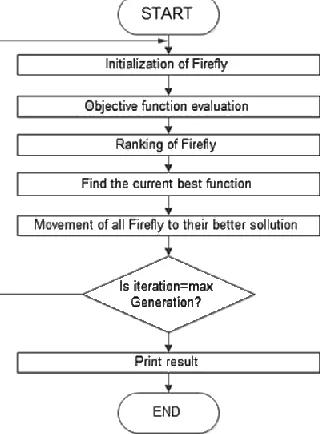
. The Flowchart of the firefly algorithm is summarized in the following figure.Figure 6. Flowchart of the firefly algorithm
Simulation Results
6
∑ | | | | | | (5)
Our purpose is to find the best value for the PI controller to optimize the above equation. For optimizing the system with the proposed firefly algorithm and fitness function, the following integral is calculated where the minimum value describes the best solution.
∫ | |
(6)
For analyzing the ability of the proposed algorithm, the results of the PSO algorithm are also studied.
In Fig. (7), the frequency fluctuations in region 1 are shown by applying a 6% disturbance. As can be seen, using the PI controller after 10 seconds makes the oscillation zero and the frequency has reached its nominal value.
In the following, the values of integral correlative controllers of the two-region system are obtained by particle optimization and firefly algorithms, and the frequency fluctuations of both regions along with the oscillatory power of the communication lines between the regions in forms is shown.
Figure 7. Frequency fluctuations in region 1 using (a) particle swarm algorithm and (b) firefly algorithm
In Fig. (8), the frequency fluctuations in region 2 are shown by applying a 6% disturbance. As can be seen, using the PI controller after 8 seconds, this oscillation is zero and the frequency has reached its nominal value.
(a) (b)
Figure 8. Frequency oscillations in region 2 (a) particle swarm algorithm and (b) firefly algorithm
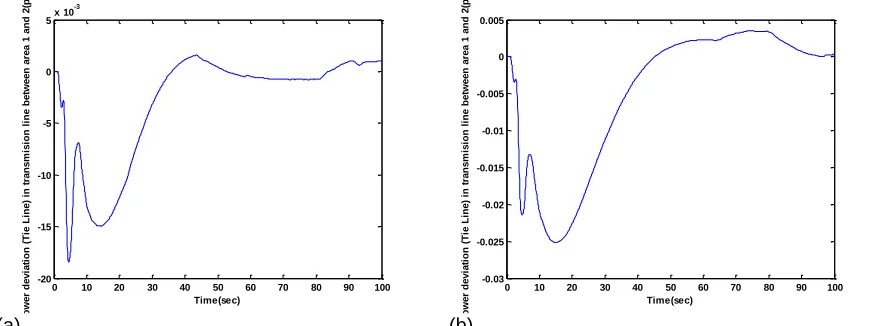
In fig.(9) and fig.(10), the power fluctuations in the transmission lines between regions 1 and 2 are shown with 6% disturbance. As can be seen, using the PI controller after 45 seconds, this oscillation is roughly dropped and power is not transmitted between the two regions.
0 10 20 30 40 50 60 70 80 90 100
-0.3 -0.25 -0.2 -0.15 -0.1 -0.05 0 0.05 Time(sec) fr e q u e n c y d e v ia ti o n o f a re a 1 (p u )
0 10 20 30 40 50 60 70 80 90 100
-0.3 -0.25 -0.2 -0.15 -0.1 -0.05 0 0.05 Time(sec) fr e q u e n c y d e v ia ti o n o f a re a 1 (p u )
0 10 20 30 40 50 60 70 80 90 100
-0.3 -0.25 -0.2 -0.15 -0.1 -0.05 0 0.05 Time(sec) fr e q u e n c y d e v ia ti o n o f a re a 2 (p u )
0 10 20 30 40 50 60 70 80 90 100
7
(a) (b)
Figure 9. Power fluctuations in the transmission lines between regions 1 and 2 (a) particle swarm algorithm and (b) firefly algorithm
(a) (b)
Figure 10. Optimal fitness function diagram for the 2-region system by (a) particle swarm algorithm and (b) firefly algorithm
In the evaluation of the two-region system, it can be seen that the optimized fitness function shows that the firefly algorithm has reached to more optimal value than the PSO by less iterations.
In addition, the oscillations of the waveforms in FA are somewhat less than those obtained by the PSO algorithm. This suggests the superiority of the firefly algorithm to the PSO algorithm.
The values of the controller coefficients calculated by the PSO and firefly algorithms for each region are given in table (1).
Table 1. PI controller coefficients by PSO and FA Controller
parameters
Region 1 Region 2
FA PSO FA PSO
KP 3.9064 6.0000 4.9255 6.0000
KI 3.7851 6.0000 0.5915 0.1154
In tables (2), the values of the parameters for PSO and FA are presented.
Table 2. Values of the parameters for PSO and FA are presente
PSO FA
Pop size C1,C2 Iteration Pop size alpha Iteration
35 2 30 35 0.01 30
0 10 20 30 40 50 60 70 80 90 100
-20 -15 -10 -5 0 5x 10
-3 Time(sec) p o w e r d e v ia ti o n ( T ie L in e ) in t ra n s m is io n l in e b e tw e e n a re a 1 a n d 2 (p u )
0 10 20 30 40 50 60 70 80 90 100
-0.03 -0.025 -0.02 -0.015 -0.01 -0.005 0 0.005 Time(sec) p o w e r d e v ia ti o n ( T ie L in e ) in t ra n s m is io n l in e b e tw e e n a re a 1 a n d 2 (p u )
5 10 15 20 25 30
0.0405 0.0405 0.0405 0.0406 0.0406 0.0406 0.0406 Iteration F it n e ss
0 10 20 30
8 CONCLUSIONS
In this study, an optimized PI controller used in a two region power system; the frequency fluctuations which occur due to various reasons such as power changes in the system was simulated. Frequency fluctuations due to changes in the rate of consumption or due to the open market of electricity were studied in the participation matrix for multi-region systems. Unlike the Fuzzy or ANFIS methods that are self-regulating, the proposed PID controller has constant values. Optimum algorithms are used to find the values of the controller parameters introduced by changing the internal parameters of the system under study. Firefly algorithm was utilized to optimize the PID controller and finalyy, it was compared by the most popular particle swarm optimization algorithm.
From the results, it was shown that the optimal controller designed by the firefly algorithm has better results compared to the optimized controller with the PSO algorithm at the optimal level of the oscillations generated at the frequency of the power system in both states, as well as the power exchange between the regions in It was kept at the very least, which would ensure the supply of each area by the production units of the same area.
REFERENCES
Abazari, A., Monsef, H., & Wu, B. (2018). Load frequency control by de-loaded wind farm using the optimal fuzzy-based PID droop controller. IET Renewable Power Generation.
Duan, C., Zhang, C.-K., Jiang, L., Fang, W., & Yao, W. (2017). Structure-exploiting delay-dependent stability analysis applied to power system load frequency control. IEEE Transactions on Power Systems, 32(6), 4528-4540.
Ganesh, V., Vasu, K., & Bhavana, P. (2012). LQR based load frequency controller for two area power system. International Journal of Advanced Research in Electrical, Electronics and Instrumentation Engineering, 1(4).
Hosseini, H., Tousi, B., & Razmjooy, N. (2014). Application of fuzzy subtractive clustering for optimal transient performance of automatic generation control in restructured power system. Journal of Intelligent & Fuzzy Systems, 26(3), 1155-1166.
Hosseini, H., Tousi, B., Razmjooy, N., & Khalilpour, M. (2013). Design robust controller for automatic generation control in restructured power system by imperialist competitive algorithm. IETE Journal of Research, 59(6), 745-752.
Hosseini, H., Tusi, B., Razmjooy, N., & Khalilpoor, M. (2011). Optimum design of PSS and SVC controller for damping low frequency oscillation (LFO). Paper presented at the Control, Instrumentation and Automation (ICCIA), 2011 2nd International Conference on.
Jaber, A., Abdalla, A., Shalash, N., Ahmed, A., Abdulkarim, H., Abaas, A., . . . Jabbar, Y. (2018). Applied of the reflection strategy of fuzzy on high complex power system frequency control. Journal of Fundamental and Applied Sciences, 10(6S), 2417-2430.
Khalilpour, M., Valipour, K., Shayeghi, H., & Razmjooy, N. (2013). Designing a robust and adaptive PID controller for gas turbine connected to the generator. Research Journal of Applied Sciences, Engineering and Technology, 5(5), 1544-1551.
Khalilpuor, M., Razmjooy, N., Hosseini, H., & Moallem, P. (2011). Optimal control of DC motor using invasive weed optimization (IWO) algorithm. Paper presented at the Majlesi conference on electrical engineering, Majlesi town, Isfahan, Iran.
Lal, D. K., Barisal, A. K., & Tripathy, M. (2018). Load Frequency Control of Multi Area Interconnected Microgrid Power System using Grasshopper Optimization Algorithm Optimized Fuzzy PID Controller. Paper presented at the 2018 Recent Advances on Engineering, Technology and Computational Sciences (RAETCS).
Qian, D., Zhao, D., Yi, J., & Liu, X. (2013). Neural sliding-mode load frequency controller design of power systems. Neural Computing and Applications, 22(2), 279-286.
Razmjooy, N., & Khalilpour, M. (2015a). A new design for PID controller by considering the operating points changes in Hydro-Turbine Connected to the equivalent network by using Invasive Weed Optimization (IWO) Algorithm. International Journal of Information, Security and Systems Management, 4(2), 468-475. Razmjooy, N., & Khalilpour, M. (2015b). A Robust Controller For Power System Stabilizer By Using Artificial Bee
Colony Algorithm.
9 Razmjooy, N., Madadi, A., Alikhani, H.-R., & Mohseni, M. (2014). Comparison of LQR and Pole Placement Design Controllers for Controlling the Inverted Pendulum. Journal of World’s Electrical Engineering and Technology, 2322, 5114.
Razmjooy, N., Madadi, A., & Ramezani, M. Robust Control of Power System Stabilizer Using World Cup Optimization Algorithm.
Razmjooy, N., & Ramezani, M. Training Wavelet Neural Networks Using Hybrid Particle Swarm Optimization and Gravitational Search Algorithm for System Identification.
Razmjooy, N., & Ramezani, M. (2014a). An Improved Quantum Evolutionary Algorithm Based on Invasive Weed Optimization. Indian J. Sci. Res, 4(2), 413-422.
Razmjooy, N., & Ramezani, M. (2014b). Using Quantum Gates to design a PID Controller for Nano robots. Int. Res. J. Appl. Basic Sci, 8, 2354-2359.
Razmjooy, N., Ramezani, M., & Namadchian, A. (2016). A new lqr optimal control for a single-link flexible joint robot manipulator based on grey wolf optimizer. Majlesi Journal of Electrical Engineering, 10(3), 53.
Razmjooy, N., Ramezani, M., & Nazari, E. (2015). Using LQG/LTR optimal control method for car suspension system. SCRO research annual report, 3, 1-8.
Rostamzadeh, M., Valipour, K., Shenava, S., Khalilpour, M., & Razmjooy, N. (2012). Optimal location and capacity of multi-distributed generation for loss reduction and voltage profile improvement using imperialist competitive algorithm. Artificial Intelligence Research, 1(2), 56.
Sahu, A., & Prasad, L. (2017). Load frequency control of interconnected five-area power system with PID controller. Paper presented at the Information, Communication, Instrumentation and Control (ICICIC), 2017 International Conference on.