Author for correspondence:
Volume-7 Issue-2
International Journal of Intellectual Advancements
and Research in Engineering Computations
A study of risk assessment and management in construction
Mr.B.Manibalu, Dr.KE.A.Palaniappan, Mr.S.Gopinathan, Ms.N.Rajalakshmi
Department of Civil Engineering, Dhanalakshmi Srinivasan Engineering College, Perambalur,
Tamilnadu, India.
ABSTRACT
No construction project is risk free. Risk can be managed, minimized, shared, transferred or accepted. It cannot be ignored. Moreover, construction, it is held, is exposed to more risk and uncertainty than perhaps any other industry sector. An effective and efficient risk management approach requires a proper and systematic methodology and, more importantly, knowledge and experience. The record of the construction industry is not acceptable in terms of coping up with risks in projects. Risk management is a process which consists of identification of risks, assessment with qualitatively and quantitatively, response with a suitable method for handling risks, and then controls the risks by monitoring. This study proposes to apply the risk management technique which includes well. This paper aims to identify and analyse the risks associated with the development of construction projects.
Keywords:
Construction Projects, Risk, Risk assessment, Risk Management.INTRODUCTION
Risk management (RM) is a concept which is used in all industries, from IT related business, automobile or pharmaceutical industry, to the construction sector. Each industry has developed their own RM standards, but the general ideas of the concept usually remain the same regardless of the sector.
The development of infrastructure is one of the most important activities that can boost up the business of various industries, thereby increasing the gross domestic product (GDP) of the country. Construction projects are always unique and risks raises from a number of different sources. Risk is defined as any action or occurrence which will affect the achievement of project objectives. Risk management is a technique which is used in many other industries from, IT related to business, automobile, pharmaceutical industry, to the construction sector. Risks and uncertainties inherent in the construction industry are more than any other industries. Risk is an integral component of any project. Risk is present in all projects
irrespective of their size or sector. No project is totally free from risks. If risks are not properly analysed and strategies are not trained to deal with them, the project is likely to lead to failures.
OBJECTIVES AND NEED OFSTUDY
The risk management technique is used very less because of less knowledge and awareness among the people. The track record is also very poor in terms of coping up with risks in projects, resulting in the affection of project objectives. Risk management is adopted to contain the possible future risks proactively rather than being reactive.
It applies to any project to evaluate the most, major, and common risks which cause bad effect on the construction project to achieve its objectives. The risk management concept is very less popular technique in the construction industry, and then it is necessary to spread awareness of the same.
METHODOLOGY
In this paper, general focus has been made on the general concepts of risk management. Risk identification has been done with the study of literature. A questionnaire was developed after the identified factors affecting risk. A risk assessment can be done with the aid of qualitative and quantitative analysis. Risk response could be planned on the basis of the outcome of the study. Risk control is the last step in the process of risk management.
CONCEPT OF RISK ANALYSIS
AND MANAGEMENT
Risk management is a process which identifies the project risks, analyse them, and determine the actions to avert the threats on any project. All steps in the risk management process should be included to deal with risks, in order to
implement the process of the project. Due to the nature of construction projects, risk management is a very important process.
Construction group includes risk factors that occur due to faulty construction techniques, managerial issue, cost escalation, and delay in construction project. Politics and contract provision risk are the risk factors that occur due to legal changes and unsupportive government policies. In terms of finance, risk factors occur due to inadequate hedging of revenue streams and financing costs. In design risk category, the risk factors occur due to faulty from technical aspect and late amendment, while risk factors occurring due to the lack of enforcement are categorised as environmental risks.
The major factors responsible for these risks are employer or government delay, lack of information from the employer, difficulty of following instructions, conflict of interest and variation to changes.
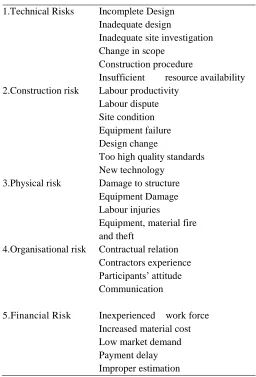
Table I Risk Factors
1.Technical Risks Incomplete Design Inadequate design
Inadequate site investigation Change in scope
Construction procedure
Insufficient resource availability 2.Construction risk Labour productivity
Labour dispute Site condition Equipment failure Design change
Too high quality standards New technology
3.Physical risk Damage to structure Equipment Damage Labour injuries
Equipment, material fire and theft
4.Organisational risk Contractual relation Contractors experience Participants’ attitude Communication
Taxes
Exchange rate fluctuation Changes in law
6.Socio- political risk Pollution and Safety rule Bribery and corruption Language
Law and Oder War and civil
Approval requirement 7.Environmental risk Natural disaster
Weather implication
FACTORS AFFECTINGRISKS
History
Newer projects are more prone to risks as they are different from the other projects. Older projects are likelihood of success against risks because there are similar projects has been done before.
Management Stability
Management stability means the whole management share the same goal or objective for any project. Therefore, it will be beneficial to achieve the project objectives with much ease. If the management is unstable then it can lead to affect the projectobjectives.
Staff expertise and experience
If the staffs for any project are sufficiently experienced and with different expertise the likelihood of Quality, cost and other objectives can be achieved.
Team Size
For larger teams of any project there are more chances of occurrence of problem because of miscommunication.
Resource Availability
If the project is available with a good amount of resources then the response to the problem will be good. Because if the project is available with greater amount of resources than it can deal with different risks with ease.
Time Compression
If the project schedule is highly compressed there are more chances of occurrence of risks in projects. When more time is available for the project, then it can be coped up by reducing risk
impact on the project. Complexity: If the project is highly complex there are more chances for the occurrence of problem in the project.
RISK MANAGEMENT PROCESS
Risk management is the process which consists of identification, assessment, response, control
Risk Identification can be done by the
following methods
Brainstorming
This is one of the most popular techniques. Generally, it is used for idea generation; it is also very useful for risk identification. All relevant persons associated with project gather at one place. There is one facilitator who is briefing about various aspects with the participants and then after note down the factors. Before closing it the facilitator review the factors eliminate the unnecessary ones.
Delphi Technique
This technique is similar to brainstorming but the participants in this do not know each other and they are not at the same place. They will identify the factors without consulting other participants. The facilitator like in brainstorming sums up the identified factors.
Interview/Expert Opinion
Past Experience
Past experience from the same kind of project, the analogy can be formed for identification of the factors. When comparing the characteristics of projects will provide insight about the common factors.
Checklists
These are simple but very useful predetermined lists of factors that are possible for the project. The
check list which contains a list of the risks identified in projects undertaken in the past and the responses to those risks provides a head start in risk identification.
Risk Assessment can be done by the following methods Qualitative Method: Risk Priority Number:
There are 4 categories defined in the above diagram. Category 1 - PI factor 9, which requires maximum attention
Category 2 - PI Factor 6, which requires a good amount of attention
Category 3 - PI Factor 3, which requires comparatively less attention to be paid
Category 4 - PI Factors of 1 and 2, requires less attention to be paid
Quantitative methods Sensitivity Analysis: This is carried out to identify the uncertain project components which will have maximum impact on the outcome of the project. After a risk model is made a sensitivity analysis is carried out to check the sensitivity of different elements of the model on project outcome. To do these the values of one variable at a time is changed and the impact of these changes is then seen on the project.
Scenario Analysis
Scenario analysis gives the impact of different scenario of the project or impact of different risk if that occurs simultaneously. A fair decision can be made after this analysis, the option which will give lesser loss or hazards that option can be opted. Probabilistic Analysis (Monte Carlo Simulation):A project simulation is done using a model to show the potential impact of different
level of uncertainties on project objectives. Monte Carlo Simulation is generally used for this analysis. It can quantify the effect of uncertainties and risks on project budget and schedule. It simulates the full system many times, each time randomly choosing a value for each factor from its probability distribution. It uses three point estimates like most likely, worst case and best case duration for each task in time management.
Decision Trees
This analysis is carried out by decision tree diagram. Decision trees are very helpful to both formulate the problem and evaluate options. In this analysis there are graphical models used to represents project and can clearly reflect the effects of each decision taken in the project.
Risk Response Planning can be done by the
following methods
Risk Avoidance
Risk Transfer
Transferring risk involves finding some other party who is willing to accept responsibility for its management, and who will bear the liability of the risk should it occur. Transferring a threat does not eliminate it; the threat still exists however it is owned and managed by another party. Transferring risk can be an effective way to deal with financial risk exposure. The aim is to ensure that the risk is owned and managed by the party best able to deal with it effectively.
Risk Mitigation/Reduction
Risk mitigation reduces the probability and/or impact of an adverse risk event to an acceptable threshold. Taking early action to reduce the probability and/or impact of a risk is often more effective.
Risk Exploit
This strategy seeks to eliminate the uncertainty associated with a particular upside risk by creating the opportunity definitely happens. Eliminate the uncertainty associated with a particular upside risk. An opportunity is defined as a risk event that if it occurs will have a positive effect on achievement of project objectives.
Risk Share
Allocate risk ownership of an opportunity to another party who is best able to maximize its probability of occurrence and increase the potential benefits if it does happen. Transferring threats and sharing opportunities are similar in that a third party is used, those to whom the threats are transferred take on the liability and those to whom opportunities are allocated should also be allowed to share in the potential benefits.
Risk Enhance
This response aims to alter the “size” of the positive risk. The opportunity is enhanced by increasing its probability and/or impact, thereby maximising the benefits gained from the project. Seeking to facilitate or strengthen the cause of the opportunity, and proactively targeting and reinforcing its trigger conditions.
Risk Acceptance
Ultimately it is not possible to eliminate all threats or take advantage of all opportunities – we can document them and at least provide awareness that these exist and have been identified, some term this „passive acceptance. This strategy is adopted when it is not possible or practical to respond to the risk by the other strategies, or a response is not justified by the grandness of the risk. When the project manager and the project team decide to accept a risk, they are agreeing to address the risk if and when it happens.
Contingency Plan
This involves the use of a fallback plan if a risk occurs. Contingencies can also be in the form of sometime kept in reserve to deal with unknown risks or in the form of costs to deal with unknown risks.
Risk Control is the final step of the process. After we have implemented response actions, we must track and record their effectiveness and any changes to the project risk profile. Did the response actions have a positive or negative effect on achieving project objectives? Responses taken in risks should also be documented for future reference and project plans.
CONCLUSIONS
REFERENCES
[1]. Akintoye, A.S. and MacLeod, M.J.; “Risk analysis and management in construction”; Internationa l Journal of Project Management. 1997.
[2]. Baker, S., Ponniah, D., and Smith, S; Risk response techniques employed currently for major projects, Construction Management & Economics (1999)
[3]. Dariusz Skorupka,; “Risk management in building projects”; AACE International Transactions (2003)
[4]. DileshPardhiAnandKumarPatil,; “Risk Management In BOT Projects”,; Thesis (2008)
[5]. Dr.M.J.Kolhatkar, Er.Amit Bijon Dutta,;“Study of Risk in Construction Projects”, ;GRA (2013) [6]. Ekaterina Osipova,;“Risk management in construction projects: a comparative study of the different
procurement options in Sweden”,; Thesis (2008)
[7]. F. Y. Y. Ling and L. Hoi,; “Risks faced by Singapore firms when taking construction projects in India,” (2006)
[8]. Kinnaresh Patel M.E. (C.E.M.)*,; A study on risk assessment and its management in India,; AJCE(2013)
[9]. Mehmood Alam, Dr. Nadeem Ehsan, Ebtisam Mirza, AzamIshaque,;“Risk Management in constructionindustry”,; (2010)
[10]. Prof. Shakil S. Malek, NazneenI. Pathan, Haaris Mal,; “Risk Management in Construction Industry”,; IJAR(2013)
[11]. S. Q. Wang and M. F. Dulami,; “Risk management frame work for construction projects in developing countries,”(2004)
[12]. Smith, N.J., Tony, M., and Jobling, P.,; Managing risk in construction projects, 2th end: Blackwell Publishing(2006)
[13]. Soon Kim; Deepak Bejaj,; Risk management in construction: An approach for contractors in South Korea,;(2000)
[14]. Tsung-ChiehTsai, Min-LanYang,; “Risk assessment of Design-Bid- Build”; Journal of the Operations Research Society of Japan (2010)
[15]. Uher, T. E. &Toakley, A. R.; Risk management in the conceptual phase of a project. International Journal of Project Management (2013).
[16]. Zenghua Kuang,; “Risk Management in Construction Projects”; (2013)