Nirmal. World Journal of Pharmaceutical and Medical Research
SEQUENCE ANALYSIS OF XYLANASE USING BASIC INSILICO TOOLS
N. Nirmal Kumar*
Department of Botany V. H. N. Senthikumara Nadar College (Autonomous) Virudhunagar-626001 Tamil Nadu, India.
Article Received on 18/05/2018 Article Revised on 08/06/2018 Article Accepted on 29/06/2018
INTRODUCTION
Bioinformatics is both an umbrella term for the body of biological studies that use computer programming as part of their methodology, as well as a reference to specific analysis "pipelines" that are repeatedly used, particularly in the fields of genetics and genomics. Common uses of bioinformatics include the identification of candidate genes and nucleotides (SNPs). Often, such identification is made with the aim of better understanding the genetic basis of disease, unique adaptations, desirable properties (esp. in agricultural species), or differences between populations. In a less formal way, bioinformatics also tries to understand the organisational principles within nucleic acid andprotein sequences.
Bioinformatics has become an important part of many areas of biology. In experimental molecular biology, bioinformatics techniques such as image and signal processing allow extraction of useful results from large amounts of raw data. In the field of genetics and genomics, it aids in sequencing and annotating genomes and their observed mutations. It plays a role in the text mining of biological literature and the development of biological and gene ontologies to organize and query biological data. It also plays a role in the analysis of gene and protein expression and regulation. Bioinformatics tools aid in the comparison of genetic and genomic data and more generally in the understanding of evolutionary aspects of molecular biology. At a more integrative level, it helps analyze and catalogue the biological pathways and networks that are an important part of systems biology. In structural biology, it aids in the simulation and modeling of DNA, RNA, and protein structures as well as molecular interactions.
Xylanase is the second most abundant polymer (EC 3.2.1.8,
endo-(1->4)-beta-xylan4-xylanohydrolase, endo-1,4-xylanase, endo-1, 4-beta-xylanase, beta-1, 4-xylanase, endo-1, 4-beta-D-xylanase, 1,4-beta-xylan xylanohydrolase, beta-xylanase, beta-1,4-xylan xylanohydrolase, beta-D-xylanase) is the name given to a class of enzymes which degrade the linear polysaccharide beta-1, 4-xylan into xylose thus breaking down hemicellulose, one of the major components of plant cell walls.
As such, it plays a major role in micro-organisms thriving on plant sources for the degradation of plant matter into usable nutrients. Xylanases are produced by fungi, bacteria, yeast, marine algae, protozoans, snails, crustaceans, insect, seeds, etc., (mammals do not produce xylanases). However, the principal commercial source of xylanases is filamentous fungi.
Commercial applications for xylanase include the chlorine-free bleaching of wood pulp prior to the papermaking process, and the increased digestibility of silage (in this aspect, it is also used for fermentative composting).
Apart from its use in the pulp and paper industry, xylanases are also used as food additives to poultry, in wheat flour for improving dough handling and quality of baked products, for the extraction of coffee, plant oils, and starch, in the improvement of nutritional properties of agricultural silage and grain feed, and in combination with pectinase and cellulase for clarification of fruit juices and degumming of plant fiber sources such as flax, hemp, jute, and ramie. Good number of scientific
ISSN 2455-3301
WJPMR AND MEDICAL RESEARCH
www.wjpmr.com
*Corresponding Author:N. Nirmal kumar
Department of Botany V. H. N. Senthikumara Nadar College (Autonomous) Virudhunagar-626001 Tamil Nadu, India.
ABSTRACT
BLAST and Rasmol which is a sequence similarity search program is an excellent starting point for teaching bioinformatics to students and it has the potential to enhance a student’s grasp of biomedical, biochemical, and biogeochemical concepts. This article discusses about the underlying concepts of the Xylanase by BLAST algorithm, the scores and statistics of thealignments; with illustrations using the NCBI BLAST. The article also emphasizes the need for students to befamiliarized with the basic concepts and programs of bioinformatics which is a necessity in biological sciencesnow-a-days because of the recent advances in data generation and analysis.
literature is available on key features of xylanase enzymes in biotechnology ranging from their screening in microbial sources to production methods, characterization, purification and applications in commercial sector.
MATERIALS AND METHODS
Study molecule: Xylanase
Blast
The Basic Local Alignment Search Tool (BLAST) finds regions of local similarity between sequences. The program compares nucleotide or protein sequences to sequence databases and calculates the statistical significance of matches
The BLAST protocol is capable of transmitting and receiving data packets simultaneously. This simultaneous bi-directional transfer saves time and online charges when files need to be both sent and received.
BLAST operates efficiently over circuits with high propagation delays (the length of time from when a character is transmitted to the time it is received). This resistance to delays is due to BLAST’s sliding-window design.
BLAST Procedure
This is the common procedure for any BLAST program.
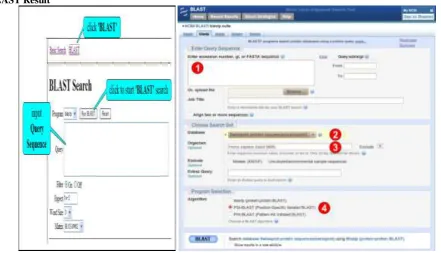
Step 1: Select the BLAST program.
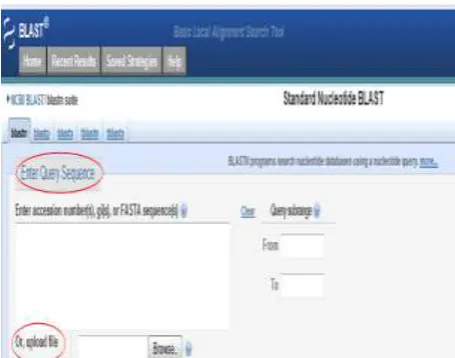
Step 2: Enter a query sequence or upload a file containing sequence.
Step 3: Select the database to search.
Step 4: Select the algorithm and the parameters of the algorithm for the search.
Step 5: Run the BLAST program.
Step 1: Select the BLAST program
Users have to specify the type of BLAST programs from the database like BLASTp, BLASTn, BLASTx, tBLASTn, tBLASTx.
Step 2: Enter a query sequence or upload a file containing sequence
Enter a query sequence by pasting the sequence in the query box or uploading a FASTA file which is having the sequence for similarity search. This step is similar for all BLAST programs. The user can give the accession number or gi number or even a raw FASTA sequence. Go to simulator tab to know more about how to retrieve query sequence.
Figure 1: Enter a query sequence or upload a file containing sequence.
Step 3: Select database to search
User first has to know what all databases are available and what type of sequences are present in those databases. Sequence similarity search involves searching of similar sequences of the query sequence from the selected databases (Figure 2).
Figure 2: Select database to search.
Step 4: Select the algorithm and the parameters of the algorithm for the search.
searches for somewhat similar sequences. Meanwhile for protein BLAST algorithms like BLASTp, searches for similarity between protein query and protein database, PSI-BLAST performs position specific search iteratively, PHI-BLAST searches for a particular pattern (user has to enter the pattern to search in the PHI pattern box provided) that is present in the sequence against the sequences in the database, DELTA-BLAST is Domain Enhanced Lookup Time Accelerated BLAST. It searches multiple sequence and aligns them to find protein homology. The different algorithmic parameters are, Target sequences, Short queries, E-value, Word size, Query range, scoring parameters (Match/Mismatch scores, and Gap penalties) and filters (Filter and Mask) which are required to run BLAST programs. Default values are provided but the user can adjust the values accordingly which is shown in figure 3.
Figure 3: Algorithm and the parameters.
Step 5: Run the BLAST program
Submission of the BLAST program can be done by clicking the BLAST button at the end of the page. Screen shot of result can be shown in figure 4.
Figure 4: Run the BLAST program.
Rasmol Simple steps www.rcsb.org/pdb/
Get into the homepage of PDB
Enter the name of protein in search box and Go Select explore
Select view structure Install the Rasmol software.
Open Rasmol Graphic Window
Get the structure from NCBI or PDB Databases and save it.
RESULTS AND DISCUSSION
The study on functionality of biological sequences needs to know their structure, characteristics and the similarities among the existing sequences. Day-to-day lot of changes is found in living organisms characteristics. So, it is essential to carry out a research study on biological sciences to find the root cause of these changes. But the existing laboratory facilities are insufficient to carry-out such research studies. The evolving technology takes its own effort in order to narrow the existing gap in this field of research study. Using this research studies, certain results could be realized in an easy approach with in short time. So, this research study is considered as most essential one.
Full Amino Acid Sequence of Xylanase
Rasmol
RasMol is a computer program written for molecular graphics visualization intended and used primarily for the depiction and exploration of biological macromolecule structures, such as those found in the Protein Data Bank.
CONCLUSION
Bioinformatics represents the creation and advancement of algorithms, computational and statistical techniques, and theory to solve formal and practical problems arising from the analysis of biological data. Computational biology, represent to hypothesis-driven investigation of a specific biological problem using computers, with experimental or simulated data, with the primary goal of discovery and the advancement of biological knowledge. Major research efforts in this field include sequence analysis, sequence alignment, gene finding, genome assembly, protein structure and alignment, protein structure prediction, prediction of gene expression and protein-protein interactions, and the modeling of evolution. The information (BLAST and RASMOL for XYLANASE) is analyzed to determine genes that encode polypeptides, as well as regulatory sequences. The structure of a Xylanase could reveal its function and evolutionary history. Extracting this information requires the structure and its relationships with other proteins and these relationships require a general knowledge of the folds. Further, these relationships will play an important role in the interpretation of sequences produced by genome projects. The aim of this research study has possible to know and identifying the patterning of the structure of protein and genomes existing in the sequences through geometrical and graphical approaches. This study could be carried out through protein sequence and nucleotide sequences that may infer more useful information for drug designing. The advantage of this research study has this is only for simple pattern identification method on the proposed biological sequence analysis. The other existing methods are complicated and it is used on either structural prediction or structural determinations. So this research study may be the best method for pattern identification on the protein and genome sequence analysis.
REFERENCE
1. Bayat A. Science, Medicine and the future: Bioinformatics in Clinical review. British Medical Journal, 2002; 324: 1018-22.
2. Korf, I. Serial BLAST searching. Bioinformatics, 2003; (12): 1492-1496.