MYCENAEAN LERNA
(PLATES
17-3 1)
T
HE EXCAVATION OF ANCIENT LERNA, south of the village ofMyloi, on the west shore of
the Argive Gulf, was conducted between 1952 and 1958 under the general direction of
John L. Caskey, then Director of the American School of Classical Studies at Athens.' The My-
cenaean finds from Lerna are stored in the Archaeological Museum at Argos. A few of them are on
display in the exhibition room devoted to Lerna. Most of the records on the Lerna excavations are
kept at Dartmouth College; some, including photocopies, are kept in Argos or at the American
School of Classical Studies at Athens.
The site of Lerna (Fig. 1) was occupied continuously from Early Neolithic times into the Late
Bronze Age. The general appearance of the area in the Late Bronze Age, after extensive erosion
and consequent deposition of alluvium in the eastern part of the plain during the Early Helladic
(EH) period, seems to be little changed today. At that time, however, the shallow Lake Lerna
existed to the north of the site, and the seacoast lay closer to the site of Tiryns.2
Evidence for the Mycenaean occupation of Lerna (Lerna VII), after the period of the Lerna
shaft graves (Lerna VI), comes chiefly from the trenches in Area D on the northeastern side of
the mound, in an area measuring roughly twenty meters by ten meters. The work here was begun
in 1952 with a trial trench and continued with more extensive excavation in 1953 and 1954. The
center of the mound had been heavily eroded and its post-Middle Helladic (MH) strata largely
lost, aside from the two shaft graves and other burials of that period.3 (t should be noted that
only about one-seventh of the entire surface of the mound was excavated.) Trial trench C, just
northwest of the main area and high in the center of the mound, produced a few Late Helladic
(LH) I-II sherds in disturbed surface lots4 but nothing later. Grave DE- 1 of early LH IIB, in
Area DE, reflected the LH II presence, and clear strata in trench F, below the LH IIIB 1 horse
burial, were datable to LH IIA-B. It is sufficiently clear that there was some kind of continuing
activity at the site from Middle Helladic times into the Late Helladic period, but in LH IIIAI
it may have been rather slight. Very few sherds that are clearly LH IIIAI have been recovered
l To Professor John L. Caskey, Director of the Lerna Excavations, I owe a large debt of thanks. From the time he invited me as a student to join the excavation staff until his early death, he encouraged me with unfailing patience and advice. Tucker Blackburn supplied every need, from photographic expertise to editorial direction. Members of the Lerna staff contributed much: S. Charitonides, Epimelete in the Department of Antiquities in the 1950s; Elizabeth G. Caskey, excavator; Helen Vasileiou Buck and Aliki Halepa Bikaki, the original trench masters of Area D, and Elizabeth Courtney Banks, who followed them and summarized their work; Elizabeth McLeod, who wrote up a survey of the Mycenaean material and kindly allowed me to use it; and Lloyd Cotsen, architect of the plans. I want also to thank Sarah Rutter, who inked most of the pottery drawings; Julia Pfaf, for the new general plan, Fig. 1; Gatewood Overbeck, who wrote a preliminary catalogue of the figurines; Jeremy Rutter, Carol Zerner, and Karen Foster, for their helpful advice; Curtis Runnels, for comments on the chipped stone here cited; the Athenian Agora Excavations, for the developing and printing of many of the photographs, most of which were taken byJ. L. Caskey; the American School of Classical Studies at Athens and its directors, past and present, especiallyJames R. McCredie and William D. E. Coulson, for much help; the staffofthe Publications office ofthe School; the Ephors ofAntiquities for the Argolid, especially Photeini Pachygianni; and the staffs, past and present, of the Corinth and Argos museums and the site of Lerna, for countless helpful acts. I owe many thanks also to the American Council of Learned Societies, for a fellowship that supported my work in 1977, to the staff of the Humanities Computer Center at Dartmouth College, for much assistance, and to the Classics Department of Dartmouth College, for making available space for the storage and use of Lerna research material.
2 Zangger 1993, pp. 56-62, fig. 35.
3Blackburn 1970, pp. 168-178.
4 Chiefly LH IIA: Caskey 1954, p. 18, pl. 6:g.
Hesperia 67.2, 1998
American School of Classical Studies at Athens is collaborating with JSTOR to digitize, preserve, and extend access to Hesperia
d |
/
f/
l /
</
l
\
\
\
|dB
CDEFGHILEGEND
F
WW1L
GUN
EMPLACEMENT
g
6g
~~~~~~~~~~~~~~~~~RAILROAD
________
~~~~~~~~~~~~~~~FENCE
CONTOURS AT I METER
tr. J
0
10
20 m~~h
INTERVALS
B
CDE
F
G
HI
MYCENAEAN
LERNA
127
(P385-P388, fill deposit 7, and P473 and P478 in trench F), an indication perhaps of a low
population at this time.
The Mycenaean deposits in Area D, at the edge of the mound, lay at a level not much
higher than that of the much older EH II House of the Tiles to the southwest. Even so, little of
the LH IIIA2-B1 Mycenaean settlement survived here. It succeeded a MH settlement without
evidence for intervening occupation, aside from scattered sherds. At some point within LH I1IA2 a
filling operation was undertaken, presumably in order to correct the unevenness of the ground
occupied in Middle Helladic times and to prepare it for occupation by a growing population. Earth
containing sherds from earlier constructions elsewhere was brought in to form fill deposit 7. Two
LH IIIA2 burials, graves D-2 and D-10, were placed here, probably before the new construction
began; the great slab of D- 10 (Plate 20:b) may have stood as a monument when the earlier floor
in Area 5 was laid down, but D-2, a child's grave east of Area 5, may have been forgotten before the
walls nearby were set. Room 1 and its main floor, and the walls west of it, were constructed within
late LH IIIA2; Area 5, with its lower floor, was perhaps laid out at the same time or slightly later.
The builders of Room 1 employed a line of MH wall foundations still standing at its southeastern
corner, and a MH street to the south continued to be used. Occupation of the main floor of
Room 1, and also of the lower paving in Area 5, ended within early LH IIIB 1. A second partial
floor in Room 1 indicates a scant reoccupation there. A deposit on a more extensive floor in Area 5
is certainly datable to early LH IIIB 1. No higher, or later, LH strata were preserved in this area,
but mixed surface deposits here and elsewhere on the site produced a few sherds of LH 111B2 date.
Beyond Area D the Mycenaean occupation is seen to the south in trench F, where the burial of
a horse, possibly to be associated with a human grave, is datable to LH IIIB
I.5
Farther to the west,
also on the lower slopes of the mound, another grave (K-1) is probably of LH 111A2 date.6 Here the
underlying strata were of Lerna IV, the latest Early Helladic period.
The pottery catalogued below represents the bulk of the Mycenaean ceramics excavated at
Lerna. Some 200 other, less diagnostic sherds are kept in the museum in Argos. The surviving
material was decreased by early discards, both at the site and in preparation for final storage in
Argos, where space was limited. Most decorated pottery was retained, but most coarse sherds and
less diagnostic unpainted sherds were not kept. Absolute proportions of pottery classes therefore
cannot be extracted from the present material, but it is unlikely that anything of substantial
chronological significance has been lost.
Most of the pottery is of the ordinary fine Mycenaean fabric (no grits larger than 2 mm).
Coarse pottery is so described. Undecorated ware, if not coarse, is either of "standard" (porous
surface) or "polished" type.7 Unless otherwise stated, the Lerna pottery is "polished," a type
formerly called "slipped." The colors of the fabric and paint of Mycenaean pottery are well known
and are recorded here, using Munsell terminology,8 only for certain significant vessels. Where
possible, shapes and decoration are identified according to the system devised by Arne Furumark,9
with modifications by Penelope Mountjoy.
10 All vessels are wheelmade unless otherwise indicated.
Pottery is numbered P1, P2, and so forth, in sequence as described, and other objects as
MOl, M02, and so forth. The pottery lot numbers mentioned are those that were assigned
during the course of excavation. The walls are numbered in sequence (W-1, W-2, and so forth),
and the room deposits are numbered according to the first wall in the room (e.g., Room 1 from wall
W-1), with deposits numbered similarly (e.g., deposit 7 from wall W-7).
5 Caskey 1954, pp. 11-12.
6 Caskey 1955, p. 47.
7 The distinctions are those of Wardle (1969, p. 281). 8
Muwsell Soil Color Chiarts, Baltimore 1975. 9 Furumark [1941] 1972.
10
The small objects include quite a number and variety of terracotta figurines and a group of
unusual faience beads from grave D-2. There is not much metal, aside from lead pottery clamps,
and tools are of stone or bone, with terracotta whorls for spinning and more elegant steatite
whorls perhaps for dress weights."
1 Two obsidian arrowheads suggest hunting, perhaps of the deer
recorded among the fauna. The faunal remains include the usual types: Sus, Capra/Ovis,
Bos, Lepus,
Canas,
and Cervus,
as well as Equus caballus
in trench E 12
The following abbreviations are used: CR = descriptions of chipped stone furnished by
Curtis Runnels; FM = Furumark motif and FS = Furumark shape;'3 Gejvall = unpublished notes
by Nils-Gustaf Gejvall in the Lerna archives. All measurements are in meters unless otherwise
indicated.
ROOM 1
Field no. Room T Figs. 2-5; P1. 1 7:a, north part of the room, from the south-southeast.
WALL FIELD NO. TOP BOTTOM LENGTH WIDTH DIR.
W-1
T
+6.05 N
2.50
0.60
N-S
+6.40 S
below +5.35
W-l (S)
AC
+6.40
+5.72
3.75
0.50
N-S
W-2
V
+6.16
below +5.35
3.75
0.50
E-W
W-3
W
+6.31/6.29
below +5.35
4.00
0.50
N-S
W-4
AK
+5.85
+5.65
1.90
0.50
E-W
Room 1 was rectangular and measured three meters east-west and approximately six meters
north-south; the southwest corner was not excavated. The wall foundations were partly preserved,
with some interruptions, and moderately well constructed of stones in random sizes. Nothing of
the upper mudbrick construction survived. Wall W- 1 bonds with wall W-2 at the northeast corner
(P1. 1 7:a). The west wall, W-3, appears to bond with wall W-2 at the northwest, but it was badly
damaged by Classical well D-2 (P1. 1 8:a), and its south end was not excavated. A Classical intrusion
(Figs. 3-5) cut through upper LH deposits in the northeast part of the room, to +5.80, but traces of
later floors were found. The chief (lower) floor associated with Room 1 sloped from +5.75 in
the south, over a MH wall (wall AM, top at +5.65), down to +5.35 at the north and +5.45 in
the northwest part of the room. The floor consisted of hard earth and some gravel and was covered
with a layer of grayish earth 0.55-0.40 in depth. The vessels numbered P1 through P17 are
assigned to the actual floor deposit; other sherds and objects came from the debris above the floor.
Wall W- 1 (at the south) and wall W-4 were at first thought to be earlier constructions of MH
date, and part of the street to the south indeed lay over W-4. As with wall W-6 to the east, however,
the earlier lines of the walls seem to have been retained here in Mycenaean times, although the
surviving parts (W- 1 [S] and W-4) are probably of MH construction.
POTTERY
After about 25 percent of the sherds (lots D 238, D 554), mostly coarseware, had been discarded
at the site, about two and one-half tins and fifteen inventoried pots remained. The percentages
were then recorded as follows: LH painted (decorated) 25%, LH monochrome 2%, LH unpainted
38%, coarse 30%, earlier wares 5%. Most of the remaining coarseware and a few other sherds
were subsequently discarded.
" Carington Smith 1992, pp. 685-686; Iakovides 1977.
12 rna I, p. 36. 13
T JI I II
- -I- - - -i- J- I--
J
J-~~~~~~~~~~~~~~~~~~~~~~~~~~~~~~-
_ - t- -|- -|- -,o ,' -'- -,'~~ -- J-_ _+ t g' _, i __ z 8_ _ .70 2 _ _.
5
51~ &W-1
W-9 <n 5.81
-i -- -3 1- j 12 ! ,grave ,
D-2
Ij +6.16 +5.95 \ W-7 \ ffi fill deposit 7
2 gr? v D-.1
t6.31/6.29 535 + -:
I
?T +60 W-12W-3 WAre 5 -!
-!
L -
e
t
tc $1
!j_ -8 - - - -j -t
i
.
_-.~.3
.
A
+66100_
tW-. +6 _,;_ , +5.81 -
15~~~~~~~~~~~~~~~~~57
-.?~~~-
15 A58 street
_
t; I_ _|_ _I_ _I_ _}_ _t_ ,t;_
~~~~+6.40 _ 'jt._ , J s _'_' ! '_
t
i
v 4 , ~~~jji- -i- J-!AREA D, LERNA VII
_ _
~ ~ ~ ~ ~ ~ ~ ~ ~
8 t_ _z t_~~~~~J
__ __ __ __W - - -- -- - _, * J20
surface
Ro
+7
+6
W12
~~~~W-3
Classical
W-
Ara5
W-7 /-W-9
W-1O
W-1 1
+6t
-L
+5 l
[
t
|
'
'
fill deposit 7
grave D-lO
grave D-2
LernaV
+4 -
+3
I
|
Lerna IV
+31
-
+2
i
unexcavated
Lerna Ill
+1
well D-2
water
0
FIG. 3. Area D: west-east section
w
+7
surface
W-1 2 W-3_.
W-12
W-3
Classical
W-1
Area5
floor
Classical
W-7
W-
9
+6
+6
/
Are 5
floor
-
~
.1
floor~~~~~~~~~~~~~~~~~~~~C
fill depositl7
1<
~~floor
KoiHeost
+5
unexcavated
Room 1
grave D-1 0
grave D-2
MH
MH
N
+7
+6t
H_
M
-
W-4
hard layer
Room 1
AM
+5 -
The bulk of the pottery in this household deposit, both that on the floor itself and that from the
debris, is made up of LH IIIA types-where most closely identifiable, either of late LH IIIA2 or
occasionally of earliest LH IIIB date. As in other household deposits, open shapes predominate,
particularly kylikes. Closed vessels are represented only by fragments. Among unpainted shapes,
the kylikes are well represented, and there are also good examples of both the curving and the
angular shallow bowl FS 295. One large, coarse, deep bowl preserves the concave-convex profile of
FS 290. The flat saucer P17 seems to be without parallel among Furumark shapes.
The two best-preserved vessels, the decorated kylix P3 and the krater P6, which were found
in situ on the floor, crushed in the collapse of the house, can reasonably be assigned to early LH IIIB 1.
P3 shows the long stem and spreading lip, painted and very slightly rounded, of Elizabeth French's
FS 258B,14 while other decorated kylikes from the room, more worn and fragmentary, have the
distinctly rounded rims of the earlier FS 257 type. The unpainted rounded kylikes are not one
of the LH IIIB 1 types illustrated by Kenneth
Wardle15
but are instead of the LH IIIA2 types FS 264
and FS 265. The krater with ring base, P6, may be Furumark's
type FS 279 or FS 281,16 although
it is smaller than average. Mountjoy states that the shape FS 281 "appears at the beginning
of LH
IIIB."'17
The main motif on P6, however, a series of Mycenaean flowers without volutes
(FM 18C), may perhaps best be paralleled in vessels of late LH IIIA2 date,18 although none is
an exact duplicate of this bold, irregular, and highly abstract version.
The less well preserved fragments, like the decorated kylikes, are, when closely datable, best
assigned to late LH IIIA2, but a few pieces may be of early LH IIIB I date. The fragment P41,
from a spouted bowl of shape FS 301, displays a bivalve shell motif (FM 25) that resembles one on
an alabastron of late LH IIIA2 date,19 but the motif is said by Mountjoy (p. 118) to occur on a
related bowl (FS 290) in LH IIIB . One ring base, P42, may come from a deep bowl (FS 284)
of LH IIIB I date, but the largest mug fragment, P2, is certainly of the ridged and fairly straight
walled shape, FS 225, which at the latest belongs to late LH IIIA2.20 The horizontal whorlshell on
a closed vessel, P22, is not likely to be later than LH IIIA2.
Room 1, then, seems to have been in use toward the end of LH IIIA2 and to have suffered major
destruction when the first novelties of the LH IIIB style were being introduced. This date puts the
group between most of the late LH IIIA2 groups described by French21 and those of LH IIIB
1,22
and close to the pottery from the terrace under the House of Shields at Mycenae (LH IIIA2/B 1)23
and that of Chamber Tomb III at Berbati (LH IIIA2),24 as well as to the transitional group at
Nichoria described by Cynthia Shelmerdine.25 The Lerna room, however, besides the actual floor
deposit (P1-P17), contains sherds from occupational breakage deposited over a period of time
and also sherds from the debris of collapsed roof or walls, unlike the Nichoria material, which is
called a group of "genuinely transitional" character.26 In Room I at Lerna there are no LH IIIB I
Zygouries kylikes, only one possible sherd of deep bowl FS 284, and a large majority of shapes
and motifs that belong within the LH IIIA2 period.
14 French 1966, p. 222.
5 Wardle 1969, pp. 285-288.
16 Furumark [1941] 1972, p. 633. 17 Mountjoy 1986, p. 115. 18
Furumark [1941] 1972, nos. 66 and 67, fig. 45. 19 Mountjoy 1986, p. 73, fig. 84:1.
20 Mountjoy 1986, p. 86. 21 French 1965.
22
French 1966; Wardle 1969.
23 French 1965, pp. 185-192. 24 Saflund 1965.
MYCENAEAN LERNA
133
CATALOGUE
POTTERY FLOOR DEPOSIT
Decorated
Fabric is fine unless otherwise indicated.
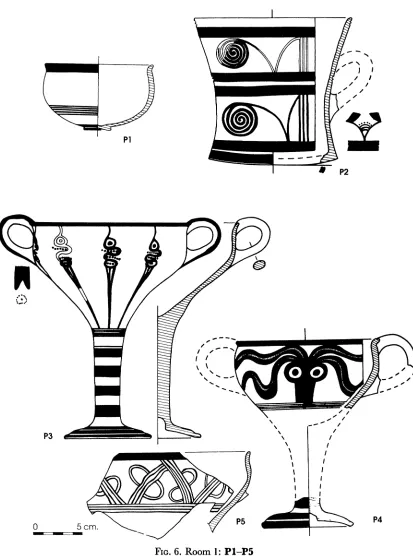
P1 (L.286). Cup or deep bowl Fig. 6 Complete profile, handle missing. Mended from eigh- teen sherds, three-quarters restored.
H. 0.07. Diam. rim 0.11. Diam. base 0.028.
FS 220 or 249, or a very small example of FS 284 (cf. P. M. Thomas 1992, p. 62). Fairly deep shape, slightly concave raised base. Linear decoration: two bands at base, five narrow bands around lower body; rim painted.
P2 (L. 1546). Mug Fig. 6; P1. 22 Complete profile with base of handle preserved. Mended from eight sherds, three-quarters restored. H. 0.159. Est. Diam. rim 0.16. Diam. base 0.136. FS 226. Fairly straight sides, two narrow grooves at waist and below rim. Running spiral (FM 46) in upper and lower zones, separated by groups of three lines; bivalve shell (FM 25) below handle. Two concentric circles on underside.
LH IIIA2, late.
P3 (L.278). Kylix Fig. 6; P1. 22 Complete except for two fragments of rim and one of body, chip missing from base. Mended from thirty sherds, restored.
H. at handle 0.236, at rim 0.23. Diam. rim 0.179. Diam. base 0.09.
FS 258, type B (French 1966, p. 222). Spreading rim, elongated stem; convex foot and round loop handles rising slightly above the rim resemble those of FS 257. Whorl- shell (FM 23, close to FM 23:5: French 1965, fig. 6:a), vertical circumcurrent; dot rosette (FM 27:17) under each handle; outside of handles painted with reserved triangles at top and a pair of tails at bottom (French 1965, p. 176). Surface very pale brown (IOYR 7/4) to reddish yellow (5YR 7/6) on one side. Paint red (2.5YR 5/8).
LH IIIB 1.
West side, floor, east of well D-2.
P4 (L. 1539). Kylix Fig. 6; P1. 22 Most of bowl and rim, part of one handle, and base preserved. Two nonjoining fragments mended from sixteen sherds, partly restored.
H. as restored 0.193. Diam. rim 0.157-0.168. FS 257. Deep rounded bowl, short rounded lip, handle rising slightly above rim, convex base with low dome. Oc- topus (FM 21), closest to type 10, one on each side. White lines down center of tentacles and white dots in three ver- tical rows down body. No prong on head. Surface pale
yellow (2.5Y 7/4). Worn, dark gray paint (2.5Y N3) with white additions.
LH IIIA2, late.
P5 (T22). Kylix Fig. 6; P1. 22 Rim and body fragment. Mended from six sherds. Est. Diam. rim 0.14.
Probably FS 257. Linked whorlshell (FM 24), closest to type 2. Diagonals quadruple on left, quintuple on right; the double half-rosettes are placed asymmetrically. Paint light red to red.
LH IIIA2, late.
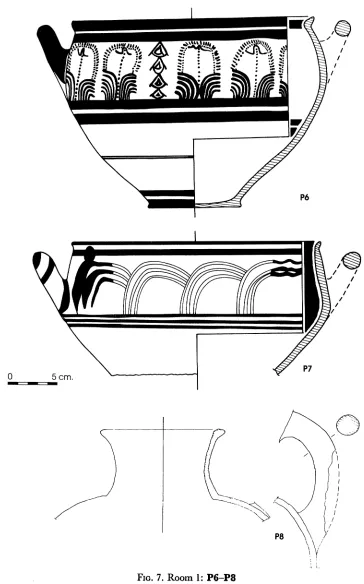
P6 (L.73). Krater, ring-based Fig. 7; P1. 22 One handle, base, and three-quarters body preserved. Mended from twenty-three sherds, restored.
H. 0.20. Max. Diam. rim 0.256. Diam. base 0.10. FS 279, late, or FS 281. Semiglobular body more rounded than usual, raised flat base, thick everted lip (Mountjoy 1976, pp. 84-85, no. 18; 1986, p. 115, fig. 142). Myce- naean flower, unvoluted (FM 18C), like type 63 (LH IIIA2, later group), five on each side, stem represented by dots; bivalve shell (FM 25), vertical chain, each with central triangle, interrupting the row of flowers on one side. An extra row of dots within the row of petals. Two bands on lower interior, two lines around lower exterior, two broad bands at base and rim and below pattern zone. Handles painted. Surface very pale brown (IOYR 7/4) to reddish yellow (5YR 7/6) to pink (5YR 7/4). Paint dark brown (7.5YR 3/2) to red (2.5YR 5/8) on one side.
Floor, east side.
Caskey 1954, pl. 6:c, right. Cf. P. M. Thomas 1992, pp. 58, 160, TS 150, fig. 14:1 (Tsoungiza); Blegen 1921, p. 63, fig. 84, found in pieces as paving for a hearth of late LH III date (Korakou).
P7 (L. 1555). Stemmed bowl Fig. 7; P1. 22 Rim and body fragment, one handle. Mended from five sherds.
P.H. 0.152. Est. Diam. rim 0.26.
FS 304. Body somewhat carinated and biconical, short rounded lip; carination unusual. Multiple stem and tongue (FM 19), perhaps, on one side, semicircular type; same or possibly wavy line (FM 53) on other side, on ei- ther side of wavy line or disintegration of octopus (French
1965, p. 178, fig. 7:16). Band below rim. Interior painted black, streaky. Four vertical strokes on upper handle. Paint black. With the base missing it is not possible to be absolutely certain whether P31 is from FS 304 or FS 281, but the cursory decoration and monochrome interior point to FS 304 (Mountjoy 1986, pp. 91-92).
_
~
~~~~~~
NP1
- P2
00
N~~~~~~~~~~~~~~~~~~~~~~~N
cm.
P3 > \s t/
"~~~~~~
P - P 4 --vY2135
P7
P8
P8 (T55). Jug, amphora, or hydria Fig. 7 Neck, shoulder, and one handle preserved. Three fragments mended from thirty-nine sherds.
Diam. rim 0.133. Th. handle 0.025. FS 69 or 105.
LH IIIB.
Cf. P. M. Thomas 1992, pp. 81-82, fig. 25 (Tsoungiza).
Unpainted
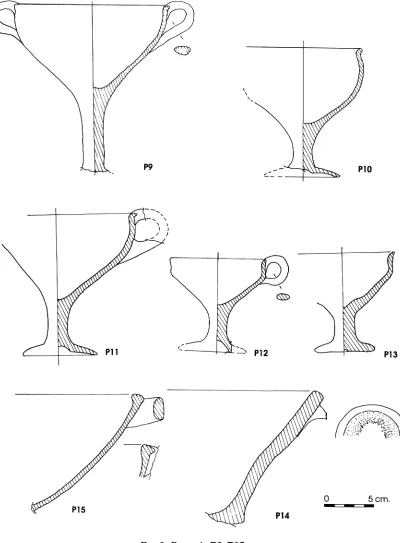
P9 (L.281). Kylix Fig. 8; P1. 23 Complete except for base and small fragments of rim and body. Mended from nineteen sherds, restored. H. as restored 0.188. Diam. rim 0.164-0.168. W handle 0.016.
FS 265. Warped, handles not exactly opposite one an- other. Standard unpolished ware.
LH IIIA2, late.
South of the center of wall W-2.
P10 (L.285). Kylix Fig. 8 Complete profile, two-thirds preserved, handles miss- ing. Mended from thirteen sherds, base restored. H. 0.136. Est. Diam. rim 0.14.
FS 264, closer to type A than is P9. Body and stem form "an elegant, coherent curve" (Furumark 1972, p. 630).
Northwest side, floor.
Pll (L.395). Kylix Fig. 8; P1. 23 Two-thirds preserved, with parts of two handles, one not attached. Mended from twenty-two sherds, stem and body partly restored.
H. 0.15. Est. Diam. rim 0.15. FS 264.
P12 (L.74). Kylix Fig. 8 Most of base missing. Mended from two sherds. P.H. 0.096. Diam. rim 0.102.
FS 267. Standard unpolished ware. Northeast part of Room 1, floor. Caskey 1954, pl. 6:c, left.
P13 (L.396). Kylix Fig. 8; P1. 23 One-half preserved, handles missing. Mended from five sherds, partly restored.
H. 0.105. Est. Diam. rim 0.11. Diam. base 0.065. FS 267. Base flat underneath, with small indentation. Surface smoothed or washed.
P14 (L.1608). Conical bowl Fig. 8 One-third preserved, with both lug handles, one unat- tached but restored in place. Mended from eighteen sherds; eight others are unattached.
-H. 0.142. Diam. inner rim 0.355.
FS 290. Slightly concave-convex profile, two crescent lugs opposite one another just below lip (cf. Dohl 1973, fig. 21,
pl. 77:3, 4). Fabric coarse, friable, with large inclusions, reddish yellow (5YR 7/6); core yellowish red (5YR 5/6). P15 (L.393). Basin Fig. 8
One-half preserved, with one handle and attachment for second; base missing. Mended from fifteen sherds, partly restored.
P.H. 0.124. Diam. rim 0.315.
FS 295, type A (Wardle 1969, p. 290, no. 116, fig. 11). Slightly concave sides, flattened horizontal handles, one attached to top of rim, other to side of rim. Heavy vessel. Standard ware, perhaps with a surface wash, pink (7.5YR 8/4). Outer fabric mostly reddish yellow (5YR 7/6), core pink (7.5YR 7/4).
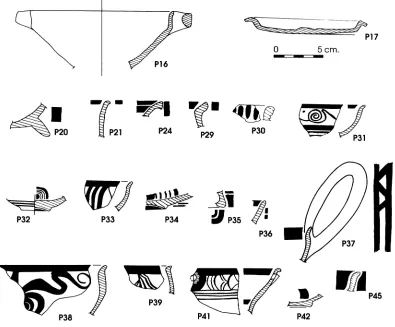
P16 (T91). Shallow angular bowl Fig. 9 Half of body, two handles, and two-thirds of rim pre- served; base missing. Three fragments mended from four sherds.
Diam. rim 0.155.
FS 295, type B (Wardle 1969, p.290, nos. 1 11-114, fig. 1; P. M. Thomas 1992, p. 92, TS 396, fig. 30:11 [Tsoungiza]). Angular profile, slightly flaring rim. Standard ware, traces of whitish wash.
P17 (L.157). Saucer Fig. 9; P1. 23 Three-quarters preserved. Mended from thirteen sherds.
H. 0.02-0.023. Diam. rim 0.13.
Shape not in Furumark. Low, flat dish, bottom slightly convex, circular groove in center of interior, slightly flar- ing sides, wide sloping lip. For the shape, see Shelmerdine 1992, p. 535, P3585, fig. 9:27, monochrome. Standard ware, well made. Surface reddish yellow (7.5YR 8/6) and pink (7.5YR 8/4), core reddish yellow (5YR 6/6).
SHERDS FROM DEBRIS ABOVE FLOOR
Decorated
P18 (T1). Jug or amphora
Vertical handle, round in section. Mended from two sherds.
Th. 0.022.
Linear decoration: thick black-to-red paint at top and bottom and in a line down the exterior.
P19 (T2). Jug
Vertical handle with flat central ridge, two holes pierced in each end. Mended from six sherds.
W 0.032.
Linear decoration; sides painted, ridge reserved. P20 (T3). Jug or amphora Fig. 9
Splaying base fragment. Est. Diam. 0.105.
137
P9PO
--- - - - --
P11 12 P P13
0
5 cm.
P15 P14
P7
0
5cm.
P16
P20 21 P24 P29 P30 P
P~~~~~~~~~~~~~~~~~~~~~3
P32 P33 P34
9
P35P36
P37
9 Tp391 P39 P P24 7+
^N~~~~~~~~~~P45
P38 P41 P42
FIG.
9. Room 1: P16, P17, P20, P21, P24, P29-P39, P41, P42, P45
P21 (T6). Jug or amphora Fig. 9Rim fragment. Min. Th. 0.003.
Linear decoration: rim painted inside and outside.
P22 (T8). Jar or krater?
Body fragment. Mended from four sherds. Min. Th. 0.005.
Large vessel. Horizontal whorlshell (FM 23), two broad bands below.
Not later than LH IIIA2.
P23 (TIO). Jar or jug Pl. 23 Body sherd.
Th. 0.004.
Small vessel. Scale pattern (FM 70), two bands.
P24 (T4). Alabastron Fig. 9 Rim fragment.
Min. Th. 0.004.
Linear decoration; paint is red to brown.
P25 (T3d). Stirrup jar P1. 23 Spout fragment.
Diam. spout 0.024.
Rock pattern I (FM 32), continuous, at base of neck.
P26 (T3e). Stirrup jar P1. 23 Body fragment.
Th. 0.004.
Linear decoration: broad band and six narrow lines. P27, P28 (TI 1, T12). Closed vessel P1. 23
Body fragments.
Th. 0.004-0.007, 0.005, respectively. Single spirals.
P29 (T13). Krater Fig. 9 Rim fragment.
Est. Diam. rim 0.21.
FS 8-9. Sharply everted lip. Linear decoration in worn brown paint.
MYCENAEAN LERNA
139
P30 (T5). Rhyton Fig. 9 Rim fragment.
Min. Th. 0.004.
FS 199. Heavy everted lip, exterior of rim grooved. Linear decoration in blobs of red paint.
LH IIIA2, late.
P31 (T15). Cup Fig. 9
Fragment extending from rim to lower body (single sherd).
Est. Diam. rim 0.12.
FS 220. Curtailed running spiral (FM 46), dot to left. Rim painted, broad band and narrow band around lower body.
LH IIIA2, late, or LH IIIB 1.
P32 (T31). Cup Fig.9
Base fragment. Diam. base 0.029.
Probably FS 220. Raised concave base. Linear deco- ration: spiral in center of interior, broad outer circle; exterior of base solidly painted, narrow lines on lower body.
LH IIIB 1? (Mountjoy 1986, p. 110).
P33 (T30). Cup or kylix Fig. 9 Rim fragment.
Min. Th. 0.004.
Running spiral, curtailed (FM 46:23).
P34 (T33). Cup or small bowl Fig. 9 Base fragment.
Est. Diam. base 0.046.
FS 220 or 284. Linear decoration: broad, red concen- tric circle on interior, enclosing three narrow concentric circles and a spiral(?); exterior of base solidly painted dark red, two narrow bands above base.
P35 (T17). Mug Fig. 9
Base fragment. Est. Diam. base 0.06.
FS 225 or 226. Linear decoration: two or three concentric circles on bottom.
P36 (T18). Mug Fig. 9
Rim fragment. Th. 0.004.
FS 225. Three fine grooves on exterior of rim. Linear decoration: band on interior of rim, two below grooves on exterior.
P37 (T28). Dipper Fig. 9 High loop handle with rim attached.
Th. handle 0.016.
FS 236. Flaring lip (cf. Mountjoy 1986, pp. 86-87, fig. 103). Linear decoration: sides and ends of handle painted red, several diagonal strokes on exterior ofhandle.
LH HIIA2.
P38 (T21). Kylix Fig. 9 Rim fragment. Mended from two sherds.
Est. Diam rim 0.16.
FS 25 7. Short, rounded, everted lip. Octopus (FM 2 1: 10), one top tentacle ending in single spiral, broad spike on head. Paint light red to red.
LH IIIA2, late.
P39 (T29). Kylix Fig. 9 Rim sherd.
Min. Th. 0.004.
Probably linked whorlshell (FM 24).
P40 (T40). Kylix P1. 23 Body sherd.
Octopus (FM 21:21; cf. French 1965, fig. 7:14). White dots on brown paint, band above.
P41 (T39). Spouted bowl Fig. 9 Rim and body fragment with part of spout. Mended from two sherds.
Est. Diam. rim 0.12.
FS 301, small size. Convex-concave profile, lip slopes down. Bivalve shell (FM 25) in horizontal row. Band on lower part of interior. Type of decoration found more usually on FS 290 (Mountjoy 1986, p. 118).
LH IIIA2, late, or LH IIIB 1.
P42 (T32). Small deep bowl Fig. 9 Base fragment.
Est. Diam. base 0.045.
FS 284? Raised concave base. Linear decoration: broad red band on interior.
P43 (T41). Kylix? P1. 23 Body sherd.
Th. 0.003.
Dot rosette (FM 27:23 or 34). Yellowish red paint. P44 (T42). Kylix? P1. 23
Body sherd. Th. 0.003. Spiral.
Solidly Painted
P45 (T54). Stemmed bowl Fig. 9 Rim fragment.
Th. 0.005.
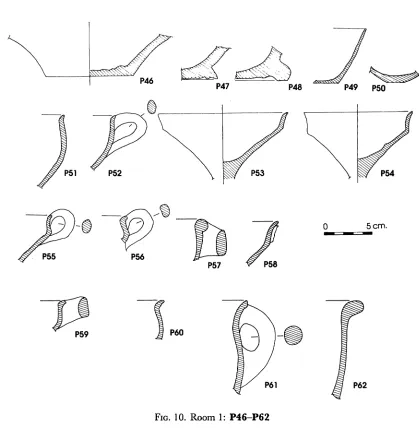
P47 P48 P49 P50
P51 P52 P53 P54
0
5 cm.P55 P56
P57 \~P8
XI
ISP60P61 P62
FIG.
10. Room 1: P46-P62
Unpainted
P46 (T56). Jug, amphora, or hydria Fig. 10 Base fragment. Mended from two sherds.
Diam. base 0.094.
Large vessel, widely flaring body, flat base. Marked wheel grooves on interior.
P47 (T57). Jug, amphora, or hydria Fig. 10 Base fragment.
Est. Diam. base 0.08.
Large vessel, splaying body, ridged under base. Standard ware.
P48 (T58). Jar Fig. 10 Base fragment.
Est. Diam. 0.15.
Large jar, with torus base. Coarse, chalky surface.
P49 (T59). Cup Fig. 10 Entire profile, one-eighth of total preserved. Single fragment; a nonjoining base fragment probably be- longs to this cup.
H. 0.058. Est. Diam. rim 0.15.
FS 204. Plain lip, slightly convex body, flat base. Standard ware.
P50 (T60). Dipper Fig. 10 Bottom and part of side. Single fragment.
MYCENAEAN
LERNA
141
P51 (T64). Kylix Fig. 10 Rim and body fragment; one-quarter rim preserved. Mended from four sherds.
Est. Diam. rim 0.16. FS 264-265. Rounded body.
P52 (T65). Kylix Fig. 10 Rim and body fragment, one vertical handle. Mended from two sherds.
Est. Diam. rim 0.15.
FS 264-265. Traces of thin wash or slip.
P53 (T76). Kylix Fig. 10 One-quarter ofbowl with rim preserved. Mended from two sherds.
Est. Diam. rim 0.12. FS 267.
P54 (T77). Kylix Fi& 10 One-half preserved, from rim to beginning of stem, with attachment for one handle. Mended from four sherds.
RH. 0.075. Est. Diam. rim 0.12. FS 267. Standard ware.
P55 (T78). Kylix Fig. 10 Rim and body fragment with one handle and one-third of rim preserved. Mended from ten sherds.
Est. Diam. rim 0.11-0.10. FS 267. Standard ware.
P56 (T79). Kylix Fig. 10 Rim and body fragment, with one handle.
W handle 0.013. FS 267. Standard ware.
P57 (T90). Basin Fig. 10 Rim fragment, with handle.
W handle 0.029.
FS 295, type A (Wardle 1969, p. 290, no. 116, fig. 1 1). Concave sides, flattened horizontal handle attached by thumb (print preserved) to the bowl. Thickened rim. Fabric fairly coarse, surface pink (5YR 7/4).
P58 (T92). Shallow angular bowl Fig. 10 Rim fragment. Mended from three sherds.
Est. Diam. rim 0.19-0.20.
FS 295, type B (Wardle 1969, p. 290, nos. 111-114, fig. 11). Angular profile, flaring rim, attachment for horizontal handle. Standard ware, with some careful smoothing.
P59 (T93). Shallow angular bowl Fig. 10 Rim fragment with one handle.
W handle 0.022.
FS 295, type B (Wardle 1969, p. 290, nos. 111-114, fig. 11). Angular profile, heavy vessel. Standard ware, with wet-finger marks.
P60 (T94). Stemmed bowl? Fig. 10 Rim fragment.
Est. Diam. rim 0.22.
FS 304? Heavy vessel. Standard ware.
P61 (T95). Cooking jar or tripod Fig. 10 Fragment of rim and vertical handle.
Est. Diam. interior rim 0.23. Th. handle 0.02. FS 320? Body profile convex-concave, spreading rim, handle round in section. Hard, gritty fabric with sparkling inclusions, light red (2.5YR 6/8).
See P. M. Thomas 1992, pp. 94-97 (Tsoungiza): ovoid jars and large cooking tripods are hard to distinguish from their rims; large tripods in "sparkling" fabric are thought by Thomas to be imported (see pp. 236-238, nos. 415- 421, fig. 32:3-8).
P62 (T96). Jar Fig. 10 Rim and body fragment.
Est. Diam. rim over 0.35.
FS 280? Slightly convex profile, spreading rounded lip (cf. the krater from Zygouries, Blegen 1928, fig. 157). Hard fabric with large inclusions, surface reddish yellow (7.5YR 6/6), edge of core light red (2.5YR 6/8), center gray. Surface smoothed or washed.
Earlr Mycenaean Survivals
P63 (T97a). Jar P1. 23 Body sherd.
Rosette (FM 17). LH II.
P64 (9). Jar or jug P. 23 Body sherd.
Max. Th. 0.007. Min. Th. 0.005.
Small vessel. Wavy line (FM 53) between bands.
LH I.
P65 (T97b). Vapheio cup P1. 23 Rim sherd.
Th. 0.003.
FS 224. Foliate band (FM 64; cf. Mountjoy 1986, fig. 8:2).
LH I.
P66 (T97c). Cup or goblet P1. 23 Body sherd.
Fragment of spiral (FM 46) preserved.
M02
0'
0
0
5cm.
e
:~~~~~~~~~~1
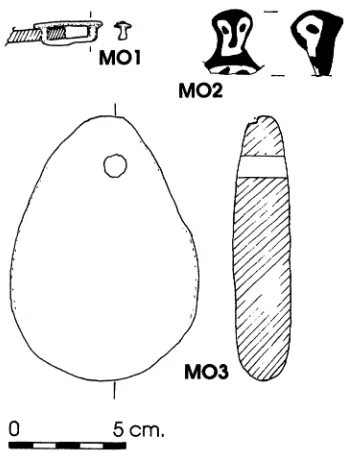
FIG. I
.
Room 1: M01-MO3
MISCELLANEOUS OBJECTSMetal
MO1 (L.319). Lead clamp
Fig, 11
Complete,
one end attached
to sherd.
L. on ext. 0.03. L. on int. 0.022. Th. 0.005.
Rectangular U-shape with backing strip, attached through drilled hole to sherd of standard, light red (2.5YR 6/6), unpainted fabric.
Cf. Catling 1992, p. 624, nos. 1945-1949, fig. 10-5.
Terraotta
MO2 (L3.2). Figurine Fig. 11 Single fragment, preserving head to top of body. P.H. 0.028.
Phi figurine, perhaps type A (French 1971, p. 116). Pellet eyes, back of head and nose painted, top of two vertical stripes on front of body, one on back. Paint red (2.5YR 5/8) to black.
East side of Room 1, at +5.80-5.60. Caskey 1954, pl. 6:d.
M03 (L4.37). Loomweight, Minoan Fig. 11; P1. 30 Intact.
L. 0.114. Th. 0.024.
Flat piriform shape, pierced with hole (Diam. 0.01) near top, groove on top. Light red (2.5YR 6/6). Smoothed, with medium-sized black pebble intrusions.
Cf. Carington Smith 1992, pp. 687-688, no. 2789, pl. 11-37, Minoan type; P.N III, p. 8, fig. 105:4, with groove on top, from area of Northwest Gateway, found with much prepalatial material (Pylos).
FAUNA (Gejvall)
Lepus sp., 2; Sus scr. sp., 6; Capra s. Owis, 8; Bos T7 sp., 3. Shells: Murex, 6; Cardiwn, 1; Arca, 2; Cerithium, 2; Puma, 1.
DEPOSIT ABOVE ROOM I
Field no. Room T. Figs. 2-5.
In the course of excavation in the upper levels within Room 1 a few patches of hard earth
or pebbles were observed near well D-2, at +6.00 and +5.83, and near the center of the room, at
+5.73 (Figs. 4, 5). Pottery, miscellaneous objects, and animal bones were recovered from levels
+6.30 through +5.60. Nothing was specifically associated with the patches of flooring, but it is
likely that the material, or some of it, represents the latest household occupation in the area, a
short-lived one immediately succeeding that of the main deposit.
POTTERY
A tin (four bags27) of sherds, lot D 553, came from these levels above the floor deposit of
Room 1. After about half of the bulk of the sherds, chiefly coarseware, had been discarded at
the site, the following percentages were recorded: LH painted (decorated) 20%, LH monochrome
5%,
LH unpainted 25%, coarse 40%, earlier wares 10%. One bag of sherds, without coarse or
pre-Mycenaean wares, was retained in the museum in Argos.
The few sherds, where datable, belong to LH IIIA2 or LH IIIB, witi several of earlier
Mycenaean date, including a sherd from a Minoan bell cup. The best-preserved vessel, stirrup
jar P67, belongs to LH IIIB1, a date that corresponds to tie date of the latest material in the
main floor deposit.
MYCENAEAN LERNA
143
o
5cm.
_ w
P87
P67 P68
-0P88 P73
P69 -7 7
P70P7P7
P80 P81 P82
p75 P76 p79 P78
FIG.
12. Deposit above Room 1: P67-P70, P72, P73, P75-P82, P87, P88
CATALOGUE
POTTERY
Decorated
P67 (T98). Stirrup jar Fig. 12 False neck, handle, and parts of upper body preserved. Two fragments mended from three sherds.
Est. Diam. body 0.15.
FS 180. Squat, globular, shoulder nearly flat (cf. Mountjoy 1986, fig. 130: very squat witl high false neck). Multiple stem and tongue (FM 19:28, 29, or 31) on shoulder. Circle on disk at top of false neck, reserved triangle at top of handle, band at base of neck, body striped with broad and narrow bands.
LH IIIB 1.
P68 (T99). Stirrup jar Fig. 12 Body and base fragment. Two fragments mended from four sherds.
Est. Diam. body 0.1 1.
FS 178 or 180. Linear decoration: broad and narrow bands on body to below maximum diameter, band at base.
P69 (T 10). Small goblet or cup Fig. 12 Rim sherd.
Est. Diam. rim 0.08-0.10.
FS 255, 220, or 245. Everted lip. Wavy line (FM 53) between bands.
LH IIIA1/2.
P70 (T102). Cup or lid Fig. 12 Rim and body sherd. Mended from two sherds. Est. Diam. rim 0.16-0.18.
FS 220? Short, rounded, everted rim. Linear decoration: rim painted, three narrow lines at maximum diameter, broad band at base.
P71 (T104). Spouted cup or bowl Spout.
P.L. 0.036.
FS 249? Open spout outlined with paint.
P72 (T105). Kylix Fig. 12 Rim sherd.
Est. Diam. rim 0.20.
FS 257. Two arms of octopus (FM 21:5 or 7), one preserving added white paint.
LH IIIA2, late.
P73 (T106). Kylix Fig. 12 Rim sherd.
FS 257? Whorlshell (FM 23), diagonal, with dotted top (cf. Mountjoy 1986, fig. 107:6).
LH IIIA2, late.
P74 (1T07). Miniature kylix Base fragment with bottom of stem. Diam. base 0.038.
Base solidly painted, two lines on stem.
P75 (TI109). Deep bowl Fig. 12 Rim and body sherd with attachment for horizontal handle.
Th. 0.004.
FS 284? Linear decoration: rim painted. Probably LH IIIB 1.
P76 (T1'I10). Bowl Fig. 12 Rim sherd.
Th. 0.004.
FS 283? Small one-handled deep bowl (or FS 300, conical bowl). Multiple stem and tongue (FM 19:21 or 22); three bands on interior; short parallel lines on the short everted lip.
Cf. French 1965, p. 193, fig. 10:5-8; 1966, p. 223, fig. 2:1-7, for small deep bowls witl patterned lip, LH IIIA2 and IIIB; also Mountjoy 1986, fig. 109:3, for the one-handled bowl.
P77 (T108). Stemmed bowl Fig. 12 Body sherd with bit of rim.
Th. 0.005.
FS 305. U-pattern (FM 45:1). Broad band below rim, band on interior of rim.
Probably LH IIIB 1.
Cf. Mountjoy 1986, pp. 92, 119, fig. 146:6.
Patterns recorded on sherds discarded earlier included rock pattern I (FM 32), spirals (FM 46 and 49), wavy line (FM 53), and parallel chevrons (FM 58).
Soidly Painted
P78 (T1'I15). Kylix Fig. 12 Two rim sherds, nonjoining.
Est. Diam. rim 0.15-0.16. FS 264? Painted black.
P79 (T I13). Kylix or goblet Fig. 12 Rim sherd.
Est. Diam. rim 0.020.
FS 264? Groove below rim. Broad everted lip. Painted red.
P80 (T I14). Kylix or cup Fig. 12 Rim sherd.
Est. Diam. rim 0.18.
Unpainted
P81 (1T 16). Cup or kylix Fig. 12 Rim sherd.
Est. Diam. rim 0.12-0.13. Broad everted lip, angular profile.
P82 (T117). Cup orkylix Fig. 12 Rim sherd.
Th. 0.003.
Broad everted lip, rounded body.
Shapes recorded for sherds of unpainted pottery discarded earlier include the cup (FS 204), jug orjar, bowl (FS 295), and pithos.
Earlier Mycenaean Survivals
P83 (Ti 1 la). Closed vessel P1. 24 Body sherd.
Th. 0.004. Stemmed spiral.
P84 71TI17c). Jug P1.24 Body sherd with start of vertical handle.
Th. 0.003.
FS 87, squat jug. Hatched loop (FM 63) on body. LH IIA-B.
P85 (T1 I17a). Cup P1. 24 Rim sherd.
Est. Diam. rim 0.1 1.
FS 211 (cf. Mountjoy 1986, fig. 31:4). Double axe (FM 35:7 or 8).
LH IIA.
P86 (T1l7b). Bellcup P1.24 Body sherd.
Th. 0.003.
FS 221. Rock pattern II (FM 33) and trefoil (FM 29:3). Interior solidly painted black.
Probably Cretan, LM IB. Cf. P506.
P87 (T100). Cup Fig. 12; P1. 24 Rim sherd.
Est. Diam. rim 0.09-0.10.
FS 237. Broad horizontal lip. Octopus (FM 21) on interior, spirals (FM 46) on exterior; top of rim banded alternately with broad stripe and groups of narrow lines.
LH IIB.
Cf. Mountjoy 1986, p. 46, fig. 52.
P88 (T103). Cup Fig. 12; P1. 24 Rim sherd.
Est. Diam. rim 0.08.
Miniature cup? Pendent rockwork I (FM 32) at rim (cf. Mountjoy 1986, p. 38).
MYCENAFAN LERNA
145
P89 (TI 11). Open vessel Pl. 24 Body sherd.
Th. 0.003.
Rockwork I (FM 32), dotted. LH II?
MISCELLANEOUS OBJECTS
Terracotta
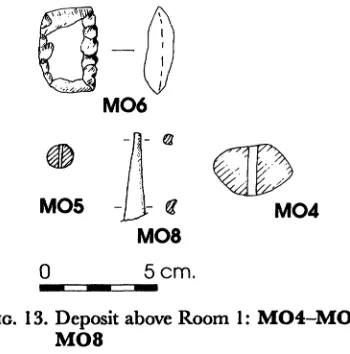
M04 (L4.19). Spindle whorl Fig. 13 Complete.
L. 0.035. Th. 0.023. Diam. hole 0.004.
Biconical, pierced. One side badly worn. Coarse reddish clay.
Cf. Carington Smith 1992, p. 679, fig. 11-2, type 3, indefinite biconical.
Stone
M05 (L4.125). Bead Fig. 13 Intact.
Diam. 0.01 1. Diam. hole 0.001.
Mottled black and white stone, globular, small round hole. Cf. Blegen 1937, p. 61, tomb XIX, fig. 116, mottled stone, LH III (Prosymna).
M06 (L4.738). Denticulate Fig. 13 Intact.
L. 0.038. W 0.026. Max. Th. 0.0095.
Possibly a sickle element (CR). Chalcedony. Opaque, off-white, teeth much worn.
Cf., at Pylos, PN I, p. 336, fig. 322:943, flint, from aqueduct area; P.M III, p. 27, fig. 107:3, 4, 7, flint, from MH fill.
M07 (L4.3). Celt
Intact except for a few chips. L. 0.078. W 0.040. Th. 0.032.
M06
MOS
M04
M08
0
5cm.
FIG.
13. Deposit above Room 1: M04-M06,
M08
Mottled green stone. Slightly flattened along sides and polished to cutting edge.
Probably Neolithic.
Bone
M08
(L4.789). Awl Fig. 13 Broken at wide end.PL. 0.04. Th. 0.009.
Concave sliver from long bone, creamy white, polished, worn, point chipped.
FAUNA (Gejvall)
Sus scr. sp., 4; Capra s. Ovis, 8; Bos T. sp., 2. Shells: Ostrea, 4; Murex, 3; Arca, 1; Pn, 1.
AREA 5, UPPER FLOOR
Field No. Area K. Figs. 2-4, 14; P1. 17:c, Area 5 from west, wall W- I in the foreground, slab of
grave D-1O in front of wall W-7 at the top of the photograph.
WALL FIELD NO. TOP BOTTOM LENGTH WIDTH DIR.
W-1
T
+6.50 N
below +5.35
2.50
0.60
N-S
+6.40 S
W-1 (S)
AC
+6.40
+5.72
3.75
0.50
N-S
W-5
K
+6.43 W
+6.02 W
6.60
0.45
E-W
W-6
J
+6.10
+5.70
1.80 S
0.40
0.50 N
W-
7
S
+6.12
+5.72
2.55
0.55
N-S
W-8
X
+6.33
+6.00
1.70
0.60
N-S
N
s
+7
surface
W-5
Are
5w~-o
floor
---debrisg
+6
- -/
__ --str e er_
_fill deposit 7
W-4
hard layer
+5
FIG.
14. Area D: Area 5 and street, north-south
section
at about +6.00 throughout this area, with the exception of a narrow strip along the east face of wall
W- 1. This floor succeeded an earlier and less well defined occupation in the same area, also of
LH III date (described below as Area 5, lower floor), which in turn lay above part of fill deposit 7.
With the exception of wall W- 1 (the east wall of Room 1, which formed the west wall of Area 5), the
walls in this area are not well preserved. The lower part of wall W-5 along the south appeared to
have been a construction of the Middle Helladic period, but its upper portion was a rebuilding
along the line of the earlier wall, about 0.10 to the north. Wall W-6 on the east consists of two
short and widely separated stretches, the southernmost of which formed a clear corner with wall
W-5. The short length of wall W-7 ran parallel to wall W-6 about 1.75 to the west of it and was
clearly bonded with wall W-9 to the east. Finally, wall W-8 lay directly on the floor, west of the
center of Area 5, and appeared to have no connection with any other wall; it may have been
part of a later construction. The whole area was perhaps an open space or courtyard, or even
a series of small rooms belonging to one or several houses. The slab marking the top of grave D- 10
(P1. 20:b, d) may have been visible still; the figurines found in Area 5 at approximately this level
may represent offerings honoring the dead.28 The cover slab of the grave lay on edge, with its
top at +5.95/6.00, and the grave may have been contemporary with or earlier than the lower floor.
POTTERYAbout two and one-half tins (ten bags) of sherds (lots D 237, D 263) and four inventoried
vessels came from this area, above the floor at +6.00. The top of the deposit was measured at
+6.43-6. 1 0 at the east. A small amount of coarse and nondescript pottery was discarded at the site,
and the remaining coarse and some unpainted sherds were later discarded at Corinth. After the
Lerna discard, the following percentages were recorded: LH patterned 20%, LH solidly painted
2%, LH undecorated slipped (polished) 3%, undecorated plain (standard ware) 25%, coarse 45%,
MH and earlier 5%, and three or four Classical or miscellaneous sherds.
The excavation record does not specify the location of the best-preserved vessels in relation
to the floor. There are no whole pots, but a number of complete or partially complete profiles
could be restored. It is possible that the vessels P95, P128, P137, P153, and possibly also P129,
P130, and P139, represent the actual floor deposit, but it is just as likely that the entire collection
is the result of some years of accumulation mixed together with debris from collapsed walls. In
MYCENAEAN
LERNA
147
any case, the pottery and figurines suggest a date decidedly within LH IIIB1, later but perhaps
not much later than the floor deposit in Room 1. There are few sherds from closed vessels; the
best-preserved specimen, a squat stirrup jar (P95), is certainly of LH IIIB 1 date, but the fragment
of a small piriform jar decorated with bivalve shell (P90) is earlier. The kylix and the stemmed bowl
are the most popular shapes; the frequency of the latter is remarkable, especially in comparison
with Room 1.29 The deep bowl, FS 284, and the Zygouries kylix, FS 258A, are both decidedly
present, as is also the kylix FS 258B, but since the deep bowl is not so popular as the kylix, we
may have here an indication of a fairly early date within LH IIIB1A0
The vertical Mycenaean flower is common on kylikes. The handmade cup P153, with
tricurved arch, and the dotted single spiral on cup sherd P105 are noteworthy. There is a range of
ordinary unpainted shapes, especially the kylix FS 267 and the basin.
The six fragments of terracotta figurines include at least one fragmnent
certainly from a Psi-type
figurine.
CATALOGUE
POTTERY
Decorated
P90 (K122). Small piriform jar Fig. 15 Parts of rim, body, and one handle preserved. One fragment mended from four sherds.
Est. Diam. rim 0.09.
FS 45. Globular body, flat sloping lip. A delicate vase. Bivalve shell (FM 25:18) in handle zone; linear decoration: broad and narrow bands on neck, shoulder, and body.
LH IIIA2.
P91 (K19). Jar Fig. 15 Body sherd with attachment for handle.
Min. Th. 0.013.
Large vessel. Scale pattern (FM 70:7).
P92 (K120). Jar Fig. 15 Body sherd. Two fragments mended from four sherds. Th. 0.005.
Shoulder of large jar. V-pattern (FM 59) and two rows of dots in white paint on broad orange band, three wide bands below. An unusual treatment.
LH IIIA2.
P93 (K121). Jar orjug Fig. 15 Base fragment.
Th. wall 0.009.
Flat base, large vessel. Black band above bottom.
P94 (K121A). Jar Fig. 15 Base sherd.
Est. Diam. base 0.14.
Torus disk base. Black bands above base.
P95 (L. 1540). Stirrup jar Fig. 15 Top, both spouts, and one handle and part of another preserved; bottom missing. Mended from ten sherds, half of top restored.
Diam. body 0.158.
FS 180. Squat globular body, flat shoulder, tall spouts. Mycenaean III flower (FM 18C) on shoulder (French 1966, p. 219, fig. 1: 17). Wavy line (FM 67) in groups in the narrow body zone, each group ending on the left with one dot rosette (FM 27). Remaining body surface covered with broad and narrow bands. Three concentric circles and a dot on top offalse spout. Tops and bottoms of spouts outlined with paint; handles painted, paint ending in tails.
LH IIIB 1.
P96, P97 (K124, K125). Stirrup jar Spout fragments.
H. spout 0.045, 0.033, respectively.
FS 178 or 180. Top and bottom outlined with broad, painted bands.
P98 (K126). Stirrup jar Fig. 15 False spout and handle.
W handle 0.036.
FS 164. Top flat. Large specimen. Rather coarse fabric, dull red paint. Diagonal stripes on handle, cross on spout. The cross is unusual here; concentric circles are standard in this position.
29
Mountjoy (1976, p. 90, note 29) remarked on the quantity of stemmed bowls in the LH IIIBI South House deposit at Mycenae.
30
K 91
P99
P93 9P9
) OJ)
)2p95 10 P981
w
y
~~~~~~~P10OO
PIO
P90 P92
P1 10 P107
P105 P106 P108
P109 P1 13 PI114
S~~~~~~P
105cm
~~~~P116
P1 15 P124 F A 5: Pcm.MYCENAEAN LERNA
149
See Mountjoy 1976, p. 84, on large stirrup jars; cf. P. M. Thomas 1992, pp. 44-45, TS52, fig. 8:4 (Tsoungiza), and pp. 320-324, Z3-Z9, figs. 42-44 (Zygouries). P98 is close to the smaller size of such jars, as listed by Thomas (p. 321).
P99 (K127). Small closed vessel Fig. 15 Body fragment.
Min. Th. 0.003.
Carelessly drawn spiral at the greatest diameter. P100 (K128). Krater Fig. 15
Rim sherd. Est. Diam. rim 0.30.
FS 8-9. Whorlshell (FM 23), vertical circumcurrent. Rim painted with broad band.
P101 (K129). Krater Fig. 15 Rim sherd.
Est. Diam. rim 0.21.
FS 8-9. Mycenaean flower (FM 18 B?), octopus (FM 21) with white dots. Rim painted with broad band. Paint badly worn.
P102 (K150). Mug Fig. 16 Body sherd with rib.
Th. 0.006.
FS 225 or 226. Scale pattern (FM 70), chevron (FM 58) in groups of three lines on rib, alternating with single solid chevrons. Zones of chevron are not used until LH 111A2 (Furumark 1972, fig. 67).
P103 (K151). Mug Fig. 16 Two body sherds, nonjoining, one with end of handle. Th. 0.006.
FS 225 or 226. Midrib grooved. Running spiral (FM 46) with zwickel fill; vertical row of dots under handle, handle painted, paint ending in tails.
P104 (K1I18). Mug?
One body fragment mended from two sherds. Th. 0.005-0.007.
FS 225 or 226? Quirk (FM 48:5) between broad bands. P105 (L.144). Cup Fig. 15
Rim sherd. Th. 0.004.
FS 230? Straight side, plain rim. Spiral with single, solid head, outlined in dots; closest to stemmed spiral (FM 51: 10). Rim painted, dark paint below the pattern. Reddish yellow fabric, red paint.
P106 (K133). Cup Fig. 15 Rim fragment. Mended from two sherds.
Est. Diam. rim 0.08.
FS 220 or 245. Curved body, thickened rim. Quirk (FM 48:5).
P107 (K134). Cup or small bowl Fig 15 Rim sherd.
Th. 0.004.
FS 230 or 284. Straight, plain rim. Rim painted black.
P108 (K135). Cup Fig. 15 Base sherd.
Diam. base 0.038.
FS 220 or 245. Linear decoration: bands in red on in- terior and exterior.
P109 (K168). Cup or bowl Fig. 15 Rim and body fragments (two nonjoining sherds). Th. 0.004.
Cup or bowl. Short everted lip. Net (FM 57) filling a delineated space below broad band. Top and interior of rim painted, exterior of rim unpainted.
LH IIIA1 ?
P110 (K131). Goblet or kylix Fig. 15 Rim sherd.
Th. 0.004.
Body thickened below everted lip. Spiral. Mended in antiquity; part of lead clamp present in hole below rim.
Plll (K136). Kylix Fig. 15 Stem and part of bowl.
Diam. stem 0.025.
FS 258A, Zygouries type. Two vertical lines on both sides of body; whorlshell (FM 23), single or a pair, or Mycenaean flower (FM 18). Decoration on both sides is unusual (P. M. Thomas [1992, p. 311] suggests that the stem pattern without fill, as seen in the Zygouries Potter's Shop, is "typologically earlier" than the filled stem).
LH IIIB 1.
P112 (K137). Kylix Fig. 15 Stem and bowl fragment. Mended from two sherds. Diam. stem 0.028.
FS 258A, Zygouries type. Three vertical lines on stem, bordered with two rows of U-pattern (FM 45), probably the stem of Mycenaean flower FM 18B.
LH IIIB 1.
P113 (K138). Kylix Fig. 15 Rim fragment. Mended from three sherds.
Th. 0.004.
FS 258B. Whorlshell (FM 23:9). Rim painted black, paint worn.
LH IIIB 1.
P114 (K139). Kylix Fig. 15 Rim sherd.