MODULAR AND BRANCHED STRUCTURE
OF INDIVIDUALIZED INTELLIGENT
E-LEARNING MATERIALS FOR SCIENCE
AND TECHNOLOGY SUBJECT COURSE
Kosta Dolenc, Igor Pesek, Boris Aberšek University of Maribor, Slovenia E-mail: [email protected]
Abstract
E-learning and online education offers important opportunities for educators as well as for students. Tra-ditional e-materials, as they are known today, do not allow the recognition of different parameters, such as: learning differences, prior knowledge, learning capabilities, learning environment, styles of learning, etc. Because e-materials are structured in such a way they cannot be successfully adapted for learners who consequently cannot control their own learning (Berge, 2002; Picciano, 2000; Saba, 2002). Such a result offers, among others, a highly anti-motivational effect. The preparation of modern e-materials therefore requires a thorough preparation in terms of content and design, which has to be (mostly) based on pedagogical and didactic theories. Modern materials, which can also be named educational e-materials, are usually accessible online (internet-based training (IBT), web-based training (WBT), online education, etc.), they enable and encourage self-learning, they are flexible, dynamic, interactive, use dif -ferent types of media, individualized and adapted to the user’s needs. Mostly the latter characteristic will receive special attention in the following research.
Key words: individualized e-learning, intelligent system, metadata.
Introduction
the nature of learning and creating environments for successful learning is currently in
the center of trends in the field of education all around the world. Because of globalization most countries including Slovenia have set achieving high levels of knowledge and skills as a prior
-ity task where special attention is given to more demanding forms of “competences for the 21st
century”(Dumont, Istance, & Benavides, 2010; Sentočnik, Erčulj, Rutar, Adlešič, & Zorman, 2013). The key concern focuses on establishing that traditional approaches to education are not suited for fulfilling such demanding goals.
in the 21 century Volume 57, 2013
17
(science of teaching) and how on the bases of these successful educational environments can be created and what needs to be considered.
Developing modern e-learning material is not a simple task, especially if this is to be adapted for an individual students. Some authors suggested that developing requires a thorough preparation in terms of content and design, which has to be (mostly) based on pedagogical and didactic theories (Bregar, Zagmajster, & Radovan, 2010), but others fields cannot be neglected. For making such individualized e-learning material at least three profiles of experts and exper
-tise are needed (Ausubel, Novak, & Hanesian, 1978; Dolenc & Abersek, 2012):
Experts in the field of didactics
• , who are responsible for designing methodology for individualized e-learning materials. In order to make the material suitable for use in the learning environment, the following questions need to be answered:
how people perceive information and how information may be provided;
o
how people learn;
o
which methods and didactic principles can be applied; and to this suitable
o
e-material needs to be adapted.
Content experts
• that have special professional subject knowledge and can answer the questions beneath:
which content is relevant to which knowledge in a given field;
o
how is this knowledge connected to the whole;
o
what is basic knowledge and what is an upgrade.
o
Experts in computer science
• or ICT to produce e-learning material to the standards and guidelines and to answer the following questions:
how computer programs are built and how on this basis e-learning materi -o
als can be built;
what are the technological capabilities of usage in education;
o
for which standards will e-learning materials be suitable for.
o
Three steps are needed for creating qualitative and most of all individualized e-learning material. In the first step the learning content must be rearranged according to the individual’s needs and cut into smaller content pieces. In scientific and research publications numerous suggestions of cutting learning content on content assets and learning objects can be found (Andreev, Ganchev, & O’Droma, 2005; Bergstedt, Wiegreffe, Wittmann, & Moller, 2003; Lai, Liou, & Soc, 2007; Leal & Queiros, 2008).
In the presented case study basic theory of programmed instruction is used, in which modular structure where the smallest piece of learning content represents a learning step is suggested (Dolenc & Abersek, 2012; Skinner, 1968; Strmičnik, 1978). In the second step, parts have to be sensibly combined into a whole. Material has to be created in such a way that it provides feedback to students (it guides them through the material), to teachers and creators of the material about students’ success at assimilating knowledge and other vital data; metadata. Metadata is data about data, they are small sets of descriptors that conveniently and efficiently describe, locate and work with other more extensive information sources (Pamela, Samuel, & Sissel, 2003). On the bases of metadata, analysis and evaluation of students’ educational achievements and the evaluation and optimization of the individualized e-learning material can be executed, which is the final and third step in creating and using the individualized e-learning material. The primary advantage of such a process and such type of individualized e-learning material is that it is flexible. It can be suited for the user and can be modified and supplemented
Volume 57, 2013
18 Theoretical Background
Based on didactic guidelines of the programmed instruction (Frank, 1996; Skinner, 1968) for the greatest possible individualization, a hierarchical structure of the learning whole shown by Figure 1 was made in the first step. The learning whole is a very complex system.
Figure 1: Modular structure diagram of e-learning material.
In presented research, attention is given only on building one of the blocks called “Gears”. Building blocks are basic and essential elements that affect the quality of e-learning material. They consist of various learning steps and at the end they (must) have a summative assessment (Figure 1). With each building block certain knowledge standards are achieved which are re
-quired by the specific subject curriculum (Fakin, Kocijančič, Hostnik, & Florjančič, 2011). The following things also have to be taken into consideration:
the didactic principle “step by step” approach which says that learning should start
•
with a simple learning content and progress to a more complex one, basic principles of Bloom cognitive taxonomy (Figure 1).
•
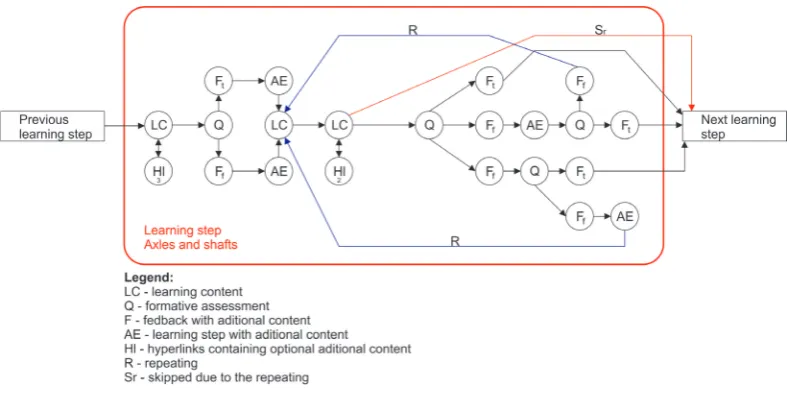
In the second step, combined learning steps for building blocks “Gears” are made into an appropriate branched structure (Figure 2).
Figure 2: Flow chart of an individualized (for axles and shafts) learning step.
Learning steps are not fragmented but connected to the previous and the following learn
-in the 21 century Volume 57, 2013
19
dents. Each learning step includes regular assessments with feedback that guides students from the beginning to the end. A formative assessment at the end is a part of each learning step.
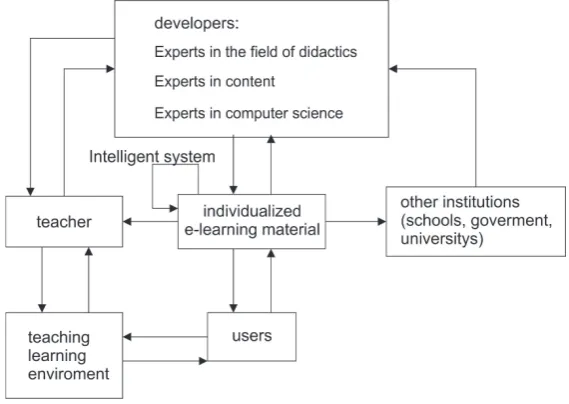
After it was used in the classroom, variables and metadata through the whole individual
-ized e-learning material was collected. Variables and metadata therefore are component parts of the individualized e-learning material and after processing also become component parts for implementing analysis and evaluation of the individualized e-learning material and his users
(figure 3).
Figure 3: Use of metadata obtained in individualized e-learning material.
When developing the individualized e-learning material metadata can be divided into two groups:
Internal,
• which is intended for the intelligent adaptation of the material to knowledge and style of the student, i.e. individualization of the student’s educational pathway. This is the metadata, which the system in interaction with the individual gathers regu
-larly, it processes it and creates new metadata, which is used to adapt the material and set up an adapted educational pathway for the user. Within this model it is possible to see the intelligence of the system, its capabilities of learning and adapting.
External,
• which is intended for the teachers, creators of the material and other institu
-tions, i.e. metadata which is intended for further analyses and evaluation.
The use of metadata and variables does not end here. Appropriately processed metadata of the individual or a group of individuals can effectively be used by a teacher, who can on their bases:
Follow individual student’s knowledge and on the bases of it adjust the following les -•
son or repeat (complement, explains in a different manner) the same lesson if he or
she, gathered from the data, determines that most students do not achieve the desired standards,
Offer additional learning assistance to a student or a group of students who do not
•
achieve the desired standards,
During, or at the end of the school year assess the level of the student’s knowledge and
•
if need be adjust teachers teaching methods,
Use the gathered metadata for self-analysis of a personal way of teaching and with the
•
Volume 57, 2013
20 • With regards to the experience gained from the classroom and gathered metadata, pro
-pose certain changes and improvements to the creators of the individualized e-learning
materials.
Developers and creators of individualized e-learning materials can with the help of meta -data:
Adequately supplement segments of the individualized e-learning material that do not
•
reach the desired results,
Add new didactic pathway in adequately evaluate the existing ones,
•
Enter new segments, which are based on different theories and test them directly in the
•
learning environment,
Appropriately adjust and optimize the individualized e-learning material so it takes
•
into account all levels of knowledge and gravitates towards better results.
Other experts, can with the help of metadata adjust lesson plans, test new theories of teaching, implement research of performance on a national level and analyse and evaluate knowledge of the whole population also on an international level.
Methodology of Research
The object of this research is the development and evaluation of a pilot model of an intel
-ligent individualized e-learning material for basic (lower secondary) school, in a subject course Science and Technology in the 8th grade. The topic of the individualized e-learning material is
Gears, where student s are achieving the lowest results in national assessments (RIC, 2013). The pilot model was devised on the bases of didactic guidelines of programmed instructions and previously mentioned steps on how to develop such individualized e-learning material.
With the help of an already made individualized e-material a pilot research study is being implemented, different metadata and variables are being collected. The pilot study is being car
-ried out on a population of 100 students, where a traditional teaching model, with a teacher in the classroom is being directly compared to teaching with an individualized e-learning material, without a help of a teacher in the classroom (self-teaching). In the first testing stage of develop
-ment methodology for individualized e-learning materials the prime topics of interest are: the deviation between levels of knowledge in the individualized e-learning material
•
(students self-learning) and traditional teaching
how the acquired metadata can be used for: improving materials, increasing knowledge
•
of the individuals and analyzing and evaluating materials.
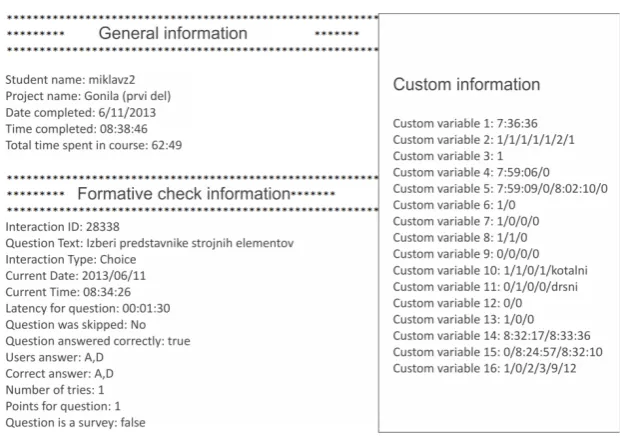
With individualized e-learning material 250-300 pieces of metadata is gathered per stu
-dent. Metadata is collected through whole of the individualized e-learning material. With every learning step and progression of the student different metadata is created within the individual
-ized e-learning material, such as: starting and finishing time of a learning step, type of a learn
-ing step, present level of a student’s knowledge on a learn-ing step, decisions for progress-ing to a different learning step, selection of answers, type of additional help, type of questions, time need for answering, etc. At the same time all metadata generated by e-material itself is col
in the 21 century Volume 57, 2013
21
Figure 4: Example of data and metadata received by electronic mail.
By collecting metadata in such a way it is possible to follow an individual throughout the whole individualized e-learning material and later assemble a complete learning path of the
same individual.
Participants and Sample Selection
In the preliminary stage of testing the methodology for creating and evaluating individu
-alized e-learning material, that contain the final pilot model of the individu-alized e-learning ma
-terial only the first part of it was tested. The individualized e-learning ma-terial was tested in the 9th grade in two randomly chosen elementary schools (suburban and urban), which have already
studied the chosen subject matter in the 8th grade. 33 learners participated in the research. The
individualized e-learning material was tested in a set of preparations for the national assessment in the field of Science and technology in the middle of the school year 2012/2013.
Research Focus
The research will in continuation focus solely on testing the methodology evaluated primarily from technological, programming perspective:
Adjusting the individualized e-learning material to the individual needs of the stu -•
dents,
Working on systems that collect and transform metadata,
•
Study of the suitability of didactic pathways and additional contents,
•
The way the individualized e-learning material works on different systems and brows -•
ers,
The stability of the system, which sends metadata, while simultaneously straining the
• server.
In addition to technical perspective the following things were monitored: How different individual pathways were generated,
•
The level of knowledge of students, who used the individualized e-learning material,
Volume 57, 2013
22 • How much time they spent learning with individualized e-learning materials,
The suitability of types of tasks and difficulty of the individualized e-learning mate -•
rial.
Preliminary Research Results and Discussion
With the preliminary research it was possible to successfully test technical functioning of individualized e-learning material. It adapted to students and the system for collecting and transforming metadata was functioning on all computers, systems and browsers. A problem was identified in the stability of the system which sends metadata. Because individualized e-learning material is independent and is not included in larger systems such as e-learning manage
-ment system (LMS) or course manage-ment system (CMS)? not many suitable solutions exist for collecting and transferring data. The tests show that the so called user friendly solutions, where all metadata could be collected simultaneously and in a clear form, depend on browsers, types of systems and the processing power of computers that are used in schools. Because of this many errors occurred, which ended in a loss of some metadata.
A certain amount of partial results were achieved concerning student’s achievements (level of knowledge, individual pathways, types of tasks, etc.), which confirmed the prior re
-sults of national assessments (RIC, 2013). The national assessment show that the part of cur
-ricula for Science and technology - Gears is the part with the poorest grades throughout entire testing. From the gathered metadata it was possible to get data on individual pathways, on the base of which analysis and evaluation of different bordering cases could be made, which could not be explained solely by the results of the national assessment.
To state an example: In the first set there were three formative assessments and a summa
-tive assessment. One of the student, who was a border case, has by studying with an individual
-ized e-learning material in all formative assessments achieved maximum points, which means that he or she answered correctly to all questions and did not need any additional help so the material graded him/her, before the summative assessment, with the highest grade. But after the summative assessment the same student achieved a below average result (Figure 5).
Figure 5: Formative and summative assessment results.
If all metadata and the results of the formative assessments were not collected, a below average result would mean that the student falls under a category of the weaker students. With the results collected from the formative assessments it could be assumed that he/she had unau
-thorized help in the first part or could not fully explain such a result.
-in the 21 century Volume 57, 2013
23
dividualized e-learning material, and was running out of time for the last part of it. This means that in the desire to finish before the intended time for testing expired he/she only randomly skimmed through the summative assessment. By analyzing metadata of other participants it was established that students, who had an average or above average result in formative assess
-ment, had similar problems related to momentary loss of motivation or lack of time.
Conclusion
Although the pilot research is still in progress it was possible, with the help of the meta
-data from the preliminary research, to adequately adjust certain contents and didactic pathways of the individualized e-learning material, which proved to be inadequate, especially the system of transferring metadata. Thus it was decided that in order to solve the problem of transferring metadata, the metadata after every set in the pilot research needs to be transferred by electronic mail. Although this method requires more work for analysing and evaluating metadata it is be
-cause of its simplicity more effective.
Metadata from the preliminary research has benefited mostly all three types of experts who develop such individualized e-learning materials and who could on their bases adequately prepare all further sets of its. Acquired evaluated data was of the most benefit to the field con
-nected to ICT and didactics. An extra building block was integrated into the material, in which the material independently analyses and evaluates the gathered metadata and seeks out border case students and in accordance with the received data provides instructions so they can try to achieve better results. In order to avoid time pressure and consequently poorer results the time needed for answering was prolonged.
References
Andreev, R., Ganchev, I., & O’Droma, W. (2005). Content Metadata Application and Packaging Service (CMAPS) - Innovative framework for producing SCORM-compliant e-Learning content. 5th IEEE International Conference on Advanced Learning Technologies, Proceedings, 274-278. doi: 10.1109/icalt.2005.93
Ausubel, D., Novak, J., & Hanesian, H. (1978). Educational Psychology: A Cognitive View (2nd Ed.). New York: Holt, Rinehart & Winston.
Berge, Z. L. (2002). Active, interactive and reflective eLearning. Quarterly Review of Distance Educa-tion, 3 (2), 181-190.
Bergstedt, S., Wiegreffe, S., Wittmann, J., & Moller, D. (2003). Content Management Systems and e-learning-systems - A symbiosis? 3rd Ieee International Conference on Advanced Learning Technologies, Proceedings, 155-159. doi: 10.1109/ICALT.2003.1215047
Bregar, L., Zagmajster, M., & Radovan, M. (2010). Osnove e-izobraževanja. Ljubljana: Andragoški cen -ter Slovenije.
Dolenc, K., & Abersek, B. (2012). E-learning and Teaching - Methodological or Technological Problem. Divai 2012: 9th International Scientific Conference on Distance Learning in Applied Informat -ics: Conference Proceedings, 73-81.
dumont, h., istance, d., & benavides, f. (2010). The Nature of Learning, Using Research to Inspire Practice: oecd.
Fakin, M., Kocijančič, S., Hostnik, I., & Florjančič, F. (2011). Učni načrt. Program osnovna šola. Tehnika in tehnologija. Ljubljana: Ministrstvo RS za šolstvo in šport, Zavod RS za šolstvo.
Frank, H. (1996). Klerigkibernetiko/Bildung Kybernetik: Esprima.
Lai, C. Y., Liou, W. C., & Soc, I. C. (2007). A service-oriented architecture for constructing ontology-based learning objects repository. Ism Workshops 2007: Ninth Ieee International Symposium on Multimedia - Workshops, Proceedings, 349-354. doi: 10.1109/ISM.Workshops.2007.65 Leal, J. P., & Queiros, R. (2008). Integration of e-Learning Systems With Repositories of Learning Ob
Volume 57, 2013
24 Lowe, R., & Schnotz, W. (2008). Learning with Animation: Research Implications for Design. New York: Cambridge University Press.
Mayer, R. E. (2009). Multimedia Learning: Second Edition. New York: Cambridge University Press. O’Neil, H. F., & Perez, R. S. (2003). Technology Applications in Education: A Learning View. NJ: Erl
-baum, Mahwah.
pamela, r., samuel, s., & sissel, G. s. (2003). Metadata in e-learning system: Focus on its value for the user. Paper presented at the Second international conference on multimedia and ICTs in educa -tion, Bajadoz, Spain.
picciano, a. G. (2000). Distance learning: Making connections across virtual space and time. New York: Prentice Hall.
Pytllik Zillig, L. M., Bodvarsson, M., & Bruning, R. (2005). Technology-Based Education. Greenwich, CT: Information Age Publishing.
Reiser, R. A., & Dempsey, J. V. (2007). Trends and Issues in Instructional Design and Technology. Upper Saddle River, NJ: Pearson Merrill Prentice Hall.
ric. (2013). Nacionalno preverjanje znanja, predmet Tehnika in tehnologija. Retrieved 25.09.2013, from http://www.ric.si/preverjanje_znanja/predmeti/ostali_predmeti/2011120911050119/ Rouet, J.-F., Levonen, J. J., & Biardeau, A. (2001). Multimedia Learning: Cognitive and Instructional
Issues. Oxford, UK: Pergamon.
Saba, F. (2002). Student attritions: How to keep your online learner focused. Distance Education Report, 14 (4), 1-2.
Sentočnik, S., Erčulj, J., Rutar, D., Adlešič, G., & Zorman, M. (2013). O naravi učenja: uporaba raziskav za navdih prakse. Ljubljana: Zavod Republike Slovenije za šolstvo.
Skinner, B. F. (1968). Lehrmaschinen, 1958 (Correl W: Programmiertes Lernen und Lernenmaschinen ed.). Braunschweig: Westerman.
Spector J. M., Merrill, M. D., Van Merrienboe, J., & Driscoll, M. P. (2008). Handbook of Research on Educational Communications and Technology. New York: Erlbaum.
Strmičnik, F. (1978). Sodobna šola v luči programiranega pouka. Ljubljana: DDU Univerzum.
Advised by Laima Railienė, University of Siauliai, Lithuania
received: October 15, 2013 Accepted: December 12, 2013
Kosta Dolenc Young Researcher, University of Maribor, Faculty of Natural Science and Math-ematics, Koroška 160, 2000 Maribor, Slovenia.
E-mail: [email protected]
Igor Pesek PhD., Assistant Professor, University of Maribor, Faculty of Natural Science and Mathematics, Koroška 160, 2000 Maribor, Slovenia.
E-mail: [email protected]
Boris Aberšek PhD., Professor, University of Maribor, Faculty of Natural Science and Mathemat-ics, Koroška 160, 2000 Maribor, Slovenia.