A COMPARATIVE CROSS SECTIONAL STUDY ON KNOWLEDGE ATTITUDE AND
PRACTICE TOWARDS SELF-MEDICATION PRACTICES AMONG RURAL AND
URBAN POPULATION OF FIELD PRACTICE AREAS OF S.N.MEDICAL COLLEGE
BAGALKOT-NORTH KARNATAKA
Dr. Sachin V. Desai*1,Dr. M. G. Keshannavar2, Manne Rohith Reddy3,Yogesh Hiremath4,Juna Mary George5, A. Surya Teja Reddy6
1
Assistant Professor, Department of Community Medicine, S. Nijalingappa Medical College, Navnagar, Bagalkot-587103.
2
Lecturer, Department of Clinical Pharmacy, HSK College of Pharmacy, Bagalkot-587101.
3,4,5,6
Pharm D Interns, Department of Clinical Pharmacy, HSK College of Pharmacy, Bagalkot.
Article Received on 01/09/2018 Article Revised on 22/09/2018 Art icle Accepted on 12/10/2018
INTRODUCTION
Self-medication is riskier than remedy. Emerging trend of using over the counter drugs all over the India are posing threat to increase in self-medication practices. It is a well-known fact that, in India prescription only drugs are easily available without prescription. India does not have a well-defined over the counter drugs list. Most countries around the world have proper guidelines for usage of over the counter drugs while there are none in India. This scenario leads to people practicing self-medication fall prey to harmful effects of irrational usage of drugs .As per various studies conducted in different cities of India, prevalence of self-medication in Jabalpur.[1] was 42.7%, Bangalore.[2] was (40.5%), Berhampur.[3] was (18.7%), and Kancheepuram.[4] was (53.4%). Irrational use of drugs, especially
self-medication practices leads to antimicrobial resistance and adverse drug reaction. Anti-microbial resistance is microbes develop resistance to the antibiotics. It becomes difficult as the patient does not respond to the highest level of antibiotics. Either the patient has been on self-medication or too many antibiotics have been prescribed to him/her over a period of time. At the clinical-level, it becomes difficult to treat the patient due to the increased resistance. Particularly in a country like India, where on the counter drugs (OTC) are easily available, self-medication is alarmingly high. Various studies reported that self-medication practices may result in delay of case seeking which results in self-contradictory economic loss due to delay in the diagnosis of underlying conditions and appropriate treatment.
ISSN 2455-3301
WJPMR AND MEDICAL RESEARCH
www.wjpmr.com
*Corresponding Author: Dr. Sachin V. Desai
Assistant Professor, Department of Community Medicine, S. Nijalingappa Medical College, Navnagar, Bagalkot-587103.
ABSTRACT
Background: Self-medication is widely used by young adults. Self-medication is more of a risk than remedy. It is a potential contributor to pathogen resistance to antibiotics. Self-medication is an emerging threat to Indian healthcare system. Objectives: To analyze (1) The reasons and source for self-medication practice. (2) Diseases for which self-medication is commonly used. (3) Knowledge, Attitude and practice towards self-medication practices. Methods: This comparative cross-sectional study was carried out to analyze the knowledge, attitude, and practice regarding self-medication among rural and urban field practice areas of Department of Community Medicine, SN Medial College, Bagalkot, Karnataka, India among230 adults in 18-59yrs age group, 115 each, from rural and urban areas. Results: 60 % of urban and 75% of rural participants’ major source of information was pharmacist. In urban majority preferred self-medication as their immediate response when they fell sick and rural sample population preferred consulting a pharmacist. Self-medication is always the first line of treatment for (62%). Modern medicine was the most preferred treatment modality in urban (86%) and rural (96%) respectively. 59% of urban population opted for self-medication,1-2 days after they fell sick; whereas immediately, in rural population. Majority of urban (82.6%) and rural (71.3%) participants took self-medication for 1 – 2 days. Conclusion: The primary factor which influenced the choice of self-medication is quick relief, practiced more in rural population due to inadequate health care services in rural area. Government should provide proper instructions to the pharmacist to supply drugs only on prescription.
The knowledge, attitude and practice of self-medication in urban and rural population of Bagalkot was assessed.
Reasons For Self Medication[5]
A number of reasons could be enumerated for self-medication. Urge for self-care, lack of adequate health services available, to avoid waiting at the clinics, financial constraint as increasing in doctor consultation fee leading to self-medication, in rural areas drugs are available in stores other than pharmacies favour for increase in self-medication practices.
Risks Associated With Self Medication Practices[5] Potential risks of self-medication practices include: incorrect self-diagnosis, delays in seeking medical advice when needed, severe adverse drug reactions, drug-drug interactions, wrong manner of drug administration, risk of dependence and abuse, incorrect choice of therapy, masking of severe disease, wrong dosage, use of excessive drug dosage, prolonged duration of use.
The source of information for self-medication is usually family/friends, neighbours, advertisements, pharmacists etc. The prevalence of self-medication practices among rural and urban population of Karnataka has not been widely studied. There is no data on usage pattern of self-medication between rural and urban population. Data on extent of self-medication and reasons for the same may provide insight on behavioural patterns related to health among rural and urban population. Hence this study was planned to fulfil above vacuum.
MATERIALS AND METHODS
1. Study Design: A Comparative cross-sectional study was selected to analyses the self-medication pattern among rural and urban population.
2. Study setting: This study was organized in the field practice area of department of community medicine, urban health training centre and rural health training centre of Bagalkot, Karnataka, India.
3. Study duration: From Feb 2018 –July 2018 (6 months)
4. Sample size: Sample size was 230 including both rural and urban.
5. Sampling technique: Systematic random sampling technique was done, through this technique sample size was calculated by using Karnataka census 2011.[6]
6. Ethical clearance: Ethical clearance is obtained from institutional ethics committee. Reference number is HSKCOP/IEC/18/1.
Operational definitions
Self-medication: Self-medication is defined as “obtaining and consuming drugs without the advice of physician either for diagnosis, prescription surveillance of treatment.[7]
Adverse drug reaction (ADR): A response to a drug which is noxious and unintended, and which occurs at
doses normally used in man for the prophylaxis, diagnosis, or therapy of disease, or for the modifications of physiological function.[8]
Knowledge: The facts, information and skills acquired through experience or education.
Attitude: A settled way of thinking. Materials
1. Written informed consent: Written informed consent form was designed and verbal explanation regarding the study and its outcome was discussed with the subjects and interviewed after their will to participate
2. Pre-tested pre – designed questionnaires
Questionnaires included 3 categories as knowledge, attitude and practice
3. Data collection: Study data was collected under these headings
A] Socio-demographic data: This part of questionnaire included age, sex, Family type, educational status, occupation type and income status as per MODIFIED B.G PRASSAD scale.
B] Knowledge: Knowledge of the subject regarding self-medication was analysed based on source of information regarding the choice of drug, whether the Community pharmacist counselled prior to self-mediation and for what kind of Symptoms did self-medication was selected. These set of data provide population knowledge on self-medication.
C] Attitude: This category of questions is related to the positive and negative attitude towards self-medication, with reasons in favour of self-medication and how often was self-medication optioned whenever the respondents felt sick, and whether the same drug/medication was suggested to someone who had similar symptoms. D] Practice: This section of questions includes the choice of treatment modality of the subjects, and whether they combine herbal and allopathic medications. The general practice of respondents whether they go through the storage label and expiry date before taking the medication and do they dispose or return them back to drug store after symptoms subdue. The total number of days the respondent was on self-medication.do they reuse the prescription when they have similar symptoms, whether they increase the dose of the drug by themselves and are they habituated to any drug.
RESULTS
A total of 230 people participated in the study. 115 of the total participants were residing in urban areas, while 115 in rural areas of Bagalkot, Karnataka.
Socio demographic details
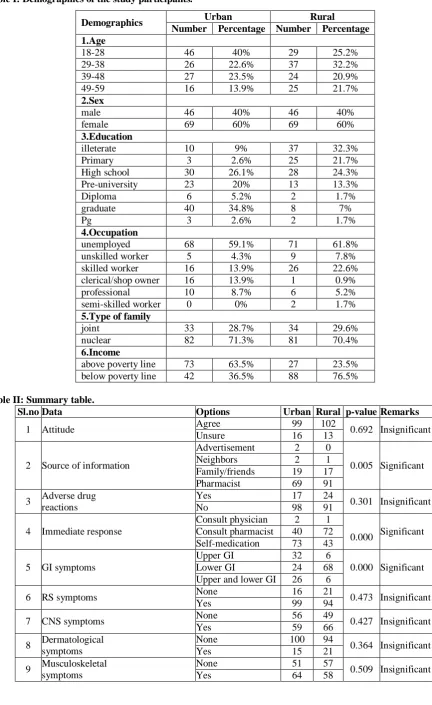
According to the study the age group of 18-28 years are predominant in practicing the self-medication. Out of urban and rural participants 46 (40.0%) were males and 69 (60.0%) were females. The illiteracy rate was more in rural compared to urban which was 37 (32.3%) and 10(9.0%) respectively. Majority were unemployed in both urban and rural, 68 (59.1%) and 71 (61.8%) respectively. Among urban population 16 (13.9%) were skilled workers, 16 (13.9%) were clerical workers and shop keepers, 10 (8.7%) were professional workers, 5(4.3%) were unskilled labour. Among rural population 26 (22.6%) were skilled workers, 9 (7.8%) were unskilled workers, 6 (5.2%) were professionals, 2 (1.7%) were semi-skilled workers, 1(0.9%) were clerical workers. Most of the study subjects in urban are above poverty line 73 (63.5%) whereas in rural are below poverty line 88 (76.5%).
Knowledge regarding self-medication
Strong association was found between area and source of information with p value of 0.005. A large proportion from both urban and rural preferred pharmacist as their primary source of information, followed by family and friends. Among urban population, 69 (60.0%) had pharmacist as their source of information for self-medication, 19 (16.0%) from family and friends, 2 (1.7%) from advertisements and 2 (1.7%) from neighbours, 11(9.5%) from both family, friends and pharmacist, 7(6.0%) optioned for both advertisements and pharmacist. In rural population, 91 (79.0%) from pharmacist and 17(15.0%) from family and friends and 4(3.4%) optioned for both family and pharmacist, 2(1.7%) optioned for neighbours and pharmacist, 1(0.8%) from neighbours.
Regarding the symptoms for which self-medication is used, Out of 115 urban participants, among complaints of gastrointestinal symptoms (GI) , 32 (27.8%) use self-medication for upper GI symptoms like oral ulcer and vomiting, followed by 24 (20.8%) for lower GI symptoms like dyspepsia, stomach ache, constipation, diarrhoea etc.. and 26 (22.6%) for both upper and lower GI symptoms. Among 115 rural participants, 68 (59%) use self-medication for lower GI symptoms, followed by 6 (5%) for upper GI symptoms and 6 (5%) for both upper and lower GI symptoms. Self-medication practice for Respiratory symptoms (RS) were more in both urban and rural area which was, 99 (86%) and 94 (81.7%) respectively. Whereas 59 (51.3%) in urban and 66 (57.5%) in rural used self-medication for central nervous system symptoms (CNS) symptoms like headache. Only 15 (13.04%) from urban and 21 (18.2%) from rural had dermatological complaints. More than half of the
population in both urban and rural area used self-medication for musculoskeletal complaints like body ache, joint pain etc, which was 64 (55.6%) in urban and 58 (50.4%). Self-medication practice for General complaints like fever were more in urban compared to rural that is 81 (70.4%) and 55 (47.8%) respectively.
Attitude towards self-medication
Most of the Urban population 99 (86%) and Rural 102 (88%) population had a positive attitude towards self-medication practice which in turn reflects the increased prevalence of self-medication practice. In urban a major portion i.e. 73 (63%) chose self-medication as their immediate response when fall sick, whereas in rural 72 (62%) consulted pharmacist as their immediate response (p value: 0.000). Participants gave many reasons for taking self-medication, most of them in both urban 60 (52%) and rural 67(58%) area has mentioned quick relief as their primary reason for consuming self-medication, followed by past experience 28 (24%) in urban area and minor illness 26 (22%) in rural area. Regarding the treatment modality, allopathic was the most preferred treatment modality in both urban and rural area which was 99 (86%) and 111 (96%) respectively, with high significance (p value: 0.000)
Practice of self-medication
Table I: Demographics of the study participants.
Demographics Urban Rural
Number Percentage Number Percentage 1.Age
18-28 46 40% 29 25.2%
29-38 26 22.6% 37 32.2%
39-48 27 23.5% 24 20.9%
49-59 16 13.9% 25 21.7%
2.Sex
male 46 40% 46 40%
female 69 60% 69 60%
3.Education
illeterate 10 9% 37 32.3%
Primary 3 2.6% 25 21.7%
High school 30 26.1% 28 24.3% Pre-university 23 20% 13 13.3%
Diploma 6 5.2% 2 1.7%
graduate 40 34.8% 8 7%
Pg 3 2.6% 2 1.7%
4.Occupation
unemployed 68 59.1% 71 61.8%
unskilled worker 5 4.3% 9 7.8% skilled worker 16 13.9% 26 22.6% clerical/shop owner 16 13.9% 1 0.9%
professional 10 8.7% 6 5.2%
semi-skilled worker 0 0% 2 1.7% 5.Type of family
joint 33 28.7% 34 29.6%
nuclear 82 71.3% 81 70.4%
6.Income
above poverty line 73 63.5% 27 23.5% below poverty line 42 36.5% 88 76.5%
Table II: Summary table.
Sl.no Data Options Urban Rural p-value Remarks
1 Attitude Agree 99 102 0.692 Insignificant
Unsure 16 13
2 Source of information
Advertisement 2 0
0.005 Significant
Neighbors 2 1
Family/friends 19 17 Pharmacist 69 91
3 Adverse drug reactions
Yes 17 24
0.301 Insignificant
No 98 91
4 Immediate response
Consult physician 2 1
0.000 Significant Consult pharmacist 40 72
Self-medication 73 43
5 GI symptoms
Upper GI 32 6
0.000 Significant Lower GI 24 68
Upper and lower GI 26 6
6 RS symptoms None 16 21 0.473 Insignificant
Yes 99 94
7 CNS symptoms None 56 49 0.427 Insignificant
Yes 59 66
8 Dermatological symptoms
None 100 94
0.364 Insignificant
Yes 15 21
9 Musculoskeletal symptoms
None 51 57
0.509 Insignificant
10 General complaints None 34 60 0.001 Significant
Yes 81 55
11 Reasons for self- medication
Minor illness 16 26
0.052 Significant Quick relief 60 67
Past experience 28 17 Emergency use 11 5
12 Combination of herbal and allopathic Yes 30 18 0.074 Insignificant
No 85 97
13 First line of treatment
Always 61 82
0.006 Significant Occasionally 54 33
14 Time of beginning SM
Immediately 40 75
0.000 Significant 1-2 days 68 40
7 days 7 0
15 Treatment modality preferred
Allopathy 99 111
0.000 Significant
Ayurveda 12 1
Homeopathy 2 0
others 2 0
16 Checking expiry date
Yes 95 40
0.000 Significant
No 20 75
17 Pharmacist counseled or not
Yes 106 100
0.281 Significant
No 9 15
18 Reusing prescription
Yes 46 58
0.145 Insignificant
No 69 57
19 Increase dose by yourself
Yes 11 15
0.533 Insignificant
No 104 100
20 Suggest medicine to someone
Yes 58 22
0.000 Significant
No 57 93
21 Status of unused medicines
Dispose 82 96
0.040 Significant
Return 33 19
22 Reading storage label
Yes 40 10
0.000 Significant
No 75 105
23 Duration of SM
1-2 days 95 82
0.040 Significant
7 days 19 33
More than 7 days 1 0
DISCUSSION
Self-medication occurs throughout the world. A study conducted by James D et al,[9] in Britain reported that 93% of patients experienced body pain within one month, and of these 75% of study population used OTC analgesics as their choice of drug for self-medication; a study conducted by Ren J et al.,[10] stated that 72% of study population with cold, headache, and cough in the US would choose to medicate. The usage of self-medication was to an extent of 75% in Chile,[11] 65% in Brazil,[12] and 53% in Mexico.[13] In this study 230 participants were there. 115 from the urban area and 115 participants from the rural area. Among urban participants 46 participants (40%) were in the age group 18-28 years, 26 participants (22.6%) were 29-38 years of age, 27 (23.5%) were 39-48 years of age, and 16 (13.9%) were in the age group 49-59. Among them 46 (40.0%) were males and 69 (60.0%) females. Among rural participants 29 (25.2%) were in the age group 18-28 years, 37 (32.2%) were 29-38 years,24 (20.9%) were 39-48 years and 25 (21.7%) were 49-59 years of age. Among rural participants 46 (40.0%) were males and 69 (60.0%).We acknowledge that this type of study using a
questionnaire is dependent upon information provided by participants at that point of time. This study revealed that self-medication was a common practice among different age groups, gender, financial status, and education levels 102 (88.6%)of rural population have Agreeing attitude towards self-medication as due to easy utility of drugs and time saving, while 13 (11.3%) population reported to be unsure regarding practice of self-medication. In another study conducted by kumar CA et al.,[14] in south Indian villages had reported the prevalence of self -medication was about 51.5%. When the urban population was evaluated for self- medication it reported to be 99 (86%) agreed on practicing self-medication, while 16 (14%) were unsure regarding self-medication practice. In another study conducted by Mir et al.,[15] in urban area of Kashmir had reported a prevalence rate of self-medication was found to be 89.7%. In our study, 69 (60%) reported that pharmacists were the major source of drug information and while family/friends 19 (16%) in urban area and in rural population, pharmacist has a major role of drug information with 90 (79.13%) and 17 (14.7%) from friends/family. Whereas a study conducted
by kalaivani Annadurai et al.,[16] in Tamilnadu reported
information in rural population. About 17 (14.7%) of urban population experienced ADR on self-medication, and in rural around 24 (20.86%). Whereas a study conducted by joshi M.C et al.,[17] in 2011 stated that adverse consequences of self-medication practice was seen in 28.15% participants.
When evaluated, around 82 (71.3%) of population in urban optioned for self-medication for GI symptoms while it was lower in rural with 80 (69.5%). In another study conducted by kalaivaniannadurai et al.[16] in Tamil Nadu reported of about 32.94% of rural population optioned for self-medication. Around 99 (86.08%) of sample population in urban area used self-medication for RS symptoms which include cough (productive and non-productive), sore throat and cold, while in rural area it was found to be 94(81.7%) population used self-medication for RS. In a study conducted by Aqeel et al[18]
in urban and rural population of Islamabad in Pakistan, has reported 14.4% of population used self-medication for respiratory symptoms. Among urban participants, majority of the people are using self-medication for general symptoms like fever i.e. 81 (70%) out of 115, and 64 (55.6%) for musculoskeletal symptoms like body pains and joint pains, 59 (51.3%) for CNS symptoms like headache, and 15 (13%) of dermatological symptoms. Among rural participants, 66(57.3%) for CNS symptoms, 58 (50%) for musculoskeletal symptoms, 55 (47.8%) for general complaints, and 21 (18%) for dermatological symptoms. According to a meta-analysis conducted by
Dnyanesh et al[19] in Germany, self- medicated health
complaints were cough and cold(43%), body pain (32%), GI diseases (31%), fever (29%), infection (23%), headache (17%), Menstrual problems (8%), skin diseases (7%) and malaria (4%).
In present study, gaining quick relief is the major reason for using self- medication in both 60 (52%) urban and 67 (58.2) rural population, again confirms the report from Bhopal study conducted by Malvireetesh et al[20]
mentioning quick relief as the important driver for self- medication. Among 115 participants in urban area 61(53%) were always choosing self-medication as their first line of treatment and 54(47%) choose occasionally and out of 115 participants in rural area 82(71%) were always choosing self-medication as their first line of treatment and 33(29%) choose occasionally. Another study conducted by Dipon Uppal et al[21] on self-medication shows that more than 80% of participants used self-medication as their first line of treatment occasionally. Out of 115 participants in urban area 40(34%) will begin self-medication immediately, 68(59.1%) will begin self -medication 1-2 days after experiencing discomfort and only 7(6%) were stated to begin after 7 days of experiencing discomfort. Among 115 participants in rural area 75(65.2%) will begin self -medication immediately after experiencing discomfort, 40(34.7%) will begin to take after 1-2 days of experiencing discomfort. A study by Dipon et al.,[21]
conducted on college students shows that about 58.5% of
participants used self-medication 1-2 days after experiencing symptoms and 25.5% of participants used self-medication as soon as they experience any discomfort. In the total of 115 participants in urban area 99(86%) have Allopathy as their modality of medicines, 12(10%) have preferred Ayurveda, 2(1.7%) have preferred homeopathy and 2(1.7%) preferred other modality like home remedies as their treatment modality. Out of 115 participants in rural area 111(96.5%) were preferred using allopathy, 1(0.8%) were preferred Ayurveda and 3(2%) participants were preferred both allopathy and Ayurveda. Where as a study conducted by
Hajirasaba et al.,[2] in rural area of Bangalore shows that
87% of participants prefer allopathy, 2% of participants prefer Ayurveda and 11% of participants were preferred multiple modalities.
95(82.6%) participants out of 115 were conscious about the expiry date and only 20(17%) participants were not conscious about checking expiry date. In the rural area only 40(34.7%) were positive about checking expiry date and 75 (65%) were not. Similarly, a study conducted by
Prathibha et al.,[22] in Udaipur, India shows that out of 220 subjects 108(49.1%) were positive in checking and 112 (50.9%) were not aware on checking expiry date. A similar study conducted by the number of participants re-used the prescription in the urban area are 46(40%) and those who not re-used are 69 (60%). out of 115 participants the number of participants re-used the prescription in the rural area are 58(50.4%) and those who not re-used are 57(49.5%). A study conducted by
pal J et al.,[23] in students of medical college, out of 187 students, 118(63.1%) were re-using the prescription and 69(36.8%) were not re-using the prescription. Regarding the pattern of practice, the current study showed that only 15 (13%) of rural population and 11(9%) of urban population used to increase dose by themselves. The result is more consistent with another study done by pal
J et.al.[23] in Kolkata where 82.4% claimed that they did
not increase the dose when symptoms are not relieved. Attitude towards the self-medication suggested that rural people had a more cautious attitude towards the use of self-medication than urban. As most of the rural people 93 (80%) disagreed to the statement that “their drugs can be advised to others” than the urban 57 (49%). Whereas in a study done in new Delhi by Dipon Uppalet. al.,[21] it was found that around 41% medical students agreed with the statement that they can suggest their drugs to friends/relatives/others.
In our study 96 (86%) of rural participants dispose the extra medication and only a few 19 (14%) return the leftover drugs to pharmacy. Among urban population 82 (71%) dispose the remaining drugs and 33 (29%) return the leftover drugs to pharmacy. Returning of left over drugs is more practiced among urban population. In contrast to this a study conducted in South India by
(9%) of rural participants, comparatively very less than urban 40 (34%). Whereas in a study conducted by
chunHsien lee et al.,[24] in china found that one third of the participants engaged in inappropriate self-medication, such as not reading drug labels because they can’t understand the information on a drug label or instructions.
CONCLUSION
Self-medication is used mostly to relive from fever, gastro-intestinal symptoms like stomach ache, ulcer, diarrhea and respiratory symptoms like cold and cough. Major source of self-medication is community pharmacist in both urban and rural area. Pharmacist should be more responsible while dispensing drugs without prescription. Community pharmacist is the bridge between self-medication and people. So, he plays a vital role in public health. Community pharmacist should be more concerned regarding restricting the public from practicing self-medication.
The primary factor which influenced the choice of self-medication is quick relief. Self-self-medication used more in rural population due to lack of adequate health care services in rural area. Government should provide proper instructions to the pharmacist to supply drugs only on prescription. The public has to be continuously educated on harmful effects of irrational usage of drugs. Chance of biased information, lack of co-operation from respondents and lack of experimentation of researchers also influenced the study.
RECOMMENDATIONS
The study implies that educating the people on rational use of drugs may improve their chances of avoiding harmful effects of self-medication. Public health education programs, health campaigns and advertisement may help people avoiding the practice of self-medication. Though the study population is educated and having proper health care facilities, the self-medication practice was prevalent in urban area. So conducting the similar study in large sample size can provide precise results. Pharmacoepidemiologic studies on OTC drugs need to be carried out in large sample for the detailed information on self-medication.
REFERENCES
1. Shubham Jain, Aditya Thakur, Kunal Peepre, Shivika Kaushal1, Pradeep Kasar. Prevalence of self-medication practices among the residents of urban slums located near govt. medical college, Jabalpur. International Journal of Community Medicine and Public Health Jain S et al. Int J Community Med Public Health, 2018 Feb; 5(2): 811-817.
2. Hajirasaba I, Shivanaanda K S, MiniJayan, C althaf Hussain. Prevalence of self-medication practice and its associated factors in rural Bengaluru, Karnataka,
INDIA. Saba HI et al, IntJ community med public health, 2016 jun; 3(6); 1481-1486.
3. Panda A, Pradhan S, Mohapatra G, Mohapatra J.Drug-related problems associated with self-medication and self-medication guided by prescription: A pharmacy-based survey. Indian J Pharmacol, 2016 Sep-Oct; 48(5): 515-521.
4. Kalavani Annadurai, Selvasri.S, Jagadeesh Ramasamy; Self-medication practices among rural population of Nellikuppam village, Kancheeouram district, Tamilnadu. KJIMSU, January – March 2017; 6(1),
5. Dr. Kandavalli Sridevi, M.Venkata subbaiah, M.Surekha, J.Harini, D.Sujana, A.Ravi Sankar. Assesment of self-medication practices among community people. IOSR Journal of dental and medical sciences, 2007; 16(5): 75-82.
6. https://www.census2011.co.in.
7. Montastruc JL, Bagheri H, Geraud T, Lapeyre MM. Pharmacovigilance of self-medication. Therapie, 1997; 52(2): 105–10.
8. http://www.who.int/medicines/areas/quality_safety/s afety_efficacy/trainingcourses/definitions.pdf. 9. James D., French H. The development of the
self-medicating scale (SMS): A scale to measure people’s beliefs about self-medication. Pharm. World Sci., 2008; 30: 794–800. doi: 10.1007/s11096-008-9227-2.
10. Ren J., Kan H., Duan G. Present situation, problems, countermeasures and suggestions of self-medication. China Pharm, 2016; 27: 4888–4890.
11. Fuentes A.K., Villa Z.L. Analysis and quantification of self-medication patterns of customers in community pharmacies in southern Chile. Pharm. World Sci., 2008; 30: 863–868. doi: 10.1007/s11096-008-9241-4.
12. Bertoldi A.D., Camargo A.L., Silveira M.P., Menezes A.M., Assunção M.C., Gonçalves H., Hallal P.C. Self-medication among adolescents aged 18 Years: The 1993 Pelotas (Brazil) birth cohort study. J. Adolesc. Health. 2014; 55: 175–181. doi: 10.1016/j.jadohealth.2014.02.010.
13. Balbuena F., Aranda A., Figueras A. Self-medication in older urban mexicans: An observational, descriptive, cross-sectional study. Drugs Aging, 2009; 26: 51–60. doi: 10.2165/0002512-200926010-00004.
14. Chandani Ashok Kumar, Niroop Revannasiddaiah. Assessment of self-medication patterns in a rural area of south India: a questionnaire based study. Kumar CA et.al, Int.J. Community Med Public Health, 2018 Jan; 5(1): 354-360.
15. Shakeel ahmedh mir. A cross-sectional study on self-medication practices and medication adherence among kashmiri urban population. Asian J Pharm Clin Res., 2018; 11(4): 390-392.
district, Tamilnadu. KJIMSU, January – March 2017; 6(1).
17. Joshi, M.C. &, Shalini & Agarwal, S. A questionnaire based study of self-medication practices among young population. Research Journal of Pharmaceutical, Biological and Chemical Sciences, 2011; 2: 761-766.
18. T. Aqeel, A. Shabbir, H. Basharat, M. Bukhari, S. Mobin, H. Shahid and S.A. Waquar, Prevalence of self-medication among urban and rural population of Islamabad, Pakistan. Tropical journal of pharmaceutical research, April, 2014; 13(4): 627-633.
19. Dnyanesh Limaye, Vaidehi Limaye, Gerard Krause, Gerard Fortwengal. A Systematic review of the literature to assess self-medication practices. Annals of medical and health sciences research, September 2017, vol-7, Issue 1.
20. Malvireetesh et al. A study of self-medication among the people of Bhopal region Madhya Pradesh, INDIA, IRJP, 2011; 2(12): 163-165. 21. Diponuppal, Monika Agarwal, Vandanaroy.
Asessement of knowledge, attitude and practice of self-medication among college students. International journal of basic and clinical pharmacology, Nov-Dec-2014; 3(6): 988.
22. Prathibha Sultane et al. Preparation about self-medication practices for oral health problems among patients attending dental hospital Udaipur, INDIA. Indian journal of oral care and research Jan –march, 2017; 5(1): 1-6.
23. Pal j et al, Prevalence and pattern of self-medication among undergraduates’ students in a medical college of Kolkata Int j community med public health, 2017; 4(10); 3619-3624.