R E S E A R C H
Open Access
Dynamic content synchronization between
learning management systems over limited
bandwidth network
Royyana M Ijtihadie
1,2*, Bekti C Hidayanto
2, Achmad Affandi
2, Yoshifumi Chisaki
1and Tsuyoshi Usagawa
1*Correspondence:
[email protected] 1Kumamoto University, Kumamoto, Japan
2Institut Teknologi Sepuluh Nopember, Surabaya, Indonesia
Abstract
Well-designed instructional material is equally important for successful e-Learning implementation. Teachers and instructors play a major role in terms of designing and building learning content. In one respect, it requires costs in terms of effort, time and experience. In other respects, a good learning content is likely a result of recurring revisions as a result of teaching experience as well as evaluating student activities. In the case of higher educational institutions (HEI) in developing countries (such as Indonesia), resource sharing in many aspects is highly recommended effort against high cost and redundant works, e-Learning is no exception. Sharing and re-using e-Learning content on particular subject between Learning Management Systems (LMS) can be one of the methods. In addition, collaborative teaching may cause a content develops gradually while conducting content sharing. Thus, the capability of synchronizing the content between LMS is necessary. On the other hand, typical e-Learning implementation might not be appropriate due to the concerns of network infrastructure in developing countries. In some areas, the network has less bandwidth and even frequent disconnections. This paper introduces a novel method of sharing e-Learning content between distributed Learning Management Systems by using dynamic content synchronization. This method also suites the need of course sharing which supports collaborative teaching activity. Moreover, this approach is designed to address the needs of content sharing in areas with network infrastructure limitation in terms of bandwidth and availability.
Keywords: Dynamic content synchronization, Distributed learning management systems, Course sharing, Unidirectional content synchronization, Limited bandwidth, Developing countries
Introduction
As Information Technology (IT) spreads very rapidly, its usage becomes less expensive and more affordable whereas power and storage capacity improves greatly. The use of IT to support every aspect of life has became commonplace, as well as to support learning activities in educational institutions such as in school or university with e-Learning.
Well-designed instructional material is equally important for successful e-Learning implementation. Teachers and instructors play a major role in terms of designing and building learning content. In one respect, it requires costs in terms of effort, time and
experience. In other respects, a good learning content is likely a result of recurring revi-sions as a result of teaching experience as well as evaluating student activities. In the case of higher educational institutes (HEI) of developing countries such as Indonesia, in which the resource gap is still prominent, such concerns need to be addressed. Several younger HEIs may not be able to afford to hire experienced professors to teach cer-tain subjects as well as to create learning content on Learning Management System (LMS). Accordingly, sharing the learning content among individual university’s/HEI’s LMS over the network can be an appropriate solution against performing redundant effort.
Furthermore, a collaborative teaching may take place and may lead to active evalua-tion upon particular content on LMS at the origin/provider side. As a result, the content may dynamically change at times within a short period of time. On another LMS, while the course is in progress and conducting student activities, the existing shared content might need to be updated with the recent changes from the origin. Such update process should refrain from affecting current student activities. Despite simple practical methods are available, for example, using existing Moodle’s backup-and-restore tool or database’s dump-and-restore utility, both of which do not consider existing course related student activities information while performing the restoring process. As a result, all information related with student activities will be erased which could cause a harmful situation.
Some parts of the world, such as developing countries, are still suffering from high prices and unstable Internet bandwidth as well as connectivity problems which makes the effort of e-Learning useless due to slow access to the LMS [1]. Aside from the resource gap, certain developing countries such as Indonesia are suffering from limitation of net-work infrastructure in terms of bandwidth and stability in which we referred to as limited bandwidth network.
In addition , there is still low ICT penetration in broader areas and insignificant deploy-ment of advanced network technology for data communication, particularly in rural and isolated areas. Some areas may still be enjoying older technology such as Plain Old Tele-phony System (POTS) in which the connection speed is relatively slow. Moreover, wide variation of physical infrastructure quality may cause frequent disconnection or disrup-tion which is not good for data communicadisrup-tion as well as for sharing learning content among LMSs.
Accordingly, sharing the content by means of providing accessible single LMS to other HEI’s students might inappropriate unless the network is stable and has enough band-width to pass simultaneous requests. In addition, student’s registration information needs to be stored in the LMS side, which typical HEIs might be reluctant to do.
Unidirectional content synchronization
This section describes the concept behind unidirectional content synchronization which comprises of background and illustration upon how the course sharing activities taking place. The following definitions are used for the rest of this paper. Let Master LMS refers to Learning Management Systems (LMS) which shares its content (in which its scope is limited to a particular course within LMS) while Slave LMS refers to LMS which employs the content obtained from Master LMS. The term unidirectional is used to depict the direction of content sharing which is carried out in a single direction (Master LMS to Slave LMS).
The original content is expected to be designed by certain HEIs that has a group of experienced resources on a particular subject which can then be reflected to e-Learning content. Assuming to address the resource gap for developing a well-designed learning content in the context of e-Learning, sharing the content unidirectionally is preferred and more appropriate while the user side of the content will only be conducting student activ-ities and the teaching. The feedback that might come from the user side is supposed to be directed to the course author at origin side. Bi-directional activity might be inadequate to be conducted in particular network situation in which down-link bandwidth is much bigger than its up-load bandwidth.
The synchronization process is basically a process to distribute changes of particu-lar content on Master LMS to Slave LMS by means of network infrastructure with the demand from Slave LMS. To accommodate continuous evaluation as well as collaborative teaching on a particular content, Master LMS allows it to be modified gradually along the way. For example, a particular content might be conducting only 2 introduction units at the beginning of the semester and several units later on. In order to follow the change of the relevant content, the outdated content at the Slave LMS needs to perform synchro-nization process with the one at Master LMS while keeping the student activity record unaffected.
For the case of unidirectional synchronization, after the content has been dis-tributed and shared among LMSs, only the origin side of the content (Master LMS) is allowed to make modification while the content at the Slave LMS is not, thus to avoid con-tent inconsistency and confusion. Also the concon-tent of Master LMS is copyrighted as the original.
Figure 1 shows the illustration of content synchronization among Learning Manage-ment Systems at different schools. In this system, any particular school’s LMS can act either as a Master or Slave. School A shares its contents with School B while at the same time employing contents from School C.
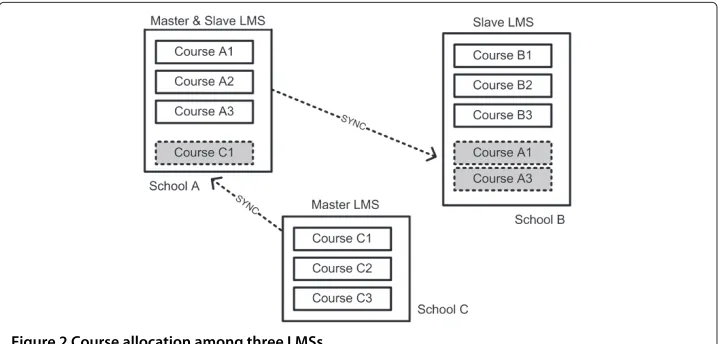
Figure 2 shows the illustration of synchronized content allocation among LMSs. Course C1 from School C is being shared to School A while Course A1 and A3 are shared to School B. In LMS’s point of view, the synchronized content would be accounted as reg-ular content. Thereby, while particreg-ular LMS can have a flexible role, it also allows the synchronized content to exist together with the already existing content.
Implementation
Platform and system architecture
Figure 1 Concept of content synchronization among the schools.
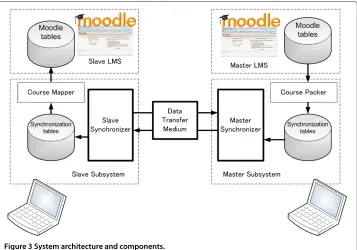
system [2,3] which puts the remote content in local network while keeping both content similar with respect to the available bandwidth [1]. Content synchronization and differen-tial updates delivery are performed in a separate subsystem from current LMS. At Master LMS, a subsystem called Master subsystem is responsible for determining the differen-tial updates to be delivered to Slave LMS. This Master subsystem has a course packer to transform involved Moodle internal tables into synchronization tables. The general architecture and its relationship between components are shown in Figure 3.
The Master synchronizer and Slave synchronizer are responsible for ensuring both synchronization tables on both sides are consistent. While the content at Master LMS altered, the content at Slave LMS will become outdated making the synchronization tables between them inconsistent. During the synchronization process, the Slave syn-chronizer will discover the inconsistent part and will make a request to the Master
Figure 3 System architecture and components.
synchronizer to obtain the missing part. After such parts are obtained, the synchroniza-tion table at Slave LMS is said to be consistent and is ready to be converted back to Moodle table’s format.
This system is using Moodle [4], a Learning Management System which is considered to be one of the most popular web-based LMSs and designed based on social construction pedagogy [5], aiming to help teachers to create effective online learning communities [6]. In order to be operational, both sides (Master LMS and Slave LMS) need to run the same version of Moodle (1.9). In addition, this system is running as an independent mod-ule running along with existing Moodle. LMSs that are assigned as a Master LMS and Slave LMS need to run applications called Master console and Slave console, respec-tively. Both applications need PHP and MySQL database to be running which are also the requirement of Moodle.
The Slave synchronizer requests the updates by communicating with the Master syn-chronizer by means of well-known Hyper Text Transfer Protocol (HTTP). In this case, pull based communication is performed whereas Slave LMS is the initiator of every syn-chronization process. Since HTTP is based on TCP/IP, it is possible to use this mode in conjunction with with common wide-area-network technology using IP network such as either satellite network, PSTN dial-up networking, or Mobile GPRS.
Master and slave communication
As described, content modification at the Master LMS is expected to occur as a result of development process of course material and is assumed to be carried out occasionally within a short period of time. With respect to limited bandwidth channel, efficient use of the communication link needs to be taken into account. Instead of distributing the entire content, sending only the necessary part is preferred. Common differential delivery technique and usage of hashes will be used throughout the synchronization process.
Differential delivery is employed to distribute the modified part by finding the differen-tial between the previous version of content with the new version. In addition, differendifferen-tial delivery has been commonly used and known in computer systems for dealing with trans-fer over limited resource [7] including in software version control system such as git [8] and concurrent version system [9].
Hash table has been widely used in computer science as well, mainly for quick search of things in each of different value, and is able to identify certain location [10,11]. Another popular use of hash is message digest or fingerprint such as MD5 [12] to ensure integrity in a large amount of data (such as files or records) by either identifying or verifying using a small amount of information. Hash is also used in several major applications for iden-tifying the changed part within large datasets such as remote file synchronization tool [13,14] and squid proxy server [15].
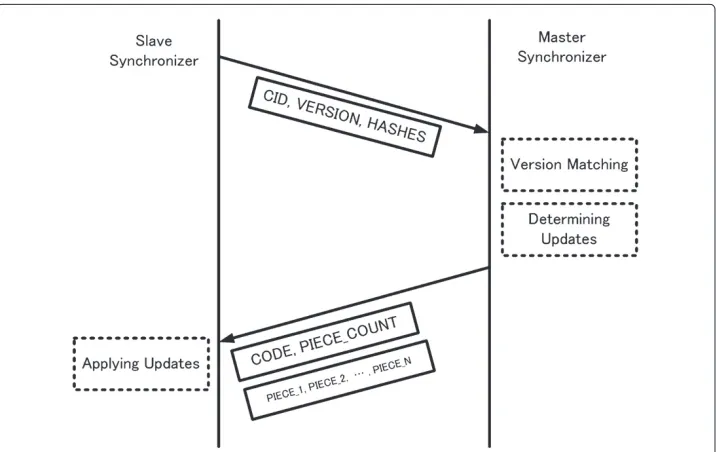
Figure 4 shows the communication flow between Master synchronizer and Slave syn-chronizer during synchronization process. Internal processes are drawn in dotted pattern boxes, which areversion matching,determining updatesandapplying updates. The com-munication between Master synchronizer and Slave synchronizer will be carried out entirely using HTTP. The Slave side initiates by sending (CID,version,hashes) tuple to Master synchronizer designated URL (Uniform Resource Locator) whereCIDis mapped course ID,versionis the version of current synchronization table, andhashescontains all the hashes from each record of synchronization table.
The Master synchronizer performs version matching and then determining updates
while serving the request. Resultant updates will then be replied back to requesting Slave in the form of (code,piece_count) and followed by the series of updated information in the form ofpiece_1untilpiece_n. Thecodehas two possible values to reflect either “no changes” are made or “detected” changes have been made. The number of the updates to be transferred is reflected inpiece_count.Applying updatesprocess will be performed immediately if the successful receiving process is done.
If disrupted information exchange (such as failed connection or disconnected trans-fer) occurs between Master synchronizer and Slave synchronizer, the system will drop the synchronization giving notification to the Slave console thus indicating inappropriate time to synchronize the particular course. The operator of the Slave console might try to do it later on.
Synchronization process
Differential operation is employed to obtain differential updates between the previous content and the current content. During synchronization process, content will be handled by both Master subsystem and Slave subsystem. Particular content is transformed into synchronization table which (for the rest of this paper, will be referred to assynctable).
Synctablecomprises number of records depending on the content size with every records containing (ID,content,hash) tuple information.IDis record identifier,contentcontains transformed records from corresponding Moodle tables, and finallyhashcontains MD5 hashes ofcontent.
Suppose the Slave subsystem has a copy of outdatedsynctable(ts) and Master subsystem has the current version ofsynctable(tm) in which the abstract source code is shown below. In order to detect inconsistency between them, a set of hashes and a set of IDs in each
synctablerecord will be used to comparetsandtminstead of comparing the whole records they have.
r_chgs = [ ] r_tsi = tsi r_tsh = tsh
l_diff = diff(tmi,r_tsi) foreach id in l_diff
r_chgs = r_chgs + ( id,append,tm[id] )
r_tsh[id] = tmh[id] end for
r_diff = diff(r_tsi,tmi)
foreach id in r_diff
r_chgs = r_chgs + (id,delete,)
delete r_tsh[id] end for
if (r_tsh not equal tmh) then foreach id in tmh
if (tmh equal r_tsh) then
continue
end if
r_chgs = r_chgs + (id,update,tm[id])
At Master subsystem, lettmibe a set of IDs belonging totmandtmhbe a set of hashes which correspond totmi. Similarly, at Slave subsystem, lettsibe a set of IDs belonging to
tsandtshbe a set of hashes which corresponds totsi.
In addition,vmandvswill define the version information oftmandtsrespectively. Any modifications taking place at Master subsystem should change the content ofvm, tm, tmh,
andtmi.
Version matching
Version matching is carried out using MD5 hash algorithm which is meant to detect whether modifications at the other end are already in place. By exchanging the version information, Slave synchronizer only needs to send several bytes of data to represent the whole of the records. In the beginning of synchronization process, Slave synchronizer will sendvsto Master synchronizer in order to check the version of latestvm. If these are dif-ferent, Slave synchronizer will learn that modifications have taken place and then proceed to the next step. Otherwise, the process will stop since both contents are similar. Hence, further operation is not necessary.
Determining updates
Modifications at Master subsystem have several possibilities: addition, deletion, or
modificationof records withintm. To obtain such a list of modifications, determining differential content betweentmandtsis carried out during synchronization. The Slave synchronizer is required to send bothtsiandtshto the Master synchronizer as a represen-tation ofts. Before continuing, please note that the changes will be stored in a list named
r_chgs.
At Slave subsystem,r_tsiandr_tshare used for representing remotetsiand remotetsh
respectively. The first step is to determine whichr_tsiexist attmbut not atts. This can be obtained by using relative complement ofr_tsiintmidenoteddiff(tmi,r_tsi) which later will be stored inl_diff, appended intor_chgslist and marked as‘append’.
The subsequent step is actually the reverse of the former step, determiningr_diff con-tainingtswhich does not exists intm(relative complement oftmiinr_tsi). In order to maketmandtsconsistent, suchr_diff values are supposed to be removed. Accordingly, those values will be added inr_chgslist and marked as‘delete’.
The last step is to check consistency betweentmandtsby matching each of thetmh
andr_tshvalues. Should differences be found, the corresponding records and IDs will be appended tor_chgsand marked‘update’.
Applying the received updates
Finally, the final content ofr_chgs will be replied back to the Slave synchronizer as a response of sending the tsh andtsi beforehand. When the process is completed, the updates will be applied tosynctableand later convert back to Moodle tables. In further synchronization process, whentmhas not been altered,tmandtswill have similar content identified byvmandvs.
Experiments and results
Figure 5 Snapshot of school A and school B courses list (initial).(a) Course list at school A (Master LMS). (b) Course list at school B (Slave LMS).
Content synchronization running example
This subsection presents a running example to show the functionality of the system. Sup-posing School A shares some of their content (in the form of courses) to School B hence School A has a role as the Master LMS while school B is the Slave LMS. School B has sev-eral existing courses yet also desires to utilize sevsev-eral of School A’s courses. All the course content in this example are obtained from Moodleshare [16]. For showing examples of this system, a series of snapshot images are shown in Use Figures 5, 6, 7, 8 and 9.
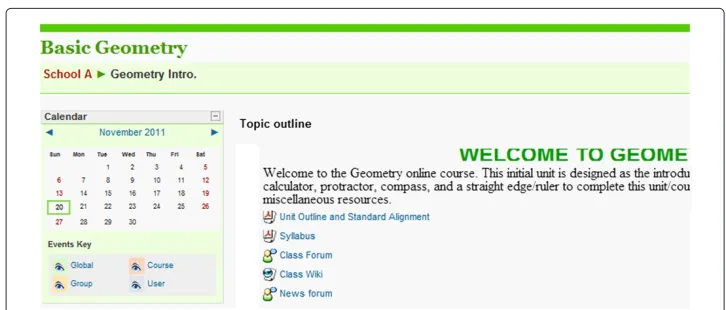
Figure 5a shows School A shares courses, namely “Basic Geometry” and “Introduc-tion to statistics”, while School B already has a course named “Multi-step equa“Introduc-tions” (Figure 5b). Figure 6 shows part of course content “Basic Geometry” in school A.
To be able to receive the synchronized contents, School B is required to provide empty course for the synchronization process holder, namely “HOLD_1” and “HOLD_2”. “HOLD_1” and “HOLD_2” will be a holder for “Basic Geometry” and “Introduction to statistics”, respectively.
Master side
As described in Figure 3, the Master side needs to perform function in course packer to transform current learning content into synchronization tables. Accordingly, in order to
Figure 7 Snapshot of master synchronization control panel at school A (Master LMS).
inform other LMSs regarding the latest content available, this function needs to be re-executed every time content modification occurs. Course packer function is carried out by running master synchronizer control panel as shown in Figure 7.
The figure shows all available course list. A particular course can be shared by activating the option on the right side of the screen. In this experiment, the course named “Basic Geometry” and “Introduction to statistics” are available to other LMSs while the course “Structure of the atom” is not. If the changes occur to any particular course, a relevant teacher/assistant needs to publish those changes by clicking the ‘Update’ link.
Slave side
The Slave side will perform course mapper function (shown in Figure 3) by the end of the synchronization process. The process is initiated from the Slave side through the Slave console application named course mapper.
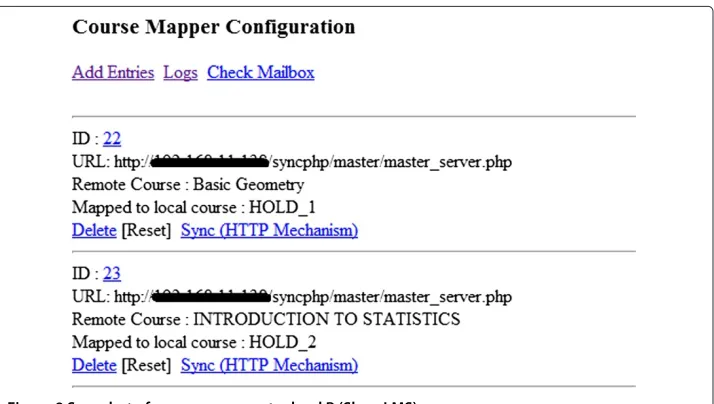
School B is required to form a map in order to define the pair ofdestination course holderandorigin course. The map requires information about : 1) the web service URL address where the course will be obtained from, 2) the course holder identifier where the course will be written into. Such map entry is created by course mapper application which is shown in Figure 8. This figure shows the map configuration for definition pair between the “HOLD_1” holder and the “Introduction to Geometry” course from School A.
By using the course mapper application at School B, either a teacher or an assistant can start the synchronization process by clicking the “Sync” link on any particular map definition as shown in Figure 8.
Figure 9 Snapshot of school B (Slave LMS) after synchronization.(a) Snapshot course list at school B (Slave LMS) after synchronization. (b) Snapshot of ‘Basic Geometry’ at school B (Slave LMS) after synchronization.
With synchronization process having taken place, school B will receive the updates, and the courses list will be modified as shown in Figure 9a. Figure 9b shows the part of course “Basic geometry” at school B which is formerly named “HOLD_1”.
Experiments using experimental satellite and Internet Experiment environment
In 2007, the Japanese organization JAXA (Japan Aerospace Exploration Agency) and NICT (National Institute of Information and Communications Technology) launched an experimental satellite called WINDS (Wideband Internetworking engineering test and Demonstration Satellite). WINDS primary features are ultra-high-speed Internet com-munication capability and wide coverage. Its primary purpose is related to education, disaster management, and communication technology. It is also designed to have a capa-bility of 155 Mbps down-link speed with a relatively smaller size ground station which is less difficult to install. As of 2008, the satellite had capability to cover one third of the globe [17].
Since its launch, JAXA-NICT has given opportunity for overseas and domestic insti-tutions to carry out experiments using WINDS related to education, disaster manage-ment, and communication technologies. Having such opportunity, Kumamoto Univer-sity (KU), Japan and Institut Teknologi Sepuluh Nopember (ITS) Surabaya, Indonesia created a collaborative experiment despite very limited available time and uncertain quality of the connection condition. In fact, the expected high downstream band-width was never realized. Approximately, fluctuating 1-5 Mbps of TCP connection is available instead.
Figure 10 General experiment configuration between ITS(Indonesia) and KU(Japan).
both sides using the Internet during work hours. Authors measured that the performance of TCP connection between the involved servers is approximately 1.1 Mbps.
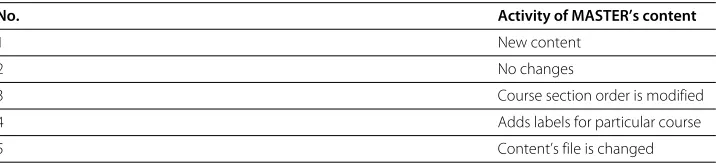
The experiment was conducted by carrying out a typical content situation on Master LMS’s particular course (referred to as content thereafter). The subject of experiment is a course titled “Basic of geometry” which has size approximately 16 MB. In the rest of this section, MASTER and SLAVE is used to refer to Master subsystem and Slave subsystem respectively. On the other side, the slave side’s operator clicks the ’Sync’ link (referred to as ’Sync’ hereafter) on each situation while at the same time recording bandwidth utiliza-tion. Several content situations are listed in Table 1. More detailed description about the activities/actions are as follows :
Table 1 Typical course situations for experiment
No. Activity of MASTER’s content
1 New content
2 No changes
3 Course section order is modified
4 Adds labels for particular course
5 Content’s file is changed
• 2)No changes. No content changes at Master LMS. Slave LMS already has the latest content. A small volume of data transfer is expected since MASTER learns that SLAVE already has the latest content. Thereby, no download transfer is taking place. • 3)Course section order is modified. Operator makes content changes at Master LMS,
modifying course section order. A small volume of data transfer is expected since only few changes are made. MASTER replies the SLAVE with the updated part only. • 4)Adds labels for particular course. Operator makes content changes at Master LMS,
adding some additional labels and links to the content which is quite usual in e-Learning activities to give more resources for student to study. A small volume of data transfer is expected since only few changes are made. MASTER replies SLAVE with the updated part only.
• 5)Content’s file is changed. Operator makes changes on certain files relevant to the content. A medium volume of data transfer is expected depending upon the file size. MASTER replies back to the SLAVE with the relevant file.
In the case of experiment using satellite, a conditional setup is carried out prior to the experiment as follows:
• Master LMS, placed in ITS, having done setup for a particular course to be available and sharable using Master synchronizer console.
• Slave LMS, placed in KU, having done setup for a particular course mapping (course-origin : course-local) using Course mapper console.
• For each typical content situation, Master side’s operator performs the particular action. On the other side, operator clicks the ‘Sync’ link.
• Conducted 5 times, during work hours in December 2011 (11:00 JST - 17:00 JST).
Prior to conducting the experiment using Internet, a quite similar conditional setup is carried out as follows:
• Master LMS, placed in KU, having done setup for a particular course to be available and sharable using Master synchronizer console.
• Slave LMS, placed in ITS, having done setup for a particular course mapping (course-origin : course-local) using Course mapper console.
• For each typical content situation, Master side’s operator performs the particular action. On the other side, SLAVE’s operator clicks the ‘Sync’ link.
• Conducted 5 times, during work hours in June 2012 (11:00 JST - 17:00 JST).
Bandwidth utilization measurement
Table 2 Measurement of bandwidth utilization
Activity WINDS DL (kbps) WINDS UL (kbps) Internet DL (kbps) Internet UL(kbps)
1 3220 0.04 43.98 3.20
2 1 9.32 0.13 94.66
3 9.8 6.10 14.66 53.80
4 12.5 7.12 20.30 50.50
5 66.5 0.38 51.22 464
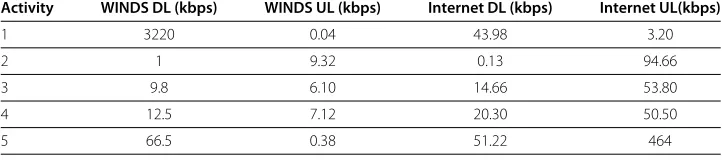
on each activity would be appear approximately similar with activity number 1 in which it will be inefficient. Table 2 shows that the activity number 1, takes utmost amount of bandwidth utilization (3220 kbps (WINDS) and 43.98 kbps (Internet)).
Activity 2 takes the least utilization of among the other activities since both have the latest version of the content already. In this activity, SLAVE will send only its version and metadata information. From the version information, MAS-TER will learn that SLAVE already has the latest and MASMAS-TER will reply with no reply message. Such interaction appears to make the upload utilization (9.32 kpbs (WINDS), 94.66 kbps (Internet)) bigger than the download utilization (1 kbps (WINDS), 0.13 kbps (Internet)).
Activity 3 takes a quite bigger utilization than activity 2. MASTER replies with several updates regarding the changes. Therefore, it does not utilize bandwidth as performed in activity 1. The download takes 9.8 kbps (WINDS) and 55.80 kbps (Internet). Activity number 4 does quite similar with activity 3.The download takes 7.12 kbps (WINDS) and 50.50 kbps (Internet).
Despite quite similar with previous activity (3,4), activity 5 takes quite bigger utilization since file transfer are performed. In this system, file will be stored in synchronization table rather than its origin form in file system. If a particular file was removed from content and being replaced by another, the transfer will reflect the size of the file plus overhead of its synchronization table’s metadata.
From the measurement, it appears that this system works as expected to utilize the bandwidth efficiently. By using differential delivery, the utilization reflects the degree of changes happened at origin.
Evaluation
This approach and the implementation has been working well in terms of functionality as shown in section “Content synchronization running example”. Slave LMS has managed to synchronize a learning content from Master LMS. Experiment had been conducted both using Internet and limited time satellite network (WINDS).
Previously, authors made experiment using Moodle’s course sharing plugin (Sharing cart [18]) and it takes approximate bandwidth of 51.6 kbps for each of the actions.
The measurement shows that by using this system, bandwidth utilization during syn-chronization process depends on the changes has been made on the Master side in which authors referred to as utilizing the bandwidth efficiently.
Contributions
The main contribution of this paper is to provide a novel method for sharing e-Learning content between distributed LMS by using dynamic content synchronization. Further-more, the contribution has an importance of addressing the need of resource sharing in educational sector within developing countries, in a form of course sharing between LMSs which supports collaborative teaching activity. In addition, the method presented is designed to address the concern of content sharing among LMSs in areas with network infrastructure limitation in terms of bandwidth and availability.
Related works
This section describes some existing sites and tools which are related to our work. Moodleshare [16] is a website dedicated to sharing courses to Moodle course format. This website appears to be a hub/repository for a Moodle user community to share their Moodle course. In each particular course, each contributor permits the public to re-use their content by providing a single archive file which is downloadable and ready to use with Moodle.
Community hub [19] is a recent advancement of later version of Moodle. Community hub allows people to share their work of learning content on a central repository server. Prior to this, sharing cart [18] has been existed to perform similar function. Both allows people sharing their work among distributed LMS.
Despite the fact that these methods provide re-usable content for sharing either on-line or off-on-line, they only provide the content to be shared in a static way. That means any particular content can be downloaded and then restored in particular user LMS, and using it within a semester without considering changes at the origin. In addition, such a way of sharing does not support collaborative teaching activity that may take place in the source side . In such teaching activity, a particular content may change at times within a short period of time. On the other LMS, while the course is in progress and conducting student activities, the existing shared content might need to be updated with recent changes from the origin side. Such update process should refrain from affecting current student activities which has not been addressed in the works mentioned ear-lier. Our approach tries to overcome such concerns by performing synchronization of courses with regards to maintain the current teaching activity as well as utilizing the bandwidth efficiently.
Conclusions and future works
An approach for unidirectional dynamic content synchronization between LMSs is dis-cussed. This approach was evaluated by experimental connections between distributed LMSs to realize a distributed e-Learning environment. The experiments show that this system works well, and is capable of doing content synchronization between Learning Management Systems efficiently.
Competing interests
The authors declare that they have no competing interests.
Authors’ contributions
AA, BCH, TU, and YC conducts the preliminary work including grand concept and the idea of course synchronization among Learning Management Systems. Meanwhile, RMI conducts the implementation including system design, experiments, acquisition of evaluation data as well as manuscript drafting and revising. All authors read and approved the final manuscript.
Acknowledgements
A part of this research is supported by Strategic Information and Communications R&D Promotion Programme –Regional topic (SCOPE) #082310003. The authors would also like to thank Institut Teknologi Bandung (ITB) member (Dr. Utoro and Dr. Basuki Suhardiman) for their great support in establishing a network link for the WINDS project experiment.
Received: 12 December 2011 Accepted: 17 October 2012 Published: 5 November 2012
References
1. Hassler B, Jackson AM (2010) Bridging the bandwidth gap: Open educational resources and the digital divide. IEEE Trans Learn Technol. 3:110–115
2. Usagawa T, Affandi A, Hidayanto BC, Rumbayan M, Ishimura T, Chisaki Y (2009) Dynamic synchronization of learning contents among distributed moodle systems. In: Proceeding of the 25th Annual Conference of JSET. JSET, pp 1011–1012
3. Affandi A, Firmansyah A, Hidayanto BC, Ishimura T, Chisaki Y, Usagawa T (2009) Performance of unidirectional LMS synchronization in various network capacity. In: Proceeding of The Asian Conference on Education, IAFOR, pp 1241–1246
4. Moodle.org (2011) Open-source community-based tools for learning. http://moodle.org/ 5. Chavan A, Pavri S (2004) Open-source learning management with moodle. Linux Journal 2004: 2
6. Qing L, Lau RWH, Shih TK, Li FWB (2008) Technology supports for distributed and collaborative learning over the internet. ACM Trans Internet Technol. 8:5:1–5:24
7. Hunt JW, McIlroy MD (1976) An algorithm for differential file comparison. Computing Science Technical Report. Bell Laboratories
8. Git (2011) Distributed version control system. http://git-scm.com/
9. Free Software Foundation (2011) CVS - Open Source Version Control. http://www.nongnu.org/cvs/ 10. Goodrich MT, Tamassia R (2004) Data Structures and Algorithms in Java, Wiley
11. Mehlhorn K, Sanders P (2008) Algorithms and Data Structures The Basic Toolbox, Springer 12. Rivest R (1992) Rfc 1321, the md5 message-digest algorithm
13. Tridgell A, Mackerras P (1996) The rsync algorithm. Technical Report TR-CS-96-05, Australian National University, Department of Computer Science (see also: http://rsync.samba.org)
14. Suel T, Noel P, Trendafilov D (2004) Improved file synchronization techniques for maintaining large replicated collections over slow networks. In: Data Engineering, 2004. Proceedings. 20th International Conference on, IEEE, pp 153–164
15. Squid (2011) Squid cache website. http://www.squid-cache.org
16. Moodleshare (2011) A place for Moodlers to share their Moodles. http://courses.moodleshare.org 17. WINDS (2011) Wideband internetworking engineering test and demonstration satellite. http://www.jaxa.jp/
projects/sat/winds/index_e.html
18. Moodle sharing chart plugin (2011) Moodle Sharing chart plugin. http://docs.moodle.org/23/en/Sharing_Cart 19. MOOCH (2011) Moodle.org Open Community Hub. http://docs.moodle.org/23/en/Community_hubs
doi:10.1186/2192-1962-2-17
Cite this article as:Ijtihadieet al.:Dynamic content synchronization between learning management systems over limited bandwidth network.Human-centric Computing and Information Sciences20122:17.
Submit your manuscript to a
journal and benefi t from:
7 Convenient online submission
7 Rigorous peer review
7 Immediate publication on acceptance
7 Open access: articles freely available online
7 High visibility within the fi eld
7 Retaining the copyright to your article