A R T I C L E
DOI 10.1007/s12651-016-0206-0
Measuring hours worked in Germany – Contents, data and
methodological essentials of the IAB working time measurement
concept
Susanne Wanger1· Roland Weigand1· Ines Zapf1
Published online: 6 September 2016
© The Author(s) 2016. This article is available at SpringerLink with Open Access.
Abstract This article presents the Working Time Measure-ment Concept of the Institute for EmployMeasure-ment Research, which determines the hours worked in Germany and their individual components. The Working Time Measurement Concept is the key data product on working time in Ger-many and underlies the German national accounts figure on labour input. These statistics on hours worked are essen-tial for a proper analysis of aggregate labour market trends and cyclical fluctuations. In the Working Time Measure-ment Concept, changes in working hours due to collective agreements and economic fluctuations are brought together with shifts in employment structure, thus producing a dif-ferentiated picture of the scope, structure and development of the annual working time of gainfully employed persons. We outline the conceptual and methodological framework of the measurement, which continually evolves due to its integration in the system of national accounts and due to in-novations to the statistical procedures applied. An overview of single components and their data sources is given, while the resulting time series of hours worked and the volume of work are depicted according to their long run trends, cyclical variation and reaction in the 2008/09 financial and economic crisis.
Susanne Wanger [email protected] Roland Weigand [email protected]
Ines Zapf [email protected]
1 Institute for Employment Research (IAB), Regensburger Strasse 104, 90478 Nuremberg, Germany
Keywords IAB working time measurement concept · Hours worked · Volume of work · Components · Persons in employment · System of national accounts
JEL classification C82 · E01 · J2
Die Berechnung der geleisteten Arbeitsstunden in Deutschland – Inhalte, Daten und methodische Grundlagen der IAB Arbeitszeitrechnung
zykli-schen Verhaltens, und ihrer Reaktion auf die Finanz- und Wirtschaftskrise 2008/09 untersucht werden.
1 Introduction
Regular and trustworthy data on hours worked and their components over longer periods of time are indispensable for applied research in economics and the social sciences. Consider the tracking of major labour market trends, such as the increasing flexibility of working-time arrangements, the replacement of paid overtime by transitory overtime hours, as well as the long-term increase in part-time employment. These developments are of significant importance for pol-icymakers and provide interesting facts to be faced and explained by researchers.
Business cycle analysis is another area where high-qual-ity measures of working-time matter. Traditionally, cyclical fluctuations of labour input and hourly productivity are used to assess the empirical validity of real business cycle the-ories; see e. g. Kydland and Prescott (1982) and Hansen (1985). More recently, the reaction of these indicators to identified shocks (see e. g. Gali1999), or equilibrium devi-ations like the so-called ‘labour wedge’ (Chari et al.2007; Shimer2010) have been studied in order to identify empiri-cally tenable theories. Likewise, the accounting of the reac-tions to the global financial and economic crisis of 2008/09 draws heavily on hours worked data; cf. Burda and Hunt (2011). Ohanian and Raffo (2012) highlight the impor-tance of internationally comparable data on hours worked and compile a data set on hours worked for OECD countries using official national accounts statistics where available.
Official data on hours worked in Germany are pro-vided by the Working Time Measurement Concept (Ar-beitszeitrechnung, AZR) of the Institute for Employment Research (IAB). The AZR is the key data product on work-ing time in Germany and underlies the German national accounts figure on labour input. The two key indicators provided by the AZR are the hours worked per employed person and the labour volume, which is the product of hours worked per employed person and the number of persons in employment (Reyher and Kohler1986; Kohler and Reyher
1988).1 Because the AZR is based on a componentwise accounting system, changes in working hours due to col-lective agreements and economic fluctuations are brought together with shifts in employment structure and produce a differentiated picture of the scope, structure and devel-opment of the annual working time of gainfully employed
1 Other terms for labour volume which are synonymously used in this article are volume of work, hours worked by all employed persons, overall hours worked in the economy, yearly hours actually worked etc.
persons. The results of the AZR on hours worked and the labour volume offer a unique basis for the evaluation of labour market developments and further perspectives.
Working time measurement has a long tradition at the IAB: Already in 1969 a differentiated approach was devel-oped to record yearly hours actually worked per employed person and the labour volume. The development of the AZR occurred against the background that the statistical recording of actual working hours was initially far from satisfactory. Only statistical fragments of varying quality and definition were available, which is one of the reasons why empirical analyses on diverse issues related to work-ing time and the volume of work did not meet elementary requirements for a long time, and why shortcomings persist. Over the years, changing labour market policies, the in-creasing flexibility of working time, but also improved data availability entail continuous conceptual development of the AZR (cf. Bach 2001; Koch 2001; Bach and Koch 2002; Wanger2003,2013; Wanger et al.2014). The AZR was re-fined and deepened, but also adjusted to changes in working time reality. It has gradually evolved to become an impor-tant basis of national and international empirical economic and labour market research. Thus, the aggregated results of the AZR have been included into the quarterly national ac-counts of the German Federal Statistical Office since 1996. Consequently, they are also a component of Germany’s data transmissions to the Statistical Office in the European Union (Eurostat).
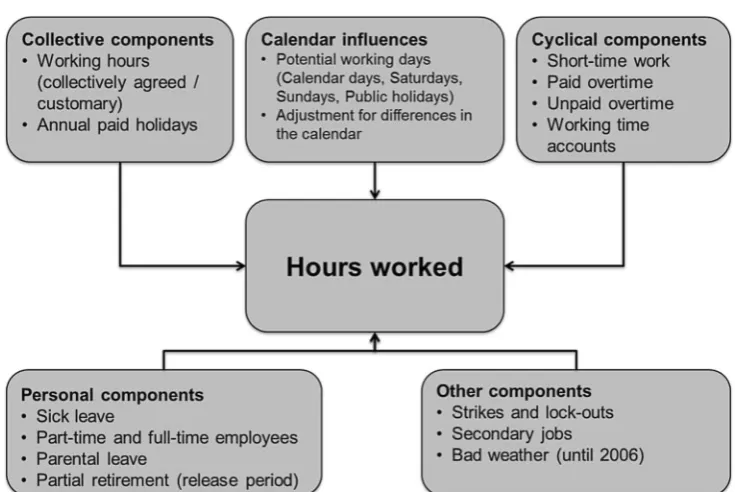
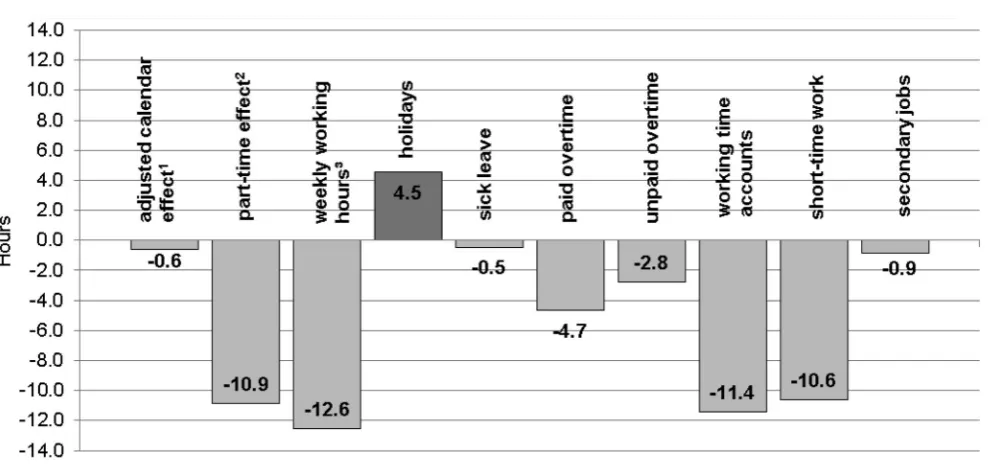
Fig. 1 Components of hours worked in the Working Time Measurement Concept
With respect to statistical agencies and their representa-tives, the current paper contributes to the discussion on the proper compilation of national accounts and similar prod-ucts from different data sources. In addition to serving as a proposal concept specifically for working time account-ing, where an internationally accepted gold standard has not evolved so far, overall principles like model-based statisti-cal nowcasting, as applied in the AZR in various compo-nents, might be of interest also in other branches of official statistics.
In short, this article is structured as follows: Sect. 2 in-troduces the basic concept of the AZR. In Sect. 3 the single components of working time are presented along with their data sources and measurement concepts. Sect. 4 provides selected results on working time, such as long term trends, cyclical properties, and the reaction in the 2008/09 financial and economic crisis, before Sect. 5 gives a short summary.
2 Basic concept of the AZR
2.1 Component accounting
The calculation of hours worked and the volume of work within the framework of the AZR is based on a differen-tiated componentwise accounting concept, where calendar effects, collectively agreed standards, business cycle influ-ences as well as personal and other components are con-sidered (Fig.1). As a result, the AZR provides quarterly consistent time series for the development of hours worked and their components as well as for the labour volume in
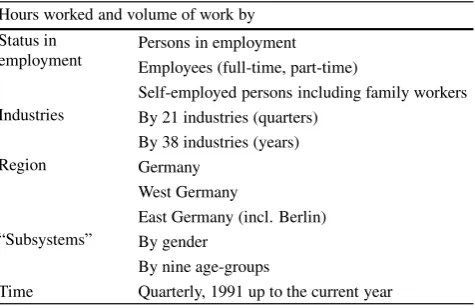
Germany since 1991.2Working hours are calculated sepa-rately for dependent employees as well as for the self-em-ployed persons and family workers, resulting in the working hours of all gainfully employed persons. They include all hours worked by persons who have several jobs at the same time. However, hours paid but not worked, for example because of annual leave, parental leave, holidays, short-time work or sick leave, are not part of the labour volume. All components are broken down into full-time and part-time employment, into West and East Germany, and into 38 economic sectors, known as the A*38 aggregates accord-ing to the WZ 2008 classification of economic branches (European Commission2008).3
Following a bottom-up concept, the starting point for the calculations of hours worked and the volume of work is the number of employees on the one hand and the number of potential working days on the other hand. Based on
2 Comprehensive quarterly and annual results of the AZR are pub-lished regularly and can be freely retrieved from the IAB web page (www.iab.de). The results and estimates of hours worked are also in-corporated into the labour market short-time projections of the IAB (cf. Fuchs et al. 2015). The Federal Statistical Office also regu-larly publishes quarterly and annual results on the average number of hours worked and the labour volume together with employment figures and the GDP (Fachserie 18 National Accounts). See Fach-serie 18, Series 1.4 Volkswirtschaftliche Gesamtrechnungen, Inlands-produktsberechnung – Detaillierte Jahresergebnisse (only available in German)/Fachserie 18, Series 1.2 National Accounts – Domestic Prod-uct – Quarterly results/Fachserie 18, Series 1.3 Domestic ProdProd-uct Sea-sonally adjusted quarterly results, available viahttps://www.destatis. de.
3 Additionally, hours worked are calculated separately for men and women as well as age groups in a subsystem (cf. Wanger2006,2011,
Table 1 The simplified model of calculating the components of the IAB Working Time Mea-surement Concept and how they add up to the total volume of work
Calculations for employees
Component of volume of work Calculation
Collectively agreed/customary volume of work Daily working hours (wh) * working days in period (wd) * number of employees (E)
– Volume of paid holidays Paid holidays * wh * E
– Volume of sick leave (Adjusted) sick leave in % * wd * wh * E + Volume of paid overtime Daily paid overtime * wd * E
+ Volume of unpaid overtime Daily unpaid overtime * wd * E ± Volume of flows on working-time accounts Daily transitory overtime * wd * E
– Volume of short-time work Short-time worker * percentage loss of working hours per short-time worker * working hours in period (adjusted for sick leave)
– Volume of bad weather (until 2006) Affected employees * number of lost hours – Volume of strikes and lock-outs Lost days by strikes and lock-outs * wh ± Volume of adjustments for differences in the
calen-dar
(1) Long term working hours (ltwh) = (long-term working days/working days in period) * coll. agreed/customary working hours in period (cwh)
(2) – (cwh – ltwh) * (inverse) working-days-elasticities * E
+ Volume of secondary jobs Persons with secondary jobs * working hours in secondary jobs in period
= Volume of work of employees (HE)
Calculations for self-employed and family workers
Component of volume of work Calculation
Normally worked volume of work Daily working hours (whs) * working days of employed and family workers (wds) * self-employed and family workers (S)
– Volume of holidays Holidays * whs * S
– Volume of sick leave Sick leave in % * whs * wds * S
+ Volume of secondary jobs Persons with secondary self-employed jobs * working hours in secondary jobs in period = Volume of work of self-employed and family workers (HS)
these, the collectively agreed or customary volume of work for employees is calculated; see Table1. Proceeding from this, we calculate a loss or additional volume of work for each component using the available data, e. g., on holiday leave, sick leave, paid and unpaid overtime hours, transitory overtime hours, short time work, bad weather, strikes, ad-justments for calendar effects and secondary employment. The results for all single components are brought together in one overall figure to obtain the hours worked per em-ployee as well as for all emem-ployees (the labour volume). Likewise, for self-employed and family workers a smaller number of relevant components, like holidays, sick leave, and secondary jobs, are used to adjust the normally per-formed volume of work for that group.
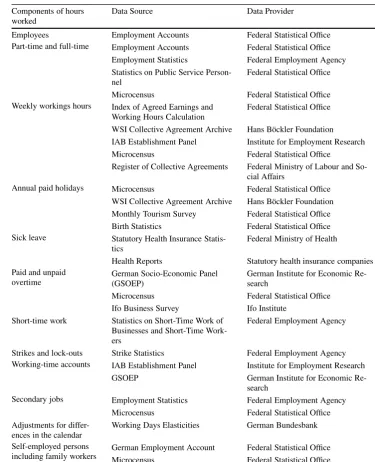
This componentwise accounting concept combines ad-ministrative data sources, survey-based data and household surveys to measure hours worked in accordance with the rules of official statistics (cf. Sect. 2.3). Due to the nu-merous components and dimensions to be considered in the AZR, a total of 20 different statistics and surveys are
processed (Table 2) to cover all areas with sufficient in-formation. As a consequence, the measurement concept faces differing sources, periodicities, types of surveys and degrees of coverage, while additionally some of the data sources are available only with a substantial publication lag. This explains the need of model-based estimation pro-cedures for some components (see Sect. 2.2). The compo-nentwise concept allows selecting suitable methods for the estimation of each component.
As in the overall calculation of hours worked and the labour volume, we calculate the results for each component following a bottom-up approach in principle. The disaggre-gated results by status in employment, by industry and by region are aggregated to a macroeconomic outcome. Hence, also the aggregated labour volume can be decomposed ac-cording to
HT otal D
38
X
iD1 2
X
jD1 2
X
kD1
HE;ij kC
38
X
iD1 2
X
jD1
Table 2 The most important data sources of the IAB Working Time Measurement Concept
Components of hours worked
Data Source Data Provider
Employees Employment Accounts Federal Statistical Office
Part-time and full-time Employment Accounts Federal Statistical Office Employment Statistics Federal Employment Agency Statistics on Public Service
Person-nel
Federal Statistical Office
Microcensus Federal Statistical Office
Weekly workings hours Index of Agreed Earnings and Working Hours Calculation
Federal Statistical Office WSI Collective Agreement Archive Hans Böckler Foundation IAB Establishment Panel Institute for Employment Research
Microcensus Federal Statistical Office
Register of Collective Agreements Federal Ministry of Labour and So-cial Affairs
Annual paid holidays Microcensus Federal Statistical Office WSI Collective Agreement Archive Hans Böckler Foundation Monthly Tourism Survey Federal Statistical Office Birth Statistics Federal Statistical Office Sick leave Statutory Health Insurance
Statis-tics
Federal Ministry of Health
Health Reports Statutory health insurance companies Paid and unpaid
overtime
German Socio-Economic Panel (GSOEP)
German Institute for Economic Re-search
Microcensus Federal Statistical Office
Ifo Business Survey Ifo Institute Short-time work Statistics on Short-Time Work of
Businesses and Short-Time Work-ers
Federal Employment Agency
Strikes and lock-outs Strike Statistics Federal Employment Agency Working-time accounts IAB Establishment Panel Institute for Employment Research
GSOEP German Institute for Economic
Re-search
Secondary jobs Employment Statistics Federal Employment Agency
Microcensus Federal Statistical Office
Adjustments for differ-ences in the calendar
Working Days Elasticities German Bundesbank Self-employed persons
including family workers
German Employment Account Federal Statistical Office
Microcensus Federal Statistical Office
where
HE= Volume of work of employees
HS= Volume of work of self-employed and family workers
i= industries
j= regions
k= status in employment (full-/part-time).
This approach is demanding in terms of the availability of sector-specific data, but offers a great potential for struc-tural sector research. Table 3 gives an overview of the subdivision of the AZR.
Not each primary statistic provides sufficiently rich sec-tor-specific data to allow for precise estimation, however. In order to enhance disaggregated estimates, ancillary statis-tics are used for some components (see Sects. 3.3 and 3.5).
Table 3 Overview of the subdivision of the IAB Working Time Measurement Concept
Hours worked and volume of work by Status in
employment
Persons in employment Employees (full-time, part-time)
Self-employed persons including family workers Industries By 21 industries (quarters)
By 38 industries (years)
Region Germany
West Germany
East Germany (incl. Berlin) “Subsystems” By gender
By nine age-groups
Time Quarterly, 1991 up to the current year
on the basis of collective agreements for all EU member states for the purpose of cross-country comparisons (Cabrita
2014).
As another alternative, measurements of hours worked and volume of work can be derived directly from survey in-terviews. For most of the establishment surveys, however, the findings are limited to particular groups of persons or companies, questions relate to paid hours rather than actual hours worked, or interviews take place only infrequently. Also in household interviews, e. g., labour force surveys, the questions to record hours actually worked and not worked, respectively, are not sufficient to yield a solid overall figure. Besides typical problems with household surveys such as proxy interviewing or memory errors, questions on “hours actually worked last week” or similar questioning may in-duce a systematic bias due to underreported occurrence of components such as holidays or sick leave which cause interviews not to take place. Likewise, multiple jobhold-ing is underreported by survey participants as was found by Steward (2014) for U.S. data. Fleck (2009), who also discusses several other shortcomings of surveys when mea-suring hours worked, shows that, all in all, the hours worked series estimated directly from labour force surveys provide higher measures as compared to other concepts.
In contrast to direct survey estimates, our comprehen-sive measurement concept contributes to a precise estima-tion of the overall and industry-specific volume of work since full coverage statistics are used where available to reduce the impact of survey errors and biases. Addition-ally, early available official numbers such as the sick leave ratio reported by health insurers replace survey results pub-lished with a substantial time lag, and thus contribute to the timeliness of reliable estimates. By using inputs such as employment by industries and person groups directly from other contributors to the national accounts, the accounting system becomes more consistent and reliable as compared to a concept where representativeness of household surveys
is relied on. Most obviously, the AZR improves upon sur-vey questions on “hours worked last week” as the impact of the different components of working time can be separately assessed. This allows the user to analyse the influence of the components, while the contribution and relevance of these numerous different developments can still be presented in an overall figure, such as the annual change of average hours worked.
As a flipside of the componentwise approach with mul-tiple data inputs, it is not possible to compute standard errors of the final estimates in a conceptionally straight-forward way for several reasons (see Carson and Laliberté
2002 for a related discussion regarding national accounts statistics). Firstly, the uncertainty related to key inputs such as the number of persons employed, which is itself estimated using multiple sources, is not available. This precludes attempts to quantify the uncertainty if one is not willing to make ad-hoc assumptions on the errors of these components. Secondly, a possible quantitative assessment of uncertainty would include sampling errors, but would necessarily ignore survey biases, errors induced by work-ing assumptions in the accountwork-ing concept, and summwork-ing- summing-up constraints, such that error bands would be overly op-timistic. Thirdly, the uncertainty of an estimate is time-dependent at least for recent quarters due to the permanent inflow of data sources, since survey errors interact with model-based nowcasting errors. At least the latter are mu-tually dependent across working time components so that the overall uncertainty cannot be assessed for recent figures which are arguably the most interesting ones for policy ap-plications.
Statistical agencies have proposed alternative, more qual-itative ways to assess the accuracy of national accounts, in-cluding analysis of revisions and judgmental valuation of the different components (Carson and Laliberté2002), but an adoption to the current framework is beyond the scope of this text and therefore left as a future development step of the AZR.
2.2 Model-based statistical methods
computation for other reasons. Missing data points may occur if the source does not range back to 1991, if the orig-inal data are of a lower, e. g. yearly, frequency, or if the data are collected according to reference dates rather than in a continuous way. Furthermore, long publication lags of some survey or administrative data intricate the compu-tations at the current edge. Finally, data gaps as well as statistical breaks occur if data sources undergo revisions or surveys are restructured. In contrast to these cases of missing information, there is often more than one primary source for a specific component to measure. This poses an additional challenge for the statistician wishing to honour the available sources properly.
Under such circumstances, a model-based estimation strategy is called for, which helps estimate the unknown quantities by making efficient use of the available data. Recently, state space methods have become a valuable tool in official statistics; see e. g. Durbin and Koopman (2012) for a textbook treatment and Pfeffermann and Tiller (2006) as well as Krieg and van den Brakel (2012) for recent applications in official statistics. The state space approach combines assumptions on the dynamics of the underly-ing series with a suitable model for the measurements by observed data. Corresponding filtering and smoothing al-gorithms produce estimates of the underlying time series, which borrow strength from several data sources, related variables and from its own past.
During the recent revision of the AZR, state space mod-els have been installed as a major methodological innova-tion. For the most part, univariate or multivariate struc-tural time series models, with separately modelled trend, seasonal, cyclical and irregular components, are used as dynamic specification. Since that revision, the application of such models, for example, helps to face the publication delay of secondary jobs, allows us to treat missing data peri-ods and statistical breaks in the part-time ratio of regularly employed persons, and enables us to construct quarterly sick leave estimates from official data available for refer-ence dates and additional sources; see Wanger et al. (2014) for more details on the specific models for each compo-nent. The most comprehensive use of state space models in the AZR is for the business cycle related components over-time hours and net flows on working-over-time accounts. There, Weigand et al. (2015) propose and implement a model in which the information of several primary surveys, but also additional business cycle and labour market indicators are exploited. This is made possible by using a factor structure in the statistical model.
For each use case of state space methods in the AZR, the final estimates are forced to match the corresponding survey or administrative data source where available. Hence, no spurious fluctuations are induced, but rather data gaps at the current edge or within the series are filled. To understand
both the overall level and main movements of the series, it is sufficient to focus on data sources rather than now-casting methods in Sect. 3 when discussing the individual components.
2.3 Integration in the national accounts and statistical concepts
Due to the integration of the AZR in the national accounts, and to enhance international comparability, the “European System of National and Regional Accounts 2010” (ESA 2010) is essential for the calculation of hours worked. The ESA 2010 specifies the concepts, definitions, classifications and accounting rules to be applied by statistical agencies of the European Union (EU) when compiling national ac-counts.4 In addition, it contains the frequency and timing of the transmission program. As a European regulation, the ESA 2010 is directly legally binding for all EU Member States, and hence comparable harmonized data should exist throughout Europe to support political and economic deci-sions (cf. Federal Statistical Office2013). Consequently, also the definition of hours worked and labour volume in the AZR is based on ESA 2010 (European Commission2013a), where binding requirements are provided in line with the recommendations of the International Labour Organisation (ILO) (ILO 2008). When calculating hours worked and the labour volume, the AZR draws on national accounting figures of the Federal Statistical Office, particularly on Em-ployment Accounts(cf. Lüken2012), and on theProduction Accounts of Gross Domestic Product(GDP) (cf. Mai2010). These national accounts figures are subject to regular revisions, which are distinguished into ongoing revisions and major revisions, also referred to as “general revisions” (cf. Räth and Braakmann 2014). Ongoing revisions are possible to each date of delivery, but they are only carried out for the recent past. At the main calculation date in August of each year, the data revision is limited to the last four years. In contrast, major revisions also comprise re-calculations for the whole period to avoid breaks in the time-series. Therefore, fundamental revisions and further methodological developments in the AZR are synchronized with the general revisions of the national accounts, and these are usually carried out at intervals of five to ten years (cf. Lüken2012).
4 ESA 2010 replaced the previous ESA 1995 in September 2014. ESA 2010 is based on the global “System of National Accounts 2008” (SNA
Especially the recent general revision 2014 led to fun-damental changes regarding the concept, the methods and therefore the resulting time series of the AZR. As an impor-tant innovation, the new component “unpaid overtime” was added, which has become necessary due to the changeover to ESA 2010. Another key part of the methodological changes was due to the introduction of state space methods as described above. Hence, in the course of the revision also the components paid overtime and working-time accounts were revised and now model-based estimation methods are applied. The 2014 revision also introduced a correction for artificial variation in the official sick leave ratio. Further-more, we took into account several data revisions of the
Employment Statisticsof the Federal Employment Agency (BA). Consequently, the revision of single components af-fects the calculation of actual hours worked on average and the volume of work. In the course of the revision, however, the average annual working time and the labour volume, both for employees and for all persons in employment, did not change dramatically. The deviations in the single ob-servation years (1991–2013) are between –1.6 and +0.5 % with respect to the average annual working time of em-ployees and between –1.8 and +0.2 % with respect to the average annual working time of all persons in employment. Regarding the volume of work of employees the deviations range from –0.5 to +1.8 %, while differences in the labour volume of all persons in employment are between –0.8 and +1.3 %. More detailed comparisons of the results for the single components and calculated time series are given by Wanger et al. (2014).
As the AZR is integrated in the national accounts, a reg-ular data exchange is carried out, which is organized in co-operation between the IAB, the Federal Statistical Office as well as the “Arbeitskreis Erwerbstätigenrechnung des Bun-des und der Länder”.5 At binding delivery dates, sectoral data for hours worked and labour volume are transmitted to the national accounts.
3 Single components of the AZR
In this section, we provide detailed information about the single components and the steps of their calculation. We describe the components in the natural order in which they add up to the overall results as shown in Table1. At the same time, the classification to the categories of working time as introduced in Fig.1is reflected by the ordering.
5 This working group consists of the statistical offices of the 16 Ger-man states (Länder), the Federal statistical office as well as the German association of Cities and Towns and has the task to calculate and pub-lish official employment statistics for the individual states and urban and rural districts (http://www.aketr.de/aketr.hestala.de/index.html).
3.1 Part-time and full-time employees
To calculate the average actual hours worked and the vol-ume of work, the number of gainfully employed persons is calculated and their structure is considered. The number of gainfully employed persons comprises employees subject to social insurance contributions, marginally employed per-sons, civil servants, and persons in work opportunities ( Per-sonen in Arbeitsgelegenheiten,so-called One-Euro-Jobs) as well as self-employed persons and family workers (for fur-ther details see Appendix B). The quarterly and annual fig-ures stem from theEmployment Accounts(cf. Lüken2012). As there is no specific subdivision in theEmployment Ac-countsaccording to working time, one fundamental element of the AZR is the allocation of employees into part-time or full-time employees. For calculating the part-time rate, dif-ferent statistics are combined in the AZR.
The register-basedEmployment Statisticsof the BA is the basis for calculating the number of part-time and full-time employees subject to social insurance contributions. It is based on standardised social security notifications, which include all employees (also those in vocational training) subject to compulsory health insurance, compulsory pen-sion insurance or compulsory insurance in accordance with the German Social Code, Book III (SGB III). With this no-tification, employers also provide information on whether the employee has a full-time or a part-time job. Part-time employment is defined by contractual hours of work be-low the company’s customary hours. However, the regular weekly working hours of the employees are not submitted. Breaks in the time-series of the Employment Statistics of the BA due to changes in the notification procedure (cf. Dundler and Frank 2012; Bertat et al. 2013) or a modern-ized data processing (cf. Frank and Grimm2014) have been removed using a structural time-series model (cf. Wanger et al.2014).
Marginally employed persons are a special form of part-time employees. They are not subject to social insurance contributions, but considered as gainfully employed follow-ing the labour force concept of the ILO if they performed at least one hour of paid work within the reporting period. Marginal employees are calculated by theEmployment Ac-counts. Here, three groups of marginal employed persons are summarized: marginally gainful employed persons (so-called Mini-Jobs), marginally short-term employed persons and persons in One-Euro-Jobs.
subject to social insurance contributions, the marginal part-time employees including persons in One-Euro-Jobs and the part-time civil servants we get the number of all part-time employees. Furthermore, persons on parental leave and per-sons in the release period of partial retirement (cf. Wanger
2009) are considered as part-time employees. These per-sons are included as employed in the statistics but perform zero hours of work, which is taken into account to avoid an overestimation of the macroeconomic volume of work. The part-time rate represents persons employed part-time as a percentage of all employees.
3.2 Potential working days
In the calculations of the number of potential working days a five-day week is assumed throughout. This common assumption presumes that employees are given compen-satory time off on other days when they work on saturdays, sundays, or on public holidays.6 The number of potential working days therefore results from the number of calen-dar days minus saturdays, sundays, and public holidays. Regional holidays that do not apply throughout Germany are weighted with the number of employees subject to so-cial insurance contributions within the states ( Bundeslän-der) level to calculate averages. The different numbers of annual working days have a nonnegligible irregular ef-fect on annual hours worked. In addition to the resulting number of days, the effect of working days on the collec-tively agreed annual working time is presented in TableA.1
(see Appendix A). The corresponding line in the lower part of TableA.1 shows the percentage change of collectively agreed working time compared with the previous year due to an increase or decrease of the potential working days.
3.3 Collectively agreed or customary working hours
The collectively agreed or customary weekly working hours is the major source of the long-term development of hours worked. Collectively agreed hours worked are collected in theIndex of Agreed Earnings and Working Hours Calcula-tion(cf. Bick and Decker2013). There, the development of collectively agreed income and working hours of employ-ees in Germany is recorded together with indices of agreed earnings. Additionally, information from the Collective
6 According to evaluations on basis of the GSOEP, about 1/10 of em-ployees are working 6 or 7 days a week while this proportion is reduc-ing gradually over time. The distribution of hours worked is unknown, however. Note that ignoring deviations from a 5-day-week may in-duce overestimation of calendar effects, but changes neither the overall level nor the cyclical behaviour of hours worked. This effect is partly adjusted for by the corrections described in Sect. 3.9. The GSOEP is a longitudinal survey of approximately 11,000 private households in Germany. For more information see e. g.http://www.diw.de/de/soep.
Agreement Archiveof the Institute of Economic and Social Research (WSI) of the Hans-Böckler Foundation and the
Register of Collective Agreements of the Federal Ministry of Labour and Social Affairs are added to cover gaps. Many industries have agreed on labour-related opening clauses and flexible working time regulations in the collective bar-gaining process, but since the actual use of such numerous variations on the enterprise level is not recorded or eval-uated in the statistics, in particular the collectively agreed working hours is regarded as reference level for a certain period.
These data, however, cover only the weekly hours worked by employees in establishments with collective agreements. Results from the IAB Establishment Panel
show that in establishments with collective agreements the weekly working hours are fewer than in those without collective agreements. Collective bargaining coverage de-creased over the past years (cf. Ellguth and Kohaut2014). Thus, the customary working hours in establishments which are not bound by collective agreements gain importance. This must be considered in the AZR since otherwise the component of collectively agreed or customary working hours is estimated too low. Through analyses of the IAB Establishment Panel, a correction factor is estimated for each industry, which compensates for this effect.
Information on collectively agreed or customary work-ing hours typically refers to full-time employment. Infor-mation from the Microcensus7 is used to obtain the aver-age weekly hours worked by part-time employees. For the different economic sectors, the ratio of hours worked by regular part-time and marginal employees to those of full-time employees is calculated. The results are then applied to the collectively agreed or customary working hours by full-time employees. For One-Euro-Jobs, information on average weekly hours worked are obtained from the BA. Because there is no differentiation according to economic sectors in this statistic, the variation of the working time of One-Euro-Jobbers across economic sectors is assumed to be proportional to that of marginal employees.
3.4 Annual holiday leave
According to the Federal Holidays Act ( Bundesurlaubsge-setz), the minimum entitlement to paid recreational holiday is 20 working days per year based on a five-day work week. Many collective or individual agreements, however, include more favourable regulations. Overall, the annual leave
titlement for workers covered by collective agreements in Germany is six weeks per year (cf. Schnitzlein2011). The
Collective Agreement Archiveof the WSI reports this col-lectively agreed annual paid holiday leave of employees, distinguishing basic and actual total leave by industries. Collective agreements can determine basic leave for an em-ployee, which is then raised in one or more stages to the actual total leave. Requirements for an increase can be age, duration of affiliation with the enterprise, wage bracket, etc. Based on details provided by the WSI, basic and actual total leave are weighted on a 40/60 basis to obtain the over-all leave, which is a plausible proportion also according to analyses of the GSOEP.
The quarterly distribution of the annual holiday leave is estimated with the help of theMonthly Tourism Survey
(Federal Statistical Office), which includes the guest-nights by nationals in places of accommodation. TheCollective Agreement Archiveof the WSI additionally provides infor-mation on special leave which is customary in some eco-nomic sectors and hence also included in the AZR.
Besides the collectively agreed annual paid holiday leave, also times of maternity leave are considered. Based on theBirth Statistic of the Federal Statistical Office, the number of births by female employees is estimated via the ratio of female employees to the female population (of age 20–40). The corresponding volume of lost work-ing hours can be calculated via the times of protection of six weeks before and eight weeks after giving birth. The ratio of female employees to the female population is established using the Microcensus. Furthermore, special effects of additional leave for heavy or hazardous work, school holidays for teachers, and additional leave for the severely handicapped, are also taken into account. Rough calculations indicate an average of about one day per year on average per employee.
3.5 Sick leave
The benchmark figure for the calculation of sick leave is the monthly sick leave ratio, which is measured in % of compulsory members of the state health insurance scheme with continued payment of wages of at least six weeks.8 The sick leave ratio is an official recording by the Statu-tory Health Insurance Statisticsof the Federal Ministry of Health based on reporting dates. It comprises employees that reported unfit for work at the first of each month. The periods of short-term incapacity for work lasting up to three
8 Today, approximately one third of the German population are oblig-atory members of the statutory health insurance. Together with retired persons and family members the share increases to 87 % according to the National Association of Statutory Health Insurance Funds. Another 11 % are members of a private health insurance (German Federation of Private Health Insurers).
days, which are under-recorded in this series, are possibly offset by non-compulsorily insured persons (employees not covered by the agreed pay scale, civil servants, and marginal part-time employees) with their typically lower levels of lost working hours. Cases in which people resume work while still certified unfit for work by a physician have a similar effect.
However, the reference of sick leave statistics to a single date creates problems if the first day of the month is on a weekend or a floating public holiday. Then, the number of sick leaves is well below the level found for normal working days, and artificial fluctuations both in the original as well as in the seasonally adjusted time series occur. To avoid such problems we adjust the time-series of sick leave using usual weekday and holiday effects and modify the series to fit the seasonal patterns reported by the major statutory health insurers AOK and BKK. For these calculations, we make use of statistical state space methods, which allow us to separate weekday and holiday effects from seasonal and other fluctuations (cf. Wanger et al. 2014).
Since the monthly statistics of the Federal Ministry of Health are not broken down into economic sectors, the an-nual health reports of AOK and BKK (cf. Knieps and Pfaff
2014, Meyer et al. 2014) are used to compute the sector-specific figures in a top-down approach. The annual health reports indicate days of sick leave for different economic branches, which are adjusted to gain representativeness for all employees subject to social insurance contributions.
3.6 Definitive and transitory overtime hours
Overtime work is classified into definitive and transitory overtime hours (cf. Zapf2012). Definitive overtime work comprises paid and unpaid overtime hours (cf. Sect. 3.6.1), both of which extend the working time of an employee without an inherent balancing mechanism. In contrast, tran-sitory overtime hours (cf. Sect. 3.6.2) are additional hours worked that can be used up later by employees, so that they can take time off in lieu of overtime. Transitory overtime hours only change the allocation of the working time, while the number of working hours over a longer reference period is unaffected (cf. Kohler and Reyher1988; Bundesmann-Jansen et al. 2000). During the last years, transitory over-time hours got more important. This growing importance can also be attributed to the increasing deployment of work-ing-time accounts, where transitory overtime hours can be accumulated (cf. Zapf2012).
3.6.1 Paid and unpaid overtime
Paid and unpaid overtime hours are calculated mainly on the basis of the yearlyGSOEPwhile also theMicrocensus
GSOEPcontains information about the number of weekly overtime hours and its compensation form (compensated with off; partly paid, partly compensated with time-off; paid; not compensated at all). On that basis, the num-ber of annual paid and unpaid overtime hours can be calcu-lated. Problems arise due to the assignment of partly paid overtime hours. Since 2001, these overtime hours can be assigned through information by the additional question of the number of paid overtime hours last month. With this in-formation the otherwise undetermined cases of partly paid overtime hours are made unambiguous, while the result-ing fraction of paid hours among the ambiguous cases is extrapolated to previous years. Certain groups of employ-ees (marginally employed, apprentices and employemploy-ees with zero working hours, e. g., on parental leave) do not work paid overtime according to their contract, which we take into account in the calculations.
Since 2010, the Microcensus regularly contains ques-tions on paid and unpaid overtime hours. Average figures can be calculated on a quarterly basis as the survey is carried out during the whole year and enter the accounts through a statistical model-based approach. The model also allows us to take into consideration several related surveys and other indicators containing information on overtime fluctu-ation. They improve the estimates especially at the current edge, where the main survey sources are not yet available; see Weigand et al. (2015). One major additional indica-tor for the calculation of overtime hours is theIfo Business Survey, where establishments indicate whether employees work overtime at the moment, and whether overtime hours are unusually high. Additionally, the GDP, new orders for all manufacturing industries, the industrial production in-dex, the number of persons in employment, registered un-employment, compensation for employees, the willingness to buy from the GfK, the business expectations and situation from the Ifo Institute, as well as the Ifo employment barom-eter are integrated in the calculations. To obtain the number of paid overtime hours separately for industries, West and East Germany and for full-time and part-time employees, data of theStructure of the Earnings Surveyof the Federal Statistical Office are used additionally to theGSOEP and theMicrocensus.
Despite the efforts to make overtime statistics as pre-cise and timely as possible, due to the impact of GSOEP survey errors on the final estimate and limited intra-year in-formation, these components are less accurate as compared to other components of the AZR, and hence the estimates should be used in view of this uncertainty.
3.6.2 Working-time accounts
As outlined above, a second major cyclical component of hours worked is due to changing hours on working-time
accounts. Deviations from regular or collectively agreed working hours lead to savings (credits) or deficits (debits) on these accounts, which have to be balanced during a cer-tain period of time (cf. Seifert1998,2001).
Although different datasets contain information about the distribution of working-time accounts among establish-ments and employees, there exist few data sources on the accumulation and reduction of working hours on these ac-counts. Especially, regularly surveyed information about working hours on working-time accounts is very sparse.
As mentioned above, theGSOEPcomprises information about overtime hours which are compensated with time-off later. These can be viewed as the accumulation of time credits on working-time accounts, as the compensation with time-off needs a formal or informal documentation and recording of the additional hours worked. However, un-til 2014 where an according question has been introduced, there is no information on the reduction of time credits, i. e., the compensation of additionally hours worked with time-off. Thus, an estimation of the net flows on work-ing-time accounts cannot be conducted solely on basis of the GSOEP. For this reason, we draw additional informa-tion from the Microcensus. Here, survey participants are asked about their regular working time, the actual working hours in the last week before the survey and the main rea-son why they worked more or less than the regular working time. One reason for fewer working hours is a compen-sation for additional hours worked (e. g. flexible working hours), while a reason for additional hours worked is the accumulation of time credits or reduction of time deficits. These variables are the basis for the estimation of time se-ries models for the changes of balances on working-time accounts.
3.7 Short-time work
Short-time work leads to a temporary reduction of the actual hours worked. It is used to relief the pressure from enter-prises by reducing the payroll costs during temporary times of low business activity (cf. Crimmann et al. 2010). Since the rearrangement of short-time work in 2007, the German system distinguishes three kinds of short-time work: be-sides short-time work for economic reasons and seasonal short-time work, the so-called “transfer-short-time work” is possible for firms which face a permanent loss of em-ployment due to restructuring measures at the firm level.
When calculating hours lost due to short-time work, data published by the BA are considered. The lost working hours per short-time worker are calculated from the statistically documented percentage loss, assuming that the percentage loss of working hours per short-time worker is not different between part-time and full-time workers.
Until 2006, a “bad weather-component” was also part of the AZR. The number of lost hours and the affected employees due to bad weather were recorded to the extent that the BA paid benefits until 2006. The loss of working hours through bad weather was by definition only possible in the construction sector. In 2007 the bad weather compen-sation (Winterbauförderung) was replaced by the seasonal short time working allowance (see above). Therefore the time-series on working hours lost due to bad weather end in 2006 (see Appendix A, TableA.1) and are captured in line with the total short time working allowance component from 2007 on.
3.8 Strikes and lock-outs
After failed negotiations for new collective agreements, usually strikes are taking place. However, they are quite rare as centralized agreements prevail in the German econ-omy. Lockouts are defined as the refusal of an employer to give the employee access to their workplace and refusal to pay wage at the same time during a strike. In Germany lock-outs are also rarely used.
TheStrike Statistics9of the BA provides sufficiently deep economic and temporal breakdowns for the strikes and lock-outs and can be directly converted into volumes of hours lost using the collectively or customary hours worked. In theStrike Statisticslabour disputes are only shown if they are lasting longer than one day and at least 10 employees are involved (affected) or generating a loss of more than 100 working days. All other disputes are classified as small claims (Bagatellstreitigkeiten) and are listed for information
9 This statistic of the BA show companies and employees affected by strikes and lockouts as well as the days lost.
only. As far as they are reported to the BA they are also considered in the calculation.
3.9 Adjustments for differences in the calendar
As described in Sect. 3.2, differences in the potential num-ber of working days occur depending on whether public holidays are on weekdays or on whether the current year is a leap year. The deviations from the average number of working days over many years are compensated to some extent by adjustments to overtime and working-time ac-counts (Deutsche Bundesbank 2012). However, at least a portion of the effects on working time is not covered by the latter. An additional weekend day or public holiday does not lead to zero working hours, as a certain amount of labour is indispensable and is either done even on holi-days or weekends, or gives rise to shorter breaks and other unobserved flexibility in working time. This is mirrored by economic output which does not change proportionally to the development of working days: an increase in the num-ber of working days by one per cent leads on average to a 0.3 % increase of total economic production (Deutsche Bundesbank2012).
In the components discussed so far, the changing num-ber of working days leads to a proportional change in the volume of work. This would result in an excessively volatile productivity development caused by calendar-ef-fects. Therefore, working time elasticities specific to eco-nomic branches are needed to approximate the correla-tion between a change of number of working days and a change of labour volume. These working-time elastic-ities should measure by how many hours the annual hours worked change when more or less working days are avail-able, and hence the latter are not included in annual hours worked one-to-one. As suitable data for estimating these effects are not available, we take the elasticities to corre-spond to working days elasticities of production calculated by the German Bundesbank. These elasticities indicate the percentage by which the production increases if the poten-tial working hours are extended by one per cent due to (the fraction of) an additional working day. The estimated work-ing day effect reflects the difference of production carried out at a normal work day and the production carried out at a weekend day.
not fully taken into account in the annual hours worked, but only a fraction given by the working days elasticities. The remaining hours are the compensatory hours taken into ac-count within the component “adjustment for differences in the calendar”. This procedure is carried out sector-specific and for full- and part-time employees separately.
3.10 Secondary jobs
Besides the time worked by employees at their main (or only) job also the volume of work from second or third jobs is taken into account. Up to 2003, the only source for the number of employees and average hours worked in sec-ondary jobs was theMicrocensus. Since then, it is also pos-sible to use the sector-specific BA statistics on secondary employment of employees subject to social insurance con-tributions. These additional information in theEmployment Statisticsof the BA are the result of legal changes regarding secondary employment10.
Since theEmployment Statistics of the BA provide no information on the duration or length of working hours, we use basic information from theMicrocensusto obtain the average weekly hours worked by employees in the side job. The ratio of the average number of hours worked by side employees to the average number of hours worked by full-time employees is calculated for each industry.
3.11 Hours worked by self-employed and unpaid family workers
In addition to the hours worked by dependent employ-ees, the hours worked by self-employed and unpaid family workers are considered in the measurement concept. Since patterns of hours worked by self-employed persons them-selves and their unpaid family members differ fundamen-tally, both groups are treated separately in the AZR. The calculations of hours worked differ methodologically from those for employees because a large part of the components of hours worked are not relevant here (see Sect. 2.1).
The most important source for average hours worked of self-employed and unpaid family workers is the Microcen-sus, collecting the hours (normally) worked per calendar week. It is assumed that the hours worked are distributed evenly over the whole year. The only exception is the agri-culture and forestry sector, where working hours outside the
10 Until 1999, marginal secondary employment with a regular work-ing week of 15 h or less was exempt from social insurance contribu-tions. This changed in 1999: marginal secondary employment was completely liable to tax and social insurance contributions. Then, from 2003 on, marginal secondary employment besides a main job has be-come more appealing again, because no social insurance contributions are paid when the income does not exceed an income limit. This in-come limit currently amounts to 450 C.
high season is presumed to be lower. Thus, we use a 30 % lower working time for the first and fourth quarter.11
According to the GSOEP (cf. Saborowski et al. 2004
and own calculations), self-employed persons only take two thirds of the number of holidays as compared to employ-ees, which we use to estimate the holiday leave for self-em-ployed persons of each specific industry. For the seasonal distribution of leave, we assume that there is no difference between self-employed persons and employees. For the former, also the extent of sick leave is substantially lower than for employees. However, there are considerable vari-ations in the results of sick leave days for self-employed persons. The statistics of statutory health insurance compa-nies indicate that the number of sick leave days is between one third and one half of those of employees (cf. Küsgens et al. 2002), while theEmployment Surveysof the Federal Institute for Vocational Education and Training (BIBB) and the Federal Institute for Occupational Safety and Health (BAuA) indicate values between one third and two thirds. On the basis of these analyses we assume half the sick leave rate of employees. Based on results of the Microcen-sus, the labour volume performed by persons who are self-employed in a second activity is also considered here.
4 Selected results from the AZR
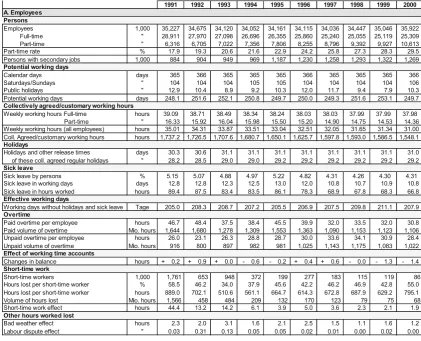
In this section, we present selected results of the AZR. We aim to illustrate the overall development of different groups of employment, of hours worked and of the volume of work in Germany during the last 25 years, as well as the influence of the different components on that longer-term development. Moreover, emphasis is given to the business cycle properties of hours worked in Germany and to the development in the 2008/09 financial and economic crisis. Detailed results referring to the data version of March 2015 can be found in TableA.1(see Appendix A).
4.1 Employment by status
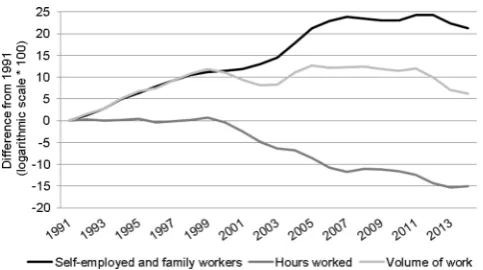
In 2014 around 42.7 mio. persons were in employment, which is a 10 % increase as compared to 1991 (Fig. 2).
Fig. 2 Development of employment, hours worked and volume of work; annual averages 1991–2014. (IAB Working Time Measurement Concept, Federal Statistical Office and own calculations)
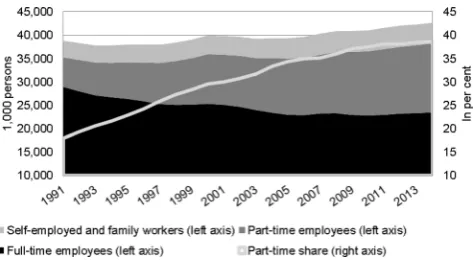
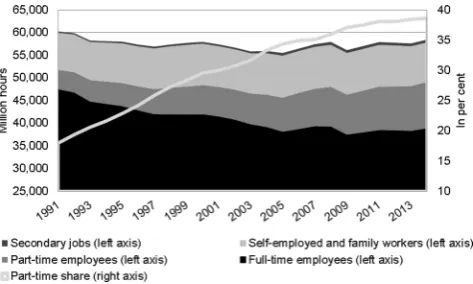
Behind the increasing number of persons in employment there are different developments of full-time and part-time employment as well as the number of self-employed per-sons and family workers (Figs.3, 4and5). In 2014, the number of employees was around 3 mio. persons higher than in 1991 (TableA.1). However, the so-called “normal employment relationship” (Normalarbeitsverhältnis) deter-mines the development of employment to a fewer extent as the number of full-time employees decreased (Fig.6and4). In contrast, contracts with less working hours are more and more widespread, as the number of part-time workers has more than doubled (TableA.1). Since 2006, however, also the number of full-time employees increased slightly – with the exception of a decline due to the financial and economic crisis in 2008/09. The contrary developments of full-time and part-time employment led to an increasing part-time rate, which rose from 17.9 % in 1991 to 38.6 % in 2014 (Fig.6). From this rate, 15 percentage points can be at-tributed to persons in marginal employment.
In 2014, around 4.4 mio. persons were self-employed or family workers. In comparison to 1991 their number increased by 24 % (Fig.5). The share of family workers within this group was around 4 % in 2014, with their im-portance decreasing rapidly since 1991 (12 %), especially due to the strong decline in the agricultural sector.
The increase of self-employed and family workers since 2002 can be mainly attributed to the increase of self-em-ployed workers without employees (Solo-Selbstständige). In 2014, their share was 56 %. The increase of self-em-ployed workers without employees is supported by gov-ernment aid. It can be assumed that one part of this in-crease can be attributed to the intensified use of labour market policy instruments, like interim payment ( Über-brückungsgeld) and grants for business start-ups ( Existenz-gründungszuschuss). Since 2006, these labour market pol-icy instruments are combined as start-up subsidies ( Grün-dungszuschuss). However, since 2011, the financial support of the BA for self-employed workers declined considerably.
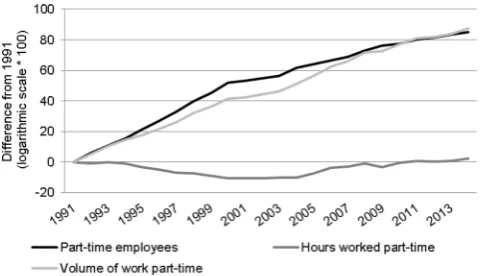
Fig. 3 Development of part-time employees, hours worked and vol-ume of work; annual averages 1991–2014. (IAB Working Time Mea-surement Concept, Federal Statistical Office and own calculations)
4.2 Working time
4.2.1 Components of hours worked
In this section, results for the single working time compo-nents are presented, which are greatly affecting the hours worked and the labour volume (see Table A.1). The ef-fects of the different components vary a lot and changes in their importance have different impacts on the amount of hours worked and the volume of work. The components bad weather and labour disputes are of minor importance for the overall economy and are consequently left from our review of results here.
Of major importance is the collectively agreed or cus-tomary weekly working hours of employees. It is the refer-ence point for all working time agreements beyond full-time employment. In 2004, the collectively agreed or customary weekly working hours for full-time employees reached its lowest level with 37.9 h on average, and increased slightly since then. Due to reductions during the financial and eco-nomic crisis (cf. Bogedan et al.2009), however, the collec-tively agreed or customary weekly working hours declined temporarily.
The gap between collectively agreed or customary weekly working hours in East and West Germany is still remarkable (0.8 h), but it has already declined considerably since 1991, when the difference was 2.4 h. There are also noteworthy differences between industries. In public ser-vice and in the construction industry the collectively agreed or customary weekly working hours increased, whereas it decreased in non-public parts of the service sector and in the manufacturing industry.
Fig. 4 Development of full-time employees, hours worked and vol-ume of work; annual averages 1991–2014. (IAB Working Time Mea-surement Concept, Federal Statistical Office and own calculations)
also absences from work due to illness decrease the annual working time. Until 2007, sick leave in hours worked de-creased to a historically low level of 49 h per employee and since then it increased again. The long-term decline of sick leave can be partly attributed to structural shifts in em-ployment to industries and occupations with fewer physical burdens for employees. Additionally, it can also be ex-plained by changes in behaviour on the establishment side, like e. g. better safety regulations and health management (cf. Knieps and Pfaff2014).
During the last two decades the importance of paid time decreased sharply. In 1991, the volume of paid over-time hours was 1.6 bn. h (Fig. 7), while it declined to 0.8 bn. h in 2014. In 2009, the volume of paid overtime work reached its lowest level due to the crisis. The decline of paid overtime hours and the volume of paid overtime can be explained by several reasons: On the one hand, groups of employees who traditionally work less paid overtime hours gain importance, e. g., women. Likewise, sectors in which paid overtime work is less widespread get more im-portant, e. g., the service sector. On the other hand, flexible working time arrangements like working-time accounts are increasingly popular. In 2014, the volume of unpaid over-time hours was 1.1 bn. h (Fig.7) and hence higher than the volume of paid overtime hours. Unpaid overtime hours are mainly worked by employees with a higher qualification level and by employees with managerial responsibility (cf. Weber et al. 2014). Employees supply unpaid overtime e. g. to get promotions and pay rises (cf. Anger2006).
As was explained in Sect. 3.6.2, one major part of addi-tional hours worked can be accumulated on working-time accounts and used up later by working fewer hours. Due to the financial and economic crisis, the number of accumu-lated hours on working-time accounts was reduced by 9.1 h per employee over the whole economy. In 2009, also the number of short-time workers sharply increased to 1.1 mio. on average (Fig.8). The intensive use of short-time work during the crisis can partly be explained by the eased
uti-Fig. 5 Development of self-employment, hours worked and volume of work; annual averages 1991–2014. (IAB Working Time Measure-ment Concept, Federal Statistical Office and own calculations)
lization. The government extended the period to use short-time work and employers were relieved from social insur-ance contributions. Based on all employees, the average loss was 12.5 h per employee in 2009. At the beginning of the 1990s short-time work was also used intensively due to the German reunification.
Among the components of hours worked, the importance of secondary jobs increased. From 1991 to 2014, the num-ber of persons with a secondary job shot up from 0.9 to 2.8 mio. people, with the share of persons with secondary job increasing to 7.2 % (1991: 2.5 %). Only from 2000 to 2002 the number of persons with a secondary job decreased due to the introduction of compulsory insurance. In 2003, the new regulations of marginal employment promoted the increase of secondary jobs as the legal framework allows an additional income of 450 C largely exempted from taxa-tion and social security. Since 1991, the effect of secondary jobs on hours worked has nearly doubled from 8.9 to 17.0 h in 2014 per employee. The reasons for a secondary job are manifold. Some persons are voluntarily searching for flexible forms of employment, while others are in need of additional income. However, the majority of secondary jobs is characterized by a high qualification level (see e. g. Brenke 2009; Heineck2009). Additionally, Schmidt and Voss (2014) show that employees who would like to work longer in their main job and women with a lower income are more likely to perform a secondary job.
4.2.2 Hours worked
Fig. 6 Development of employment and the part-time share; annual averages 1991–2014. (IAB Working Time Measurement Concept, Federal Statistical Office and own calculations)
major consequences on the average hours worked by all part-time employees and also on the average hours worked by all employees (in full-time and part-time). As a con-sequence, a high number of employees do not necessarily lead to a higher overall labour volume if the structure of employees is changing.
In 2014, the average annual working time of full-time employees was 1657 h and hence slightly higher than in 1991 (1643 h), when short-time work was highly used (Fig.4and9). The average annual working time of part-time employees was also higher in 2014 as compared to 1991 (Fig.3 and9). At the end of the 1990s and at the beginning of the 2000s it mainly decreased due to the increasing importance of marginal employment. That in-creasing importance can be partly attributed to the Hartz-II reforms12which took effect in 2003. The ratio of annual working hours of part-time employees to the annual work-ing hours of full-time employees decreased to 36.5 % until 2004. Since then this ratio increased again and in 2014 it was 41.8 %.
Due to the enormous increase of the part-time rate the average hours worked of all employees (without secondary jobs) decreased from 1470 h in 1991 to 1285 h in 2014 (–185 h or 12.6 %). If the average working time of all em-ployees is compared to the average working time of full-time employees, then the increasing importance of the time effect becomes evident. From 1991 to 2014, the part-time effect increased from 173 to 372 h (Fig.9).13As a con-sequence, the decline of the average annual hours worked of all employees in the last 25 years is not the result of pure working time reductions, but rather results from structural changes in employment.
12 More information about the Hartz reforms in Germany is given by Möller (2014).
13 The part-time effect is calculated by subtracting the working time of all employees (in full-time and part-time) from the working time of full-time employees.
Fig. 7 Volume of work and volume of (un-)paid overtime work; an-nual averages 1991–2014. (IAB Working Time Measurement Concept)
The working time of self-employed workers and family workers exceeds the annual hours worked of employees to a great extent. In 2014, self-employed and family workers performed on average 1973 h. In the 1990s their annual working time was on average 320 h higher, but since 2001 it declines. This decline is due to the increasing share of self-employed workers without employees, with one third of them working part-time. As a result the part-time rate among self-employed workers strongly increased. One rea-son for this increase is the larger use of subsidized founding until 2011. Recent studies show that the working time in those newly founded establishments is lower than among traditional self-employed workers, and that self-employ-ment in part-time seemed to be realised with this instruself-employ-ment (cf. Caliendo et al. 2009). Other studies also show that the foundation process in Germany seems to change from self-employment in full-time to part-time self-self-employment (cf. Brenke2013).
The annual hours worked of all persons in employment consists of the annual working time of employees and the annual working time of self-employed and family work-ers. The development of the annual working time of all employed persons is mainly driven by the annual working time of employees. In 2014, the annual working time of all employed persons was 1371 h and considerably lower as compared to 1991 (1554 h).
4.3 Volume of work
full-Fig. 8 Number of time workers and overall volume of short-time work; annual averages 1991–2014. (IAB Working Time Mea-surement Concept)
Fig. 9 Development of hours worked; annual averages 1991–2014. (IAB Working Time Measurement Concept)
Fig. 10 Development of volume of work and the part-time share; an-nual averages 1991–2014. (IAB Working Time Measurement Concept)
time employees decreased by 8.6 bn. h (18.1 %), whereas that of part-time employees more than doubled: In 2014, it was 10.2 bn. h and made 20.6 % of the overall volume of work of all employees (Fig.3and4). These results reflect the overall development in gainful employment: Compared to 1991a lower volume of work is distributed among more employees.
In the 1990s, the development of the labour volume of self-employed workers and family workers was mainly driven by the changes of their number, whereas the actual
annual working time mainly remained constant (Fig. 5). Since 1991, the volume of work increased by 0.5 bn. h or 6.4 %, respectively, to 8.7 bn. h This corresponds to a share of 14.9 % of the overall volume of work in the German economy.
Between 1991 and 2014, the labour volume of all per-sons in employment decreased by 3.0 %. In 2014, it made up 58.5 bn. h as compared to 60.3 bn. h in 1991 (Fig. 2
and10). As mentioned earlier, this decline results from the decreasing number of full-time employees until the year 2005. The decreasing volume of work of full-time employ-ees (Fig.4and10) could only be partly compensated by the increasing volume of work of part-time employees (Fig.3
and10) and the volume of work of self-employed workers and family workers (Fig.5and10).
4.4 Cyclical behaviour of labour input and productivity
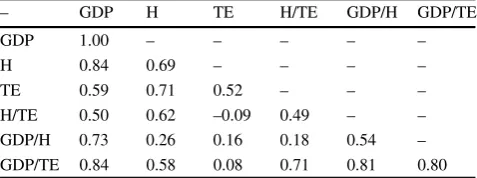
We conduct a cyclical analysis of working hours and re-lated measures in Germany. More precisely, we investigate the fluctuations of seasonally adjusted per capita labour in-put and productivity around their long-run trends, assessing the size of such fluctuations as well as their co-movements with real GDP and among each other. Summary statis-tics of this kind are of vital importance for the empirical assessment and calibration of business cycle models. At the same time, they allow cross-country comparisons of cyclical labour market behaviour and an identification of changes in the dynamic properties. To make the outcomes comparable with previous studies, we use the method of Hodrick and Prescott (1997) to subtract the trend from the logarithmic series. The standard smoothing parameter for quarterly data,D 1600, is applied. The results of Oha-nian and Raffo (2012) serve as a benchmark for interna-tional comparisons. There, the AZR data before the major revision enter the assessments, which are mostly aggregated over EU countries.
Table 4 gives summary results for the series of real GDP, labour volume (H), total persons employed (TE), hours worked per person employed (H/TE), productivity per hour (GDP/H) and productivity based on persons employed (GDP/TE) for quarterly data from 1991Q1 to 2014Q4. The main diagonal shows the standard deviation of the trend adjusted series relative to the volatility of GDP.