R E S E A R C H
Open Access
A simple method for plasma total vitamin C
analysis suitable for routine clinical
laboratory use
Line Robitaille and L. John Hoffer
*Abstract
Background:In-hospital hypovitaminosis C is highly prevalent but almost completely unrecognized. Medical awareness of this potentially important disorder is hindered by the inability of most hospital laboratories to determine plasma vitamin C concentrations. The availability of a simple, reliable method for analyzing plasma vitamin C could increase opportunities for routine plasma vitamin C analysis in clinical medicine.
Methods:Plasma vitamin C can be analyzed by high performance liquid chromatography (HPLC) with electrochemical (EC) or ultraviolet (UV) light detection. We modified existing UV-HPLC methods for plasma total vitamin C analysis (the sum of ascorbic and dehydroascorbic acid) to develop a simple, constant-low-pH sample reduction procedure followed by isocratic reverse-phase HPLC separation using a purely aqueous low-pH non-buffered mobile phase. Although EC-HPLC is widely recommended over UV-HPLC for plasma total vitamin C analysis, the two methods have never been directly compared. We formally compared the simplified UV-HPLC method with EC-HPLC in 80 consecutive clinical samples.
Results:The simplified UV-HPLC method was less expensive, easier to set up, required fewer reagents and no pH adjustments, and demonstrated greater sample stability than many existing methods for plasma vitamin C analysis. When compared with the gold-standard EC-HPLC method in 80 consecutive clinical samples exhibiting a wide range of plasma vitamin C concentrations, it performed equivalently.
Conclusion:The easy set up, simplicity and sensitivity of the plasma vitamin C analysis method described here could make it practical in a normally equipped hospital laboratory. Unlike any prior UV-HPLC method for plasma total vitamin C analysis, it was rigorously compared with the gold-standard EC-HPLC method and performed equivalently. Adoption of this method could increase the availability of plasma vitamin C analysis in clinical medicine.
Keywords:Ascorbic acid, Ascorbic acid deficiency, Avitaminosis, Dehydroascorbic acid, Malnutrition, Vitamin C
Background
The disease of terminal vitamin C deficiency–scurvy– is first suspected on clinical grounds. The diagnosis is confirmed by documenting a plasma vitamin C concen-tration < 11.4 μmol/L and observing prompt clinical im-provement after appropriate vitamin C provision [1, 2]. Scurvy is rare in the modern world, but hypovitamino-sis C (plasma vitamin C concentration < 28.4 μmol/L [3]) or marginal vitamin C deficiency (plasma vitamin C
concentration < 28.4 μmol/L but > 11.4μmol/L [3]) is not. Hypovitaminosis C occurs in ~ 10 % of the general popula-tion [4], in ~ 30 % of cigarette smokers [5, 6] and ~ 60 % of acutely hospitalized patients [7–14], in whom it could contribute to fatigue and mood disturbance [13–15], im-mune system dysfunction [7, 16, 17], impaired wound healing [18–20], the complex regional pain syndrome [21] and the complications of cardiovascular disease [22–26].
Vitamin C distributes rapidly throughout the body’s extra-cellular fluids. Systemic inflammation and intravenous fluid therapy increase the body’s extracellular fluid volume, with resultant lowering of the concentration of vitamin * Correspondence:[email protected]
Lady Davis Institute for Medical Research and Department of Medicine, McGill University and Jewish General Hospital, 3755 Cote Sainte Catherine, Montreal, QC H3T 1E2, Canada
C in the bloodstream [27–29]. In-hospital hypovitaminosis C is not solely a phenomenon of extravascular redistribu-tion, however [12, 29, 30]. Systemic inflammation ignites an oxidative process that accelerates cellular vitamin C uptake and catabolism and increases its nutritional requirement
[31–33]. The best-studied human example of this
phenomenon is cigarette smoking [20, 34, 35], which accel-erates vitamin C catabolism [35], lowers its plasma and tis-sue concentrations [36, 37] and increases its nutritional requirement [6, 34]. The depleted plasma vitamin C con-centration of cigarette smokers can be re-normalized either by smoking cessation [38] or vitamin C supplementation [34], both of which decrease circulating concentrations of the biomarkers of oxidative stress [39, 40]. Acutely hospi-talized patients experience inflammatory-oxidative stresses that are much greater than the stress caused by cigarette smoke. A combined history of inadequate vitamin C intake and systemic inflammation strongly predicts hypovitami-nosis C [10, 11, 41, 42].
The high prevalence, potentially serious adverse conse-quences and easy preventability of in-hospital hypovitami-nosis C would normally motivate vigorous investigation of its clinical implications, especially since small randomized clinical trials of vitamin C supplementation in vitamin C-deficient patients suggest clinical benefit [7, 14, 43]. How-ever, much greater physician awareness and many more clinical trials would be required to change the current bias of medical practice, which is to avoid prescribing vitamin C supplements even to patients whose dietary intake is in-adequate and who are likely to be vitamin C-deficient.
It is a barrier to medical awareness of in-hospital hypovitaminosis C that very few clinical laboratories are equipped to detect it. Shipment of samples to reference laboratories is problematic because vitamin C is notori-ously unstable, requiring rapid plasma stabilization and continuous storage at -80o C [44, 45]. We attempted to surmount this barrier by developing a simple, accurate, robust and inexpensive plasma vitamin C method that could easily be set up and taken down in any normally equipped clinical laboratory.
The most sensitive and selective method for plasma vitamin C analysis uses high-pressure liquid chromatog-raphy (HPLC) coupled to an electrochemical (EC) detector [46–57]. EC-HPLC is invaluable in the research laboratory, but it requires costly, dedicated, high-maintenance equipment operated by specifically trained technicians. HPLC methods that require only an ordinary UV light detector are available [49, 51, 52, 56, 58–68] but their practicality in a non-specialized clinical laboratory is limited by a variety of characteristics: complicated mobile phase compositions with appreciable preparation and col-umn conditioning times, dedicated colcol-umns, and compli-cated procedures to reduce dehydroascorbic acid to ascorbic acid in order to analyze total vitamin C, or
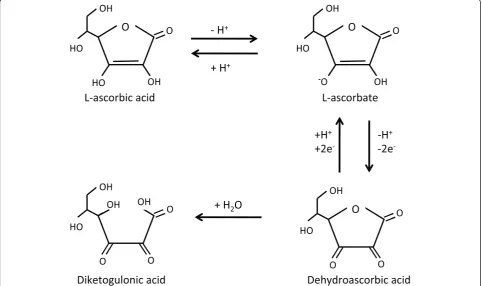
inability to measure total vitamin C at all. Vitamin C con-sists of ascorbic acid and its redox partner, dehydroascor-bic acid. The generic terms are used here, acknowledging that at physiological pH ascorbic acid is almost completely ionized and hence more correctly termed ascorbate (see Fig. 1). We incorporated recent improvements in food vitamin C analysis [69, 70] to develop a streamlined UV-HPLC plasma vitamin C analysis that is simple, sensitive and accurate enough for use in any normally equipped clinical laboratory.
EC-HPLC is commonly recommended as the method of choice for plasma vitamin C analysis [46, 49, 51, 56, 57], but no direct comparison of EC-HPLC and UV-HPLC methods for plasma total vitamin C have been re-ported. We therefore formally compared the simplified UV-HPLC method with EC-HPLC in 80 consecutive clin-ical samples.
Methods
Sample acquisition, handling, and storage
Venous blood (4 mL) was drawn into a 4 mL K2EDTA
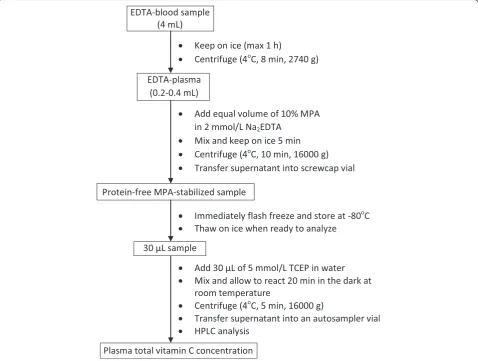
Vacutainer tube, mixed and immediately pushed into crushed ice and delivered to the laboratory for process-ing within one hour, as previously described [13, 14]. The plasma was separated in a refrigerated centrifuge (4o C, 8 min, 2740 g) after which 0.2–0.4 mL of the resulting supernatant was immediately added to an equal volume of 10 % (w/v) metaphosphoric acid (MPA) in 2 mmol/L disodium EDTA, left on ice for 5 min, and cold-centrifuged (4oC, 10 min, 16,000 g) as described by Lykkesfeldt [55]. The resulting protein-free acid super-natant was immediately flash-frozen in dry ice/ethanol and stored continuously at -80o C until analysis either by EC- or UV-HPLC.
EC-HPLC
The EC-HPLC method used to analyze ascorbic acid was closely similar to that of Levine, Wang and Rumsey [53]. Total vitamin C was analyzed using the sample re-duction procedure described by Lykkesfedlt [54, 55]. We have used these reliable methods in our research labora-tory for several years [13, 14, 71].
The analytical system consisted of an Agilent 1100 series HPLC system equipped with a Coulochem III electrochemical detector (ESA Inc) and a 5011A analyt-ical cell. Electrode 1 was set to -175 mV, detector range 500 nA, and electrode 2 was set at 550 mV, detection
range 50 μA. The HPLC column was a reverse phase
chloride and 36.6μmol/L tetraoctylammonium bromide, adjusted to pH 4.8 using orthophosphoric acid. The flow rate was 0.8 ml/min (isocratic). Retention times varied between 6 and 8 min depending on the extent of column conditioning. At the time of analysis, acidic protein-free plasma samples were thawed on ice in dim light and processed in two aliquots. To measure ascorbic acid, 50 μL of sample was mixed with 200 μL of water. The analysis of total vitamin C (ascorbic acid plus dehydroas-corbic acid) required a reduction reaction in which 50 μL of sample was mixed with 25 μL of 2.5 mmol/L tris(2-carboxy ethyl) phosphine hydrochloride (TCEP) in 800 mmol/L TRIS buffer (pH 9) and allowed to stand in the dark for 5 min, after which 175μL McIlvaine buffer (0.28 mol/L citric acid in 0.56 mol/L dibasic sodium phosphate, pH 4.5) was added. Both aliquots were cen-trifuged (4o C, 5 min, 16,000 g) and the supernatants kept on ice and manually injected (20 μL) into the HPLC. At the end of each day’s sample run, the system was flushed with 25 % methanol in water in order to elute the buffers, but not so extensively as to affect ion-pairing conditions and alter analyte retention times.
The HPLC column required regeneration at 3–4
month intervals. The EC device was passivated with strong acid at 6–12 month intervals. These procedures required re-equilibration of the column and system, a process lasting a day or longer.
UV-HPLC
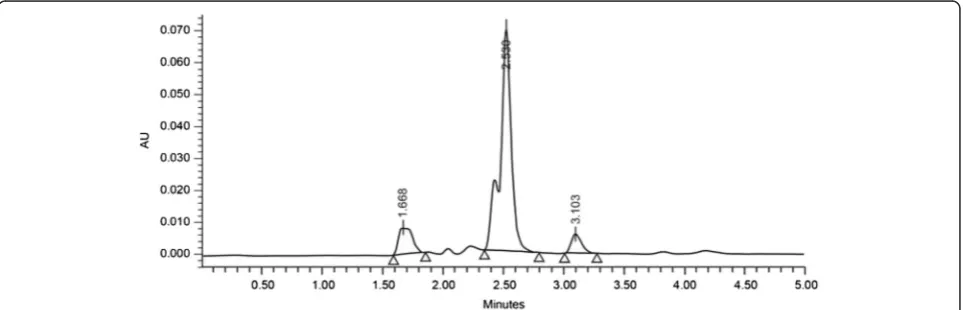
The analysis was carried out using a Waters 2695 Separa-tions Module equipped with a Waters 2487 dual wave-length UV detector set to 245 nm. The column was a reverse phase Agilent Zorbax Eclipse XDB-C18 (4.6 x 150 mm, 3.5μm) fitted with an Agilent Eclipse XDB-C18 guard column. The column temperature was maintained at 25oC. The mobile phase consisted of 1.8 mmol/L sul-furic acid (pH 2.7). The flow rate was 0.8 mL/min. The re-tention time was 3 min. There was a 7 min delay between injections to allow the uric acid peak to elute (5–6 min).
Zero-degree thawed samples were divided into two aliquots of 30 μL in 0.6 mL plastic Eppendorf tubes. To measure total vitamin C, an equal volume of 5 mmol/L TCEP in water (pH 2) was added and the sample allowed to react for 20 min at room temperature in the dark. To
measure ascorbic acid, an equal volume of water was added instead of TCEP and the sample kept on ice. Both samples were then centrifuged (4oC, 5 min, 16,000 g) and the supernatants kept on ice and transferred to autoinjec-tion vials and either injected immediately onto the HPLC column (injection volume 20 μL) or kept in the refriger-ated auto-sampler for up to 4 h. At the end of the day’s sample run, the system was rinsed with 40 % acetonitrile in water to remove the acidic mobile phase and any po-tential sample contaminants. Figure 2 summarizes the sample procedure for total vitamin C analysis.
For both methods, a standard curve was developed by using a peak areas linear regression equation from six ascorbic acid standards made up in MPA/EDTA ranging in concentration from 0 to 100 μmol/L. Each sample run included a plasma quality control sample.
Patients
The UV-HPLC and EC-HPLC methods were used to analyze ascorbic acid and total vitamin C in plasma samples obtained
from 80 consecutive clinical samples from patients attending an out-patient oncology clinic and enrolled in a study to evaluate their nutritional status. The protocol for that study was approved by the Research Ethics Committee of the Jewish General Hospital (clinicaltrials.gov registration #NCT01631526); its results will be reported separately.
Statistical analysis
Statistical analyses were performed using Graph Pad Prism Version 5.01.
Results
Validation of the UV-HPLC method
A range of TCEP concentrations and reaction times was tested to verify the effectiveness of the sample reduction procedure described above, namely, 20 min incubation using 5 mmol/L TCEP at pH 2. Extension of the TCEP incubation period to 40 min left the results unchanged. The UV absorbance signal was linear both within the usual physiological range (5–100 μmol/L) and higher
(r2> 0.99). Sample spiking experiments within the physio-logical range (addition of 25 and 50μmol/L known ascor-bic acid to plasma samples with a concentration of 37 μmol/L) yielded total vitamin C recoveries of 106 % and 100 % respectively. The identity and specificity of the ascorbic acid chromatographic peak was verified by treat-ing plasma samples withascorbate oxidaseand document-ing complete disappearance of the ascorbic acid peak without any other change in the chromatogram.
The stability of MPA-stabilized samples (for the
ascor-bic acid measurement) and TCEP-reduced
MPA-stabilized samples (for the total vitamin C measurement) were assessed by allowing them to remain in the HPLC autosampler at 4oC for up to 4 h prior to on-column in-jection (samples are normally injected within one hour). The ascorbic acid signal for un-reduced samples (ascor-bic acid) decreased by 3–6 % after 4 h in the autosam-pler, whereas the signal for TCEP-reduced samples (total vitamin C) remained unchanged for at least 5 h. Figure 3 illustrates a typical UV-HPLC-derived chromatogram.
Comparison of EC-HPLC and UV-HPLC methods
A control plasma sample was re-analyzed on 10 different days, yielding coefficients of variation for the EC and UV methods of 4.5 % and 3.3 %, respectively (for total vitamin C analysis) and 5.3 % and 4.4 %, respectively (for ascorbic acid analysis). The concentrations (mean ± SD) were as follows: ascorbic acid 104 ± 5.5 μmol/L by EC-HPLC and 107 ± 4.7μmol/L by UV-HPLC; total vitamin C 106 ± 4.8 μmol/L by EC-HPLC and 110 ± 3.7μmol/L by UV-HPLC. The lower limit of signal quantization was 1.34 μmol/L with EC-HPLC and < 4.0μmol/L with UV-HPLC.
As shown in Table 1, plasma ascorbic acid and total vitamin C concentrations in 80 consecutive clinical
sam-ples determined by both methods ranged from 4–
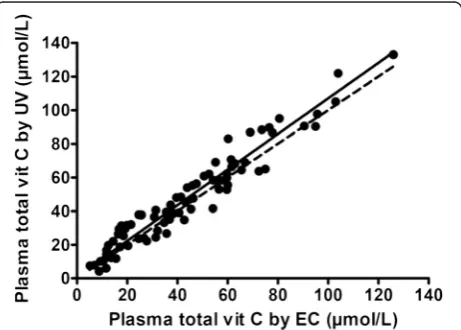
134μmol/L; the individual values were highly correlated (Spearman r = 0.96, P < 0.0001 both for ascorbic acid and total vitamin C). The Deming regression graph for total vitamin C is shown in Fig. 4. The 95 % confidence inter-val for the slope of the regression equation encompassed 1 (0.99–1.12) and the corresponding interval for the Y-intercept encompassed zero (-2.15–4.49), indicating that the concentrations reported by the different methods were equal and indistinguishable. There was similarly close agreement for the ascorbic acid analysis.
Even a very high correlation does not, in itself, provide sufficient evidence of acceptable agreement between two methods, so a Bland-Altman analysis was carried out to quantify any systematic difference between the two methods [72]. The resulting Bland-Altman plot is shown in Fig. 5. The mean difference (bias) between the EC and UV results was -3.70 μmol/L. Bland-Altman plots are generally interpreted informally and in the context of their clinical significance. For total vitamin C concen-trations < 28.4 μmol/L, which represented 24 % of the sample and are the ones of most clinical interest, the bias between the methods was -1.02μmol/L (not signifi-cantly different from zero).
Table 2 compares EC-HPLC as used in our laboratory, the three available UV-HPLC methods [59, 63, 64] for total vitamin C, and the UV-HPLC method described here regarding its use in an ordinary clinical laboratory.
Discussion
UV-HPLC analysis of vitamin C in biological fluids is not novel as a general procedure: it was first reported more than 40 years ago [73] and many variations have subsequently been published [49, 51, 52, 56, 58, 60–67]. However, a variety of methodological complexities and the inability, in all but a few of them [59, 63, 64], to
determine the clinically important analyte, total vitamin C, limit their usefulness in the clinical setting.
Total plasma vitamin C is the measurement of choice for two reasons: first, it indicates the total amount of vitamin C in the sample, and second, ascorbic acid can easily oxidize to dehydroascorbic acid in a busy clinical setting due to inadvertent and sometimes unavoidable delays or minor technical shortcomings in sample hand-ling or the analysis procedure. Indeed, there is some evi-dence that much or most dehydroascorbic acid detected in plasma may be artificially generated during sample handling and processing [49, 74]. Treatment of samples with an appropriate reducing agent helps prevent under-estimation of vitamin C concentrations (and hence over-diagnosis of hypovitaminosis C) due to minor vagaries in sample handling and processing [75]. It is a major ad-vantage of the present method that the sample reduction procedure is extremely simple and trouble-free.
The UV-HPLC method described here for plasma ascor-bic acid and total vitamin C analysis demonstrates highly acceptable sensitivity and reproducibility. It is especially notable for easy and rapid setup, analytical column condi-tioning, fewer reagents and sample manipulations than other comparable methods, and a very simple
constant-low-pH sample reduction procedure. The only instru-ments required are a reverse-phase HPLC column and pre-column and UV detector, standard equipment in hos-pital laboratories. Although these features are less import-ant in a dedicated research or reference laboratory, they make the method practical for use in an ordinary clinical laboratory.
The mobile phase is extremely simple, stable and iso-cratic. This type of mobile phase composition was previ-ously reported for analyzing vitamin C in green beans [69], but the procedure had to be modified to account for the much greater sensitivity required for plasma ana-lysis, plasma’s much higher protein concentration (which necessitates a high concentration of the deproteinizing acid) and the need to separate the analyte peak from uric acid. (In fact, the uric acid peak is so well separated that uric acid can be analyzed using this method [62, 66], but it provides no advantage over the automated analysis rou-tinely available in clinical laboratories.) The second major advantage of the present method is the use of the reducing agent TCEP at very low pH [70, 76], which allows extremely simple, trouble-free sample processing and analysis at constant low pH. Other methods for reducing dehydroascorbic acid to ascor-bic acid often involve multi-step and potentially error-prone pH adjustments, perhaps contributing to the
Table 1Plasma ascorbic acid and total vitamin C concentrations (μmol/L) as measured by EC-HPLC and UV-HPLC in 80 consecutive patient samples
EC-HPLC UV-HPLC
Ascorbic acid Mean ± SD 39.1 ± 24.3 45.2 ± 27.6
Median (interquartile range) 35.3 (17.1-53.5) 38.1 (25.0-60.0)
Range 5.80-117 4.10-134
Total vitamin C Mean ± SD 43.3 ± 26.3 47.0 ± 27.8
Median (interquartile range) 39.0 (20.0-59.9) 40.0 (26.5-63.3)
Range 5 - 126 4 - 133
Fig. 4Correlation between the electrochemical (EC) and ultraviolet (UV) detection methods in 80 consecutive clinical samples. The solid line represents the Deming regression line. The dashed line is the line of identity
known problem of inter-laboratory variability in results re-ported with this analysis [44].
The present method agreed closely with the gold-standard method, EC-HPLC. The Bland-Altman analysis indicated that, on average, plasma total vitamin C con-centrations are 3.7μmol/L higher with the UV method. This small bias did not exist for concentrations below the lower limit of the normal range, 28.4μmol/L, which are of greatest clinical interest. It is indeterminate whether the UV method slightly over-estimates plasma vitamin C concentrations or the EC method slightly un-derestimates them. This formal comparison between UV and EC vitamin C detection methods was made on 80 consecutive clinical samples with no samples excluded.
EC-HPLC is widely recommended over UV-HPLC for plasma vitamin C analysis [46, 49, 51, 56], but direct evi-dence that supports this recommendation is unavailable. The only previous direct comparison of EC-HPLC with UV-HPLC was with regard to ascorbic acid rather than total vitamin C, it was based on only 27 samples from healthy individuals, and it lacked a Bland-Altman ana-lysis [52]. Nevertheless, the close agreement that was re-ported between EC and UV detection of ascorbic acid, even at low plasma concentrations, is consistent with our observations regarding total plasma vitamin C con-centrations in a much larger number of consecutive clin-ical samples.
A very recent article describes a UV-HPLC method for simultaneously determining ascorbic acid and dehy-droascorbic acid in human plasma [68]. The applicability of this method to clinical medicine seems doubtful,
because its lower limits of detection for ascorbic acid (11.4μmol/L) and dehydroascorbic acid (57μmol/L) are well above the range of clinical interest. Moreover, it in-dicates a normal plasma dehydroascorbic acid concentra-tion of ~ 50μmol/L [68], despite the heavy preponderance of evidence that plasma dehydroascorbic acid concentra-tions seldom exceed 5 μmol/L [77] and under optimum handling and processing conditions are usually close to zero [74].
The UV-HPLC method described here has limitations. We used a standard reverse phase HPLC column (and precolumn) which demonstrated excellent performance for more than 1 year during which a large numbers of samples were injected onto it. In situations in which large numbers of samples are analyzed, polymeric or polar embedded reverse phase columns could be consid-ered, for they are more resistant to long-term degrad-ation caused by a completely aqueous, highly acidic mobile phase [56]. Another potential problem is a greater chance of interference by exogenous molecules than EC-HPLC [51, 56]. This problem has not been re-ported during 30 years of UV-based plasma vitamin C analysis, but hospitalized patients receive many different drugs. Plasma vitamin C concentrations could be overes-timated if a small exogenous molecule absorbed UV light at 245 nm and eluted from the HPLC column at precisely the same time as ascorbic acid.
Conclusion
In-hospital hypovitaminosis C is highly prevalent, poten-tially serious, and easily preventable, but most physicians
Table 2Comparison of HPLC methods for total plasma vitamin C analysis
ECa Other UV methodsb Present UV method
Equipment
Availability Limited Wide Wide
Cost High Moderate Moderate
Maintenance Complex, lengthy Simple Simple
Separation column Dedicated ion-pairing Reverse phase or ion-pairing Reverse phase
Number of reagents 14 3-6 4
Reagent preparation time (h) 4 1.5 1
Number of proceduresc 7 4-6 4
Number of pH adjustments 3 0-2 0
Time prior to sample injection (h)d 4-5 2-3 2
Chromatographic run time (min) 8 2-16 6
pH
Mobile phase 4.8 4.5-5.7 2.7
Low pH throughout procedure No No Yes
a
As described in the Methods section b
As described in [59,63,64] c
Preparation of reagents and mobile phase, pH adjustments and sample handling d
remain unaware of it. The unavailability of simple and reliable plasma vitamin C determinations in hospitalized patients creates a barrier to medical awareness and in-vestigation of this potentially important phenomenon. We describe a method that fulfills these requirements by making technical improvements to existing UV-HPLC procedures and demonstrating that the resulting method performs equivalently to the gold-standard method, EC-HPLC.
Competing interests
The authors declare that they have no competing interests.
Authors’contributions
LR conceived of the project and developed the method in collaboration with LJH. Both authors contributed equally to the validation strategy, analysis and interpretation of the results and preparation of the manuscript. Both authors read and approved the final manuscript.
Funding
This research was funded in part by a grant from the Lotte and John Hecht Memorial Foundation and internal funds from McGill University.
Received: 23 February 2016 Accepted: 13 April 2016
References
1. Crandon JH, Landau B, Mikal S, Balmanno J, Jefferson M, Mahoney BS. Ascorbic acid economy in surgical patients as indicated by blood ascorbic acid levels. N Engl J Med. 1958;258:105–13.
2. Zipursky JS, Alhashemi A, Juurlink D. A rare presentation of an ancient disease: scurvy presenting as orthostatic hypotension. BMJ Case Rep. 2014; 2014. doi:10.1136/bcr-2013-201982:1-3.
3. Lykkesfeldt J, Poulsen HE. Is vitamin C supplementation beneficial? Lessons learned from randomised controlled trials. Br J Nutr. 2010;103:1251–9. 4. Lindblad M, Tveden-Nyborg P, Lykkesfeldt J. Regulation of vitamin C
homeostasis during deficiency. Nutrients. 2013;5:2860–79.
5. Schectman G, Byrd JC, Hoffmann R. Ascorbic acid requirements for smokers: analysis of a population survey. Am J Clin Nutr. 1991;53:1466–70. 6. Pfeiffer CM, Sternberg MR, Schleicher RL, Rybak ME. Dietary supplement use
and smoking are important correlates of biomarkers of water-soluble vitamin status after adjusting for sociodemographic and lifestyle variables in a representative sample of U.S. adults. J Nutr. 2013;143:957S–65S. 7. Hunt C, Chakravorty NK, Annan G, Habibzadeh N, Schorah CJ. The clinical
effects of vitamin C supplementation in elderly hospitalised patients with acute respiratory infections. Int J Vitam Nutr Res. 1994;64:212–9.
8. Teixeira A, Carrie AS, Genereau T, Herson S, Cherin P. Vitamin C deficiency in elderly hospitalized patients. Am J Med. 2001;111:502.
9. Fain O, Paries J, Jacquart B, Le Moel G, Kettaneh A, Stirnemann J, et al. Hypovitaminosis C in hospitalized patients. Eur J Intern Med. 2003;14:419–25. 10. Gariballa S, Forster S. Effects of acute-phase response on nutritional status
and clinical outcome of hospitalized patients. Nutrition. 2006;22:750–7. 11. Gan R, Eintracht S, Hoffer LJ. Vitamin C deficiency in a university teaching
hospital. J Am Coll Nutr. 2008;27:428–33.
12. Evans-Olders R, Eintracht S, Hoffer LJ. Metabolic origin of hypovitaminosis C in acutely hospitalized patients. Nutrition. 2009;26:1070–4.
13. Zhang M, Robitaille L, Eintracht S, Hoffer LJ. Vitamin C provision improves mood in acutely hospitalized patients. Nutrition. 2011;27:530–3. 14. Wang Y, Liu XJ, Robitaille L, Eintracht S, Macnamara E, Hoffer LJ. Effects of
vitamin C and vitamin D administration on mood and distress in acutely hospitalized patients. Am J Clin Nutr. 2013;98:705–11.
15. Crandon JH, Lund CC, Dill DB. Experimental human scurvy. N Engl J Med. 1940;233:353–69.
16. Anthony HM, Schorah CJ. Severe hypovitaminosis C in lung-cancer patients: the utilization of vitamin C in surgical repair and lymphocyte-related host resistance. Br J Cancer. 1982;46:354–67.
17. Hemila H, Louhiala P. Vitamin C may affect lung infections. J Royal Soc Med. 2007;100:495–8.
18. Lund CC, Crandon JH. Ascorbic acid and human wound healing. Ann Surg. 1941;114:776–90.
19. Blass SC, Goost H, Burger C, Tolba RH, Stoffel-Wagner B, Stehle P, et al. Extracellular micronutrient levels and pro-/antioxidant status in trauma patients with wound healing disorders: results of a cross-sectional study. Nutr J. 2013;12:157.
20. Sorensen LT, Toft BG, Rygaard J, Ladelund S, Paddon M, James T, et al. Effect of smoking, smoking cessation, and nicotine patch on wound dimension, vitamin C, and systemic markers of collagen metabolism. Surgery. 2010;148:982–90.
21. Shibuya N, Humphers JM, Agarwal MR, Jupiter DC. Efficacy and safety of high-dose vitamin C on complex regional pain syndrome in extremity trauma and surgery–systematic review and meta-analysis. J Foot Ankle Surg. 2013;52:62–6.
22. Vita JA, Keaney Jr JF, Raby KE, Morrow JD, Freedman JE, Lynch S, et al. Low plasma ascorbic acid independently predicts the presence of an unstable coronary syndrome. J Am Coll Cardiol. 1998;31:980–6.
23. Padayatty SJ, Levine M. Vitamin C and myocardial infarction: the heart of the matter. Am J Clin Nutr. 2000;71:1027–8.
24. Juraschek SP, Guallar E, Appel LJ, Miller III ER. Effects of vitamin C supplementation on blood pressure: a meta-analysis of randomized controlled trials. Am J Clin Nutr. 2012;95:1079–88.
25. Rodrigo R, Korantzopoulos P, Cereceda M, Asenjo R, Zamorano J, Villalabeitia E, et al. A randomized controlled trial to prevent post-operative atrial fibrillation by antioxidant reinforcement. J Am Coll Cardiol. 2013;62: 1457–65.
26. Frei B, Birlouez-Aragon I, Lykkesfeldt J. Authors’perspective: What is the optimum intake of vitamin C in humans? Crit Rev Food Sci Nutr. 2012;52: 815–29.
27. Marcus SL, Petrylak DP, Dutcher JP, Paietta E, Ciobanu N, Strauman J, et al. Hypovitaminosis C in patients treated with high-dose interleukin 2 and lymphokine-activated killer cells. Am J Clin Nutr. 1991;54:1292S–7S. 28. Schorah CJ, Downing C, Piripitsi A, Gallivan L, Al-Hazaa AH, Sanderson MJ,
et al. Total vitamin C, ascorbic acid, and dehydroascorbic acid concentrations in plasma of critically ill patients. Am J Clin Nutr. 1996;63: 760–5.
29. Wilson JX. Mechanism of action of vitamin C in sepsis: ascorbate modulates redox signaling in endothelium. Biofactors. 2009;35:5–13.
30. Fowler III AA, Syed AA, Knowlson S, Sculthorpe R, Farthing D, DeWilde C, et al. Phase I safety trial of intravenous ascorbic acid in patients with severe sepsis. J Transl Med. 2014;12:32.
31. Weitzel LR, Mayles WJ, Sandoval PA, Wischmeyer PE. Effects of pharmaconutrients on cellular dysfunction and the microcirculation in critical illness. Curr Opin Anaesthesiology. 2009;22:177–83.
32. Fukushima R, Yamazaki E. Vitamin C requirement in surgical patients. Curr Opin Clin Nutr Metab Care. 2010;13:669–76.
33. Giladi AM, Dossett LA, Fleming SB, Abumrad NN, Cotton BA. High-dose antioxidant administration is associated with a reduction in post-injury complications in critically ill trauma patients. Injury. 2011;42:78–82. 34. Lykkesfeldt J, Christen S, Wallock LM, Chang HH, Jacob RA, Ames BN.
Ascorbate is depleted by smoking and repleted by moderate
supplementation: a study in male smokers and nonsmokers with matched dietary antioxidant intakes. Am J Clin Nutr. 2000;71:530–6.
35. Northrop-Clewes CA, Thurnham DI. Monitoring micronutrients in cigarette smokers. Clin Chim Acta. 2007;377:14–38.
36. Bui MH, Sauty A, Collet F, Leuenberger P. Dietary vitamin C intake and concentrations in the body fluids and cells of male smokers and nonsmokers. J Nutr. 1992;122:312–6.
37. Tsuchiya M, Asada A, Kasahara E, Sato EF, Shindo M, Inoue M. Smoking a single cigarette rapidly reduces combined concentrations of nitrate and nitrite and concentrations of antioxidants in plasma. Circulation. 2002;105: 1155–7.
38. Lykkesfeldt J, Prieme H, Loft S, Poulsen HE. Effect of smoking cessation on plasma ascorbic acid concentration. BMJ. 1996;313:91.
39. Kuiper HC, Langsdorf BL, Miranda CL, Joss J, Jubert C, Mata JE, et al. Quantitation of mercapturic acid conjugates of hydroxy-2-nonenal and 4-oxo-2-nonenal metabolites in a smoking cessation study. Free Rad Biol Med. 2010;48:65–72.
41. Langlois M, Duprez D, Delanghe J, De Buyzere M, Clement DL. Serum vitamin C concentration is low in peripheral arterial disease and is associated with inflammation and severity of atherosclerosis. Circulation. 2001;103:1863–8.
42. Sanchez-Moreno C, Dashe JF, Scott T, Thaler D, Folstein MF, Martin A. Decreased levels of plasma vitamin C and increased concentrations of inflammatory and oxidative stress markers after stroke. Stroke. 2004;35:163–8. 43. Hunt C, Chakravorty NK, Annan G. The clinical and biochemical effects of
vitamin C supplementation in short-stay hospitalized geriatric patients. Int J Vitam Nutr Res. 1984;54:65–74.
44. Bates CJ. Plasma vitamin C assays: a European experience. EC FLAIR Concerted Action No. 10: Micronutrient Measurement, Absorption and Status. Int J Vitam Nutr Res. 1994;64:283–7.
45. Hoffer LJ. Re:“Vitamin C deficiency in a population of young Canadian adults”. Am J Epidemiol. 2010;171:387–8.
46. Pachla LA, Kissinger PT. Analysis of ascorbic acid by liquid chromatography with amperometric detection. Methods Enzymol. 1979;62:15–24. 47. Kutnink MA, Hawkes WC, Schaus EE, Omaye ST. An internal standard method
for the unattended high-performance liquid chromatographic analysis of ascorbic acid in blood components. Anal Biochem. 1987;166:424–30. 48. Behrens WA, Madere R. A highly sensitive high-performance liquid
chromatography method for the estimation of ascorbic and
dehydroascorbic acid in tissues, biological fluids, and foods. Anal Biochem. 1987;165:102–7.
49. Margolis SA, Davis TP. Stabilization of ascorbic acid in human plasma, and its liquid-chromatographic measurement. Clin Chem. 1988;34:2217–23. 50. Nagy E, Degrell I. Determination of ascorbic acid and dehydroascorbic acid
in plasma and cerebrospinal fluid by liquid chromatography with electrochemical detection. J Chromatogr A. 1989;497:276–81.
51. Washko PW, Welch RW, Dhariwal KR, Wang Y, Levine M. Ascorbic acid and dehydroascorbic acid analyses in biological samples. Anal Biochem. 1992; 204:1–14.
52. Liau LS, Lee BL, New AL, Ong CN. Determination of plasma ascorbic acid by high-performance liquid chromatography with ultraviolet and
electrochemical detection. J Chromatogr. 1993;612:63–70.
53. Levine M, Wang Y, Rumsey SC. Analysis of ascorbic acid and dehydroascorbic acid in biological samples. Methods Enzymol. 1999;299:65–76.
54. Lykkesfeldt J. Determination of ascorbic acid and dehydroascorbic acid in biological samples by high-performance liquid chromatography using subtraction methods: reliable reduction with tris[2-carboxyethyl]phosphine hydrochloride. Anal Biochem. 2000;282:89–93.
55. Lykkesfeldt J. Unit 7.6: measurement of ascorbic acid and dehydroascorbic acid in biological samples. Current Protocols in Toxicology, Supplement 12. 2002.7.6.1-7.6.15. Internet: http://mrw.interscience.wiley.com/emrw/ 9780471140856/cp/cptx/article/tx0706/current/pdf.
56. Novakova L, Solich P, Solichova D. HPLC methods for simultaneous determination of ascorbic and dehydroascorbic acids. Trends Anal Chem. 2008;27:942–58.
57. Li X, Franke AA. Fast HPLC-ECD analysis of ascorbic acid, dehydroascorbic acid and uric acid. J Chromatogr B Analyt Technol Biomed Life Sci. 2009; 877:853–6.
58. Rose RC, Nahrwold DC. Quantitative analysis of ascorbic acid and dehydroascorbic acid by high-pressure liquid chromatography. Anal Biochem. 1981;114:140–5.
59. Schreiber J, Lohmann W, Unverzagt D, Otten A. Determination of ascorbic acid, dehyroascorbic acid, and isoascorbic acid in blood. Fresenius’Z Anal Chem. 1986;325:473–5.
60. Ziegler SJ, Meier B, Sticher O. Rapid and sensitive determination of dehydroascorbic acid in addition to ascorbic acid by reversed-phase high-performance liquid chromatography using a post-column reduction system. J Chromatogr A. 1987;391:419–26.
61. Manoharan M, Schwille PO. Measurement of ascorbic acid in human plasma and urine by high-performance liquid chromatography. Results in healthy subjects and patients with idiopathic calcium urolithiasis. J Chromatogr B Biomed Appl. 1994;654:134–9.
62. Ross MA. Determination of ascorbic acid and uric acid in plasma by high-performance liquid chromatography. J Chromatogr B Biomed Appl. 1994; 657:197–200.
63. Esteve MJ, Farre R, Frigola A, Garcia-Cantabella JM. Determination of ascorbic and dehydroascorbic acids in blood plasma and serum by liquid chromatography. J Chromatogr B Biomed Sci Appl. 1997;688:345–9.
64. Karlsen A, Blomhoff R, Gundersen TE. High-throughput analysis of vitamin C in human plasma with the use of HPLC with monolithic column and UV-detection. J Chromatogr B Analyt Technol Biomed Life Sci. 2005;824:132–8. 65. Karlsen A, Blomhoff R, Gundersen TE. Stability of whole blood and plasma
ascorbic acid. Eur J Clin Nutr. 2007;61:1233–6.
66. Ferin R, Pavao ML, Baptista J. Rapid, sensitive and simultaneous
determination of ascorbic and uric acids in human plasma by ion-exclusion HPLC-UV. Clin Biochem. 2013;46:665–9.
67. Kand’ar R, Zakova P. Determination of ascorbic acid in human plasma with a view to stability using HPLC with UV detection. J Sep Sci. 2008;31:3503–8. 68. Kim Y, Ha N, Kim MG. Simultaneous determination of L-ascorbic acid and
dehydroascorbic acid in human plasma. Anal Methods. 2015;7:9206–10. 69. Sanchez-Mata MC, Camara-Hurtado M, Diez-Marques C, Torija-Isasa ME.
Comparison of high-performance liquid chromatography with
spectrofluorimetry for vitamin C analysis of green beans (Phaseolus vulgaris L). Eur Food Res Technol. 2000;210:220–5.
70. Chebrolu KK, Jayaprakasha GK, Yoo KS, Jifon JL, Patil BS. An improved sample preparation method for quantification of ascorbic acid and dehydroascorbic acid by HPLC. Food Sci Technol. 2012;47:443–9. 71. Hoffer LJ, Robitaille L, Zakarian R, Melnychuk D, Kavan P, Agulnik J, et al.
High-dose intravenous vitamin C combined with cytotoxic chemotherapy in patients with advanced cancer: a phase I-II clinical trial. PLoS ONE. 2015;10: e0120228.
72. Bland JM, Altman DG. Statistical methods for assessing agreement between two methods of clinical measurement. Lancet. 1986;1:307–10.
73. Bigler WN, Kelly DM. Liquid chromatographic analysis of ascorbate and ascorbate-2-sulfate. Ann N Y Acad Sci. 1975;258:70–1.
74. Dhariwal KR, Hartzell WO, Levine M. Ascorbic acid and dehydroascorbic acid measurements in human plasma and serum. Am J Clin Nutr. 1991;54:712–6. 75. Margolis SA, Duewer DL. Measurement of ascorbic acid in human plasma
and serum: stability, intralaboratory repeatability, and interlaboratory reproducibility. Clin Chem. 1996;42:1257–62.
76. Wechtersbach L, Cigic B. Reduction of dehydroascorbic acid at low pH. J Biochem Biophys Methods. 2007;70:767–72.
77. Margolis SA, Ziegler RG, Helzlsouer KJ. Ascorbic and dehydroascorbic acid measurement in human serum and plasma. Am J Clin Nutr. 1991;54(Suppl): 1315S–8S.
• We accept pre-submission inquiries
• Our selector tool helps you to find the most relevant journal
• We provide round the clock customer support
• Convenient online submission
• Thorough peer review
• Inclusion in PubMed and all major indexing services
• Maximum visibility for your research
Submit your manuscript at www.biomedcentral.com/submit