R E S E A R C H
Open Access
The Korean undiagnosed diseases program:
lessons from a one-year pilot project
Soo Yeon Kim
1†, Byung Chan Lim
1†, Jin Sook Lee
2†, Woo Joong Kim
1, Hyuna Kim
1, Jung Min Ko
3, Ki Joong Kim
1,
Sun Ah Choi
4, Hunmin Kim
4, Hee Hwang
4, Ji Eun Choi
5, Anna Cho
6, Jangsup Moon
7, Moon Woo Seong
8,
Sung Sup Park
8, Yun Jeong Lee
9, Young Ok Kim
10, Jon Soo Kim
11, Won Seop Kim
11, Young Se Kwon
12,
June Dong Park
13, Younjhin Ahn
14, Joo-Yeon Hwang
14, Hyun-Young Park
15, Youngha Lee
16, Murim Choi
1,16and
Jong-Hee Chae
1,17*Abstract
Background:The Korean Undiagnosed Diseases Program (KUDP) was launched in January 2017 as a one-year pilot project to address the increasing global interest in patients with undiagnosed rare diseases. The purpose of this paper is to summarize the project results and emphasize the unmet research needs among patients with undiagnosed rare diseases in Korea.
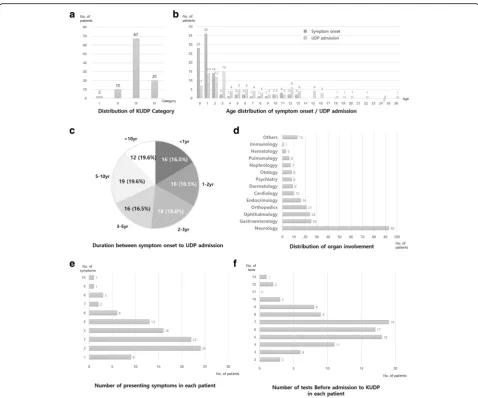
Results:Patient enrollment, assessment, and diagnostic processes were determined by the KUDP clinical expert consortium. Patients followed a diagnostic workflow after being categorized into one of four groups: I) insufficient clinical information or lack of standard diagnostic processes; II) undiagnosed due to low disease awareness; III) clinically diagnosed but unconfirmed genetically due to genetic heterogeneities; or IV) unknown disease due to complex, atypical clinical presentations. After excluding two patients from group I, 97 patients were enrolled, including 10 in group II, 67 in group III, and 20 in group IV. Most of them (92 of 97, 94.8%) were pediatric patients (< 18 years old) and 59 (60.8%) were male. The primary symptoms for 80 patients (82.5%) were neurologic. During the one-year pilot study, 72 patients completed a diagnostic assessment including clinical and molecular genetic analyses; some patients also underwent pathological or biochemical analysis. Twenty-eight of these patients (28/72, 38.9%) achieved molecular genetic diagnosis. Thirteen patients were diagnosed based on traditional tests, including biochemical assay, single or targeted genetic analysis, and chromosomal microarray. We performed whole exome sequencing on 52 patients, among whom 15 (28.8%, 15/52) reached a final diagnosis. One new disorder was identified via international collaboration. Conclusions:Using an efficient clinical diagnostic workflow, this KUDP pilot study resulted in a fair diagnostic success rate, improving the potential for additional diagnoses and new scientific discovery of complex and rare diseases. KUDP also satisfied unmet needs for rare diseases with multisystem involvement, highlighting the value of emerging genomic technologies for further research into rare and still-undiagnosed conditions.
Keywords:Rare disease, Undiagnosed disease program, Korea, Whole exome sequencing
© The Author(s). 2019Open AccessThis article is distributed under the terms of the Creative Commons Attribution 4.0 International License (http://creativecommons.org/licenses/by/4.0/), which permits unrestricted use, distribution, and reproduction in any medium, provided you give appropriate credit to the original author(s) and the source, provide a link to the Creative Commons license, and indicate if changes were made. The Creative Commons Public Domain Dedication waiver (http://creativecommons.org/publicdomain/zero/1.0/) applies to the data made available in this article, unless otherwise stated.
* Correspondence:[email protected]
†Soo Yeon Kim, Byung Chan Lim and Jin Sook Lee are equal first authors. 1Department of Pediatrics, Pediatric Clinical Neuroscience Center, Seoul
National University Children’s Hospital, Seoul National University College of Medicine, Seoul, Korea
17
Division of Pediatric Neurology, Department of Pediatrics, Pediatric Clinical Neuroscience Center, Seoul National University Children’s Hospital, Seoul National University College of Medicine, 101 Daehakro Jongno-gu, Seoul 110-744, Korea
Background
Rare disease (RD) is defined as one that affects fewer than 5 per 10,000 persons in the European Union (EU) or fewer than 200,000 persons in the United States (US). In Korea, the Rare Disease Act of 2016 defined RD as affecting fewer than 20,000 patients or for which the prevalence is unknown because of its rarity. There are countless RDs worldwide, with almost 8% of the general population suf-fering from a RD despite their relative rarity [1]. To date, more than 7000 RDs have been identified and their numbers have continued to increase, while there remain numerous unidentified diseases [2,3]. Patients with a RD can spend more than 5–6 years reaching a diagnosis, while many remain undiagnosed [4, 5]. These circumstances cause excessive medical costs and long-term social bur-dens, as well as loss of well-being among both patients and their families. Thus, undiagnosed RDs are a global chal-lenge that must be overcome.
Global networks, funds, and new technology develop-ment will be required to meet these goals. Fortunately, in-vestigations are improving through the use of advanced genetic technologies, including next-generation sequencing (NGS) and growing international collaboration. Many countries have initiated projects on undiagnosed RDs, including the Undiagnosed Diseases Program (UDP) by the US National Institutes of Health (NIH), the Solving the unsolved rare diseases (Solve-RD) program funded by the European Commission, the Finding of Rare Disease Genes (FORGE) project in Canada, and the Initiative on Rare and Undiagnosed Diseases (IRUD) project in Japan [4, 6–8]. While Undiagnosed Diseases Network International (UDNI) was established with international effort, UDP-WA in Australia was clinically implemented within the public health system in 2016 [9]. For several years, the Korea Na-tional Institute of Health (KNIH) of the Korea Centers for Disease Control and Prevention (KCDC) have supported the genetic diagnosis of patients with some RDs. Recently, the KNIH added to their supporting policy all “ undiag-nosed”or“unknown” RDs and launched KUDP. The first step in this process was a one-year pilot project starting in January 2017 to determine the Korean context for undiag-nosed patients and to plan a sustainable KUDP. Herein, we summarize the results of this one-year pilot project and emphasize the importance of a sustainable KUDP.
Methods
Study approval and preparation of the project
The pilot project was initiated and supported by the KNIH. Seoul National University Children’s Hospital functioned as the main center and supervised this process. Three re-gional hospitals were also involved to recruit and evaluate patients. The expert consortium consisted of more than 20 specialists covering nearly all divisions of pediatrics and re-lated departments, such as pediatric neurology, cardiology,
nephrology, hematology, surgery, as well as adult neur-ology, rheumatneur-ology, endocrinneur-ology, ophthalmneur-ology, otol-ogy, orthopedics, clinical genetics, laboratory medicine, and bioinformatics, across six institutes. Patients were en-rolled via two methods: a referral letter from local clini-cians, and by presenting directly to a central hospital clinic. Written informed consent for DNA preparation and de-tailed tests was obtained from all enrolled patients or their legal representatives. Procedures were approved by the In-stitutional Review Board (IRB) of Seoul National University Hospital (IRB No. 1101-110-353, 1406-081-588, 1511-099-722, 1408-010-599).
Diagnostic workflow
A total of 99 patients were referred for the study. All but two of these visited the central hospital. The others were referred by local clinicians via recruitment letter. The ex-pert consortium classified each patient into one of four groups: I) insufficient clinical information or lack of stand-ard diagnostic processes; II) undiagnosed due to low disease awareness; III) genetically undiagnosed due to genetic and clinical heterogeneities; or IV) unknown disease due to complex, atypical clinical presentations. Two patients who were referred by letter were classified into group I and could not be recruited into the project because of a lack of clinical information and standard evaluation for suspicious diagnoses. The remaining 97 patients were finally enrolled and underwent a serial diagnostic process based on deci-sions by the clinical expert consortium. The first-tier test included chromosomal microarray, enzyme assay, single-gene sequencing, and targeted multi-single-gene panel. Whole ex-ome sequencing (WES) was conducted as a first diagnostic test as well as a second-tier test, in some cases based on the decision of the expert consortium. Muscle biopsy was also performed in two patients with suspicious primary muscle disease. In cases undiagnosed after the first-tier test, the ex-pert consortium reviewed each one and decided on the next step, including performing a second-tier genetic test or connecting to nationwide and/or international scientific research networks. Detailed procedures, including DNA ex-traction, for each test have been previously described [10– 12].
Results
Patient characteristics
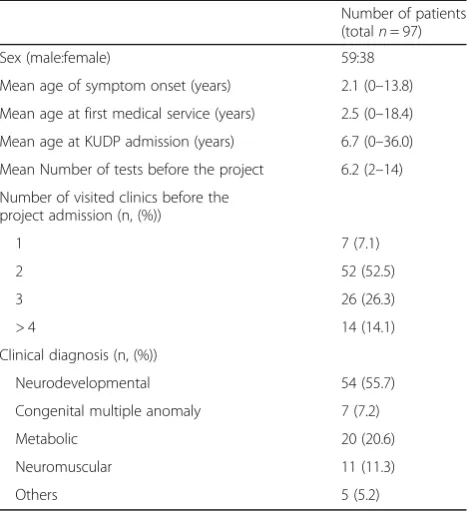
patients visited an average of 2.5 clinics, including 1.6 tertiary centers, such as university-based major medical centers, where they had an average of 6.2 types of tests (range 2–14). About 70% of patients (68 of 97) had one or more genetic tests, including chromosomal microarray, single gene sequencing, designed target gene panel se-quencing, and clinical exome sese-quencing, which uses the TruSight One Sequencing Panel to target more than 4800 genes associated with specific clinical phenotypes. Despite exhaustive diagnostic efforts, they remained undiagnosed for an average of 5.3 years (0–17.7 years). More than half of the patients (67/97, 69.1%) were classified into group III, 10 into group II, and 20 into group IV. More than 90% of these patients (93/97, 95.9%) complained of one or more neurologic manifestations, including developmental delay, intellectual disability, intractable seizures, involun-tary movements, or muscle weakness. All but nine pa-tients (88/97, 90.7%) had more than one presenting symptom in different organs: gastrointestinal problems in-cluding growth failure in 25 (25.8%); ophthalmologic symptoms in 24 (24.7%); and skeletal involvement in 21 (21.6%).
Diagnostic success rate
After KUDP admission, patients underwent individualized tests by stages. The overall schematic diagnostic process and its result are shown in Additional file 1: Figure S1. Among the 97 patients, 72 (74.2%) completed one or more diagnostic process and 28 (28/72, 38.9%) had confirmative diagnosis. Ten patients in group II had traditional tests,
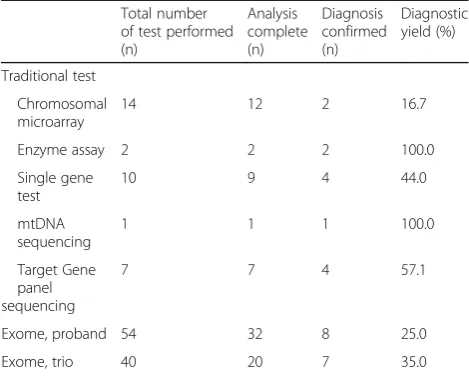
including single-gene sequencing, single enzyme assay, and multi-gene panel sequencing, based on clinical suspicions. Among these, eight patients (8/10, 80%) received confirma-tive diagnoses. In most cases, patients in groups III and IV had WES as their first- or second-tier tests, although five patients achieved a molecular diagnosis through traditional tests. Diagnostic yield according to each modality is de-scribed in Table2. Traditional tests, including biochemical assay, single or targeted genetic analysis, and chromosomal microarray, led to accurate molecular diagnosis in 13 of the 31 completely analyzed tests (41.9%). WES indicated 28.8% of the diagnostic yield: 25.0% for proband only and 35.0% for trio analysis. None of these patients had dual diagnoses. In addition, three candidate genes that had not been previously reported in human diseases were found. We initiated a functional study of one candidate gene and used web-based matchmaking tools for the other two [13]. Detailed genotypes and phenotypes for each case with genetic confirmation are described in Table3.
Illustrative cases
Ending the diagnostic odyssey
A 10-month-old girl admitted to KUDP initially presented with developmental delay from the age of 5 months. She had been seen at two different tertiary care neurology clinics and had undergone extensive testing, including re-peat brain magnetic resonance imaging (MRI), metabolic screening, and diagnostic exome sequencing. These com-prehensive evaluations failed to identify genetic defects, al-though she was identified as having developmental delay with brain malformation. After KUDP admission followed by reevaluation at an expert clinic, additional findings such as myopathic face and elevated serum CK level (6275 IU/L, normal range 20–270 IU/L) were identified. The expert consortium suspected alpha-dystroglycan-related congenital muscular dystrophy, including Fukuyama type, and fukutin gene analysis was performed. Compound heterozygous mu-tations inFKTN, c.165 + 835 T > G (deep intronic mutation, founder mutation in Korean population) and c.49A > C, were identified as a confirmative diagnosis [14].
In another case, a 12-month-old girl had been evaluated for developmental delay at two other tertiary hospitals. Brain MRI had revealed mild brain atrophy and delayed myelination, and laboratory tests including metabolic screening were unremarkable except for slightly elevated liver enzymes. She was admitted to KUDP and reevaluated by the expert consortium, which recognized her develop-mental arrest as being followed by regression and noticed diffuse hypomyelination on her brain MRI. We then performed a skeletal survey, which indicated dysostosis multiplex such as inferior beaking of the lumbar spine. Suspecting GM1-gangliosidosis, enzyme assay for β -galac-tosidase was ordered, which revealed markedly decreased activity (1.0 nmol/hr./mg protein, normal range 80–140
Table 1Enrolled patient demographics
Number of patients (totaln= 97)
Sex (male:female) 59:38
Mean age of symptom onset (years) 2.1 (0–13.8)
Mean age at first medical service (years) 2.5 (0–18.4)
Mean age at KUDP admission (years) 6.7 (0–36.0)
Mean Number of tests before the project 6.2 (2–14)
Number of visited clinics before the project admission (n, (%))
1 7 (7.1)
2 52 (52.5)
3 26 (26.3)
> 4 14 (14.1)
Clinical diagnosis (n, (%))
Neurodevelopmental 54 (55.7)
Congenital multiple anomaly 7 (7.2)
Metabolic 20 (20.6)
Neuromuscular 11 (11.3)
nmol/hr./mg protein). We also performed Sanger sequen-cing forGLB1and identified compound heterozygous mu-tations, c.517_519delCTC and c.1343A > T.
Correction of misdiagnosis
A 13-year-old boy with progressive lordosis, asymmetric scapular deformity was admitted to KUDP. For 9 years prior to admission, his clinical diagnosis was facioscapu-lohumeral muscular dystrophy, although there were nei-ther abnormalities in his genetic analysis nor specific findings of muscle pathology. After KUDP admission, we reanalyzed the patient’s phenotype; under the clinical diagnosis of another type of primary muscle disease, tar-geted multi-gene panel sequencing for muscle disease was performed, revealing compound heterozygous muta-tions of GAA (c.1316T > A and c.2238G > C). The boy was finally diagnosed with late-onset Pompe disease, and
started enzyme replacement therapy. After molecular diagnosis, we again reviewed his muscle pathology and, interestingly, noticed very few muscle fibers with fine, small purple-colored granules, a pathognomonic finding suggesting Pompe disease (Fig.2). This case clearly dem-onstrated the clinical utility of NGS in atypical presenta-tion of known genetic disorder. In addipresenta-tion, it highlights the importance of appropriate treatment with accurate diagnosis, which can reverse the clinical course.
Discovery of a new disease via international collaboration
An 8-year-old boy was admitted to KUDP with develop-mental delay and cryptorchidism since birth, and pro-gressive melanocytic nevus with skin pigmentation since the age of 1 year. His brain MRI revealed myelination delay and corpus callosum hypogenesis. As there was no definite clinical diagnosis, trio WES was performed,
revealing a de novo variant in RAB11B, c.64G > A. Be-causeRAB11Bhad never been reported in a human as a disease-causing gene, we shared the phenotype and gen-omic data with other international groups through the online matchmaking service and thereby confirmed that the genetic defect disturbing the GTP/GDP binding pocket of RAB11B caused this specific neurodevelop-mental syndrome [15].
Discussion
KUDP was launched in January 2017 as a one-year pilot project, considering the growing international interest in undiagnosed patients with RDs, to determine the feasi-bility and usefulness of a sustainable UDP in Korea and a medical system for rare disease diagnostics. Recently emerging genomic technology and international collab-oration made it possible to increase insights into various and complex RDs and their phenotypes. Comparable to previous studies, this report shows that more than three-quarters of recruited patients were children youn-ger than 18 years old who had neurologic symptoms [4,
16–19]. Only limited data have been published detailing patients’struggles for a definite RD diagnosis. According to some studies, patients can spend 5–6 years awaiting a molecular diagnosis, after multiple visits to clinics and 1–12 diagnostic tests (average 3–5) [17, 19]. In our study, patients visited on average 2.5 clinics (range, 1–5) including 1.6 tertiary hospitals and had 6.2 tests prior to KUDP admission. We also evaluated medical accessibil-ity, represented by the time from symptom onset to their first hospital visit, which was an average of 6 months, with 90 of 97 patients (92.8%) able to access tertiary hos-pital care within 12 months. Based on the Korean med-ical referral and insurance system, accessibility of the tertiary hospitals (e.g., major medical centers including
the KUDP central hospital) was simple. Therefore, we fa-cilitated two different routes to KUDP admission: 1) a referral letter from clinicians and 2) a direct visit for the patient to the KUDP central hospital. All included pa-tients enrolled in KUDP using the latter route, which likely had advantages, including that experts could examine the patients directly and decide whether to en-roll them or not within a short period. Considering the Korean medical referral and insurance system, we would want to maintain those two separate routes to KUDP ad-mission, although we expect a gradual increase in en-rolled patients through a nationwide network from regional clinics. We classified patients into four categor-ies (I–IV). Category II, undiagnosed due to low aware-ness, consisted of undiagnosed patients who had received extensive diagnostic workup at other tertiary university-based medical centers. We enrolled these pa-tients in the “pilot”project to evaluate their rare disease diagnostic status within the current health care system and to develop a nation-wide network for successful and effective development of diagnostic pathway of the KUDP. Henceforth, we plan to exclude patients in cat-egory II from the main UDP project and refer them back to their local network hospital, along with guidelines for appropriate diagnostics. We also plan to expand the adult patients included in the program and focus on undiagnosed patients in categories III and IV, followed by related functional research studies.
Among the 97 enrolled patients, one or more tests with analyses were completed in 72, and 28 patients received a final diagnosis (diagnostic success rate: 28/72, 38.9%) dur-ing 1 year (from January 2017 to December 2017). Trad-itional tests including chromosomal microarray, enzyme assay, single-gene analysis, mitochondrial DNA sequen-cing, and multi-gene panel accounted for 26.6% (34/128) of the tests performed, which led to confirmative diagnosis in 13 patients. For the 14 patients who remained undiag-nosed after traditional tests, WES was usually performed as a second-tier test. This was also useful as a first diag-nostic step in relatively well-known genetic disorders with multiple causative genes or missed patients with complex and atypical presentation. As for exome sequencing, we had diagnostic success in 15 of 52 patients whose analyses were completed (diagnostic yield: 15/52, 28.8%). This rate is similar to previous studies with WES, which has shown rates of 25–51.9% [17–21]. Our total success rate was 38.9%, and the diagnostic yield within categories III and IV was 31.7% (20 of 63), similar to previous studies [22]. In contrast, the success rate for the WES in the first year of this pilot program was relatively lower, possibly because of incomplete WES within the proband. Twelve patients were awaiting additional trio exome sequencing and were postponed because of budget restrictions (the initial budget was 130,000,000 Korean Won/year). Work on
Table 2Diagnostic tests and results
Total number of test performed (n)
Analysis complete (n)
Diagnosis confirmed (n)
Diagnostic yield (%)
Traditional test
Chromosomal microarray
14 12 2 16.7
Enzyme assay 2 2 2 100.0
Single gene test
10 9 4 44.0
mtDNA sequencing
1 1 1 100.0
Target Gene panel sequencing
7 7 4 57.1
Exome, proband 54 32 8 25.0
Exome, trio 40 20 7 35.0
Table 3Phenotypes and genotypes of positive cases
No. Gender/age Clinical presentation Diagnostic test Genotype Associated disease
(MIM number.)
1 M/7.9 Global developmental delay, microcephaly, facial dysmorphism, photosensitivity
WES, proband ERCC5, c.1627-2A > G
Cockayne syndrome (MIM #278780)
2 F/3.9 Developmental delay, myopathic face Single gene FKTN, c.165 + 835 T > G/c.49A > C
Muscular dystrophy-dystroglycanopathy (MIM #253800)
3a M/5.4 Gait abnormality Enzyme assay
ARSA, c.1107 + 1delG/c.919A > C
Metachromatic leukodystrophy (MIM #250100)
4 M/17.8 Seizure gait abnormality, intellectual disability WES, proband SLC2A1, c.276-1G > A
GLUT1 deficiency syndrome 2, childhood onset
(MIM #612126)
5a F/2.2 Global developmental delay Enzyme assay GLB1, c.1343A > T/ c.517_519del
GM1-gangliosidosis, type I (MIM #230500)
6 M/1.6 Congenital hypotonia Single gene MTM1, c.566A > G Myotubular myopathy, X-linked (MIM #310400)
7 M/15.3 Global developmental delay, seizure CMA 16p22.3 (29673954– 30,119,759) 0.44 Mb deletion
8 M/9.5 Paroxysmal dyskinesia Singe gene PRRT2, c.649dupC Episodic kinesigenic dyskinesia (MIM #128200)
9 M/14.4 Progressive dystonia, dysarthria, dysphagia Single gene ATP1A3, c.2305A > C
Dystonia-12 (MIM #128235)
10 M/9.0 Congenital hypotonia, motor developmental delay, joint laxity
Targeted multi-gene panel
COL6A1, c.850G > A Ullrich congenital muscular dystrophy, 1 (MIM #254090)
11 M/3.3 Intrauterine ventriculomegaly, developmental delay, hypotonia
Targeted multi-gene panel
POMGNT1, c.1702T > C/ c.9445dupT
Muscular dystrophy-dystroglycanopathy, type A, 3
(MIM #253280)
12 F/2.9 Microcephaly, global developmental delay, hearing loss
CMA 17p13.1 (7138534–
8,151,307) 1 Mb deletion
13 M/3.0 Global developmental delay, early onset seizure
Targeted multi-gene panel
SCN8A, c.3820G > A Epileptic encephalopathy, early infantile, 13 (MIM #614558)
14 M/9.8 Global developmental delay, seizure, abnormal skin lesion
WES, trio RAB11B, c.64G > A Neurodevelopmental disorder with ataxic gait, absent speech, and decreased cortical white matter
(MIM #617807)
15 M/6.0 Global developmental delay, dysmorphic face, sparse hair, anhydrosis, dental anomaly
WES, proband EDA, c.1045G > A Ectodermal dysplasia 1, hypohidrotic, X-linked
(MIM #305100)
16 M/13.8 Developmental regression, seizure, dystonia WES, proband CLN6, c.806C > T/c.184C > T
Ceroid lipofuscinosis, neuronal, 6 (MIM #601780)
17 F/11.9 Global developmental delay, stereotyped hands movement, seizure
WES, trio SLC6A1, c.1070 C > T
Myoclonic-atonic epilepsy (MIM #616421)
18 F/10.8 Global developmental delay, dysmorphic face WES, proband NAA10, c.247C > T Ogden syndrome (MIM #300855)
19 F/14.9 Ataxia WES, trio POLR1C,
c.698insAAG/ c.713A > G
Leukodystrophy, hypomyelinating, 11 (MIM #616494)
20 F/7.5 Recurrent infection, asthma, thrombocytopenia
WES, trio NFKB2, c.2593_2594del
Immunodeficiency, common variable, 10 (MIM #615577)
21 M/3.3 Neonatal seizure, developmental delay WES, proband ALDH7A1, c.1279G > C
Epilepsy, pyridoxine dependent (MIM #266100)
22 F/8.8 Early onset seizure, global developmental delay, dysmorphic face
WES, trio DNM1, c.709C > T Epileptic encephalopathy, early infantile, 31 (MIM #616346)
these patients will soon resume as part of the main pro-ject; thus, the success rate is likely to further increase.
Despite some differences and limitations compared with other undiagnosed patient programs, the diagnostic work-flow through the KUDP pilot project was quite efficient and resulted in a high yield rate through use of frequent expert consortium meetings and well-organized genetic test strategies, the latter of which ranged from traditional to advanced tests based on the patients’ clinical features.
The importance of appropriate diagnostic tests, including detailed history taking and traditional tests, has been iden-tified previously [22]. Furthermore, we verified some likely pathogenic variants in novel genes that have not previously been reported in human disease. We registered these vari-ants on an online international match program to find that one had been published by another study group as a new disease discovery [15]. We also started functional validation of another three genes either independently or through
Fig. 2Pathology findings and mutation profiles of patient with Pompe disease.a,bMuscle pathology with hematoxylin and eosin staining and modified Gomori trichrome staining, indicating small angulated muscle fiber with rimmed vacuole, respectively.cPedigree with mutation profiles and result of GAA sequencing for patient
Table 3Phenotypes and genotypes of positive cases(Continued)
No. Gender/age Clinical presentation Diagnostic test Genotype Associated disease
(MIM number.)
pulmonary, 2 (MIM #610913)
24 F8.3 Ataxia, seizure, progressive muscle weakness mtDNA sequencing
m.8344A > G
25 M/22.3 Progressive scoliosis, scapular deformity Targeted multi-gene panel
GAA, c.T1316A/ c.G2238C
Glycogen storage disease II (MIM #232300)
26 M/12.8 Global developmental delay, failure to thrive, congenital heart disease
WES, trio POC1A, c.241C > T/c.239C > T
Short stature, onychodysplasia, facial dysmorphism, and hypotrichosis (MIM #614813)
27 F/8.6 Congenital hypotonia, failure to thrive, bilateral hip dislocation, imperforated anus, congenital heart disease
WES, trio HSPA9,c.383A > G/c.884_885del
Even-plus syndrome (MIM #616854)
28 M/15.7 Tip toeing, slurred speech, pathologic reflexes WES, proband C19orf12, c.294del Neurodegeneration with brain iron accumulation, 4
(MIM #614298) WESwhole exome sequencing,CMAchromosomal microarray
a
international collaboration and further scientific achieve-ments are thus expected (data now shown). We anticipate that the diagnostic yield may increase following completion of all diagnostic processes and additional functional studies with international collaborations.
Despite this, more than half of the cases reported here may remain undiagnosed after all factors have been con-sidered, a rate similar to undiagnosed patient programs in other countries [17,18,23]. Further research is there-fore needed for those patients, combined with advanced bioinformatics and genomic technologies such as RNA (transcriptome) sequencing and whole-genome sequen-cing, and more active international data sharing and collaborations [20].
Overall, the one-year pilot KUDP project demonstrated full feasibility and established the need for planning a sustainable KUDP. The cases illustrated here support the program’s necessity in terms of correcting misdiagnosis, ending patients’diagnostic odyssey, and facilitating precise genetic counseling and therapeutic options for patients.
Conclusions
We have summarized the results of the one-year pilot Ko-rean Undiagnosed Diseases Program. Using an efficient diagnostic process, we achieved a successful diagnostic rate of 38.9% and clearly illustrated the need for an ongoing, sustainable program for undiagnosed rare diseases in Korea.
Additional file
Additional file 1:Figure S1.Schematic diagram of diagnostic workflow of all patients. (JPG 213 kb)
Abbreviations
IRB:Institutional Review Board; KCDC: Korea Centers for Disease Control and Prevention; KNIH: Korea National Institute of Health; KUDP: Korean Undiagnosed Diseases Program; NGS: Next-generation sequencing; WES: Whole exome sequencing
Acknowledgements
We greatly appreciate the contributions to DNA preparation by the pediatric neurology laboratory at Seoul National University Children’s Hospital. WES and target gene panel sequencing were performed at Theragen Etex Co. Ltd. (Seoul, Korea).
Funding
This study was supported by the Research Program funded by the Korea Centers for Disease Control and Prevention (Grant No. 2018ER690101).
Availability of data and materials
All data generated or analyzed for the study are available from the corresponding author upon reasonable request.
Authors’contributions
SYK, BCL, and JSL contributed to data acquisition and managing the process; they prepared the first draft of the manuscript and edited all manuscript drafts. WJK, HK, SAC, HK, HH, and JEC contributed to data acquisition and managed the study protocol. AC, JSL, JM, YL, and MC analyzed patients’ genetic data. AC, JSL, MWS, SSP, JSK, WSK, MC, KJK, YJL, YOK, JDP, and J-HC
participated in the expert consortium and made decisions about the diag-nostic process. YA, J-YH, H-YP, and JHC planned and conducted the project as principal investigators. JHC edited the manuscript drafts through the final draft and mentored the first author through the process via correspondence. All authors read and approved the final manuscript.
Ethics approval and consent to participate
The study protocol was in accordance with the tenets of the Declaration of Helsinki and was approved by the Institutional Review Board of Seoul National University.
Consent for publication Not applicable.
Competing interests
The authors declare that they have no competing interests.
Publisher’s Note
Springer Nature remains neutral with regard to jurisdictional claims in published maps and institutional affiliations.
Author details 1
Department of Pediatrics, Pediatric Clinical Neuroscience Center, Seoul National University Children’s Hospital, Seoul National University College of Medicine, Seoul, Korea.2Department of Pediatrics, Department of Genome
Medicine and Science, Gil Medical Center, Gachon University College of Medicine, Incheon, Korea.3Department of pediatrics, Division of Clinical Genetics, Seoul National University College of Medicine, Seoul, Korea.
4Department of Pediatrics, Seoul National University Bundang Hospital,
Gyeonggi-do, Korea.5Department of Pediatrics, SMG-SNU Boramae Hospital,
Seoul, Korea.6Department of Pediatrics, Ewha Womans University College of Medicine, Seoul, Korea.7Department of Neurology, Department
Neurosurgery, Seoul National University Hospital, Seoul, Korea.8Department
of Laboratory Medicine, Seoul National University Hospital, Seoul, Korea.
9
Department of Pediatric, School of Medicine, Kyungpook National University, and Kyungpook National University Hospital, Daegu, Korea.
10Departmentof Pediatrics, Chonnam National University Medical School,
Gwangju, Korea.11Department of Pediatrics, College of Medicine, Chungbuk
National University, Cheongju, Korea.12Department of Pediatrics, School of Medicine, Inha University, Incheon, Korea.13Department of Pediatrics, Seoul
National University College of Medicine, Seoul, Korea.14Division of Rare
Diseases, center for Biomedical Science, Korea National Institute of Health, KCDC, Chungcheongbuk-do, Korea.15Center for Genome Science, Korea National Institute of Health, KCDC, Shungcheongbuk-do, Korea.
16Department of Biomedical Sciences, Seoul National University College of
Medicine, Seoul, Korea.17Division of Pediatric Neurology, Department of
Pediatrics, Pediatric Clinical Neuroscience Center, Seoul National University Children’s Hospital, Seoul National University College of Medicine, 101 Daehakro Jongno-gu, Seoul 110-744, Korea.
Received: 28 November 2018 Accepted: 28 February 2019
References
1. Baird PA, Anderson TW, Newcombe HB, Lowry RB. Genetic disorders in children and young adults: a population study. Am J Hum Genet. 1988;42:677–93. 2. Boycott KM, Vanstone MR, Bulman DE, MacKenzie AE. Rare-disease genetics
in the era of next-generation sequencing: discovery to translation. Nat Rev Genet. 2013;14:681–91.
3. Rath A. Orphanet-2016 activity report. In: Orphanet Report Series, Reports Collection; 2017.http://www.orpha.net/orphacom/cahiers/docs/GB/ ActivityReport2016.pdf. Accessed 30 Mar 2018.
4. Tifft CJ, Adams DR. The National Institutes of Health undiagnosed diseases program. Curr Opin Pediatr. 2014;26:626–33.
5. Basel D, McCarrier J. Ending a diagnostic odyssey: family education, counseling, and response to eventual diagnosis. Pediatr Clin N Am. 2017;64:265–72. 6. Beaulieu CL, Majewski J, Schwartzentruber J, Samuels ME, Fernandez BA,
7. Adachi T, Kawamura K, Furusawa Y, Nishizaki Y, Imanishi N, Umehara S, Izumi K, Suematsu M. Japan's initiative on rare and undiagnosed diseases (IRUD): towards an end to the diagnostic odyssey. Eur J Hum Genet. 2017;25:1025–8. 8. http://solve-rd.eu/. Accessed 10 Jan 2018.
9. Baynam G, Broley S, Bauskis A, Pachter N, McKenzie F, Townshend S, Slee J, Kiraly-Borri C, Vasudevan A, Hawkins A, et al. Initiating an undiagnosed diseases program in the Western Australian public health system. Orphanet J Rare Dis. 2017;12:83.
10. Kim SY, Choi SA, Lee S, Lee JS, Hong CR, Lim BC, Kang HJ, Kim KJ, Park SH, Choi M, Chae JH. Atypical presentation of infantile-onset farber disease with novel ASAH1 mutations. Am J Med Genet A. 2016;170:3023–7.
11. Lee JS, Hwang H, Kim SY, Kim KJ, Choi JS, Woo MJ, Choi YM, Jun JK, Lim BC, Chae JH. Chromosomal microarray with clinical diagnostic utility in children with developmental delay or intellectual disability. Ann Lab Med. 2018;38:473–80. 12. Chae JH, Vasta V, Cho A, Lim BC, Zhang Q, Eun SH, Hahn SH. Utility of next
generation sequencing in genetic diagnosis of early onset neuromuscular disorders. J Med Genet. 2015;52:208–16.
13. Gene Matcher. BHCMG Centers for Mendelian Genomics. 2013.https:// www.genematcher.org
14. Lim BC, Ki CS, Kim JW, Cho A, Kim MJ, Hwang H, Kim KJ, Hwang YS, Park WY, Lim YJ, et al. Fukutin mutations in congenital muscular dystrophies with defective glycosylation of dystroglycan in Korea. Neuromuscul Disord. 2010;20:524–30.
15. Lamers IJC, Reijnders MRF, Venselaar H, Kraus A, Study DDD, Jansen S, de Vries BBA, Houge G, Gradek GA, Seo J, et al. Recurrent de novo mutations disturbing the GTP/GDP binding pocket of RAB11B cause intellectual disability and a distinctive brain phenotype. Am J Hum Genet. 2017;101:824–32.
16. Sawyer SL, Hartley T, Dyment DA, Beaulieu CL, Schwartzentruber J, Smith A, Bedford HM, Bernard G, Bernier FP, Brais B, et al. Utility of whole-exome sequencing for those near the end of the diagnostic odyssey: time to address gaps in care. Clin Genet. 2016;89:275–84.
17. Valencia CA, Husami A, Holle J, Johnson JA, Qian Y, Mathur A, Wei C, Indugula SR, Zou F, Meng H, et al. Clinical impact and cost-effectiveness of whole exome sequencing as a diagnostic tool: a pediatric center’s experience. Front Pediatr. 2015;3:67.
18. Yang Y, Muzny DM, Reid JG, Bainbridge MN, Willis A, Ward PA, Braxton A, Beuten J, Xia F, Niu Z, et al. Clinical whole-exome sequencing for the diagnosis of mendelian disorders. N Engl J Med. 2013;369:1502–11. 19. Shashi V, McConkie-Rosell A, Rosell B, Schoch K, Vellore K, McDonald M,
Jiang YH, Xie P, Need A, Goldstein DB. The utility of the traditional medical genetics diagnostic evaluation in the context of next-generation sequencing for undiagnosed genetic disorders. Genet Med. 2014;16:176–82. 20. Cummings BB, Marshall JL, Tukiainen T, Lek M, Donkervoort S, Foley AR, Bolduc V, Waddell LB, Sandaradura SA, O'Grady GL, et al. Improving genetic diagnosis in Mendelian disease with transcriptome sequencing. Sci Transl Med. 2017; 9(386):eaal5209.
21. Gahl WA, Markello TC, Toro C, Fajardo KF, Sincan M, Gill F, Carlson-Donohoe H, Gropman A, Pierson TM, Golas G, et al. The National Institutes of Health Undiagnosed Diseases Program: insights into rare diseases. Genet Med. 2012;14: 51–9.
22. Splinter K, Adams DR, Bacino CA, Bellen HJ, Bernstein JA, Cheatle-Jarvela AM, Eng CM, Esteves C, Gahl WA, Hamid R, et al. Effect of genetic diagnosis on patients with previously undiagnosed disease. N Engl J Med. 2018;379: 2131–9.