It’s not what you expect: feedback negativity is independent
of reward expectation and affective responsivity
in a non-probabilistic task
Jonathan M. Highsmith.Karl L. Wuensch. Tuan Tran.Alexandra J. Stephenson. D. Erik Everhart
Received: 18 March 2016 / Accepted: 6 April 2016 / Published online: 18 April 2016 The Author(s) 2016. This article is published with open access at Springerlink.com
Abstract ERP studies commonly utilize gambling-based reinforcement tasks to elicit feedback negativity (FN) responses. This study used a pattern learning task in order to limit gambling-related fallacious reasoning and possible affective responses to gambling, while investigating rela-tionships between the FN components between high and low reward expectation conditions. Eighteen undergradu-ates completed measures of reinforcement sensitivity, trait and state affect, and psychophysiological recording. The pattern learning task elicited a FN component for both high and low win expectancy conditions, which was found to be independent of reward expectation and showed little rela-tionship with task and personality variables. We also observed a P3 component, which showed sensitivity to outcome expectancy variation and relationships to mea-sures of anxiety, appetitive motivation, and cortical asymmetry, although these varied by electrode location and expectancy condition. Findings suggest that the FN reflected a binary reward-related signal, with little rela-tionship to reward expectation found in previous studies, in the absence of positive affective responses.
Keywords Affect regulationDecision makingCortical asymmetryFeedback negativity
1 Introduction
1.1 Overview
Although being studied for over a century [1], reward-based learning remains an area of investigation to help understand human decision making. While some might argue that understanding the cognitive aspects of this process is unnecessary [2], reward learning inherently requires an executive control cognitive process: online monitoring of behavioral performance. A consistent view of the systems thought to regulate decision making and online performance monitoring includes the anterior cin-gulate cortex (ACC) [3–5], basal ganglia [6], and prefrontal cortex (PFC) areas as a network that performs planning and complex decision making [7, 8]. Electrophysiological investigations focused on this performance monitoring commonly involve eliciting an event-related potential (ERP) characterized by a negative deflection in the wave-form over frontal scalp areas, termed the feedback nega-tivity (FN), which is suggested as a component of a general and flexible system involved in overall error-related pro-cessing [9].
Source localization studies suggest the FN is generated in the ACC [10–15], which is supported by functional neuroimaging [16–21]. The ACC is a nexus of inputs and outputs with links to numerous cortical and subcortical structures, including being a portion of the limbic system and having interconnectivity with many prefrontal areas [22,23]. Reinforcement learning (RL) theory proposes that error-related ERP components reflect ACC responses through its connection to the mesencephalic dopamine system, via deviations from predicted expectations [24]. Many prefrontal cortex areas are also associated with encoding of expectancy and reward outcomes, suggesting J. M. HighsmithK. L. WuenschT. Tran
A. J. StephensonD. E. Everhart
Department of Psychology, East Carolina University, 238 Rawl Building, East 5th St., Greenville, NC 27858, USA
T. TranA. J. StephensonD. E. Everhart (&) Mulidisciplinary Studies Program in Neuroscience, East Carolina University, East 5th St., Greenville, NC, USA e-mail: [email protected]
that cortical areas are involved in addition to the dopamine reward system [8,25–27]. Early studies suggested that the frontal error ERPs corresponded only to valence of out-comes [24,28, 29], while later studies demonstrated that both valence and magnitude of outcomes influenced FN signals [15, 30–32]. Alternately, various studies have shown that valence, magnitude, and probability are all involved in prediction errors, or the difference between expected and actual rewards, and that FN deflections are related to the overall probability of reward outcomes [10,
16,30].
The ACC is also directly involved in the conscious experience of emotions [3], decision making related to affective behaviors, affective motor programs [33] and as the primary cortical area for both emotion reception and emotional motor output [34]. The ACC is further impli-cated as the affective processing center in that abnormal ACC activity has been associated with depression, and that depressed participants show abnormal responses to errors within the rostral ACC [35], with attenuated FN responses in severely depressed individuals [36,37]. This implicates the ACC in both general performance monitoring and affective processing, and suggests that the FN may be influenced by both bottom–up and top–down cognitive and affective processes.
1.2 Feedback negativity and individual differences
While these basic cognitive and affective processes may influence the expression of the FN, research on individual differences in reward sensitivity has also been theorized to play a role in general approach and withdraw behaviors and responses to affective stimuli, which are linked to trait levels of resting activation in the frontal cortices [38–40]. A number of studies have identified that frontal activity is related to approach and withdraw behaviors and increased responsiveness to valenced affective stimuli [39, 41–43]. Subcortical inputs from periaqueductal gray and septo-hippocampal systems have also been posited to influence reinforcement sensitivity via individual differences in a behavioral activation system (BAS) and behavioral inhi-bition system (BIS), leading to greater sensitivity to certain types of stimuli and general response tendencies, shown through surface level trait impulsivity and anxiety [34]. These effects may be evident in the BIS/BAS constructs and their relationship to personality variables such as impulsivity, reward responsiveness, and sensation seeking and individual differences in risk taking behavior during gambling tasks [44] and feedback negativity [45]. The frontal asymmetry model shows some overlap with the BIS and BAS model, but there is a significant disparity in that measures of BAS and increased trait left frontal activity show consistent agreement, while any links between BIS
and increased right frontal activity are less clear [38,46–
49].
Many researchers have already completed significant work on isolating factors influencing FN responses to stimuli. Investigation of the ACC responses to feedback commonly involves gambling tasks with expectancy induced through variations in outcome probability [10,27,
30,50–53] with the FN showing larger amplitude respon-ses for unpredicted outcomes [51]. Within many of these studies, researchers used varying reward probabilities as an index of reward expectancies, although there is consider-able evidence that people do not have rational beliefs about randomness, probabilities, nor gambling [54–56]. There are even indications that the ACC is directly involved during uses of fallacious reasoning [57]. Thus, we cannot simply assume rational expectation of reward based on neither previous stimulus reinforcement nor direct variation of apparent probability, particularly within gambling type tasks.
Bellebaum and Daum [10] found that the FN showed increased amplitude with unexpected outcomes and the magnitude between the expectation and actual rewards, but that the effect did not appear until after the subjects suc-cessfully learned the probability rule. Bellebaum et al. [30] showed that the FN response coded for valence, magnitude in the non-rewarded trials, and higher expectancy for those learning the task and concluded that the FN coded the total degree of departure from expectancy along all three ele-ments (valence, magnitude, and probability). De Pascalis et al. [46] found a relationship between the FN and BIS; however, the task involved the continuous winning of money and induced significant increases in positive affect in all participants, being further enhanced in those subjects reporting high reward responsiveness. Van den Berg et al. [58] used a gambling task to elicit a FN, but found no association between the FN and reward responsiveness, while Lange et al. [45] found that FN elicited by unex-pected outcomes was associated with higher BAS. More recently, Bress and Hajcak [59] found that gambling-re-lated FN amplitudes were larger for individuals with higher self-reported reward sensitivity and behavioral reward sensitivity on a signal detection task.
1.3 Hypotheses
based largely on presentation of the task as a simple executive function (memory of small sequences). It was hypothesized that participants would not demonstrate affective response or report mood changes associated with the task, and that the FN would not show a significant negative deflection based on participant expectancy of losses in the absence of task-induced affect responses.
2 Methods
2.1 Participants
Eighteen healthy, adult undergraduates (10 women) with a mean age of 20.4 years (SD=2.8) participated and were provided class credit. All participants were right-handed and reported normal or corrected vision with no history of neurological or psychological disorders. Subjects were rescheduled if they reported receiving less than 5 h of sleep the night before, or reported use of drugs or alcohol within 48 h of the study, or report use of any other substance that might interfere with alertness or electrophysiological measurement. No participants reported symptoms sugges-tive of problem gambling behavior on the South Oaks Gambling Screen (SOGS) [60]. In order to limit any monetary remuneration influence on participant selection, only following reporting for the study and disclosing no disqualifying information were participants informed that they would be entered in a raffle for a $50 cash prize, with their performance during the task determining the number of entries. All participants provided written informed consent prior to the study, which was approved by the University and Medical Center Institutional Review Board.
2.2 Measures
Participants completed the Stroop Neuropsychological Screening Test (SNST) [61] and confirmed non-impaired ranges of incongruence processing and attention with Tscores from 42 to 99 (M=72.44, SD=22). Participants also completed Carver and White’s [62] BIS and BAS scales prior to psychophysiological recording. After preparation for recording, participants completed two self-report questionnaires measuring both trait and baseline affect and anxiety consisting of the State-Trait Anxiety Inventory—Form Y (STAI) [63] and the Positive and Negative Affective Schedule (PANAS) [64]. The PANAS measure was repeated following completion of the proce-dure. Additionally, subjects were instructed to complete Self-Assessment Manikin (SAM) scales measuring affect and arousal, following completion of each six series within the experimental procedure as an additional within-task verification of affect and arousal response.
2.3 Procedure
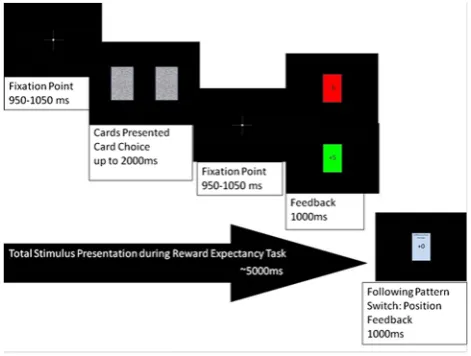
Participants were briefed regarding the experimental pro-cedures and were explicitly told that the correct choices were not random, but came in four different response patterns, and to utilize patterns to maximize winnings. They were also informed that these patterns would shift throughout the procedure. Participants were seated in a dimly lit acoustically shielded room approximately 1 m from a LCD stimulus display. They were instructed to limit movement during baseline and task measurements, and were verbally directed to close or open eyes for each minute of baseline recording. Following baseline recording procedures, participants were directed to comfortably arrange a four key stimulus keypad in both hands, with their thumbs positioned on the outside two of the four keys. The stimulus display presented directions regarding the responses, specifically to use the thumb of their left hand to select the left card and the thumb of their right hand to select the right card. Participants were given the opportu-nity to conduct two practice series to familiarize them-selves with the game. These series consisted of two trials following the pattern of alternating win and loss feedback. Each task trial totaled approximately 5 s in length, as shown in Fig.1, and began with a 1-s presentation of a fixation point followed by the presentation of two textured rectangles (roughly mimicking a playing card) equally spaced horizontally on the LCD screen, which remained until participants selected one of the two rectangles. Fol-lowing selection, the fixation cross reappeared for one second after which a feedback rectangle appeared, centered on the LCD screen, filled green for win and red for loss with the number of points won or lost centered in the middle of the rectangle (?5 or -5). Feedback was pre-sented for one second, followed by the reappearance of the
fixation cross for the next trial. However, following a shift in correct response pattern, the feedback presentation was followed by additional presentation of current total win-nings and their difference from the average of all partici-pants on that series presented in another rectangle for 1 s each prior to the reappearance of the fixation cross. As the task required little cognitive load, the scores showed little variability with feedback of?5 to-5 points of the average presented in all cases, intended to limit any affective response due to consistent wins experienced.
Each presented pattern consisted of a 2 trial learning phase with mixed win–loss feedback, with a subsequent period of 6–15 consistent wins based on randomly deter-mined length of pattern repetition and participant perfor-mance. This consistent period was designed to increase expectancy of win feedback during the period, the middle trial of which was taken to represent the high expectancy win trial. Participants were given a loss feedback to signal a pattern shift and represented the high expectancy loss trial. The subsequent trials in which participants were guessing the new pattern consisted of both win and loss feedback, which represented the low expectancy win and low expectancy loss trials. Variation between number of trials per pattern and selection of the middle pattern trial was conducted to prevent the possible confound of the participants expecting a pattern shift in later win trials and thus demonstrating decreasing win expectancy as pattern shifts became more likely due to a high number of con-sistent wins. Thirty pattern shifts were presented with an average number of 13 trials per pattern and a total task time of approximately 45.5 min, with five breaks following each 6 pattern shifts for SAM scale completion. Total participant time burden was approximately 90 min.
2.4 Electrophysiological recording
Cortical electrical activity was recorded using Ag/AgCl— sintered electrodes mounted in an elastic Quik-Cap (Compumedics Neuroscan; Herndon, VA) at 32 scalp sites using the international 10/20 placement system (Fp1, Fp2, F7, F8, F3, F4, FT7, FT8, FT9, FT10, T3, T4, FC3, FC4, C3, C4, CP3, CP4, TP7, TP8, T5, T6, P3, P4, O1, O2, Fz, FCz, Cz, CPz, Pz, Oz) with a ground electrode placed on the frontal aspect anterior to electrode Fz, and referenced to linked ears (A1–A2/2). The impedance of all electrodes was maintained at less than 5 kX prior to acquisition. Electro-ocular (EOG) activity and eye blinks were acquired simultaneously and continuously using pairs of Ag/AgCl electrodes placed lateral to the lateral canthus of each eye for EOG, and placed superior and inferior to the center of the left eye for eye blinks. All measurements were acquired using a 40-channel NuAmps DC amplifier and NEU-ROSCAN ACQUIRE 4.4 (Compumedics Neuroscan),
using a 512 Hz sampling rate within the 0.1–50 Hz fre-quency band. EOG and eye-blink ocular artifact reduction transformation occurred offline using a multiple lag time domain regression analysis [65,66].
EEG baseline was collected using eight 1-min record-ings using alternating eyes-open and eyes-closed periods. Following eye-blink and EOG corrections, each 1-min period was transformed from the time to frequency domains using overlapping 2.048 s epochs extracted through a Hamming Window with contiguous epochs overlapping 75 %, and then power spectra were calculated using a fast Fourier transformation and summed across all recordings as outlined in suggested recording guidelines [67]. Total alpha power between 8 and 13 Hz was exam-ined and assumed to be the inverse of cortical activity [40,
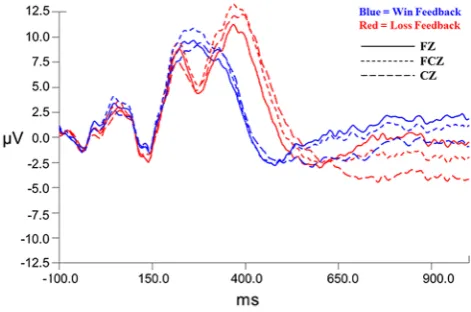
68]. Power spectral data were confirmed to be positively skewed, prompting use of a natural log transformation to normalize the spectral data prior to averaging across all baseline measures. Asymmetry scores were computed as ln(right)-ln(left) for each electrode pair, so that higher scores are indicative of increased right alpha power and thus inferred to represent greater left cortical activity [40]. ERPs were extracted from continuous measurements using 1100 ms epoch windows, including a 100 ms pre-feedback baseline and the 1000 ms following time locked feedback presentation in the eye-movement corrected data [69]. All files were digitally filtered using a 24 db low pass filter and baseline corrected relative to the 100 ms pre-feedback baseline. Time course windows for the FN were determined relative to computed grand averages, as shown in Fig.2. The FN amplitudes were extracted as the most negative peak in the time window between 225 and 325 ms following feedback presentation. Grand average wave-forms revealed an obvious large positivity occurring after the FN-type response in the high win expectancy condition, around 400 ms, and a large positivity occurring about 400 ms post feedback presentation in difference waves for
both high and low expectancy conditions. Although not planned a priori, this prompted further investigation of the component, which was referred to as the P3 in subsequent analyses. As there were no planned analyses for this ERP component, it was decided to simply duplicate the analyses selected a priori for the FN component.
Separate average waveforms were obtained for four identified experimental conditions (High Expectancy Loss, High Expectancy Win, Low Expectancy Loss, and Low Expectancy Win). The High Expectancy Win condition was taken from the fourth epochal feedback window during consistent win presentation signaling correct pattern establishment and, presumably, a higher expectation of subsequent win feedback. The High Expectancy Loss condition was taken from the epochal feedback window following the first incorrect trial following consistent pat-tern establishment, signaling a patpat-tern shift to the partici-pant. The Low Expectancy Win condition was taken from the epochal window following the first correct trial fol-lowing a pattern shift, while the Low Expectancy Loss condition was taken from the window following the first incorrect trial following the loss signaling a pattern shift.
3 Results
3.1 Demographics
Of the screening and collected demographic information, only age and education level were significantly positively related; this relationship was marginal (r=.476, p=.046). Participant age was also found to be signifi-cantly positively related to PANAS positive affect scores assessed following completion of the task (r=.699, p=.001). StroopT scores were found to be significantly positively related to STAI Trait Anxiety scores (r=.569, p=.014).
3.2 Performance data
Participant average response times ranged from 416 to 629 ms (M=498.7, SD=61.78). Participant scores ran-ged from 1635 to 1900 points (M=1818, SD=70.52), but was negatively skewed (g1= -1.717) due to the presence of two outliers with a large number of response time errors, defined as a subject response within 100 ms of stimulus presentation, showing a positive skew (g1= 1.961). Due to the departure from normality in the score and response time errors accounting for almost all of the score variance (r= -.971, p\.001), overall score was not utilized in later analyses. Due to the positive skew in the response time error data, a log transformation was utilized to induce normality. These log-transformed
response time errors were significantly related to an overall tendency to respond quickly in pattern response decision making (r= -.648, p =.004), and subject Stroop T scores (r= -.564, p=.015), suggesting that these response time errors may be a behavioral indicator of impulsive responding. In addition, average response times were significantly related to BAS-Drive (r=.524, p =.025) and BAS Total (r=.484, p =.042) such that individuals endorsing a high level of drive to achieve rewards spent more time making response decisions, as well as fewer errors (r= -.515, p=.029). Of note, however, is that a high number of response time errors were also related to increased baseline negative affectivity (r=.590, p =.01), suggesting that perhaps individuals presenting with higher state negative affect tended toward lower overall investment in the task and/or more impul-sivity in task-related decision making, which could also explain the correlation between response time errors and Stroop T scores reported earlier. For the anterior asym-metry measures, only the F4–F3 electrode pair was sig-nificantly related to response time errors (r= -.550, p =.018) so that greater relative left frontal activity was related to fewer response time errors.
3.3 Affective response to task
As the response pattern learning task with win feedback consisting primarily of points was selected in an effort to limit possible affective responses to the task, a number of analyses were conducted to identify any within task affect variation. Within subjects repeated measures ANOVA on within task visual-analog scales indicated a significant reduction in positive affect across the five blocks, F(4, 14)=3.673, p=.009, MSE=2.15, g2=.21. A trend analysis indicated that the data were well fit by a linear model accounting for a significant portion of the variance in affect (g2=.19, p=.017). A second within subjects repeated measures ANOVA on within task visual-analog scale of arousal showed that arousal was not significantly changed over the course of the task, F(4, 14)=1.070, p =.378, MSE=2.06, g2=.04. This suggests that our task did not eliminate affective responses and somewhat negatively affected overall subjective affect with a boring task, while overall arousal was not significantly affected.
affectivity, but not a significant increase in negative affectivity or general arousal. As reported earlier, partici-pant age was significantly positively related to PANAS positive affect scores at posttest, but not at baseline. This suggests that the older, more senior student participants showed less of an emotional response to the task and showed greater preservation of positive affect, possibly due to greater acceptance of experiment participation in gen-eral, and not simply due to the design of the task itself. Regardless, these findings suggest that affective responses may be having an effect on feedback processing.
3.4 ERP analysis
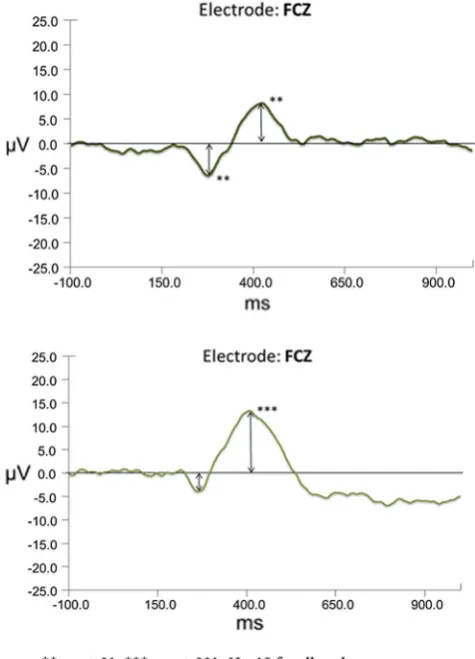
In order to determine if an FN response was induced between positive and negative feedback, win and loss grand average waveforms were created for each expec-tancy condition. Pairedt tests were conducted on the FN amplitudes extracted for each of the frontocentral electrode points. Difference waves were constructed as a subtraction of the loss condition grand average minus the win condi-tion grand average with a representative waveform for the FCZ electrode shown in Fig.3.
A negative deflection in processing of feedback was found in the low win expectancy condition with amplitudes being significantly lower for loss versus win feedback for the FZ electrode,t(17)=2.519, p=.022, SEM=0.925, d=0.60, and for the FCZ electrode, t(17)=3.041, p=.007, SEM=0.821, d =0.72, but not for the CZ electrode, t(17)=1.994, p=.062, SEM=0.887, d=0.48. Comparisons of component latency revealed no significant differences between conditions for FZ, t (17)=0.173, p=.87, SEM=9.64, d =0.05, FCZ, t(17)=0.476, p =.640, SEM =9.58, d=0.12, or CZ, t(17)=1.963, p=.066, SEM=13.13, d =0.47. Thus, the significant amplitude differences between the loss and win feedback were identified in the more frontal electrodes, with no differences in latency, suggesting an FN-type response. Win and loss grand average waveforms were also constructed for the high win expectancy conditions. There was a negative deflection occurring in loss feedback pro-cessing within the established FN time window: however, amplitude differences were not statistically significant for FZ, t (17)=0.921, p=.37, SEM=1.74, d=0.22, for FCZ,t(17)=1.185, p=.252, SEM=1.58,d =0.28, or for CZ, t(17)=1.347, p =.196, SEM=1.50, d =0.37 suggesting that either a significant FN-type deflection was not yielded, or no true FN was manifested in the high win expectancy condition.
We tested our main hypothesis that the FN would not show a significant negative deflection based on participant expectancy of losses in the absence of task-induced affect responses, through use of a one-samplettest on computed
FN amplitude difference scores (low win expectancy dif-ference—high win expectancy difference), for the FZ, FCZ, and CZ electrodes. As shown in Table1, for all three electrode sites, FN amplitude differences were not signif-icantly different from zero.
3.5 Personality analysis
While the study was powered for the above ERP analyses, exploratory analyses were conducted on personality mea-sures to identify any additional indications of possible associations with theorized motivation systems. As these analyses suffer from reduced power, non-significant Fig. 3 Difference waveforms for loss–win for low win expectancy (top) and high win expectancy
Table 1 One-samplettests of FN component difference scores Measure Diff (lV) tvalue Sig (2-tailed) SEM
FN FZ .726 .496 .626 1.464
FN FCZ .637 .439 .666 1.451
FN CZ -.247 .178 .860 1.385
associations were not interpreted. With the BAS subscales, the derived total score was significantly correlated with only BAS-Drive (r=.820, p\.001) and BAS Fun Seeking (r=.650, p=.003), with BAS reward respon-siveness being non-significantly negatively correlated with BAS Fun Seeking (r= -.311), resulting in the BAS total score being dropped from later analyses as it likely repre-sented a non-unitary measure with limited interpretive utility. Of the anterior alpha asymmetry measures, the F4– F3 electrode pair was significantly correlated with scores on the BAS-RR scale (r=.471,p =.048), suggesting that overall greater left cortical activity is associated with reward seeking behavior and increased reward sensitivity. STAI trait anxiety scores were significantly positively correlated with the Behavioral Inhibition Scale (r=.648, p=.004). PANAS negative affectivity scores were also significantly related to BIS scores (r=.571, p=.013). Anterior alpha asymmetry was significantly related to baseline state anxiety on lateral frontal electrodes (r= -.648, p=.004) and negative affect (r= -.497, p=.036), so that greater relative left frontal activity was associated with decreases in both state anxiety and negative affect at baseline, which is intuitive in light of the positive relationship found of left frontal cortical activity and measures of appetitive motivation. Not surprisingly, STAI trait anxiety was significantly negatively correlated with BAS Fun Seeking scores (r= -.517, p =.028), while scores on behavioral inhibition were also significantly related to BAS Fun Seeking (r= -.633,p=.005). STAI state anxiety was significantly negatively related to base-line positive affectivity scores (r= -.481, p=.043), supporting the view of PANAS scores as a state variable.
3.6 Reward sensitivity/affect and ERPs
Higher P3 amplitude differences for the FZ electrode were significantly related to higher trait anxiety (r=.474, p=.047). While higher CZ amplitude differences were related to higher scores on BAS reward responsiveness (r=.518, p=.028), BAS-Drive (r=.718, p=.001), and greater amounts of left cortical activity (F4–F3 elec-trode pair,r=.540,p =.021). This seems to suggest that the P3 component in the low expectancy condition is related to more negative trait measures, while the midline electrode differences were related to individual variations in the positive trait measures reward responsiveness, appetitive drive, and left cortical activity. In the high win expectancy condition, amplitude differences for the FZ electrode were significantly related to higher amounts of left cortical activity (F4–F3 electrode pair, r=.547, p=.019).
As FN amplitudes are hypothesized to be related to measures of reward sensitivity, negative affectivity, and
frontal asymmetry measures in favor of greater relative right frontal baseline activity, BAS reward responsiveness and STAI scores were selected and entered simultaneously into a multiple linear regression model for predicting FN amplitude differences for those electrode locations identi-fied as statistically significant in initial hypothesis testing (low expectancy FZ and FCZ). In this case, none of the personality models were significant. This suggested that the FN was relatively independent of the measured personality variables; however, due to the overall low power of the analysis because of the small sample sizes needed for the primary ERP analyses, and the higher chance of a type II error, negative findings were not interpreted.
In addition, multiple linear regression models were computed for predicting individual differences in the P3 response amplitude differences between the high and low win expectancy conditions identified as significant in the earlier hypothesis testing (FZ, FCZ, and CZ electrodes). If the P3 differences were related to increased levels of affect responses to the expectancy violations in the high expec-tancy condition, as suggested by their correlations between personality measures and cortical asymmetry scores, P3 amplitudes were hypothesized as being significantly pre-dictable by a weighted linear combination of personality scores.
Due to multicollinearity, F4–F3 was selected as an anterior asymmetry predictor, STAI-T as a personality predictor and baseline negative affect were selected and entered simultaneously into the regression model, as shown in Table2. Of the predictor variables, only F4–F3 (p\.01) and STAI-T (p\.05) had significant zero-order correlations with FZ P3 amplitude difference scores between expectancy conditions, and both had significant partial effects in the full model. The three-predictor model was able to account for 60 % of the variance in P3 amplitude differences for the FZ electrode, F(3, 14)=7.057,p =.004,g2=.60. For FCZ, a model com-posed of identical predictors was not as good a fit, but was still able to account for 46 % of the variance in P3 amplitude difference F(3, 14)=4.01, p=.03, g2=.46.
differences showed similar processing, while greater rela-tive left cortical activity predicted greater differences in feedback processing by expectancy conditions (i.e., that unexpected loss feedback showed increased P3 amplitude than more expected losses).
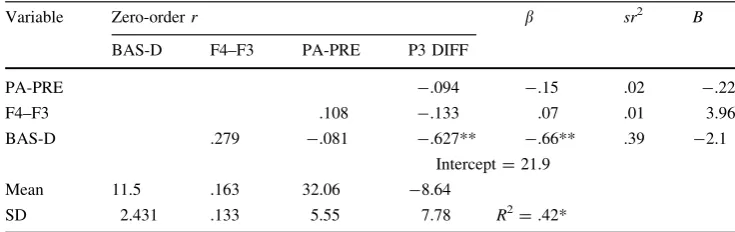
With the previous findings of the closer relationship of more central midline P3 amplitude with measures of appet-itive motivation, a separate regression model for predicting CZ P3 differences was constructed and is shown in Table3. F4–F3 was retained from the previous model and had a non-significant zero-order negative correlation with P3 CZ amplitude difference (p=.30), while baseline negative affect was replaced by baseline positive affect, which also had a non-significant negative zero-order correlation with P3 CZ amplitude difference (p=.355), and trait anxiety was replaced with BAS-Drive, which had a significant negative zero-order correlation with P3 CZ amplitude difference scores (p\.01). The three-predictor model was significant and was able to account for 42 % of the variance in P3 amplitude difference for the CZ electrode,F(3, 14)=3.349, p=.049, g2 =.42. This suggests that the P3 amplitude differences for the central midline electrode showed little difference between high and low expectancy conditions for individuals with higher positive affect, higher drive to receive reward, and increased left cortical activity.
4 Discussion
The major findings from this study support our initial null hypothesis regarding FN amplitude differences; there were
no significant differences in amplitudes with varying levels of win expectancy in a task without induction of positive affect responses by a boring task without semblance of gambling or monetary reward. Our findings support the conceptualization of the FN as a phasic suppression effect resulting from coding valence of outcomes as proposed in early studies of feedback processing [24, 28, 29]. The presentation of negative feedback in our fixed reward magnitude task induced an FN-type negative deflection occurring in the 225–325 ms post feedback time window. However, as hypothesized, the FN amplitudes did not significantly differ between high and low win expectancy. This deviation from the previous literature, and resultant hypothesis is based on the premise that previous studies have not necessarily accounted for reward expectations and affect response. Indeed, while previous studies have found FN differences are related to objective reward probability outcomes [10,16,30], and relationship to reward respon-siveness measures [45,59], the nature of these tasks sug-gests that differences in FN responses could have been due to other factors, such as subjective reward expectations not matching objective probabilities due to fallacious reason-ing, affect responses occurring following unexpected wins or losses of actual money, or a higher reward salience of more immediate reinforcement value in the feedback. Moreover, our findings are similar to that reported by Van den Berg and colleagues [58] who found no association between FN and reward responsiveness in a gambling task. Our task was not able to completely limit emotional responsivity, demonstrated through an overall decrease in subjective perception of affect through reduction in Table 2 Individual differences
in FZ P3 amplitude difference related to measures cortical asymmetry, affect, and personality (N=18)
*p\.05, **p\.01
Variable Zero-orderr b sr2 B
STAI-T F4–F3 NA-PRE P3 DIFF
NA-PRE -.097 .17 .02 .260
F4–F3 -.263 .614** .64** .38 33.09
STAI-T -.045 .208 -.473* -.48* .21 -.427
Intercept=.198
Mean 34.17 .163 13.5 -5.46
SD 7.79 .133 4.53 6.92 R2=.602**
Table 3 Individual differences in CZ P3 amplitude difference related to measures cortical asymmetry, affect, and personality (N=18)
*p\.05, **p\.01
Variable Zero-orderr b sr2 B
BAS-D F4–F3 PA-PRE P3 DIFF
PA-PRE -.094 -.15 .02 -.22
F4–F3 .108 -.133 .07 .01 3.96
BAS-D .279 -.081 -.627** -.66** .39 -2.1
Intercept=21.9
Mean 11.5 .163 32.06 -8.64
positive affect in the participants. Although this was found to be related to participant age and undergraduate class status, the reduction in affect was not intended by our task design. Although affect reduction limits our ability to interpret the results as affectively neutral, it does allow us to identify that violation of subjective reward expectations did not lead to increases in FN amplitudes in the absence of positive affective responses. This supports the previous findings of reduced FN amplitude in tasks involving no response choices and low subjective involvement in tasks [52], and implicates the possible role of affective infor-mation influencing overall ACC activation and FN responsiveness in tasks likely to induce affective responses. The overall reduction in positive affect might not suggest a lack of motivation on the part of the participants, as par-ticipant task-related accuracy was over 90 %, including the trials where correct response patterns were not yet known. Utilizing the personality and cortical asymmetry infor-mation provides some insight into the relationships between the ERP responses and behavioral markers theo-rized to represent the functioning of underlying neurobio-logical systems. The basic relationships between these measures provided additional support to and replication of previous research, as measures of appetitive motivation, positive affect, and greater relative left cortical baseline activation tended to positively correlate. Similarly, mea-sures of inhibition and negative affect tended to positively correlate and negatively correlate greater relative left cor-tical baseline activation. Although none of the personality or cortical asymmetry measures significantly related to FN amplitudes, these analyses were underpowered and suggest the need for additional research designed for individual differences analyses. As we found significant relationships between the P3 potential and these measures, these results hint that FN within the pattern response learning task was less strongly related to personality, cortical asymmetry, or outcome probability and supports its role in signaling the deviation from reward expectation, regardless of proba-bility, to allow engagement of more adaptive response strategies.
The surprising finding of positive deflection occurring around 400 ms in the post feedback time window provides some insight into interpreting the feedback-related pro-cessing which occurred in the task. The ERP was signifi-cantly different from zero in loss feedback processing in both the high and low expectancy conditions, although amplitudes were significantly higher for more unexpected losses. This task design presented the high win expectancy loss feedback as a single negative stimulus following a string of highly expected win stimuli. Thus, this loss feedback could have represented a novel stimulus that was meaningful in the task as a signal of deviation from expectancy, suggesting that this component represents a
P3b ERP component, as suggested by Donchin’s [70] schema updating model. A second possibility is that neg-ative feedback, particularly in the high win expectancy condition, signals a need for stopping ongoing response patterns, and that this component represents a need to update response selection, which again would represent a P3b type component, but closer to Verleger and colleagues’ [71] conceptualization of the P3b.
However, the presence of the significant component during the periods of guessing new response patterns, where the negative feedback occurred equally with positive feedback, suggests that this component is not a classic novel P3b response and may indicate other cognitive pro-cesses. This would remain as a signal for needing to change the response output initially selected to one that matches the provided feedback pattern. A third possibility remains that the presence of this component during differences between the conditions may represent a trait response to the more unexpected negative feedback.
When directly correlated with measures of personality and affect, the low expectancy condition P3 amplitudes were related to higher trait anxiety for the FZ electrode, and low expectancy P3 amplitudes related to reward responsiveness and increased drive to obtain reward for the CZ electrode. With the functional divisions of the cingulate cortex into anterior affective processing and dorsal response selection processing, these relationships highlight that the P3 component may reflect the summation of varied processes. Specifically, that the anterior electrodes are more closely related to a general tendency to experience increased anxiety, while the more dorsal electrodes are more closely related to variables that may impact response selection, such as increased appetitive drive which would presumably spurn greater focus on immediate response selection in order to maximize rewards. However, for the high expectancy condition, only higher relative left cortical baseline activity was positively related to P3 amplitude for the FZ electrode, which seems counterintuitive in that anterior cingulate processing has been linked to negative affective processing and greater left cortical activation has been linked to measures of positive affect. This could suggest that those participants who have a general propensity for experiencing positive affect showed a heightened negative response to more unexpected loss feedback. However, without identifying the generator of this component, these links with cingulate functional division processes remain speculative.
midline electrodes showed a good overall fit with measures of cortical asymmetry, baseline positive affect, and higher appetitive drive. While this does not suggest that a P3 type cognitive process is not occurring, it does suggest some individual differences in that process. If the P3 truly rep-resents a context monitoring process, it appears that those individuals with higher anxiety and negative affect show reduced perception of differences in the subjective mean-ing of the losses within differmean-ing contexts. If the P3 rep-resents a response selection and initiation process, this suggests that those individuals with a higher drive to receive reward feedback react equally strongly to loss-re-lated feedback, as each loss would signal a need to modify planned response patterns in the current experimental paradigm, regardless of the expectancy of the feedback outcome.
Source localization techniques may aid in identifying presumed locations of component generation, but were not performed in the current study. While the FN has consid-erable support for ACC generation, the P3 waveform generated in the current study might have a different gen-erator and reflect a different cortical process. While the current study was originally designed to stabilize within-task affect variation, affective measurements did not occur throughout the task. Use of pre-post affect measurement and periodic visual analog scales allowed for some infor-mation concerning overall affect variation; no affect responses were assessed on a trial-by-trial basis. Thus, participants may have experienced within task affect responsivity to consistent wins and unexpected losses, which stabilized prior to the visual analog assessment. Similarly, the current paradigm revealed some overall reduction in positive affect that although supports the lack of positive affect induced by the task, also suggests that our results include unexpected error from the affect variation. Future research may seek to utilize variations in task design seeking to increase motivational salience without the inclusion of gambling and direct monetary reward, in order to further stabilize overall affect variation and allow more specific findings regarding FN variation due to task-induced affect responses. Future studies could attempt to directly compare affective and non-affective inducing tasks with a single participant group, looking for such FN variability. Future studies may also attempt to identify if inducing a P3b type response through a more classic oddball paradigm shows similar relationships with affective measures and cortical asymmetry. Finally, future research attempting to stabilize affect responsivity could include trial-by-trial affect assessment to verify that participant affect is not varying significantly within trial blocks.
Overall, the current study could not directly relate FN and P3 amplitudes to most measures of affective and cor-tical asymmetry, and suggests that these components
predominantly represent basic performance monitoring cognitive processes. Information regarding the differences between high and low expectancy suggest that affective states and traits and baseline asymmetry may predispose differences in cognitive processing of loss-related feed-back. The P3 showed sensitivity to participant win expectancy, and showed some relationships to trait anxiety and appetitive motivation measures, but these were more pronounced for low win expectancy. Individual differences in error-related processing were revealed in the differences in P3 processing between the two conditions, such that trait anxiety, state negative affect, and baseline cortical asym-metry predicted differences in the cognitive processing of loss-related feedback. This suggests that while the overall amplitudes of the components reflect cognitive processes, affective states seem to predispose some participants to process loss-related feedback equivalently, regardless of whether they perceived the losses as occurring while guessing or occurring after the establishment of a learned pattern of response.
Author’s contribution The authors of this manuscript express gratitude to Karl Wuensch, Ph.D., and Tuan Tran, Ph.D., for their service on the thesis committee from which this work was based. In addition, the writers would like to acknowledge the assistance of Katie Lehockey, Ph.D., and Alicia Sufrinko, Ph.D., for assistance with laboratory procedures during data collection.
Compliance with ethical standards
Ethical approval All procedures performed in studies involving human participants were in accordance with the ethical standards of the institutional and/or national research committee and with the 1964 Helsinki declaration and its later amendments or comparable ethical standards.
Informed consent Informed consent was obtained from all indi-vidual participants included in the study.
Open Access This article is distributed under the terms of the Creative Commons Attribution 4.0 International License (http://crea tivecommons.org/licenses/by/4.0/), which permits unrestricted use, distribution, and reproduction in any medium, provided you give appropriate credit to the original author(s) and the source, provide a link to the Creative Commons license, and indicate if changes were made.
References
1. Thorndike EL (1998) Animal intelligence: an experimental study of the associative processes in animals (originally published 1898). Am Psychol 53:1125–1127. doi:10.1037/0003-066X.53. 10.1125
2. Skinner BF (1950) Are theories of learning necessary? Psychol Rev 57:193–216
4. Holroyd CB, Hajcak G, Larsen JT (2006) The good, the bad, and the neutral: electrophysiological responses to feedback stimuli. Brain Res 2006:93–101. doi:10.1016/j.brainres.2005.12.015 5. Posner MI, Di Girolamo GJ (1998) Executive attention: Conflict,
target detection, and cognitive control. In: Parasuraman R (ed) The attentive brain. MIT Press, Cambridge, pp 401–423 6. Brown LL, Schneider JS, Lidsky TI (1997) Sensory and cognitive
functions of the basal ganglia. Curr Opin Neurobiol 7:157–163. doi:10.1016/S0959-4388(97)80003-7
7. Damasio AR (1995) On some functions of the human prefrontal cortex. Ann N Y Acad Sci 769:241–252. doi: 10.1111/j.1749-6632.1995.tb38142.x
8. Hampton AN, O’Doherty JP (2007) Decoding the neural sub-strates of reward-related decision making with functional MRI. PNAS Proc Nat Acad Sci USA 104:1377–1382. doi:10.1073/ pnas.0606297104
9. Holroyd CB, Nieuwenhuis S, Mars RB, Coles MG (2004) Anterior cingulate cortex, selection for action, and error pro-cessing. In: Posner MI (ed) Cognitive neuroscience of attention. Guilford Press, New York, pp 219–231
10. Bellebaum C, Daum I (2008) Learning-related changes in reward expectancy are reflected in the feedback-related negativity. Eur J Neurosci 27:1823–1835. doi:10.1111/j.1460-9568.2008.06138.x 11. Dehaene S, Posner MI, Tucker DM (1994) Localization of a
neural system for error detection and compensation. Psychol Sci 5:303–305. doi:10.1111/j.1467-9280.1994.tb00630.x
12. Gehring WJ, Willoughby AR (2002) The medial frontal cortex and the rapid processing of monetary gains and losses. Science 295:2279–2282. doi:10.1126/science.1066893
13. Holroyd CB, Dien J, Coles MG (1998) Error-related scalp potentials elicited by hand and foot movements: evidence for an output-independent error-processing system in humans. Neurosci Lett 242:65–68. doi:10.1016/S0304-3940(98)00035-4
14. Pizzagalli DA, Sherwood RJ, Henriques JB, Davidson RJ (2005) Frontal brain asymmetry and reward responsiveness. A source-localization study. Psychol Sci 16:805–813. doi: 10.1111/j.1467-9280.2005.01618.x
15. Yu R, Zhou X (2009) To bet or not to bet? The error negativity or error-related negativity associated with risk-taking choices. J Cogn Neurosci 21:684–696. doi:10.1162/jocn.2009.21034 16. Alexander WH, Brown JW (2010) Competition between learned
reward and error outcome predictions in anterior cingulate cortex. NeuroImage 49:3210–3218. doi:10.1016/j.neuroimage.2009.11.065 17. Brown JW, Braver TS (2005) Learned predictions of error like-lihood in the anterior cingulate cortex. Science 307:1118–1121. doi:10.1126/science.1105783
18. Carter CS, Braver TS, Barch DM, Botvinick MM, Noll DN, Cohen JD (1998) Anterior cingulate cortex, error detection, and the online monitoring of performance. Science 280:747–749. doi:10.1126/science.280.5364.747
19. Stevens MC, Kiehl KA, Pearlson GD, Calhoun VD (2009) Brain network dynamics during error commission. Hum Brain Mapp 30:24–37. doi:10.1002/hbm.20478
20. Ullsperger M, von Cramon D (2001) Subprocesses of perfor-mance monitoring: a dissociation of error processing and response competition revealed by event-related fMRI and ERPs. NeuroImage 14:1387–1401. doi:10.1006/nimg.2001.0935 21. Ullsperger M, von Cramon D (2003) Error monitoring using
external feedback: specific roles of the habenular complex, the reward system, and the cingulate motor area revealed by func-tional magnetic resonance imaging. J Neurosci: Off J Soc Neu-rosci 23:4308–4314
22. Vogt BA, Gabriel M (1993) Neurobiology of cingulate cortex and limbic thalamus: a comprehensive handbook. Birkhauser, Cambridge
23. Vogt BA, Nimchinsky EA, Vogt LJ, Hof PR (1995) Human cingulate cortex: surface features, flat maps, and cytoarchitecture. J Comp Neurol 359:490–506
24. Holroyd CB, Coles MG (2002) The neural basis of human error processing: reinforcement learning, dopamine, and the error-re-lated negativity. Psychol Rev 109:679–709. doi: 10.1037/0033-295X.109.4.679
25. Glascher J, Hampton AN, O’Doherty JP (2009) Determining a role for ventromedial prefrontal cortex in encoding action-based value signals during reward-related decision making. Cereb Cortex 19:483–495. doi:10.1093/cercor/bhn098
26. Knutson B, Cooper JC (2005) Functional magnetic resonance imaging of reward prediction. Curr Opin Neurol 18:411–417 27. Knutson B, Taylor J, Kaufman M, Peterson R, Glover G (2005)
Distributed neural representation of expected value. J Neurosci 25:4806–4812. doi:10.1523/JNEUROSCI.0642-05.2005 28. Gehring WJ, Goss B, Coles MG, Meyer DE, Donchin E (1993) A
neural system for error detection and compensation. Psychol Sci 4:385–390.www.jstor.org/stable/40062567
29. Nieuwenhuis S, Holroyd CB, Mol N, Coles MG (2004) Rein-forcement-related brain potentials from medial frontal cortex: origins and functional significance. Neurosci Biobehav Rev 28:441–448. doi:10.1016/j.neubiorev.2004.05.003
30. Bellebaum C, Polezzi D, Daum I (2010) It is less than you expected: the feedback-related negativity reflects violations of reward magnitude expectations. Neuropsychologia 48: 3343–3350. doi:10.1016/j.neuropsychologia.2010.07.023 31. Goyer JP, Woldorff MG, Huettel SA (2008) Rapid
electrophys-iological brain responses are influenced by both valence and magnitude of monetary rewards. J Cogn Neurosci 20:2058–2069. doi:10.1162/jocn.2008.20134
32. Philiastides MG, Biele G, Vavatzanidis N, Kazzer P, Heekeren HR (2010) Temporal dynamics of prediction error processing during reward-based decision making. NeuroImage 53:221–232. doi:10.1016/j.neuroimage.2010.05.052
33. McNaughton N (1989) Biology and emotion. Cambridge University Press, New York
34. Gray JA, McNaughton N (2000) The neuropsychology of anxi-ety: an enquiry into the functions of the septo-hippocampal sys-tem. Oxford University Press, New York
35. Pizzagalli DA, Peccoralo LA, Davidson RJ, Cohen JD (2006) Resting anterior cingulate activity and abnormal responses to errors in subjects with elevated depressive symptoms: a 128-channel EEG study. Hum Brain Mapp 27:185–201. doi:10. 1002/hbm.20172
36. Bress JN, Smith E, Foti D, Klein DN, Hajcak G (2012) Neural response to reward and depressive symptoms in late childhood to early adolescence. Biol Psychol 89:156–162. doi:10.1016/j.biop sycho.2011.10.004
37. Foti D, Hajcak G (2009) Depression and reduced sensitivity to non-rewards versus rewards: evidence from event related potentials. Biol Psychol 81:1–8. doi:10.1016/j.biopsycho.2008. 12.004
38. Coan JA, Allen JJ (2003) Frontal EEG asymmetry and the behavioral activation and inhibition systems. Psychophysiology 40:106–114. doi:10.1111/1469-8986.00011
39. Coan JA, Allen JJ (2004) Frontal EEG asymmetry as a moderator and mediator of emotion. Biol Psychol 67:7–49. doi:10.1016/j. biopsycho.2004.03.002
40. Davidson RJ (1993) Cerebral asymmetry and emotion: concep-tual and methodological conundrums. Cogn Emot 7:115–138. doi:10.1080/02699939308409180
42. Harmon-Jones E, Peterson CK (2008) Effect of state and trait motivation on aggressive inclinations. J Res Pers 42:1381– 1385
43. Wheeler RE, Davidson RJ, Tomarken AJ (1993) Frontal brain asymmetry and emotional reactivity: a biological substrate of affective style. Psychophysiology 30:82–89. doi: 10.1111/j.1469-8986.1993.tb03207.x
44. Demaree HA, DeDonno MA, Burns KJ, Everhart DE (2008) You bet: how personality differences affect risk-taking preferences. Personality Individ Differ 44:1484–1494. doi:10.1016/j.paid. 2008.01.005
45. Lange S, Leue A, Beauducel A (2012) Behavioral approach and reward processing: results on feedback-related negativity and P3 component. Biol Psychol 89:416–425. doi:10.1016/j.biopsycho. 2011.12.004
46. De Pascalis V, Varriale V, D’Antuono L (2010) Event-related components of the punishment and reward sensitivity. Clin Neurophysiol 121:60–76. doi:10.1016/j.clinph.2009.10.004 47. Harmon-Jones E, Allen JJ (1997) Behavioral activation
sensi-tivity and resting frontal EEG asymmetry: covariation of putative indicators related to risk for mood disorders. J Abnorm Psychol 106:159–163. doi:10.1037/0021-843X.106.1.159
48. Hewig J, Hagemann D, Seifert J, Naumann E, Bartussek D (2006) The relation of cortical activity and BIS/BAS on the trait level. Biol Psychol 71:42–53. doi:10.1016/j.biopsycho.2005.01.006 49. Sutton SK, Davidson RJ (1997) Prefrontal brain asymmetry: a
biological substrate of the behavioral approach and inhibition systems. Psychol Sci 8:204–210. doi:10.1111/j.1467-9280.1997. tb00413.x
50. Hajcak G, Holroyd CB, Moser JS, Simons RF (2005) Brain potentials associated with expected and unexpected good and bad outcomes. Psychophysiology 42:161–170. doi: 10.1111/j.1469-8986.2005.00278.x
51. Hajcak G, Moser JS, Holroyd CB, Simons RF (2007) It’s worse than you thought: the feedback negativity and violations of reward prediction in gambling tasks. Psychophysiology 44:905–912. doi:10.1111/j.1469-8986.2007.00567.x
52. Yeung N, Holroyd CB, Cohen JD (2005) ERP correlates of feedback and reward processing in the presence and absence of response choice. Cereb Cortex 15:535–544. doi:10.1093/cercor/ bhh153
53. Mennes M, Wouters H, van den Bergh B, Lagae L, Stiers P (2008) ERP correlates of complex human decision making in a gambling paradigm: detection and resolution of conflict. Psychophysiology 45:714–720. doi:10.1111/j.1469-8986.2008.00678.x
54. Fischhoff B, Slovic P, Lichtenstein S (1977) Knowing with cer-tainty: the appropriateness of extreme confidence. J Exp Psychol Hum Percept Perform 3:552–564
55. Gilovich T (1991) How we know what isn’t so: the fallibility of human reason in everyday life. Free Press, New York
56. Sundali J, Croson R (2006) Biases in casino betting: the hot hand and the gambler’s fallacy. Judgm Decis Mak 1:1–12.http://www. jstor.org/stable/41761194
57. Campbell-Meiklejohn DK, Woolrich MW, Passingham RE, Rogers RD (2008) Knowing when to stop: the brain mechanisms of chasing losses. Biol Psychiatry 63:293–300. doi:10.1016/j. biopsych.2007.05.014
58. Van den Berg I, Franken I, Muris P (2011) Individual differences in sensitivity to reward. J Psychophysiol 25:81–86. doi:10.1027/ 0269-8803/a000032
59. Bress JN, Hajcak G (2013) Self-report and behavioral measures of reward sensitivity predict the feedback negativity. Psy-chophysiology 50:610–616. doi:10.1111/psyp.12053
60. Lesieur HR, Blume SB (1987) The south oaks gambling screen (SOGS): a new instrument for the identification of pathological gamblers. Am J Psychiatry 144:1184–1188
61. Trenerry MR, Crosson B, DeBoe J, Leber WR (1989) Stroop neuropsychological screening test manual. Psychological Assessment Resources, Adessa
62. Carver CS, White TL (1994) Behavioral inhibition, behavioral activation, and affective responses to impending reward and punishment: the BIS/BAS scales. J Pers Soc Psychol 67:319–333 63. Spielberger CD, Gorsuch RL, Lushene R, Vagg PR, Jacobs GA (1983) Manual for the state-trait anxiety inventory. Consulting Psychologists Press, Palo Alto
64. Watson D, Clark LA, Tellegen A (1988) Development and val-idation of brief measures of positive and negative affect: the PANAS scales. J Pers Soc Psychol 54:1063–1070. doi:10.1037/ 0022-3514.54.6.1063
65. Kenemans JL, Molenaar PC, Verbaten MN, Slangen JL (1991) Removal of the ocular artifact from the EEG: a comparison of time and frequency domain methods with simulated and real data. Psychophysiology 28:114–121. doi:10.1111/j.1469-8986.1991. tb03397.x
66. Verleger R, Gasser T, Mo¨cks J (1982) Correction of EOG arti-facts in event-related potentials of the EEG: aspects of reliability and validity. Psychophysiology 19:472–480. doi: 10.1111/j.1469-8986.1982.tb02509.x
67. Pivik RT, Brougton RJ, Coppola R, Davidson RJ, Fox N, Nuwer MR (1993) Guidelines for the recording and quantitative analysis of electroencephalographic activity in research contexts. Psy-chophysiology 30:547–558. doi:10.1111/j.1469-8986.1993. tb02081.x
68. Allen JJ, Coan JA, Nazarian M (2004) Issues and assumptions on the road from raw signals to metrics of frontal EEG asymmetry in emotion. Biol Psychol 67:183–218. doi:10.1016/j.biopsycho.2004. 03.007
69. Picton TW, Bentin S, Berg P, Donchin E, Hillyard SA, Johnson R, Taylor MJ (2000) Guidelines for using human event-related potentials to study cognition: recording standards and publication criteria. Psychophysiology 37:127–152. doi:10.1111/1469-8986. 3720127
70. Donchin E (1981) Surprise!…Surprise? Psychophysiology 18:493–513. doi:10.1111/j.1469-8986.1981.tb01815.x
71. Verleger R, Jaskowski P, Wascher E (2005) Evidence for an inte-grative role of P3b in linking reaction to perception. Journal of Psychophysiology 19:165–181. doi:10.1027/0269-8803.19.3.165
Jonathan M. Highsmithreceived his PhD from the Clinical Health Doctoral Program at East Carolina University. He is currently completing a 2-year postdoctoral fellowship in clinical neuropsy-chology at South Texas Veterans Health Care System. His research interests include the cognitive neuroscience of decision making.
Karl L. Wuenchreceived his PhD from Miami University in Oxford, Ohio. He is a professor at East Carolina University. His research interests include comparative psychology and evolution, multivariate design and statistics, and social psychology.
Alexandra J. Stephensonis a doctoral student in the Clinical Health Psychology program (with emphasis in clinical neuropsychology) at East Carolina University. Her research interests include neurophys-iological processes associated with adherence to treatment for sleep disorders and traumatic brain injury.
D. Erik Everhart received his PhD from Virginia Tech. He completed a postdoctoral fellowship in clinical neuropsychology at University at Buffalo. He is a professor at East Carolina University.