R E S E A R C H
Open Access
Distributed multi-objective scheduling
of power consumption for smart buildings
Marvin Nebel-Wenner
1*, Christian Reinhold
2, Farina Wille
3, Astrid Nieße
4and Michael Sonnenschein
1FromThe 8th DACH+ Conference on Energy Informatics, Salzburg, Austria, 26-27 September, 2019
*Correspondence:
1OFFIS - Institute for Information Technology, R&D Division Energy, Escherweg 2, 26121, Oldenburg, Germany
Full list of author information is available at the end of the article
Abstract
Load management of electrical devices in residential buildings can be applied with different goals in the power grid, such as the cost optimization regarding variable electricity prices, peak load reduction or the minimization of behavioral efforts for users due to load shifting. A cooperative multi-objective optimization of consumers and generators of power has the potential to solve the simultaneity problem of power consumption and optimize the power supply from the superposed grid regarding different goals. In this paper, we present a multi-criteria extension of a distributed cooperative load management technique in smart grids based on a multi-agent framework. As a data basis, we use feasible power consumption and production schedules of buildings, which have been derived from simulations of a building model and have already been optimized with regard to self-consumption. We show that the flexibilities of smart buildings can be used to pursue different targets and display the advantage of integrating various goals into one optimization process.
Keywords: Multi-objective optimization, Optimization of domestic Loads, Distributed optimization, Multi-agent systems
Introduction
The use of cost-efficient flexibilities in production and consumption of electrical power is a key factor in the realization of an energy supply concept based on solar and wind energy (Elsner et al.2015). An important element here is the load management of devices in domestic buildings, which has already been treated in various studies (Maier2018, chap. 6). Increasing the potential of this technology in the future is possible due to the increased use of heat pumps and electric vehicles. However, these devices can also contribute to the problem of imbalance of generation and consumption as well as of the grid load by the potentially high simultaneity of consumption (see e.g. (Fernandez et al.2011)).
Load management of electrical devices in residential buildings can be applied with different goals in the power grid:
• Cost optimization of households in terms of own consumption in regards to a local PV system and a local battery storage
• Cost optimization in terms of variable power tariffs • Reduction of grid load in the low voltage grid
• Minimization of comfort loss for the consumer due to load shift
The problem of energy management to be solved therefore consists of amulti-criteria optimizing schedule planning for the flexibilities of the devices (compare (Barbato and Capone2014)). In particular, in order to solve the simultaneity problem of power con-sumption, but also to optimize the power supply from the superposed grid, a smart grid optimization technology at the level of a low-voltage grid is required (in contrast to local optimization within a smart building).
In this decentralized technical system of flexible and inflexible consumers and (inflexible) power generators, a distributed algorithmic approach to optimization makes sense. In particular, multi-agent systems bring several advantages as robustness and easy expand-ability and have already been studied with some of the optimization goals mentioned above (see e.g. (Coelho et al.2017; Sonnenschein et al.2015)).
Given the interactive nature of certain goals such as reducing the grid load in the low voltage grid as well as the fact that consumers vary in their power consumption behav-ior and in their availability of (low-priced) flexibility, a cooperative algorithmic approach allows for an optimal co-operation among all participating units. That way, a solution that constitutes the optimum for all interconnected units can be achieved. In contrast, a com-petitive approach would lead to locally optimal scheduling for each single unit only, which is likely to be suboptimal on the aggregated level. Furthermore, it makes sense that all of the participating units optimize regarding all of the different criteria. That way it can be assured that no optimization possibilities are lost.
In this paper, we present a multi-criteria extension of a distributed cooperative load management technique in smart grids based on a multi-agent framework. It integrates all of the optimization goals mentioned above into one algorithm. Agents represent the flexibilities of buildings, which in turn have already made an optimization with regard to self-consumption in case of an existing local PV system and battery storage. This smart grid optimization technique is used for a future scenario of the electricity supply of the year 2050, in which different type days for two different low-voltage grids were exam-ined. The achieved results of this simulation study are discussed in particular with regard to the benefits of a distributed and cooperative multi-criteria optimization, and thus an algorithmic integration of the optimization goals. In addition, we discuss the effect of the number of participating agents on the optimization results.
Related Work
Optimization of modern electrical power systems has been a research topic for a long time (Kallrath et al. 2009; Zhu 2015) including a great variety of research regarding the optimization potential of demand side management. Research about demand side management mainly focuses on the optimization of one single criterion such as shaving energy usage peaks, reducing the consumers electricity costs or integrating and managing decentralized energy resources cost-effectively (Esther and Kumar2016).
important research direction: environmental impact is used measure to adapt usage behavior (Seebauer et al.2013).
Many market-based approaches in the field of demand side management and demand response have been presented that use software agents to represent individual house-hold preferences. In most approaches, concepts related to behavioral shifting efforts, like “inconvenience” or “comfort” are measured on a monetary or utility scale (Arias et al.2018). While some of the presented approaches examine the overall effectiveness of agent-based concepts in these scenarios (like the well-known PowerMatcher concept (Kok et al. 2005)), others focus on the research topic of price models, e.g. to identify efficient time-of-use prices (Robu et al.2018). Ramchurn et al. present an agent-based concept to adapt deferrable loads in private households according to grid prices that dynamically reflect grid usage and thus maximize social welfare (Ramchurn et al.2011). The overall goal of this study – to evaluate the possibilities to both reflect global efficiency and local comfort preferences using a monetarization modeling paradigm – is similar to the work presented here. In contrast to this, the agents in the work presented here act in a competitive environment, while we analyze the effectiveness of distributed cooperative multi-criteria optimization. It has been highlighted in the introduction why cooperative multi-agent environments are a relevant research topic in the context of building energy management.
In this respect, Fioretto et al. present an important similar approach (Fioretto et al. 2017). They formalize the problem of load control in private households as distributed constraint optimization problem (DCOP), and solve this using a cooperative agent-based approach. The focus of this work is on the formalization and monetarization of local and global constraints using real-time energy prices, while the distributed optimization algorithm is straightforward and only able to identify locally optimal solutions. This approach implements distributed scheduling of devices but does not take behavioral adaption costs into account. In the approach presented in our contribution, an abstract interface between the smart building model and the smart grid optimization is provided, based on a set of admissible schedules with associated behavioral adaption costs.
Additionally, it has been shown that the application of DCOP algorithms is problematic in energy scheduling tasks with global constraints due to the fully connected constraint graph and the resulting complexity (Hinrichs and Sonnenschein2016). We therefore eval-uate the applicability of algorithmically distributed optimization heuristics to the task of smart buildings’ energy scheduling using a monetarization approach to integrate different optimization goals.
Methodical Foundations
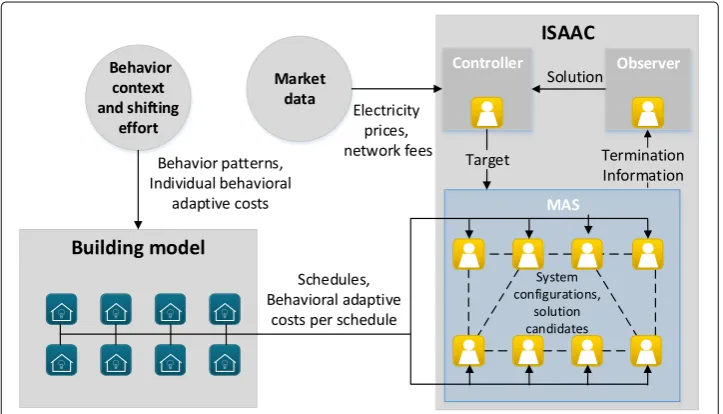
In order to get a well founded data basis for this work, preliminary work has been under-taken. This applies to the modelling of smart buildings and its flexibilities as well as to the behavior of the inhabitants including efforts and costs for a behavior adaptation (see Fig.1for a system overview).
Behavior context and shifting effort
Fig. 1Data generation and data flow for the simulation of the distributed optimization process
interventions for increasing user flexibility, like providing information and feedback are also estimated to be small in their effect, lying between 5% to 15% (Schuitema et al.2017). Next to the problem of low numbers of participants in demand response programs in Europe, the problem of user inflexibility or respective, the inelasticity of demand, as it is studied within economic concepts, has received increasing attention (Torriti et al.2010). Suggestions from behavioral science to unlock the potential of smart grid technologies have addressed these issues of consumer adoption and optimal use. One stated idea is to increase the effectiveness of applying operant conditioning principles in time-of-use pric-ing settpric-ings by combinpric-ing them with internal motivators like values (Sintov and Schultz 2015). Staying within the perspective of the theory of operant conditioning and selec-tion by consequences (Skinner1981), we suggest, that one important factor, which might explain the limited effectiveness and large variance of interventions aiming to increase user flexibility, could be restricting contextual factors of residential user behavior Descrip-tions of user behavior, when integrated into technical simulaDescrip-tions should allow for such considerations in order to evaluate the theoretical potential of user flexibility in a future smart grid scenario.
time of usage is assumed to be the optimal time point under current behavioral restrictions. We carried out an online survey assigning participants randomly to either choose a matching weekday activity profile or weekend activity profile. The chosen profile constitutes the restricting context for that participant. Criteria are the behavioral effort for shifting behavior and the preferred time of using an electrical appliance. Behavioral effort is asked for in Euro on a scale from 0 Euro to 10 Euro in increments of 10 Cents for the minimal amount necessary to shift the appliance use behavior away from the pre-ferred time of use for each full hour within 24 h. Since we monetized the indicator for behavioral effort, we termed it behavioral adaptive cost (bac). For 107 participants we described bac curves (bac on y-axis and on x-axis positive and negative hourly shifts away from preferred use point set to zero) by first identifying different curve types relating to the amount of peaks and width of amplitude. We then aggregated the individual curves for the different curve types and fitted gaussian peak functions with an acceptable over-all fit of R2 = 0.89 to describe the bac curves for the three weekday clusters and six weekend day clusters for each of the seven appliances. In order to investigate the poten-tial for user flexibility and integrate a consumer focused optimization criterion within the multi-objective optimization, this information is integrated into the building model. Fur-ther details regarding the empirical study and the computation of bac can be found in ((Blaufuß et al.), chap. 9.1).
Building Model
The interface between the user-behavior model and the distributed optimization strategy is the building model, which is embedded in the modular simulation environmenteSE (elenia Simulation Environment) (Reinhold and Engel2017). A building is composed of a number of electrical and thermal load and generation plants (e.g. photovoltaic system, storage system or household appliances), which are modeled energetically in their plant behavior with a bottom-up approach. The devices and control systems exchange infor-mation with each other via time-dependent inforinfor-mation and power flows. Each building can be flexibly parameterized and assembled via distribution functions and external data sets. A user model is used to investigate flexibility potentials through behavioral changes. This model includes the parameterization of the user, the clustered behavior patterns and the dependencies of the behavioral adaptive costs. The time-dependent behavior of the users and the interaction possibility with electrical appliances is realized in the form of an algorithm for the determination of activity profiles, appliance activity profiles and appear-ance profiles (Reinhold et al.2018).
Especially for user-driven appliance classes (e.g. washing machine, television), the time shift of the preferred time of use is assumed to come in hand with an adaptational effort of users’ behavior and is hence priced with the indicator behavioral adaptive costs, which we down scaled by the factor 100 to make it a viable criterion within the building model opti-mization. For each appliance schedule, these costs were aggregated to one per building schedule.
Technical Foundations
In the following section, we describe the technical foundations for this work. These comprise the distributed optimization heuristic COHDA, which is used to solve the opti-mization problem at hand. Furthermore, the multi-agent system ISAAC is described, which is used to simulate the distributed optimization process.
COHDA
In this work, the distributed optimization heuristic COHDA (Combinatorial Optimisation Heuristic for Distributed Agents) is applied in order to solve the optimization problem at hand. COHDA is a fully decentralized optimization heuristic that uses self-organizing mechanisms to optimize a common target. The heuristic is presented by Hinrichs and Sonnenschein in (Hinrichs and Sonnenschein2016). The key concept of the heuristic is an asynchronous and iterative best-response behavior of distributed agents, where each agent represents a distributed energy resource (DER). Each agent knows the set of feasible schedules of its unit and is only allowed to change the power schedule of its own unit. Furthermore, each agent has a working memory that is exchanged with other agents. The working memory contains the global target function, the most up to date information about the planned energy consumption of all agents in the system and a solution candidate to the optimization problem. The solution candidate comprises a collection of schedules for each agent, which constitutes the currently best known combination of schedules with respect to the target function. For each unit, the set of feasible schedules is regarded as private information and is not part of the working memory.
The algorithmic approach can be described in three steps:
1. Perceive: When an agent receives a message from one of its neighbors, it updates information about the planned energy consumption of other agents and replaces the existing solution candidate, if the new candidate contains more elements or yields a better rating.
2. Decide: The agent then searches for the best of the feasible schedules of its unit taking into account the information about the planned energy consumption of other agents and the global target. If the resulting system state yields a better rating regarding the global target than the current solution candidate, a new solution candidate is created, which replaces the old one.
3. Act: If any component of the working memory has been modified, the agent sends its working memory to its neighbors.
heuristic terminates in a state where the working memories are identical for all agents and represent an at least local optimum.
COHDA offers important properties for the predictive scheduling of DERs. First of all, COHDA ensures convergence and termination even in case of single communication faults, which is an important aspect in a critical infrastructure such as the energy sys-tem. However, fast convergence depends on massively parallel communication. If applied to the real world, long-term-evolution (LTE) standards such as 3G, 4G or DSL are thus recommended as communication technologies (Hölker et al.2017). Furthermore, privacy constraints are considered by leaving information regarding the set of feasible schedules of the energy unit private to the associated agent. However, during the optimization pro-cess the currently chosen schedule is communicated to other agents. Finally, autonomy of the individual energy unit is preserved, as the decisions regarding the selection of power schedules can only be made by its associated agent.
ISAAC
ISAAC1 is an energy unit aggregation and planning software based on the heuristic COHDA. It is presented by Niesse and Tröschel in (Nieße and Tröschel2016). ISAAC encompasses a multi-agent system (MAS) based on aiomas2, a lightweight MAS
frame-work written in python that supports the implementation of distributed systems like MAS. Main use cases of ISAAC are the aggregation of DERs for virtual power plants as well as smart control in distribution grids.
In ISAAC, each unit agent represents a single energy unit (in our case generally smart buildings), from which it knows the capabilities and flexibilities. Unit agents implement a modified version of the COHDA algorithm. They are connected through a small world overlay network. However, the topology management is a module that allows for choosing different types of overlay communication networks.
In order to prevent undesired behavior, ISAAC is embedded into a observer / controller architecture (see Fig.1). In this setting, there are two new types of agents present in the MAS. The controller is able to receive optimization targets and communicate them to the MAS. The observer agent monitors the self-organized behavior of the MAS during run-time and passes information to the controller agent, if necessary. The controller agent may also perform control actions to alter the optimization process, e.g. assuring termination of a negotiation within a desired time. Generally, the observer / controller architecture combines the benefits of self-organized system behavior with the possibility of avoiding unwanted behavior.
Flexibility is represented by a number of different feasible schedules for each unit. Each schedule covers a fixed period and consists of a number of power values for a defined interval length. In our case the period is set to 24 h and the interval length to 15 min, leading to 96 power values per schedule.
Building Agents and Battery Agents
In our work the energy units under consideration are smart buildings. Some of the smart buildings include battery storages. The flexibility of such storages is usually very high compared to the aggregated flexibility of all other electrical devices in smart buildings.
To account for this difference, we integrated two unit agents into ISAAC for all buildings including a controllable battery storage: one agent that controls the battery storage only and one agent that controls all other electrical devices of the smart building. While build-ing agents receive a set of 30 feasible schedule from the buildbuild-ing model, the battery agent only receives the reference battery schedule that is optimized regarding self-consumption. The battery agent then uses this reference schedule and creates various alternative schedules. However, certain restrictions exist for the alternative schedules:
• The physical constraints of the battery must be respected.
• Alternative schedules must be balance-neutral in that the state of charge at the end of the simulation must be equal to the reference schedule.
• The optimization regarding self-consumption must not be violated. If charging or discharging of power is scheduled in the reference schedule, this cannot be overwritten within the alternative schedule.
• Additional cycle costs of the alternative schedule must be displayed.
On the basis of these restriction, a battery agent may create thousands of alterna-tives schedules, which can then be used within the optimization process. Within the optimization process, battery agents and building agents behave equally again.
Multi-objective optimization of scheduling power consumption
In this work, the scheduling of the power consumption of smart buildings has been optimized regarding multiple optimization goals. According to (Logenthiran et al. 2012), there are several possible objectives of demand side management: maximiz-ing the use of renewable energy resources, maximizmaximiz-ing the economic benefit, min-imizing the power imported from the main distribution grid or reducing the peak load. The following high level optimization goals have been included in the work at hand:
• Cost optimization in terms of own consumption • Minimization of the peak load
• Minimization of electricity costs
• Minimization of behavioral adaptation efforts
magnitude, normalization of objectives is required to get a solution that is in accordance with the weights of the decision maker (Grodzevich and Romanko2006).
As the design of the heuristic COHDA allows a distributed optimization of a sin-gle objective function, we transformed all objectives to one scale, using a monetization approach. Using a monetary scale for non-monetary values has received criticism (e.g. in (Silvertown2015)). However, in our case, we consider a cooperative bottom-up approach, in which interconnected buildings collectively optimize their scheduling in order to achieve a common goal. In this regard, the common goal of maximizing the monetary return (or minimizing the costs) seems adequate. Another advantage of the monetization approach is that we can make use of existent functions that map e.g. the peak load to a monetary value. In this way, we can implement the necessary normalization of the single objectives.
The following function t was used as the objective function for the optimization problem. It describes the costs of an aggregated schedulesof all interconnected smart buildings and consists of four elements:
t(s)=(s)−φ(s)+γ (s)+α(s) (1)
(s)describes the costs at the electricity market,φ(s)depicts the payments due to feed-in to the grid,γ (s)describes the costs of the grid usage and inα(s)the behavioral adaptive costs are computed. In the following, we will explain each of the four sub-functions in detail.
In(s)the costs for the electricity taken from the superposed grid are computed. Since a variable pricing approach is assumed, fluctuation of market prices had to be included. Based on historical data of the German spot market for the period 2015 to 20183 the
average price development of a working day, a Saturday and a Sunday for the different seasons Summer, Winter, Transition was derived4.
Inφ(s), the payments due to feed in are computed. We assume no subsidizes for feed-in for DERs and hence the feed-in payment is based on calculations at (Faulstich and et al. 2016) regarding the electricity generation cost, which is assumed to be 8.3 cent/kWh.
γ (s)describes the fees for the grid usage. The function is inspired by the cost function of the grid charge in Germany for users with power measurement. The costs are based on two positions: the overall consumed energy within one year (in kWh) and the maximum load within one year (in kW). For the maximum load we considered positive and negative load, meaning that feed-in into the grid is charged, if its value is higher than the maximum positive load. The prices for each of these positions were set based on fees of a regional utility5. However since we simulate single days, the fees were scaled down from one year to one day4.
Finallyα(s)describes the behavioral adaptive costs. They are computed in the smart building model and assigned to each schedule. Inα(s)the individual behavioral adaptive costs are summed up for all buildings and remain unchanged within the target function.
By using this target function, all high level optimization goals mentioned above are included in the optimization process. Since payments for the feed-in of power are always lower than the costs of electricity, cost optimization of households in terms of own
3Data source: “Bundesnetzagentur” (German Federal Network Agency),www.smard.de
4The electricity price data and the implementation of the network fees are available at
https://github.com/mnebel-wenner/Data-multi-objective-scheduling
consumption is implicitly included in the target function. The peak-load and electricity costs as well as the behavioral adaptive costs are explicitly included. Since the target func-tion describes costs, the optimizafunc-tion goal for the interconnected smart buildings is to minimizet(s).
Results
Single day simulations Simulation setup
In order to execute simulations with well-funded input data, preliminary work has been conducted regarding the behavioral adaptation of users as well regarding the compo-sition and aggregation of numerous smart devices into one smart building model (see “Methodical Foundations” section). These models include photovoltaic systems and bat-tery storages, as well as charging stations for electrical vehicles. The findings derived from the research about users behavior and its adaptational efforts served as input for the parameterization of the smart building model. The smart building model was then directly coupled with the multi-agent System ISAAC, using the co-simulation platform mosaik6. The data flow in this setting is unidirectional: For every simulated day, each smart building model sends one default schedule and 29 alternative schedules to ISAAC. For each of the alternative schedules, a monetary value is provided, which indicates the resulting behavioral adaptive costs for the users of the smart building.
To account for seasonal and daily variations, different simulations have been executed including varying parameter settings. Detailed information about the scenario definition as well as the parameter setting for the simulated year 2050 can be found in ((Blaufuß et al.), chap. 9.5) and (Blank et al.2019). Nine different days have been considered in this study: a working day, a Saturday and a Sunday during each of the seasons summer, winter and a transition phase (spring or autumn). Additionally, two example grids have been con-sidered: one represents a rural setting, the other one represents an urban setting. In each of the grids, different housing units exist: single-family houses, apartment buildings with more than one residential unit, commercial buildings and agricultural farms (in the rural grid). For the simulated year 2050, the rural grid consists of 97 units from which 32 are controllable, whereas the urban grid grid consists of 64 units from which 30 are control-lable. Various different devices have been simulated within the building model. Regarding PV systems we assumed a penetration of 59% in the rural grid and 53% in the urban grid. Battery storages were assumed to be applied only in combination with PV systems. In our scenarios 48% of the buildings with a PV system had a battery storage. Moreover, we assumed 47% of all vehicles to be electrical vehicles, while the number of vehicles per household depended on the size of the household, ranging from 0.63 in single households to 1.82 in a five-person household. Using this setting, 18 simulations have been executed, each of which simulates the load development for one day (precisely 24 h beginning at 6 a.m.) in one specific grid at the year 2050. Given the computational intensive simulations for each day (besides the optimization process, several smart buildings have been simulated including various devices), only one simulation per scenario has been executed. We note however, that the behavior of inhabitants is partly modelled stochastically and hence our presented result constitute exemplary results for the given days.
Simulation results
As described above, different simulations including varying parameter settings have been executed.
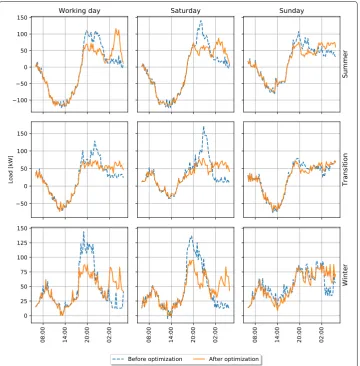
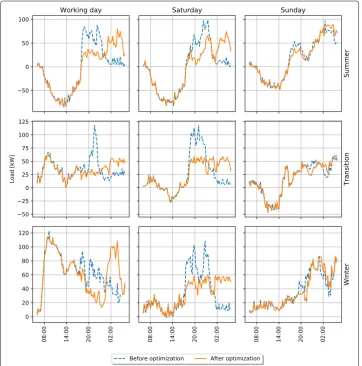
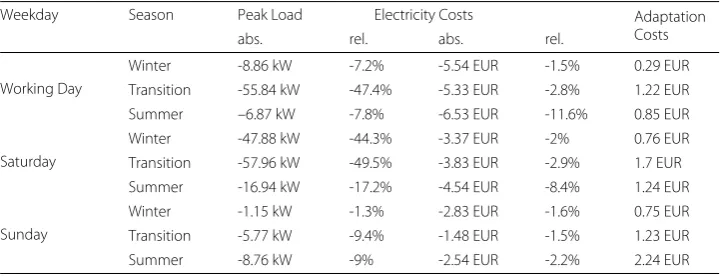
Figure2and Fig.3show the development of the aggregated load of all controllable smart buildings before and after optimization for the simulated days within the two different grids. Table1 and Table 2 show the effect of the optimization regarding the different optimization goals in further detail.
It becomes apparent that the optimization of the scheduling leads to a decrease in the maximum load taken or feed-in to the grid in all simulations. Overall, load peaks can be observed within different periods of the day. In summer days, a negative load peak is observable between 12:00 and 14:00, due to an excessive feed-in of photovoltaic sys-tems. Some simulated days during winter show a peak load in the morning hours due to the electrical demand of heat pumps (e.g. the working day in winter in the urban grid). However, most of the time the most prominent load peak occurs between 18:00 and 23:00. The time and load structure of the households indicate that such peaks stem from charging processes of electrical vehicles.
Fig. 3Simulation results of the aggregated load of 30 interconnected buildings within the urban grid for 2050
The reduction of the load peaks works differently well, depending on the type of the peak. Negative load peaks due to the feed-in of photovoltaic systems can hardly be reduced. The reason for that is that there is usually only little flexibility available during the period of feed-in within the smart buildings. Additionally, the existing flexibility is often associated with high adaptational effort and hence very costly. Another reason for
Table 1Effect of the optimization regarding the multiple objectives for the different simulated days in the rural grid
Weekday Season Peak Load Electricity Costs Adaptation
Costs
abs. rel. abs. rel.
Working Day
Winter -56.8 kW -39.4% -9.30 EUR -3.7% 0.86 EUR
Transition -56 kW -43.5% -5.60 EUR -3.6% 1.90 EUR
Summer -5.36 kW -4.4% -7.11 EUR -11.2% 1.26 EUR
Saturday
Winter -41.72 kW -30.5% -4.24 EUR -1.9% 1.00 EUR
Transition -92.42 kW -54% -4.94 EUR -2.9% 1.55 EUR
Summer -26.19 kW -18.6% -4.22 EUR -7% 1.22 EUR
Sunday
Winter -5.47 kW -5.9% -4.51 EUR -1.8% 1.42 EUR
Transition -7.75 kW -9.8% -5.37 EUR -3.8% 1.85 EUR
Table 2Effect of the optimization regarding the multiple objectives for the different simulated days in the urban grid
Weekday Season Peak Load Electricity Costs Adaptation
Costs
abs. rel. abs. rel.
Working Day
Winter -8.86 kW -7.2% -5.54 EUR -1.5% 0.29 EUR
Transition -55.84 kW -47.4% -5.33 EUR -2.8% 1.22 EUR
Summer –6.87 kW -7.8% -6.53 EUR -11.6% 0.85 EUR
Saturday
Winter -47.88 kW -44.3% -3.37 EUR -2% 0.76 EUR
Transition -57.96 kW -49.5% -3.83 EUR -2.9% 1.7 EUR
Summer -16.94 kW -17.2% -4.54 EUR -8.4% 1.24 EUR
Sunday
Winter -1.15 kW -1.3% -2.83 EUR -1.6% 0.75 EUR
Transition -5.77 kW -9.4% -1.48 EUR -1.5% 1.23 EUR
Summer -8.76 kW -9% -2.54 EUR -2.2% 2.24 EUR
the poor performance regarding the reduction of the negative peaks lies in the fact, that the battery storages within the buildings are run in an immediate charging mode for their reference schedule. Within days of high solar radiation, most of the storages are hence already fully charged in the morning hours. In this case, the storages cannot absorb any more load during the period of the highest solar radiation and the load is directly fed back into the grid.
However, the distributed optimization can lead to a significant reduction of the peak load that arises in consequence of the charging processes of electrical vehicles. If uncon-trolled, the charging processes usually overlap leading to highly simultaneous energy consumption of the different buildings (compare e.g. (Putrus et al.2009)). After optimiza-tion, the charging processes are more evenly spread throughout the possible charging period and hence the peak load can be reduced.
While table1and Table2show that the peak load is reduced in all simulated days, there is a high variance in the amount of this reduction. The main reason for that is that the reduction of negative load is less successful than the reduction of positive load. Therefore, the effect of the optimization regarding the reduction of the peak load is less promi-nent in summer days, when the main grid usage is determined by the negative load due to the feed-in of photovoltaic systems. Another reason for the variance is that the refer-ence schedules for all buildings are based on the behavior of the house inhabitants, which is partly stochastic. Therefore, in some days a higher simultaneity in charging electrical vehicles can be observed (e.g. working day transition in the urban grid) than in other days (e.g. Sunday transition in the urban grid). The collective optimization can lower the simultaneity of energy consumption and hence the optimization effect is more prominent during days of highly simultaneous energy consumption.
Concerning the objective of reducing the maximum load, the benefit of a collective opti-mization becomes apparent. Only if there is a collective goal and knowledge about the scheduled power consumption of other buildings, agents can schedule their power con-sumption accordingly. An optimization of the peak load at the single building level would perform worse in this regard, as the load peaks of different buildings do not necessarily overlap.
Table 1 and Table2 show that this indication is true. However, there is less variance in this effect between the simulated days. This is due to the fact, that the main benefit regarding electricity costs can be derived from shifting positive load from the evening period towards the early morning period which can be done independently of weather conditions.
γ (s)is implemented such that only the maximum load taken from the grid or fed into the grid is charged. If there is a certain maximum load value that cannot be reduced (or reducing it is too costly), γ (s) cannot be reduced any further. In these cases, the other subfunctions of the target function (e.g. (s)) play a more dominant role. This can be seen for example in the working day in summer for the rural grid (Fig. 2). In this simulation, the maximum grid usage is determined by the feed-in of the photo-voltaic systems at around 13:00. Because of this, creating another peak that does not exceed this value would not raise the costs of γ (s). Accordingly, after optimization we can see a new peak regarding the positive load in the early morning hours, where elec-tricity prices are low. However, the absolute value of this new peak does not exceed the maximum absolute value of the negative load caused by the photovoltaic systems. Such optimization strategies are another example for the benefit of a collective opti-mization. At a single building level, there would be no information about the collective negative peak during the day and hence those buildings without a photovoltaic sys-tem could not optimize their scheduling regarding the variable electricity prices as effectively.
However, the underlying flexibilities of the buildings are not sufficient to success-fully match generation and consumption of electricity. That becomes apparent in simulations, where a high feed-in appears during the day due to the photovoltaic systems. There is not enough flexibility to shift a significant amount of load to such periods. One reason for that is that the major power consumer - the electri-cal vehicle - is usually not present at the smart building during the day (and hence it cannot be charged). Another reason is that the user-driven electrical loads are of rather small amount and they are costly to shift as they involve behavioral adaptation efforts.
Regarding the adaptation costs, we can see that the savings of electricity costs always exceed the amount of behavioral adaptation costs. As it is the case with all objectives, this holds for the aggregated view of all interconnected buildings and not necessar-ily at the single building level. As we assume that all agents act on a cooperative basis and solely try to maximize the global target function, an agent would always choose the schedule that is most beneficial for all interconnected buildings, even if the adaptational costs for its building exceeded its individual benefit. A compensa-tion payment between buildings of different owners could be an approach to solve this problem.
Simulations with varying number of controllable buildings Simulation setup
Investigations regarding a varying number of controllable buildings have been performed. For this, configurations for one of the above mentioned simulations has been fixed (the urban grid at a working day in autumn). Using the corresponding parameter set, we exe-cuted numerous simulations with a varying number of controllable buildings. For this we grouped the smart buildings on the basis of their flexibility profile. For each smart building, we calculated the area of the flexibility band as follows:
1. Determine the maximum and the minimum possible power output of the building for each 15-min interval.
2. Calculate the spread of the maximum and the minimum load for each interval. 3. Sum up all these spreads for the whole day.
On the basis of these calculations, we clustered the buildings into four different flexibility groups: buildings with no flexibility, buildings with low flexibility, buildings with medium flexibility and buildings with high flexibility.
We then simulated different scenarios, which differed only in the number of controllable buildings included in the optimization process. In each scenario, the number of control-lable buildings was fixed, as well as the corresponding flexibility groups from which the buildings were picked. However, the particular buildings that were chosen from each flex-ibility group was determined randomly and hence we executed 10 simulations for each scenario with varying random numbers. Non-controllable buildings were assumed to realize their default schedule with no adaptation costs. In the last simulations, all building in the grid (102 buildings) were assumed to be controllable and hence all buildings were included in the optimization process.
Simulation results
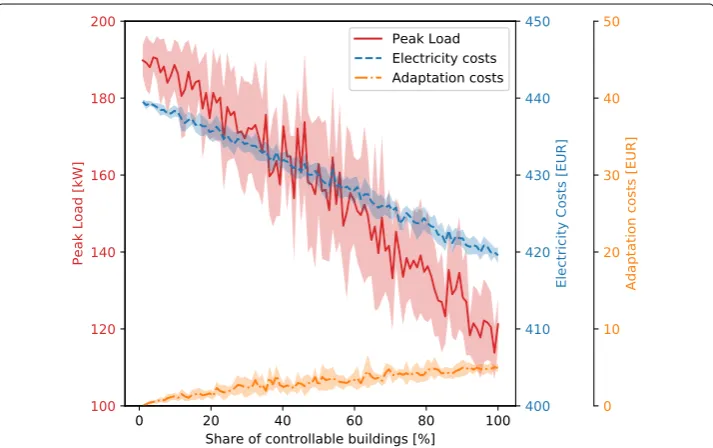
Figure4shows the results of simulations with a varying number of controllable build-ings. It becomes apparent that increasing the amount of smart buildings that are part of the multi-objective optimization process leads to a reduction of the peak load and to a decrease of electricity costs for the whole grid, while the adaptation costs increase. The course of this effect is linear. Interestingly, the results for the peak load show the highest standard deviation. This indicates that there are certain buildings with critical schedules, which - if uncontrolled - lead to a high peak load. Regarding the development of electric-ity costs and adaptation costs there is less variation. However, on average an increase of the share of controlled buildings in the grid does lead to an average net benefit for both scales. Therefore, the share of controllable buildings remains a critical parameter when analyzing the effect of the optimization for a whole grid, in which not all buildings are controllable.
Conclusion, Discussion and Outlook
Fig. 4Results of simulations with a varying number of interconnected buildings regarding the maximum load, the electricity costs and the adaptational costs. For each setting, 10 simulations with different controllable buildings have been executed. The shaded area displays the standard deviation
simulations with a well-funded data basis, we carried out intensive preliminary research about the users behavior and its adaptational efforts as well as about the modelling of smart buildings and its flexibilities of electricity consumption.
We showed that the given flexibilities of smart buildings can be used to pursue all tar-gets. Furthermore, we displayed the advantage of integrating the different goals into one optimization process. If for example a certain peak load cannot be reduced any further, this peak can be seen as a limit. The remaining flexibilities can then be used to shift a large amount of load towards times of low electricity prices as long as any new peak does exceed the existing one. Another advantage of integrating multiple criteria into one opti-mization process lies in a more complete cost-benefit analysis of the given flexibility. An optimal decision can be made only if the aggregated net benefit of a certain schedule including all optimization goals is evaluated. Certain flexibility may be too expensive to justify its use solely for peak load reduction or electricity cost reduction. However, this may change, when the aggregated benefits for both targets are taken into account.
In order to integrate the different objectives into one target function, we chose a monetarization approach. This seems justifiable, given that the use case under investi-gation describes a rather bottom-up approach, in which interconnected smart buildings optimize their electricity consumption in order to get a monetary benefit.
Regarding the simulated load curves, it becomes apparent that, if the number of electri-cal vehicle increases massively, the corresponding charging processes play an important role in a future electricity grid. Our simulations confirm that, if uncontrolled, the con-current charging of electrical vehicles produces high load peaks. This can be significantly reduced by a control mechanism which spreads the charging processes throughout a longer time span.
In our work, the potential of battery storages is not included in its full extent, as we assumed battery storages to run in a grid-unaware mode. Because of that, the battery stor-ages in our simulation do hardly contribute in reducing negative peaks. However, massive feed-in of photovoltaic systems may play a prominent role in a future energy system. It can be assumed that this problem can be reduced, if battery storages reserved a certain share of their capacity for times with high feed-in of photovoltaic systems. However, as the flexibility of battery storages is generally a lot greater compared to the flexibility of domestic load, we implemented a separate battery agent, which calculates the flexibility of battery storages in a more suitable manner.
Regarding the investigated time period we chose to simulate nine different days includ-ing different characteristics regardinclud-ing the weekday and the season. However, simulations still remained in an 24 h frame, which leads to a limited representation of the flexibility. This can be seen when looking at the flexibility of electrical heat pumps. In reality heat pumps are flexible to shift part of their needed electricity consumption in order to fulfill the thermal demand towards earlier times. However, this is not included in our simula-tions as all simulasimula-tions start at 06:00. In future work, simulasimula-tions of longer periods must be executed to see, if these load peaks of electrical heat pumps can be reduced.
In this work we have solely used COHDA as the underlying optimization heuristic. Comparing the presented results to simulation results with another distributed optimiza-tion heuristic using the exact same setting would certainly be interesting. However, due to the enormous simulation effort we had to forgo additional simulations. In (Hölker2018), the three distributed optimization heuristics COHDA, PowerMatcher and PrivADE (see (Brettschneider et al.2017) for more details about PrivADE) are compared. As no signif-icant differences between the three heuristics regarding the quality of the results could be identified, we do not expect the choice of the distributed optimization heuristic to be critical for this work.
Overall, we presented a novel approach for a distributed cooperative optimization of the scheduling of power consumption for smart buildings on the basis of multiple criteria. We showed that our approach leads to a net-benefit for the interconnected smart buildings regarding all included criteria. We additionally displayed possibilities for further investi-gation and improvement of the presented approach and hence provided a valuable basis that can be used for further research regarding a cost-efficient use of flexibilities in the consumption of electrical power.
About this supplement
This article has been published as part of Energy Informatics Volume 2 Supplement 1, 2019: Proceedings of the 8th DACH+ Conference on Energy Informatics. The full contents of the supplement are available online athttps:// energyinformatics.springeropen.com/articles/supplements/volume-2-supplement-1
Authors’ contributions
efforts. AN was involved in the “Related Work” section as well as in the implementation of the multi-agent system ISAAC. MS was involved in writing the introduction and moreover gave his scientific support during the whole research period. All authors have read and approved the final manuscript.
Funding
We gratefully acknowledge funding for the project “NEDS - Nachhaltige Energieversorgung Niedersachsen” supported by the Lower Saxony Ministry of Science and Culture through the “Niedersächsisches Vorab” grant programme (grant ZN3043). Publication of this supplement was funded by Austrian Federal Ministry for Transport, Innovation and Technology.
Availability of data and materials
Data regarding the electricity prices and the network fees used within the target function can be found athttps://github. com/mnebel-wenner/Data-multi-objective-scheduling. The concrete scenario definition can be found in ((Blaufuß et al.), chap. 9.5) and (Blank et al.2019). Details about the building model are available at ((Blaufuß et al.), chap. 9.2). Information about the determination of behavioral adaption costs can be found in ((Blaufuß et al.), chap. 9.1).
Competing interests
The authors declare that they have no competing interests.
Author details
1OFFIS - Institute for Information Technology, R&D Division Energy, Escherweg 2, 26121, Oldenburg, Germany. 2Technische Universität Braunschweig, Institute for High Voltage Technology and Electrical Power Systems - elenia,
Schleinitzstraße 23, 38106, Braunschweig, Germany.3Technische Universität Braunschweig, Institute of Psychology,
Division of Research Methods and Biopsychology - IPMB, Spielmannstraße 19, 38106, Braunschweig, Germany.4Leibniz
Universität Hannover, Faculty for Electrical Engineering and Computer Science, Group Energy Informatics, Appelstr. 9a, 30167, Hannover, Germany.
References
Arias L, Rivas E, Santamaria F, Hernandez V (2018) A review and analysis of trends related to demand response. Energies 11(7):1617
Barbato A, Capone A (2014) Optimization models and methods for demand-side management of residential users: A survey. Energies 7(9):5787–5824
Blank M, Blaufuß C, Glötzel M, Minnemann J, Nebel-Wenner M, Nieße A, Pothen F, Reinhold C, Schwarz JS, Stahlecker K, Wille F, Witt T, Eggert F, Engel B, Geldermann J, Hofmann L, Hübler M, Lehnhoff S, Paech N, Sonnenschein M (2019) Whitepaper: NEDS Szenarien – Zukunftsszenarien für eine nachhaltige Energieversorgung in Niedersachsen für das Jahr 2050.https://www.neds-niedersachsen.de/uploads/tx_tkpublikationen/Whitepaper-Szenarien-V1.pdf. Accessed 7 Jan 2019
Blaufuß C, Dumeier M, Kleinau M, Krause H, Minneman J, Nebel-Wenner M, Reinhold C, Schwarz JS, Wille F, Witt T, Busse C, Eggert F, Engel B, Geldermann J, Hofmann L, Hübler M, Lehnhoff S, Sonnenschein M, Seidel J Development of a Process for Integrated Development and Evaluation of Energy Scenarios for Lower Saxony – Final Report of the Research Project NEDS – Nachhaltige Energieversorgung Niedersachsen. Cuvillier, Göttingen. (2019, in print) Bremer J, Lehnhoff S (2018) Hybridizing s-metric selection and support vector decoder for constrained multi-objective
energy management. In: International Conference on Hybrid Intelligent Systems. Springer, Berlin, Heidelberg. pp 249–259
Brettschneider D., Hölker D., Scheerhorn A., Tönjes R. (2017) Preserving privacy in distributed energy management. Comput Sci-Res Dev 32(1-2):159–171
Coelho VN, Weiss Cohen M, Coelho IM, Liu N, Guimarães FG (2017) Multi-agent systems applied for energy systems integration: State-of-the-art applications and trends in microgrids. Appl Energy 187(1):820–832
Ehrgott M. (2005) Multicriteria optimization. Springer Science, Heidelberg, Berlin
Elsner P, Fischedick M, Sauer DU (2015) Flexibilitätskonzepte Für die Stromversorgung 2050 – Technologien, Szenarien, Systemzusammenhänge. acatech, Reihe Energiesysteme der Zukunft, München
Esther BP, Kumar KS (2016) A survey on residential demand side management architecture, approaches, optimization models and methods. Renew Sust Energ Rev 59:342–351
Fernandez LP, San Roman TG, Cossent R, Domingo CM, Frias P (2011) Assessment of the impact of plug-in electric vehicles on distribution networks. IEEE Trans Power Syst 26(1):206–213
Faulstich M, et al. (2016) Szenarien zur Energieversorgung in Niedersachsen im Jahr 2050: Gutachten. Technical report. Niedersächsisches Ministerium für Umwelt, Energie und Klimaschutz, Hannover
FDZ der Statistischen Ämter des Bundes und der Länder (2015) Zeitverwendungserhebung 2012/2013. Technical report, Statistisches Bundesamt, Wiesbaden
Fioretto F, Yeoh W, Pontelli E (2017) A multiagent system approach to scheduling devices in smart homes. In: Proceedings of the 16th Conference on Autonomous Agents and MultiAgent Systems. AAMAS ’17. International Foundation for Autonomous Agents and Multiagent Systems, Richland. pp 981–989
Geppert J, Stamminger R (2010) Do consumers act in a sustainable way using their refrigerator? The influence of consumer real life behaviour on the energy consumption of cooling appliances. Int J Consum Stud 34(2):219–227 Grodzevich O., Romanko O. (2006) Normalization and other topics in multi-objective optimization. In: Proceedings of the
Fields-MITACS Industrial Problems Workshop 2006. MITACS, Toronto
Hinrichs C, Sonnenschein M (2016) A distributed combinatorial optimisation heuristic for the scheduling of energy resources represented by self-interested agents. Int J Bio-Inspired Comput 8:69–78
Hölker D (2018) Qualitätsbewertung von Energiemanagement-Algorithmen unter Berücksichtigung eingeschränkter Kommunikationsparameter. PhD thesis, BIS der Universität Oldenburg
Hölker D, Brettschneider D, Toenjes R, Sonnenschein M (2017) Choosing communication technologies for distributed energy management in the smart grid. In: 2017 IEEE PES Innovative Smart Grid Technologies Conference Europe (ISGT-Europe). IEEE, Piscataway. pp 1–6
Kallrath J, Pardalos PM, Rebennack S, Scheidt M (2009) Optimization in the Energy Industry. Springer, Berlin Kok K, Warmer C, Kamphuis R, Mellstrand P, Gustavsson R (2005) Distributed Control in the Electricity Infrastructure. In:
Proceedings of the International Conference on Future Power Systems, 2005. IEEE, Piscataway
Logenthiran T, Srinivasan D, Shun TZ (2012) Demand side management in smart grid using heuristic optimization. IEEE Trans Smart Grid 3(3):1244–1252
Maier M (2018) Metaanalyse: Digitalisierung der energiewende. Agentur für erneuerbare Energien, Forschungsradar Energiewende
Nieße A, Tröschel M (2016) Controlled self-organization in smart grids. In: 2016 IEEE International Symposium on Systems Engineering (ISSE). IEEE, Piscataway. pp 1–6
Putrus GA, Suwanapingkarl P, Johnston D, Bentley EC, Narayana M (2009) Impact of electric vehicles on power distribution networks. In: 2009 IEEE Vehicle Power and Propulsion Conference. IEEE, Piscataway. pp 827–831 Ramchurn SD, Vytelingum P, Rogers A, Jennings N (2011) Agent-based control for decentralised demand side
management in the smart grid. In: The 10th International Conference on Autonomous Agents and Multiagent Systems - Volume 1. AAMAS ’11. International Foundation for Autonomous Agents and Multiagent Systems, Richland, SC. pp 5–12
Reinhold C, Engel B (2017) Simulation environment for investigations of energy flows in residential districts and energy management systems. In: ETG (ed.) International ETG Congress 2017. VDE Verlag GmbH, Berlin and Offenbach Reinhold C, Wille F, Engel B, Eggert F (2018) Empirische und synthetische Lastprognose von nutzerabhängigen
Verbrauchsgeräten. In: 15. Symposium Energieinnovation. Verlag der Technischen Universität Graz, Graz
Robu V, Vinyals M, Rogers A, Jennings NR (2018) Efficient Buyer Groups With Prediction-of-Use Electricity Tariffs. IEEE Trans Smart Grid 9(5):4468–4479
Schuitema G, Ryan L, Aravena C (2017) The consumer’s role in flexible energy systems. IEEE Power Energy Mag 15(1):53–60 Seebauer S, Berger M, Kettl K, Moser M (2013) Green gang vs. captain carbon. integration of automated data collection
and ecological footprint feedback in a smartphone-based social game for carbon saving. In: 2013 5th International Conference on Games and Virtual Worlds for Serious Applications (VS-GAMES). pp 1–2
Silvertown J. (2015) Have ecosystem services been oversold?. Trends Ecol Evol 30(11):641–648
Sintov ND, Schultz PW (2015) Unlocking the potential of smart grid technologies with behavioral science. Front Psychol 6:410
Skinner B (1981) Selection by consequences. Science 213(4507):501–504
Sonnenschein M, Lünsdorf O, Bremer J, Tröschel M (2015) Decentralized control of units in smart grids for the support of renewable energy supply. Environ Impact Assess Rev 52:40–52
Stamminger R (2011) Modelling resource consumption for laundry and dish treatment in individual households for various consumer segments. Energy Efficiency 4(4):559–569
Torriti J, Hassan MG, Leach M (2010) Demand response experience in europe: Policies, programmes and implementation. Energy 35(4):1575–1583
Zhu J (2015) Optimization of Power System Operation vol. 47. Wiley, Hoboken
Publisher’s Note
Springer Nature remains neutral with regard to jurisdictional claims in published maps and institutional affiliations.
Submit your manuscript to a
journal and benefi t from:
7Convenient online submission
7Rigorous peer review
7Immediate publication on acceptance
7Open access: articles freely available online
7High visibility within the fi eld
7Retaining the copyright to your article