R E S E A R C H A R T I C L E
Open Access
Bubble CPAP to support preterm infants in
rural Rwanda: a retrospective cohort study
Evrard Nahimana
1,5*, Masudi Ngendahayo
2, Hema Magge
1,3,4, Jackline Odhiambo
1, Cheryl L. Amoroso
1,
Ernest Muhirwa
1, Jean Nepo Uwilingiyemungu
2, Fulgence Nkikabahizi
2, Regis Habimana
2and Bethany L. Hedt-Gauthier
1,5Abstract
Background:Complications from premature birth contribute to 35 % of neonatal deaths globally; therefore, efforts to improve clinical outcomes of preterm (PT) infants are imperative. Bubble continuous positive airway pressure (bCPAP) is a low-cost, effective way to improve the respiratory status of preterm and very low birth weight (VLBW) infants. However, bCPAP remains largely inaccessible in resource-limited settings, and information on the scale-up of this technology in rural health facilities is limited. This paper describes health providers’adherence to bCPAP protocols for PT/VLBW infants and clinical outcomes in rural Rwanda.
Methods:This retrospective chart review included all newborns admitted to neonatal units in three rural hospitals in Rwanda between February 1st and October 31st, 2013. Analysis was restricted to PT/VLBW infants. bCPAP eligibility, identification of bCPAP eligibility and complications were assessed. Final outcome was assessed overall and by bCPAP initiation status.
Results:There were 136 PT/VLBW infants. For the 135 whose bCPAP eligibility could be determined, 83 (61.5 %) were bCPAP-eligible. Of bCPAP-eligible infants, 49 (59.0 %) were correctly identified by health providers and 43 (51.8 %) were correctly initiated on bCPAP. For the 52 infants who were not bCPAP-eligible, 45 (86.5 %) were correctly identified as not bCPAP-eligible, and 46 (88.5 %) did not receive bCPAP. Overall, 90 (66.2 %) infants survived to discharge, 35 (25.7 %) died, 3 (2.2 %) were referred for tertiary care and 8 (5.9 %) had unknown outcomes. Among the bCPAP eligible infants, the survival rates were 41.8 % (18 of 43) for those in whom the procedure was initiated and 56.5 % (13 of 23) for those in whom it was not initiated. No complications of bCPAP were reported.
Conclusion:While the use of bCPAP in this rural setting appears feasible, correct identification of eligible newborns was a challenge. Mentorship and refresher trainings may improve guideline adherence, particularly given high rates of staff turnover. Future research should explore implementation challenges and assess the impact of bCPAP on long-term outcomes.
Keywords:bCPAP, Very low birth weight, Preterm, Premature, Respiratory distress, CPAP, Rwanda, Africa
Background
Over 2.9 million neonatal deaths occur every year, repre-senting 44 % of all under five deaths [1–3]. In Rwanda, despite a rapid decline in under-five mortality, the number of deaths in the neonatal period remains high (27/1000 live births) with little change over the past 10 years [4, 5].
Major causes of neonatal deaths include preterm birth, birth asphyxia and infections. Recently, complications re-lated to prematurity have surpassed pneumonia and diar-rheal diseases as the number one cause death in children, and account for 35 % of all neonatal deaths [1–3, 6–8]. Hospital-based interventions targeting these causes are needed to reduce neonatal mortality, particularly in low and middle income countries [9–11].
The implementation of hospital-based interventions is challenging in resource limited settings. Specifically, in-tensive care unit technology for respiratory distress, such * Correspondence:[email protected]
1Partners In Health/Inshuti Mu Buzima, Rwinkwavu, Rwanda 5
Department of Global Health and Social Medicine, Harvard Medical School, 02115 Boston, MA, USA
Full list of author information is available at the end of the article
as a mechanical ventilation, is often not available due to high costs, maintenance demands and the need for highly trained staff. However, continuous positive airway pressure (CPAP) has been demonstrated to be a simple, low-cost and effective alternative to improve the respiratory status of preterm infants with respiratory distress syndrome [12, 13], and decrease the need for conventional mechanical ventila-tors [12, 14]. CPAP helps keep the respiratory tract and lungs open, promotes comfortable breathing, improves oxygen levels and decreases apnea in premature infants. Bubble CPAP (bCPAP) is the least expensive and least complicated CPAP option, making this the preferred tech-nology in resource-limited settings [15, 16].
To date, few studies have been conducted to show the impact and feasibility of bCPAP in areas with limited re-sources. These studies, most of which were conducted in teaching and/or urban hospitals, have shown that bCPAP can reduce the need for mechanical ventilation and can be applied by nurses after a short on-the-job training on the protocol and equipment [12, 17]. However, little research has been done on the use of bCPAP in rural resource-limited settings and hospitals without pediatric specialists.
In January 2013, the Rwandan Ministry of Health (MOH), in collaboration with Partners In Health (PIH), introduced a bCPAP program integrated into broader neonatal care services for newborns with respiratory dis-tress in three rural district hospitals (Butaro, Kirehe and Rwinkwavu District Hospitals). Nurses and general practi-tioners working in the neonatal units in these hospitals with a background in neonatal care services received in-tensive training on advanced neonatal care, focusing on the bCPAP protocol, safe assembly, maintenance and trouble-shooting of different issues related to bCPAP use. The training was supplemented by ongoing clinical men-torship and intermittent refresher trainings led by PIH and local MOH bCPAP champions.
The objectives of this study are to describe the pro-vider adherence to bCPAP protocol for preterm and very low birth weight (PT/VLBW) infants and to describe the outcomes of these infants at the three district hospitals. The ultimate goal is to better understand the use of bCPAP in rural resource-limited settings in order to im-prove the quality of bCPAP implementation and inform the scale-up of this technology in similar settings.
Methods
This retrospective cohort study included infants receiving care at neonatal units at Rwinkwavu, Kirehe and Butaro District Hospitals from February 1, 2013 to October 31, 2013. The catchment area included 865,000 people and care at the hospital was obtained after referral from one of the 41 health centers within the districts. These three hos-pitals were selected for the study as they were the only rural district hospitals providing basic neonatal care using
bCPAP in Rwanda in 2013. A team of nurses and general practitioners worked permanently in these units providing care to an average of 25 infants every month in each hos-pital. Infants who needed intensive neonatal care, includ-ing mechanical ventilators, were referred to tertiary hospitals in Kigali city (the capital of Rwanda). Following the training on implementation of bCPAP, Rwinkwavu and Kirehe District Hospitals benefited from fairly consist-ent mconsist-entorship from PIH pediatric specialists during the study period while Butaro hospital had more intermittent specialist presence.
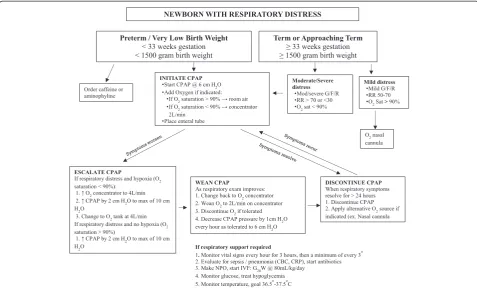
Respiratory assessment to determine the need for bCPAP is based on physical examination (such as grunt-ing, nasal flaring and chest retraction) and vital signs (including respiratory rate and/or oxygen saturation). In addition, the etiology of respiratory symptoms and the natural history of that diagnosis are considered. Once the overall assessment is complete, the degree of respira-tory distress is categorized as mild, moderate or severe. Moderate to severe signs include moderate to severe grunting, flaring, retractions and respiratory rate >70 or <30 and/or oxygen saturation <90 % (The oxygen saturation was measured using pulse oximeter). Based on the bCPAP protocol used in the three district hospi-tals, any newborn with a moderate to severe respiratory distress should have been initiated on bCPAP (Fig. 1). Furthermore, preterm (gestational age (GA) <33 weeks) or very low birth weight (<1500 g) infants with any de-gree of respiratory distress (mild, moderate or severe) should have been initiated on bCPAP. Preterm infants with significant apnea and bradycardia of prematurity were also eligible.
after data validation. We analyzed data using Stata 12.1 (College Station, TX: StataCorp LP). We used descriptive statistics reporting number and percent of infant charac-teristics, infants identified as eligible for bCPAP, infants for whom bCPAP was initiated and clinical outcomes based on CPAP eligibility. We also used median and interquartile range for the duration of stay in the hospital.
The study received technical and ethical approvals from Rwanda institutional review boards: The Inshuti Mu Buzima Research Committee (IMBRC), the National Health Research Committee (NHRC) and the Rwanda Na-tional Ethics Committee (RNEC). As the study used de-identified routinely corrected data, the consent for parents was waived. STROBE (STrengthening the Reporting of OB-servational studies in Epidemiology) guidelines were also followed for this study.
Results
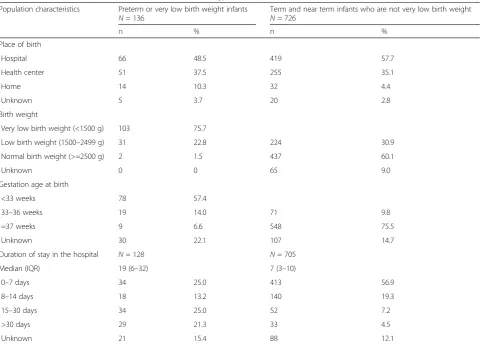
During the study period, 862 infants were admitted in the three hospitals. Of these, 136 (16 %) were identified as PT/ VLBW and included in the analysis (Table 1). Of the 136 infants, 75.7 % (n= 103) were VLBW and 57.4 % (n= 78) were preterm. Most of the PT/VLBW infants (n= 117, 86 %) were born at a health facility, either hospital or health center. The median number of days of stay at the hospital was 19 with an interquartile range of 6–32 days. In assessing the presence of respiratory distress symptoms
among PT/VLBW infants, 61.0 % (n= 83) showed at least one sign of respiratory distress (Table 2). Many of the infants (50.7 %, n= 69) had low oxygen saturation (SpO2<90 %) and 38 infants (28.4 %) had chest retraction. In some cases, the clinicians only mentioned infants in re-spiratory distress without specifying the physical symp-toms. One infant did not have documentation of the presence or absence of respiratory distress and thus, bCPAP eligibility could not be determined.
Of the 135 PT/VLBW infants whose bCPAP eligibility could be determined, 61.5 % (n= 83) were bCPAP-eligible of which 59.0 % (n= 49) were correctly identified by health providers and for 51.8 % (n= 43) bCPAP was initi-ated. Twenty-three bCPAP-eligible infants (27.7 %) had no indication of being identified as bCPAP eligible or of being initiated on bCPAP. Information around identification was missing for 13.3 % (n= 11) of infants who were eligible (Table 3). For the 52 infants who were not bCPAP-eligible, 45 (86.5 %) were correctly identified as not bCPAP-eligible and 46 (88.5 %) did not receive bCPAP.
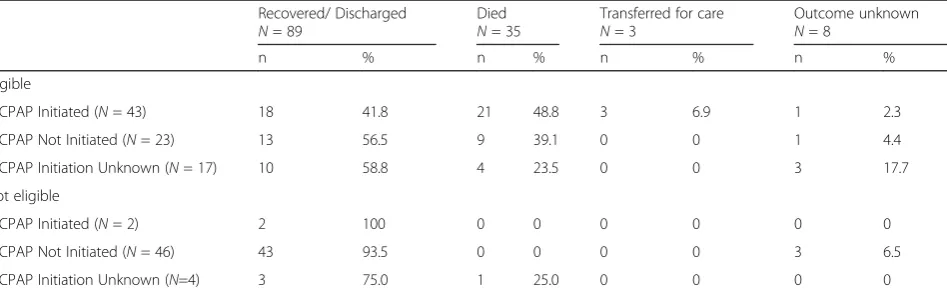
(Table 4). Of the 23 bCPAP-eligible infants for whom bCPAP was not initiated, 56.5 % (n= 13) recovered, 39.1 % (n= 9) died and information about the outcome was miss-ing for 4.4 % (n= 1). Outcome information was missing for 1 (2.3 %) infant. A large proportion of infants who were CPAP ineligible recovered whether bCPAP was initiated (100 %, 2 out 2) or not initiated (93.5 %, 43 out of 46). For infants who did receive bCPAP, no complications such as skin injury, pneumothorax or abdominal distention were reported.
Discussion
In this study, we assessed the implementation of bCPAP with PT/VLBW infants at three district hospi-tals in rural Rwanda and found the intervention feasible in a resource-limited rural setting. Over the nine-month period, 45 infants were initiated on bCPAP, demonstrating that bCPAP–an evidence-based intervention to improve survival or PT/VLBW infants – is filling a medical care need for neonates. However, only 52 % of bCPAP-eligible infants received bCPAP, suggesting ongoing gaps in cor-rect identification and initiation of eligible infants. We suspect that this low sensitivity might be a result of
turnover of nurses and doctors and could be improved with increased onsite mentorship and refresher trainings, particularly to identify early and mild signs of distress promptly for immediate CPAP initiation to gain the full benefit of the intervention. Qualitative research to assess and understand the barriers to implementation experi-enced by nurses and doctors is also advised.
Conversely, 88.5 % of bCPAP ineligible infants were not initiated, indicating that clinicians are not exposing Table 1Characteristics of infants admitted to the neonatology unit in three district hospitals in Rwanda
Population characteristics Preterm or very low birth weight infants Term and near term infants who are not very low birth weight
N= 136 N= 726
n % n %
Place of birth
Hospital 66 48.5 419 57.7
Health center 51 37.5 255 35.1
Home 14 10.3 32 4.4
Unknown 5 3.7 20 2.8
Birth weight
Very low birth weight (<1500 g) 103 75.7
Low birth weight (1500–2499 g) 31 22.8 224 30.9
Normal birth weight (>=2500 g) 2 1.5 437 60.1
Unknown 0 0 65 9.0
Gestation age at birth
<33 weeks 78 57.4
33–36 weeks 19 14.0 71 9.8
=37 weeks 9 6.6 548 75.5
Unknown 30 22.1 107 14.7
Duration of stay in the hospital N= 128 N= 705
Median (IQR) 19 (6–32) 7 (3–10)
0–7 days 34 25.0 413 56.9
8–14 days 18 13.2 140 19.3
15–30 days 34 25.0 52 7.2
>30 days 29 21.3 33 4.5
Unknown 21 15.4 88 12.1
Table 2Evidence of respiratory distress among preterm (<33 weeks) or very low birth weight (<1500 g) infants
Sign of respiratory distress (N= 136) Infants with symptoms
n %
SpO2<90 % 69 50.7
Grunting (N= 134) 17 12.7
Chest retraction (N= 134) 38 28.4
Nasal flaring (N= 134) 15 11.2
Respiration rate <30 or >70 24 17.7
At least one sign of respiratory distress (N= 135)
ineligible infants to possible bCPAP side effects and con-serving the machines for the infants most in need. Only two of the bCPAP initiated infants were bCPAP ineligible according to medical file documentation, an improvement over a study in Malawi where of the 11 neonates treated with bCPAP, six did not meet initiation criteria [16].
A quarter of infants included in this study died before discharge from the hospital. This mortality rate is similar to outcomes of PT/VLBW infants in similar settings in sub-Saharan Africa [18–20]. The highest rate of death in this study, nearly 49 %, occurred in infants eligible for CPAP who died after initiation. Given the low sensitivity of CPAP initiation, we suspect that this group had a higher severity of respiratory distress and other comorbidities compared to infants who were not initiated on CPAP. We were unable to accurately assess the severity of respiratory distress among those who were eligible but not initiated on CPAP; however, we suspect that they were likely to be less severely ill. In addition, our study was conducted in rural hospitals without full-time pediatric specialists on staff; however, similarly high mortality rates among bCPAP initi-ated infants have been reported in studies conducted in teaching hospitals with more specialized staff [15–17, 21].
There are several limitations to consider for this study. This study is based entirely on routinely collected data available in the patient file. While we cannot verify the ac-curacy of diagnosis, we believe the information provided by clinicians is reliable because of their clinical back-ground and expertise. For some cases, however, there was limited documentation from clinicians especially on the severity of respiratory distress. Our study excluded term and near-term infants whose bCPAP eligibility depended on the severity of respiratory distress, which was difficult to capture in patients records. Furthermore, we were un-able to assess the degree of distress among eligible infants whom were not provided bCPAP to assess for possible selection bias. In a few cases for the PT/VLBW infants, it was difficult to determine whether the infant was identified for bCPAP or initiated on bCPAP. To improve documen-tation and resulting quality improvement, we recommend the revision of the neonatology patient chart and onsite training/supervision. Despite these challenges, we believe these results are informative as they represent the first as-sessment of bCPAP implementation in rural Rwanda and thus provide a basis for informing better service delivery and bCPAP scale-up in similar settings.
Table 3bCPAP identification and initiation for preterm (<33 weeks) or very low birth weight (<1500) infants
bCPAP eligible bCPAP Not eligible Total
N= 83 N= 52 N= 135a
n % n % n %
Identified as bCPAP-Eligible
Yes 49 59.0 3 5.8 52 38.5
No 23 27.7 45 86.5 68 50.4
Unknown 11 13.3 4 7.7 15 11.1
bCPAP Initiated
Yes 43 51.8 2 3.9 36 33.3
No 23 27.7 46 88.5 60 51.3
Unknown 17 20.5 4 7.7 21 17.9
a
One infant’s eligibility could not be determined
Table 4Clinical Outcomes for Preterm (<33 weeks) or very low birth weight infants (<1500 g) with and without bCPAP intervention
Recovered/ Discharged Died Transferred for care Outcome unknown
N= 89 N= 35 N= 3 N= 8
n % n % n % n %
Eligible
bCPAP Initiated (N= 43) 18 41.8 21 48.8 3 6.9 1 2.3
bCPAP Not Initiated (N= 23) 13 56.5 9 39.1 0 0 1 4.4
bCPAP Initiation Unknown (N= 17) 10 58.8 4 23.5 0 0 3 17.7
Not eligible
bCPAP Initiated (N= 2) 2 100 0 0 0 0 0 0
bCPAP Not Initiated (N= 46) 43 93.5 0 0 0 0 3 6.5
Conclusion
To our knowledge, this is the first study of implementation of bCPAP in rural district hospitals in sub-Saharan Africa. We found that bCPAP is a feasible way to support infants with respiratory distress in resource-limited settings. While the introduction and use of bCPAP in this setting appears promising, there remain challenges in terms of guideline adherence. We believe that providing more intense men-torship and refresher trainings can improve guideline ad-herence, particularly given the high rates of staff turnover. We also recommend the adaption of clinical charts to facilitate clinical determination of degree of respiratory dis-tress and consequent decision-making. Future qualitative and prospective research is needed to determine challenges encountered by clinicians in using bCPAP as well as delin-eate the reasons for high mortality among infants put on CPAP. Finally and critically, more research is needed to assess the impact of bCPAP on long-term survival and out-comes for PT/VLBW infants.
Abbreviations
BCPAP:Bubble continuous positive airway pressure; CPAP: Continuous positive airway pressure; GA: Gestation age; ID: Identification; IMB: Inshuti Mu Buzima; MOH: Ministry of Health; PIH: Partners In Health; PT: Preterm; SpO2: Oxygen saturation; STROBE: STrengthening the Reporting of
OBservational studies in Epidemiology; VLBW: Very low birth weight.
Competing interests
The authors declare that they have no competing interests.
Authors’contributions
EN and MN led the study design, data collection oversight, data analysis and interpretation, and manuscript preparation. HM provided inputs on study design, data analysis and interpretation, and manuscript preparation. JO supported data collection oversight, data analysis and interpretation, and manuscript preparation. CA supported determination of study design, data analysis, interpretation, manuscript preparation and team mentorship. EM, JNU, FN and RH supported study design, data interpretation, and manuscript preparation. BHG supervised the research process and provided inputs in study design, data analysis, interpretation, manuscript preparation and mentorship. All authors read and approved the final manuscript.
Authors’information
EN: MD, District Clinical Director, Partners In Health/Inshuti Mu Buzima, Rwanda.
MN: MD, Head of Pediatric Department, Kirehe District Hospital, Ministry of Health/ Rwanda.
HM: MD, Director of Pediatrics, Partners In Health/Inshuti Mu Buzima, Rwanda.
JO: BA, Research Fellow, Partners In Health/Inshuti Mu Buzima, Rwanda. CA: MPH, Director of Research, Monitoring and Evaluation and Health Information Systems, Partners In Health/Inshuti Mu Buzima, Rwanda. EM: Monitoring and evaluation coordinator, Partners In Health/Inshuti Mu Buzima, Rwanda.
JNU: MD, Director of Kirehe Hospital, Ministry of Health/Rwanda. FN: MD, Director of Rwinkwavu Hospital, Ministry of Health/Rwanda. RH: MD, Head of Pediatric Department, Butaro Hospital, Ministry of Health/ Rwanda.
BHG: PhD, Research Advisor, Partners In Health/Inshuti Mu Buzima, Rwanda.
Acknowledgements
We acknowledge Partners In Health/Inshuti Mu Buzima and the IMB Innovation Grants for the support of this work. This study was developed under the Partners In Health/Inshuti Mu Buzima Intermediate Operational Research Training Program, developed and facilitated by Bethany Hedt-Gauthier and Cheryl Amoroso. Authors
also thank PIH and the MOH for providing support for the implementation of bCPAP at the three districts. We express our gratitude to the data collectors Lisa Munyana, Michel Nshimiyimana, Lievin Bayahunde and Liliose Mukantaganzwa.
Author details 1
Partners In Health/Inshuti Mu Buzima, Rwinkwavu, Rwanda.2Ministry of Health, Kigali, Rwanda.3Division of General Pediatrics, Boston Children’s Hospital, Boston, USA.4Division of Global Health Equity, Brigham and Women’s Hospital, Boston, USA.5Department of Global Health and Social Medicine, Harvard Medical School, 02115 Boston, MA, USA.
Received: 28 January 2015 Accepted: 11 September 2015
References
1. United Nations Children’s Fund (UNICEF), World Health Organization (WHO), The World Bank. Levels and trends in child mortality: report 2013. New York: UNICEF; 2013.
2. Lawn JE, Blencowe H, Oza S, You D, Lee AC, Waiswa P, et al. Every Newborn: progress, priorities and potential beyond survival. Lancet. 2014;384(9938):189–205.
3. Liu L, Oza S, Hogan D, Perin J, Rudan I, Lawn JE, et al. Global, regional, and national causes of child mortality in 2000–13, with projections to inform post-2015 priorities: an updated systematic analysis. Lancet. 2014. http:// dx.doi.org/10.1016/S0140-6736(14)61698-6.
4. Farmer PE, Nutt CT, Wagner CM, Sekabaraga C, Nuthulaganti T, Weigel JL, Farmer DB, Habinshuti A, Mugeni SD, Karasi JC, Drobac PC. Reduced premature mortality in Rwanda: lessons from success. Br Med J. 2013;346. http://dx.doi.org/10.1136/bmj.f65.
5. Rwanda Demographic and Health Survey 2010. http://www.statistics.gov.rw/ publications/demographic-and-health-survey-2010-final-report.
6. Blencowe H, Cousens S, Chou D, Oestergaard M, Say L, Molle AB, et al. Born Too Soon: the global epidemiology of 15 million preterm births. Reprod Health. 2013;10 Suppl 1:S2.
7. Cooper PA. The challenge of reducing neonatal mortality in low-and middle-income countries. Pediatrics. 2014;133(1):4–6.
8. Black RE, Cousens S, Johnson HL, Lawn JE, Rudan I, Bassani DG, et al. Global, regional, and national causes of child mortality in 2008: a systematic analysis. Lancet. 2010;375:1969–87. http://dx.doi.org/10.1016/S0140-6736(10)60549-1. 9. Bhutta ZA, Das JK, Bahl R, Lawn JE, Salam RA, Paul VK, et al. Can available interventions end preventable deaths in mothers, newborn babies, and stillbirths, and at what cost? Lancet. 2014;84(9940):347–70. http://dx.doi.org/ 10.1016/S0140-6736(14)60792-3.
10. Lawn JE, Kinney MV, Belizan JM, Mason EM, McDougall L, Larson J, et al. Born Too Soon: accelerating action for prevention and care of 15 million newborns born too soon. Reprod Health. 2013;10 Suppl 1:S6. doi:10.1186/ 1742-4755-10-S1-S6.
11. Dickson KE, Simen-Kapeu A, Kinney MV, Huicho L, Vesel L, Lackritz E, et al. Every Newborn: health-systems bottlenecks and strategies to accelerate scale-up in countries. Lancet. 2014;384(9941):438–54. http://dx.doi.org/ 10.1016/S0140-6736(14)60582-1.
12. Martin S, Duke T, Davis P. Efficacy and safety of bubble CPAP in neonatal care in low and middle income countries: a systematic review. Arch Dis Child . 2014;99(6):F495–504.
13. Brown J, Machen H, Kawaza K, Mwanza Z, Iniguez S, Lang H, et al. A high-value, low-cost bubble continuous positive airway pressure in low-resource settings: technical assessment and initial case reports. PLoS One. 2013;8(1), e53622. 14. Vivek N, Edward F, Steven B, Henry T, Jean J, Alan H. Early Bubble CPAP and
outcomes in ELBW preterm infants. J Perinatol. 2003;23:195–9.
15. Kawaza K, Machen HE, Brown J, Mwanza Z, Iniguez S, Gest A, et al. Efficacy of a Low-Cost Bubble CPAP system in treatment of respiratory distress in a neonatal ward in Malawi. PLoS One. 2014;9(1), e86327.
16. Van Den Heuvel M, Blencowe H, Mittermayer K, Rylance S, Couperus A, Heikens G, et al. Introduction of Bubble CPAP in a teaching hospital in Malawi. Ann Trop Paediatr. 2011;31:59–65. doi:10.1179/1465328110Y.0000000001. 17. Koyamaibole L, Kado J, Qovu JD, Colquhoun S, Duke T. An evaluation of
bubble-CPAP in a neonatal unit in a developing country: effective respiratory support that can be applied by nurses. J Trop Pediatr. 2006;52(4):249–53. 18. Hedstrom A, Ryman T, Otai C, Nyonyintono J, McAdams RM, Lester D, et al.
19. Mwaniki MK, Gatakaa HW, Mturi FN, Chesaro CR, Chuma JM, Peshu NM, et al. An increase in the burden of neonatal admissions to a rural district hospital in Kenya over 19 years. BMC Public Health. 2010;10(1):591. 20. Liu L, Johnson HL, Cousens S, Perin J, Scott S, Lawn JE, et al. Global, regional,
and national causes of child mortality: an updated systematic analysis for 2010 with time trends since 2000. Lancet. 2012;379(9832):2151–61.
21. Shrestha M, Basnet S, Shrestha PS. Bubble-CPAP in neonatal unit of TUTH. J Nepal Pediatr Soc. 2010;30(1):64–8.
Submit your next manuscript to BioMed Central and take full advantage of:
• Convenient online submission
• Thorough peer review
• No space constraints or color figure charges
• Immediate publication on acceptance
• Inclusion in PubMed, CAS, Scopus and Google Scholar
• Research which is freely available for redistribution