University of New Hampshire
University of New Hampshire Scholars' Repository
Inquiry Journal 2006
Inquiry Journal
Spring 2006
Reaffirmation of “Ritual Cosmos”: Tibetan
Perceptions of Landscape and Socio-Economic
Development in Southwest China
Tyler Denison
University of New Hampshire
Follow this and additional works at:
https://scholars.unh.edu/inquiry_2006
Part of the
Asian Studies Commons
, and the
Economics Commons
This Article is brought to you for free and open access by the Inquiry Journal at University of New Hampshire Scholars' Repository. It has been accepted for inclusion in Inquiry Journal 2006 by an authorized administrator of University of New Hampshire Scholars' Repository. For more information, please [email protected].
Recommended Citation
Denison, Tyler, "Reaffirmation of “Ritual Cosmos”: Tibetan Perceptions of Landscape and Socio-Economic Development in Southwest China" (2006).Inquiry Journal. 5.
UNDERGRADUATE RESEARCH JOURNAL, SPRING 2006
Reaffirmation of “Ritual Cosmos”: Tibetan Perceptions of Landscape
and Socio-Economic Development in Southwest China
—Tyler Denison
In 2002, the Chinese government decided to officially change the name of the county of Zhongdian to
“Shangri-La.” By attracting people with the amazing biodiversity and natural beauty of the region and its similarities to
(and supposed inspiration for) the Shangri-La of James Hilton’s 1933 novel Lost Horizon, the government has
successfully boosted the local economy through tourism (1). As a result, tourism in neighboring Deqin county,
part of the Diqing Tibetan Autonomous Prefecture in the northwestern corner of China’s Yunnan Province, also
greatly increased, bringing ever larger numbers of Chinese and foreign tourists to see the natural beauty and
traditional culture of the region.
My research focused on Tibetan perceptions of a
religious landscape in light of new socio-economic
realities brought on by the resulting modernization and
globalization. As an increasing number of foreign and
domestic tourists flood the area, Chinese and Western
conservation organizations have sought to ensure that
tourism does not damage the environment. These
developments have brought new social realities and
economic opportunities to the Deqin Tibetans, bringing
them in closer contact with the rest of China and the
rest of the world (2). Yet how have such
socio-economic developments changed these Tibetans’ perception of the connection between their environment and
their religion, Buddhism?
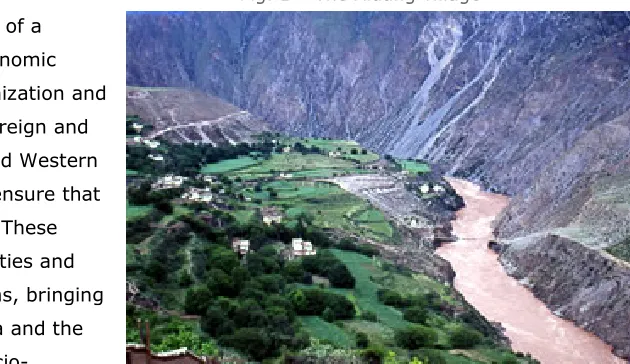
My methodology incorporated anthropological fieldwork and research of previous scholarship. I placed
paramount importance on gaining an understanding of the specific beliefs and stories of the Deqin Tibetans,
through informal interviews and observation while living with families in the villages of Yubeng, Xidang,
Mingyong, and the town of Deqin. (Fig. 1) I was unable to arrange a translator, so all my communication with
the locals was in Chinese (Mandarin, the official language of China), which made some conversations very
difficult, but not impossible. At times, visiting Chinese tourists would assist in conversation, their more standard
Mandarin making things easier. I also interviewed members of The Nature Conservancy, a non-governmental
organization doing work in the area, and relied on secondary accounts from journal articles, monographs, and
ethnographies for help in analysis and interpretation. Through this research, I discovered that in Northwest
Yunnan, the Tibetan religious perceptions of landscape are not disappearing with increased Western and
Chinese influences. Yet, at the same time, these perceptions are not unchanged. Instead, the beliefs have
gained increasing importance in everyday life, as the Tibetans have adapted to the new developments,
reevaluating and reaffirming their belief in the “ritual cosmos.” This study then has significance for further
research, as Tibetan perceptions can be seen as part of a dynamic cultural process, rather than a static reality
(3, 4).
The Landscape as a Ritual Cosmos
The Deqin Tibetan perceptions of landscape are tied to the greater Tibetan worldview of the ritual cosmos, or
“sacred geography,” in which every part of the natural environment is alive with various types of spirits and
deities (5). These beings must be interacted with, respected, and appeased in everyday life, as part of a
mutual, obligatory relationship (6). If humans regularly give offerings to the deities and do not commit
transgressions against the natural world, then the spirits and deities will help them gain material benefits, such
as fertility, productive harvests, monetary success, or good health (5, 6). In anthropological terms,
“Transgressions, whether inadvertent or intentional…can upset the sensitive and often capricious local deities of
nature who might cause, for example, environmental irregularities, illness and lowered fertility” (6). As was
explained to me by a visiting lama (a high spiritual teacher in Tibetan Buddhism) in Xidang village, the
wrongdoer is not always the only one punished: “Sometimes the anger of a spirit affects a whole village, or just
someone who is unlucky.”
Despite the risk of angering the deities, religious authorities realized that humans could not survive without
some sort of land exploitation and building. Thus, the rigua, or “sealing the mountain,” line was developed: a
physical boundary between the human-inhabited lands and the spirit world, maintained by lamas and enforced
by local village chiefs. The locals explained to me that
many normal human activities are considered profane and
are forbidden on the sacred side of the line. These
activities include the harvesting of mushrooms or herbs,
hunting or killing of any kind, yak or cow grazing, the
cutting down of trees, and the building of structures. Even
on the human side of the rigua line, spirits inhabit every
part of the natural world, and must be appeased and
convinced to coexist with humans, or forced to coexist,
which can only be done with the intervention of a lama.
Central to the belief in the rigua line, and in the ritual cosmos as a whole, are the deities that inhabit the
surrounding mountains. According to the prominent Tibet scholar Toni Huber, “mountains have, without a
doubt, been the most venerated and culturally significant feature of the Tibetan landscape throughout space
and time” (7). The spirits that inhabit mountains are usually the most powerful in the area, and thus the rigua
lines are set in relation to the mountain deities and are found at a certain elevation on the mountainside. For
example, in Yubeng, the rigua line is about a two-hour hike uphill from the village, at about 3,400 meters
(11,152 feet) in elevation.
The most important of these mountains are the néri, or “mountain abodes.” As Huber states, “Although a great
many mountains throughout Tibetan areas are considered to have resident deities,” there are only eight néri
mountains in the entire Tibetan cultural area.* One of these is néri Kawa Karpo, which is located in Deqin
County on the border with Tibet. (Fig. 2) Kawa Karpo, along with the other néri, “are considered the places of
residence and activity of certain important…‘defenders of Buddhist religion,’ a class of [protector] deities that
constitute a large section of the rich Tibetan pantheon” (7).
*By Tibetan Cultural Area I refer to the regions which Tibetans inhabit and have influenced (to a great extent)
culturally. This includes the Tibetan Autonomous Region (political Tibet, what most Westerners picture when
they think of Tibet), and areas of the Western provinces of Sichuan, Qinghai, Gansu, and Yunnan in China; and
the countries of Bhutan, Nepal, and parts of India.
A villager in Lower Yubeng told me the following story of how Kawa Karpo became a protector deity of the
Deqin area:
Néri Kawa Karpo was once a horrible being with nine heads and eighteen bodies. He terrorized
many people and destroyed those who stood against him. One day a special lama defeated Kawa
Karpo, cutting off all his heads but one and all of his bodies but one. Kawa Karpo was humiliated,
and vowed to change his ways. The Buddha [Sakyamuni] was touched with compassion when he
heard of Kawa Karpo’s desire to abandon evil. He took Kawa Karpo as a disciple, and Kawa Karpo
studied Buddhism for many years. The Buddha gave Kawa Karpo an army and told him to walk
through Tibet in search of an area in need of protection. After years of travel, he came to Deqin,
and assumed the form of a mountain.
According to this story, Kawa Karpo’s wife, children, uncle, and army followed him and also assumed mountain
forms, making up the entire range of thirteen snow-covered peaks and several lesser peaks that tower above
the Deqin area. (Fig. 3)
As a néri, Kawa Karpo is one of the most important pan-Tibetan Buddhist sacred sites, making it a very
important pilgrimage site. Every autumn to early winter, thousands of pilgrims from all over cultural Tibet travel
to Kawa Karpo to show respect for the deity. Kawa Karpo holds specific importance not only in the entire
Tibetan worldview, but also in how the local Tibetans conceptualize their landscape. The snowy mountains of
Kawa Karpo and his followers dominate the
Deqin landscape as a physical representation of
the deity and his power. The locals are aware
of this supernatural presence, and they
understand that, in their everyday lives, they
must maintain a good relationship with the
spirits that inhabit their world, especially Kawa
Karpo. Their belief in Kawa Karpo, and the
importance they place on him in the ritual
cosmos, have greatly shaped how they
perceive the increasing number of outside
visitors and changing socio-economic realities.
(Fig. 4)
Socio-economic Change and the Ritual Cosmos
While conducting my research, I couldn’t help but notice the number of visitors, either pilgrims or tourists, to
this seemingly remote area. When I first visited in November 2003, there were hundreds of pilgrims from all
over cultural Tibet coming to see the sacred sites every day. These pilgrims either follow the outer pilgrimage
path that circumambulates the mountains, or the inner path that visits the sacred waterfall outside of Lower
Yubeng village and the temples located under the Mingyong glacier that tumbles down the side of Kawa Karpo,
above Mingyong village.
During my summer 2004 visit, not many pilgrims came to see the sacred sites, but there were many Chinese
and foreign tourists visiting the area. The villagers explained to me that during the summer, Tibetans are too
busy harvesting crops, and during the late autumn when the fields are dry, there is more time to go on
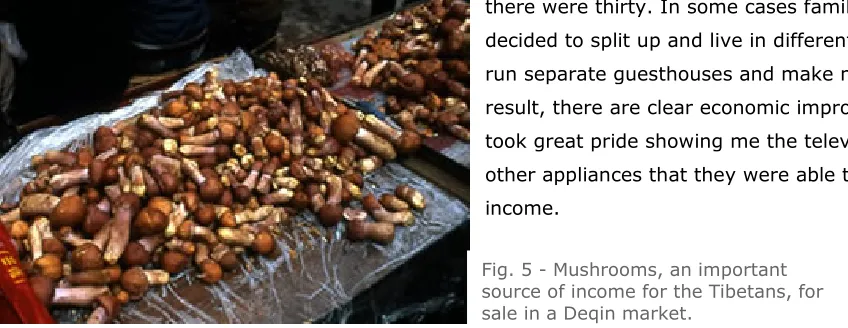
pilgrimage. As I noticed, the local villagers were busy all summer long collecting medicinal herbs and
mushrooms. These items are sold to the market in the town of Deqin, then to bigger markets in the provincial
capitol of Kunming, and eventually in larger cities such as Beijing, Shanghai, or Hong Kong. (Fig. 5)
Despite some economic stability from mushroom and herb cultivation, the residents of Diqing prefecture are
among the poorest in China, with more than 60% of inhabitants living below China’s poverty line of US $70 a
year (8). The government and the locals are hoping that tourism will bring a needed boost to the economy.
Presently, many villagers of Yubeng, Mingyong, and Xidang run guesthouses (spare rooms they build on their
homes) and guide tourists to view the sacred sites. The guesthouses are built with the help of The Nature
Conservancy, which has been promoting sustainable eco-tourism that coincides with local beliefs in the sacred
geography. The locals welcome the idea, and have been turning their homes into guesthouses at an increasing
rate. For example, in 2002 there was only one guesthouse in Upper and Lower Yubeng combined. As my
informants explained to me, at the beginning of 2003 there were fifteen guesthouses; by the end of the year
there were thirty. In some cases families have even
decided to split up and live in different homes, in order to
run separate guesthouses and make more money. As a
result, there are clear economic improvements, as villagers
took great pride showing me the televisions, radios and
other appliances that they were able to buy with the added
income.
However, the socio-economic influence of the new cross-cultural contact has not diminished the religious
importance of landscape and, in fact, has helped reassert its importance. Tibetans I spoke with described their
happiness with the increased visitors to the area, as long as the tourists respect the landscape and their beliefs.
For example, one group of tourists that came to Yubeng while I was there visited the sacred waterfall, and then
wanted to visit a small, glacial lake that is situated under the mountain believed to be Kawa Karpo’s uncle. It
was raining , and the locals explained that Kawa Karpo was angry that outsiders had camped at the lake the
previous year. The rain, their guide explained, was a sign to the visitors that they should not visit the lake at
that time.
Moreover, since the turn of the twentieth century there have been several attempts by Chinese and foreign
mountaineers to climb Kawa Karpo, none of which have been successful. The most tragic of these attempts was
in 1991, when a joint Sino-Japanese team of seventeen climbers perished. The failed attempts, the locals
explained, reasserted the god’s power over even outside powers, as he was angry at the attempts to be
conquered.
Another reassertion of the Tibetans’ continuing identity with the landscape has come through the pilgrimage
itself. Modernization has brought an increasing number of pilgrims, traveling by road and air, many of which
have never made the pilgrimage before. The locals explained to me that the tourists coming to the area are
also, in a way, pilgrims. One man, who works as a guide in Yubeng, eloquently stated his understanding of the
changes:
We bring the Chinese and outsiders [waiguoren in Chinese] to see the sacred sites, and they see
what is important to us. Yes, making money is important, but I feel that by bringing people to see
Kawa Karpo, I am also becoming closer to him [Kawa Karpo], and that is very important.
Reaffirmation of the Ritual Cosmos
Viewing landscape as a dynamic process shows the need to further redefine what is considered “traditional”
Tibetan society. Westerners popularly perceive Tibetans before the 1950 ”liberation” by China ”as a happy,
peaceful people devoted to the practice of Buddhism, whose remote and ecologically enlightened land, ruled by
a god-king, was invaded by the forces of evil” (9). Moreover, the Western view has been bolstered by
Tibetans-in-exile, recalling memories of their homeland to call attention to their plight (10, 11).
Rather than finding Tibetan tradition being destroyed by Chinese rule and the influx of people, goods and ideas
from the modern world, I witnessed firsthand the importance of Kawa Karpo and the ritual cosmos in the lives
of the Tibetans of Deqin county: it has not been diminished. Tibetans’ enduring perception of the landscape as a
ritual cosmos cannot be termed a static reality of tradition, but more a dynamic cultural process, as they are
continually renegotiating and redefining their beliefs in light of new social and economic realities (4).
The various ways that modernity takes shape in specific contexts show that there are multiple issues that
”problematize a host of previously assumed dichotomies, including those between tradition and modernity,
between the West and the rest, and between the local and the global (levels)” (2, 12). As globalization
increases, the world does, in a sense, become increasingly connected and similar; however, globalization does
not affect a Deqin Tibetan village in exactly the same way a town in another part of China, or the rest of the
world, may be affected (13). Cultural processes, such as landscape and modernization, need to be examined
and understood more specifically in their own contexts as well as in relationship to others, without tending
toward the broad dichotomies of “modernity” and “tradition.” I am hopeful that my study will further this
discussion.
I would like to thank the villagers and townspeople of Deqin county, the Nature Conservancy, and the Chinese
and foreign tourists I met during the course of my research. I would also like to thank the Undergraduate
Research Opportunities Program (UROP) and donors for the generous Summer Undergraduate Research
Fellowship (SURF) award that allowed me to conduct this research project. In addition, my research mentor
professor Lu Yan has been an invaluable source of guidance and encouragement, academically and personally,
and I cannot thank her enough. Lastly, I would like to thank my family and friends, whose support has been
References
1. J. Hilton. Lost Horizon. (Morrow, New York, 1993).
2. H. G. West, T. Sanders. Power Revealed and Concealed in the New World Order. In Transparency and
Conspiracy: Ethnographies of Suspicion in the New World Order. West and Sanders Eds. (Duke
University Press, Durham, NC, 2003).
3. E. Hirsch, M. O’Hanlon. Introduction. In The Anthropology of Landscape: Perspectives on Place and
Space. Hirsch and O’Hanlon Eds. (Oxford University Press, New York, 2003).
4. T. Ingold. Introduction to Social Life. Companion Encyclopedia of Anthropology: Humanity, Culture, and
Social Life. (Routledge, London, 1994), p. 738.
5. G. Samuel. Civilized Shamans: Buddhism in Tibetan Societies. (Smithsonian Institution Press,
Washington, 1995).
6. T. Huber, P. Pederson. Meteorological Knowledge and Environmental Ideas in Traditional and Modern
Societies: The Case of Tibet. The Journal of the Royal Anthropological Institute. 3, 577-597 (1997).
7. T. Huber. The Cult of Pure Crystal Mountain: Popular Pilgrimage and Visionary Landscape in Southeast
Tibet. (Oxford University Press, New York, 1999).
8. A. Anderton. Saving Shangri-La. Asia Inc: Asian Business Asian Views,
http://www.asia-inc.com/March04/shangrila_mar.htm. (December 2004)
9. D. S. Lopez, Jr. Prisoners of Shangri-La: Tibetan Buddhism and the West. (University of Chicago Press,
Chicago, 1998).
10. T. Gyatso. My Land, My People. (McGraw-Hill, New York, 1962).
11. T. Gyatso. Freedom in Exile: The Autobiography of the Dalai Lama. (Harper Collins, New York, 1990).
12. J. Comaroff, J. Comaroff. Introduction. In Modernity and its Malcontents: Ritual and Power in
Postcolonial Africa. Comaroff and Comaroff, Ed. (University of Chicago Press, Chicago, 1993).
13. J. Ferguson. Global Disconnect: Abjection and the Aftermath of Modernism. In The Anthropology of
Globalization: A Reader. J. X. Inda, R. Rosaldo, Eds. (Blackwell Publishing, 2002).