by
Dustin J. Eno and Annie Prud’homme-Généreux
Life Sciences
Quest University, Canada
An Infectious Cure
Part I – A Suspicious Treatment for Cholera
India, 1926 *
It was cholera season again. Cholera struck twice a year; once after the springtime run-off from the high Himalayas, and once after the monsoons. Dinesh was walking home from the fi elds when his friend, a merchant at the lassi stand, called him over.
“It’s started,” he said in a mournful tone. “What?” asked Dinesh.
“Harpriet just died of cholera.”
And so this year’s outbreak had begun. Cholera was a fact of life in this small village. Several people died of this disease every year. Dinesh would know all of them. Perhaps he would even be one of the victims this year. Cholera was a horrible disease that was dreaded by all. Th e affl icted endured severe abdominal pain, vomiting, and diarrhea, and some unfortunate people died from dehydration after several days.
A few days later, as Dinesh was walking towards the fi elds, he noticed a group of European men pouring something into the village well. Coming closer, he overheard one of them explaining to the village elder that this was going to prevent and cure cholera. A similar treatment had apparently helped to treat Europeans. Dinesh had no reason to believe these claims and was suspicious.
Th e elder was similarly unimpressed by the promises made by the Europeans. Later that day, he called all the able-bodied men in the village to drain the village well. Th ey instructed all the villagers to take water from other wells surrounding the town.
A few days later, the European men returned and asked about the state of the cholera outbreak. Cholera had claimed more lives and new people were getting sick. Th e foreigners seemed surprised. Th eir surprise turned to outrage when they discovered that the well in which they poured their treatment had been drained.
Questions
1. Cholera is caused by bacteria that infect the small intestine. Th ese bacteria are typically contracted by drinking contaminated water. Th e symptoms are brought about by the secretion of a toxin that disrupts the functioning of the cells of the small intestine. Given this information, what might the European men have poured into the wells? Be as specifi c as you can in explaining how your proposed treatment cured and prevented cholera. Come up with more than one hypothesis.
2. What ethical issues does imposing a treatment on the villagers without their consent raise? Are there factors that make it more or less acceptable?
3. At the time, the Europeans did not fully understand how their well treatment worked. Th ey only had
indications that it worked once in Europe. Were they justifi ed in imposing their treatment? Are there steps they could have taken that would have made the situation more acceptable?
4. Is it ever appropriate to force a “cure” on a population? Remember that in North America many municipalities put fl uoride in the water supply to prevent tooth decay.
Part II – Big Fleas Have Lesser Fleas Upon Their Backs to Bite Them, and So On Infi nitum
In nature, every organism is part of an ecosystem. It feeds on prey and is preyed upon by its predators. Bacteria (including the cholera-causing bacteria) are no exception. Th eir enemies are bacteriophages, tiny viruses that use them as virus-making factories, often killing them in the process.
A bacteriophage is composed of genetic information (RNA or DNA) and proteins. It is shaped like a moon lander and has three distinct regions (Figure 1). Th e head contains the genetic material. Proteins form a protective coat around it, giving the head a roundish appearance. Th e neck and helical sheath are also composed of proteins and serve as a conduit for injecting the genetic material into a bacterium – like a syringe. Finally, the base plate and the tail fi bers are responsible for recognizing and binding to target bacteria. Since they are composed of proteins, they
have unique three dimensional shapes that fi t into specifi c targets on a bacteria’s surface, in a lock and key fashion.
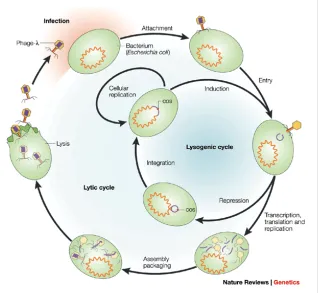
Like all viruses, bacteriophages are inert and can only replicate inside a cell, using the cell’s energy and machinery. Infection begins when the bacteriophage base plate and tail fi bers come into contact with its specifi c bacterial target (Figure 2). Th e bacteriophage attaches to the bacteria,
makes a hole in the bacterial cell wall, and injects its genetic material into the cell. Th e genetic material can then follow one of two fates. It may use the bacterial machinery to replicate its genome and make more of its proteins. In eff ect, the bacterium becomes a virus-producing factory. Eventually, the bacteriophage directs the production of two proteins that cause the cell wall of the bacterium to rupture, killing the bacterium and releasing the newly synthesized viral particles into the environment to infect other cells. Th is process is called the
lytic cycle. Other times, once inside the
Figure 1. Bacteriophage structure.
(1) Head, (2) Tail, (3) Nucleic acid, (4) Capsid, (5) Collar, (6) Sheath, (7) Tail fi ber, (8) Spikes, (9) Baseplate
Each bacteriophage binds to, infects, and kills only specifi c target bacteria by virtue of the specifi city conveyed by its proteins. Bacteria that suff er mutations that change the proteins displayed on their cell surface will escape infection. Th rough natural selection, these bacteria will thrive and their genome will become the most prevalent one in the
bacterial population. However, these bacteria constitute fertile grounds, and natural selection predicts that mutations in the bacteriophage proteins that allow the virus to recognize and infect these bacteria will develop over time. Th rough this process of co-evolution, bacteriophage can adapt to bacterial defenses.
Although not completely understood by the Europeans at the time, this was the basis of the treatment poured into the wells of Dinesh’s village.
Questions
1. Would the villagers need to drink repeatedly or only once from the treated wells to obtain a suffi cient dose to serve as a cure? What is the basis of your answer?
2. Once a person ingests a dose of phages, how long will the treatment remain eff ective in his or her body? In other words, what is the time course of the treatment? Would you expect the eff ectiveness of this treatment to increase or decrease over time? Why?
3. Will the process of viral and bacterial co-evolution continue indefi nitely?
4. Should the villagers be concerned that this bacterial virus will be harmful to their microbial fl ora (such as their intestinal bacteria)? Why or why not?
5. What might be a negative health consequence of killing many cholera bacteria with bacteriophage in a short time? Hint: Th ink about what causes the symptoms of cholera (see Part I, Question 1).
6. Th e villagers should not be concerned that the bacteriophage will lyse and infect their cells. Bacteriophages are not believed to be able to infect human cells. Propose why this might be. Hint: Consider the structural diff erences between human and bacterial cells.
7. What would be the eff ect on treatment if the bacteriophage that was poured into the wells adopted a lysogenic life cycle?
8. What will happen to the bacteriophages once the supply of cholera bacteria in the intestine of an infected person has run out?
9. What do you think are some of the risks of “phage therapy” (using bacteriophage to treat bacterial infections)? 10. Imagine the following scenario. A bacteriophage taken for the treatment of cholera infects a cholera-causing
bacterium and temporarily enters the lysogenic stage. When the virus re-enters the lytic cycle, it includes some pieces of the bacterial DNA in its own genome. Specifi cally, this DNA encodes information for making the cholera toxin. Imagine some of the possible consequences of this scenario. What will happen to the next bacteria that the virus infects? What will happen to the human in which this bacteriophage exists?
Part III – Why Not Use Antibiotics?
Th e potentials of phage therapy as a treatment for bacterial diseases were overshadowed by the discovery of antibiotics in the early 20th century. Antibiotics are chemicals that can prevent the growth of bacteria or even kill them. Typically, a range of bacterial species are susceptible to the eff ects of an antibiotic.
Unfortunately, bacteria are evolving in response to the pressures imposed by antibiotics. When an antibiotic is applied to a population of bacteria, some bacteria have inherent mutations that make them less susceptible to the antibiotic. Th ese bacteria survive, multiply, and eventually make up the majority of bacteria in the population. Th us, we are now facing a situation where bacteria are evolving resistance to our antibiotics faster than we can fi nd new antibiotics to challenge them (Levy & Marshall, 2004).
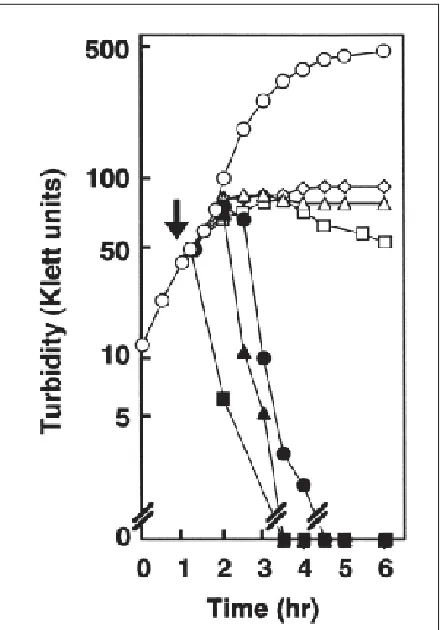
Figure 3 shows the result of an experiment where the growth of a bacterial population was monitored over time. Staphylococcus aureus bacteria were grown with all the required nutrients. Th ese common bacteria are the culprit of a range of infections from pimples to pneumonia. Growth was monitored by measuring the turbidity of the culture (the more turbid a culture, the more cells are present). At 1 hour, the bacteria were divided into 7 diff erent fl asks. Th e bacteria in each of these fl asks were subjected to diff erent treatment (see below), and the bacteria were incubated and their growth monitored.
• Th e open circles show the growth of bacteria when nothing was added to the fl ask.
• Th e open rhomboids, triangles, and squares show the growth of the culture when rifampicin, vancomycin, and oxacillin, respectively, were added to the culture at time = 1 hour. All three of these chemicals are antibiotics.
• Th e closed circle, triangle, and square show the growth of the culture after the addition of bacteriophages that target
Staphylococcus aureus. Diff erent amounts of phage were added in the three fl asks: 0.1, 1, and 10 MOI, respectively. An MOI is a Multiplicity of Infection and corresponds to the ratio of infectious agent to bacteria.
Questions
1. Based on the results of this fi gure, comment on the comparative eff ectiveness of antibiotics and phage on the growth of Staphylococcus.
2. Th is experiment does not capture some of the complexities
Figure 3. Comparative eff ects of bacteriophages and antibiotics on the number of bacterial cells in culture.
•
Case copyright held by the National Center for Case Study Teaching in Science, University at Buff alo, State University of New York. Originally published October 17, 2011. Please see our usage guidelines, which outline our policy concerning permissible
Part IV – Why Not Use Phage Therapy?
Phage therapy is not an approved treatment for human use in North America. It has yet to pass a rigorous clinical trial to show its eff ectiveness. Some pharmaceutical companies are showing interest in developing it, but phage therapy off ers a few challenges. First, since phages only kill specifi c bacteria, phage therapy is an extremely individualized treatment. Bacteria must be isolated from the patient and an appropriate virus found. Th is runs contrary to the current pharmaceutical company model, which is based on the mass production and marketing of products that work for everyone. In addition, given the individualized nature of the cure, it is very diffi cult to patent each virus used. Th e patent process ensures that the companies that develop these treatments can recuperate their costs. Finally, such individualized treatment would require a fundamental shift in our medical practices, which is geared towards a one-disease, one-treatment model. Phage therapy requires personalized treatment and customized medicines. It is very laborious, time intensive, and costly. In addition, the time taken to select an appropriate virus may not be possible with certain bacterial diseases that progress rapidly. However, phages are able to access areas of the body that antibiotics cannot, and viruses are produced in those areas where they are most needed (the maximal viral dose is in the area of greatest bacterial infection), ensuring continued interest in this treatment.
Despite the challenges, phage treatment of bacterial infections is routinely used in other applications. Meats are sometimes treated with solutions of phages to kill off potentially harmful bacteria such as Salmonella (Hausler, 2006). Certain high-value crops, such as tomatoes, are now sprayed with phage solutions (Obradovic et al., 2004). Th ere is a very good chance that you have already eaten phages.
Questions
1. Given this new information, review the advantages and disadvantages of each form of treatment. Create a table that summarizes your answer.
2. Are there some diseases that lend themselves more to phage therapy than antibiotics? Are there types of infections for which the reverse is true? Explain your reasoning.
3. Do you think restrictions on the use of phage therapy in North America should be loosened? Why or why not?
References
Campbell, A (2003). Th e future of bacteriophage biology. Nature Reviews Genetics 4: 471–477. doi:10.1038/nrg1089. Hausler, T. (2006). Viruses vs. Superbugs. (K. Leube, Trans.) New York: Macmillan.
Levy, S.B., and Marshall, B. (2004). Antibacterial resistance worldwide: causes, challenges and responses. Nature Medicine Supplement 10(12): S122–S129.
Matsuzaki, S., Rashel, M., Uchiyama, J., Sakurai, S., Ujihara, T., Kuroda, M., Ikeuchi, M., Tani, T., Fujieda, M., Wakiguchi, H., and Imai, S. (2005). Bacteriophage therapy: A revitalized therapy against bacterial infectious
diseases. J Infect Chemother 11: 211–219.
Obradovic, A., Jones, B., Monol, M., Balogh, B., and Olson, S. (2004). Management of tomato bacterial spot in the fi eld by foliar application of bacteriophages and SAR Inducers. Plant Disease 88 (7): 736–740.
Parfi tt, T. (2005). Georgia: An unlikely stronghold for bacteriophage therapy. Th e Lancet 365 (9478): 2166–2167.
Suggested Readings
Hausler, T. (2006). Viruses vs. Superbugs. (K. Leube, Trans.) New York: Macmillan.