Modified True/False
Indicate whether the statement is true or false. If false, change the identified word or phrase to make the statement true.
____ 1. Losing excessive amounts of water through evaporation may affect a plant’s ability to carry out photosynthesis. _________________________
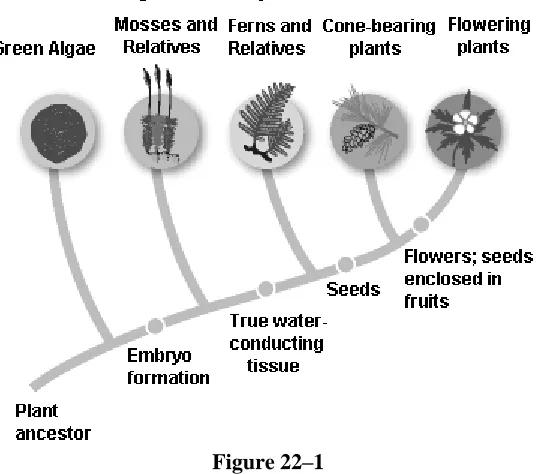
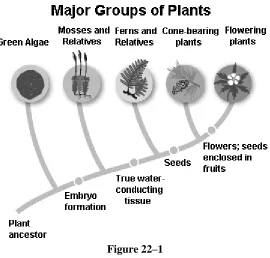
Figure 22–1
____ 2. Figure 22–1 shows the evolutionary relationships among the major plant groups living on Earth today. _________________________
____ 3. When you look at a mature gymnosperm or angiosperm, you see the more conspicuous gametophyte. _________________________
____ 4. The first plants on Earth were bryophytes. _________________________
____ 5. Many green algae form multicellular specialized tissues. _________________________
____ 6. A reason that bryophytes are small is that they lack vascular tissue. _________________________
____ 7. Xylem carries solutions of nutrients and food produced by photosynthesis. _________________________
____ 8. The key adaptation that enabled the earliest gymnosperms and angiosperms to live in dry environments was the spore. _________________________
____ 10. In gymnosperms, gametophytes are encased in cones. _________________________
____ 11. Pollen cones are also called female cones. _________________________
____ 12. In angiosperms, the ovule becomes the fruit. _________________________
____ 13. An evolutionary advantage of flowers is that they attract pollinators. _________________________
____ 14. If a seed has two cotyledons, it will have fibrous roots. _________________________
____ 15. Biennials are pollinated during their first year of growth. _________________________
____ 16. In plants, the main organs in which photosynthesis takes place are leaves. _________________________
____ 17. Phloem is made up of vessel elements and companion cells. _________________________
____ 18. Meristems produce new cells by mitosis. _________________________
____ 19. Root hairs are made up of ground tissue. _________________________
____ 20. The high concentration of mineral ions in the plant cells causes water molecules to move into the plant by active transport. _________________________
____ 21. The area of a root through which water cannot pass is the epidermis. _________________________
____ 22. A bud contains ground tissue. _________________________
____ 23. The secondary growth of a dicot stem results from cell divisions in the stem’s vascular cambium and xylem. _________________________
____ 24. In a tree, the heartwood is made up of older xylem that no longer conducts water. _________________________
____ 25. The thin, flat part of a leaf is called the petiole. _________________________
____ 26. Transpiration from leaves occurs because of the osmosis of water from the leaf to the environment. _________________________
____ 27. When the guard cells of a leaf lose water, the stomata open. _________________________
____ 28. In plants, the opening and closing of stomata balance water loss with the need for carbon dioxide. _________________________
____ 29. Water rises to the top of a giant redwood tree by transpirational pull. _________________________
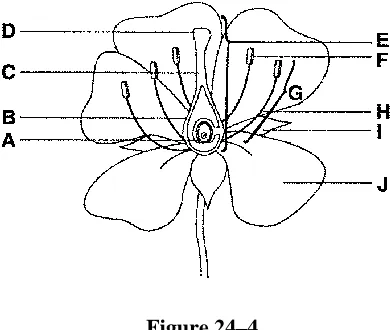
____ 31. In Figure 24–4, letters D, C, and A point to the female parts of a flower. _________________________
____ 32. In Figure 24–4, letter J indicates the carpel of the flower.
____ 33. Angiosperms are the only plants that undergo double fertilization. _________________________
____ 34. A plant cutting used for propagation should have one or more buds containing meristem tissue. _________________________
____ 35. A fruit almost always contains one or more seeds. _________________________
____ 36. Seeds that are dispersed by animals are typically contained in lightweight fruits. _________________________
____ 37. Some seeds go through a period of dormancy, during which they are alive but do not grow. _________________________
____ 38. Ethylene delay(s) the aging of leaves in plants. _________________________
____ 39. Cells on the shaded side of a stem elongate more than cells on the side receiving light because of the hormone ethylene. _________________________
____ 40. The tropism that allows seedlings to find their way out of the soil and into the sunlight is photoperiodism. _________________________
____ 41. The growing tip of a climbing vine exhibits phototropism when it coils around a stake. _________________________
____ 42. The orange and yellow colors of fall leaves are a result of the reduction of chlorophyll in the leaf, revealing phytochrome pigments. _________________________
____ 43. Long-day plants flower when nights are long. _________________________
____ 45. People often use plants for building materials and medicines.
Completion
Complete each statement.
46. Plants need to exchange ______________________________ in order to carry out the processes of photosynthesis and respiration.
Figure 22–1
47. According to Figure 22–1, cone-bearing plants evolved before ____________________.
48. Figure 22–1 shows that plants evolved _________________________ before they evolved seeds.
49. The shift between phases in the plant life cycle is known as _________________________.
50. The life cycle of a plant shifts between a _________________________ phase and a _________________________ phase.
51. _________________________ include plants whose cells form multicellular groups but lack specialization.
52. Most photosynthesis takes place in the _________________ stage of the moss life cycle.
53. The process by which bryophytes draw water into their cells from the environment is called ____________________.
56. Two ovules lie at the base of each scale on a(an) ____________________.
57. The angiosperm _________________________ plays a major role in the dispersal of seeds.
58. Looking at the _________________ pattern in a leaf can tell you if an angiosperm is a monocot or dicot.
59. Farmers must plant wheat each year because wheat is a(an) ____________________.
60. The stems of a(an) ____________________ do not form wood.
61. The three main organs of seed plants are roots, leaves, and ____________________.
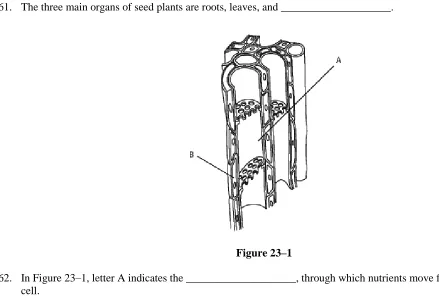
Figure 23–1
62. In Figure 23–1, letter A indicates the ____________________, through which nutrients move from cell to cell.
63. In xylem and phloem, the cells that keep their nuclei and organelles are the ____________________.
64. _________________________ at the tips of stems and roots produce rapid growth in plants.
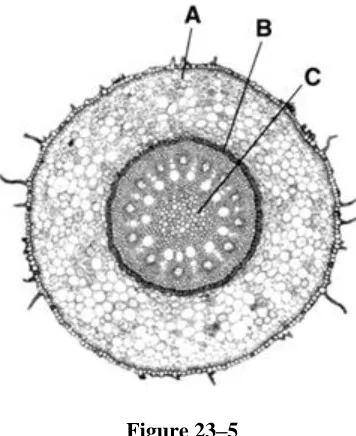
Figure 23–5
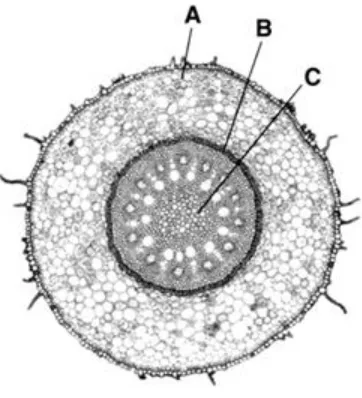
66. In Figure 23–5, structure B is the ____________________, which includes a waterproof zone called the ____________________.
67. As the relative concentration of mineral ions in a root’s cells increases, the osmosis of water molecules into the root ____________________.
68. The ____________________ on a stem contain apical meristems that can produce new stems and leaves.
69. During ____________________, cells in the apical meristems become longer, adding to the length of roots and stems.
70. If a cross section of a tree has 12 tree rings, it is most likely ____________________ years old.
71. In conifers and dicots, the meristem that lies between the xylem and phloem is the _________________________, and the meristem that is part of the bark is the _________________________.
72. The air spaces in the _________________________ layer of a leaf connect with air through stomata in the epidermis of the leaf.
73. ____________________ control the opening and closing of stomata.
74. Capillary action is a product of both _________________________, which is the attraction of water molecules to each other, and _________________________, which is the attraction of water molecules to other kinds of molecules.
75. The _________________________ explains the movement of materials through phloem.
78. In angiosperm fertilization, a triploid cell that eventually becomes ____________________ is produced by a second fertilization event.
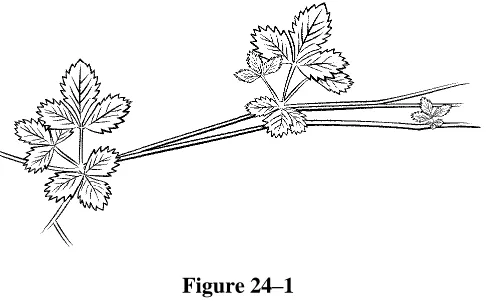
Figure 24–1
79. In the strawberry plant shown in Figure 24–1, new plants are growing from structures called _________________________.
80. Angiosperm seeds are surrounded by a mature ovary called a ____________________.
81. The seeds of fruits that are eaten by animals have tough ____________________.
82. Many lightweight seeds are dispersed by wind or ____________________.
83. A seed that is dispersed far away from the parent plant may be more successful because it faces no ____________________ from the parent plant.
84. Extreme environmental conditions such as heat and cold may affect the timing of a mature seed’s ____________________.
85. Fruit ripening can be stimulated by ____________________.
Figure 24–3
87. In Figure 24–3, the response of the bean seedling’s roots is due to ____________________.
88. A plant pigment called ____________________ is responsible for plant responses to increasing or decreasing day length as the seasons change.
89. The major crop plants in the world today are wheat, rice, soybeans, and ____________________.
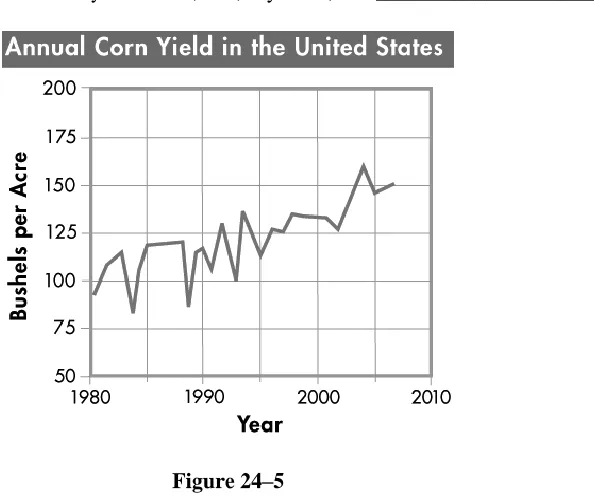
Figure 24–5
90. Figure 24–5 shows that between 1980 and 2007, the annual yield of corn in the United States fluctuated up and down. The overall trend, however, is that corn yield has ____________________.
Short Answer
91. What are the basic needs of plants?
Figure 22–1
93. Based on Figure 22–1, identify which group of plants is most closely related to the ancestor of all plants and which group of plants evolved most recently.
94. Why is the sporophyte phase of all plants diploid?
95. Describe the alternation of generations in plants.
96. How can green algae survive without the specialized tissues found in other plants?
97. How are the rhizoids of mosses similar to roots? How are they different?
98. Where in a plant are tracheids found? Describe their role.
99. Compare xylem and phloem.
100. What is a pollen grain?
101. Describe pollination in gymnosperms.
102. Define fruit.
103. What could cause an angiosperm seedling to grow a long distance from the location of its parent plant?
105. Lilies have flower parts in multiples of three and vascular bundles scattered throughout their stems. Corn plants have fibrous roots and leaves with parallel veins. Roses have tap roots and two cotyledons. Would you categorize lilies with corn plants or roses? Explain your answer.
106. How is the function of a tree trunk related to photosynthesis?
107. Contrast the flow of materials in xylem and phloem.
108. Why are protective structures such as seed coats made up of sclerenchyma?
109. In which tissue of a plant would you expect to find the greatest number of new cells?
110. What three kinds of tissues do meristems develop into?
Figure 23–5
111. In Figure 23–5, what is structure C? Identify the tissues that make up this structure.
112. What do roots absorb from the soil?
113. In what function do both roots and stems play a part?
114. A scientist discovers a new plant. She notes that the plant forms wood as it becomes taller. Did the scientist discover a monocot or a dicot? Explain.
115. In what part of a leaf would you expect to find the greatest number of chloroplasts? Why?
116. During a very hot, sunny day, are stomata likely to be open or closed? Explain.
117. By what three processes does water rise from the roots to the top of a tree?
120. In the pressure-flow hypothesis, what does the term sinkcell refer to?
121. Name the four kinds of specialized leaves in a flower.
122. How is angiosperm fertilization different from fertilization in other plants? What two cells does fertilization in angiosperms produce?
123. Name three ways in which new plants are produced by vegetative reproduction.
124. If you were planning to graft two plants, what aspect of their growing conditions should you consider, and why?
125. What happens as angiosperm seeds mature?
126. How can you tell by looking at a fruit how the seeds it contains are likely dispersed?
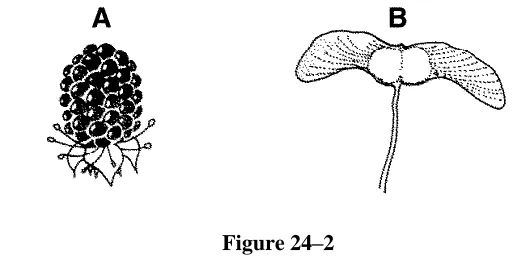
Figure 24–2
127. Of the fruits shown in Figure 24–2, which has seeds that are more likely spread by wind? How can you tell?
128. Name two environmental factors that can end a seed’s dormancy.
129. What role does water play in the germination of a seed?
130. Sofia studied two genetically identical potted plants. One plant was tall and skinny and the other plant was short and bushy. Based on your understanding of plant hormones, what likely happened?
131. What is a plant hormone?
132. List three environmental stimuli to which plants respond.
133. What three major changes do deciduous plants undergo to get ready for winter?
134. Briefly describe the development of modern corn from a wild grass.
Other
Figure 22–6
136. Infer Figure 22–6 illustrates the life cycle of a bryophyte. Which labeled structures are haploid?
137. Compare and Contrast How do structures A and B in Figure 22–6 differ? List at least two differences.
138. Infer In Figure 22–6, which labeled structure is formed by fertilization? What is the name of this structure?
139. Infer In Figure 22–6, what labeled structures are formed by meiosis? Name the structures.
140. Classify In Figure 22–6, what are structures H and I, and what are their functions?
Monocots Dicots
Leaves Parallel veins Branching veins
Flowers Parts in multiples
of three
Parts in multiples of four or five
Vascular Bundles in Stems
Scattered throughout stem
Arranged in a ring
Roots Fibrous Taproot
141. Interpret Tables Corn is a monocot. According to the table in Figure 22–7, does a corn seed have one or two seed leaves?
142. Classify Is the maple leaf in Figure 22–7 a monocot or a dicot? How do you know?
143. Interpret Tables Based on Figure 22–7, how are the vascular bundles in the stem of the corn plant arranged?
144. Compare and Contrast Which flower in Figure 22–7 is a monocot? How do you know?
Figure 22–3
146. Classify Figure 22–3 shows reproduction for a member of what group of plants?
147. Infer Which part of the cycle shown in Figure 22–3 takes place when conditions are unfavorable?
148. Infer Based on Figure 22–3, does this organism undergo alternation of generations? Explain your reasoning.
149. Infer Identify which part of the cycle shown in Figure 22–3 is asexual reproduction, and identify which part of the cycle is sexual reproduction.
151. Use Models In Figure 23–6, which letters indicate structures that allow for the secondary growth of the stem? Identify the structures.
152. Classify Which labels in Figure 23–6 indicate ground tissue? Identify the cell types that might be found in ground tissue.
153. Predict In Figure 23–6, how does growth in the tissues labeled H and G affect the stem?
154. Compare and Contrast Which label in Figure 23–6 indicates cells that are secondary growth tissues, B or C? Identify the tissues.
155. Use Models Which structures in Figure 23–6 were formed by primary growth? What are they called?
Figure 23–3
156. Use Models Which four structures in Figure 23–3 protect the leaf from drying out? Identify the structures.
158. Interpret Visuals Are the stomata in the leaf in Figure 23–3 open or closed? Identify the letter of the stoma.
159. Draw Conclusions What is the importance of the spaces between the cells labeled C in Figure 23–3?
160. Interpret Visuals In Figure 23–3, what is structure F? What two types of tissues make up this structure?
Figure 23–7
161. Interpret Visuals What do the arrows in Figure 23–7 represent?
162. Infer What process is helping to move water upward through part A of Figure 23–7?
163. Infer In part C of Figure 23–7, what process is helping to bring water to the top of the plant?
164. Infer In Figure 23–7, what process causes water to move upward in part B of the plant?
166. Infer Which label indicates the structure in Figure 24–4 that is most likely to be brightly colored? What is the structure?
167. Interpret Visuals Which labels Figure 24–4 point to male parts of the flower? Which labels point to female parts?
168. Interpret Visuals Which label points to the part of the flower in Figure 24–4 that produces pollen grains? What is this structure?
169. Interpret Visuals Which structure in Figure 24–4 receives pollen during pollination? What is the structure?
Figure 24–6
171. Interpret Visuals Which structure shown in Figure 24–6 allows sperm cells to enter the ovary?
172. Apply Concepts How many nuclei are in the embryo sac shown in Figure 24–6? How did these nuclei form?
173. Apply Concepts What evidence does Figure 24–6 show that the endosperm is unique among structures that form during plant reproduction ?
174. Interpret Visuals According to Figure 24–6, what happens to the endosperm as seed development progresses?
176. Predict Which of the plants in Figure 24–7 would you expect to have the highest level of cytokinin in the fall? Explain your answer.
177. Apply Concepts Describe the effect that phytochrome has on the bearded iris in Figure 24–7.
178. Interpret Visuals According to Figure 24–7, what will happen to each plant if it receives more than 12 hours of darkness each day? Why?
179. Infer Why doesn’t the chrysanthemum in Figure 24–7 bloom when exposed to light in the middle of the
night?
180. A plant-nursery owner wanted to sell bearded iris plants that bloom in December. Based on Figure 24–7, what should he or she do in order to produce winter-blooming bearded iris?
Essay
181. In an experiment, a scientist puts a plant in a closed system and controls the amount of air the plant gets. The plant gets plenty of light, water, and nutrients. If the scientist does not allow additional air into the system, how do you expect the air to change over time? How will the plant likely be affected?
182. Compare multicellular green algae with land plants. What do similarities between these organisms suggest?
184. How might Earth be different today if the continents had not become much drier about 400 million years ago?
185. What does the term alternation of generations refer to? Describe a unique characteristic of alternation of generations in green algae, bryophytes, seedless vascular plants, and seed plants compared to the other groups.
186. Describe how a sporophyte is formed during the life cycle of a moss plant.
187. Explain the importance of vascular tissue in plants.
188. What structure in the fern life cycle is analogous to the embryo in a seed? How are the two structures similar? How are they different?
189. Compare and contrast angiosperms and gymnosperms.
190. How do animals aid in the reproduction of angiosperms?
191. In what ways do the leaves of a plant depend on the plant’s roots and stem?
192. How do the functions of the three kinds of cells that form ground tissue differ?
193. Explain the role of active transport in the movement of water and dissolved nutrients from the soil to the root of a plant.
194. Describe the three main functions of stems.
195. A nail that has been hammered into the trunk of a tree is found at the same height year after year, even as the tree grows taller. Explain why.
196. Contrast primary growth and secondary growth.
197. Explain how the structure of the mesophyll of a plant is adapted to carry out photosynthesis.
198. Explain why the stomata of a plant open after the plant has been watered.
199. Under what conditions of rainfall, temperature, and light would a plant’s stomata be closed? Explain your answer.
200. According to the pressure-flow hypothesis, under what conditions might roots contain the source cells and leaves contain the sink cells for sugars?
201. What advantage does vegetative reproduction offer someone who needs to grow large numbers of a specific plant variety for commercial sales?
202. Describe the formation of a fruit in an angiosperm.
205. The seeds of some plants can remain dormant for many years, germinating only when conditions are
favorable. Why might a long period of dormancy be an advantage to a plant that lives in a harsh environment?
206. Explain why sealing fruit in a bag might cause the fruit to ripen quickly.
207. What happens to a plant when a gardener snips off the highest growing tip of a plant? What phenomenon has the gardener interrupted?
208. Briefly describe how plants respond to light and gravity.
209. Describe some of the changes that take place during winter dormancy, and explain how dormancy helps plants survive winter.
Plants Practice Test
Answer Section
MODIFIED TRUE/FALSE
1. ANS: T PTS: 1 DIF: L2
REF: p. 635 OBJ: 22.1.1 Describe what plants need to survive. STA: UT.BIO.2.2.b | UT.BIO.5.3.b TOP: Foundation Edition BLM: comprehension
2. ANS: T PTS: 1 DIF: L1
REF: p. 636 OBJ: 22.1.2 Describe how the first plants evolved. STA: UT.BIO.5.2.a TOP: Foundation Edition BLM: knowledge
3. ANS: F, sporophyte
PTS: 1 DIF: L3 REF: p. 638
OBJ: 22.1.3 Explain the process of alternation of generations. STA: UT.BIO.4.1.a BLM: comprehension
4. ANS: F, green algae
PTS: 1 DIF: L1 REF: p. 639
OBJ: 22.2.1 Identify the characteristics of green algae. STA: UT.BIO.5.2.a | UT.BIO.5.3.b TOP: Foundation Edition BLM: knowledge
5. ANS: F, colonies
PTS: 1 DIF: L2 REF: p. 640
OBJ: 22.2.1 Identify the characteristics of green algae. STA: UT.BIO.5.2.a | UT.BIO.5.3.b TOP: Foundation Edition BLM: comprehension
6. ANS: T PTS: 1 DIF: L1
REF: p. 641 OBJ: 22.2.2 Describe the adaptations of bryophytes. STA: UT.BIO.5.3.b TOP: Foundation Edition BLM: knowledge
7. ANS: F, Phloem
PTS: 1 DIF: L1 REF: p. 643
OBJ: 22.2.3 Explain the importance of vascular tissue. STA: UT.BIO.5.2.a | UT.BIO.5.3.b TOP: Foundation Edition BLM: knowledge
8. ANS: F, seed
PTS: 1 DIF: L2 REF: p. 646
OBJ: 22.3.1 Describe the reproductive adaptations of seed plants.
STA: UT.BIO.4.1.a | UT.BIO.5.2.a | UT.BIO.5.3.b TOP: Foundation Edition BLM: comprehension
9. ANS: F, angiosperms
PTS: 1 DIF: L1 REF: p. 646
OBJ: 22.3.1 Describe the reproductive adaptations of seed plants.
OBJ: 22.3.2 Identify the reproductive structures of gymnosperms. STA: UT.BIO.4.1.a | UT.BIO.5.3.b TOP: Foundation Edition BLM: knowledge
11. ANS: F, Seed cones
PTS: 1 DIF: L2 REF: p. 648
OBJ: 22.3.2 Identify the reproductive structures of gymnosperms. STA: UT.BIO.4.1.a | UT.BIO.5.3.b TOP: Foundation Edition BLM: comprehension
12. ANS: F, ovary
PTS: 1 DIF: L1 REF: p. 651
OBJ: 22.4.1 Identify the reproductive structures of angiosperms. STA: UT.BIO.5.3.b TOP: Foundation Edition BLM: knowledge
13. ANS: T PTS: 1 DIF: L2
REF: p. 651 OBJ: 22.4.1 Identify the reproductive structures of angiosperms. STA: UT.BIO.5.3.b TOP: Foundation Edition
BLM: comprehension 14. ANS: F, taproots
PTS: 1 DIF: L2 REF: p. 653
OBJ: 22.4.2 Identify some of the ways angiosperms can be categorized. STA: UT.BIO.5.3.a | UT.BIO.5.3.b TOP: Foundation Edition BLM: comprehension
15. ANS: F, second
PTS: 1 DIF: L3 REF: p. 654
OBJ: 22.4.2 Identify some of the ways angiosperms can be categorized. STA: UT.BIO.5.3.a | UT.BIO.5.3.b BLM: comprehension
16. ANS: T PTS: 1 DIF: L1
REF: p. 664 OBJ: 23.1.1 Identify the principal organs of seed plants. STA: UT.BIO.3.1.b TOP: Foundation Edition
BLM: knowledge 17. ANS: F, sieve tube
PTS: 1 DIF: L1 REF: p. 666
OBJ: 23.1.2 Explain the primary functions of the main tissue systems of seed plants. STA: UT.BIO.3.1.a | UT.BIO.3.2.d TOP: Foundation Edition
BLM: knowledge
18. ANS: T PTS: 1 DIF: L1
REF: p. 667 OBJ: 23.1.3 Contrast meristems with other plant tissues. STA: UT.BIO.3.2.d TOP: Foundation Edition
BLM: comprehension 19. ANS: F, dermal
OBJ: 23.2.1 Describe the main tissues in a mature root.
STA: UT.BIO.3.1.a | UT.BIO.3.1.c | UT.BIO.3.2.d TOP: Foundation Edition BLM: knowledge
20. ANS: F, osmosis
PTS: 1 DIF: L2 REF: p. 672
OBJ: 23.2.2 Describe the different functions of roots.
STA: UT.BIO.2.3.c | UT.BIO.3.1.b | UT.BIO.3.1.c BLM: comprehension 21. ANS: F
Casparian strip endodermis
PTS: 1 DIF: L2 REF: p. 672
OBJ: 23.2.2 Describe the different functions of roots.
STA: UT.BIO.2.3.c | UT.BIO.3.1.b | UT.BIO.3.1.c TOP: Foundation Edition BLM: knowledge
22. ANS: F, apical meristems
PTS: 1 DIF: L2 REF: p. 675
OBJ: 23.3.1 Describe the main functions of stems.
STA: UT.BIO.3.1.b | UT.BIO.3.1.c | UT.BIO.3.2.d TOP: Foundation Edition BLM: comprehension
23. ANS: F, cork cambium
PTS: 1 DIF: L2 REF: p. 676 | p. 677
OBJ: 23.3.2 Contrast the processes of primary growth and secondary growth in stems.
STA: UT.BIO.2.3.e BLM: knowledge
24. ANS: T PTS: 1 DIF: L2
REF: p. 678 OBJ: 23.3.2 Contrast the processes of primary growth and secondary growth in stems. STA: UT.BIO.2.3.e BLM: comprehension
25. ANS: F, blade
PTS: 1 DIF: L2 REF: p. 680
OBJ: 23.4.1 Describe how the structure of a leaf enables it to carry out photosynthesis. STA: UT.BIO.3.1.b | UT.BIO.3.1.c BLM: knowledge
26. ANS: F, evaporation
PTS: 1 DIF: L2 REF: p. 681
OBJ: 23.4.1 Describe how the structure of a leaf enables it to carry out photosynthesis. STA: UT.BIO.3.1.b | UT.BIO.3.1.c TOP: Foundation Edition
BLM: comprehension 27. ANS: F, close
PTS: 1 DIF: L2 REF: p. 682
OBJ: 23.4.2 Explain how gas exchange in leaves relates to homeostasis. STA: UT.BIO.2.3.c TOP: Foundation Edition BLM: comprehension
28. ANS: T PTS: 1 DIF: L3
BLM: comprehension 30. ANS: F, branches
PTS: 1 DIF: L2 REF: p. 687
OBJ: 23.5.2 Describe how the products of photosynthesis are transported throughout a plant. STA: UT.BIO.2.2.b BLM: comprehension
31. ANS: T PTS: 1 DIF: L2
REF: p. 696 OBJ: 24.1.1 Identify the functions of various structures in a flower. STA: UT.BIO.3.1.a | UT.BIO.3.1.c TOP: Foundation Edition
BLM: application 32. ANS: F, petal
PTS: 1 DIF: L1 REF: p. 696
OBJ: 24.1.1 Identify the functions of various structures in a flower. STA: UT.BIO.3.1.a | UT.BIO.3.1.c TOP: Foundation Edition BLM: knowledge
33. ANS: T PTS: 1 DIF: L2
REF: p. 700 OBJ: 24.1.2 Explain how fertilization differs between angiosperms and other plants. STA: UT.BIO.4.1.a TOP: Foundation Edition
BLM: comprehension
34. ANS: T PTS: 1 DIF: L2
REF: p. 703 OBJ: 24.1.3 Describe vegetative reproduction. STA: UT.BIO.4.1.b TOP: Foundation Edition BLM: comprehension
35. ANS: T PTS: 1 DIF: L1
REF: p. 704 OBJ: 24.2.1 Describe the development of seeds and fruits. STA: UT.BIO.5.1.a TOP: Foundation Edition
BLM: knowledge 36. ANS: F, wind
PTS: 1 DIF: L2 REF: p. 705
OBJ: 24.2.2 Explain how seeds are dispersed. STA: UT.BIO.5.1.a TOP: Foundation Edition BLM: comprehension
37. ANS: T PTS: 1 DIF: L1
REF: p. 706 OBJ: 24.2.3 List the factors that influence the dormancy and germination of seeds. STA: UT.BIO.5.1.a TOP: Foundation Edition
BLM: comprehension 38. ANS: F, Cytokinins
PTS: 1 DIF: L2 REF: p. 710 | p. 711
OBJ: 24.3.1 Describe the effects of hormones on plant growth and development. STA: UT.BIO.2.3.e TOP: Foundation Edition
BLM: comprehension 39. ANS: F, auxin
PTS: 1 DIF: L2 REF: p. 709
STA: UT.BIO.2.3.e TOP: Foundation Edition BLM: comprehension
40. ANS: F, gravitropism
PTS: 1 DIF: L3 REF: p. 712
OBJ: 24.3.2 Identify three tropisms exhibited in plants. STA: UT.BIO.2.3.e BLM: synthesis
41. ANS: F, thigmotropism
PTS: 1 DIF: L2 REF: p. 712
OBJ: 24.3.2 Identify three tropisms exhibited in plants. STA: UT.BIO.2.3.e TOP: Foundation Edition BLM: comprehension
42. ANS: F, carotenoid
PTS: 1 DIF: L2 REF: p. 714
OBJ: 24.3.3 Describe how plants respond to seasonal change. STA: UT.BIO.2.3.e TOP: Foundation Edition BLM: knowledge
43. ANS: F, Short-day
PTS: 1 DIF: L1 REF: p. 713
OBJ: 24.3.3 Describe how plants respond to seasonal change. STA: UT.BIO.2.3.e TOP: Foundation Edition BLM: comprehension
44. ANS: F, endosperm
PTS: 1 DIF: L3 REF: p. 716
OBJ: 24.4.1 Identify the major food-supply crops for humans. STA: UT.BIO.5.1.d BLM: synthesis
45. ANS: T PTS: 1 DIF: L1
REF: p. 718 OBJ: 24.4.2 Describe how humans benefit from plants. TOP: Foundation Edition BLM: comprehension
COMPLETION
46. ANS: gases
carbon dioxide and oxygen
PTS: 1 DIF: L2 REF: p. 635
OBJ: 22.1.1 Describe what plants need to survive. STA: UT.BIO.2.2.b | UT.BIO.5.3.b TOP: Foundation Edition BLM: knowledge
47. ANS: flowering plants
PTS: 1 DIF: L2 REF: p. 636
OBJ: 22.1.2 Describe how the first plants evolved. STA: UT.BIO.5.2.a TOP: Foundation Edition BLM: application
48. ANS: vascular tissue
PTS: 1 DIF: L2 REF: p. 636
PTS: 1 DIF: L1 REF: p. 637
OBJ: 22.1.3 Explain the process of alternation of generations. STA: UT.BIO.4.1.a TOP: Foundation Edition BLM: knowledge
50. ANS: haploid, diploid
PTS: 1 DIF: L2 REF: p. 637
OBJ: 22.1.3 Explain the process of alternation of generations. STA: UT.BIO.4.1.a TOP: Foundation Edition BLM: knowledge
51. ANS: Green algae
PTS: 1 DIF: L3 REF: p. 639 | p. 640
OBJ: 22.2.1 Identify the characteristics of green algae. STA: UT.BIO.5.2.a | UT.BIO.5.3.b BLM: application
52. ANS: gametophyte
PTS: 1 DIF: L3 REF: p. 641 | p. 642
OBJ: 22.2.2 Describe the adaptations of bryophytes. STA: UT.BIO.5.3.b BLM: application
53. ANS: osmosis diffusion
PTS: 1 DIF: L2 REF: p. 641
OBJ: 22.2.2 Describe the adaptations of bryophytes. STA: UT.BIO.5.3.b TOP: Foundation Edition BLM: comprehension
54. ANS: tracheophytes
PTS: 1 DIF: L2 REF: p. 643
OBJ: 22.2.3 Explain the importance of vascular tissue. STA: UT.BIO.5.2.a | UT.BIO.5.3.b BLM: knowledge
55. ANS: seed coat
PTS: 1 DIF: L2 REF: p. 647
OBJ: 22.3.1 Describe the reproductive adaptations of seed plants.
STA: UT.BIO.4.1.a | UT.BIO.5.2.a | UT.BIO.5.3.b TOP: Foundation Edition BLM: comprehension
56. ANS: seed cone
PTS: 1 DIF: L3 REF: p. 649
OBJ: 22.3.2 Identify the reproductive structures of gymnosperms. STA: UT.BIO.4.1.a | UT.BIO.5.3.b TOP: Foundation Edition BLM: comprehension
57. ANS: fruit
PTS: 1 DIF: L3 REF: p. 651
58. ANS: vein
PTS: 1 DIF: L3 REF: p. 653
OBJ: 22.4.2 Identify some of the ways angiosperms can be categorized. STA: UT.BIO.5.3.a | UT.BIO.5.3.b BLM: application
59. ANS: annual
PTS: 1 DIF: L2 REF: p. 654
OBJ: 22.4.2 Identify some of the ways angiosperms can be categorized. STA: UT.BIO.5.3.a | UT.BIO.5.3.b BLM: application
60. ANS: herbaceous plant
PTS: 1 DIF: L1 REF: p. 653
OBJ: 22.4.2 Identify some of the ways angiosperms can be categorized. STA: UT.BIO.5.3.a | UT.BIO.5.3.b TOP: Foundation Edition BLM: comprehension
61. ANS: stems
PTS: 1 DIF: L1 REF: p. 664
OBJ: 23.1.1 Identify the principal organs of seed plants. STA: UT.BIO.3.1.b TOP: Foundation Edition BLM: knowledge
62. ANS: sieve tube elements
PTS: 1 DIF: L2 REF: p. 666
OBJ: 23.1.2 Explain the primary functions of the main tissue systems of seed plants. STA: UT.BIO.3.1.a | UT.BIO.3.2.d TOP: Foundation Edition
BLM: knowledge 63. ANS: companion cells
PTS: 1 DIF: L2 REF: p. 666
OBJ: 23.1.2 Explain the primary functions of the main tissue systems of seed plants. STA: UT.BIO.3.1.a | UT.BIO.3.2.d BLM: knowledge
64. ANS: Meristems
PTS: 1 DIF: L1 REF: p. 667
OBJ: 23.1.3 Contrast meristems with other plant tissues. STA: UT.BIO.3.2.d TOP: Foundation Edition BLM: knowledge
65. ANS: root hairs
PTS: 1 DIF: L2 REF: p. 670
OBJ: 23.2.1 Describe the main tissues in a mature root.
STA: UT.BIO.3.1.a | UT.BIO.3.1.c | UT.BIO.3.2.d TOP: Foundation Edition BLM: knowledge
66. ANS: endodermis, Casparian strip
PTS: 1 DIF: L3 REF: p. 672
OBJ: 23.2.2 Describe the different functions of roots.
STA: UT.BIO.2.3.c | UT.BIO.3.1.b | UT.BIO.3.1.c TOP: Foundation Edition BLM: knowledge
STA: UT.BIO.2.3.c | UT.BIO.3.1.b | UT.BIO.3.1.c BLM: comprehension 68. ANS: buds
PTS: 1 DIF: L1 REF: p. 675
OBJ: 23.3.1 Describe the main functions of stems.
STA: UT.BIO.3.1.b | UT.BIO.3.1.c | UT.BIO.3.2.d TOP: Foundation Edition BLM: knowledge
69. ANS: primary growth
PTS: 1 DIF: L1 REF: p. 676
OBJ: 23.3.2 Contrast the processes of primary growth and secondary growth in stems. STA: UT.BIO.2.3.e TOP: Foundation Edition
BLM: comprehension 70. ANS: 12
PTS: 1 DIF: L1 REF: p. 678
OBJ: 23.3.2 Contrast the processes of primary growth and secondary growth in stems. STA: UT.BIO.2.3.e TOP: Foundation Edition
BLM: comprehension
71. ANS: vascular cambium, cork cambium
PTS: 1 DIF: L2 REF: p. 676 | p. 677
OBJ: 23.3.2 Contrast the processes of primary growth and secondary growth in stems. STA: UT.BIO.2.3.e BLM: comprehension
72. ANS: spongy mesophyll
PTS: 1 DIF: L2 REF: p. 681
OBJ: 23.4.1 Describe how the structure of a leaf enables it to carry out photosynthesis. STA: UT.BIO.3.1.b | UT.BIO.3.1.c BLM: comprehension
73. ANS: Guard cells
PTS: 1 DIF: L1 REF: p. 682 | p. 681 OBJ: 23.4.2 Explain how gas exchange in leaves relates to homeostasis. STA: UT.BIO.2.3.c TOP: Foundation Edition BLM: knowledge
74. ANS: cohesion, adhesion
PTS: 1 DIF: L2 REF: p. 686
OBJ: 23.5.1 Explain the process of water movement in a plant. STA: UT.BIO.2.3.d TOP: Foundation Edition BLM: comprehension
75. ANS: pressure-flow hypothesis
PTS: 1 DIF: L1 REF: p. 687
OBJ: 23.5.2 Describe how the products of photosynthesis are transported throughout a plant. STA: UT.BIO.2.2.b TOP: Foundation Edition
PTS: 1 DIF: L1 REF: p. 696 | p. 697 OBJ: 24.1.1 Identify the functions of various structures in a flower. STA: UT.BIO.3.1.a | UT.BIO.3.1.c TOP: Foundation Edition BLM: knowledge
77. ANS: embryo sac
PTS: 1 DIF: L2 REF: p. 699
OBJ: 24.1.2 Explain how fertilization differs between angiosperms and other plants.
STA: UT.BIO.4.1.a BLM: knowledge
78. ANS: endosperm
PTS: 1 DIF: L2 REF: p. 700
OBJ: 24.1.2 Explain how fertilization differs between angiosperms and other plants. STA: UT.BIO.4.1.a BLM: comprehension
79. ANS: stolons stems
PTS: 1 DIF: L2 REF: p. 702
OBJ: 24.1.3 Describe vegetative reproduction. STA: UT.BIO.4.1.b TOP: Foundation Edition BLM: knowledge
80. ANS: fruit
PTS: 1 DIF: L2 REF: p. 704
OBJ: 24.2.1 Describe the development of seeds and fruits. STA: UT.BIO.5.1.a TOP: Foundation Edition BLM: comprehension
81. ANS: seed coats coatings
PTS: 1 DIF: L2 REF: p. 705
OBJ: 24.2.2 Explain how seeds are dispersed. STA: UT.BIO.5.1.a TOP: Foundation Edition BLM: knowledge
82. ANS: water
PTS: 1 DIF: L1 REF: p. 705
OBJ: 24.2.2 Explain how seeds are dispersed. STA: UT.BIO.5.1.a TOP: Foundation Edition BLM: knowledge
83. ANS: competition
PTS: 1 DIF: L3 REF: p. 704 | p. 705
OBJ: 24.2.2 Explain how seeds are dispersed. STA: UT.BIO.5.1.a BLM: comprehension
84. ANS: germination
PTS: 1 DIF: L2 REF: p. 706
OBJ: 24.2.3 List the factors that influence the dormancy and germination of seeds. STA: UT.BIO.5.1.a BLM: comprehension
STA: UT.BIO.2.3.e TOP: Foundation Edition BLM: knowledge
86. ANS: cytokinins, auxins
PTS: 1 DIF: L3 REF: p. 709 | p. 710 | p. 711
OBJ: 24.3.1 Describe the effects of hormones on plant growth and development. STA: UT.BIO.2.3.e BLM: comprehension
87. ANS: gravitropism
PTS: 1 DIF: L2 REF: p. 712
OBJ: 24.3.2 Identify three tropisms exhibited in plants. STA: UT.BIO.2.3.e BLM: synthesis
88. ANS: phytochrome
PTS: 1 DIF: L2 REF: p. 713
OBJ: 24.3.3 Describe how plants respond to seasonal change. STA: UT.BIO.2.3.e TOP: Foundation Edition BLM: comprehension
89. ANS: corn
PTS: 1 DIF: L1 REF: p. 715
OBJ: 24.4.1 Identify the major food-supply crops for humans. STA: UT.BIO.5.1.d TOP: Foundation Edition BLM: knowledge
90. ANS: increased risen
PTS: 1 DIF: L2 REF: p. 717
OBJ: 24.4.1 Identify the major food-supply crops for humans. STA: UT.BIO.5.1.d TOP: Foundation Edition BLM: application
SHORT ANSWER
91. ANS:
Plants need sunlight, they need to exchange gases, and they need water and minerals.
PTS: 1 DIF: L1 REF: p. 635
OBJ: 22.1.1 Describe what plants need to survive. STA: UT.BIO.2.2.b | UT.BIO.5.3.b TOP: Foundation Edition BLM: knowledge
92. ANS:
Plants take in energy from sunlight, carbon dioxide from the atmosphere, and water and nutrients from soil. They release oxygen into the atmosphere.
PTS: 1 DIF: L2 REF: p. 635
OBJ: 22.1.1 Describe what plants need to survive. STA: UT.BIO.2.2.b | UT.BIO.5.3.b TOP: Foundation Edition BLM: comprehension
Green algae are most closely related to the ancestor of all plants. Flowering plants, or angiosperms, were the last group of plants to evolve.
PTS: 1 DIF: L2 REF: p. 636
OBJ: 22.1.2 Describe how the first plants evolved. STA: UT.BIO.5.2.a TOP: Foundation Edition BLM: analysis
94. ANS:
The sporophyte results from the fusion of an egg and sperm, which are both haploid.
PTS: 1 DIF: L3 REF: p. 637
OBJ: 22.1.3 Explain the process of alternation of generations. STA: UT.BIO.4.1.a BLM: comprehension
95. ANS:
Plants shift between a haploid sporophyte phase and a diploid gametophyte phase.
PTS: 1 DIF: L1 REF: p. 637
OBJ: 22.1.3 Explain the process of alternation of generations. STA: UT.BIO.4.1.a TOP: Foundation Edition BLM: comprehension
96. ANS:
Green algae live in areas where they are in direct contact with water. They can absorb moisture directly from their surroundings and do not need specialized cells to do so.
PTS: 1 DIF: L2 REF: p. 639
OBJ: 22.2.1 Identify the characteristics of green algae. STA: UT.BIO.5.2.a | UT.BIO.5.3.b BLM: comprehension
97. ANS:
Like roots, rhizoids anchor plants in the ground and absorb water and minerals from the soil. Unlike roots, rhizoids do not have vascular tissue.
PTS: 1 DIF: L2 REF: p. 641
OBJ: 22.2.2 Describe the adaptations of bryophytes. STA: UT.BIO.5.3.b BLM: analysis
98. ANS:
Tracheids are found in vascular tissue in the xylem. Openings between tracheids allow water to flow through a plant more efficiently than by diffusion alone.
PTS: 1 DIF: L3 REF: p. 643
OBJ: 22.2.3 Explain the importance of vascular tissue. STA: UT.BIO.5.2.a | UT.BIO.5.3.b BLM: synthesis
99. ANS:
Xylem transports water while phloem transports solutions of nutrients and carbohydrates.
PTS: 1 DIF: L2 REF: p. 643
OBJ: 22.2.3 Explain the importance of vascular tissue. STA: UT.BIO.5.2.a | UT.BIO.5.3.b TOP: Foundation Edition BLM: analysis
100. ANS:
A pollen grain is a tiny structure produced by seed plants that contains the male gametophyte.
PTS: 1 DIF: L1 REF: p. 647
Pollen grains are moved by wind from male cones to female cones.
PTS: 1 DIF: L2 REF: p. 648
OBJ: 22.3.2 Identify the reproductive structures of gymnosperms. STA: UT.BIO.4.1.a | UT.BIO.5.3.b TOP: Foundation Edition BLM: comprehension
102. ANS:
A fruit is an angiosperm structure that forms from an ovary and contains one or more seeds.
PTS: 1 DIF: L1 REF: p. 651
OBJ: 22.4.1 Identify the reproductive structures of angiosperms. STA: UT.BIO.5.3.b TOP: Foundation Edition BLM: knowledge
103. ANS:
The fruit that contained the seed from which the seedling grew could have been carried a long distance by the wind or eaten and carried by an animal before its seeds were dispersed.
PTS: 1 DIF: L3 REF: p. 651
OBJ: 22.4.1 Identify the reproductive structures of angiosperms. STA: UT.BIO.5.3.b BLM: comprehension 104. ANS:
A monocot has one seed leaf; a dicot has two seed leaves.
PTS: 1 DIF: L1 REF: p. 653
OBJ: 22.4.2 Identify some of the ways angiosperms can be categorized. STA: UT.BIO.5.3.a | UT.BIO.5.3.b TOP: Foundation Edition BLM: knowledge
105. ANS:
Lilies and corn should be categorized together because their features described are of monocots. The features described of roses are of dicots.
PTS: 1 DIF: L3 REF: p. 653
OBJ: 22.4.2 Identify some of the ways angiosperms can be categorized. STA: UT.BIO.5.3.a | UT.BIO.5.3.b BLM: evaluation
106. ANS:
The xylem in a tree trunk carries water from the roots to the leaves. The water is used for photosynthesis. The tree trunk carries the carbohydrates produced during photosynthesis from the leaves to other parts of the plant.
PTS: 1 DIF: L3 REF: p. 664
OBJ: 23.1.1 Identify the principal organs of seed plants. STA: UT.BIO.3.1.b BLM: analysis
107. ANS:
Through the xylem, water moves only upward into the plant. Through the phloem, carbohydrates and other materials can move both upward and downward.
PTS: 1 DIF: L2 REF: p. 666
STA: UT.BIO.3.1.a | UT.BIO.3.2.d TOP: Foundation Edition BLM: analysis
108. ANS:
Sclerenchyma is a type of ground tissue in which cells have extremely thick and rigid cell walls. This makes sclerenchyma the ideal material for a seed coat, which protects a developing embryo.
PTS: 1 DIF: L3 REF: p. 667
OBJ: 23.1.2 Explain the primary functions of the main tissue systems of seed plants. STA: UT.BIO.3.1.a | UT.BIO.3.2.d BLM: synthesis
109. ANS:
The greatest number of new cells are found in the meristems.
PTS: 1 DIF: L2 REF: p. 667
OBJ: 23.1.3 Contrast meristems with other plant tissues. STA: UT.BIO.3.2.d BLM: comprehension
110. ANS:
Meristems develop into dermal, vascular, and ground tissues.
PTS: 1 DIF: L1 REF: p. 668
OBJ: 23.1.3 Contrast meristems with other plant tissues. STA: UT.BIO.3.2.d TOP: Foundation Edition BLM: knowledge
111. ANS:
Structure C is the vascular cylinder, which is made of xylem and phloem.
PTS: 1 DIF: L3 REF: p. 670
OBJ: 23.2.1 Describe the main tissues in a mature root.
STA: UT.BIO.3.1.a | UT.BIO.3.1.c | UT.BIO.3.2.d BLM: application 112. ANS:
Roots absorb water and dissolved nutrients from the soil.
PTS: 1 DIF: L1 REF: p. 671
OBJ: 23.2.2 Describe the different functions of roots.
STA: UT.BIO.2.3.c | UT.BIO.3.1.b | UT.BIO.3.1.c TOP: Foundation Edition BLM: knowledge
113. ANS:
Both roots and stems transport substances.
PTS: 1 DIF: L3 REF: p. 674 | p. 675 | p. 671 OBJ: 23.3.1 Describe the main functions of stems.
STA: UT.BIO.3.1.b | UT.BIO.3.1.c | UT.BIO.3.2.d BLM: analysis 114. ANS:
The plant forms wood, which results from secondary growth. Monocots rarely go through secondary growth, so the scientist likely discovered a dicot.
PTS: 1 DIF: L3 REF: p. 676 | p. 677
OBJ: 23.3.2 Contrast the processes of primary growth and secondary growth in stems.
STA: UT.BIO.2.3.e BLM: synthesis
115. ANS:
116. ANS:
On a hot sunny day, stomata will most likely be closed because the plant will need to conserve water.
PTS: 1 DIF: L2 REF: p. 683
OBJ: 23.4.2 Explain how gas exchange in leaves relates to homeostasis. STA: UT.BIO.2.3.c TOP: Foundation Edition BLM: analysis
117. ANS:
Water rises from the roots to the top of a tree by root pressure, capillary action, and transpirational pull.
PTS: 1 DIF: L2 REF: p. 685 | p. 686
OBJ: 23.5.1 Explain the process of water movement in a plant. STA: UT.BIO.2.3.d TOP: Foundation Edition BLM: knowledge
118. ANS:
Guttation does not occur in the leaves of trees because root pressure alone cannot force water high enough to reach the leaves.
PTS: 1 DIF: L3 REF: p. 685 | p. 686
OBJ: 23.5.1 Explain the process of water movement in a plant. STA: UT.BIO.2.3.d BLM: synthesis
119. ANS:
When sugars are pumped into phloem, water moves by osmosis from xylem into the phloem, increasing the pressure in the phloem. The increased pressure forces the sugars through the phloem.
PTS: 1 DIF: L2 REF: p. 687
OBJ: 23.5.2 Describe how the products of photosynthesis are transported throughout a plant. STA: UT.BIO.2.2.b BLM: comprehension
120. ANS:
Sink cells are places in a plant where sugars are used or stored.
PTS: 1 DIF: L2 REF: p. 687
OBJ: 23.5.2 Describe how the products of photosynthesis are transported throughout a plant.
STA: UT.BIO.2.2.b BLM: knowledge
121. ANS:
sepals, petals, stamens, and carpels
PTS: 1 DIF: L1 REF: p. 696
OBJ: 24.1.1 Identify the functions of various structures in a flower. STA: UT.BIO.3.1.a | UT.BIO.3.1.c TOP: Foundation Edition BLM: knowledge
122. ANS:
Angiosperms undergo double fertilization, which produces a diploid zygote and a triploid cell that eventually produces endosperm.
PTS: 1 DIF: L2 REF: p. 700
BLM: comprehension 123. ANS:
New plants may grow from underground stems, from aboveground stolons, and from sections of stems that are dropped by plants.
PTS: 1 DIF: L2 REF: p. 702
OBJ: 24.1.3 Describe vegetative reproduction. STA: UT.BIO.4.1.b TOP: Foundation Edition BLM: comprehension
124. ANS:
The plants should be dormant so wounds from the graft can heal before growth starts again.
PTS: 1 DIF: L2 REF: p. 703
OBJ: 24.1.3 Describe vegetative reproduction. STA: UT.BIO.4.1.b BLM: comprehension
125. ANS:
The ovary walls thicken to form a fruit, which surrounds the seeds.
PTS: 1 DIF: L1 REF: p. 704
OBJ: 24.2.1 Describe the development of seeds and fruits. STA: UT.BIO.5.1.a TOP: Foundation Edition BLM: application
126. ANS:
Seeds that are contained in dry, lightweight seeds likely are likely dispersed by wind or water, whereas seeds encased in a sweet, fleshy fruit likely are likely dispersed by animals.
PTS: 1 DIF: L3 REF: p. 705
OBJ: 24.2.2 Explain how seeds are dispersed. STA: UT.BIO.5.1.a BLM: synthesis
127. ANS:
Because they are contained in lightweight fruits that can be carried in the air, the seeds of B are more likely spread by wind.
PTS: 1 DIF: L1 REF: p. 705
OBJ: 24.2.2 Explain how seeds are dispersed. STA: UT.BIO.5.1.a TOP: Foundation Edition BLM: application
128. ANS:
temperature and moisture
PTS: 1 DIF: L1 REF: p. 706
OBJ: 24.2.3 List the factors that influence the dormancy and germination of seeds. STA: UT.BIO.5.1.a TOP: Foundation Edition
BLM: comprehension 129. ANS:
Germinating seeds absorb water, which causes the endosperm to swell, cracking open the seed coat and allowing the young root and shoot to emerge.
PTS: 1 DIF: L2 REF: p. 706
OBJ: 24.2.3 List the factors that influence the dormancy and germination of seeds. STA: UT.BIO.5.1.a BLM: comprehension
PTS: 1 DIF: L3 REF: p. 709 | p. 710
OBJ: 24.3.1 Describe the effects of hormones on plant growth and development.
STA: UT.BIO.2.3.e BLM: analysis
131. ANS:
A plant hormone is a chemical signal that affects a plant’s growth, activity, and development and that coordinates its responses to the environment.
PTS: 1 DIF: L2 REF: p. 708
OBJ: 24.3.1 Describe the effects of hormones on plant growth and development. STA: UT.BIO.2.3.e TOP: Foundation Edition
BLM: knowledge 132. ANS:
light, gravity, and touch
PTS: 1 DIF: L1 REF: p. 712
OBJ: 24.3.2 Identify three tropisms exhibited in plants. STA: UT.BIO.2.3.e TOP: Foundation Edition BLM: comprehension
133. ANS:
Photosynthetic pathways are turned off, nutrients are transported from the leaves to the roots, and the leaves are sealed off from the rest of the plant.
PTS: 1 DIF: L1 REF: p. 714
OBJ: 24.3.3 Describe how plants respond to seasonal change. STA: UT.BIO.2.3.e TOP: Foundation Edition BLM: application
134. ANS:
Through selective breeding, humans developed modern corn from a wild grass called teosinte. Teosinte has tiny kernels. Over thousands of years, humans selected certain traits, producing the much larger kernels of modern corn.
PTS: 1 DIF: L2 REF: p. 716
OBJ: 24.4.1 Identify the major food-supply crops for humans. STA: UT.BIO.5.1.d TOP: Foundation Edition BLM: knowledge
135. ANS:
Sample answer: Humans might use walnut trees for wood, which in turn could be used to build furniture or to build a home.
PTS: 1 DIF: L2 REF: p. 718
OBJ: 24.4.2 Describe how humans benefit from plants. BLM: synthesis
OTHER
136. ANS:
Structures B, D, E, F, G, H, I, J, K, L, and N are haploid.
PTS: 1 DIF: L2 REF: p. 642
BLM: application 137. ANS:
Structure A is a sporophyte. It is diploid. It produces spores and is dependent on the gametophyte for water and nutrients. Structure B is a gametophyte. It is haploid. It carries out most of the plant’s photosynthesis and has rhizoids. Both represent different stages in the life cycle of a moss.
PTS: 1 DIF: L3 REF: p. 642
OBJ: 22.2.2 Describe the adaptations of bryophytes. STA: UT.BIO.5.3.b BLM: analysis
138. ANS:
Structure M is formed by fertilization; it is called a zygote.
PTS: 1 DIF: L2 REF: p. 642
OBJ: 22.2.2 Describe the adaptations of bryophytes. STA: UT.BIO.5.3.b BLM: application
139. ANS:
Spores, which are labeled D, are formed by meiosis.
PTS: 1 DIF: L2 REF: p. 642
OBJ: 22.2.2 Describe the adaptations of bryophytes. STA: UT.BIO.5.3.b BLM: application
140. ANS:
Structure H is an archegonium, which produces eggs. Structure I is an antheridium, which produces sperm.
PTS: 1 DIF: L2 REF: p. 642
OBJ: 22.2.2 Describe the adaptations of bryophytes. STA: UT.BIO.5.3.b BLM: application
141. ANS:
A corn seed has one seed leaf.
PTS: 1 DIF: L1 REF: p. 653
OBJ: 22.4.2 Identify some of the ways angiosperms can be categorized. STA: UT.BIO.5.3.a | UT.BIO.5.3.b TOP: Foundation Edition BLM: application
142. ANS:
The maple leaf is a dicot because it has branching veins.
PTS: 1 DIF: L1 REF: p. 653
OBJ: 22.4.2 Identify some of the ways angiosperms can be categorized. STA: UT.BIO.5.3.a | UT.BIO.5.3.b TOP: Foundation Edition BLM: application
143. ANS:
The vascular bundles are scattered throughout the stem.
PTS: 1 DIF: L1 REF: p. 653
OBJ: 22.4.2 Identify some of the ways angiosperms can be categorized. STA: UT.BIO.5.3.a | UT.BIO.5.3.b TOP: Foundation Edition BLM: application
144. ANS:
STA: UT.BIO.5.3.a | UT.BIO.5.3.b TOP: Foundation Edition BLM: application
145. ANS:
Angiosperms were once classified as monocots or dicots, but evidence suggests that dicots should be classified in several clades. However, monocots are classified in one clade, so corn and the iris belong in the same clade because they are both monocots.
PTS: 1 DIF: L3 REF: p. 652
OBJ: 22.4.2 Identify some of the ways angiosperms can be categorized. STA: UT.BIO.5.3.a | UT.BIO.5.3.b BLM: evaluation
146. ANS:
The reproduction of a type of green alga is shown.
PTS: 1 DIF: L2 REF: p. 640
OBJ: 22.2.1 Identify the characteristics of green algae. STA: UT.BIO.5.2.a | UT.BIO.5.3.b BLM: application
147. ANS:
Part II takes place when conditions are unfavorable.
PTS: 1 DIF: L2 REF: p. 640
OBJ: 22.2.1 Identify the characteristics of green algae. STA: UT.BIO.5.2.a | UT.BIO.5.3.b BLM: application
148. ANS:
Based on the figure, the organism undergoes alternation of generations, but it may stay in the haploid phase for a long period of time.
PTS: 1 DIF: L2 REF: p. 640
OBJ: 22.2.1 Identify the characteristics of green algae. STA: UT.BIO.5.2.a | UT.BIO.5.3.b BLM: analysis
149. ANS:
Part I shows asexual reproduction. Part II shows sexual reproduction.
PTS: 1 DIF: L2 REF: p. 640
OBJ: 22.2.1 Identify the characteristics of green algae. STA: UT.BIO.5.2.a | UT.BIO.5.3.b BLM: application
150. ANS:
The zygote undergoes meiosis to produce four haploid flagellated algal cells.
PTS: 1 DIF: L2 REF: p. 640
OBJ: 22.2.1 Identify the characteristics of green algae. STA: UT.BIO.5.2.a | UT.BIO.5.3.b BLM: comprehension
151. ANS:
Label G indicates the vascular cambium and label H indicates the cork cambium. Together, these two meristems allow for the secondary growth of the stem.
PTS: 1 DIF: L3 REF: p. 676 | p. 677
STA: UT.BIO.2.3.e TOP: Foundation Edition BLM: application
152. ANS:
Label A indicates cortex and label F indicates pith; both are parenchyma, a type of ground tissue. Ground tissue can be parenchyma, collenchyma, or sclerenchyma.
PTS: 1 DIF: L3 REF: p. 676 | p. 677 | p. 667 | p. 670 OBJ: 23.3.2 Contrast the processes of primary growth and secondary growth in stems. STA: UT.BIO.2.3.e BLM: application
153. ANS:
Labels H and G indicate meristems. Growth in these two areas makes the stem wider.
PTS: 1 DIF: L2 REF: p. 676 | p. 678
OBJ: 23.3.2 Contrast the processes of primary growth and secondary growth in stems. STA: UT.BIO.2.3.e TOP: Foundation Edition
BLM: analysis 154. ANS:
Label C points to secondary phloem and label B points to primary phloem. Label C points to the secondary growth tissues.
PTS: 1 DIF: L2 REF: p. 676
OBJ: 23.3.2 Contrast the processes of primary growth and secondary growth in stems.
STA: UT.BIO.2.3.e BLM: analysis
155. ANS:
Labels A, B, E, and F indicate structures that were formed by primary growth. Label A indicates the cortex, B indicates the primary phloem, E indicates the primary xylem, and F indicates the pith.
PTS: 1 DIF: L3 REF: p. 676 | p. 677
OBJ: 23.3.2 Contrast the processes of primary growth and secondary growth in stems. STA: UT.BIO.2.3.e BLM: application
156. ANS:
Structure A, the cuticle, and structure D, the epidermis, protect the leaf from drying out. Structure E, the stoma, and structure G, the guard cells, also play roles in conserving water.
PTS: 1 DIF: L2 REF: p. 681
OBJ: 23.4.1 Describe how the structure of a leaf enables it to carry out photosynthesis. STA: UT.BIO.3.1.b | UT.BIO.3.1.c BLM: application
157. ANS:
Structure F is a leaf vein; its tissues, xylem and phloem, lack chlorophyll.
PTS: 1 DIF: L2 REF: p. 681
OBJ: 23.4.1 Describe how the structure of a leaf enables it to carry out photosynthesis. STA: UT.BIO.3.1.b | UT.BIO.3.1.c TOP: Foundation Edition
BLM: analysis 158. ANS:
The stomata, one of which is indicated by letter E, are open.
PTS: 1 DIF: L1 REF: p. 681
atmosphere.
PTS: 1 DIF: L2 REF: p. 681
OBJ: 23.4.1 Describe how the structure of a leaf enables it to carry out photosynthesis. STA: UT.BIO.3.1.b | UT.BIO.3.1.c TOP: Foundation Edition
BLM: application 160. ANS:
Structure F is a leaf vein, which includes xylem and phloem.
PTS: 1 DIF: L2 REF: p. 681
OBJ: 23.4.1 Describe how the structure of a leaf enables it to carry out photosynthesis. STA: UT.BIO.3.1.b | UT.BIO.3.1.c TOP: Foundation Edition
BLM: application 161. ANS:
The arrows represent the movement of water through a plant.
PTS: 1 DIF: L2 REF: p. 685 | p. 686 | p. 687
OBJ: 23.5.1 Explain the process of water movement in a plant. STA: UT.BIO.2.3.d TOP: Foundation Edition BLM: analysis
162. ANS:
Root pressure is helping to move water upward through part A.
PTS: 1 DIF: L1 REF: p. 685 | p. 686 | p. 687
OBJ: 23.5.1 Explain the process of water movement in a plant. STA: UT.BIO.2.3.d TOP: Foundation Edition BLM: comprehension
163. ANS:
Transpiration is helping to bring water to the top of the plant.
PTS: 1 DIF: L1 REF: p. 685 | p. 686 | p. 687
OBJ: 23.5.1 Explain the process of water movement in a plant. STA: UT.BIO.2.3.d TOP: Foundation Edition BLM: comprehension
164. ANS:
Capillary action causes water to move upward in part B.
PTS: 1 DIF: L1 REF: p. 685 | p. 686 | p. 687
OBJ: 23.5.1 Explain the process of water movement in a plant. STA: UT.BIO.2.3.d TOP: Foundation Edition BLM: comprehension
165. ANS:
Xylem tissue transports water through a plant.
PTS: 1 DIF: L1 REF: p. 685 | p. 686 | p. 687
OBJ: 23.5.1 Explain the process of water movement in a plant. STA: UT.BIO.2.3.d TOP: Foundation Edition BLM: comprehension
166. ANS: J, the petal
OBJ: 24.1.1 Identify the functions of various structures in a flower. STA: UT.BIO.3.1.a | UT.BIO.3.1.c TOP: Foundation Edition BLM: comprehension
167. ANS:
Labels F, G, and H point to male parts. Labels A, B, C, D, and E point to female parts.
PTS: 1 DIF: L3 REF: p. 696
OBJ: 24.1.1 Identify the functions of various structures in a flower. STA: UT.BIO.3.1.a | UT.BIO.3.1.c TOP: Foundation Edition BLM: application
168. ANS: F, the anther
PTS: 1 DIF: L2 REF: p. 696
OBJ: 24.1.1 Identify the functions of various structures in a flower. STA: UT.BIO.3.1.a | UT.BIO.3.1.c TOP: Foundation Edition BLM: comprehension
169. ANS: D, the stigma
PTS: 1 DIF: L2 REF: p. 696
OBJ: 24.1.1 Identify the functions of various structures in a flower. STA: UT.BIO.3.1.a | UT.BIO.3.1.c TOP: Foundation Edition BLM: application
170. ANS: the style
PTS: 1 DIF: L1 REF: p. 696
OBJ: 24.1.1 Identify the functions of various structures in a flower. STA: UT.BIO.3.1.a | UT.BIO.3.1.c TOP: Foundation Edition BLM: application
171. ANS: pollen tube
PTS: 1 DIF: L2 REF: p. 701 | p. 700
OBJ: 24.1.2 Explain how fertilization differs between angiosperms and other plants. STA: UT.BIO.4.1.a TOP: Foundation Edition
BLM: application 172. ANS:
There are eight nuclei in the embryo sac. They formed from a single haploid cell that underwent mitosis.
PTS: 1 DIF: L2 REF: p. 699
OBJ: 24.1.2 Explain how fertilization differs between angiosperms and other plants. STA: UT.BIO.4.1.a BLM: application
173. ANS:
Endosperm is a triploid structure, which does not form in other kinds of plants.
PTS: 1 DIF: L3 REF: p. 700 | p. 701
PTS: 1 DIF: L2 REF: p. 700 | p. 701
OBJ: 24.1.2 Explain how fertilization differs between angiosperms and other plants. STA: UT.BIO.4.1.a BLM: application
175. ANS:
The pollen for the flower shown in Figure 24–6 is most likely dispersed by animals. The structure of the flower does not appear to facilitate pollen dispersal by wind.
PTS: 1 DIF: L3 REF: p. 700 | p. 701
OBJ: 24.1.2 Explain how fertilization differs between angiosperms and other plants.
STA: UT.BIO.4.1.a BLM: synthesis
176. ANS:
Chrysanthemum. A chrysanthemum blooms and produces seeds in the fall. Cytokinin is produced in developing seeds.
PTS: 1 DIF: L3 REF: p. 713 | p. 710
OBJ: 24.3.3 Describe how plants respond to seasonal change. STA: UT.BIO.2.3.e BLM: synthesis
177. ANS:
Phytochrome regulates the response to photoperiod. It causes the iris to bloom on long days, which take place in the summer.
PTS: 1 DIF: L2 REF: p. 713
OBJ: 24.3.3 Describe how plants respond to seasonal change. STA: UT.BIO.2.3.e BLM: application
178. ANS:
The chrysanthemum will bloom, but the bearded iris will not. The chrysanthemum is a short-day plant, and the bearded iris is a long-day plant.
PTS: 1 DIF: L2 REF: p. 713
OBJ: 24.3.3 Describe how plants respond to seasonal change. STA: UT.BIO.2.3.e BLM: application
179. ANS:
Chrysanthemums are adapted to blooming only when they have a long period of uninterrupted darkness. They are short-day plants.
PTS: 1 DIF: L2 REF: p. 713
OBJ: 24.3.3 Describe how plants respond to seasonal change. STA: UT.BIO.2.3.e BLM: application
180. ANS:
He or she grow should grow the plants inside and control photoperiod, exposing the plants to more light during wintertime and less light during summertime.
PTS: 1 DIF: L3 REF: p. 713
OBJ: 24.3.3 Describe how plants respond to seasonal change. STA: UT.BIO.2.3.e BLM: synthesis
181. ANS:
Over time, the carbon dioxide concentration would decrease and the oxygen content would increase. This happens because the plant takes in carbon dioxide for photosynthesis and releases oxygen, which is a byproduct of photosynthesis. Over time, the plant will use most or all of the carbon dioxide. Without carbon dioxide, the plant cannot continue photosynthesis. Eventually, it will die.
PTS: 1 DIF: L3 REF: p. 635
OBJ: 22.1.1 Describe what plants need to survive. STA: UT.BIO.2.2.b | UT.BIO.5.3.b BLM: evaluation
182. ANS:
Land plants and multicellular green algae are both part of the plant kingdom. They both have cellulose-based cell walls and identical photosynthetic pigments. They also have similar reproductive cycles. These
similarities suggest that plants evolved from an organism much like the multicellular green algae living today.
PTS: 1 DIF: L3 REF: p. 636 | p. 640
OBJ: 22.1.2 Describe how the first plants evolved. STA: UT.BIO.5.2.a BLM: evaluation
183. ANS:
No, the angiosperms did not evolve from the gymnosperms. Rather, both the angiosperms and gymnosperms evolved from the same ancestral plant group. This group diverged and formed two distinct plant groups, the modern gymnosperms and the modern angiosperms. Angiosperms evolved more recently than gymnosperms.
PTS: 1 DIF: L3 REF: p. 636 | p. 637
OBJ: 22.1.2 Describe how the first plants evolved. STA: UT.BIO.5.2.a BLM: evaluation
184. ANS:
The earliest plants were green algae and bryophytes, which require a great deal of water. Seedless vascular plants are also dependent on water. If Earth had stayed wet, these plants would likely still dominate Earth’s ecosystems. Gymnosperms and angiosperms might not exist. The types of animals living on land today might also be different.
PTS: 1 DIF: L3 REF: p. 636 | p. 639 | p. 641 | p. 644 OBJ: 22.1.2 Describe how the first plants evolved. STA: UT.BIO.5.2.a BLM: synthesis
185. ANS:
The term refers to the life cycle of plants in which a diploid sporophyte phase alternates with a haploid gametophyte phase. In green algae, some green algae do not alternate between the haploid phases in every generation; they may stay in the haploid phase for a long period of time. So, the haploid phase is dominant. In bryophytes, the gametophyte is larger than the sporophyte. In seedless vascular plants such as ferns, the gametophyte is smaller than the sporophyte. In seed plants, the sporophyte is the visible part of the plant and the gametophytes are tiny and hidden within the tissues of the sporophyte. In gymnosperms, the gametophytes are found inside cones. In angiosperms, they are found inside flowers.
PTS: 1 DIF: L3
REF: p. 637 | p. 638 | p. 640 | p. 642 | p. 644 | p. 648 | p. 649 | p. 650
OBJ: 22.1.3 Explain the process of alternation of generations. STA: UT.BIO.4.1.a BLM: comprehension
PTS: 1 DIF: L2 REF: p. 642
OBJ: 22.2.2 Describe the adaptations of bryophytes. STA: UT.BIO.5.3.b BLM: comprehension
187. ANS:
Vascular tissue allows water and dissolved nutrients to move throughout the plant body more efficiently than by osmosis alone. As a result, plants with vascular tissue do not have to grow close to the ground and can become larger in size. Also, lignin in the cell walls of vascular tissue supports the plant.
PTS: 1 DIF: L2 REF: p. 643
OBJ: 22.2.3 Explain the importance of vascular tissue. STA: UT.BIO.5.2.a | UT.BIO.5.3.b TOP: Foundation Edition BLM: comprehension
188. ANS:
The embryo in the fern’s archegonium is analogous to the embryo in a seed. Both are diploid and grow into a mature sporophyte. However, the embryo in a seed is protected by a seed coat and is surrounded by a food supply. The fern embryo is not. As a result, the embryo in the seed may not grow until conditions are favorable. The fern embryo dies if conditions are unfavorable.
PTS: 1 DIF: L3 REF: p. 645 | p. 646 | p. 647 OBJ: 22.3.1 Describe the reproductive adaptations of seed plants.
STA: UT.BIO.4.1.a | UT.BIO.5.2.a | UT.BIO.5.3.b BLM: synthesis 189. ANS:
Both angiosperms and gymnosperms are vascular plants that produce seeds. The gametophytes of
angiosperms and gymnosperms grow and mature within the sporophyte. In gymnosperms, the gametophytes are in cones. In angiosperms, the gametophytes are in flowers. In both gymnosperms and angiosperms, the male gametophyte is a pollen grain. In gymnosperms, the pollen grain is transferred to the female
gametophyte by wind. In angiosperms, the pollen grain is transferred to the female gametophyte by wind or animals. In gymnosperms, the seeds that result from pollination are formed on the surfaces of cone scales. In angiosperms, the seeds are formed in flowers. In angiosperms, a protective tissue called an ovary covers a seed. The ovary develops into a fruit.
PTS: 1 DIF: L2 REF: p. 645 | p. 646 | p. 648 | p. 650 | p. 651 OBJ: 22.3.1 Describe the reproductive adaptations of seed plants.
STA: UT.BIO.4.1.a | UT.BIO.5.2.a | UT.BIO.5.3.b TOP: Foundation Edition BLM: analysis
190. ANS:
Some animals, such as bees, are attracted to flowers. They transfer male gametophytes (pollen grains) to the structures that house female gametophytes. Animals also help to disperse seeds by picking up seeds on their fur or feathers or by eating fruits and the seeds inside them and then passing the seeds out of their bodies, usually some distance from the parent plant.
PTS: 1 DIF: L2 REF: p. 647 | p. 651 OBJ: 22.4.1 Identify the reproductive structures of angiosperms. STA: UT.BIO.5.3.b TOP: Foundation Edition BLM: analysis