ePortfolio
Performance
Support Systems
Constructing, Presenting,
and Assessing Portfolios
The Perspectives on Writing series addresses writing studies in a broad sense. Consistent with the wide ranging approaches characteristic of teaching and scholarship in writing across the curriculum, the series presents works that take divergent perspectives on working as a writer, teaching writing, administering writing programs, and studying writing in its various forms.
The WAC Clearinghouse and Parlor Press are collaborating so that these books will be widely available through free digital distribution and low-cost print edi-tions. The publishers and the Series editor are teachers and researchers of writ-ing, committed to the principle that knowledge should freely circulate. We see the opportunities that new technologies have for further democratizing knowl-edge. And we see that to share the power of writing is to share the means for all to articulate their needs, interest, and learning into the great experiment of literacy.
Other Books in the Series
Charles Bazerman and David R. Russell (Eds.), Writing Selves/Writing Societies
(2003)
Gerald P. Delahunty and James Garvey, The English Language: From Sound to Sense (2009)
Charles Bazerman, Adair Bonini, and Débora Figueiredo (Eds.), Genre in a Changing World (2009)
David Franke, Alex Reid, and Anthony Di Renzo (Eds.), Design Discourse: Composing and Revising Programs in Professional and Technical Writing
(2010)
Martine Courant Rife, Shaun Slattery, and Dànielle Nicole DeVoss (Eds.),
Copy(write): Intellectual Property in the Writing Classroom (2011)
Doreen Starke-Meyerring, Anthony Paré, Natasha Artemeva, Miriam Horne, and Larissa Yousoubova, Writing in Knowledge Societies (2011)
Andy Kirkpatrick and Zhichang Xu, Chinese Rhetoric and Writing: An Introduction for Language Teachers (2012)
Charles Bazerman et al. (Eds.), International Advances in Writing Research: Cultures, Places, Measures (2012)
Chris Thaiss et al. (Eds.), Writing Programs Worldwide: Profiles of Academic Writing in Many Places (2012)
PERFORMANCE SUPPORT
SYSTEMS: CONSTRUCTING,
PRESENTING, AND ASSESSING
PORTFOLIOS
Edited by Katherine V. Wills and Rich Rice
The WAC Clearinghouse
wac.colostate.edu
Fort Collins, Colorado
Parlor Press
© 2013 by Katherine V. Wills and Rich Rice. This work is licensed under a Creative Commons Attribution-Noncommercial-No Derivative Works 3.0 United States License.
Printed in the United States of America
Library of Congress Cataloging-in-Publication Data
ePortfolio Performance Support Systems: Constructing, Presenting, and Assess-ing Portfolios / edited by Katherine V. Wills and Rich Rice.
p. cm. -- (Perspectives on writing) Includes bibliographical references.
ISBN 978-1-60235-441-8 (pbk.: acid-free paper) -- ISBN 978-1-60235-442-5 (hardcover: acid-free paper) -- ISBN 978-1-64215-049-0 (pdf) -- ISBN 978-1-64215-050-6 (epub)
1. Electronic portfolios in education. 2. Academic achievement--Evaluation. 3. English language--Rhetoric--Study and teaching (Higher) I. Wills, Katherine V., 1957- II. Rice, Richard Aaron.
LB1029.P67E69 2013 378.166--dc23
2013019920
Copyeditor: Don Donahue Designers: Mike Palmquist Series Editor: Susan H. McLeod
This book is printed on acid-free paper.
The WAC Clearinghouse supports teachers of writing across the disciplines. Hosted by Colorado State University, it brings together scholarly journals and book series as well as resources for teachers who use writing in their courses. This book is avail-able in digital format for free download at wac.colostate.edu.
Acknowledgements . . . .3 Introduction . . . .5
Katherine V. Wills and Rich Rice
Section 1: Systematic Performance Support Systems � � � � � � � � � � � � � � � � � �17
Chapter 1. Postmodernism, Palimpsest, and Portfolios: Theoretical Issues in the Representation of Student Work . . . .19
Kathleen Blake Yancey
Chapter 2. The Hypermediated Teaching Philosophy ePortfolio Performance Support System . . . .41
Rich Rice
Chapter 3. The Social ePortfolio: Integrating Social Media and Models of Learning in Academic ePortfolios . . . .57
Lauren F. Klein
Section 2: Constructing the Bridge � � � � � � � � � � � � � � � � � � � � � � � � � � � � � � �75
Chapter 4. ePorts: Making the Passage from Academics to Workplace . . . . .77
Barbara J. D’Angelo and Barry M. Maid
Chapter 5. What Are You Going to Do With That Major? An ePortfolio as Bridge from University to the World . . . .89
Karen Ramsay Johnson and Susan Kahn
Chapter 6. Career ePortfolios: Recognizing and Promoting Employable Skills . . . .109
Karen Bonsignore
Section 3: Presenting Interactive Designs � � � � � � � � � � � � � � � � � � � � � � � � 121
Chapter 7. Showcase Hybridity: A Role for Blogfolios . . . .123
Geoffrey Middlebrook and Jerry Chih-Yuan Sun
Chapter 8. Accessible ePortfolios for Visually-Impaired Users: Interfaces, Designs, and Infrastructures . . . .135
Sushil K. Oswal
Chapter 9. From Metaphor to Analogy: How the National Museum of the American Indian can inform the Augusta Community Portfolio . . . . .155
Section 4: Authentic Assessment Tools and Knowledge Transfer � � � � � � � 181
Chapter 10. Mapping, Re-Mediating, and Reflecting on Writing Process Realities: Transitioning from Print to Electronic Portfolios in First-Year Composition . . . 183
Steven J. Corbett, Michelle LaFrance, Cara Giacomini, and Janice Fournier
Chapter 11. ePortfolios as Tools for Facilitating and Assessing Knowledge Transfer from Lower Division, General Education Courses to Upper Division, Discipline-specific Courses . . . 205
Carl Whithaus
Chapter 12. Balancing Learning and Assessment: A Study of Virginia Tech’s Use of ePortfolios . . . 221
PERFORMANCE SUPPORT
SYSTEMS: CONSTRUCTING,
PRESENTING, AND ASSESSING
Katherine V. Wills
Indiana University Purdue University Columbus
Rich Rice
Texas Tech University
Institutions of higher learning have dedicated much energy and many re-sources to assessment measurements and standards through individual tools, through high-stakes testing, and through ePortfolio management systems. An ePortfolio is a selected collection of work presented electronically. An electronic performance support system, specifically, is an integrated electronic environ-ment designed to reduce complexity in order to make sense of things, to pro-vide employee performance information in order to foster improvement, and to provide workers with a decision support system in order to maximize produc-tivity. As higher education continues to learn from efficiencies and new technol-ogies in the workplace that refine performance measurement, study knowledge transfer and Web 2.0 tools (Gerben, 2009), and develop viable and sustainable products through interaction theory and website design principles, this col-lection of essays from knowledgeable scholars and practitioners of ePortfolios helps foster increased understanding of intersections between ePortfolio com-posing, presentation, and assessment in the academy and workplace, includ-ing ideas for embracinclud-ing electronic performance support systems. Ideas and the discussion related in this collection published by the WAC Clearinghouse are extended online through Creative Commons licensing, as well. Please consider purchasing the print version, but also freely link to and share materials in the online version.
in an institution. But institutions work to prepare students for the workplace (including academic workplaces), and the workplace demands much different forms of performance and support measurements. ePortfolios should be de-signed with scalability and potential workplace applications in mind.
The collection is categorized into four sections each with three essays (chap-ters) that conduct an intertexual discussion and point to possibilities and gaps for ePortfolios future discussion.
1. SYSTEMATIC PERFORMANCE SUPPORT SYSTEMS
We open the discussion with Kathy Yancey’s seminal article, “Postmodern-ism, Palimpsest, and Portfolios: Theoretical Issues in the Representation of Stu-dent Work,” which is reprinted with permission from the National Council of Teachers of English. Originally published in College Composition and Com-munication in 2004, Yancey’s piece situates portfolios as reflective “exercises in remediation” in a public space. Classrooms, too, are public spaces.
Throughout the collection, contributors Rice, Ramsay Johnson and Kahn, Cambridge, Corbett et al., and others expand on Yancey’s concept of how eP-ortfolios can iteratively resituate and reconstitute ePortfolio artifacts into new interpretive understanding. This ability of ePortfolios to not only reproduce, but also to reformulate meanings across time and space lends ePortfolios their additive possibilities. Adding one plus one artifact does not equal two, but more than two because of the variety of possible interpretations. The intentional gathering and remixing of artifacts lends to the viability of ePortfolios across workplaces and lives, as Yancey alluded to in her 2004 CCC article. We felt we would be remiss if we did not launch this collection with Yancey’s piece because we knew her work would be foundational to the ePortfolio conversations of this collection. And, as Yancey predicted in her article and as this collection shows, digital portfolios are evolving nationally and internationally and atten-tion should be paid to the intenatten-tionality of the development.
has brought together over 60 institutions from around the world to document the learning represented in electronic portfolios. Editor of the flagship jour-nal of writing studies College Composition and Communication, Yancey has au-thored or co-auau-thored over 70 articles and book chapters and auau-thored, edited, or co-edited eleven scholarly books, including Portfolios in the Writing Classroom
(1992), Reflection in the Writing Classroom (1998), Situating Portfolios (1997b),
Delivering College Composition: The Fifth Canon (2006), Electronic Portfolios 2.0: Emergent Research on Implementation and Impact (2009), and the forthcom-ing co-authored Contexts of Writing: Transfer, Composition, and Sites of Writing, which is a study of the transfer of writing knowledge and practice in college.
Rich Rice follows Yancey’s principles and core values of representation in “The Hypermediated Teaching Philosophy ePortfolio Performance Support System.” Rice directs the Multiliteracy Lab in the Texas Tech University De-partment of English, and he teaches using ePortfolios both online and face-to-face in the TTU Technical Communication and Rhetoric program. See http:// richrice.com. He is a member of the Conference on College Composition and Communication’s Committee on Best Practices for Online Writing Instruc-tion. His recent articles are in the areas of new media knowledge creation, mo-bile medicine, basic writing and photo essays, remediated film, nontraditional graduate support systems, ePortfolios, and media labs. With Nedra Reynolds (2006a, 2006b) he has co-written the second editions of Portfolio Keeping and
Portfolio Teaching. Reynolds is soon to release third editions. In this essay, Rice draws on research in electronic performance support systems in order to point out ways in which the traditional teaching philosophy essays fall short as a genre of invoking its intended audience and multiple purposes because of hypertex-tual and reflective exegeses similar to those in ePortfolios. He suggests that in order to become an effective ePortfolio support system, the teaching philoso-phy should be taught and received as a networked performance space. In this second essay, Rice opens by expanding on Yancey’s belief that ePortfolios, like a palimpsest, can be “retooled.” Rice then hints at upcoming ideas in Lauren Klein’s essay that discusses how blurring the boundaries of social media and ePortfolios can enhance classroom and workplace experiences. Furthermore, Rice elaborates on Carl Whithaus’ discussion later in the collection of teaching philosophies as a “thirdspace” from Grego and Thompson (2008). ePortfolios multiply opportunities for presenting the self in diverse kairotic performances such as hypermediated teaching philosophies.
Me-dia, and Communication at the Georgia Institute of Technology, where she also directs the Digital Humanities Lab. Her essay, “The Social ePortfolio: Integrat-ing Social Media and Models of LearnIntegrat-ing in Academic ePortfolios,” examines recent research in social networking. She points out how many users can apply ePortfolio systems and social network sites in order to bridge the academy and other workplaces. What can an ePortfolio be? An ePortfolio can shapeshift into almost anything, according to Klein. Her essay closes Section 1 by moving readers among Yancey’s foundations, Rice’s teaching philosophy constructions, and then Klein’s worlds of social networking: practical and creative, personal and social, textual and digital. This builds a foundation for the essays in Section 2, Constructing the Bridge, which explores ePortfolio transitioning into non-academic workplaces as sustainable academy-to-workplace programs, capstone courses, and feedback loops that improve the ePortfolio experience and product.
2. CONSTRUCTING THE BRIDGE
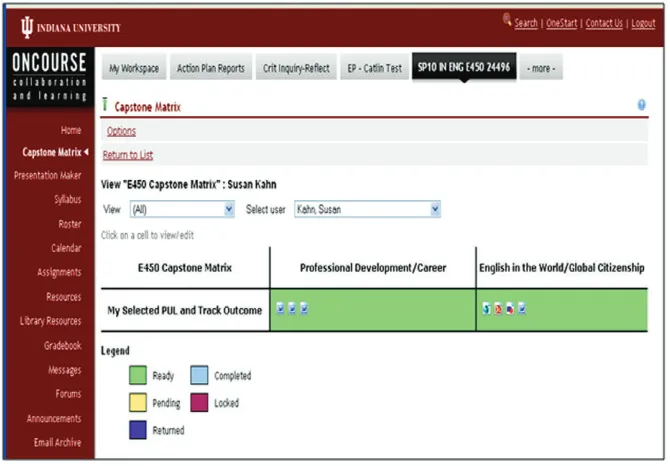
Next, Karen Ramsay Johnson and Susan Kahn at Indiana University Purdue University at Indianapolis (IUPUI) highlight their perspectives on challenges embedded in capstone projects. The essay connects the dots with English ma-jors and professional programs transitioning to careers or further study. Similar to the previous essay regarding ASU, the authors relate work being done at IUPUI, including integration of ePortfolios with other adopters across campus. Johnson and Kahn show the evolution of their work in relation to work from Barrett (2004), to matrices and webfolio work of Hamilton and Kahn (2009), to Zubizarreta (2009), and to Cambridge, Cambridge, and Yancey in Electron-ic Portfolios 2.0 (2009). This chapter continues a thread on reflective process in ePortfolios that runs through the work of Darren Cambridge. Whether in the classroom or community, reflective process weaves through the collection. More than a case study of ePortfolios within the collection, Johnson and Kahn’s piece shares the reflective experiences of four English Capstone students us-ing ePortfolios. The feedback loop between students and authors/researchers shows that the technology of ePortfolios may not resolve inherent pedagogical and social problems. Readers are reminded that ePortfolios are always already “works-in-progress.” Johnson has given numerous presentations on ePortfolios and their use in both Liberal Arts programs and in assessment. Kahn has pub-lished, presented, and consulted widely on faculty development, assessment, and electronic portfolios, including co-editing Electronic Portfolios: Emerging Practices in Student, Faculty, and Institutional Learning (2001). She currently chairs the Board of Directors of the Association for Authentic, Experiential, and Evidence-Based Learning (AAEEBL), the international association for eP-ortfolio practitioners.See http://academicaffairs.iupui.edu/plans/ePort for more discussion on IUPUI’s approachs.
advice. Thus, the three discussions in Section 2 about constructing bridges ex-amine the nuanced interplay of outcomes, reflection, and audience in variety of ePortfolio capstone courses and community projects.
3. PRESENTING INTERACTIVE DESIGNS
Geoffrey Middlebrook from the University of Southern California and Jerry Chih-Yuan Sun from National Chiao Tung University begin “Showcase Hy-bridity: A Role for Blogfolios” with a powerful volley to the ePortfolio field about the limitations of static approaches to ePortfolios. They encourage data-base-driven and more dynamic approaches to the ePortfolio imagination. Spe-cifically, this chapter discusses a project at USC to implement a portfolio-based system. Hybrid “blogfolios” can result in flexible research processes for person-al, intellectuperson-al, and vocational benefits. Middlebrook and Chih-Yuan Sun evoke Ali Jafari’s (2004) positioning of students as stakeholders at the “cyber-table.” Students and web bloggers do not only reproduce digital identity through con-tent; their identity is developed through aesthetic, software, and media choices (Farmer, 2006). Chih-Yuan Sun has published journal and conference papers in the areas of online teaching and learning, student motivation, electronic feed-back devices, OpenCourseWare, and ePortfolios. Middlebrook is the recipi-ent of numerous grants and awards, among them the University of Southern California Provost’s Prize for Teaching with Technology. For more information about current work, see Middlebrook at http://dornsife.usc.edu/cf/faculty-and-staff/faculty.cfm?pid=1003534, and Chih-Yuan Sun through http://blog.jerry-sun.net and http://elearning-lab.nctu.edu.tw.
and Watson’s chapter regarding what constitutes effective ePortfolio production and accessibility. For more information on Sushil K. Oswal’s current work, see
http://depts.washington.edu/disstud/faculty/sushil_oswal.
And the third chapter in this section comes from Darren Cambridge: “From Metaphor to Analogy: How the National Museum of the American Indian can inform the Augusta Community Portfolio.” Cambridge’s latest books on eP-ortfolios are well-cited throughout this collection. Cambridge works for the American Institutes for Research, and spends much time analyzing ePortfolio work being done around the world. Cambridge explores the use of a specific metaphor to suggest that the individual and the system must be better inte-grated. The metaphor he uses is that of a museum. Here, Cambridge studies the Augusta Community Portfolio project and uses details from the National Mu-seum of the American Indian to suggest ePortfolio design must be highly inter-active in order maximize effectiveness. Cambridge asks for a “balanced relation-ship between community ePortfolio authors and readers, developing design and content that both provides audiences with immediate value.” The demands of public, academic, professional, and personal spaces should not override authen-tic literacy. This third section at once heralds, praises, and criauthen-tically questions the value of interactivity of digital literacies. He co-leads the Inter/National Coalition for Electronic Portfolio Research; is third country coordinator for the Europortfolio project funded by the European Union’s Lifelong Learning pro-gram; and serves on the board of the Association for Authentic, Experiential, and Evidence-Based Learning. He has developed technical specifications for IMS Global Learning Consortium and open source ePortfolio software through the Sakai Foundation. For more of Cambridge’s recent work, see Electronic Port-folios 2.0: Emergent Research on Implementation and Impact (2009), and Eport-folios for Lifelong Learning and Assessment (2010). Links can be found at http:// ncepr.org/darren.
4. AUTHENTIC ASSESSMENT TOOLS
AND KNOWLEDGE TRANSFER
a workplace. What results are enhanced by critical reflection, better under-standing of learning processes, and a more specific underunder-standing of audience? Corbett et al.s’ student data models authentic and evidence-based learning in much the same way as Johnson and Kahn’s. All authors draw attention to in-cremental changes in instructional practices, cultures of assessment, and insti-tutional support that will have to go hand in hand with ePortfolio application at the programmatic level. Corbett is Southern Connecticut State University Co-Director of Composition (http://writing.colostate.edu/portfolios/portfolio. cfm?portfolioid=2870), LaFrance is at the University of Massachusetts, Dart-mouth (http://michellelafrancephd.com), Giacomini is University of Wash-ington Research Manager of Academic and Collaborative Applications (http:// sites.google.com/a/uw.edu/cara-giacomini), and Fournier is University of Washington Research Scientist of the Program for Educational Transformation Through Technology (http://depts.washington.edu/pettt/team). See their Web pages to learn more about their current work.
Next, Carl Whithaus’ chapter, “ePortfolios as Tools for Facilitating and As-sessing Knowledge Transfer from Lower Division, General Education Courses to Upper Division, Discipline-specific Courses,” investigates relationships be-tween ePortfolios and knowledge transfer at a divisional level general educa-tion program. Whithaus’ work is of particular used to administrators, program directors, and internal and external assessment bodies. Whithaus uses Grego and Thompson’s (2008) notion of “thirdspace” (previously discussed) to sug-gest ePortfolios can be used as valuable tools for outcome-based assessments of lower-divisions. How can knowledge transfer be tracked from lower-level cours-es though upper division, graduate, and beyond? Whithaus sharcours-es convincing cases for the use of ePortfolios from around the world. He has published two books that focus on writing instruction and information technologies: Writing Across Distances and Disciplines: Research and Pedagogy in Distributed Learning
(2008) and Teaching and Evaluating Writing in the Age of Computers and High-Stakes Testing (Erlbaum, 2005). The three chapters of this last section, in some part, deal with measuring and improving writing skills through ePortfolios. The data gathering, reflecting and, and archiving functions of ePortfolios lend greater depth and validity than the traditional culminating student surveys. The archiving function (through use of databases) mentioned in Whithaus’ text paves the way to Zaldivar, Summer, and Watson’s final discussion that seeks to capture useful assessment data, student voices, and authentic learning. For more information on Whithaus’ current work, see http://writing.ucdavis.edu/ faculty-staff/directory/whithaus.
evidence-based portfolios to both teach and assess in “Balancing Learning and Assessment: A Study of Virginia Tech’s Use of ePortfolios.” Specifically, the essay which closes our collection opens new questions for us, such as how do we en-courage administrators and faculty and staff to see value in ePortfolio learning? What are the greatest challenges confronting us with ePortfolio performance support systems? Zaldivar is Virginia Tech University Director of the ePortfolio Initiatives and works with EDUCAUSE (see http://www.educause.edu/mem-bers/virginia-tech), Summers is Assistant Director of Virginia Tech’s ePortfolio Initiatives (see http://eportfolio.vt.edu), and Watson is Virginia Tech University Director of Professional Development and Strategic Initiatives (see http://www. uopd.vt.edu/IT_Leadership/Scholar_Bios/Edward_Watson.html). This final chapter in the collection asks readers to reflect on useful assessment data with attention to student voices and authentic learning.
Ultimately, this gathering of thought-provoking essays asks how ePortfolios can be used not only to document past experience, but also to change the cli-mate of learning and assessment on college campuses while preparing college graduates for successful job applications and careers. How do ePortfolios evolve into and out of workplace environments, public spaces, and across academic curricula? What are the benefits and drawbacks of authentic, evidence-based ePortfolios that link students’ voices and their learning to ePortfolios and da-tabases? ePorfolios are mediation of performance, participation, and (re)inven-tion. Contributors present findings and recommendations based on their expe-riences and research using ePortfolios in a variety of institutional and workplace settings for a variety of purposes. Through additive uses of interactive media, databases, feedback loops, and global networking, ePortfolios are positioned to make continued and significant contributions to learning and knowledge cre-ation. Please review additional examples and the on-going programs discussed in this collection online through The WAC Clearinghouse’s Open-Access Books page (http://wac.colostate.edu/books).
REFERENCES
Cambridge, B., Cambridge, D., & Yancey, K. B. (Eds.). (2009). Electronic portfo-lios 2.0: Emergent research on implementation and impact. Sterling, VA: Stylus. Cambridge, D. (2010). ePortfolios for lifelong learning and deliberative
assess-ment. San Francisco: Jossey-Bass.
Farmer, J. (2006). Blogging to basics: How blogs are bringing online education back from the brink. In A. Bruns, & J. Jacobs (Eds.), Uses of blogs (pp.
Gerben, C. (2009). Putting 2.0 and two together: What web 2.0 can teach composition about collaborative learning. Computers and composition online, (Fall 2009). Retrieved from http://candcblog.org/Gerben
Grego, R., & Thompson, N. S. (2007). Teaching/writing in thirdspaces: The Stu-dio Approach. Carbondale, IL: Southern Illinois University Press.
Hamilton, S., & Kahn, S. (2004). Enhancing learning, improvement, and ac-countability through electronic portfolios. Metropolitan Universities Journal,
14(4), 90-101.
Jafari, A. (2004). The “Sticky” ePortfolio system: Tackling challenges and iden-tifying attributes. EDUCAUSE Review, 39(4), 38-49.
Reynolds, N., & Rice, R. (2006a). Portfolio keeping: A guide for students (2nd ed.). Boston: Bedford/St. Martin’s.
Reynolds, N., & Rice, R. (2006b). Portfolio teaching: A guide for teachers (2nd ed.). Boston: Bedford/St. Martin’s.
Roen, D., Glau, G., & Maid, B. (2012). The McGraw-Hill guide: Writing for college, writing for life. New York: McGraw-Hill.
Whithaus, C. (2005). Teaching and evaluating writing in the age of computers and high-stakes testing. Mahwah, NJ: Lawrence Erlbaum.
Whithaus, C., & Lakin, M.B. (2005). Working (on) electronic portfolios: Con-nections between work and study. Kairos: A Journal of Rhetoric, Technology, and Pedagogy, 9(2). Retrieved from http://english.ttu.edu/kairos/9.2/bind-er2.html?coverweb/whithaus/cover.htm
Yancey, K. B. (Ed.). (1992). Portfolios in the writing classroom: An introduction. Urbana, IL: NCTE.
Yancey, K. B. (1998). Reflection in the writing classroom. Logan, UT: Utah State University Press.
Yancey, K. B. (2004a). Postmodernism, palimpsest, and portfolios: Theoretical issues in the representation of student work. College Composition and Com-munication, 55(4), 738-762.
Yancey, K. B. (2004b). Teaching literature as reflective practice. Urbana, IL: NCTE.
Yancey, K. B., & Weiser, I. (1997a). Situating portfolios: An introduction. In K. B. Yancey, & I. Weiser (Eds.). Situating portfolios: Four perspectives (pp. 1-20). Logan, UT: Utah State University Press.
Yancey, K. B., & Weiser, I. (1997b). Situating portfolios. Logan, UT: Utah State University Press.
Zubizarreta, J. (1997). Improving teaching through portfolio revisions. In P. Seldon, The teaching portfolio (2nd ed.), pp. 37-45. Bolton, MA: Anker. Zubizarreta, J. (2004). The learning portfolio: Reflective practice for improving
PERFORMANCE SUPPORT
SYSTEMS
What our age needs is communicative intellect. For intellect to be communicative, it must be active, practical, engaged. In a culture of the simulacrum, the site of communicative engagement is electronic media.
—Taylor & Saarinen,
Imagologies: Media Philosophy (2004), p. 2
POSTMODERNISM,
PALIMPSEST, AND
PORTFOLIOS:
THEORETICAL ISSUES IN
THE REPRESENTATION OF
STUDENT WORK
Kathleen Blake Yancey
Florida State University
What we ask students to do is who we ask them to be. With this as a defining proposition, I make three claims: (1) print portfolios offer fundamentally different intellectual and affective opportunities than electronic portfolios do; (2) looking at some student portfolios in both media begins to tell us something about what intellectual work is possible within a portfolio; and (3) assuming that each portfolio is itself a composition, we need to consider which kind of portfolio-as-composition we want to invite from students, and why.
I was of three minds, Like a tree
In which there are three blackbirds
—Wallace Stevens
To begin at the beginning ...
One beginning for thinking about the representation of student work is located in the context of our own research. When someone talks about rep-resentation of student work, what’s often being discussed is a mediated repre-sentation, that is, our representation of that work—typically presented as part.
A number of issues locate this meaning of representation, many scholars and organi-zations—among them the CCCC—ad-dressing them.
Backing up, we might consider an earli-er beginning: the representations of students that we as teachers invite or permit. These representations, regardless of the form that they take (essay test, PowerPoint project, or portfolio), simultaneously invite certain constructions and (yet) provide the texts that we assess. Put differently, what we ask students to do is who we ask them to be. As important, these representations
con-stitute a rhetorical situation, precisely (1) because they are immediate, direct, and substantive—composing, as they do, the material of our teaching lives and those of our students’—and (2) because they perform a double function—pro-viding grist for the twin mills of identity and assessment.
(Yet) Another beginning is both professional and personal, the practices we’ve developed with and through the portfolios that began populating writing classrooms and programs over two decades ago. For many, portfolios played a major role in the quest for a better way of representing student achievement— qua grades—than summing their grades on individual essays. As a selected body of plural performances narrated by the writer in a reflective text and located at a particular point in time, portfolios seemed (and still seem) a representation preferable to incremental measures that seem, by contrast, to represent our suc-cesses as teachers at least as much as a student’s sucsuc-cesses as a writer.1
In other words, any representation is situated in multiple contexts. And: a single representation, regardless of how innocent it may seem, can also serve multiple intents and can also work to unintended effects. So here a small post-modern beginning—in the sense that I have abandoned a master narrative about representation of student work, calling instead upon what Richard Freed describes as a “proliferation of little narratives” or, in Clifford Geertz’s terms, a “dialogue of local interpretations.” Each interpretation presented above—
1. representation of student work by faculty;
2. representation by students of their own work in response to faculty; 3. representation of students by faculty in the currency of grades
—is located within its own context, its own narrative. Making sense of an issue—in this case, representation of student work—requires multiple contexts,
As in a file cabinet, information is organized into categories (file drawers), subcategories (file folders), and elements (pieces of information in the file folders) ���� the information resides in the owner’s portfolio, providing easy access to all the data needed to support a lifetime of formative and summative evaluations (my italics)�
fluidity, plurality. Or: in a postmodern world, what in earlier times might have regarded as fragmentation, indeterminacy, and heterogeneity are understood today as necessary virtues.
How we organize and represent the world: that too is the palimpsest of my title. In The Practice of Everyday Life, Michel de Certeau presents palimpsest as another kind of representation, focusing in his illustration on the map as type. Mapmaking itself, he says, is exemplar par excellence of representation: typically, maps seek through various representational devices to stabilize a fluid and dynamic space, which (admittedly) is a useful practice for those needing the direction maps provide. At the same time, of course, what goes unnoticed is that such a stable representation achieves this stability precisely through
misrepresentation: a map fundamentally misrepresents the thing represented. Moreover, such representations, as the example of the Mercator map attests, are ubiquitous, and we are impervious. Seeking a radical design practice that would permit representation of multiplicity in maps of various kinds—located in per-spectives oriented to territory, socioeconomic distribution, political conflicts, identifying symbolism, and the like—de Certeau found in palimpsest a new semiotic, a new means of showing the “imbricated strata” inherent in any space a map might mark. The space itself, according to de Certeau, is a palimpsest, which only becomes obvious if and when
the means of representation are likewise multiple.
Taking a cue from de Certeau, Ben Bar-ton and Marthalee BarBar-ton have discussed layering as one “palimpsest” method for accomplishing a fuller representation. As they suggest, we might think in terms of multiply layered maps of the world through which we achieve a representa-tion.2 As important, whenever we seek to “map” materially or metaphorically, we might go “multiple,” as in the case of us-ing x-rays—taken from various vantage points—to represent and thus assist in constructing a more accurate diagnosis.3 And of course, we might use such multiple mapping to represent student development and achievement. Recently, literary theo-rist Michael Davidson has talked about a
CHAPTER ONE I AM BORN Whether I shall turn out to be the hero of my own life, or whether that station will be held by anybody else, these pages must show�
CHAPTER LXIII A VISITOR [The Penultimate Chapter] What I have purposed to record is nearly finished; but there is yet an incident conspicuous in my memory, on which it often rests with delight, and without which one thread in the web I have spun would have a raveled end�
related concept, what he calls the role of palimtext—a specifically verbal applica-tion of palimpsest—in understanding any given work of an artist. He claims:
The palimtext is neither a genre nor an object, but a writing-in-process that may make use of any number of textual sources. As its name implies the palimtext retains vestiges of prior writings out of which it emerges. Or more accurately, it is the still-visible record of its responses to those earlier writings. (Davidson, 1995, p. 78)
According to Davidson, reading a text in its own developmental context—that is, reading it as a palimtext, much as we read the final draft of a student text in the context of earlier drafts of that essay or a portfolio of finished texts in the light of earlier work, including notes and peer reviews and teacher commen-tary—is a best way of reading precisely because of the contextual framework it privileges. As important, both of these—palimpsest and palimtext—speak to the shifting relationships between context and text: to make meaning, they both include context as a central element of text.
Context is what allows us to understand, to interpret, to make meaning. It allows us to answer the question, “Relative to what?” “Relative to the mul-tiple contexts from which the writing emerged, to the contexts made visible and made an explicit part of the reading,” we reply. Related to teaching and learning, the idea of context allows us to interpret, to represent, in many ways, simultaneously. As teachers we do this as part of daily practice, often tacitly: interpret what we intend in the context of past experiences, relative to what we hope. Students likewise:
In a first instance (perhaps a default instance), a student represents learning within the context of time past and present: her past, for instance, explaining what knowledge she has brought with her from previous experiences to current time as she explores what she seeks to know now.
Concurrently, in a second instance, she represents what she is learning with-in the context of space: learning in multiple contexts concurrently, she notes what she learns in one setting, a class or service learning setting, for example, at the same time that she includes what she is learning in another class.
And in a third instance, she can do both in the context of the subordinate
The inclusion of these contexts in our teaching and learning as a kind of pa-limpsest makes meaning more complex, more sophisticated (if not always more immediately coherent) as it makes it more specific, less anonymous.
Never more so than when we ask students to represent their work and, thus of course, their selves when we ask them to compose portfolios.
These claims—among them that an assessment (like a portfolio) constructs that which it purports to measure—aren’t new. What is new, at least in terms of portfolios, is the medium in which they are created. Print portfolios, in class-rooms and programs, have enriched writing programs for nearly two decades (Belanoff & Dickson, 1991; Yancey & Weiser, 1997); electronic portfolios, as the recent American Association for Higher Education publication Electronic Port-folios (Cambridge) suggests, aim for analogous changes both in what and in how we learn and teach.
The student represented in each portfolio—print and digital—is not co-identical, however, principally because these spaces that students are invited to make their own offer fundamentally different intellectual and affective oppor-tunities: that’s my first claim.
Looking at some student portfolios in both media begins to tell us some-thing about what intellectual work is possible within a portfolio: that’s my sec-ond claim.
And if it’s so that the intellectual work made possible differs according to medium, then a question we need to consider when we design our courses isn’t so much, portfolios or not, but which kind of portfolio, which kind of compo-sition, and why? That’s my third claim.
which becomes a function of the medium you choose—iswho you invent. And: who you invent is who you represent. Or:
If arrangement constrains and shapes what we invent, and if what we invent leads to what it is that we represent, then what arrangements do we require, request, or recommend?
And how do we invite and review these arrangements?
Within this rhetorical context, I want to begin (again) by thinking about how we arrange materials in print portfolios. Typically, we have three options: (1) in a genre-based way, according to the documents of the course (essay one, argument two, and so forth); (2) in an outcomes-based way, according to what a student knows and can do (showing evidence of conceptual understanding and applications of concepts); and (3) in an intellectual framework, according to major questions or key terms of the course (using work samples to answer questions like “what is rhetoric?”). A fourth option is possible, as well: some hybrid combination of the earlier possibilities. Most often, students are asked to use a document- or genre-based approach that mirrors the sequence of as-signments; the tendency is for students in their portfolio arrangement to repli-cate the (linear) curriculum and their always-forward processes of development almost hand-in-hand. In addition, the notebook often encasing the portfolio underscores this sense of development in its linear representation of materials. And while it is possible to read such a portfolio hypertextually (Allen, Frick, Sommers, & Yancey, 1997), the medium makes such a hypertextual reading process more difficult, not less, and as important, the design of the notebook itself acts to frame what appears as a linear development of the student. (And it’s worth noting that this forward-progress development is precisely what we teachers hope for, so it too matches neatly with our desires.)
Likewise, digital portfolios can take one of three principal arrangements, and in this case, since the three offer very different rhetorical opportunities, it’s worth pausing a moment to define them. The first, what we might call an
More ambitious (and disconcerting) in its own way is the OpenSource Uni-versity of Minnesota “cradle-to-grave” model of electronic portfolio, created for employees and students at all UM campuses. This portfolio model offers the user the ability to “store and selectively share information in that portfolio with anyone, anywhere, at any time,” a feature the designers call a “virtual identity” (Truer & Jensen, 2003, p. 34). To add “self-reported information” into the portfolio, much as in the Florida State model, the “UM Electronic Portfolio owner fills out text fields in a template that corresponds to a portfolio element” (Truer & Jensen, 2003, p. 35). There are (as of this printing) sixty-five such ele-ments, each one of which (name of institution attended, degrees earned, and so on) permits the user to attach a file or link to a URL. Portfolio owners can also “create new elements to meet specific needs” (Truer & Jensen, 2003, p. 35). As the careful reader will note, however, not all information in this port-folio model is “self-reported.” The UM “administrative system,” through the software PeopleSoft, automatically displays system information in each owner’s portfolio. This includes the user’s name, university ID photo, contact informa-tion, demographic informainforma-tion, and education records. An essential part of the UM Electronic Portfolio design is that system information is displayed dynami-cally. This means, first, that an owner
can-not modify system-entered information, and, second, the portfolio always displays the most up-to-date information (Truer & Jensen, 2003, p. 36).
The opportunities for assessment in such a model are numerous, including ad-visors using it to help students in
“place-ment and course selection”; instructors assessing “learning achieve“place-ment”; and even the parents of students, with permission, checking to see how their stu-dent-children are progressing. (Interestingly, the parents are apparently check-ing their children’s performance in the single course requirement represented in the prototypic model: composition.) The online assessment electronic portfo-lio, then, is portfolio-like in its capacity to collect exhibits and in its inclusion of opportunities for reflection. An online assessment system, however, is very un-portfolio-like, as we in composition studies have understood portfolios, in several ways, most notably in that each portfolio has two composers, (1) a stu-dent and (2) the system, with the system’s override capability exerting greater authority.
A second model of digital portfolio, what we might call “print uploaded,” is a version of portfolio that is identical in form to the print but that is distributed electronically. In this model, the reviewer typically links from an item on the
Whatever else learning may be, it is clearly a disposition to form structures�
opening page to a second item—and back, much as one does in the online version of university phone books. This model is particularly useful for students morph-ing into the digital from the print. Lizette Piccello, a teacher at Virginia Beach City Schools, uses this approach to help stu-dents move from one medium (print) to the next (digital), advising students, first, to create a Table of Contents, and, second, to link each entry in the table to the ap-propriate exhibit—and back (L. Piccello, personal communication, July 22, 2003). While such a model doesn’t fully exploit what digital environments make possible (the inclusion of images and pictures, links to other sites, and audio, color and photographs), such a portfolio is very like the print model in its collection, selection, and reflection and, at the same time, like the digital in its use of technology to
cre-ate connections. To use another metaphor, it’s a bit like the interlanguage that a speaker of a new language creates between the home language (print) and the target language (digital), including elements of each in a hybrid design.
A third digital portfolio, the one I’ll focus on here, is what we might call “Web sensible,” one that through text boxes, hyperlinking, visuals, audio texts, and design elements not only inhabits the digital space and is distributed elec-tronically but also exploits the medium. In other words, this model may include print texts, but it will include as well images and visuals, internal links from one text to another, external links that provide multiple contexts, and commentary and connections to the world outside the immediate portfolio. For example, in a portfolio composed inside a course, a stu-dent might include links to process pieces as well as to completed drafts; links to a stream-ing video that welcomes the portfolio reader and narrates the opening; links to the class blog as well as to a group PowerPoint presen-tation. An audio file may narrate the Power-Point presentation, and the PowerPower-Point may
[In designing my digital portfolio] I do realize that it seems strange for me to include a section entitled “Visual Communication” ���� I decided ��� for the following reasons� First, I eventually want to add more work from my Visual Communication course to the website� Much of the work I’d like to include is being finished up toward the end of the semester� I hope to eventually include it in the site� Second, I avoided the title of “Rhetoric” and used “Other” instead because I would like to leave space in that section available to include coursework I complete down the road in other classes�
—Cate Heatly
also link to several Web pages that provide context for the concepts presented in the PowerPoint as well as links to an explanation of the kinds of links that are being used. The portfolio may also link to texts composed in other classes, some of which have separate reflections. The medium, then, is media; the links numerous and varied, connecting to multiple kinds of exhibits. Typically, as I have argued elsewhere (Yancey, 2004), the “Web-sensible” model offers at least two navigational paths, and it’s not uncommon for a portfolio composer to sug-gest explicitly to readers ways to chart those paths. In this sense, the portfolio composer sounds much like the “Dear Reader” narrator of the Victorian, novel, each instructing the reader both how to read and how to understand the new genre:
Once you do get into this site, here are a few tips to help you with browsing. This site is divided into three parts: computers I work with, the hobbies I enjoy ... and my reputation. There are three ways to navigate this site. This homepage has all the links, with a short description of each neatly planned out. If you get lost, or want to jump to something, use the
side frames. But first you should go to the reflective essay. It describes all the works in this portfolio and has links to them inside of it. If you want to see something else, simply come back to the homepage.
* * *
The most important part of this website is for you to leave it. You don’t have to leave now, but there are some really cool sites out there.
—Matthew Yancey
The Web-sensible digital portfolio, then, offers a new kind of space for stu-dent work.
All of which allows me to suggest that these portfolios—the familiar model of print and the Web-sensible digital—are different in kind rather than degree and that their differences speak to the possibilities for student invention and representation.
As Jay Bolter and Richard Grusin explain in Remediation, and as Marshall McLuhan suggested before that, nearly every medium is re/mediated on an-other medium. In an-other words, consciously or an-otherwise, we create the new in
Only final because nothing came afterward�
the context of the old and based on the model of the old. Television is commonly understood to be remediated on film, for example, and the Web is commonly un-derstood to be remediated on magazines. Remediation can be back-ended as well, as we see in the most recent CNN interface on TV, which is quite explicitly remediat-ed on the Web. In early September 2003,
The Miami Herald announced its remedi-ated iteration, also intentionally based on the Web (S. Apostle, e-mail, September 15, 2003). As Bolter and Grusin observe, “Whenever one medium seems to have convinced viewers of its immediacy, other media try to appropriate that convention” (Bolter & Grusin, 2000, p. 9). The new, then, repeats what came before, while at the same time remaking that which it models.6
Portfolios are exercises in remediation. Like new media themselves, portfo-lios “emerge from within cultural contexts, and they re-fashion other media, which are embedded in the same or similar contexts” (Bolter & Grusin, p. 19). From this perspective, a print portfolio seems remediated on a book. Typically, it opens with a letter or table of contents, then proceeds in a linear fashion from beginning to end. It privileges a single story, typically an argument, or a narrative that argues; it highlights the story of development told by the writer; it culminates in a narrative of accomplishment. Like chapters in a book, the entries in the portfolio testify to this story line. Although the reader may move through the portfolio hypertextually, the linear arrangement of the book argues for a beginning-to-end reading. The reader of the portfolio is, more often than not, singular: the teacher. The portfolio is typically read in isolation, silently.7 The portfolio, in other words, is public in the small sense: within the classroom. Because of the print medium, which outside of a school culture culminates in a publication that is only revised if the number of copies sold is sufficient, the argument is frozen in a particular spot of time: a print portfolio is, typically, published only once. And once published, the story opens, progresses, and most importantly, concludes. In sum, the arrangement of the portfolio, modeled on a book, provides for the invention of a particular kind of student: one who can state a claim, synthesize material, lead a reader through a tale of progress and achievement, and conclude.
Because the web portfolio is a newer medium, criteria for evaluating them will emerge as the medium itself matures� Generally, excellent web portfolios will be characterized by the extent of the web, the creativity of the links, the meaningful coherence of the whole, the quality of the individual sites, the clarity of the overall design (its logic), the degree to which the rationale for particular links is explicit and sensible, the critical judgment apparent in the selection of external sites, and the overall aesthetic quality of the portfolio�
Still, a print portfolio is a re-mediation: as such, it offers more and other than a book. A book itself, for instance, is the product of many processes, most of which are invisible: what we tend to see in the finished product is the trace of the processes that produced it. In contrast, a print portfolio, particularly a class-room print portfolio, can intend to show process, proposes to show the pulleys and galleys that went into the final publication as well as the final publication itself. Much like Coosje Van Bruggen’s Frank O. Gehry’s Guggenheim Museum Bilbao, which records in reiterative detail the museum’s “conception through design and construction” (1997), a print portfolio often shows us the how of development as well as the achievements of it. In the terms of literary theorist Davidson, what a print portfolio offers, in this way of process and product, is a palimtext, the still-visible record of its responses to earlier writings (1992, p. 78).
As students compose the print portfolio, showing both the making and the made, they engage in activities that the authors of The Myth of the Paperless Of-fice identify as knowledge making. The product of research into the activities of “knowledge workers,” The Myth of the Paperless Office outlines the myriad processes of gathering, storing, and sorting of documents that writers use to “construct and organize thoughts” (Sellen & Harper, 2001, p. 61), processes that, the authors claim, rely quite explicitly on the presences and arrangement of print documents. Writers, for example, keep information available as “con-textual cues to remind them of where they were in the space of ideas” (Sellen & Harper, 2001, p. 61, emphasis added). The “laying out of the paper reports,” and the “time bringing together and organizing reports for themselves or other people” are two critical activities for making knowledge. Another is the follow-ing: “... act of flicking through these documents, bringing to mind what was important to them and why they were important. The main implication of all this is that paper is important because it makes information accessible and tangible and gives it a persistent presence.” (Sellen & Harper, 2001, p. 63)The collection of the documents and the arrangement of them, as with portfolios, permit the creation of knowledge needed in an information age. And the pat-tern, Abigail Sellen and Richard Harper claim, is consistent across a diversity of workplaces:
Harper, 2001, p. 72)
Portfolios, of course, are exercises in deeply reflective activity. More generally, print portfolios, by virtue of the medium, ask students to engage in processes leading to knowledge and processes associated with reflective thinking.
Not least, the coherence achieved in the print portfolio is a verbal coherence, as is the means of representation. Put in terms of Howard Gardner’s multiple intelligences, print portfolios are more singular than plural (1993).8 Digital portfolios, like their print cousins, are exercises in mediation; they can re-mediate in one of two ways. As we saw earlier, some electronic portfolios, even though they are created in a digital environment, remediate a print model. This portfolio is the academic analogue to the print catalogue, a genre that is written for the page, not the screen, and whose digitality serves two purposes: easier storage, quicker dissemination. As noted elsewhere, it is one version of print uploaded (Wickliffe & Yancey, 2001). Its arrangement is identical to that of a print model: regardless of the fact that it is housed in the digital environment, it does not participate in the environment, and the student resembles her print cousin. She is the invention of print.
outward. It is the electronic text described by Richard Lanham in The Electronic Word: “No ‘final cut’ means no conventional endings, or beginnings or middles either. Interactive literary texts will ... require some basic non-Aristotelian ad-justments” (Lanham, 1993, p. 7).
If, then, the print portfolio is Aristotelian, the digital is post-Aristotelian. The digital portfolio seems gallery-like both within a single course, as student portfolios span temporal, spatial, and intellectual contexts, and beyond the single course, as students develop portfolios that span courses, that chart devel-opment over longer time, that from semester to semester provide a continuing place for students to compose. Indeed, the digital portfolio, located in multiple and multiple kinds of relationships, is a digital composition: a single, unified text through which various fragments rational and intuitive are related to each other, directly, associatively. Moreover, as students move from one curricular experience to another—from first-year composition to service learning assign-ment to the introduction to the major to the internship to the junior seminar to the capstone—they find in the portfolio a continuing site where experiences can be planned, articulated, interrogated, reflected upon, made sense of. Much as we see in a gallery, in the digital portfolio students continue a re/iteration project. Students create multiple iterations of the portfolio, returning to the original, carrying forward some prose and reworking it, creating new images, raising new questions. Located both within the curriculum writ large and yet outside and between it—a key distinction I’ll return to—the digital portfolio is the gallery canvas on which the student composes identity between, as it were, electronic drafts. And much as in a gallery, the various drafts are explained, interpreted, represented chronologically and juxtapositionally more than in a master narrative of progress uninterrupted; that is, a student may well plot a linear narrative of progress within this medium, but the medium itself invites other narratives, other arrangements, and thus other selves.
Like a print portfolio, the digital includes traces of earlier thinking: palim-text and palimpsest both. The palimpsest of multiple representations occurs through linking, which itself functions to provide multiple layers. Digital port-folios, because they are “spatial,” inhabit three dimensions. They are quite liter-ally and materiliter-ally another space of ideas. Like maps, each link takes the viewer to something not quite captured-and thus the value of multiple layering.
Because you can link externally as well as internally and because those links are material,
you have more contexts you can link to, more strata you can layer,
more invention to represent.
Digital portfolios, then, precisely because they are digital, privilege perspec-tive and multiplicity and a representation of palimpsest. Or: that is the hope.
Which is not always realized, of course. As in the case of print, students may weave a narrative that is not supported by the “textual evidence.” Stu-dents may not write well for either page or screen, and digital tends to require both. Students may produce links that literally don’t link, or that don’t create a substantial or significant relationship between the linked items. (And in fact, the linking may be the point on which the digital hinges: who decides if a link “works”? Or why?) The task of design may be overwhelming.
More generally, however, what this list of concerns demonstrates is that the medium is suggestive rather than deterministic. The virtues of the digital out-lined here are more potential than realized, but this articulation demonstrates potential for a new identity, one not fully determined by medium, but possible within and through it.
Finally, I want to borrow from humanist geography to think in another way about digital portfolios. The concept of weaving is instructive here. The word itself derives from the Latin texere, meaning “to weave,” which came to mean the thing woven (textile) and the feel of the weave (texture). But it also refers to a “weave” of an organized arrangement of words or other intangible things (context). A textile is created by bringing together many threads and, as such, represents ordered complexity. Language, too, is ordered complexity, and when we understand a word by its context we are discerning a pattern and filling in a gap, sewing together what is torn, extracting meaning not only from what is said but from the relationships this act of saying sets up with other statements, conditions, events, and situations (Adams, Hoelscher, & Till, 2001, p. viii).
Knowledge, in this metaphor, is created through relationships, which pro-vide the center of the digital portfolio, the pattern of the intellectual weave. We see such complexity valued in models like that at St. Olaf College, where students create digital portfolios to represent their individual majors. It’s knowl-edge as a function of the weaving of ordered complexity.
Multiple modes of coherence are possible: verbal, contextual, visual. Like the print portfolio, the digital is produced through the processes outlined in
And from yet another vantage point, there are curricular issues associated with the digital that haven’t surfaced with print portfolios or other forms of pro-gressive pedagogy. As Lanham points out in The Electronic Word, the electronic medium provides a new place for students to work:
Electronic text creates not only a new writing space but a new educational space as well. Not only the humanities curriculum, but school and university structures,
administrative and physical, are affected at every point, as of course is the whole cultural repository and information system we call a library. (Lanham, 1993, p. xii)
Perhaps so, but if so, this new medium of portfolio may need to find a new curricular place within—but probably not inside of—the curriculum. The distinction is critical. Inside the curriculum is the place where students stay inside. In the aggregate, inside the curriculum is inside each of the disparate courses that compose a student’s course of study. Inside the curriculum is the minimal portfolio submission. Because of institution’s exigency, because of an exit requirement, let’s say, or a rising junior hurdle, students put a portfolio together, submit it, and hope it suffices. Digitally, this portfolio takes the form of a “dynamically delivered, web-interfaced” system; like a standardized test, it asks that students fill up the predigested slots and comment reflectively on how satisfying it felt. The new place cited by Lanham is the digital portfolio created
within and beyond the curriculum, and this place is likewise a new curricular place. If the curriculum is one text and the extracurriculum another, this port-folio is intertextually curricular, itself an exercise in palimpsest. It asks students to write for the screen as well as for the page; to create relationships between and among linked material, as between and among experiences; to update it as a habit of mind; and to represent learning in part by exploring the connections the digital environment invites.
Or: so digital portfolios are developing at several places across the country. As they do, it behooves us to be intentional, to understand that these portfolios, like their print cousins, bring with them opportunities and challenges.
Among them:
As program portfolios are developed, will they be “thematized” as artifacts of local culture? The LaGuardia model, for instance, invites students to represent both their home culture as well as their school culture, which makes particular sense given that a majority of students (and of faculty as well) are immigrants; they speak in two cultures already; the portfolio model welcomes that. The Clemson general education model may well include the theme of the “higher seminary of learning,” given that this is part of its mission, and other initiatives (like an orientation reading program) are being built around that idea, too.
Will students work on their portfolios in some new physical space, a studio of some kind, as at Clemson University?9
What effects will these portfolios exert? Embedded in an interdisciplinary yearlong first-year seminar at Portland State, digital portfolios are cited as one reason the retention rate, from first year to second, has more than doubled in the last four years, from 30+% to 67%: is the power of connecting, within the intimate context of a yearlong themed seminar, this powerful?10
What are the exhibits that will most help students? Are they the same as we see in print? Different? What is the role that the concept and processes of composition will play in these portfolios, especially if we define the digital port-folio not as a templated drag-and-drop online assessment, but as a new kind of composition?
What is the relationship between intellectual connections and digital linking? Does the kind of linking matter? There are many ways to categorize links, from the simple dichotomy of internal and external to the kinds of classification offered by Scott DeWitt and Kip Strasma and by Emily Golson. Does one kind of link lead to greater learning? Does one set of links, either of one special type or of a certain mix, characterize more sophisticated learning?
What will students tell us about the learning in digital portfolios?11
What will teachers need to learn in order to teach the digital portfolio? How can this learning be supported?
If digital portfolios call for a new definition of composition, how will that affect graduate programs? How will that affect the labor of composition, both in terms of our “work” and in terms of the qualifications for those who teach composition?
How will we read digital portfolios? As we navigate these texts, at what point is the arrangement we-as-readers plot sufficiently different one person to the next that we are creating different texts? When (if ever)/ Is such difference a problem?12
How/Will the digital portfolio change teaching, learning, and the academy itself? Will we continue to move to a visual rhetoric only, or will we, in main-stream composition classes, begin to incorporate media, not for the sake of teaching writing but for the sake of teaching media? As important, what role, if any, will we teachers of composition play?
The answer to the previous question depends in part on the answer to this: who is the digital composer, and where inside/outside the curriculum does she or he learn this composing?
Digital portfolios operate on the “felt edge” (R. Bass, personal communica-tion, June 7, 1997) between technology and portfolio, in a space that could be productive, that, alternatively, could be Foucaultian, given the impulse of the portfolio to collect, the impulse of technology to collect and systematize. How do we navigate this felt edge without harming others, without getting hurt ourselves?
When the blackbird flew out of sight It marked the edge
Of one of many circles
Wallace Stevens’ poem “Thirteen Ways of Looking at a Blackbird,” a highly associative poem, speaks to what and how we know. The blackbird’s mark[ing] the edge/ Of one of many circles suggests a plurality of possibility. “Each sense of the blackbird defines an intelligible circle, the ‘meaning’ of which exists only until the blackbird crosses its horizon” (Leggett, 2000). In other words, the exis-tence of the world isn’t in question, only an exisexis-tence outside the perspective of the perceiver. Digital portfolios seek to represent exactly this-the perspective of the perceiver-over time, in space, aesthetically, intuitively, intellectually. These representations are themselves practices, which, as Todd May reminds us, are constitutive in ways we don’t always appreciate. Much like Donald Schon and Lee Schulman, May suggests that what we know and what we hold dear are cre-ated through practice. He also understands practice as social and thus ethical. Like the rhetoricians of ancient Greece, May looks to language—to that or-dered complexity—for the means of helping people move beyond information to understanding, possibly to wisdom. Through practice, we compose identity, task by rhetorical task, moment by reflective moment.
teach and learn composition, charting this potential may define us even more than it will define our students, and for all of us, we should, in Cindy Selfe’s terms, pay attention.
Our future will be shaped as we do.
ACKNOWLEDGMENTS
I am indebted to several colleagues: Barbara Cambridge and Pat Hutchings for inviting me to the MLA session where I gave an early version of this paper; David Booth of St. Olaf College for inviting another version, and whose work inspires much of my own thinking; Todd Taylor who provided encouragement, suggestions, and (best of all) questions; Donna Winchell and Shane Peagler for their work with me on the Clemson project; reviewers Bill Condon and Gill Creel for their helpful readings and recommendations; and Marilyn Cooper for her thorough reading and able advice.
NOTES
1. Of course, as I suggest later in the chapter, a digital portfolio doesn’t guarantee that this won’t happen, either.
2. It’s interesting that the syntax cues us as to the issue: is a fuller representation achieved, or do we achieve a fuller representation?
3. As the example of the x-rays for diagnosis makes clear, the issue of how we represent is not merely a theoretical point.
4. For a discussion of this point regarding delivery, see Martin Jacobi’s “Delivery: A Definition and History,” in Kathleen Blake Yancey (Ed.) (2006), Delivering College Composition, Heinemann.
5. My argument here is similar to Richard Lanham’s in that I see the potential of digi-tal technology to radically alter the delivery of education as well as its substance. As I explain later, the digital portfolio is one specific site for such education.