Research project:
STATE AND STIMULATI0N;OF DEVELOPMENT IN
CHILDREN AGED
8-9
LIVING UNDER WAR CONDITIONS
' I . M. VraneM,
2.
Dj. RadojeviC, 3.
E.
ZCindiC-Nokas and H. Kulenovie'
I . Fakultet zajizicku kulturu Sarajevo,
2.
Filozofski fakultet u Tuzli
-
Odsjekjizickog
vaspitanja, 3. Medicinski fakultet Sarajevo
SUMMARY
(Wan*mass-I), 30.57 and 28.37 V02kg(ml*kg-l'min- I), 168.6 and 166.6 fc(beats*min-I), 5.08 and 5.31 The somatic. functional and metabolic characteristics of V02*fc-l, 64.7 ad 62.6 V02*V02 m a - 1 %, 85.9 and children at 8 years of age have been established. These 85.4 fc'fc(V02max)-l %, 63.4 and 62.6 children have, for the previous three years, lived under w*w[v02max-I)%.stressful conditions of direct shelling, poor nutrition and movement. At the same time there has been an evaluation of the effects of programmed physical activities which have been applied in the aim of stimulating natural phys- ical dynamics and functional developments and the elim- ination of stagnation of development which occurs from conditions of unfavorable factors. The research and the program of physical activities included 41 boys, starting at an average age of 8 years and four months. The somat- ic characteristics of the boys, according to 25 antropo- metric measures (IBP), show a lag in the boy's physical development according to their age group by one year. The lagging behind is especially evident in volume dimensions and underskin tissue fat (Przulj, 1991.. Bonacin, 1995. Blaha, 1982.). An improvement of condi- tions and a greater scope of movement activities for the duration of 8 months did not significantly influence on the improvement of the somatic and functional status of the boys in comparison with the controlled group (N=21) of the same average age during another measurement period. While resting, on the level of aerobic threshold, anaerobic threshold and maximal oxygen uptake, the value of ergonometric, functional and metabolic parame- t e n were confirmed: V 0 2 stpd
,
Ve btps, Ve*
"02-1, Ve'VCO2-I, RQ, fc (beats'min-I), work load in Watts and on the basis of these relative indicators were com- pleted. The gradual growth of work load was completed with the help of bicyklergometer (Monark). After 3 min- utes of easy pedaling (warming-up) an initial work load was given of Watt8body mass and increased by 113 of the massiWan every minute until the achievement of maxi- mal oxygen uptake. Individual aerobic and anaembic thresholds (Aep) and (Anp), for each person examined were confirmed on the basis of the smallest sizes in the points of the crucial curves Ve'V02-I and Ve'VCO2-1 (Wasserman et al., 1973 and 1991, Cooper et al, 1984, Yacov. 1991). For the level of maximum oxygen uptake, the work load was taken, on which the greatest worth of V 0 2 was achieved and it did not increase with the fol- lowing greater work load. The average value of ergono- metric, functional and metabolic parameters of the initial state and the final measurement of the experiment group:-
level of aerobic threshold: 2.4 and 2.3 work load. .
-
level of anaerobic threshold: 2.7 and 2.7 work load (Wan*mass-I), 33.15 and 34.54 V 0 2 kg(ml*kg-l'min-I), 175.4 and 175.7 fc (beats'min-I). 5.6 and 6.1 V02*fc-I, 74.4 and 76.2 VO2*V02max-1%. 89.3 and 90.1 fc'fc(V02max). 70.7 and 72.7 W8W(V02max)-
. -. 1%.
-
level of maximum oxygen uptake: 3.8 and 3.7 work load (Wan'mass-I), 47.2 and 45.3 VO2kg(mlbkg-l'min-I),196.3 and 195.1 fc(beats*min-I), 6.8 and 7.3 V02.f~-I.
Significant statistical differences are confirmed only on the values of V02' fc-l I and I1 measuring P = 001.
The results confirm the assumption of the general strate- gy of adaptation, directed in the formation and protection of functional reserves from exhaustion, for priority of growth needs and development and only on that basis can an increase of ability for an even greater level of their total and rational usage can occur. For a significant growth ability of a greater level of mobilization of func- tional reserves t h e n is a need for a greater intensity and a longer time period in completing physical activities.
INTRODUCTION
With a view into somatic status and functional potential of boys at the age of 8 years, an assessment of parameters of growth and physical development and functional and metabolic parameters have been established on the level of aerobic and anaerobic threshold and maximal oxygen uptake (Brdaric, 1973. Radojevic, 1973. Vranesic, 1988. Przulj, 1991. Bonacin, 1995.). A full program of anthro- pometric measurements (IBP), ergonometric, Functional and metabolic parameters on the level of aerobic and anaembic thresholds (as an indicator of the ability for mobilization of functional potential) and the maximum oxygen uptake (as a measure of total aerobic organism productivity) are assumed as criteria for:
-
an objective estimate of a three year reaction tostress-
- t o estimate of effects of the applied program the eight . - Ergonometric, functional and metabolic p a n m e t e n months physical activities for the over coming of stag-
With the ergonometric parameters the created level of nation which resulted from somatic and functional
work load in Watts were registered and relative function- development of boys.
al and metabolic parameters indicators were completed The assumption is that with this type of approach a c m - on the basis of their.
plex notion of the character ofthe adaptation process, can
be achieved for this growth period for the increase of functional reserves of the organism and the ability for their most complete rational mobilization.
METHOD
The research included 41 boys of 8 years and four months of age in the first measurement and 9 and one month old in the second measurement. The control group was made up of 21 boys with an average of 9 years and three months of age. The choice of those examined was completed among boys from a narrow urban environment, after the expressed desire and agree- ment of their parents who wished there to be a testing of their functional abilities.
I The program was realized in the duration of 8 months, three times weekly work in comparison to kg of physical mass (2.4 Wan*kg mass-I). Work load before Aep in comparison to the size of the work load before V02 max reaches 63.4%. The pulse cost of the Wan load is 1.23 fc0Wan-l and the oxygen cost of the Wan load is 9.99 V02'Watt -1. The absolute and relative middle values of the ergonometric parameters ofthe boys in the experimental groups before testing at the beginning of the experiment in total support the work load of the boys of the same age group who have less movement activities. The per- centage of completed work effectiveness total is 29.6.
The level of ernonommetric parameten at the com~letion
-
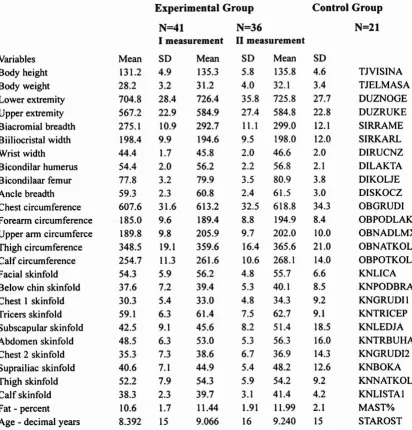
of the~h~ somatic characteristics ofthose examined were con- experiment (11 measure) results in a greater absolute value (71.8
firmed by the applied antropometric measures which Watts). The differences in the sizes of relative ergonometric parameters are of statistical meaning. except the percentage of represent the basic antropometric dimension. Body the work load in in comparison to achieved work load length is established by measuring the body height. before maximum oxygen usage (62.8%).
nere
an no meaning- length of upper extremities (arm length) and lower ful .-. statistical differences in the size of ereonometric oarameten - ~ - - . ~ - ~ ~ ~ ~ - ~~~ ~~~~ ~~~~-~
~~~ ~~ ~~~
extremities
(I&
. - -length). Transversal dimensions and the . of the bovs of the exoeriment and the control ~rouo. skeletal size are established with parameters: shoulderwidth, hip width, diameter of hand joints, diameter of palm, knee diameter, diameter of ankle joints. The dimension of the body volume is determined by the parameters: circumference of the breast skin, circumfer- ence of elbows, circumference of upper arms tensed, cir- cumference of upper leg.
The dimension of underskin fat tissue is established by anthropometric measures: facial skin wrinkles, chin skin wrinkles, breast skin wrinkles 1, skin wrinkles above m. triceps, skin wrinkles under the shoulder blades, stom- ach skin wrinkles , breast skin wrinkles 2, hip skin wrinkles, skin wrinkles above the patella, skin wrinkles under the knee. Especially established is the percentage of the fat (fat %), Parizkova.J. 1963.
The estimation of oxygen and carbon dioxide in exhaled air is determined by the Beckman-Oxygen Analyzer OM-11 and C 0 2 Analyzer LB-2 system. The program of physical activity (elementary games, natural scope of movement and sport games), the boys of the experimen- tal group were included. The middle value (MV) and standard deviation (SD) were established for all investi- gations o f the parameter. Meaningful differences between meddle values of the parameters was estab- lished by T-tests and between groups of methods of dis- criminatory analysis (Ben. W. Bolch, 1979.)'
The hctional and metabolic parameten on the level of aerobic threshold of the experimental group, I and I1 measures, is pro- portional with the size of their peen with close somatic charac- teristics. The intensity of the oxygen usage total is 858 ml'min-
Anaerobic threshold (Anp)
The achieved level of work load before Anp is greater than the level of work load before the Aep by 7.2 that is 11.4%. The examinees achieve an average work load of 2.68 Wan*k-1 that is 70.8
-
72.7% load in Watts in com- parison to the level of work load achieved before the maximum oxygen consumption. This shows the fact that the aerobic-anaerobic zone overcomes a relatively nar- row, which according to all judging this is a general characteristics of this age group. Before Anp growth mobilization of oxygen and pulse capacity in compari- son to the value before V02 max total is lO%that is 4%. Oxygen uptake by kg physical mass achieved 35.35 VO2kg (m18kg-l*min-I) and oxygen pulse 5.63-6.15 V02*fc-I. The pulse cost of work is somewhat lower 1.06 dfc*Watt-I, and oxygen cost is meaningfully greater 10.7 dVO2'Watt-I than before Aep. The com- pleted growth of functional and metabolic parameters after 8 months of applied program of all sides of the physical activities of the boys in the experimental group (I1 measurement) is of statistical meaning. The parame- ters with the greatest discriminant arrangement are: ven- tilation equivalent C02, ventilation equivalent VO2, percentage of achieved work load and pulse achieved on the level of V02 max, work load Wanekg physical mass-1 and oxygen uptake by kg physical mass. Differences in ergonometric, functional and metabolic parameters of the boys of the experimental group (sec- ond measurement) and the control group are on the level of meaning P.033. The size of the measurement of parameters before Anp are proportional actual somatic characteristics and characteristics of the everyday phys- ical activities.Level of maximum oxygen consumption
(V02max)
Ergonometric, funaional and metabolic sizes estab- lished on the level of V02 max are taken as upper limits of inclusion of aembic potential and reliable measures of the estimate of the level of mobilized functional reserves of the organism on the level of aembic and anaerobic threshold. It should be kept in view
,
the fad that the direction of adaptive functional changes is determined beforehand by intensity of work activities that is they are determined by energetic sources. The level of work load before VO2 max is, in comparison to the level of Anp, relatively high. The difference is around 30%. Close to the same size of the growth of the same oxygen con- sumption in comparison to the kg physical mass and oxygen pulse. The pulse cost of the work load and per- centage of achieved work effectiveness are at least on this level of load. In accordance to the oxygen cost of Watts load achieves the greatest size. Achieved growthof the size of ergonometric, functibnal and metabolic parameters confirmed before the second measurement of the experiment group is of statistical meaning. The greatest discriminant value has a ventilation equivalent to oxygen, involvement of heart contractions, work load and intensity of oxygen uptake in comparison to kg body mass and pulse cost of work load. A meaningful differ- ence in ergonomtric, functional and metabolic parameter sizes on the level of V02 max experimental and control group is on the level of P . 0 2 7 (Table 2b).
General characteristics of the mobilization of ergono- metric, functional and metabolic parameters on the level of aerobic threshold, aerobic thishold and maximum oxygen uptake are the following:
-great level of dependence between somatic status, ergonometric, functional and metabolic sizes,
-narrow zone of aerobic-anaerobic crossing and rela- tively low involvement of ergonometric sizes, func- tional and metabolic potential before anaerobic thresh- old,
-
high level of mobilization of functional capacity before aerobic threshold,-
expressed relative sizes of mobilized aerobic-anaerobic functional reserves of the organism on the level of maximum oxygen usage.Table 1.
SOMATIC CHARACTERISTICS
Experimental G r o u p Control G r o u p
N 4 1
N=36
N=2 1
I measurement U measurement
Variables Mean SD Mean SD Mean SD
Body height 131.2 4.9 135.3 5.8 135.8 4.6 TJVISINA Body weight 28.2 3.2 31.2 4.0 32.1 3.4 TJELMASA Lower extremity 704.8 28.4 726.4 35.8 725.8 27.7 DUZNOGE Upper extremity 567.2 22.9 584.9 27.4 584.8 22.8 DUZRUKE Biacromial breadth 275.1 10.9 292.7 11.1 299.0 12.1 SIRRAME Biiliocristal width 198.4 9.9 194.6 9.5 198.0 12.0 SIRKARL Wrist width 44.4 1.7 45.8 2.0 46.6 2.0 DIRUCNZ Bicondilar humerus 54.4 2.0 56.2 2.2 56.8 2.1 DILAKTA Bicondilaar femur 77.8 3.2 79.9 3.5 80.9 3.8 DIKOWE Ancle breadth 59.3 2.3 60.8 2.4 61.5 3.0 DISKOCZ Chest circumference 607.6 31.6 613.2 32.5 618.8 34.3 OBGRUDI Forearm circumference 185.0 9.6 189.4 8.8 194.9 8.4 OBPODLAK Upper arm circumferce 189.8 9.8 205.9 9.7 202.0 10.0 OBNADLMX Thigh circumference 348.5 19.1 359.6 16.4 365.6 21.0 OBNATKOL Calf circumference 254.7 11.3 261.6 10.6 268.1 14.0 OBPOTKOL Facial skinfold 54.3 5.9 56.2 4.8 55.7 6.6 KNLICA Below chin skinfold 37.6 7.2 39.4 5.3 40.1 8.5 KNPODBRA Chest 1 skinfold 30.3 5.4 33.0 4.8 34.3 9.2 KNGRUDII Tricers skinfold 59.1 6.3 61.4 7.5 62.7 9.1 KNTRICEP Subscapular skinfold 42.5 9.1 45.6 8.2 51.4 18.5 KNLEDJA Abdomen skinfold 48.5 6.3 53.0 5.3 56.3 16.0 KNTRBUHA Chest 2 skinfold 35.3 7.3 38.6 6.7 36.9 14.3 KNGRUDI2 Suprailiac skinfold 40.6 7.1 44.9 5.4 48.2 12.6 KNBOKA Thigh skinfold 52.2 7.9 54.3 5.9 54.2 9.2 KNNATKOL Calf skinfold 38.3 2.3 39.7 3.1 41.4 4.2 KNLISTAI Fat
-
percent 10.6 1.7 11.44 1.91 11.99 2.1 M A S m Age-
decimal years 8.392 15 9.066 16 9.240 15 STAROSTTable
2.
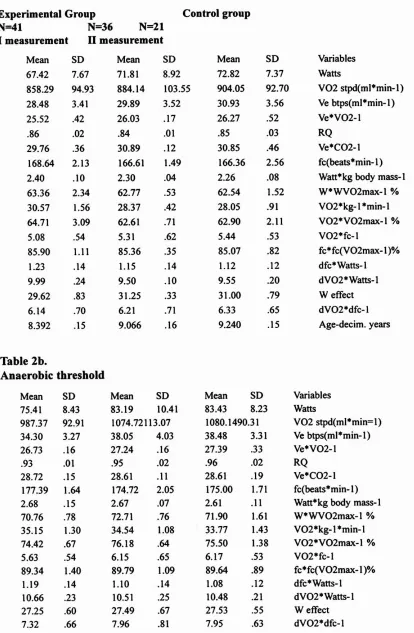
F U N C T I O N A L
AND
METHABOLIC CHARACTERISTICS
Resting
Experimental G r o u p Control G r o u p
N 4 1
N=36
N=21
I
measurementII
measurementMean SD Mean SD Mean SD Variables
189.54 22.65 202.97 25.71 207.48 21.78 V02
stpd
7.37 .89 7.82 1 .OO 8.02 .88 V&pd
.85 .02 .86 .03 .86 .03 RQ
ERGONOMETRIC, FUNCTIONAL
AND
METHABOLIC CHARACTERISTICS
Aerobic threshold
Experimental Group
Control group
N=41
N=36
N=21
I
measurement
I1
measurement
Mean67.42 858.29 28.48 25.52 .86 29.76
168.64 2.40 63.36 30.57 64.71 5.08 85.90
1.23 9.99 29.62 6.14 8.392
Mean 71.81 884.14 29.89 26.03 .84 30.89 166.61 2.30 62.77 28.37 62.61 5.31 85.36 1.15 9.50 3 1.25 6.21 9.066
Table
2b.
Anaerobic threshold
Mean
SD
MeanSD
75.41 8.43 83.19 10.41 987.37 92.91 1074.72113.07 34.30 3.27 38.05 4.03 26.73 .16 27.24 .16 .93 .01 .95 .02 28.72 .15 28.61 .I1 177.39 1.64 174.72 2.05 2.68 .IS 2.67 .07 70.76 .78 72.71 .76 35.15 1.30 34.54 1.08 74.42 .67 76.18 .64 5.63 .54 6.15 .65 89.34 1.40 89.79 1.09
1.19 .14 1.10 .14 10.66 .23 10.51 .25 27.25 .60 27.49 .67 7.32 .66 7.96 .81
Mean 72.82 904.05 30.93 26.27 .85 30.85 166.36 2.26 62.54 28.05 62.90 5.44 85.07 1.12 9.55 31.00 6.33 9.240
Mean
SD
83.43 8.23 1080.1490.31 38.48 3.31 27.39 .33 .96 .02 28.61 .19 175.00 1.71 2.61 .I1 71.90 1.61 33.77 1.43 75.50 1.38 6.17 .53 89.64 .89 1.08 .12 10.48 .21 27.53 .55 7.95 .63
Variables Watts
VO2 stpd(ml*min-1) Ve btps(ml*min-I) VeaVO2-I
RQ
VeaC02-1 fc@eats*min-1) Wanekg body mass-1 W'WV02max-1% VO2*kg-l *min-1 V02*V02max-1% VO2'fc-1
fc*fc(V02max-I)% dfc'watts-1
dV02* Watts- 1 W effect dV02'dfc-1 Agedecim. years
Variables Wans
V02 stpd(ml*min=l) Ve btps(ml*min-1) Ve*V02-I
RQ
Ve'C02-I fc(beats*min-I) Watt*kg body mass-1 W'WV02max-1% VO2*kg-lamin-1 VO2*V02max-1% V02'fc-1
Maximal
oxygen uptake level
Mean SD Mean SD
106.61 12.04 114.42 14.41 1327.02126.57 1410.58149.57 59.43 5.76 64.54 6.90 34.46 1.19 35.21 2.01 1.04 .02 1.06 .02 1380.80131.92 1498.28158.60 33.14 .45 33.54 .39
196.32 3.52 194.14 2.74 3.79 .03 3.67 .04 47.23 .96 45.33 .95 6.84 .66 7.32 .79 1.06 .12 .99 .12 10.73 .22 10.58 .24 26.59 .55 26.97 .62 10.67 1.02 11.27 1.21 8.392 .I5 9.066 .16
Mean 116.10 1431.33 65.86 35.83 1.07 1526.90 33.65 196.43 3.62 44.72 7.44 .98 10.56 27.02 11.48 9.240
Variables Watts
V02max stpd Ve bps Ve*V02-I
RQ
v c 0 2 Ve'VC02-1 fc(beatsernin-1) W*kg body mass-1 V02max(ml*min-1) V02max'fc-1 dfc*Watts-1 dVO2* Watts-1 W Effect dV02*dfc- 1 Agedecirn. years
P.. StMojsvi$ lccaka, mlam
" L.- A A
Die LcisNng
1 oder in, m e d i n n - Y
PI- i i z fur & :&imun
P., C hL - i n w i v e fie'
BIBLIOGRAPAY 13. H i o b 4 K.. Mayjam% A.. Inaki. M.. Misaka, IC: Effm of snd- training of excessive CO2 apiration due to lactat po-
I . A n d m q L . B . a n d ~ r . I . : ~ m y g n u p ( a g m a x i d duction i n e x a i r Eur. I.Appl. Physiol. 1992.64:73-77.
YOm MmadphVsieal aniviv 14. Kitk,
I. C u m : Commmtay on "Children and Fibhll: A @tic
ahrlcl. Ew. J.Appl. Physiol., 1993.67:315-320.
health perspective". Res. Quat. Exerrise and Spnf 1987. 58, 2.Armom Y., Cooper, D.M., Florcs, R. Z~IICOMIO, Stefanih and 4:3 15-320.
Barstow, J.T.: Oygen uptake dynamics during high intmsily cxcr-
IS. Kanin& M,F, and Bans: Relatiomhip beawin body fat and
ciw in children and adulk. J. Appl. Physiol.. 1991.70.2:841-848.
anthmgwn& variables. Int 1. Spom Med. 1 W . Vol.l5. 4:163- 3. Blaha, P.: Amhrogwnctric mkoslovsmkc populace od 6 do 35 l e t 167.
Praha. 1982.
16. Lcso, I. Btm, V, Msak, N, Pirie. I.: W c k e hyti na u m i
4. Brdaric. R. /
.
Markovic,:.
I.: Anobni i a ~ n o b n i h o prahu. Teor. h eel. Wch1982.30.6:36€-370. anacrobni k selekciji d dih sportista17. Mader. A. Hsk, H A Theory of matabolic origin of anaerobic Sporbmmedicl~rs oojavs., 1973. god.,% or.,-r. su.487404.
thmhold. I n t I. Sports Med.. 1986.7:45-65.
5' Bornin. D'' R' N' Mn*ovic' M': Changa of 18. Matkovic, B.. Medved. R, Madcovic, Bojka, Iankovic, S.: Morphological motor chamcterirtiu i n primary school first fmm LongiMinalne promjme aerobnog kapacitna kod djccaka
male pupils under the influence of thc &month athletic pmgnme.
Kine~ologija, 1986. 20.2:81-89. Kinniologija (Zag'cb), 1995.25.1:3849.
6. Busse, M., Maavn N, Bonin. D.: I '^ 'hulj. D.: Fincki rarvimk djecs mladj- skoWIog u~arta
-
>rnakke osobim. Zavod ra f i z i c h k u l w Sarajevo, 1991. Kriterium dcr acmbcn K a p u i t aMuskelglykogcnin. Rcichltart H(ed). Sp adoj~iC, Dj., V m i c . M.: Anaerobni i Mobni @itcci i Bcrlin.Springer, 1987.455467. m n c karakteristike djece skolskog unasta Spwmomedicitl~ke
objave, 1973. 10. 1-3:73-79. 7. C m n i , F.. Fmari. M.. Zigio. P.G. mwgnmt. I
...
Determination of thc anacmbic threshold by a non 21. Rwbmudg T. Wymam. M, Ghsrquicrr I,Oavag D. S b j m H.:
tea m e m . I. Appl Physiol., 1982. 52:869-873. Vcnrilataymningmadmill o;aeisc in K i c h i l d r m Eucl. Appl. Physial. 1982,50.1:7%86.
8. Cooper, D.M.. D.M. Rawell, BJ. Whipp, K. Wassmnan: Aembic
ofexmir as a hnctio,, of body during gd in 22. Spring-. C.. Banow. T.. Waaerman and Cooper. D.:
Wm
children. I. A w l . Physiol.. 1984, E n v i m E x m i w Physiol. V56. uptake and hean rate responses during hypoxic exercise i n chil- N.3. p& 628-634. Aerobic pmductivity of Children Aged 7-14 drcn and adulk. M e d and Sci. in Spom and E x a i w , 1991. yeam. J. Appl. Physiol. At Phmacol. Acta, Supp.,1988.24;6.493- 23,1:71-79.495. 23. Sunon. J.R.: VOZ m a
-
new con- on an old theme. Md. Sci. 9. Cooper, D, Ekrry, C.. LMwq N. and Waucrmnn, K.: K i m i c s of Sports. Ex- 1992.24, 1:2&29.oxygen uptake heart rate at on sct of exercise i n chi~dren.
I.
A ~ I . 24. Urhaurm. A. Corn B.. Weilcr, B.. Ki- W.: Individual Physiol., 1985, 59:211-217. anerobics thmhold and maximal lactate steady state. I n t I. Sport I0.Delamarche. P.. Binel, 1.. Lacour and Flandmis. R: Med. 1993, 14:134-139.Thcmorrgulation af resf and during exercise in -bcrtal born 25. V m i c . M. and m o j c v i c . Dj.: b p i - System Rams Eur. I. Appl. Physiol. 1990.60:436-440. and Diffnsm Aembic Productivity Levels of Children Aged 7-14
II. Frrsdson. P.. P d , I., Hintenneimr. R, McCmun, R. Ross, I.. years. I. Appl. Physiol. At Pharmssol.Actasupp.. 1988.24.6:493-
Ward, A., Guny, M.. Rcpp. I.: Crilcria for defining VO2 mnx: a 495.
new appmach to an old pmblnn. ~ e d Sci. Sports Ex-. 1986, 26. Wascnnann. K.. Whipp. B.I.. Koyal. S.N
...
Bcsm. W . L18:36. Anacmbic Threshold and m p i r a u l y gas exchange during a c r - 12. Hidoba. K.,Mayjarm, A. M iK.: Dywnics of VCOZ and V ciw. I.Appl. Physiol.. 1973.35:23&243.
during i m e n t a l c x a i s e and d cwurk capacity. Kyushu h. T., ASMO. K.. Nomwa, T., Malsuzika, A., Hiiakoba. IC:
Phys. Educ. Sports (lapan). 1987. 1:4744. .inctics of VC02 during incremental exercise. Ip I. Phys.