IntroductIon
Residues are parent compounds and/or metabolites of bio-logical and chemical substances routinely used in prescribed concentrations and in certain phases of animal produc-tion [1]. Antibiotics residues are the most common artificial inhibitory substances in cow’s milk with negative impact on human health, processing and quality of the milk [2,3]. Besides infectious diseases agents common to animals and humans, contamination with environmental pathogens, antibiotics residues represent major problem in producing safe and good quality animal products. In many countries milk is contin-uously controlled for residues according to the legislative
requirements. Numerous factors influence concentration of residues in milk, including individual characteristics, health of the animal, amount and type of applied antibiotics, quan-tity of milk production, method of antibiotics application etc. Parenteral applied antibiotics are excreted much faster through milk, while with intramamary application, residues are found for the longest period and in higher concentrations [2,3]. In our study we focused on Beta (β) lactam group of antibiotics, since they are widely used in therapy for bacterial infections in cattle, particularly for the treatment of mastitis. In addition as determined in this study all commercial dairies in Bosnia and Herzegovina (BiH) use antimicrobial residue tests, and 95% of testing is for β lactams. Aims of the study were: (1) asses sensitivity and specificity for the three most used screening tests for beta lactams residues in milk using standardized con-centrations of penicillin, (2) evaluate efficacy of three most used screening test through proportions of presumably false positive and false negative results on samples from three ani-mal study groups and (3) determine agreement of the results between all test pairs.
*Corresponding author: Sabina Šerić-Haračić,
Department of Animal Health Economics, Veterinary faculty, University of Sarajevo, Zmaja od Bosne 90, Sarajevo, Bosnia and Herzegovina,
Phone: +387 33 663 515 Fax: +387 33 663 515
E-mail: [email protected]
Submitted: 12 May 2013 / Accepted: 16 April 2014
Beta lactam antibiotics residues in cow’s milk:
comparison of efficacy of three screening tests used
in Bosnia and Herzegovina
Nihad Fejzić1, Muris Begagić2, Sabina Šerić-Haračić1*, Muhamed Smajlović1
1Department of Animal Health Economics, Veterinary Faculty, University of Sarajevo, Zmaja od Bosne 90, 71 000 Sarajevo, Bosnia and
Herzegovina. 2BosnaVet Ltd, Goraždanska 36A, 72 000 Zenica, Bosnia and Herzegovina
Abstract
Beta lactam antibiotics are widely used in therapy of cattle, particularly for the treatment of mastitis. Over 95% of residue testing in dairies in Bosnia and Herzegovina is for Beta lactams. The aim of this paper is to compare the efficacy of three most common screening tests for Beta lactam resi-dues in cow’s milk in our country. The tests used in the study are SNAP β Lactam test (Idexx), Rosa Charm β Lactam test (Charm Sciences) and Inhibition MRL test (A&M). Study samples included: standardized concentrations of penicillin solution (0, 2, 3, 4, 5 and 6 ppb). In addition we tested milk samples from three equal size study groups (not receiving any antibiotic therapy, treated with Beta lactams for mastitis and treated with Beta lactams for diseases other than mastitis). Sensitivity and specificity were determined for each test, using standard penicillin concentrations with threshold value set at concentration of 4 ppb (Maximum residue level – MLR). Additionally we determined proportions of presumably false negative and false positive results for each test using results of filed samples testing. Agreement of test results for each test pair was assessed through Kappa coefficients interpreted by Landis-Koch scale. Detection level of all tests was shown to be well below MRL. This alongside with effects of natural inhibitors in milk contributed to finding of positive results in untreated and treated animals after the withholding period. Screening tests for beta lactam residues are important tools for ensuring that milk for human consumption is free from antibiotics residues.
Key wORDS: β lactam residues; screening tests; cow’s milk; Bosnia and Herzegovina
MAterIAls And Methods
Tests
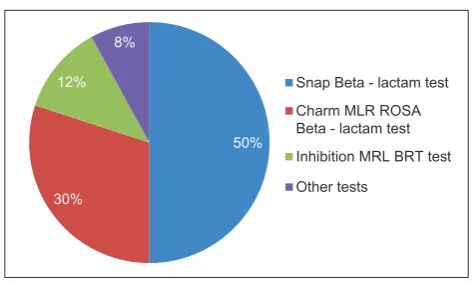
we selected tests to be evaluated in this study according to the frequency of their use for screening for βlactam resi-dues in cow’s milk in B&H. Questionnaire was administrated to all laboratories, milk collectors and processing plants in the country regarding testing for residues in milk they applied during 2010. Results of the frequency of use of different tests for screening for β lactam antibiotics in milk were shown in Figure 1. Based on results shown in Figure 1, following tests were used in the study: SNAP β Lactam test (Idexx), Rosa Charm β Lactam test (Charm Sciences) and Inhibition MRL test (A&M). even though all the tests used are intended for testing of bulk milk, they were applied in this study on individ-ual animas samples, due to the fact that all test users in B&H apply them also on individual samples.
Samples
Samples of standardized concentrations of penicillin were prepared using standards produced by AiM, available as lyo-philized milk containing penicillin G concentration of 0, 2, 3, 4, 5, and 6 ppb. Samples were liquefied using distilled and deionized water according to the manufacturer instructions. Concentrations of 2, 3, 5 and 6 ppb were represented with 10 samples each, five samples had concentration of 0 ppb and 20 samples contained 4 ppb (MLR for penicillin). Preparation and testing of the standardized concentrations of penicillin was done in Institute for food safety Zenica (regional autho-rized laboratory) and Food safety laboratory within the Veterinary faculty of the University of Sarajevo (national ref-erence laboratory).
Milk samples were taken from three animal study groups, each containing 30 animals. The groups included:
• Group 1 - animals not receiving any antibiotic therapy during current and prior lactations,
• Group 2 - animals treated with β lactams for mastitis by intramamry application,
• Group 3 - animals treated with β lactams for diseases other than mastitis by intramuscular application. Animals from the group 2 were tested within the with-holding period, and day 1, 2 and 3 after the withwith-holding period has passed. For treatment of cows with mastitis single appli-cation intramamary injector intended for use during lactation was used containing 100.000 i.u. procaine-benzyl penicillin. withholding period for this product is 3 days. For treatment of animals for diseases other than mastitis intramuscular applica-tion of water suspension of penicillin with 150.000 i.u./ml was used. withholding period for this product is days of therapy plus 5 more days. All sampled animals were Simmental breed, and according to the farm records in their second or third lac-tation. Appearance and nutrient content of all milk samples was approximately equal (data not shown).
After sampling milk was cooled at <5 °C and tested within 3 hours from sampling. Samples of milk were prepared for testing according to the instructions of test manufacturer. Preparation and testing of the field milk samples was done in the Institute for food safety Zenica and veterinary institute Teolab in Bijeljina (regional authorized laboratory).
For every test using results of testing of the standardized penicillin concentrations <4 ppb we determined specificity as proportion of negative results and overall samples with less than 4 ppb tested. Results of testing of the standardized penicillin concentrations equal or above 4 ppb were used for calculation of the sensitivity for every test as proportion of positive results and overall samples with equal or more 4 ppb tested.
Using results of the testing of standardized penicillin con-centrations Kappa coefficient was calculated for every pair of tests used in order to evaluate agreement between tests [4]. Kappa coefficients were evaluated using Landis-Koch scale [5]: • <0 – poor agreement
• 0.01-0.20 – slight agreement • 0.21-0.40 – fair agreement • 0.41-0.60 – moderate agreement • 0.61-0.80 – substantial agreement • 0.81-1.00 – almost perfect agreement
Test results from field milk samples originating from ani-mals without antibiotics treatment, and aniani-mals sampled after withholding period were used to calculate proportions of pre-sumably false positive results. Numerator of this proportion was number of positive results and denominator was number of tested animals in these two study groups. This proportion was referred as presumably false positive proportion since no confirmatory quantitative method was applied and therefore it was impossible to ascertain true if any concentration of β lactam residues in these samples.
6QDS%HWDODFWDPWHVW &KDUP0/5526$ %HWDODFWDPWHVW ,QKLELWLRQ05/%57WHVW 2WKHUWHVWV
Test results from field milk samples originating from ani-mals treated with penicillin within withholding period were used to calculate proportions of presumably false negative results. Numerator of this proportion was number of nega-tive results and denominator was number of tested animals in these two study groups. This proportion was referred as presumably false negative proportion since no confirmatory quantitative method was applied and therefore it was impos-sible to ascertain true if any concentration of beta lactam resi-dues in these samples.
Since only Inhibition MRL test in addition to positive and negative results had option for suspect samples, all suspect results of this test were considered as positive for the purposes of data analysis.
results
Results of the testing of standardized penicillin concentra-tion showed level of detecconcentra-tion of 2 ppb for the Charm Rosaβ-lactam and Inhibition MRL test, and 3ppb for the Snap β-lac-tam test. Accordingly the Snap β-lacβ-lac-tam test gave negative result for 52% of samples of standardized penicillin concen-tration bellow 4 ppb (specificity was 52%). Specificities of the Charm Rosa β-lactam test and the Inhibition MRL test were 24% and 20%, respectively (Figure 2).
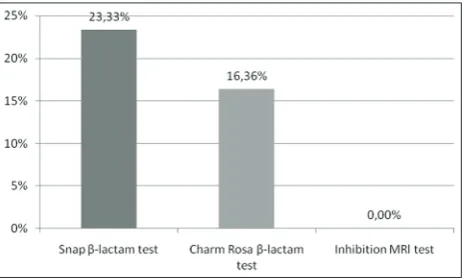
None of the tests gave n egative results for standardized penicillin concentrations equal or above 4 ppb, resulting in 100% sensitivity for all three tests. Agreement between tests was assessed using Kappa coefficient for every test pair, inter-preted according to the Landis-Koch scale (Table 1). Results of the testing of field milk samples from three study animal groups are shown in Table 2. Proportions of presumably false positive were given separately for group 1 (animals not treated with antibiotics) and group 2 (animals treated for mastitis) tested 1, 2 and 3 days after the withholding period. Overall proportion of presumably false positive results for each test for the above mentioned animals was given in Figure 3. All test results of the animas treated for mastitis within the with-holding period were positive. Figure 4 shows proportion of presumably false negative results of animals treated with anti-biotics for reasons other than mastitis within the withholding period.
dIscussIon
Since β lactam antibiotics, dominantly penicillin, are most widely used in treatment of the bacterial diseases of cattle, therefore the tests for the detection of beta lactam residues are most widely used in control of milk for antibiotics resi-dues. even though they are useful tool for the prevention of use of residue contaminated milk, simultaneously they carry numerous disadvantages, firstly their ability to detect residues
Figure 2. Specificity of the Snap β-lactam, Charm Rosa β-lactam and Inhibition MRL test assessed on samples of standardized pen-icillin concentration bellow 4 ppb
Table 1. Kappa coefficient for every pair of the tests and its interpretation according to the Landis Koch scale
Test pair Kappa Interpretation of Kappa according to
the Landis-Koch scale
Snap β-lactam and Charm Rosa β-lactam 0.512 Moderate agreement
Snap β-lactam and Inhibition MRL 0.508 Moderate agreement
Charm Rosa β-lactam and Inhibition MRL 0.901 Almost perfect agreement
Figure 3. Overall proportion of presumablly false positive resuts (%) for each test for animals not treated with antibiotics (n=30), animals treated for masitis an samples 1, 2 and 3 day after the witholding period (n=90)
bellow the maximum tolerated concentration. In our study we determined that residue screening tests for milk are applied in laboratories, milk collectors and processing plants, while milk producers themselves do not use them. However, legal requirements of the european Union, which B&H seeks to apply demand control of residues in milk on farm, through appropriate use of antibiotics, respecting the withholding period as well as testing of milk for the presence of antibiotics residues [6,7]. Most of the residue test users in B&H use test for β lactam residues while residue test that detect other anti-biotics are neglected.
Lowest concentration of penicillin detected by the tests in our experiment was 2 ppb for the Charm Rosa β-lactam and Inhibition MRL tests and 3 ppb for the Snap β-lactam test, what is in accordance with the manufacturer specifications and other studies [8,9].
Perfect sensitivities and relatively low specificities of all three tests show determination of the test manufacturer towards protection of consumer’s health rather than for the economic interests of the milk producers. Since according to the legal requirement producers are obliged to produce milk absolutely free from any residues, while MRL are set as the most tolerable concentrations, setting lowest concentration detectable by the test below required MLR seems justified and reasonable.
Differences in agreement between tests results were therefore influenced exclusively by the differences in tests specificities and chemical principle of residue detection, since all test had 100% sensitivity. Since Charm Rosa β-lactam and Inhibition MRL test had similar specificities (24% and 20%, respectively) agreement between these two tests was the high-est. Higher specificity of the Snap β-lactam test influenced its agreement with both Charm Rosa β-lactam and Inhibition MRL test results. Based on these results it seems appropriate to combine test with lower agreement of results, in addition to no economic justification for the use of combination of tests that provide almost identical results.
Snap β-lactam and Charm Rosa β-lactam test gave negative results for all field samples of milk originating from animals in the Group 1 (no antibiotics treatment). In other study [8] sam-ples of residue free milk were tested by the Snap β-lactam and Charm Rosa β-lactam test resulting in 2.73% and 7.27% of false
positive results respectively. In our study, in contrast to these two enzyme based test, inhibition MRL test gave 11/30 sus-pect and 8/30 positive results in this group. High proportion of presumably false positive results for the Inhibition MRL test can be explained by natural inhibitors present in normal milk. Before testing we did not apply any procedure for the inacti-vation of theses inhibitors neither is this recommended by the test manufacturer or applied by test users in B&H. However in 1963 in study by Kosikowski and O’Leary [10] positive results of the inhibition tests were explained by natural inhibitors in the milk, since after heating milk at 82 °C for 5 minutes with aim to inactivate natural inhibitors, only 1 sample remained positive out of 11 samples without residues that were positive in initial testing by inhibition test. Other research on residue free milk samples with positive inhibition test results con-firmed this finding [11-14]. Additionally, the Inhibition MRL test in testing standardized penicillin concentrations (without inhibitors) gave negative results for all samples with concen-trations bellow level of detection.
In our study, presumably false positive results on all three tests, first and second day after the withholding period origi-nated form the same animals. Therefore it is possible that these samples either contained residues above MRL or slightly below but reacted positive since level of detection of the tests is lower than MRL set at 4 ppb. Also these presumably false positive results particularly on the Inhibition MRL test may have risen due to natural inhibitors in the milk. In another research 87,5% of milk samples taken first day after the withholding period tested gave positive results on LacTek and Charm test due to the natural inhibitors and not due to the contained antibiotic residues [15]. Many studies show relatively high proportion of the positive results on the screening residue test after the withholding period [9-16]. Factors relevant to the individual animal and most commonly associated with residues in milk over the set MRL after the withholding period are: simultane-ous treatment with different drugs and different application methods [15], constantly high somatic cells count, amount of milk produced, adjuvants of the applied drug [16], too long and excessive use of antibiotics [17]. Studies show higher rate of false positive results after the withholding period in animals with repeated mastitis [18]. Disease history for the animals in our study was not taken into the consideration.
Table 2. Proportions of presumably false positive results (%) of the Snap β-lactam, Charm Rosa β-lactam and Inhibition MRL test for animals not treated with antibiotics and animals treated for mastitis day 1, 2 and 3 after the withholding period
Study group Snap β-lactam test β-lactam testCharm Rosa Inhibition MRL test n1
Group 1 – animals not treated with antibiotics 0.00%2 0.00% 63.33% 30
Group 2 – animals treated with antibiotics for mastitis day 1 after the withholding period 20.00% 40.00% 80.00% 30
Group 2 – animals treated with antibiotics for mastitis day 2 after the withholding period 20.00% 20.00% 80.00% 30
Group 2 – animals treated with antibiotics for mastitis day 3 after the withholding period 0.00% 0.00% 60.00% 30
Test results for the animals in group 3 (treated by antibiot-ics by intramuscular injection for reasons other than mastitis) gave surprisingly high proportion of presumably false negative results (testing done during the withholding period). These proportions were 23.33% and 16.66% for the Snap β-lactam and Charm Rosa β-lactam test respectively. we could not find any studies with similar results. Possible explanation of this finding may be application of lower than prescribed dose or error in farm records, so that the sampling was done either too soon (excretion of penicillin in milk not yet begun) or too late (with-holding period was already over).
conclusIon
In summary, most of our results we were able to confirm with other relevant research. we prove significance of testing milk residue in cows but also different issues in interpreta-tion of each of the test results. Our results would be more complete if we were able to investigate other parameters of the sampled milk such as somatic cell count, bacteria count, confirmation of the true residue concentration, particularly for samples with positive results after the withholding period. On the other hand all used test are intended for testing of the bulk milk, where milk from many animals is mixed. In case that milk from one or more animals contained antibiotics residues their concentration would be significantly reduced by the rest of the residue free milk. Applying and interpret-ing tests on the individual milk samples would therefore defi-nitely influence proportions of false positive results.
declArAtIon of Interest
The authors declare no conflict of interest.
references
[1] wHO/FAO. Glossary of terms. In: Barlow S, Renwick A, (eds.). Principles and methods of the risk assessment for chemicals in food. Geneva: wHO; 2009, A1
[2] Samaržija D, Antunac N. Važnost dokazivanja prisutnosti antibi-otičkih ostataka u mlijeku. Mljekarstvo 2002; 52(1):61-70.
[3] Ruegg P. Antimicrobial Residues and Resistance: Understanding and Managing Drug Usage on Dairy Farms. University of winsconsin, Dept. of Dairy Scinece, Madison, wisconsin; 2013.
[4] Gwet KL. Handbook of Inter-Rater Reliability: The Definitive Guide to Measuring the extent of Agreement Among Multiple Raters: Advanced Analytics Press, 3rd edition;2012.
[5] Landis JR, Koch GG. The measurement of observer agreement for categorical data. Biometrics 1977; 33(1):159-174.
[6] eC Regulation 470/2009. Community procedures for the estab-lishment of residue limits of pharmacologically active substances in foodstuffs of animal origin.
[7] eC Regulation 37/2010. Pharmacologically active substances and their classification regarding maximum residue limits in food stuffs of animal origin.
[8] Kantiani L, Farre M, Barcelo D. Analytical methodologies for the
detection of β-lactam antibiotics in milk and feed samples. TrAC
2009; 28 (6); 729-744.
[9] Martins T, Santos AFS, Miranda MS, Motta TP, Ambrosio LA, Pozzi CR, et al. Detection of antimicrobial residues in milk from cows with and without subclinical mastitis: Microbiological testing. Proceedings of the XVth International Congress of the International Society for Animal Hygiene, Vienna, 2011: 1423-1425.
[10] Kosikowski FV, O’Leary M. Natural inhibitory characteristics of
some irish manufacturing milks. J Dairy Sci 1963;46(2):89-94.
[11] Ghanavi Z, Mollayi S, eslami Z. Comparison Between the Amount of Penicillin G Residue in Raw and Pasteurized Milk in Iran. Jundishapur Journal of Microbiology 2013; 6(7): e12724
[12] Hennart SL, Faragher J. Validation report of the Delvotest Delvotest SP NT DA. Performance Tested Method 011101. J AOAC Int. 2012; 95(1); 252-260.
[13] Cullor JS, Van eenennaam A, Dellinger J, Perani L, Smith w, Jensen L. Antibiotic residue assays: Can they be used to test milk
from individual cows?. Vet Med 1992; 87(5): 477-494.
[14] Gibbons-Burgener SN, Kaneene JB, Lloyd Jw, Leykam JF, erskine RJ. Reliability of three bulk-tank antimicrobial residue detection assays used to test individual milk samples from cows with mild clinical mastitis. Am J Vet Res 2001;62(11):1716-1720.
[15] Kang JH, Jin JH, Kondo F. False-Positive Outcome and Drug Residue in Milk Samples Over withdrawal Times. J Dairy Sci
2005;88(3):908-913.
[16] Oliver SP, Maki JL, Dowlen HH. Antibiotic residues in milk
follow-ing antimicrobial therapy durfollow-ing lactation. J Food Prot 1990; 53 (8):
639-696.
[17] Mercer HD, Geleta JN, Schultz eJ, wright ww. Milk-out rates for antibiotics in intramammary infusion products used in the treat-ment of bovine mastitis: Relationship of somatic cell counts, milk production level, and drug vehicle. AJVR 1970; 31(9):1549-1560.
[18] Tan X, Jiang YW, Huang YJ, Hu SH. Persistence of gentamicin res -idues in milk after the intramammary treatment of lactating cows