Temperature Dependence of Internal Quantum
Efficiency in SiGe Lasers
Hassan Kaatuzian, Alireza Jorkesh*
Photonics Research Laboratory (PRL), E.E. Department, Amirkabir University of Technology, Tehran, Iran
Abstract
Recently, SiGe lasers have been widely developed in research centers. Their applications in high-speed facilities and recent improvements have made them interesting R&D subjects. One characteristic which needs to be studied is internal quantum efficiency having an important role in laser quality. In studies presented until now, the temperature has been presumed to be constant; An assumption that will fade as the lasers perform in the experiments. After a little operation, the temperature increases and even with large fans, it somehow impossible to fix this factor. We present a study of this characteristic for SiGe lasers in various temperatures by studying recombination rate and its dependence on temperature. Meanwhile, we will present a way which enhances this factor to higher percentages. Changing the temperature, we can obtain different efficiencies which can lead to various applications.Keywords
Internal Quantum Efficiency, Temperature dependence in lasers, Temperature in IQE1. Introduction
Semiconductor lasers play important roles for Silicon-based photonic technology and among semiconductors, Ge is suggested as the only material capable of conforming to the CMOS standards and also be a light emitter for photonic integration [1]; however, progresses in optical communications demand for low-cost high-speed technology and thus, SiGe-based devices are promising solutions for filling these gaps [2].
Two types of quantum efficiency for different lasers are often considered:
External Quantum Efficiency (EQE) is the ratio of the number of charge carriers collected by the emitting cell to the number of photons of a given energy shining on outside (incident photons).
Internal Quantum Efficiency (IQE) is the ratio of the number of charge carriers collected by the emitting cell to the number of photons of a given energy, shining on the cell from outside and are absorbed by the cell itself.
The IQE is always larger than the EQE. A low IQE indicates that the active layer of the laser is unable to make good use of the photons. To measure the IQE, first, we need to measure the EQE of the laser devices. Then, its transmission and reflection need to be measured and combined to infer the IQE. The ideal quantum efficiency graph has a square shape, where the QE value is fairly
* Corresponding author:
[email protected] (Alireza Jorkesh) Published online at http://journal.sapub.org/optics
Copyright © 2016 Scientific & Academic Publishing. All Rights Reserved
constant across the entire spectrum of wavelengths measured; However, the QE for most solar cells is reduced because of the effects of recombination, where charge carriers are not able to move into an external circuit. The same mechanisms that affect the collection probability also affect the QE. For example, modifying the front surface can influence carriers generation near the surface [3, 4].
Internal quantum efficiency can be obtained by dividing the number of electrons per second to the number of absorbed photons per second. Although deriving an exact formula which can get us to complete understanding of this discussion has been calculated formerly, it is challenging to understand which parts are dependent on temperature [5].
It is very interesting to know a way which could change this property. In this article, we will do our best to modify the dependence of this property on temperature and enhance it.
2. Theoretical Background for IQE
Estimation
The recombination rate of carriers in a single-quantum-well device is given by the so-called ABC model.
𝑑𝑑𝑑𝑑
𝑑𝑑𝑑𝑑 =
𝐽𝐽
𝑒𝑒𝑑𝑑− 𝐴𝐴𝑑𝑑 − 𝐵𝐵𝑑𝑑2− 𝐶𝐶𝑑𝑑3 (1)
where J/ed is the carrier injection rate, J is the injected current density, d is the quantum well width, An is the Shockley–Read–Hall recombination rate, 𝐵𝐵𝑑𝑑2 is the rate
of radiative recombination and 𝐶𝐶𝑑𝑑3 is the Auger
current and carrier density is given by (2).
𝐽𝐽=𝑒𝑒𝑑𝑑(𝐴𝐴𝑑𝑑+𝐵𝐵𝑑𝑑2+𝐶𝐶𝑑𝑑3) (2) To define this property more accurately, first, we need to explain and understand recombination rate [4]. Recombination is the rate in which the electrons and holes get together and recombine again. This rate can be obtained by (3).
Recombination= An + Bn2 + Cn3 (3) At high current densities (high carrier densities), the Auger mechanism becomes the dominant recombination process which leads to nonradiative carrier loss and reduced high-power efficiency. The IQE of the device η is given by the ratio of the carriers that recombine radiatively over the total recombination rate
η=𝐴𝐴𝑑𝑑+𝐵𝐵𝑑𝑑𝐵𝐵𝑑𝑑22+𝐶𝐶𝑑𝑑3 (4)
In order to discuss the temperature dependence, it is needed to study these coefficients (A, B, and C) and their dependence on temperature. Following, we discuss all three. [6]
2.1. Bimolecular Recombination Coefficient Basically, this coefficient is defined by as followed:
𝐵𝐵𝐵𝐵𝐶𝐶 →𝐵𝐵𝐵𝐵
𝐿𝐿 =
𝑈𝑈°×𝐶𝐶
𝑄𝑄𝑒𝑒 ×
𝑑𝑑𝑑𝑑𝑡𝑡
𝑑𝑑𝑒𝑒 (5)
Where 𝑑𝑑𝑑𝑑𝑡𝑡 is the capacitance transit time and 𝑑𝑑𝑒𝑒 is
extraction time. Both of these components do not depend on temperature because these two are always fixed constants and are dependent on the material itself. The only factor needed to study is 𝐵𝐵𝐿𝐿 because all other factors are fixed for a
special kind of material [7].
C is the capacitance which only depends on the shape of the laser. The only reason that can change this factor is the temperature where it can lead to the expansion of layers. As the changes are at last 300 degrees centigrade, we can easily ignore this item and presume it fixed. It will be really helping in other parts.
𝑈𝑈° is the applied voltage known as 𝑣𝑣𝑎𝑎, too. Since the
source for applying this voltage is invariable, this factor is not dependent on temperature [8].
First, 𝐵𝐵𝐿𝐿 can be obtained by (6).
𝐵𝐵𝐿𝐿 =𝑒𝑒Ɛ(µ𝐺𝐺𝑒𝑒𝑑𝑑×+µƐ𝑆𝑆𝑆𝑆𝑃𝑃) (6)
The laser which we decide to discuss on is highly n-doped. So, the part concerning electrons is dominant for high carrier concentrations.
µ𝑑𝑑 ≫µ𝑝𝑝 → 𝐵𝐵𝐿𝐿 =Ɛ𝐺𝐺𝑒𝑒𝑒𝑒×µ×Ɛ𝑑𝑑𝑆𝑆𝑆𝑆 (7)
Given that
𝑄𝑄𝑒𝑒 =∫ 𝑗𝑗𝑒𝑒𝑑𝑑𝑑𝑑= lim𝑑𝑑𝑒𝑒→∞
1 𝑑𝑑𝑒𝑒∫
𝐼𝐼𝑒𝑒
𝐴𝐴𝑑𝑑𝑑𝑑=
𝐼𝐼𝑒𝑒
𝐴𝐴×𝑑𝑑𝑒𝑒
𝑑𝑑𝑒𝑒
0 ∞
0 (8)
By applying (7) and (8) in (5), we can conclude (9).
𝐵𝐵=𝑐𝑐𝑈𝑈𝐼𝐼°𝐴𝐴𝑑𝑑𝑒𝑒
𝑒𝑒 ×
𝑑𝑑𝑑𝑑𝑡𝑡
𝑑𝑑𝑒𝑒 ×
𝑒𝑒𝜇𝜇𝑑𝑑
𝜀𝜀𝐺𝐺𝑒𝑒𝜀𝜀𝑆𝑆𝑆𝑆 =
𝑐𝑐𝑣𝑣𝑎𝑎𝑒𝑒
𝐼𝐼𝑒𝑒𝜀𝜀𝐺𝐺𝑒𝑒𝜀𝜀𝑆𝑆𝑆𝑆×
𝑑𝑑𝑑𝑑𝑡𝑡𝜇𝜇𝑑𝑑×𝐴𝐴 (9)
The first proportion ( 𝑐𝑐𝑣𝑣𝑎𝑎𝑒𝑒
𝐼𝐼𝑒𝑒𝜀𝜀𝐺𝐺𝑒𝑒𝜀𝜀𝑆𝑆𝑆𝑆) are completely invariant
and do not change as temperature changes. The only changing factors are 𝑑𝑑𝑑𝑑𝑡𝑡 and 𝜇𝜇𝑑𝑑. So, the final equation can
be simplified as (10).
𝐵𝐵=𝐵𝐵°𝑑𝑑𝑑𝑑𝑡𝑡𝜇𝜇𝑑𝑑 (10)
Where 𝐵𝐵° is the invariant proportion. Mobility dependence on temperature has been modified in data books. 2.2. Auger Coefficient
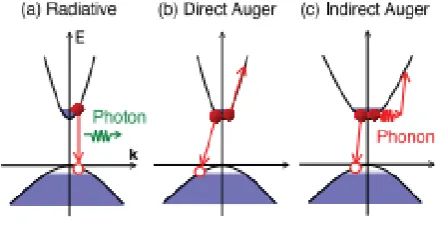
Auger coefficient can be differently modified based on various circumstances and materials. Figure 1. shows the three main auger coefficients. As it can be observed in this figure, Auger coefficient can be radiative, direct, and indirect [9].
Figure 1. Radiative, Direct, and Indirect Auger coefficient
First, we assume that the case we are working on is a direct Auger coefficient. According to our assumption, the Auger recombination rate is determined by Fermi’s golden rule as (11).
𝐵𝐵𝐴𝐴𝐴𝐴𝐴𝐴𝑒𝑒𝑡𝑡 = 2 ×2ħ𝜋𝜋 ∑1234𝑓𝑓1𝑓𝑓2(1− 𝑓𝑓3)(1− 𝑓𝑓4)|𝑀𝑀1234|2
𝜎𝜎(𝜀𝜀1+𝜀𝜀2− 𝜀𝜀3− 𝜀𝜀4) (11)
Where 1≡(n1, k1), etc. are composite band and wave-vector indices, f is a statistics factor that accounts for fermionic occupation numbers and the delta function ensures the overall energy conservation. The electron–electron scattering matrix elements are given in terms of the screened Coulomb interaction W(r, r0) [10].
|𝑀𝑀1234|2= | < 12|𝑊𝑊|34 >−< 12|𝑊𝑊|43 > |2 +| < 12|𝑊𝑊|34 > |2+ | < 12|𝑊𝑊|43 > |2 (12) Where W can be defined as equation (13).
< 12|𝑊𝑊|34≥
∬ 𝜓𝜓1∗(𝑡𝑡)𝜓𝜓2∗(𝑡𝑡́)𝜓𝜓3∗(𝑡𝑡)𝜓𝜓4∗(𝑡𝑡́)𝑊𝑊(𝑡𝑡,𝑡𝑡́)𝑑𝑑𝑡𝑡𝑑𝑑𝑡𝑡 ́ (13)
𝐶𝐶=𝐵𝐵𝐴𝐴𝐴𝐴𝐴𝐴𝑒𝑒𝑡𝑡
𝑉𝑉.𝑑𝑑3 (14)
In (14), n is the carrier density. For low carrier densities, the recombination rate is dependent on the cube of this carrier. This will lead to the independence of Auger coefficient on carrier density. In higher carrier densities, this coefficient is linear and by increasing the carrier density, this linearity will fade little by little. This will cause in lowering IQE by decreasing the bipolar fields effect [11].
Figure 2. Internal Quantum Efficiency based on different number of dopants
Figure 2. demonstrates IQE based on a different number of dopants and various carrier densities. X is the percentage of germanium in SiGe compositions [12].
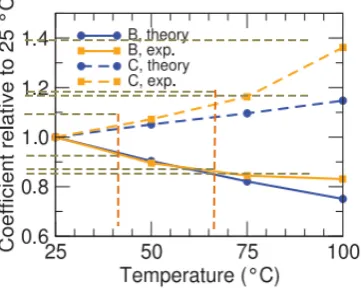
Figure 3. Bimolecular recombination and Auger coefficients dependence on temperature both in theory and experiment where they are relative to their quantities in 25°C. The experimental data are from [14]
As it is discussed in 2.1 and 2.2, Figure 3. shows the complete dependence of these two coefficients on the temperature in both theory and experiment. Clearly, in temperatures less than 5°C the laser efficiency will change and the equation will not be proper anymore as the shape of the laser will not be the same anymore [13]. In temperatures higher than 75°C there is a difference between theoretical and experimental data. The experimental relative B/B(25°C)–C/C(25°C) ratio at 100°C is 0.61 while the theoretical one is 0.65, thus the difference is only 7%. We attribute the remaining differences between the data to the
uncertainties in the experimental determination of the B and C coefficients and the omission of temperature-dependent effects in the theoretical calculations, such as thermal expansion and the temperature dependence of the band gap.
3. Simulation and Discussion
As it was mentioned earlier, IQE can be obtained by (4). Since the carrier density in SiGe lasers are mostly high and they are highly doped, equation (4) can be simplified as (15). η=𝐵𝐵𝑑𝑑𝐶𝐶𝑑𝑑23 (15) Where A and B are ignored because of cube carrier density in the denominator. n is the carrier density which can be simplified in both the numerator and denominator. this will lead to(16).
η=𝐶𝐶𝑑𝑑𝐵𝐵 (16) As it was discussed in section 2.1, bimolecular recombination coefficient is dependent on the temperature. This dependence can be shown in equation (17).
𝐵𝐵=𝐵𝐵∘𝑇𝑇
−3
2 (17)
Auger coefficient was formerly discussed in section 2.2 and can be considered as a fixed number. It can also be shown as a linear function with a very slight slope. Here, we consider it fixed; however, it is different for temperature higher and below 50°C. For lower temperatures, C is equal to C̥ but on the other hand for higher ones we have 5% increase.
Our study does not satisfy temperatures close to 100 and above that because some of earlier assumptions will vary in higher temperatures.
Table 1. Theoretical and Experimental Bimolecular Recombination coefficient in different temperatures
Property
Temperature
B coefficient
Experimental (10-4 B
o)
Theoretical (Co)
0 ---- 2.2170
25 1 1.9439
50 0.9 1.7226
75 0.85 1.5404
100 0.81
----Table 2. Theoretical and Experimental Auger coefficient in different temperatures
Property
Temperature
Auger coefficient
Experimental (Co)
Theoretical (Co)
0 ---- 1
25 1 1
50 0.8750 1
75 0.7456 1.05
100 0.6136
Tables 1 and 2 demonstrate different values for B and C coefficients respectively. The theoretical data are obtained based on the discussion part and the experimental ones are gathered in laboratories. Experimental data are calculated based on Figure 3 [14]; however theoretical data for B and C can be obtained by (17) and previous discussion respectively. By the help of these data, IQE can be obtained.
Table 3 shows IQE in different temperatures. The experimental data and theoretical ones are different as in theory we have B̥ in the nominator. All these data in table 3
are based on what we calculated in tables 1 and 2. In the other words, IQE in different temperatures is done based on what was gathered and calculated in previous tables. Tables themselves are written based on figure 3.
There are three things that need to be explained. First, the difference between experimental and theoretical data in B, C and IQE are because of Bo and Co that are considered in
experiment but not theory.
Second, the experimental data are not accessible since this in this temperature, specific circumstances are needed for the correct function of these kinds of lasers.
Third, the theoretical data cannot be calculated as the simplifications that we proposed in previous sections are not valid anymore. High temperature can especially enhance the influence of ignored factors in Auger coefficient.
Using data in table 3, we can have table 4 in which IQE variations can be shown. Table 4 contains the percentage which this property has been changed comparing to this
value in base temperature. The base temperature is considered 50°C. The reason is that we study the lasers after a little function so that they get to a steady state. At this point, the temperature is about 50°C.
Table 3. Theoretical and Experimental Internal Quantum Efficiency in different temperatures
Property
Temperature
IQE
Experimental (n-1
o)
Theoretical (10-4 B
on-1)
0 ---- 2.2170
25 1 1.9439
50 0.8750 1.7226 75 0.7456 1.4670
100 0.6136
----Table 4. IQE changes based on working temperature Change
Temperature Experimental Theoretical 0 ---- +28.70% 25 +14.28% +12.85% 50 Steady State Steady State 75 -14.79% -14.83% 100 -29.87%
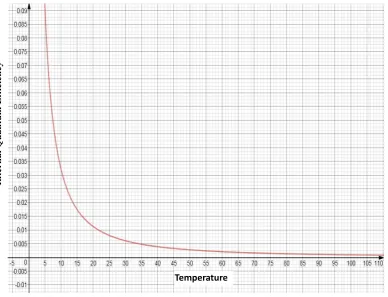
----Figure 4. IQE in different temperatures using MATLAB for drawing based on equation (17)
In
tern
al
Q
ua
nt
um
Ef
fici
en
cy
For a more accurate study, Auger coefficient ought to be a linear function which is described in (18).
𝐶𝐶
𝐶𝐶∘=
𝑇𝑇 750+
29
30 (18)
Where C is the Auger coefficient and T is the temperature in degrees centigrade. This equation is valid for degrees from 5 to 100°C, though. The reason is that for temperatures less than 5°C or higher than 100°C, icing problem and shape shifting will cause differences in both B and C coefficients and this will lead to invalidity of our former equations.
By applying (17) and (18) into (16), IQE can be defined as (19).
η(T) = 𝐵𝐵∘
𝐶𝐶∘𝑑𝑑×
𝑇𝑇−23
(750𝑇𝑇 +2930) (19)
Figure 4. shows IQE at various temperatures starting from 5°C. At first, it is at its highest value and then gets to near zero at higher temperatures.
4. Conclusions
As it has been declared in table 4, the temperature has a main effect on IQE. Changing this factor can lead to a wide range of variation of this characteristic. By getting the temperature near icing temperature, IQE can be enhanced by 28.7%. This is an essential result since by improving this characteristic, we can have well-functioned lasers with higher efficiencies.
It is also important to know that temperature controlling is an essential process which can change this function. In the case which there is no application of fans, the temperature can get as high as 100°C which will decrease the IQE percentage as much as 29.87%.
In this article, we tried to work on the IQE and define different parts of it for conducting a function based on temperature. We could also get to an improvement of 28.70% in this characteristic. IQE was calculated at different temperatures which are mostly ignored and assumed fixed.
REFERENCES
[1] R. E. Camacho-Aguilera, Ge-on-Si LASER for Silicon Photonics, Massachusetts Institute of Technology, 2013. [2] H. Davoodi, H. Kaatuzian, “Base Composition Effects Study
On NBR Current and Current Gain in SiGe HBT, Int. J. Mod. Phys. B 27, 1350097, 2013.
[3] Träger, Frank, Handbook of Lasers and Optics, Berlin Heidelberg: Springer, 2012, ISBN 9783642194092, pp. 601, 603.
[4] B. Stoib, T. Langmann, S. Matich, T. Antesberger, N. Stein, S. Angst, N. Petermann, R. Schmechel, G. Schierning, D. E. Wolf, H. Wiggers, M. Stutzmann, M. S. Brandt, Laser-sintered thin films of doped SiGe nanoparticles, 2012, arXiv:1201.4370v1.
[5] Sh. Saeidi, H. Kaatuzian, Theoretical Estimation to Improve Optical Characteristics of Germanium Lasers for Integrated Silicon Photonics Application, 2015, International Journal of Optics and Applications, DOI: 10.5923/j.optics.20150503.03. [6] S. Marchetti, M. Martinelli, R. Simili, M. Giorgi, M. Fantoni, measurement of Ge electrical parameters by analysing its optical dynamics, 2001, Phys. Scr., vol 64, pp. 509-511. [7] A. Pivrikas, G. Jus ˇka, A. J. Mozer, M. Scharber, K.
Arlauskas, N. S. Sariciftci, H. Stubb, R. O ¨ sterbacka, Bimolecular Recombination Coefficient as a Sensitive Testing Parameter for Low-Mobility Solar-Cell Materials, 2005, PRL 94, 176806.
[8] G. Jus ˇka, M. Viliu nas, K. Arlauskas, J. Koc ˇka, Phys. Rev.
B 51, 16 668, 1995.
[9] E. Kioupakis, P. Rinke, K.T. Delaney, Chris G. Van de Walle,
Indirect Auger recombination as a cause of efficiency droop in nitride light-emitting diodes, 2011, APPLIED PHYSICS LETTERS 98, 161107.
[10] G. Cappellini, R. Del Sole, L. Reining, F. Bechstedt, Model dielectric function for semiconductors, 1993, Phys. Rev. B 47 9892–5.
[11] E. Kioupakis, D. Steiauf, P. Rinke, K. T. Delaney, Ch. G.
Van de Walle, First-principles calculations of indirect Auger recombination in nitride semiconductors, 2015, arXiv:1412.7555v2.
[12] P. Giannozzi, S. Baroni, N. Bonini, M. Calandra, R. Car, C. Cavazzoni, D. Ceresoli, G. L. Chiarotti, M. Cococcioni, I. Dabo, A. Dal Corso, S. de Gironcoli, S. Fabris, G. Fratesi, R. Gebauer, U. Gerstmann, C. Gougoussis, A. Kokalj, M. Lazzeri, L. Martin-Samos, N. Marzari, F. Mauri, R. Mazzarello, S. Paolini, A. Pasquarello, L. Paulatto, C. Sbraccia, S. Scandolo, G. Sclauzero, A. P. Seitsonen, A. Smogunov, P. Umari, and R. M. Wentzcovitch, J. Phys.: Condens. Matter 21, 395502, 2009.
[13] E. Kioupakis, Q. Yan; D. Steiauf; Ch. G Van de Walle,
Temperature and carrier-density dependence of Auger and radiative recombination in nitride optoelectronic devices, 2013, New Journal of Physics 15 125006,
doi:10.1088/1367-2630/15/12/125006.