Developing Research Careers
In and Beyond Europe:
Enabling – Observing – Guiding and Going Global
European Science Foundation (ESF) The European Science Foundation (ESF) is an independent, non-governmental organisation, the members of which are 72 national funding agencies, research performing agencies and academies from 30 countries.
The strength of ESF lies in its influential membership and in its ability to bring together the different domains of European science in order to meet the challenges of the future.
Since its establishment in 1974, ESF, which has its headquarters in Strasbourg with offices in Brussels and Ostend, has assembled a host of organisations that span all disciplines of science, to create a common platform for cross-border cooperation in Europe.
ESF is dedicated to promoting collaboration in scientific research and in funding of research and science policy across Europe. Through its activities and instruments, ESF has made major contributions to science in a global context. ESF covers the following scientific domains :
• Humanities
• Life, Earth and Environmental Sciences • Medical Sciences
• Physical and Engineering Sciences • Social Sciences
• Marine Sciences
• Materials Science and Engineering • Nuclear Physics
• Polar Sciences • Radio Astronomy • Space Sciences
www.esf.org
Member Organisation Fora
An ESF Member Organisation Forum is an output-oriented, issue-related venue for the Member Organisations, involving other organisations as appropriate, to exchange information and experiences and develop joint actions in science policy. Typical subjects areas discussed in the Fora are related to: • Joint strategy development and strategic
cooperation with regard to research issues of a European nature.
• Development of best practices and exchange of practices on science management, to benefit all European organisations and especially newly established research organisations.
• Harmonisation of coordination by MOs of national programmes and policies in a European context.
www.esf.org/mo-fora
Authors
This report has been written by Beate Scholz, in collaboration with the Chair and Co-Chairs of the ESF Member Organisation Forum ‘European Alliance on Research Career Development’.
Acknowledgements
ESF is grateful to the Chair of the ESF Member Organisation Forum ‘European Alliance on Research Career Development’ – Iain Cameron (RCUK, UK), to the Co-Chairs – Ulrike Kohl (National Research Fund of Luxembourg), Marie-Claude Marx (National Research Fund of Luxembourg), Maria Starborg (Swedish Research Council), Hans Borchgrewink (Research Council of Norway), to the members and observers of the MO Forum, as well as to Laura Marin (ESF) and Beate Scholz (Scholz – consulting training coaching) for the management of the Forum.
Contents
Executive Summary 3
1. Setting the Scene: Why focus on ‘research careers in and beyond Europe’? 5
1.1 EARCD: membership and mission 5
1.2 Results, input and tasks from the previous ESF MO Forum on Research Careers 5
1.3 Role and responsibility of research organisations in developing research careers 7
in and beyond Europe
1.4 Modus operandi and activities of the EARCD 7
1.5 Interactions and achievements to date 8
2. Results, Recommendations and Ways Forward 10
2.1 Enabling: developing a European Researcher Development Framework 10
2.2 Observing: creating an International Platform for Research Career Tracking and Monitoring 14
2.3 Guiding: suggesting new concepts of mobility and their acknowledgement 18
2.4 Going global 22
Annexes 25
Annex 1. List of Forum members 26
Annex 2. List of references 27
De
ve
lo
pi
n
g R
es
ea
rc
h C
a
re
er
s I
n a
n
d B
ey
on
d E
u
ro
pe
3
The EARCD –
rationale, background, aims
Core prerequisites for realising a successful and competitive European Research Area include a critical mass of skilled researchers and diversity of research groups. This is the rationale of the ESF Member Organisation Forum ‘European Alliance on Research Career Development’ (EARCD), launched in February 2011. In line with chap-ter 2 ‘Promoting European Research Careers’ of the EUROHORCs and ESF Vision on a Globally Competitive ERA and their Road Map for Actions,
the EARCD aims to adopt a common strategy to ensure the attractiveness of research careers and thereby to create and improve European-level and coordinated national policies and pro-grammes for different career stages and career paths. It builds on the results of the previous ESF Member Organisation Forum on Research Careers, published in the report Research Careers in Europe – Landscape and Horizons.
The EARCD membership comprises 21 research funding and research performing organisations from 19 countries. In addition, representatives from seven international organisations regularly attend meetings as observers and contribute to the progress of the forum. The EARCD complements the work of other initiatives such as the ERA Steering Group on Human Resources and Mobility.
The subsequent findings, recommendations and projected next steps are derived from a number of activities, the results of which are laid out in the report below, specifically:
• A comprehensive survey of member organisations which addressed all of the Forum’s focus areas; • A pilot project studying the prerequisites for a
Executive Summary
l l l
Summary of key recommendations • Enabling: creating a European Researcher
Development Framework
• Observing: setting up an International Platform for Researcher Career Tracking and Monitoring • Guiding: establishing guidelines to acknowledge
new concepts of researcher mobility (international, intersectoral, interdisciplinary, virtual)
• Going Global: working towards a Global Forum for Research Career Development
‘European Professional Development Framework for Researchers’ in six countries representing dif-ferent parts of Europe;
• A joint ESF-FNR international conference on ‘How to Track Researchers’ Careers’;
De
ve
lo
pi
n
g R
es
ea
rc
h C
a
re
er
s I
n a
n
d B
ey
on
d E
u
ro
pe
4
Key recommendations
• Enabling:Researchers’ careers are increasingly diverse. Thus, researchers need to develop a wide range of skills in order to master complex situations. We see an urgent need to offer them a framework which helps them to validate their already acquired skills and to identify needs for improvement. We therefore recommend
creating a European Researchers’ Professional
Development Framework. The European Commission should consider investing in making available a pan-European Researcher Development Framework (RDF). As a first step, the European Commission should provide funding to support a wider independent trial of the UK’s Vitae RDF at European/institution/national level.
• Observing: Research organisations are
accountable vis-à-vis their researchers and society at large to show that their programmes achieve the desired impact and that scarce
resources are well spent. Tracking and
monitoring researchers’ careers are important elements in this respect. We are convinced
that in the long run a European Research
Career Observatory will be essential to create transparency regarding the challenges, bottlenecks and opportunities of research careers and to help research organisations to better tailor their policies and activities to researchers’ needs. As an initial means we will launch a joint
International Platform for Research Career Tracking and Monitoring with the aim of providing orientation on how to set up surveys, studies and/or career tracking systems based on international good practice.
• Guiding: Recognising the increasing diversification of careers, research organisations need to
revisit their policies towards both mobility and appraising researchers’ achievements. We
suggest new concepts of mobility and their
acknowledgment including combined part-time positions as a means to support different forms of mobility. In order to better assess researchers’ individual career portfolios and mobility patterns
we will work out a guideline for peer review and
evaluation in interaction with the ESF’s Member Organisation Fora on Evaluation and on Peer Review.
• Going Global: Globalisation makes
interdependencies grow in all fields of life and the
grand challenges of humankind are not limited to single countries or continents. Insular European approaches are no longer timely, especially when research careers are concerned. Hence, we plan
to work towards a Global Forum for Research
Career Development. As a first step we will
organise an EARCD dissemination conference
De
ve
lo
pi
n
g R
es
ea
rc
h C
a
re
er
s I
n a
n
d B
ey
on
d E
u
ro
pe
5
1.1
EARCD: membership
and mission
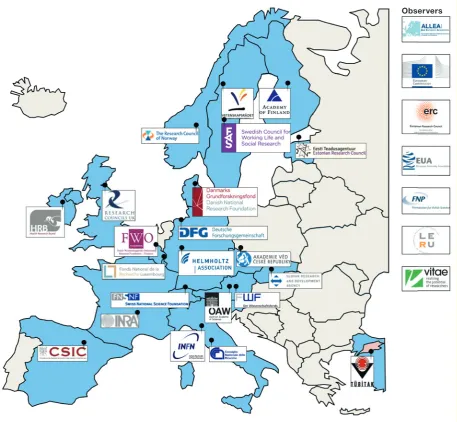
The European Alliance on Research Career Development is a strategic forum that brings together experts from 21 national research funding organisations and non-university research perform-ing organisations (see Figure 1).1 It interacts closely with European level organisations, in particular the ERA Steering Group on Human Resources and Mobility (ERA SGHRM), the European Research Council (ERC), the League of European Research Universities (LERU), the European University Association (EUA), and All European Academies (ALLEA). The group has a long-standing track record of collaborating on the development and implementation of research career strategies built on mutual trust.
The EARCD aims to adopt a common strategy to ensure the attractiveness of research careers and thereby to create and improve European-level and coordinated national policies and programmes for different career stages and career paths.
Initially, the forum was chaired by Professor Nüket Yetis, Scientific and Technological Research Council of Turkey. She was succeeded by Dr Iain Cameron, Research Councils UK. Working groups have been chaired by Ms Ulrike Kohl, National Research Fund of Luxembourg (working group on Research Career Structure & Research Career
1. The list of EARCD members is included in Annex 1.
1.
Setting the Scene:
Why focus on ‘research careers
in and beyond Europe’?
l l l
Tracking), Dr Marie-Claude Marx, National Research Fund of Luxembourg, together with Dr Maria Starborg, Swedish Research Council (work-ing group on Professional Skills Development), Dr Hans Borchgrevink, Research Council of Norway (working group on Mobility). The EARCD has been coordinated and advised by Ms Laura Marin, European Science Foundation, and Dr Beate Scholz, Scholz – consulting training coaching.
1.2
Results, input and tasks
from the previous ESF Member
Organisation Forum on Research
Careers
The European Alliance on Research Career Development builds on the results and outcomes of the previous ESF Member Organisation Forum on Research Careers that operated between November 2007 and April 2010.2 Its findings and recommendations were published in January 2010 in the report Research Careers in Europe – Landscape and Horizons.3 The forum developed an imple-mentation plan to form the backbone of its future activities. In particular, it recommended a set of joint actions to be taken, namely:
• improving the attractiveness and competitiveness
2. http://www.esf.org/activities/mo-fora/completed-mo-fora/ research-careers.html.
De
ve
lo
pi
n
g R
es
ea
rc
h C
a
re
er
s I
n a
n
d B
ey
on
d E
u
ro
pe
6
of European research careers by: – structuring of research careers;
– providing “equal playing fi elds” for researchers of all backgrounds (especially women);
– supporting the development of “portfolio careers”;
• developing and implementing European policies for research career development.
Th e Research Careers Forum also identifi ed
needs for further actions, specifi cally:
• Providing orientation and enhancing the predict-ability of research careers for researchers wishing to work in Europe;
• Avoiding inherent or hidden biases in the peer review system, creating obstacles for the career advancement of researchers having left the (European) academic research system, e.g., for family reasons, to work in industry or to go abroad as well as for researchers with especially
risk-taking and innovative approaches;
• Allowing for researchers’ continuous professional development, given that research careers nowa-days “tend to be less path-dependent & to develop more and more into ‘portfolio careers”;4
• Acknowledging that “all obstacles and bottle-necks identifi ed during a research career aff ect the careers of women scientists more severely than those of men” 5 and thus integrating this issue as a cross-cutting topic in all aspects under considera-tion by the European Alliance on Research Career Development.
4. European Science Foundation Member Organisation Forum on Research Careers: Research Careers in Europe – Landscape and Horizons, Strasbourg 2010, p. 12.
5. Ibid., p. 4. Figure 1. Map of EARCD Member Organisations and list of observers (Logos)
De ve lo pi n g R es ea rc h C a re er s I n a n d B ey on d E u ro pe 7
1.3
Role and responsibility
of research organisations
in developing research careers
in and beyond Europe
The EARCD has operated in line with chap-ter 2 ‘Promoting European Research Careers’ of the EUROHORCs and ESF Vision on a Globally Competitive ERA and their Road Map for Actions and the tasks as defined by the Member Organisation Forum on Research Careers. Yet, one may ask why developing research careers is a topic of continuous importance and needs persistent commitment,
in competition with other topics ranking high on the science policy agenda, such as research infra-structures, open access to research results or grand challenges: research careers should matter simply because research organisations are there to ensure and promote the quality of research. How could they achieve this goal any better than by creating conditions for researchers that make a research career attractive and compatible with research-ers’ individual life plans and talents? Even the best research infrastructures would be useless, if there were no highly skilled researchers to operate them.
However, rapid changes in increasingly dynamic research systems together with the growing diver-sity of researchers’ careers raise questions and create insecurities that research policy makers and research organisations at national and European level have to respond to:
• We expect researchers to act responsibly and accountably in respect of the highest scientific and ethical standards and at the same time to develop a high level of creativity. Therefore, we need to ask what can research organisations do in order to enable individual careers and train research-ers “to become creative, critical and autonomous intellectual risk takers”? 6
• Society expects a high level of responsibil-ity, accountability and creativity not just from researchers, but also from research organisations, especially in times of scarce resources and concur-rent societal and political demands on how these resources should be spent. Therefore, research funding and research performing organisations need to observe the results of their activities in terms of outputs, e.g., the career choices of the researchers they have trained, and outcomes in terms of these researchers’ contributions to soci-ety and the economy.
6. League of European Research Universities: Doctoral Degrees Beyond 2010. Training talented researchers for society, March 2010, p. 3.
• Expectations also exist on the side of research-ers, especially at times of increasing complexity. Thus, we are faced with the challenge to guide
researchers on what to expect when they embark on a research career: Which are the pre-conditions for career advancement, which opportunities do researchers have, which bottlenecks do they need to face? How can their individual career paths be rec-ognised and their achievements be acknowledged?
1.4
Modus operandi
and activities
of the EARCD
In order to tackle these questions the EARCD set up three working groups during its launch conference in Brussels on 9 and 10 February 2011:
1. Research career structure & career tracking The goals of this working group were twofold: • Contributing to the development and
endorsement of the European Framework
for Research Careers in interaction with the European Commission;
• Bringing the issue of Research Career
Tracking and Monitoring onto the research policy agenda in Europe by conducting an international workshop in February 2012. 2. Professional skills development The working group’s aim was to agree on a
pan-European Professional Development Framework for Researchers and joint tool for researchers‘ continuous professional development by means of conducting a feasibility study and thereby validating the UK’s Vitae Researcher Development Framework.
3. Mobility
The primary objective of this working group was
to develop a policy recommendation on New
Concepts of Mobility, especially in view of acknowledging portfolio careers in peer review and supporting intersectoral mobility, including combined part-time positions.
During the launch conference the members agreed on an evidence-based policy approach. Consequently, the findings, recommendations and projected next steps of the EARCD result from the subsequent activities and publications:
• A comprehensive Survey of Member Organi-sations carried out between May and January 2012, which addressed all of the Forum’s focus areas;7
De
ve
lo
pi
n
g R
es
ea
rc
h C
a
re
er
s I
n a
n
d B
ey
on
d E
u
ro
pe
8
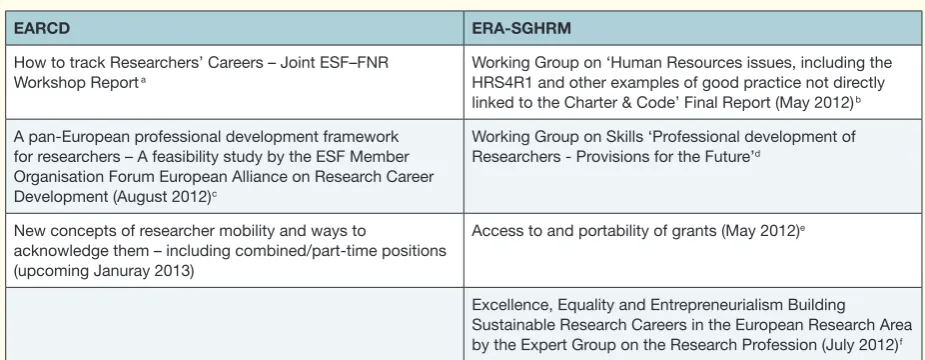
Careers,10 agreeing joint support for the European Framework11 and the skills strategy of the OECD.12 By greater sharing of its agenda and coordinating its activities with those of the Commission (the ERA SGHRM) an effective division of labour was agreed during 2011. For example, the forum addressed the skills development and career tracking of research-ers, while the Commission has addressed the European Framework, the portability of grants and the HR Strategy for Researchers.
Those recent reports produced by the ERA SGHRM which are particularly relevant to the work of the forum are listed in the following table alongside the reports produced by the EARCD itself. Together these reports provide a substan-tial picture of research careers in Europe. In some instances both the forum and the ERA SGHRM addressed related issues. An example is Researcher Development where the forum reported on a pilot study looking at the potential applicability of the Vitae Researcher Development Framework in six countries outside the UK whereas the ERA SGHRM working group addresses the question of “How are we making researchers more employable?”. In the latter report the provision for researcher develop-ment in a number of countries has been presented using a matrix of the four domains and the four career stages of the European Framework for Research Careers.
10. http://ec.europa.eu/euraxess/pdf/research_policies/Towards_a_ European_Framework_for_Research_Careers_final.pdf
11. See EARCD’s letter of endorsement (Annex 3). 12. http://skills.oecd.org/documents/
OECDSkillsStrategyFINALENG.pdf. • A pilot project studying the prerequisites for
a Pan-European Professional Development
Framework for Researchers in six countries rep-resenting different parts of Europe, conducted in autumn 2011;8
• A joint ESF-FNR international conference on
How to Track Researchers’ Careers, held in Luxembourg on 9 and 10 February 2012;9
• An expert hearing on New Concepts of Mobility and Their Acknowledgement, Including Combined Part-Time Positions, held in London on 29 May 2012;
• A policy document on New concepts of researcher mobility and ways to acknowledge them – including combined/part-time posi-tions, to bepublished in January 2013;
• Four working meetings of all forum members and observers (Brussels, February 2011; Istanbul, April 2011; Strasbourg, November 2011; London, May 2012).
1.5
Interactions and achievements
to date
The forum has actively sought to engage with other organisations such as the European Research Council (ERC), the League of European Research Universities (LERU), the European University Association (EUA) and All European Academies (ALLEA) through invitations to join its meetings. In addition, the membership was aware of the need to fruitfully interact and thus to avoid any actual or perceived duplication of effort with related work such as that undertaken by DG Research and Innovation. Cross-membership of two members with the ERA SGHRM and of another member with the European Commission’s Expert Group on the Research Profession enabled reciprocal aware-ness of relevant actions and formal updates of the forum’s work were provided through letters to the Chair of the ERA SGHRM.
The work of the EARCD has previously impacted on the European Commission, with respect to theEuropean Framework on Research
8. European Science Foundation Member Organisation Forum ‘European Alliance on Research Career Development’: A pan-European professional development framework for researchers - A feasibility study by the ESF Member Organisation Forum European Alliance on Research Career Development, Strasbourg 2012, http:// www.esf.org/fileadmin/Public_documents/CSSD/MO_Fora/ ESF_RDF_pilot_report_310812_final.pdf.
De
ve
lo
pi
n
g R
es
ea
rc
h C
a
re
er
s I
n a
n
d B
ey
on
d E
u
ro
pe
9
Table 1. Recent and anticipated reports produced by the EARCD and the ERA SGHRM
EARCD ERA-SGHRM
How to track Researchers’ Careers – Joint ESF–FNR Workshop Report a
Working Group on ‘Human Resources issues, including the HRS4R1 and other examples of good practice not directly linked to the Charter & Code’ Final Report (May 2012) b
A pan-European professional development framework for researchers – A feasibility study by the ESF Member Organisation Forum European Alliance on Research Career Development (August 2012)c
Working Group on Skills ‘Professional development of Researchers - Provisions for the Future’d
New concepts of researcher mobility and ways to
acknowledge them – including combined/part-time positions (upcoming Januray 2013)
Access to and portability of grants (May 2012)e
Excellence, Equality and Entrepreneurialism Building Sustainable Research Careers in the European Research Area by the Expert Group on the Research Profession (July 2012)f
a. Available at: http://www.esf.org/activities/mo-fora/esf-member-organisation-forum-on-european-alliance-on-research-career-development.html
b. http://ec.europa.eu/euraxess/pdf/research_policies/SGHRM-WG1-on-HR-Issues-Final-report-May-2012.pdf
c. http://www.esf.org/fileadmin/Public_documents/CSSD/MO_Fora/ESF_RDF_pilot_report_310812_final.pdf
d. Published at: http://ec.europa.eu/euraxess/pdf/research_policies/Professional_Development_of_Researchers_Provisions_for_the_Fut.pdf.
e. http://ec.europa.eu/euraxess/pdf/research_policies/access_to_and_portability_of_grants_may_2012.pdf
f. http://ec.europa.eu/euraxess/pdf/research_policies/ExpertGrouponResearchProfession.pdf
Further relevant policy documents relating to research careers can be found on the EU EURAXESS website under Jobs – Research Policies.13
De
ve
lo
pi
n
g R
es
ea
rc
h C
a
re
er
s I
n a
n
d B
ey
on
d E
u
ro
pe
10 As one of the milestones of their activities EARCD
members agreed to conduct a survey of ESF mem-ber organisations with the aim of investigating the respective organisations’ policies and promising practices referring to the focus areas of the forum.14 During the survey phase, lasting from mid-May until the end of July 2011, 20 replies from research organisations were received, representing 17 dif-ferent European countries. Each of the subsequent chapters will start by providing background infor-mation on the topic and by presenting a summary of the respective findings from the survey as well as of the EARCD’s respective working group’s activities. We will then list the forum’s recommendations and describe the envisaged next steps.
2.1
Enabling:
developing a European Researcher
Development Framework
Why continuous professional development?
The previous ESF Member Organisation Forum on Research Careers15 formulated a Joint European Skills Statement providing orientation to its mem-ber organisations on which skills to provide to researchers during their doctoral and postdoc-toral qualification. The EARCD has recognised the need to move beyond by focusing on continu-ous professional development opportunities for
14. European Science Foundation Member Organisation Forum ‘European Alliance on Research Career Development’: A survey analysis by the ESF Member Organisation Forum, January 2012. 15. European Science Foundation Member Organisation Forum on Research Careers: Research Careers in Europe – Landscape and Horizons, Strasbourg 2010, p. 47f.
2.
Results, Recommendations
and Ways Forward
l l l
researchers at all stages of their career. Therefore, a working group on skills development of research-ers was created, with the purpose of better defining researchers’ professional profiles and developing guidance to member organisations for the con-tinuous professional development of researchers. The working group identified the need for a com-mon and structured approach towards researchers’ skills development, which is also asked for by the European Charter for Researchers of 2005: while “particular priority should be given to the organisa-tion of working and training condiorganisa-tions in the early stage of the researchers’ careers”, employers and/or funders of researchers “should draw up (…) a specific career development strategy for researchers at all stages of their career”.16
As a starting point the EARCD working group on researchers’ professional skills development managed to formulate an agreed definition of ‘researchers’ professional development’.
Definition of Researchers’ Professional Development
Researchers’ professional development is a struc-tured approach to the continuous development of researchers’ knowledge, expertise and attrib-utes at all stages of their career to improve their competency, employability and ability to pursue multiple career paths. This may be achieved by a variety of activities, whether formal and structured, or informal and self-directed.
De
ve
lo
pi
n
g R
es
ea
rc
h C
a
re
er
s I
n a
n
d B
ey
on
d E
u
ro
pe
11 Experience of member organisations in
developing researchers’ professional skills
Obviously, the issue of professional skills develop-ment is still rather new to research organisations in Europe:17 in the survey of member organisations, only 8/20 organisations indicated having relevant policies in place; national strategies or programmes are available in only four countries, with the long-est tradition in the UK. Research performing organisations seem to be prepared to incorporate professional skills development in their internal staff development policies, whereas research funders are still seeking appropriate ways, e.g., by provid-ing extra funds to their grantees. As concerns the target groups of such policies most organisations address researchers at diff erent career stages with a primary focus on the doctorate candidate (R1 level of the European Framework for Research Careers18) level. Essentially, the need for continuous profes-sional skills development seems to be recognised. Yet only a few organisations have policies in place to acknowledge researchers’ professional skills in selection or staff promotion procedures (Figure 2).
Trial of a pan-European professional development framework for researchers
Here we present an overview of results and sugges-tions from the trial. Details have been published in
the report A pan-European professional development
17. European Science Foundation Member Organisation Forum ‘European Alliance on Research Career Development’: A survey analysis by the ESF Member Organisation Forum, January 2012, p. 22ff .
18. European Commission: Towards a European Framework for Research Careers, EU Commission DG Research and Innovation, Directorate B – Skills, 21.07.2011.
fr amework for researchers – A feasibility study by the ESF Member Organisation Forum European Alliance on Research Career Development.19
Starting point
Th e Researcher Development Framework (RDF), as developed by Vitae(UK), off ered a promising basis to achieving the goal of working out a common European framework for researchers’ professional development. Th e RDF is a professional develop-ment framework for planning, promoting and supporting the professional and career develop-ment of researchers. Th e RDF was developed and validated in a UK context and the question arose about its relevance, usefulness and potential appli-cability in a wider European context. In order to investigate this question, the ESF, with the support of EUROHORCs, commissioned Vitae to conduct a trial of the RDF in a non-UK context. In autumn 2011, the suitability of the RDF was tested in six European countries (Estonia, France, Germany, Italy, Luxembourg and Norway) with different research/cultural/socioeconomic settings. Th e pilot study was organised and conducted by Vitae, involv-ing researchers and usinvolv-ing the same methodological approach as applied in the UK-based trials.
Results
Overall, the concept of a pan-European professional development framework was well received and
indi-19. European Science Foundation Member Organisation Forum ‘European Alliance on Research Career Development’:
A pan-European professional development fr amework for researchers – A feasibility study by the ESF Member Organisation Forum European Alliance on Research Career Development, Strasbourg 2012, http://www.esf.org/fi leadmin/Public_documents/CSSD/ MO_Fora/ESF_RDF_pilot_report_310812_fi nal.pdf. Yes, already acquired skills
Yes, plans for skills development
No
I don’t know
No response
* European Science Foundation Member Organisation Forum ‘European Alliance on Research Career Development’: A survey analysis by the ESF Member Organisation Forum, January 2012, Figure 10, p. 30.
Figure 2. Do research organisations or countries acknowledge researchers’ professional skills development? N=20*
6; 30%
2; 10%
5; 25%
5; 25%
De ve lo pi n g R es ea rc h C a re er s I n a n d B ey on d E u ro pe 12
Vitae website, researchers will also want to access
concrete training and development activities within their institution or country. Professional development provision for researchers is generally improving, particularly for doctoral candidates. However, some countries have less developed pro-vision for researchers than others.
This project has been an important first step in identifying the potential opportunity of creating a pan-European professional development frame-work. The focus groups revealed:
• considerable interest from the participating researchers;
• that the readiness of research systems to use professional development frameworks varies by country;
• ways in which the RDF can be further developed and supported for pan-European use.
Suggestions
1. Explore the potential to undertake a large-scale independent trial of the RDF across Europe by making the RDF professional develop-ment framework available to larger numbers of researchers and in more countries, funded by the European Commission.
2. ESF member organisations and research organi-sations should explore in more depth the interest in and readiness of individual country contexts to adopt and use a professional development framework for researchers.
3. Initiate discussions with the European Commission on the availability of funding to develop the RDF into a pan-European version of the RDF, including additional resources, FAQs and guidance for a European audience.
4. Vitae is currently developing a web-based inter-active Professional Development Planner that will be available by licence to UK institutions. Additional financial investment and licens-ing would be required to extend this capability across Europe to other countries within Europe so as to reflect local research systems and legis-lation.
EARCD’s conclusions and recommendations based on the trial
The trial made apparent some general deficien-cies in the European systems with regard to skills and career development of researchers. There are big differences between countries in their overall awareness and readiness to engage and invest in the general development and career development of researchers. Furthermore, there is a real demand vidual researchers could see the personal value in
the RDF, irrespective of their level of experience, discipline or research/country context. However, some participants identified that the social and political contexts in some countries would influ-ence the readiness and acceptability of researchers using competency frameworks.
The outcomes from the six focus groups dem-onstrated the potential applicability of the RDF for researchers across Europe. The RDF presents an opportunity to make a step change in how European researchers are supported in their pro-fessional and career development.
As focus group participants noted, the adoption of the Researcher Development Framework across Europe would support the aims of the European Charter and Code,20 specifically the principles relating to continuous professional development, career development, access to research training and continuous development, and access to careers advice. It would also provide a common language for researchers to talk about their expertise and professional development within evaluation and appraisal systems and to potential employers in all employment sectors. Pan-European access and usage would support the European Research Area by promoting the concept of the ‘European researcher’ and facilitate mobility. However, some countries have a longer journey to travel than others in terms of the cultural and political recognition of the professional development of researchers.
The focus group participants recognised the value of the RDF in providing a comprehensive framework of researchers’ knowledge, skills and attributes, but the very nature of this comprehen-siveness impacts on the ease of engagement. More diverse and flexible resources are needed to intro-duce the RDF to researchers dependent on their experience of self-reflection and professional devel-opment. The initial receptiveness of individuals to the RDF improves through facilitated introduc-tion. To do this would require the development of supporting resources for staff with responsibility for training and developing researchers, including supervisors and principal investigators.
The value of the RDF will be enhanced signifi-cantly by signposting researchers from the RDF to readily accessible training and development opportunities. Although there is a range of online resources for researchers, particularly through the
20. European Commission Directorate-General for Research, Directorate The human factor, mobility and Marie Curie activities: European Charter for Researchers and Code of Conduct for the Recruitment for Researchers, EUR 21620 (2005),
De ve lo pi n g R es ea rc h C a re er s I n a n d B ey on d E u ro pe 13
among researchers for a more structured approach towards researchers’ professional development and active career planning.
Without claiming representativeness, the test-ing of the RDF in diff erent European setttest-ings gave encouraging results in overcoming some of the identifi ed defi ciencies and in progressing towards a shared understanding of the skills and attributes that characterise modern researchers. Furthermore, the RDF proved to be a solid basis for making researchers refl ect on their skills and attributes and on their career aspirations in general. It provides an important potential to support the professional development of researchers in any national or insti-tutional environment.
Based on the results of the study, the EARCD
has formulated recommendations on how to achieve greater effi ciency in researchers’ skills devel-opment at diff erent levels, from an overarching to an individual perspective:
Recommendation 1 (overall)
Concerted eff orts must be made by policy makers, governments, funders and research performing organisations to promote the concept and impor-tance of researchers’ professional development targeted at all levels of the hierarchy of research management, from political leaders, heads of research organisations, academics to the researchers themselves. Th e creation of a European Researcher Development Framework would provide a single European language describing researchers’ skills and attributes and thereby facilitate mobility. A European Researcher Development Framework would contribute to the concept of the European researcher and to the build-up of the ERA, and meet the objectives of the European Charter for researchers. A European Researcher Development Framework could be implemented by already existing channels at a European level such as the EURAXESS.
Recommendation 2 (EU level)
Th e European Commission should consider invest-ing in makinvest-ing available a pan-European Researcher Development Framework to promote the impor-tance of the professional development of European researchers, to guide them in their refl ections on their skills and attributes, their developmental needs and on their role as a researcher in general.
Recommendation 3
As a fi rst step, the European Commission should provide funding to support a wider independent trial of the RDF at European/institution/national
level that includes research performing organisation directors, human resources specialists, etc. as well as researchers and consider any possible country/ institution-specifi c constraints towards researchers’ professional development (e.g., national legislative barriers, etc.).
Recommendation 4 (national and institution level)
Governments, research funders and research per-forming organisations should work together to off er researchers at all career levels adequate training and development means to actively expand their profi le and progress in their career. Numerous countries/ institutions do not have appropriate supporting structures regarding researchers’ development, i.e., adequate training opportunities, career advice ser-vices, etc.
Recommendation 5 (individual researcher)
Researchers across Europe should take responsi-bility for their own professional development and refl ect how to improve their own career possibili-ties by using, for example, a tool like the suggested European Research Development Framework for a more in-depth analysis of their own competences and expertise as a researcher and their specifi c career development needs.
Envisaged next steps
Th e EARCD sees the need for activities at two levels: 1. We recommend developing a European
Researchers’ Professional Development Frame-work. Th e European Commission should consider investing in making available a pan-European Researcher Development Framework (RDF). As a fi rst step, the European Commission should provide funding to support a wider independent trial of the UK’s Vitae RDF at European/insti-tution/national level. Th e EARCD will therefore address the European Commission in order for this trial to be realised as soon as possible; 2. Research organisations have only just begun to
De ve lo pi n g R es ea rc h C a re er s I n a n d B ey on d E u ro pe 14
ity requirements vis-à-vis their sponsors and main stakeholders and to achieve strategic knowledge that may be used for policy planning and pro-gramme development.
Considering the organisations’ experience with respect to career tracking we find a mixed picture: 12 organisations have gained experience, eight have not (yet) or did not provide a clear answer. Obviously, there was up to this point no distinct understand-ing of what is precisely meant by ‘career trackunderstand-ing’: some organisations have a focus on ongoing moni-toring of researchers at certain career stages or in specific disciplines. Others have developed national cohort studies to follow up on researchers’ careers at regular intervals or conduct programme evalu-ation surveys and thereby track the careers of their alumni. Thus, we see the need to provide a definition of what is to be understood by career tracking. In categorising the different types of surveys we were able to derive a typology alongside the subsequent criteria: researchers’ career stages (e.g., doctorate holders, senior researchers), level of analysis (national or organisational level), types of studies (e.g., programme evaluation, monitoring), methodology (e.g., survey, database analysis).
The introduction of systematic career tracking of researchers seems to be largely work in progress. Slightly more than half of the organisations (11/20) plan to introduce such systems, three do not and six did not provide a clear answer. It is, however, interesting to see that several organisations or coun-tries that consider introducing career tracking seem to move broadly in the same direction, i.e., career tracking as a tool to measure the impact and suc-cess of funding or qualification schemes in view of accountability requirements.
Given the great interest of research organisations for EARCD’s career tracking conference, it would be interesting to survey whether the motivation to set up career tracking and monitoring mechanisms has since increased.
Results, conclusions and recommendations from the career tracking conference 23
The workshop How to track Researchers’ Careers on 9–10 February 2012 in Luxembourg brought together some 100 participants from national and international funding organisations as well as research institutions and universities from over 20 countries.
23. The subsequent paragraphs are extracts of the workshop report: European Science Foundation/Fonds National de la Recherche Luxembourg: How to track researchers’ careers – Joint ESF-FNR Workshop Report, Luxembourg/Strasbourg 2012.
2.2
Observing:
creating an International Platform
for Research Career Tracking and
Monitoring
Achieving transparency and understanding structures
The EARCD supports the European Framework of Research Careers with the goal of providing guid-ance to researchers and making research careers in Europe more transparent. Creating transpar-ency and understanding the structures of research careers are also the major aims why the forum has embarked on tracking and monitoring research careers. On the research organisations’ side, another motivation for career tracking and monitoring is to observe the results of their funding and career development activities. As a starting point the EARCD conducted a mapping exercise of existing career tracking approaches. It also dedicated part of the member organisation survey to this topic with the immediate objective of serving as preparatory analysis for the international workshop on career tracking in Luxembourg in February 2012, co-hosted by the European Science Foundation and the National Research Fund of Luxembourg.
The recently published TRACKIT 21 report by the European University Association underlines the “growing interest in tracking and also an increas-ing number of trackincreas-ing initiatives both at national and institutional level”. The survey of 31 European countries focused on tracking initiatives referring to undergraduate and graduate students. It also points to an important gap that the EARCD has sought to overcome by providing an agreed definition of what is to be understood by career tracking of researchers: “While there is no common understanding of what tracking actually is, the study proposes a description deduced from the common practice, which should allow distinguishing tracking from other types of data collection or research projects”.22
Survey findings
EARCD member organisations believe that by tracking research careers they will, for instance, be in a better position to analyse the impact of research career development schemes, to meet
accountabil-21. European University Association: Tracking Learners’ and Graduates’ Progression Paths – TRACKIT, Brussels 2012, available at: http://www.eua.be/Libraries/Publications_homepage_list/ EUA_Trackit_web.sflb.ashx.
De
ve
lo
pi
n
g R
es
ea
rc
h C
a
re
er
s I
n a
n
d B
ey
on
d E
u
ro
pe
15
As a result of a survey among ESF members car-ried out in 2011, the variety of concepts and practices as to tracking of researchers’ careers became appar-ent.24 In fact, among ESF member organisations, numerous funding schemes exist, designed to sup-port individual researchers in their various career stages. Currently, only a few funders and member states have ongoing career tracking studies in place, although these are obviously delivering very precious information about career trajectories of researchers. Th e main aim of the Luxembourg workshop was, thus, to bring the issue of ‘career tracking’ onto the
science policy agenda in Europe by asking whywhywhy and and
for whom career tracking is important and howhowhow it it should be carried out. Related objectives were to develop a common understanding of ‘career tracking of researchers’ and to develop a typology of career tracking approaches.
Th e following four categories of career
track-ing studies were identifi ed, with examples for each category included in the workshop report:25 • International initiative: the OECD CDH Project; • Nation- or region-wide initiatives: US, UK,
Germany, Flanders;
• Institutional initiatives, including alumni-based surveys: Wellcome Trust; CIFRE fellowships; European University Institute; Alexander von Humboldt Foundation;
• National/regional register data: Flanders, Denmark, Norway.
24. European Science Foundation Member Organisation Forum ‘European Alliance on Research Career Development’: A survey analysis by the ESF Member Organisation Forum, January 2012. 25. See present Workshop Report, (see Section II) “Overview of Career Tracking Studies”, in: European Science Foundation/Fonds National de la Recherche Luxembourg: How to track researchers’ careers – Joint ESF-FNR Workshop Report, Luxembourg/Strasbourg 2012.
Defi nition of ‘Career Tracking of Researchers’
Initiatives that follow up researchers‘ careers over a certain time period to understand researchers’ career pathways. Surveys that trace back careers over several years, cohort studies at several moments in time (not just one) or longitudinal surveys are considered to fi t the defi nition.
Th e main purposes of career tracking can be summarised as follows:
• Tracking the quality of research training and skills: By following up doctoral graduates and surveying them aft er graduation, tracking stud-ies assess the suitability of funding and the quality of training and working conditions off ered dur-ing the doctoral phase and explore whether the quality of doctoral training was appropriate to researchers for the best career opportunities in or outside academia.
• Tracking to fi nd out where researchers move in their careers: A major reason for carrying out career tracking studies is to provide infor-mation on career movements and understand international and intersectoral mobility as well as employment patterns of researchers throughout their careers.
• Tracking for accountability: Career tracking of doctorate holders is motivated by the need for accountability vis-à-vis the funders of doctoral education, i.e., in most cases taxpayers. Career tracking studies indirectly measure impact, for example by informing about occupational patterns of researchers, not only in academia. Moreover, career tracking may be used as a strategic planning tool to monitor and improve the effi ciency of grant schemes or doctoral education programmes as well as career development strategies.
Yes
No
I don’t know
No response
11; 55%
3; 15%
4; 20%
2; 10%
Figure 3. Interest by research funding organisation or by country to set up systematic career tracking of researchers, N=20*
De ve lo pi n g R es ea rc h C a re er s I n a n d B ey on d E u ro pe 16
Tracking studies compared to indicator-based follow-up
There is a trend to opt for developing indicator-based follow-up of researchers, relying principally on research outputs. Compared to an indicator-based approach, career tracking delivers complementary information on researchers’ pathways and allows moves in and out of academia and in and out of research to be analysed. By monitoring careers over time, tracking studies serve to provide different insights into the actual contribution of researchers to the economy and society. They also provide guid-ance for current researchers engaging in a doctorate to build their future careers.
Career tracking helps to identify structural problems
Besides the monitoring of programmes, the (national, regional or institutional) follow-up of researchers (for example through regular surveys) allows the detection of structural problems in the research system. To efficiently address any systemic weaknesses, tracking studies should actively involve stakeholders. An informed dialogue and involve-ment of researchers and institutional and political decision makers through an exchange based on an open dialogue proves to be most efficient (as is the case, for example, for the UK Vitae study “What do researchers do?”).
Setting up career tracking studies: choosing the right dimension, resources and outsourcing
Since career tracking studies are expensive and often long-term initiatives, they must be well planned. If carried out in a single institution, a bal-anced approach between building up institutional competence (including statistical know-how) and outsourcing is needed, in order to take full advantage of the study. In addition, if the study is outsourced to an external consultant, the commissioning and communication with the external consultant has to be organised and followed up internally. A realistic plan with budgetary and staff resources should be made before starting the study. The ESF Member Organisation Forum on Research Evaluation has had close exchanges with the EARCD and they have developed recommendations for member organi-sations concerning the dimension, resources and outsourcing of career tracking studies.
Terminology concerns
In its first ESF MO Forum on Research Careers, ESF illustrated research careers in the form of a tree. They might as well be represented as a patchwork. In order to structure career information, Europe Key Conclusions and Recommendations
Developing information on PhD holders and research careers avoiding duplication
Career tracking studies may provide data on PhD holders and researchers in their various career stages that improve our knowledge about research careers. They can very usefully complement official statistics, register data or data files on PhD holders. Europe lacks structured information on doctorates and research careers. There are examples of good prac-tice such as the UK Higher Education Statistical Agency centralising information on PhDs in the UK, or the Scandinavian countries’ register data. It should be a high priority for Europe to improve statistics and information on PhD holders and researchers at the various stages of their research careers. Complementing basic statistical data on PhD holders and researchers by tracking studies or career surveys might be a very useful approach to obtain quantitative and qualitative information on research training, employment patterns, disci-pline-specific careers, life events and their impact on researchers’ careers, etc. Some ongoing tracking studies are organised in a way where they regroup institutions under a centralised approach. This is the case in the UK, Germany and Flanders. It allows economies of scale, with institutions collecting the data which are centrally treated. Depending on the purpose of the career tracking studies, this might be a very sensitive approach. However, if the pur-pose is mainly the follow-up of fellows of a given funding scheme, a centralised nationwide approach might not be the best. Therefore, the purpose and scope of the study, the already existing statistical or institutional data, the available resources and the time period of the study should be well defined in advance in order to make the appropriate choice before starting a tracking study. Duplication of efforts should be avoided by any means. Wherever possible, initiatives of a similar nature should be regrouped or organised in a coordinated manner.
Complementarity of tracking studies and programme evaluations
De ve lo pi n g R es ea rc h C a re er s I n a n d B ey on d E u ro pe 17
has introduced a framework of four major career stages, R1–R426. Th ese of course only show a much reduced picture of the reality and do not represent the broad range of nonlinear career pathways. Th ere is a need to develop a common terminology for research careers as well as for career tracking stud-ies, as terminology is key and subject to diff erent interpretation and preconceptions.
Methodological awareness
Before starting a career tracking study, a bench-marking of existing initiatives should be done. Th e purposes of the study and the intended objec-tives have to be clearly defi ned, as this will set the framework for the methods and resources needed. Th e workshop on career tracking has identifi ed several initiatives of diff erent nature and purposes. Openness to new methodologies (e.g., life his-tory research, identity studies) and tools (e.g., CV depositories, social media) are important, as they may bring very diff erent and new approaches to the analyses of research careers. Comparability should be envisaged,27 but not necessarily comparability of studies as such, given that the respective target audience and purposes might diff er. Full account should be given to informed methodological deci-sions before starting the study (for example, for how long will researchers be tracked and at what inter-vals? Should everybody be tracked or only specifi c cohorts? If a longitudinal approach is chosen, how is panel mortality addressed, etc.).28
An international platform promoting career tracking and career surveys
To conclude, the EARCD recommends a joint ini-tiative promoting career tracking studies as well as career surveys and statistical information on research careers across Europe and beyond, link-ing them through a platform that regroups existlink-ing studies and new studies to be set up. Such a platform could integrate a broad range of information and publications on research careers, building a docu-mentation and discussion forum. New approaches such as CV databases could be taken into account. Th e workshop has only been able to assemble some
26. European Commission Directorate General Research and Innovation, Directorate B – Skills: Towards a European Framework for Research Careers, 21.07.2011.
27. For methodological concerns in view of comparability, the OECD CDH project’s basic methodology should be taken into account: www.oecd.org/sti/cdh.
28. See Workshop Report, (see section III) “Tracking of Researchers’ Careers – Why, For Whom and How”, in: European Science Foundation/Fonds National de la Recherche Luxembourg:
How to track researchers’ careers – Joint ESF-FNR Workshop Report, Luxembourg/Strasbourg 2012.
information on ongoing and past studies as well as practical guidance on why, for whom and how career tracking can be useful.29 A joint international initiative should be envisaged as an initial step to set up a platform and regular meetings of experts working in the fi eld of career tracking studies and career surveys. Several institutions have expressed their wish to participate in such an initiative. Support would be needed for the implementation of a (virtual) structure. Aft er an initial implementa-tion phase, the joint platform might be continued by the input of ongoing studies taking advantage of the knowledge exchange.
Envisaged next steps
In the long run a European Research Career
Observatory will be essential to create transparency regarding the challenges,
bottlenecks and opportunities of research careers and to help research organisations to better tailor their policies and activities to researchers’ needs. As an initial means we will launch a joint
International Platform for Research Career Tracking and Monitoring with the aim of providing orientation on how to set up surveys, studies and/or career tracking systems based on international good practice.
Th e timeliness of this endeavour is underlined by the recently published report of the European Commission’s Expert Group on the Research Profession. Th e report stipulates “the establishment of a European Monitoring System for the Research Profession with a view to overcoming the current fragmentation and lack of information, data and statistics on the research profession in Europe, thus creating a sound base for policy. (…) Th e Monitoring System should provide:
• a set of common standards to be applied at both European and national level in order to achieve consistency, especially in terms of break-down by discipline, sector, nationality, gender, type of posi-tion, remuneration
• an information system to measure and track the mobility of researchers (geographical, inter-sec-toral) and their career paths, taking into account gender.” 30
29. See Workshop Report, (see section III) “Tracking of
Researchers’ Careers – Why, For Whom and How” ”, in: European Science Foundation/Fonds National de la Recherche Luxembourg: How to track researchers’ careers – Joint ESF-FNR Workshop Report, Luxembourg/Strasbourg 2012.
De ve lo pi n g R es ea rc h C a re er s I n a n d B ey on d E u ro pe 18
ity of researchers between the public and the private research sectors could be improved. With this sur-vey we therefore wanted to highlight obstacles to intersectoral mobility, to pinpoint policies or pro-grammes to stimulate mobility between academia and industry and, eventually, to gain information on combined part-time positions or grants at uni-versities or research institutes to researchers from industry – or vice versa.
Research organisations in Europe, overall, seem to be quite conscious of the main reasons inhibit-ing intersectoral mobility. The followinhibit-ing barriers were mentioned by several organisations: lack of acceptance on the side of the research organisation; differences in merit systems; different salary levels or incentives; lack of interest/awareness of industry; different research cultures; lack of publications as a result of working in the private sector; few research activities in the private sector; lack of interest in doctorate holders; limited awareness of researchers regarding career opportunities outside academia. Obviously, a large majority of organisations (16/20) have taken initiatives to foster intersectoral col-laborations, with a certain focus on the doctoral candidate (R1) stage. However, seven organisations have comprehensive approaches in place, addressing all stages of a research career.
In analysing the details of policies or programmes to stimulate cooperation between the different sectors we find a distinct geographic distribution of policies and programmes: whereas northern European countries focus on doctoral training (industrial PhD programmes), the primarily German speaking countries rely on broader approaches to support technology transfer and southern European countries refer rather to national legislations or min-isterial programmes to foster intersectoral mobility and cooperation. Combined academia-industry posi-tions are still rather scarce (8/20 organisaposi-tions gave positive replies) and have, perhaps with the excep-tion of Norway, only recently been introduced.
Peer review and portfolio careers
In view of increasingly diversified careers the EARCD also seeks to investigate if, or to which extent, peer review is taking account of less linear career paths and to provide a guideline to this end. Therefore, the forum wanted to gain evidence on actual peer review policies or procedures in view of career breaks. In addition, we wished to find out details about the respective organisations’ or countries’ policy in dealing with different types of mobility in peer review.
A considerable majority of 14/20 organisations indicates that they acknowledge career breaks.
2.3
Guiding:
suggesting new concepts of
mobility and their acknowledgement
The EARCD based its activities in this area on the recommendation of the previous ESF Member Organisation Forum on Research Careers to provide ‘equal playing fields’ for researchers of all back-grounds through a new ‘scientific quality’ approach and to allow for a concept of inclusiveness.31 This need arises especially with respect to research-ers having left the (European) academic research system, e.g., for family reasons, to work in indus-try or to go abroad, as well as for researchers with especially risk-taking and innovative approaches. Meanwhile, it has been widely accepted that mobil-ity of researchers does not always imply physical or geographic mobility and that mobility of all types should not be seen as an end in itself, but rather as an instrument to enhance the quality of research and researchers’ career trajectories.32
In line with its evidence-based policy approach the EARCD has derived the conclusions and recom-mendations and suggested next steps in its policy document New concepts of researcher mobility and ways to acknowledge them – including combined/ part-time positions from the results of the mem-ber organisation survey as well as from the input received at an expert hearing, held in London on 29 May 2012.33
Member organisations’ strategies in dealing with different forms of mobility and portfolio careers
Intersectoral mobility
The EARCD addresses the issue of mobility in a broad sense, i.e., international, intersectoral, ‘virtual’ and interdisciplinary mobility. In view of intersec-toral mobility it is the EARCD’s aim to formulate evidence-based recommendations on how the
mobil-policies/ExpertGrouponResearchProfession.pdf.
31. European Science Foundation Member Organisation Forum on Research Careers: Research Careers in Europe – Landscape and Horizons, Strasbourg 2010, p. 4.
32. See, for example, Louise Ackers: Opportunities and Obstacles: Intra-EU Skilled Migration to the UK, Presentation held in London, 12 September 2012; European Commission (author: Annamária Inzelt): Analysis of Researchers’ Mobility in the Context of the European Research Area, 2010; European Commission Expert Group on the Research Profession: Excellence, Equality and Entrepreneurialism – Building Sustainable Research Careers in the European Research Area, Brussels, 20 July 2012.
De
ve
lo
pi
n
g R
es
ea
rc
h C
a
re
er
s I
n a
n
d B
ey
on
d E
u
ro
pe
19
Altogether, we fi nd that research organisations in Europe give particularly strong weight to fam-ily reasons and health issues when it comes to acknowledging career breaks in peer review: all organisations that recognise career breaks consider parental leaves. In the light of ageing populations it is, however, notable that only nine organisations in addition take note of elder care. Th e subsequent classification describes research organisations’ procedures in dealing with career breaks, namely: pragmatic approaches based on case by case deci-sions vs formalised authorisation procedures, guidelines to reviewers, extension of eligibility win-dows or project durations, return grants.
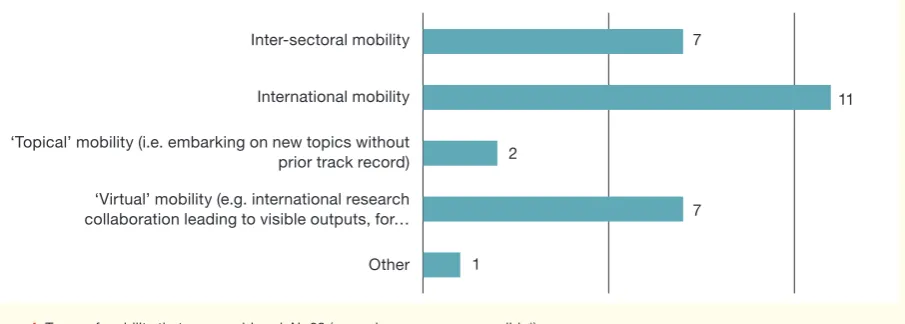
When it comes to the consideration of mobility in peer review we see quite a mixed picture. In total, 11/20 organisations acknowledge mobility; all of them consider international mobility. Intersectoral mobility and virtual mobility, which is documented through international research collaborations and related publications, are of considerably lower importance (seven organisations each). Notably, the preparedness of researchers to embark on new interdisciplinary topics is less valued by research
organisations (one reply) (Figure 4).
Conclusions and recommendations from the policy paper on New concepts of researcher mobility and ways to acknowledge them - including combined/part-time positions 34
Researcher mobility should no longer be associ-ated with physical and geographical mobility only.
34. Th e following paragraphs present a condensed version of the EARCD’s policy document on New concepts of researcher mobility and ways to acknowledge them - including combined/part-time positions, which will be available once published beginning 2013 at: http://www.esf.org/activities/mo-fora/publications.html
Mobility is not a goal in itself, but rather a means for international research collaboration across fi elds and sectors. Long-term physical mobility may be needed for the education and build-up of researchers from less favourable scientifi c environ-ments, but is hardly necessary to set up collaboration between frontline labs. Combined part-time posi-tions, including part-time ERA Chairs, may be established to counteract brain drain and link the emerging research institution to frontline institu-tions for future continuous collaboration.
The internet opens possibilities for virtual mobility and the establishing of virtual multi-disciplinary network research centres. Centres of Excellence no longer need to be established as one physical geographical location. Virtual network centres and databases and registries accessible by eScience may combine excellent and synergetic research groups across the world without physical mobility. Flexible opportunities should be encour-aged, stimulating a more eff ective use of human and fi nancial resources in research, in line with the core idea of ERA.
Scope
Research quality is associated with international research collaboration, ‘critical mass’, frontline infra-structure and competition for funding. We suggest new concepts of researcher mobility including com-bined/part-time positions that may meet researchers’ individual needs, foster scientifi c excellence, facili-tate knowledge transfer across disciplines, sectors and countries and even counteract brain drain from less attractive areas. We also recommend novel approaches to acknowledging these new concepts of researcher mobility in peer review, staff appraisal or other forms of researcher assessment.
Figure 4. Types of mobility that are considered, N=28 (several answers were possible*)
* European Science Foundation Member Organisation Forum ‘European Alliance on Research Career Development’: A survey analysis by the ESF Member Organisation Forum, January 2012, Figure 17, p. 44.
Inter-sectoral mobility
International mobility
‘Topical’ mobility (i.e. embarking on new topics without prior track record)
‘Virtual’ mobility (e.g. international research collaboration leading to visible outputs, for…
Other
7
11
2
7