Original Research Article
Menstrual disorders and treatment seeking behaviour of adolescents
Veena G. Rahatgaonkar
1*, Anuradha H. Wakankar
1, Gauri A. Oka
2, Sonal V. Kamble
2INTRODUCTION
Adolescence is characterized by immense hormonal changes.1 The most important physiological event of female puberty is the onset of menstruation which plays a key role in a woman’s reproductive life.2
Abdominal pain, heavy menstrual bleeding and irregular menstrual cycles may lead to school absenteeism and could have an adverse effect on academic performance of girls and other activities of their daily life. Often, there is a delay in seeking medical advice for menstrual problems by
adolescent girls.3,4 The present study was designed with the aim of collecting data on prevalence of menstrual patterns and menstrual disorders among adolescent girls from Pune city in India and their treatment seeking behaviour. This study could help to develop a questionnaire regarding MDOT (menstrual disorders of teenagers) as a non-invasive screening tool to identify girls who would require further investigations and treatment for menstrual abnormalities and develop an appropriate education module about menstrual health for adolescent girls.
ABSTRACT
Background: Menstrual abnormalities are a major gynaecological problem faced by adolescent girls leading to morbidity that may have an adverse effect on their school attendance. The objective of the study was to determine prevalence of menstrual disorders in girls aged 10-19 years and to study their treatment-seeking behaviour.
Methods: We conducted a cross-sectional study on 592 girls in the age group of 10 to 19 years attending schools in Pune city during January 2016 to December 2016. Permission was sought from school authorities. Girls 10-17 years were included after obtaining parental consent. For 18 and 19 year olds, informed consent was taken from the girls themselves. Demographic information, height, weight and characteristics of menstrual period were noted.
Results: Majority girls (36%) were in age group 12.1-14 years. Most prevalent menstrual disorder was painful menses reported by 70% of girls, followed by heavy menstrual bleeding (46%) and cycle irregularity (22%). All menstrual disorders were most commonly prevalent in the age group of 14.1 to 16 years. Proportion of girls visiting a doctor and taking medications for painful menses was 26.7% and 16.5% respectively, for heavy menstrual bleeding was 25.7% and 16.5% respectively and for cycle irregularity was 33% and 16.5% respectively. No association was found between mother’s education and treatment seeking behaviour for menstrual disorders.
Conclusions: In spite of high prevalence of menstrual disorders, only a minority of the adolescents seek expert advice. This underscores the need for creating awareness among girls, mothers and teachers and developing a screening tool to identify girls who could benefit by further investigation and follow-up.
Keywords: Menstrual disorders, Treatment seeking behaviour, Adolescents
1
Department of Obstetrics and Gynaecology, 2Department of Research, Deenanath Mangeshkar Hospital and Research Centre, Pune, Maharashtra, India
Received: 28 August 2018 Revised: 17 September 2018 Accepted: 18 September 2018
*Correspondence:
Dr. Veena G. Rahatgaonkar,
E-mail: [email protected]
Copyright: © the author(s), publisher and licensee Medip Academy. This is an open-access article distributed under the terms of the Creative Commons Attribution Non-Commercial License, which permits unrestricted non-commercial use, distribution, and reproduction in any medium, provided the original work is properly cited.
METHODS
This was a cross-sectional study approved by the Institutional Ethics Committee of a multispecialty tertiary care hospital in Pune, India. We approached schools and colleges in Pune city during January 2016 to December 2016 and explained the study details to respective authorities. Only those girls whose parents offered written informed consent were included in the study. Girls aged between 18 and 19 years were included in study after obtaining their written informed consent. Data was obtained from 592 girls between 10-19 years of age. A questionnaire was designed specifically for this study. Along with demographic (age, standard in which studying, mother’s education) and anthropometric information (height, weight, BMI), we collected data about characteristics of menstrual period in terms of regularity, duration, blood loss, pain during and before menstruation and other symptoms associated with menstrual period. Treatment seeking for menstrual problems, use of medication and school absenteeism was also noted. Questionnaire was self-administered, easy to understand and required five minutes to complete. Data
was analysed using SPSS 20. Associations were determined using the chi square test and odds ratios (OR) were calculated to determine risk.
RESULTS
Our study sample consisted of 592 girls with mean age 14.5 years±2.1 years (range 12-19 years) with maximum girls in the age group 12-14 years (36%) (Figure 1).
Figure 1: Age distribution of participants.
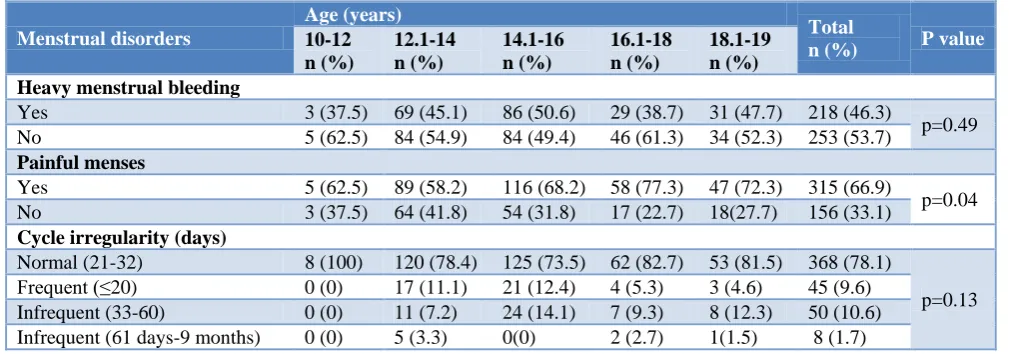
Table 1: Menstrual disorders among girls according to age (n=471).
Menstrual disorders
Age (years)
Total
n (%) P value
10-12 n (%)
12.1-14 n (%)
14.1-16 n (%)
16.1-18 n (%)
18.1-19 n (%) Heavy menstrual bleeding
Yes 3 (37.5) 69 (45.1) 86 (50.6) 29 (38.7) 31 (47.7) 218 (46.3)
p=0.49
No 5 (62.5) 84 (54.9) 84 (49.4) 46 (61.3) 34 (52.3) 253 (53.7)
Painful menses
Yes 5 (62.5) 89 (58.2) 116 (68.2) 58 (77.3) 47 (72.3) 315 (66.9)
p=0.04
No 3 (37.5) 64 (41.8) 54 (31.8) 17 (22.7) 18(27.7) 156 (33.1)
Cycle irregularity (days)
Normal (21-32) 8 (100) 120 (78.4) 125 (73.5) 62 (82.7) 53 (81.5) 368 (78.1)
p=0.13
Frequent (≤20) 0 (0) 17 (11.1) 21 (12.4) 4 (5.3) 3 (4.6) 45 (9.6)
Infrequent (33-60) 0 (0) 11 (7.2) 24 (14.1) 7 (9.3) 8 (12.3) 50 (10.6)
Infrequent (61 days-9 months) 0 (0) 5 (3.3) 0(0) 2 (2.7) 1(1.5) 8 (1.7)
Out of 592 girls, 471 (79.5%) girls had attained menarche at a mean age of 12.8±1.2 years. A minority proportion of girls (2.3%) had attained menarche before turning 10 while 10.2% attained menarche between 14.1 and 16 years. No participant had onset of menarche later than 16 years. Data of 471 girls who had attained menarche was considered for studying menstrual disorders. As shown in Table 1, the most common disorder was painful menstruation seen in 315 girls (66.9%), followed by heavy menstrual bleeding (HMB) in 218 girls (46.3%), and cycle irregularity in 103 girls (21.9%). Significantly more girls in each age group had painful menses (p=0.04).
Menstrual problems
Mean number of bleeding days were observed to be
of bleeding days (2-6 days), while 42 (8.9%) bled for more than 6 days. Out of these 42 girls, majority were in age group 12.1-14 years. In the 14.1 to 16 years age group, 155/170 girls (91.2%) had normal duration of bleeding. All the girls between 16.1 to 18 years of age had normal number of bleeding days. There was no significant association found between age and number of bleeding days (p=0.138). As regards cycle length, it was found that 368 (78.1%) girls had a normal cycle (21-32 days). Forty-five (9.6%) girls had frequent cycles (≤20 days), with almost half of them (46.7%) in the age group of 14.1 to 16 years. Infrequent cycles (33-60 days and 61 days –9 months) were seen in 50 (10.6%) and 8 (1.7%) girls respectively. The most common associated symptom reported by girls was backache (39.5%), followed by leg pain (27%) and tiredness (22%) (Figure 2).
10%
36%
30% 13%
11% 10 to 12 years
12.1 to 14 years
14.1 to 16 years
16.1 to 18 years
It was found that significantly more girls remained absent from school due to painful menses and heavy menstrual bleeding (Table 2). The odds of girls staying away from school due to painful menses were significantly higher than those who did not have painful menses (OR 14.3
with 95% CI 3.5 to 58; p<0.000). Similarly, girls with heavy menstrual bleeding had significantly higher odds of staying away from school as compared to girls who did not bleed heavily (OR 2.5 with 95% CI 1.5 to 4.1; p<0.000).
Figure 2: Other symptoms reported during menses.
Table 2: Association between menstrual symptoms and school absenteeism (n=471).
Symptom
School absenteeism
Total
n (%) p value
Yes n (%)
No n (%) Painful menses
Yes 58 (18.4) 257 (81.6) 315 (100)
< 0.000
No 2 (1.3) 154 (98.7) 156 (100)
Heavy menstrual bleeding
Yes 41 (18.8) 177 (81.2) 218 (100)
< 0.000
No 19 (7.5) 234 (92.5) 253 (100)
Table 3: Menstrual problems, medication intake and treatment seeking behaviour (n=471).
Menstrual problem
Medication intake
Total n (%)
Yes n (%)
No n (%)
Heavy menstrual bleeding 36 (16.5) 182 (83.5) 218 (100)
Painful menses 52 (16.5) 263 (83.5) 315 (100)
Cycle irregularity 17 (16.5) 86 (83.5) 103 (100)
Doctor visit
Heavy menstrual bleeding 56 (25.7) 162 (74.3) 218 (100)
Painful menses 84 (26.7) 231 (73.3) 315 (100)
Cycle irregularity 34 (33) 69 (67) 103 (100)
Table 4: Association between mother’s education level and treatment seeking behaviour (n=471).
Mother’s education
Doctor visit
Total n (%)
Yes n (%)
No n (%)
Up to 4th 25 (26) 101 (26.9) 126 (26.8)
5th to 12th 53 (55.2) 170 (45.3) 223 (47.3)
Graduate/postgraduate 18 (18.8) 104 (27.7) 122 (25.9)
Total 96 (100) 375 (100) 471 (100)
8.6%
3.8% 4.6%
39.7%
27%
22%
2.1%
As seen in Table 3, only a minority of girls suffering from any of the three menstrual problems, namely HMB, painful menses and irregular cycles, took any medication for it. As far as taking professional advice was concerned, it was again found that majority of girls suffering from menstrual problems did not seek treatment by visiting a doctor. Another fact that was observed was the practice of resorting to home remedies by 25/471 girls suffering from menstrual problems. We found that out of these 25, 22 (88%) had painful menses, 16 (64%) suffered from HMB, and 6 (24%) had irregular cycles. We also tried to examine if there was an association between mothers’ education and treatment seeking behavior for girls’ menstrual problems (Table 4). However, there was no significant association found (p=0.137).
DISCUSSION
One in every five people in the world is an adolescent as per WHO definition.5 Out of 1.2 billion adolescents worldwide, about 85% live in developing countries. Adolescents tend to underutilize health care services which may have significant impact on the physical and social health of those affected.6–9 Menstrual problems in adolescent girls have considerable effect on their everyday life. In our study, we have studied different menstrual disorders among adolescents. The age of menarche is worth studying as it may be affected by race or ethnicity.10,11 The mean age of menarche in our study sample was found to be 12.8±1.2 years (median age 13 years) with a majority of participants (36.7%) having menarcheal age between 12 and 14 years. This was comparable with Indian and Canadian studies done in past. Another study from south Ethiopia reports 13-14 years as the menarcheal age for majority adolescent girls.12–14 A study carried out in rural Ratnagiri in western Maharashtra (India) showed that mean age of menarche was 13.7 years.15 Our study found that only a minority of girls (2.3%) had a menarcheal age <10 years and >14 years (10.2%). Progressive reduction in the menarcheal age has been observed over a period of almost three decades by Pathak et al and Song et al.16,17 Late menarcheal age that is later than 14 years has been found to vary between 14-27%.12,13,18,19
Merely asking girls whether their menstrual cycles were normal or not, may lead to missing a significant number of cases of abnormal menstruation. Appropriate evaluation of menstruation and its disorders in adolescents needs detailed questioning regarding cycle length, blood flow and other symptoms. Painful menstruation was the most commonly found menstrual disorder seen in 315 (66.9%) girls in our study. This is comparable to previously reported prevalence in both, industrialized and developing countries.19–21 The proportion of girls in our study with painful menses increased with age. Prevalence of dysmenorrhoea was significantly higher among adolescents aged 16-17 years compared to those aged 14 years.20,21
Heavy menstrual bleeding was severe enough to cause school absenteeism in 18.8% of the girls in our study. Painful menstruation was the second commonest cause reported for school absenteeism in our study with 18.4% girls remaining absent from school for this reason. This finding is comparable with a study conducted in Australian teenagers, where pain was the most common reason reported for school absence by girls who missed school.22 Painful menses were responsible for greatest number of school absenteeism in adolescent girls in Nigeria.23 Mean number of bleeding days in present study was 5±1.1 days, which was comparable with findings from a study conducted in Saudi Arabia.24 HMB is denoted by blood loss for more than seven days and use of more than three pads per day or blood flow associated with blood clots. In our study, HMB was observed in 46.3% girls. Out of these 16.5% girls took medication for the same. Proportion of HMB was considerably less in a study from Hong Kong, where the prevalence of HMB was 17.9%.4
As far as the treatment seeking behaviour of girls was concerned, only 25.7% girls with HMB, 26.7% with painful menses and 33% with irregular cycles took medical advice. Our observation is similar to that noted in MDOT study in Australia, where 33% girls with painful menses took medical advice.22
Owing to immaturity of the hypothalamo-pituitary-ovarian axis, the initial few menstrual cycles in a girl’s life tend to be irregular. This variability poses a dilemma for the treating physician and may result in a delay in the diagnosis and treatment of underlying problems. In our study, cycle irregularity was seen in 21.9% girls. While 10.6% girls had infrequent cycles at an interval of 33 to 60 days, 1.7% girls had infrequent cycles at interval of 61 days to 9 months. That means, oligomenorrhoea was observed in 12.3% girls. These observations are comparable with those of the menstrual disorder study carried out in Singapore adolescents where irregular cycles were seen in 23.1% and oligomenorrhoea in 15.3% girls.25
none. Thus, we believe that irrespective of the educational status of the mother, there is a need to create awareness about menstrual problems in this age group and change in mothers’ attitude towards treatment seeking behaviour. There are Asian studies which show that attitudes towards menstruation could be affected by cultural beliefs.27,28
Over the past decade there has been paradigm shift in the field of population studies, moving from relatively singular focus on family planning to a broader focus on reproductive health. Menstrual problems are generally perceived as minor health problems and irrelevant to the public health agenda. Private nature of menstruation perpetuates the belief that menstrual complaints do not warrant too much attention.6 Observations from our study and many other studies done on adolescent menstrual disorders indicate that menstrual problems are a major cause of morbidity in adolescents and menstrual dysfunction has impact on health status and quality of personal and social life.6,18
CONCLUSION
Menstrual problems among adolescent girls are common and a significant source of morbidity. Menstrual disorders in adolescents adversely affect school attendance. However, in spite of high prevalence, only a negligible proportion of adolescents seek health advice from experts.
Recommendations
Health educational activities for adolescent girls to address menstrual health are lacking in our setting. Our study highlights scope for introduction of counselling sessions and menstrual health educational activities amongst adolescent girls along with parent and teacher participation. We strongly recommend the need for development of a screening tool or checklist which can be used even by primary health care providers to identify girls requiring further investigation. This could help to diagnose and treat associated underlying conditions at the earliest to reduce adolescent health morbidity
Funding: No funding sources Conflict of interest: None declared
Ethical approval: The study was approved by the
Institutional Ethics Committeeof Deenanath Mangeshkar
Hospital and Research Centre, Pune, India
REFERENCES
1. Blakemore SJ, Burnett S, Dahl RE. The role of puberty in the developing adolescent brain. Hum Brain Mapp. 2010;31(6):926–33.
2. Esen İ, Oğuz B, Serin HM. Menstrual
Characteristics of Pubertal Girls: A Questionnaire-Based Study in Turkey. J Clin Res Pediatr Endocrinol. 2016;8(2):192–6.
3. Miiro G, Rutakumwa R, Nakiyingi-Miiro J, Nakuya K, Musoke S, Namakula J, et al. Menstrual health and school absenteeism among adolescent girls in Uganda (MENISCUS): a feasibility study. BMC Womens Health. 2018;18(1):4.
4. Chan S, Yiu K, Yuen P, Sahota D, Chung T. Menstrual problems and health-seeking behaviour in Hong Kong Chinese girls. Hong Kong Med J. 2009;15:18–23.
5. World Population Monitoring. United Nations. 2012.
6. Smitha M, Narayana M, Srinivas B, Renuka M. Adolescent menstrual health: Profoundness of the problem and the rationale behind denial of treatment. Natl J Community Med. 2016;7(3):499– 504.
7. Ghafari M, Shamsuddin K, Amiri M. Barriers to utilization of health services: perception of postsecondary school malaysian urban youth. Int J Prev Med. 2014;5(7):805–6.
8. Kabir H, Saha NC, Wirtz AL, Gazi R. Treatment-seeking for selected reproductive health problems: Behaviours of unmarried female adolescents in two low-performing areas of Bangladesh. Reprod Health. 2014;11(1):1–7.
9. Chauhan M, Patel H, Solanki H. Reproductive Health Problems and Treatment Seeking Behavior Among Adolescent Girls of Uhtc Field Practice Area, Govt. Medical College. Natl J Community Med. 2016;7(5):355–8.
10. Deardorff J, Abrams B, Ekwaru JP, Rehkopf DH. Socioeconomic status and age at menarche: an examination of multiple indicators in an ethnically diverse cohort. Ann Epidemiol. 2014;24(10):727– 33.
11. Braithwaite D, Moore DH, Lustig RH, Epel ES, Ong KK, Rehkopf DH, et al. Socioeconomic status in relation to early menarche among black and white girls. Cancer Causes Control. 2009;20(5):713–20. 12. Pandey M, Pradhan A. Age of attainment of
menarche and factors affecting it amongst school girls of Gangtok, Sikkim, India. Int J Contemp Pediatr. 2017;44(66):2187–92.
13. Al-Sahab B, Ardern CI, Hamadeh MJ, Tamim H. Age at menarche in Canada: results from the National Longitudinal Survey of Children & Youth. BMC Public Health. 2010;10(736):1471– 2458.
14. Ayele E, Berhan Y. Age at menarche among in-school adolescents in Sawla Town, South Ethiopia. Ethiop J Health Sci. 2013;23(3):189–200.
15. Patil S, Wasnik V, Wadke R. Health Problems Amongst Adolescent Girls In Rural Areas of Ratnagiri District Of Maharashtra India. J Clin diagnostic Res. 2009;3(3):1784–90.
17. Song Y, Ma J, Wang HJ, Wang Z, Hu P, Zhang B, et al. Trends of Age at Menarche and Association with Body Mass Index in Chinese School-Aged Girls, 1985-2010. J Pediatr. 2014;165(6):1172–7. 18. Bachloo T, Kumar R, Goyal A, Singh P, Yadav SS,
Bhardwaj A, et al. A study on perception and practice of menstruation among school going adolescent girls in district Ambala Haryana, India. 2016;3(4):931–7.
19. Kumbhar SK, Reddy M, Sujana B, Roja Reddy K, Divya Bhargavi K, Balkrishna C. Prevalence of Dysmenorrhea Among Adolescent Girls (14-19 Yrs) of Kadapa District and Its Impact on Quality of Life : a Cross. Natl J Community Med. 2011;2(2):265–8.
20. Kumar S, Konjengbam S, Devi HS. Dysmenorrhea among higher secondary schoolgirls of Imphal West district, Manipur: A cross-sectional study. JMS. 2016;30(1):38–43.
21. Rigon F, De Sanctis V, Bernasconi S, Bianchin L, Bona G, Bozzola M, et al. Menstrual pattern and menstrual disorders among adolescents: an update of the Italian data. Ital J Pediatr. 2012;38:38. 22. Parker MA, Sneddon AE, Arbon P. The menstrual
disorder of teenagers (MDOT) study: Determining typical menstrual patterns and menstrual disturbance in a large population-based study of Australian teenagers. BJOG An Int J Obstet Gynaecol. 2010;117(2):185–92.
23. Nwankwo TO, Aniebue UU, Aniebue PN.
Menstrual Disorders in Adolescent School Girls in
Enugu, Nigeria. J Pediatr Adolesc Gynecol. 2010;23(6):358–63.
24. Karout N. Prevalence and pattern of menstrual problems and relationship with some factors among Saudi nursing students. J Nurs Educ Pract. 2015;5(12):1–8.
25. Agarwal A, Venkat A. Questionnaire Study on Menstrual Disorders in Adolescent Girls in
Singapore. J Pediatr Adolesc Gynecol.
2009;22(6):365–71.
26. Gulzar S, Khan S, Abbas K, Arif S, Husain SS, Sommer J. Prevalence, Perceptions and Effects of Dysmenorrhea in School Going Female Adolescents of Karachi, Pakistan. Int J Innov Res Dev. 2015;4(2):236–40.
27. Wong WC, Li MK, Chan WYV, Choi YY, Fong CHS, Lam KWK, et al. A cross-sectional study of the beliefs and attitudes towards menstruation of Chinese undergraduate males and females in Hong Kong. J Clin Nurs. 2013;22(23–24):3320–7. 28. Ranabhat C, Kim C-B, Choi EH, Aryal A, Park MB,
Doh YA. Chhaupadi Culture and Reproductive Health of Women in Nepal. Asia Pacific J Public Heal. 2015;27(7):785–95.