Abstract
Teddy Oswari
Gunadarma University [email protected]
Many researchers have reported that there is a correlation between a company’s environmental performances with its financial performance. The role of criteria pertaining to sustainability and environmental orientation could play important roles in credit risk management process. The sustainability criteria can be used to predict financial performance of a debtor and, thus, improve predictive ability of a credit rating process. This article tests the relationship by using three sustainability measures as independent variables and traditional rating as dependent variable in a stepwise regression model. The result shows improvement in prediction. However, the use of additional criteria will increase cost in the prediction process. Further cost-benefit analysis related to the addition of those criteria would be valuable for credit risk management practices.
Keywords: Credit risk rating, risk management, traditional rating, sustainability ratings.
PREDICTINg CREDIT RISKS
A
re there any significant influences of commercial debtor’s economic,environmental, and social
performance in terms of sustainability to
its credit risk rating? Will adding criteria
such as those which aimed at assessing
environmental, social or sustainability
practices improve traditional financial rating
criteria? It is important to pay attention to the
basic definitions of sustainable development
and use them in credit management in
banking businesses. The application could
contribute to sustainable development and
long term survival (Jennings and Zandberger,
1995; Rosch 2005).
In addition to natural resource based
viewpoint, sustainability of a company is
also demonstrated by its ability to manage
ecological sustainability (Jennings and
Zanberger, 1995; Shrivastava, 1995; Rosch,
2005). It is possible to broaden these views
by incorporating social and economic
sustainability (Galdwin et al., 1995). There
are necessary conditions for firms to be
called sustainable (Callens and Tyteca, 1999;
Perly, 2004). The next section of this article
will describe what sustainability could mean
for credit business. The sustainability will
be divided into three aspects: economy,
environment, and social concerns. Arguably,
sustainability might only be achieve by
fulfilling a minimum level of the three
aspects.
Credit Risk Management
Let us begin with a description of the credit
management process. There is a chain from
the risk of the borrower to the risk of the lender.
Many factors influence the borrower’s capital
stock or its liquidity and, therefore, must be
rated by the lender. These factors influence a
borrower’s ability to repay his loan and as a
result influence the bank’s credit risk. In credit
risk management, a company’s balance sheet,
its quantitative indicators, and its qualitative
indicators (such as management skills) are
among the indicators used to identify and
manage the risk of a borrower (Caouette et
al., 1998; Saunders, 1999; Werber, 2001).
In this study, concentrating on the
so-called counterparty credit risks, which are
mainly influenced by the following key
factors (Saunders, 1999; Lyubov, 2003;
Rosch, 2005): The reputation of the debtor,
including its willingness to repay and its
repayment history, the ability to repay, which
is a reflection of the debtor’s earnings, the
debtor’s capital and its ratio to debt, the
value of the collateral, sustainability risks
could significantly influence these factors
(Altman, 2002). In the following paragraph
there are some examples: A debtor’s earnings
could be influenced by increased costs of
prescribed investments into environmental
technologies. These investments, in turn,
decrease the debtor’s liquidity and therefore
the ability to repay the loan. Moreover,
the need for additional capital to invest in
environmental end-of-pipe technologies
results in a decrease in the borrower’s
capital-debt ratio, which in turn leads to an increase
in the bank’s credit risk. In addition, the site
a commercial borrower used as collateral
can depreciate, thus increasing the credit
risk for the bank. There can also be indirect
influences that affect a borrower’s earnings;
non-adequate wages in developing countries,
for example, can result in consumer boycotts,
putting a borrower’s reputation at risk.
Obviously, the economic conditions of a
country or within a sector also influence
the debtor’s risk. In this case, however, can
paid special attention to the specific risks
that are caused by or could be influenced
by the debtor. Scientific analyses of the
management of sustainability credit risks
in banks have concentrated mostly on
banks’ environmental risk management. An
analysis of the environmental performances
of different sectors showed that banking
belongs to the group of sectors with the least
activity (Springett, 2003). One result of this
finding could be that in about 10% of all credit
losses in German banks, environmental risks
were involved (Scholz et al., 1995). In a follow
up study, Weber (1997a) deduced that the
main reasons for credit losses attributable
to environmental issues were a reduction in
securities from contamination; expenditures
to resolve environmental issues forced by a
regulatory body, environmental disasters, and
environmentally caused market changes.
These risks indicate that banks should place
increasing importance on environmental
credit risk management in their corporate
lending operations (Lyubov, 2003; Katchova
and Barry, 2005). To accomplish this, they
need decision support tools to systematically
analyze and manage their environmental
credit risks in a standardized way (Gladwin
et al., 1995). Furthermore, macro level
analyses of banks’ environmental risks
showed that assuming full liability creates
an internalization of environmental risks by
lenders, thus fostering the integration of
process. In spite of this, Weber (2001) and
Coulson and Monks (1999) analyzed decision
makers in the lending business with respect
to how capably they managed environmental
risk, and those studies indicated that very
little expert knowledge of environmental
credit risk has been put into practice. This
could be one of the reasons why the banking
sector scored so low in its rating with respect
to sustainability (Springett, 2003).
The effects of risks to sustainability, however,
are not limited to credit risk, but also include
a debtor’s financial performance. A debtor
with a good capital basis and liquidity is able
to negate environmental risk by reversing
the effect of environmental damage such as
decontaminating a contaminated site easier
than a debtor with little capital. While the
former could be a good, low risk client to a
bank, the latter could be very risky. In spite of
this, most banks manage risks to sustainability
separately from traditional credit risks,
because they do not perceive them as being
that influential (Fenchel, 2003).
Economic Sustainability
in Credit Risk Management
One basic definition of economic sustainability
is the preservation of the capital basis (van
Dieren, 1995), based on the definition by the
Brundtland Commission. According to this
view, sustainable development is interpreted
as ”sustainable growth”. El Serafy (1997)
presented a similar view arguing in favor of
“greening the national accounts”. According
to this view, growth is only sustainable when
the welfare for present generations does
not involve a reduction in welfare for future
generations (Faucheux and Nicolai, 1998).
Stavins et al. (2003) outlined these concepts
by defining an economy as sustainable “if
it is dynamically efficient and the resulting
stream of welfare functions is non-declining
over time”. It is not easy, however, to apply
these economic concepts of sustainability to
the level of a firm (Jennings and Zandberger,
1995). According to Welford (1995), to be
sustainable, a firm should minimize its use of
non-renewable resources and its emissions
of pollutants. Moreover, the firm should
contribute to a reduction of unemployment
and use long-term considerations and
indicators of success. These Indicators are
similar to the long-term economic aspects
described by Callens & Tyteca (1999).
How can economic sustainability be
applied to the level of the lending business?
Commercial lending is traditionally very
close to the neoclassical view of sustainable
development. The main benefit of a loan for
the debtor is to invest the money to generate
income and pay back the interest out of a part
of the return on the investment (Stavins et al.
2003). Thus, repayment of a loan should not
decrease the capital stock of the borrower,
including externalities. The major task of a
bank is to understand credit risk. Credit risk
is defined as the probability that a borrower
will pay back a loan and the accrued interest
within the contracted period of time. Thus,
sustainable credit risk is the probability that
a borrower will repay a loan and its interest
on time using money from the return he
received on the invested loan, rather than
from his capital stock. In order to fulfill this
demand, sustainable credit ratings should
concentrate not only on the analysis of a
borrower’s securities, but also on his ability
to create a sustainable positive return on
the loan.Traditional loan evaluations have
mainly analyzed such things as a company’s
past financial performance, its management
systems, its legal compliance, and its securities,
while economically sustainable credit ratings
need to have a future oriented view of a
borrower’s development and interaction with
the environment and society.
Thus, it is becoming ever more important in
the commercial lending business to rate such
economically sustainable criteria as the future
development of an enterprise’s management
as well as the environmental impact of the
production process or of its products.
Environmentally Sustainable
Credit Risk Management
Current literature discusses new impacts on the
performance of a firm, such as environmental
or social impacts. By using stock market
measurement, Klassen and McLaughlin (1996)
were able to measure the link between strong
environmental management and future
financial performance of companies. There
seemed, however, to be special conditions,
which influenced the interaction between the
environmental and the financial performance
of firms. Russo and Fouts (1997) stressed
the interaction between environmental and
financial performance in rapidly growing
industries, while Christmann, (2000) showed
that firms require relatively high output price
levels to be induced to invest in environmental
technologies. Furthermore, regarding the
firms’ performance in terms of sustainability,
scientists concentrated on capacity building
and stressed the importance of the firms’
Vredenburg, 1998; Christmann, 2000; Stavins
et al. 2003).
The above studies showed that there
are factors that positively influence the
performance of a company, such as having
implemented green innovations or working
conditions consistent with socially acceptable
standards. By way of contrast, Weber (2001)
showed that there are environmental factors
that negatively influence the financial risk
of a firm for example, the realized risk of a
contaminated site or a reputation risk such
as the use of materials that have a negative
impact on the environment.
Social Sustainability
in Credit Risk Management
The social aspects of sustainable development
include such considerations as participation,
salary fairness, job safety, health standards
at the workplace, and creation of new jobs
(Callens and Tyteca, 1999). The results of
a study by Pava & Krausz (1996) support
the assumption that social criteria have an
impact on a firm’s performance. Using a
meta-analysis, they identified and reviewed
21 empirical studies that addressed the
interaction between social performance
and financial performance. ”Nearly all
empirical studies to date have concluded
that firms which are perceived as having
met social-responsibility criteria have either
outperformed or performed as well as other
firms which are not (necessarily) socially
responsible.” (Pava and Krausz, 1996). Other
studies, however, could not find a correlation
between a firm’s social performance and its
financial performance (Christmann, 2000).
Socially sustainable credit risk management
incorporates the non-monetary interests
of society and individuals into the decision
making process. A loan decision that is socially
oriented will not only take the consequences
for the lender into consideration, but also take
the consequences for the social environment.
These include salary fairness, workplace
health standards, job safety, and new job
creation. If a commercial debtor ignores these,
it may lead to severe financial risk, affecting
himself, his creditworthiness, and his ability
to repay the loan.
An example is a company that supports child
labor or pays wages lower than the minimum
living wage. There is a risk of consumer
boycotts, labor strikes in response to the bad
working conditions, and a possible future
internalization of costs, if large numbers of
employees are dismissed. Thus, by putting
more emphasis on assessing the social
performance of a borrower and its relation
to economic performance, a bank can predict
loan outcomes more accurately (Rosch,
2005).
The Rating Methods of Commercial Loans
Chose commercial loans for this research
because banks’ lending decisions have
a decisive influence on companies’
investments. If banks derive benefit from
incorporating sustainability criteria into
their credit management, they will do
so, hence influencing both their own risk
management and the business strategies of
their debtors. The classified loans into two
groups according to risk: good loans and
bad loans. The good loans, contained loans in
which the client fulfilled all of his contractual
loan agreements. The contained bad loans,
which were financially negative for the bank.
This includes loans, which required cost
intensive supervision measures or resulted
in credit default.
It is obvious; however, that loan risk is a
continuum. Classifying loans is mainly a
methodological strategy. In this study, the
participants rated loans in order to assure
that sample contained both high and low
risk loans. Using a risk continuum, the range
of risk of the loans is more uncertain and
irreproducible. While on the one hand,
classifying the loans in two groups is simple
and comprehensible, on the other hand,
statistical methods like discriminant analysis
reinstate a continuum of loan risk, using the
distances between the scores of the cases
cancroids of the two categories as indicators
of the risk of a case (Caouette et al., 1998;
Rosch, 2005).
The Industrial banking in Indonesia, as the
participants was credit officers who mainly
give loans to small and medium sized firms.
They were not specialists in rating the
environmental practices or sustainability of
their debtors. The credit rating process in
these cases is based on traditional scoring
or rating. Additionally, knowledge about the
debtor plays an important role. Generally, the
credit officers know their debtors personally
and have established a long-term business
relationship with them. Thus, decisions about
loans are based on a mixture of a formal
credit rating process and the credit officer’s
individual knowledge of the debtor (Weber,
There was no centralized training or strategy
for handling environmental or sustainability
criteria in these banks. Not surprisingly, found
that degrees of knowledge about using
environmental and sustainability criteria
in the credit rating process varied greatly
(Michalik et al., 1998). There was no case in
which sustainability criteria were already
part of the standardized rating process.
Thus, the credit officers’ judgments about the
sustainability criteria were based solely on
their personal knowledge. At the beginning
of a session, asked the loan officers to classify
the loans as positive or negative for the bank
based on the description above, in order
to calculate the prognostic validity of the
criteria.
This research used 33 criteria for the traditional
credit risk assessment (xtrad), basing it on a
standardized credit risk rating system. The
remaining 58 items were sustainability
criteria, which extracted from the theory
section above. To checked the homogeneity
of the items in the four groups with a reliability
analysis using Cronbach´s alpha.
As a result of the reliability analysis, selected
85 items for the later analysis. The 85 items
were those that did not decrease the alpha
of the scale. Thirty-one of the items were
economic sustainability criteria (xecon), 15
were environmental criteria (xenv), and 6
were social criteria (xsoc). All of the groups
scored a Cronbach´s alpha of .75 or higher,
which is considered satisfactory. After the
reliability check, merged the items into the
four categories using the mean of the single
items. Furthermore, researcher used the
participants’ experience with sustainability
risks (experienced vs. inexperienced), the
debtor’s categorization as belonging to the
service sector or production sector, and the
type of bank (state bank vs savings bank) as
categorical control variables.
Researcher used the following guidelines for
operational zing the control variables. The
participants who were already experienced
with sustainability risks by already having
had to rate sustainability risks in their job
as experienced. Furthermore, Researcher
distinguished between the service and
production sectors, because some types
of risk, such as the risks associated with a
contaminated site, could appear significantly
more frequently in one of the sectors. As a
third control variable, researcher used the
categorization of banks as either state or
savings banks; these differ, mainly in the sizes
of their balance sheets and credit clients, but
they belong to the same association.
Using multiple linear regression and linear
discriminant analysis to model the integration
of sustainability criteria into the credit
management process. Using multiple
regression analysis, researcher tried to
predict the traditional ratings, which were
quantitative. The sustainability criteria, which
were quantitative as well, were independent
variables. Discriminant analyses can be
used to predict group membership on the
basis of quantitative predictor variables.
They are standard methods of credit risk
prediction (Saunders, 1999). The linear
discriminant analysis for the traditional
credit scoring, which is also widely known
to be the z-score model, has the following
form (Altman, 2002): z = btradxtrad + e0
(Equation 1) with: xt = traditional lending
criteria z = critical value to classify a borrower
as good or bad e = other unsystematic
risks Integrating sustainability criteria into
the linear discriminant analysis changes
it to the following form: z¢ = beconxecon
+ benvxenv + bsocxsoc + e0 (Equation 2)
with: xecon = economical sustainability
criteria xenv = environmental sustainability
criteria xsoc = social sustainability criteria
bI = weight, e = other unsystematic risks
in approach, combined traditional ratings
and sustainability ratings by adding them
together. The new linear discriminant function
had the following form: z ¢ ¢ = btradxtrad +
beconxecon + benvxenv + bsocxsoc + e0
(Equation 3) with: xtrad = traditional lending
criteria xecon = economic sustainability
criteria xenv = environmental sustainability
criteria xsoc = social sustainability criteria, bI =
weight, e = other unsystematic risks or errors
In this function (Equation 3), the combination
of sustainability criteria and traditional credit
assessment criteria predicts the z-value,
which classifies a borrower as good (category
1) or bad (category = 0). A z-score bigger than
0 indicates that the borrower belongs to the
group of good loans and a z-score lower than
0 indicates that the borrower belongs to the
group of bad loans. The z-scores, however,
are continuous, indicating that the higher the
z-score, the higher the risk of loan.
One type of validity in discriminant analysis
is predictive validity, measured by correct
classification of the loans. If the integration of
sustainability criteria improved the predictive
validity of the discriminant analysis, there
should be a significant improvement in the
is typically used in a repeated measures
situation, in which each subject’s response
is elicited twice. In this case, researcher did
so first only using traditional criteria and
second using a combination of traditional
and sustainability criteria. The McNemar
Test determines whether classification by
traditional ratings and classification by a
combination of traditional and sustainability
ratings are equivalent. This test is useful for
detecting changes in responses in before
and after designs, which researcher used in
this analysis. Researcher used a single-sided
test, because hypothesized that integrating
sustainability criteria would increase the
correctness of the classifications.
Results
In different regions, can the savings banks and
state banks with a balance sheet of higher
than 1 million € to participate in this study
by having three representatives at a time
analyzing one bad loan and one good loan.
Out of the 40 banks, 70% participated. The
main business of the banks was lending to
private and commercial clients able to analyze
180 loans by 74 loan officers, if a bank was
not able to provide three representatives,
the remaining representatives to analyze
more than two cases. Eight percent of the
participants had had between 1 and 5 years
of job experience, 34% had had between
6 and 9 years, and 58% had had more than
10 years. The age of the majority of the
participants was between 30 and 39 years
old. Looking at job experience and age, assert
that the participants were very experienced
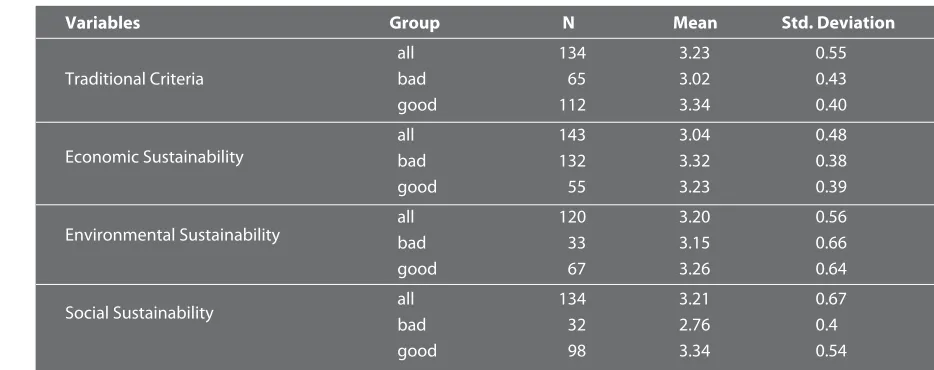
in the credit rating process. In Table 1 the
descriptive statistics for the ratings.
The influence of covariates by using Chi Square
tests to evaluate whether there is a significant
relation between the classification of a loan as
bad or good and the covariates “type of bank”
(savings banks vs. state banks, Chi Square =
.280, df = 1, p = .596), “sector” (service sector
vs. production sector, Chi Square = .479, df = 1,
p = .489), and “experience of the participants
with sustainability ratings” (experienced vs.
nonexperienced, Chi Square = .340, df = 1, p
= .560), found no covariate to be significantly
related to the classification of a loan as good
or bad. Furthermore, analyzed whether
there are significant differences between the
covariates and the ratings (traditional and
sustainability), using three 2 x 4 ANOVAs for
repeated measurement (traditional rating,
economic sustainability, environmental
sustainability, and social sustainability as the
four levels of the repeated measurement).
Researcher did not find that the type of bank
(df = 1, F = 2.86, p = .093), the sector (df = 1,
F = 2.72, p = .102), or the experience (df =
1, F = 2.31, p = .131) had a significant effect
on the ratings. Analysis of the interactions
between the covariates and the ratings did
not indicate that these interactions were
significant either. Researcher did not find
significant interactions between the type of
bank and the ratings (df = 3, F = 0.30, p = .993)
or between the sector and the ratings (df = 3,
F = 1.50, p = .219) or between the experience
and the ratings (df = 3, F = .269, p = .848).
What were the results of the rating process
using traditional, economic, environmental
and social sustainability criteria? To answer
this question need conducted a two-step
analysis. In the first step, can analyzed how
accurate sustainability criteria (independent
variables) are at predicting credit risks
according to traditional criteria (dependent
variable, risk rating by the traditional rating
system) using multiple regression analysis.
In a second step, can analyzed whether
combining traditional and sustainability
criteria as independent variables improved
the validity of discriminating good loans
from bad (categorized dependent variable,
categorization by the participants) using
discriminant analysis.
Predicting Credit Risks
Using Sustainability Criteria
As mentioned above, in first step can analyzed
the influence of the sustainability ratings on
Table 1. Descriptive Statistics for the Ratings
N for the criteria groups is different because of missing values
Variables
Traditional Criteria
Economic Sustainability
Environmental Sustainability
Social Sustainability
Group
all bad good all bad good all bad good all bad good
N
134 65 112 143 132 55 120 33 67 134 32 98
Mean
3.23 3.02 3.34 3.04 3.32 3.23 3.20 3.15 3.26 3.21 2.76 3.34
Std. Deviation
the financial performance of the borrower
using the three sustainability ratings as
independent variable and the traditional
rating as a dependent variable in a stepwise
regression model. With R Square = .790
(adjusted R Square = .614), the independent
variables economic, environmental and
social sustainability were able to predict a
significant amount of the variance of the
credit risk operationalized by the traditional
ratings. Economic sustainability was entered
(R Square = .737, p F change <.0001), social
sustainability was entered (R Square = .771,
p F change <.0001), and environmental
sustainability was entered (R Square = .790,
p F change = .003). Collinearity statistics did
not indicate collinearity of the variables, as the
tolerance of all variables was greater than .1
and the VIF was smaller than 10. Collinearity
diagnostics did not indicate collinearity either,
because all condition indices were much
smaller than 30 (Rosch, 2005).
The result that loans with higher ratings
in economic and social sustainability
(positive beta weights), but lower ratings in
environmental sustainability (negative beta
weights), have higher ratings in traditional
risk rating demands deeper analysis. Thus,
researcher distinguished between good
and bad cases and correlated traditional
ratings with environmental sustainability
ratings. This correlation analysis indicated
a significant positive correlation between
traditional criteria and environmental criteria
for the good cases (r=.316, p=.005), but
no significant correlation for the bad cases
(r=.019, p=.905).
Combining Traditional and Sustainability
Criteria to Predict Credit Risks
To analyze whether integrating sustainability
criteria, in addition to traditional criteria,
could improve the prediction of credit risks,
can conducted a multiple linear discriminant
analysis to determine whether four predictors
traditional rating, economic sustainability,
environmental sustainability and social
sustainability could predict whether a loan
would be good or bad as categorized by
the credit officers. Researcher subsequently
conducted a McNemar Test for related
samples to compare the result with the
number of correct classifications from using
only traditional criteria. The overall Wilks’s
lambda of the discriminant function was
significant (Lambda = .494, df = 4, Chi Square
= 81.04, p<.0001), indicating that overall
the predictors differentiated good loans
from bad. In the table, the beta weights
and the significance of the variables in the
discriminant function.
As expected, traditional criteria showed
the highest weights. The second highest
weights showed economic sustainability.
Environmental criteria again as in the
regression analysis showed a negative weight,
while social sustainability showed a positive
weight. To predict whether a loan belonged to
the group of good loans or bad loans, the able
to classify 86.6% of the loans in this sample
correctly with 85% correct classification for
the bad loans and 87.3% correct classification
for the good loans. In order to take chance
agreement into account, can computed a
kappa coefficient and obtained a value of
.706 (a value of 1 indicates perfect prediction).
Finally, to assess how well the classification
procedure is able to make predictions in a
new sample, can estimated the percentage
of loans accurately classified using the
leave-one-out technique and found that correctly
classified 85.7% of the cases.
As a next step, to compare the results of
the discriminant analysis above to the
prediction of good and bad loans using only
traditional criteria. The overall Wilks’s lambda
of the discriminant analysis that used only
traditional criteria was significant as well
(Lambda = .625, df = 1, Chi Square = 83.45,
p<.0001). This indicates that overall the
predictor was able to differentiate between
good and bad loans. When tried to predict
whether a loan would belong to the group of
good loans or to the group of bad loans, able
to correctly classify 78.9% of the loans in this
sample, with 80.6% correct classification for
the bad loans and 77.9% correct classification
for the good loans. In order to take chance
agreement into account, computed a kappa
coefficient and obtained a value of .564.
Researcher conducted a McNemar Test for
repeated measurement, in order to analyze
whether the integration of sustainability
criteria improved the number of correct
classifications. This test evaluates whether the
proportion of correct classifications using only
traditional criteria differs from the proportion
of correct classification using traditional and
sustainability criteria.
The use of a test for repeated measurement
is reasonable, because the participants had
rated the loans using traditional criteria and
sustainability criteria. While traditional criteria
correctly classified only 5 loans, which had not
been correctly classified by the combination
combination of traditional and sustainability
ratings correctly classified 13 loans, which
could not have been correctly classified
by traditional criteria alone. A one-sided
McNemar test of dependent proportions
indicated a significant improvement of correct
classifications by integrating sustainability
criteria into the discriminant analysis (exact
pone tailed = .048, N=119).
Conclusion
Additional research analyzing the efficiency
of incorporating sustainability criteria into
the credit risk management process would
be valuable. The result show an improvement
in the prediction. The Use of additional
criteria, however, increases cost. Thus, further
analysis of the cost benefit relation between
using additional criteria and improving risk
management would be of value booth for
science and for the industry.
Altman, E., 2002, ”Managing credit risk: challenge for the new millennium, economic notes 2-2002,” Review of Banking, Finance and Monetary Economics, 201-214.
Callens, I. and Tyteca, D., 1999, ”Towards indicators of sustainable development for firms - a productive efficiency Perspective,” Ecol. Econ., 28: 41-53.
Caouette, J. B., Altman, E. I. and Narayanan, P.,1998, Managing Credit Risk: the Next Great Financial Challenge, Wiley, New York, NY.
Christmann, P., 2000, ”Effects of ”best practices” of environmental management on cost advantage: The role of complementary assets,” Acad. Manage. J., 43(4): 663-680.
Coulson, A. B. and Monks, V., 1999, ”Corporate
e n v i r o n m e n t a l p e r f o r m a n c e considerations within bank lending decisions,” Eco-Management and Auditing, 6: 1-10.
Faucheux, S. and Nicolai, I., 1998, ”Environmental technological change and governance in sustainable development policy,” Ecol. Econ., 27(3): 243-256.
Gladwin, T., Kennelly, J. J. and Krause, T.-S., 1995, ”Shifting paradigms for sustainable development: I mplications for management theory and research.” Acad. Manage. Rev., 20(4): 874-907.
Jennings, P. D. and Zandberger, P. A., 1995, ”Ecologically sustainable organizations: An institutional approach,” Acad. Manage. Rev., 20(4): 1015-1052.
References
Katchova, A.L., Barry, P.J., 2005, ”Credit risk models: An application to agricultural lending,” American Journal of Agricultural Economics 87:195-206.
Klassen, R. D. and McLaughlin, C. P., 1996, ”The impact of environmental management on firm performance,” Manage. Sci., 42(8): 1199-1214.
Lyubov, Z., 2003., Evaluating Credit Risk Exposure in Agriculture, PhD Thesis. University of Minnesota, Minneapolis, Minnesota.
Michalik, G., Weber, O. and Scholz, R. W., 1998, Psychological fac tors of recognizing environmental credit risks,” Umweltpsychologie, 2(2): 30-41.
Pava, M. L. and Krausz, J., 1996, ”The association between corporate social-responsibility and financial performance: The paradox of social costs,” J. Bus. Ethics, 15: 321-357.
Perli, R., Nayda, W.I., 2004, ”Economic and Regulatory Capital Allocation for Revolving Retail Exposures,” Journal of Banking & Finance 28, 789-809.
Rosch, D., 2005, ”An empirical comparison of default risk forecasts from alternative credit rating philosophies,” International Journal of Forecasting 21, 37-52.
Russo, M. V. and Fouts, P. A., 1997, ”A Resource-based Perspective on Corporate Environmental Performance and Profitability,” Acad. Manage. J., 40(3): 534-559.
Saunders, A., 1999, Credit Risk Measurement: New Approaches to Value at Risk and Other Paradigms, John Wiley & Sons, New York, NY.
Scholz, R. W., Weber, O., Stünzi, J., Ohlenroth, W. and Reuter, A., 1995, The systematic measuring of environmental risk,” Credit Defaults Caused by Environmental Risk Results of a First Study. Schweizer Bank, 4: 45-47.
Sharma, S. and Vredenburg, H., 1998, ”Proactive corporate environmental strategy and the development of competitively valuable organizational capabilities,” Strategic Manage. J., 19: 729-753.
Stavins, R. N., Wagner, A. F. and Wagner, G., 2003, ”Interpreting sustainability in economic terms: dynamic efficiency plus intergenerational equity,” Econ. Lett., 79: 339-343.
Weber, O., 1997a, ”Credit management and sustainable industrial development.,” Paper presented at Science for a Sustainable Society - Integrating Natural and Social Sciences, Roskilde, Denmark.
Weber, O., 2001, ”Assessment of enterprises environmental risks: Using photographs as perceptual stimuli,” J. Environ. Psychol., 21: 165-178.