Original Research Article
Expanding access to viral load testing in Nigeria; the impact of third
party logistics
Ajani Love Adeiye
1*, Ajani Olumide Faith
1, Sanni Olaniyi Felix
2,
Abiodun Olaiya Paul
3, Justin Onyebuchi Nwofe
4, Kaniki Freddy Rukema
5, Shadi Kafi Mallak
6INTRODUCTION
The global HIV response has been remarkably successful. More than 19 million persons living with HIV (PLHIV) have accessed life-saving antiretroviral therapy (ART)
and the annual number of HIV-related deaths and new HIV infections has both plummeted.1,2 As countries strive to reach the Joint United Nations Program on HIV/AIDS (UNAIDS) 90:90:90 targets (i.e., for 90% of PLHIV to be aware of their diagnosis, 90% of those who know their
ABSTRACT
Background: Access to viral load testing in Nigeria remains a key challenge in achieving the Joint United Nations Program on HIV/AIDS (UNAIDS) 90:90:90 targets in the fight against HIV/AIDS. This study investigates the impact of 3 party logistics (3PL) on expanding access to viral load testing.
Methods: This exploratory, case study research was carried out in Abuja in December, 2018, using in-depth interview method. Open-ended questions were used to interview nine staff from the three polymerase chain reaction laboratories in Federal Capital Territory. The audios of interviews were recorded and transcribed on paper. The data was analyzed using SPSS version 24.
Results: This study revealed that the adoption of 3PL services has helped to overcome major challenges of viral load testing such as late delivery of samples, late collection of results, and rejection problems; thereby reduced sample rejection frequencies, increased efficiency, reduced turnaround time and ease viral load testing processes. Though the adoption of 3PL has helped to overcome major challenges of viral load testing, however, the challenges still facing viral load testing include the 3PLs bringing samples at any time-even at closing hours, not delivering results to facilities on time after pickup, poor medical backgrounds and inability of 3PLs to enforce instructions on facilities. However, respondents expressed satisfaction with the services of the 3PLs.
Conclusions: The findings of this study revealed that the adoption of 3PL service into viral load transport logistics has positive impacts on the process. However, only one of the laboratories uses two 3PL providers while other two use only one.
Keywords: Viral load, Logistics, HIV treatment, Sample referral system
1
Department of Logistics and Supply Chain Management, 6Department of Energy and Environment, Malaysia University of Science and Technology, Selangor, Malaysia
2Department West African Breast Cancer Study, Lagos State University Teaching Hospital, Ikeja, Lagos State, Nigeria 3Department of National Integrated Specimen Referral Network, AXIOS International, Utako, FCT, Abuja, Nigeria 4
Department of Logistics and Health System Strengthening, Excellent Community Education Welfare Scheme, Nigeria
5Department of Health Sciences, Ebenezer University of Minembwe, Minembwe, South Kivu, Democratic Republic of
Congo
Received: 23 September 2019
Revised: 15 November 2019
Accepted: 16 November 2019
*Correspondence:
Dr. Ajani Love Adeiye, E-mail: [email protected]
Copyright: © the author(s), publisher and licensee Medip Academy. This is an open-access article distributed under the terms of the Creative Commons Attribution Non-Commercial License, which permits unrestricted non-commercial use, distribution, and reproduction in any medium, provided the original work is properly cited.
diagnosis to receive ART, and 90% of those on ART to have durable viral load suppression, new guidelines, tools, and implementation strategies are vitally important.3,4 Viral load measurement is a critical tool to assess the impact of HIV treatment efforts and is now endorsed by the World Health Organization (WHO) as the primary methodology for monitoring response to ART.5,6 This recommendation is based on research demonstrating that viral suppression is associated with decreased HIV disease progression and mortality among PLHIV, and the prevention of HIV transmission to sexual partners.7 Although stakeholders were initially slow to adopt this WHO recommendation, most funders and national programmes now strongly support scaling up access to routine viral load monitoring.8
Greatly expanded access to routine viral load testing will be a game-changer in the global response to treatment. Viral load tests improve treatment quality and individual health outcomes for people living with HIV, contribute to the prevention, and potentially reduce resource needs for costly second- and third-line HIV medicines. 90% of people living with HIV knowing their HIV status, 90% of people who know their HIV-positive status accessing treatment and 90% of people on treatment having suppressed viral loads. Attaining this target would mean that, by 2020, 73% of all people living with HIV will have suppressed viral loads.3,5,8
Improvements in treatment delivery are needed at several stages along the treatment cascade, including significantly expanding the availability and use of viral load testing. Community-based advocacy will be essential to reduce costs and ensure widespread access to point-of-care viral load testing technologies that are simpler to use.9
Third-party logistics (3PL) plays a central role in managing domestic and global supply chains. As supply chains grow increasingly complex, a steadily increasing number of organizations rely on 3PLs to provide additional services necessary to support them. The menu of available services is also constantly changing. 3PL services, in this case, involve majorly the transportation of specimen for viral load testing from their various points of collection to the polymerase chain reaction (PCR) laboratories for evaluation.
According to the Council of Supply Chain Management, 3PL provider is defined as a firm which provides multiple logistics services for use by customers.10 Preferably, these services are integrated or bundled together by the provider. These firms facilitate the movement of parts and materials from suppliers to manufacturers, and finished products from manufacturers to distributors and retailers. Among the services which they provide are transportation, warehousing, cross-docking, inventory management, packaging, and freight forwarding. 3PL is also called logistics outsourcing. It means that the organization makes the outsourcing for some or all of its logistics-related activities to a third-party company or
organization for them to take care of.11 With the intensification of market competition, companies are more aware of the importance of their core competence, so the outsourcing of logistic functions has gradually increased.12,13
The service provider (s) is required to provide optimal, temperature-controlled transport, standardized samples packaging, and expedited clinical samples pick up from collection sites, collection hubs (where necessary), transportation to designated testing laboratories (referral sites) and collection of hard copy/transmission of soft copy test results/reports with delivery back to originating collection site in a timely, efficient and cost-effective manner without compromising quality of the samples and in strict adherence to applicable regulations for the safe and proper transport of infectious substances. The service is designed to transport HIV, tuberculosis and malaria samples from requesting healthcare facilities, sample processing, and storage hubs, to PCR and GeneXpert laboratory sites in Government of Nigeria, President’s Emergency Plan for Aids Relief, and Global Fund-supported regions, with an expectation to achieve national coverage.14 The objective of this study is to investigate the impact of 3PL on expanding access to viral load testing.
METHODS
Study area
This study was conducted in Abuja, the Federal Capital Territory (FCT), Nigeria in December, 2018 in all the three PCR laboratories. Purposive sampling was used to select 9 eligible candidates from the three laboratories. The staffs directly involved in viral load testing and logistics were chosen to participate in the survey.
The sample size was determined following the submission of Cohen et al.15 They stated that there is no exact size of the sample, but these depend on the purpose of the study and the nature of the population under scrutiny. In general, though, the larger the sample the more reliable it is.16 Cohen etal proposed that a sample size of thirty percent as being reliable in a case where the population is not highly heterogeneous.15
A total of 3 participants were interviewed from each PCR laboratory. Four of the participants were laboratory scientists; three were sample collection supervisors and two were head of laboratory departments. Two of the four scientists were from lab A and one each from labs B and C. One laboratory supervisor was drawn from each of the laboratories while the one head of the department was interviewed from each of laboratories B and C.
as a guide in the interview sessions with the PCR staff and sent to participants ahead of interviews. Following approval from the management of PCR laboratories, organizations were contacted and dates for interviews scheduled, interviews were held, and audio recorded which were later transcribed serially on paper, and data properly labelled for identification and processing.
Approval was obtained from the FCT Ministry of Health, Abuja for the research’s information gathering. Also, pre-interview question samples were sent ahead of the interview to help participants understand interview trend. A commitment to maintain absolute confidentiality of participants and organizations was also given, thus the non-inclusion of participants’ and organizations’ details in the research.
Recorded discussions were reviewed severally using the constant comparison method; data were compared across different participants’ and commonalities drew to gain in-depth understanding. The transcribed data was coded and tallied according to the themes and thereafter analyzed through the use of tables and figures.
The findings of the survey were analyzed and results presented in tables and figures. This analysis was based on the responses obtained from the respondents. Transcribed and coded data were analyzed by the use of SPSS version 24 and Microsoft Excel version 2016.
RESULTS
Viral load testing logistics
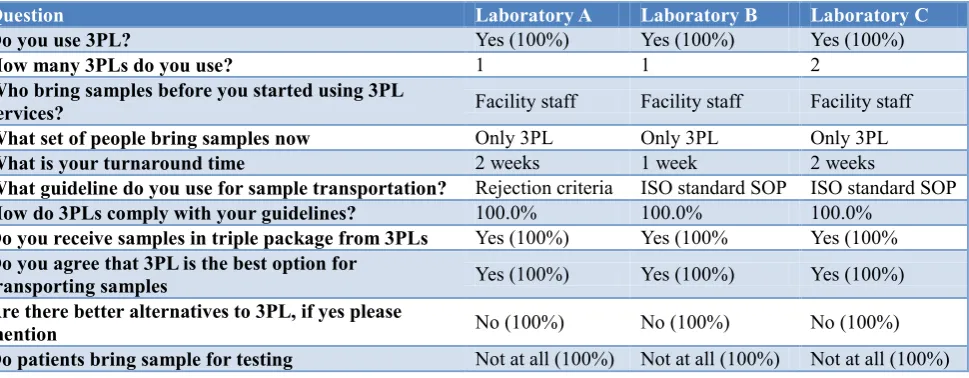
This study found that all viral load testing laboratories use 3PL services for transporting viral load samples and results. Two laboratories use one 3PL company while one laboratory uses two 3PLs. All the centres used to get samples from facility staffs before the adoption of 3PL service. All of them have guidelines for sample transportation which all the 3PL companies comply with. All 3PLs submit samples in triple packaging. All the centres agreed that 3PL is the best option for transporting samples and all believed there were no better alternatives. Also, none of the laboratories accept samples directly from patients (Table 1).
Table 1: Viral load testing transport logistics.
Question Laboratory A Laboratory B Laboratory C
Do you use 3PL? Yes (100%) Yes (100%) Yes (100%)
How many 3PLs do you use? 1 1 2
Who bring samples before you started using 3PL
services? Facility staff Facility staff Facility staff
What set of people bring samples now Only 3PL Only 3PL Only 3PL
What is your turnaround time 2 weeks 1 week 2 weeks
What guideline do you use for sample transportation? Rejection criteria ISO standard SOP ISO standard SOP
How do 3PLs comply with your guidelines? 100.0% 100.0% 100.0%
Do you receive samples in triple package from 3PLs Yes (100%) Yes (100% Yes (100%
Do you agree that 3PL is the best option for
transporting samples Yes (100%) Yes (100%) Yes (100%)
Are there better alternatives to 3PL, if yes please
mention No (100%) No (100%) No (100%)
Do patients bring sample for testing Not at all (100%) Not at all (100%) Not at all (100%)
Figure 1: Comparison of sample delivery time of 3PL and other services.
Comparison of logistics services before outsourcing 3PLs with 3PL services
Sample delivery time
Respondents were asked to compare sample delivery time of facility staffs being used before the adoption of 3PL services with that of 3PLs. Laboratory A-rated 3PL 90% and 50% for ‘before 3PL’, laboratory B 80%, 10% and laboratory C 70%, 60% for 3PL and ‘before 3PL’ respectively while the average rating for all centres was 80% for 3PL and 40% for other services (Figure 1).
Result pick-up time
Result pickup time of facility staff was rated 50%, 10% and 80% by laboratories A, B, and C respectively while
0% 10% 20% 30% 40% 50% 60% 70% 80% 90% 100%
A B C Overall
average
R
a
ti
n
g
(
%
)
Laboratory
pickup time for 3PL was rated 100% by labs A and C while lab B rated it 80%. The overall rating was 47% for ‘before 3PL’ and 93% for 3PL (Figure 2).
Figure 2: Result pick-up time before the use of 3PLs and with 3PLs.
Availability of temperature monitoring device
Figure 3 shows the rating of facility staff and 3PLs as regards the availability of temperature monitoring devices. Lab A rated facility staff 10%, B rated them 0% while C gave them 30% whereas all laboratories rated 3PLs 100%.
Figure 3: Availability of temperature monitoring device.
Cold chain transport
Respondents from lab A rated the use of cold chain for sample transportation by facility staff as 70% and 100% for 3PLs. Lab B gave 50% and 100%, lab C gave 100% and 100% for ‘before 3PL’ and 3PL respectively (Figure 4).
Temperature documentation
Laboratories A and B rated facility staff (Before 3PL) 0% on temperature documentation while lab C rated them 10%. In contrast, all the laboratories rated 3PLs 100% (Figure 5).
Figure 4: Percentage rating of the use of cold chain transport.
Figure 5: Percentage rating of temperature documentation.
Proper filling of sample requisition forms
The average rating of facility staff (before 3PL) was 33% for proper filling of sample requisition forms while 3PL was rated 93% on average. Labs A and C rated 3PL 100% while lab B rated 80%. For ‘before 3PL’, proper filling of sample requisition forms was rated 50%, 10% and 40% by labs A, B and C respectively (Figure 6).
Figure 6: Proper filling of sample requisition forms.
A B C Overall
average Before 3PL 50% 10% 80% 47% 3PL 100% 80% 100% 93%
0% 20% 40% 60% 80% 100% 120%
R
a
ti
n
g
(
%
)
A B C Overall
average Before 3PL 10% 0% 30% 13% 3PL 100% 100% 100% 100%
0% 20% 40% 60% 80% 100% 120%
R
a
ti
n
g
(
%
)
0% 50% 100%
A B C Over
all avera
ge Before 3PL 70% 50% 100% 73% 3PL 100% 100% 100% 100%
R
a
ti
n
g
(
%
)
A B C Overall
average
Before 3PL 0% 0% 10% 3%
3PL 100% 100% 100% 100%
0% 20% 40% 60% 80% 100% 120%
R
a
ti
n
g
(
%
)
0% 10% 20% 30% 40% 50% 60% 70% 80% 90% 100%
A B C Overall
averag e
Before 3PL 50% 10% 40% 33%
3PL 100% 80% 100% 93%
R
a
ti
n
g
(
%
Triple packaging of samples
Facility staffs (before 3PL) were rated on average 27% on triple packaging of samples while 3PLs were rated 100%. Laboratories A and C rated ‘Before 3PL 30% while B rated them 20% (Figure 7).
Figure 7: Triple packaging of samples.
Challenges before adopting 3PL and with 3PL service
Challenges before the adoption of 3PL services
Table 2 shows a summary of the challenges faced by laboratories before the adoption of 3PL services. All respondents (100%) mentioned non-compliance with temperature standard, non-compliance with triple packaging and cold chain system. Other challenges included insufficient samples (67%), leaking cryovial (56%), hemolyzed samples (67%), no thermometers (78%), late sample delivery and result pickup (89%), improper filling of requisition forms, frequent sample rejections (78%) among others (Table 2). The current challenges being faced from 3PLs include delivery of samples at odd times (100%), results not delivered on time after pickups (67%) and unconfirmed sample quality before shipment (67%). Other challenges include improper handling of rejections cases (33%), inability to enforce instructions from laboratories (33%) among others as depicted in Table 2. All respondents (100%) enumerated fast turnaround time as one of the major reasons while people use 3PLs. Other reasons mentioned include distance (100%), sample quality/integrity (80%) and employment creation (45%).
Recommendations for better performance of 3PL
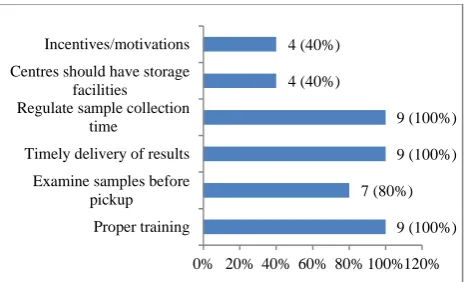
Figure 8 depicts respondents’ recommendations for better performance of 3PLs. All respondents mentioned proper training, timely delivery of results and regulation of sample collection time. Approximately eighty percent (80%) advised 3PL staff to always examine samples before picking them up, 40% advised facilities to acquire proper equipment for storing samples and 40% recommended more incentives for 3PL staff members.
Figure 8: Percentage recommendations on better performance of 3PL.
Table 2: Responses on the challenges of viral load testing before and after outsourcing 3PL services.
Challenges (n=9) N %
Before 3PL services
Insufficient samples 6 67
Leaking of cryovial 5 56
Hemolysed samples 6 67
Samples not in 0–8 0C temp. range 9 100
No temperature monitoring device 7 78
Late sample delivery and result
pick–up 8 89
Frequent rejection of samples 5 56
Improper filling of requisition
forms 5 56
Sample not in triple packaging 9 100
No use of cold chain 9 100
With 3PL services
No regulated time for sample
delivery 9 100
Results not delivered on time after
pick up 6 67
Quality of sample not confirmed
before shipment 6 67
Some are not medically inclined 3 33
Improper handling of rejection
cases 3 33
Don’t have the power to enforce
instructions of facilities 3 33 Improper filling of the requisition
form 3 33
Challenges are from facilities and
not 3PL 3 33
DISCUSSION
Comparison of logistics services before outsourcing 3PLs with 3PL services
This study revealed that viral load sample delivery time of facility staff was generally below average (40%). That was the situation before the adoption of 3PL services. On
A B C Overall
average Before 3PL 30% 20% 30% 27%
3PL 100% 100% 100% 100% 0%
20% 40% 60% 80% 100% 120%
R
a
ti
n
g
(
%
) 9 (100%)
7 (80%) 9 (100%) 9 (100%) 4 (40%)
4 (40%)
0% 20% 40% 60% 80% 100%120% Proper training
Examine samples before pickup Timely delivery of results Regulate sample collection
time
the other way, the overall delivery time was rated 80% for 3PLs which shows the value for facility staff is twice. Result pickup time for 3PL and ‘before 3PL’ was also rated ratio 2:1 (93%: 47%). This means that 3PLs are twice faster than facility staff in sample delivery and result pickup. Laboratory B even rated facility staff as low as 10% for both sample delivery and result pickup! Some of the reasons stated by respondents for the delay in sample submission on the parts of facilities is that some facilities intentionally kept samples until they have up to a particular number before sending them for testing, so also for collection of results. Other factors mentioned include distance between the laboratories and the facilities, workload of staff members as well as nonchalant attitude of some facility staff.
It was discovered that facility staff in most times delivered samples to laboratories without temperature monitoring devices even though samples were usually transported in the cold chain. Another issue with facility samples is that temperature documentation was very poor among facility staff; this might not be unconnected to the fact that samples were not usually transported with temperature monitoring devices. Similarly, proper filling of sample requisition forms was rated below average (33%) for facility staff and samples were not usually delivered in triple packaging. No wonder respondents affirmed that there were high cases of sample rejection before the adoption of 3PL services. In contrast, with 3PLs, samples are always transported in cold chain with accompanying temperature monitoring devices. Besides, there have been regular and proper documentation of temperatures and filling of requisition forms. 3PLs also deliver samples in triple packaging. These findings justify the preference of 3PLs to facility staff by all respondents.
The decision to use 3PLs could be more tactical in nature than strategic.17–19 When tactical the organizations usually have an ineffective distribution network, an inability to control internal cost, a costly or inflexible workforce, outdated warehouse facilities, or outdated information systems. Murphy et al argued that when the decision is strategic it is driven by the idea that transformation needs to take place.20 They concluded that there should be a recognition that an organization does not have sufficient internal capabilities to address the issues at hand. This was the case with facilities before adoption of 3PL services. The services rendered by facility staff were ineffective, inflexible and outdated, hence, the need for better services currently being enjoyed from 3PLs. Garcia-Leon et al further complement this argument that provider (3PL) is recognized as an integrated logistics provider, offering a range of value-added services apart from transport and storage, can meet maintenance activities, inventory control, customs services, reverse logistics, processing orders, among others.21,22 It has been argued that most healthcare organizations use traditional healthcare logistics, which means that the organization has developed its own logistic related functions at the same time of doing their main business but most
healthcare or pharmaceutical companies are not perfect with the formulation of logistics systems, the awareness of logistics-related technologies are not professional enough, or, employees' knowledge of logistics expertise is weak.12,23–25 This corroborates the finding of this study that the knowledge of facility staff on viral load logistic was weak, hence their replacement with 3PLs.
Challenges before adopting 3PL and with 3PL service
Respondents enumerated various challenges being faced before the adoption of 3PL services. These challenges were also the reasons for the frequent rejection of viral load samples before outsourcing viral load sample transportation to 3PL providers. The use of 3PL providers to transport viral load samples has helped overcome most of the highlighted challenges because 3PL staffs are well trained to always deliver samples in cold chains which are usually accompanied with temperature monitoring devices. Samples are being supplied in triple packaging with timely delivery of samples and result pickups. The challenges include non-compliance with temperature standard, non-compliance with triple packaging and cold chain system, insufficient samples, leaking cryovial, haemolysed samples, samples not accompanied with thermometers, late sample delivery and result pickup. Other challenges include improper filling of requisition forms and frequent sample rejections. It has long been established in literature that the purpose of healthcare logistics is to deliver the correct quantity of healthcare products to customers at the correct time. Additionally, in healthcare logistic the involvement of healthcare products is required to be accompanied by the acceptable quality and also meet specific healthcare sector standards this was not the case with facility staff.26,27
Though the adoption of 3PL has helped to overcome major challenges of viral load testing, however, respondents still identified some challenges with 3PL services, some of which they said rather emanated from facilities. One of the major challenges mentioned by all laboratories is that the 3PLs bring samples to their laboratories at any time, sometimes at odd times (closing hours). To overcome this challenge, laboratory A started 24 hours operations while other laboratories gave instruction that they should inform facilities of convenient times to collect and ship samples. However, the 3PLs have no power to enforce the instructions on the facilities; this is the reason why some of them said the challenges were rather from facilities.
Another major challenge mentioned is that in case some samples are rejected, the 3PLs would not bring another sample to meet up with the same batch of samples but rather delay sample replacement till the next batch, this sometimes causes delay in turnaround time. Some also complained that 3PL staffs just pick and ship samples without confirming their quality in line with standard requirements, this they said sometimes lead to rejection of samples.
Challenges such as information flow, micromanaging (control), and differences in organizational cultures have been identified with 3PL providers.9,23 Etokudoh et al identified three major challenges with 3PL services in Nigeria oil and gas industries which include vendor capability, information flow, and joint venture partnership interventions.11 However, they argued that the benefits of 3PL in Nigeria justify the need to retain these services. Similarly, the positive impacts of 3PL in expanding access to viral load testing in FCT justify the need to retain their services.
Why people outsource transportation to 3PL companies
Respondents identified distance and turnaround time as major reasons why people outsource viral load transportation to 3PL providers. The use of 3PL helps in sample collection from and result delivery to hard-to reach-areas, relieve patients of stress and bottlenecks associated with viral load testing. 3PLs also promote fast delivery of samples and result pickups. Other reasons mentioned by respondents include sample integrity/quality; this minimizes the frequency of samples rejection. 45% of the respondents said the adoption of 3PL also creates employment to some jobless people. The reasons mentioned by respondents correspond to the suggestions of Giri et al and Chen et al that companies’ recourse to 3PL to reduce the load of logistics processes and achieve customer satisfaction and competitive advantage.28,29 Also Zhu et al acknowledged that logistics outsourcing is being increasingly adopted by firms to reduce costs and increase flexibility.30
CONCLUSION
For better performance of 3PLs, respondents recommended proper training, timely delivery of samples, regulated sample pickup times as well as incentives for the staff of 3PL providers. 3PL providers were also advised to monitor their staff to ensure timely delivery of results instead of keeping them in their offices for too long. They were also advised to regulate pick up times while facilities were advised to have good storage facilities to avoid sending samples to laboratories at odd times.
Funding: No funding sources Conflict of interest: None declared
Ethical approval: The study was approved by the Institutional Ethics Committee
REFERENCES
1. Ending AIDS. Progress towards the 90–90–90 targets. Glob Aids Updat. 2017.
2. UNAIDS (Joint United Nations Programme on HIV/AIDS). On the to end AIDS 2016. Available at: https://doi.org/NPH3327. Accessed on 15 September 2019.
3. UNAIDS. UNAIDS data 2019. UNAIDS 2019. 4. ICAP. ICAP Approach to Implementation of
Routine Viral Load Monitoring. Glob Health Action; 2017.
5. WHO. What’s New in Treatment Monitoring: Viral Load and CD4 Testing. World Heal Organ; 2017. 6. WHO. Xpert MTB / RIF implementation. World
Heal Organ 2014;1:52.
7. El-Sadr WM, Rabkin M, Nkengasong J, Birx DL. Realizing the potential of routine viral load testing in sub-Saharan Africa. J Int AIDS Soc. 2017;20:1–3. 8. Lecher S, Ellenberger D, Kim AA, Fonjungo PN,
Agolory S, Borget MY, et al. Scale-up of HIV Viral Load Monitoring--Seven Sub-Saharan African Countries. MMWR Morb Mortal Wkly Rep. 2015;64:1287–90.
9. Roberts T, Cohn J, Bonner K, Hargreaves S. Scale-up of Routine viral load testing in resource-poor settings: current and future implementation challenges. Clin Infect Dis. 2016;62:1043–8. 10. Vitasek K. Supply chain management: Terms and
Glossary. Health Inform. 2013;17:58–60.
11. Etokudoh EP, Boolaky M, Gungaphul M. Third party logistics outsourcing: An exploratory study of the oil and gas industry in Nigeria. SAGE Open. 2017;7.
12. Nichols K. Viral Load Specimen Referral Network Report Zambia; 2016.
13. Dowdy DW. Minding the gap: specimen referral systems for diagnosis of infectious diseases. Clin Infect Dis. 2017;64:804–5.
14. PEPFAR. Country/Regional Operational Plan (COP/ROP). Guidance. DRAFT-- December 30, 2016. Draft Oper Plan Guid. 2017;2017:1–397. 15. Cohen MM, Amiott EA, Day AR, Leboucher GP,
Pryce EN, Glickman MH, et al. Sequential requirements for the GTPase domain of the mitofusin Fzo1 and the ubiquitin ligase SCFMdm30 in mitochondrial outer membrane fusion. J Cell Sci. 2011;124:1403–10.
16. Wiersma W, Jurs SG. Research methods in education: an introduction. Lippincott; 1969. 17. Agrawal P, Barton I, Bianco RD, Hovig D, Sarley
D, Yadav P. Moving medicine, moving minds: helping developing countries overcome barriers to outsourcing health commodity distribution to boost supply chain performance and strengthen health systems. Glob Heal Sci Pract. 2016;4:359–65. 18. Muthoni DK. Effect of supply chain processes
19. Kalinzi C. Outsourcing (Logistics) Services and Supply Chain Efficiency– A Critical Review of Outsourcing Function in Mukwano Group of Companies. J Outsourcing Organ Inf Manag. 2017: 1–22.
20. Murphy PR, Wood DF. Contemporary Logistics. New Jersey Pearson Prentice Hall; 2008.
21. Garcia-Leon A, Bermeo-Andrade H. About Regional Logistics in Tolima under SCOR Model Approach. IIIE Annu Conf Proc. 2011: 1–7.
22. Beukes HCR. The effectiveness of third party logistics providers in the public health sector. Naimbia: 2014.
23. Eholié SP, Aoussi FE, Ouattara IS, Bissagnéné E, Anglaret X. HIV treatment and care in resource-constrained environments: Challenges for the next decade. J Int AIDS Soc. 2012;15:1–7.
24. Nichols B, Girdwood S, Crompton T, Stewart-Isherwood L, Berrie L, Chimhamhiwa D, et al. Sustainable viral load monitoring scale-up: geospatial optimisation model for Zambia. Conf Retroviruses Opportunistic Infect. 2018;2018:6056. 25. Sagaon-Teyssier L, Singh S, Dongmo-Nguimfack B,
Moatti JP. Affordability of adult HIV/AIDS treatment in developing countries: Modelling price determinants for a better insight of the market
functioning: Modelling. J Int AIDS Soc. 2016;19(1):20619.
26. Wang L. Third party healthcare logistics: a study of third-party logistics providers in China; 2018. 27. Ochola EA, Aloyo J, Rahimzai M. Case study
Increasing viral load monitoring of people living with HIV on ART in Northern Uganda in line with the 90-90-90 global targets. Sweden; 2016.
28. Giri B, Sarker B. Improving performance by coordinating a supply chain with third party logistics outsourcing under production disruption. Comput Ind Eng. 2017:168–77.
29. Chen YM, Goan MJ, Huang PN. Selection process in logistics outsourcing- a view from third party logistics provider. Prod Plan Control. 2011;22:308– 24.
30. Zhu W, Ng SCH, Wang Z, Zhao X. The role of outsourcing management process in improving the effectiveness of logistics outsourcing. Int J Prod Econ. 2017;188:29-40.
Cite this article as: Adeiye AL, Faith AO, Felix SO, Paul AO, Nwofe JO, Rukema KF, et al.Expanding