IJSRSET1844199 | Received : 10 March | Accepted : 25 March 2018 | March-April-2018 [(4) 7 : 122-130 ]
© 2018 IJSRSET | Volume 4 | Issue 7 | Print ISSN: 2395-1990 | Online ISSN : 2394-4099 Themed Section : Engineering and Technology
122
Video Content Sharing With Security Using Time - Domain
Attribute
1
S. Sangeetha,
2P. Alaguthai
1
Research Scholar, Department of Computer Science, Sakthi College of Arts and Science for Women, ddanchatram, India
2
Assistant Professor, Department of Computer Science, Sakthi College of Arts and Science for Women, Oddanchatram, India
ABSTRACT
Internet is gaining more and more popular now a days, so there is need to provide security for everything on internet. One of the most important concepts where we need to provide higher security is in communication between sender and receiver. Due to security threats the requirement of the secure transmission of the data is also increased the reason for developing the Data Hiding is the easy access of images, documents confidential data by the hackers who always monitor the system. Data hiding is the process of secretly embedding information inside a source without changing its content and meaning there is numerous techniques which hides the data. This paper aims to implement data hiding in compressed video. Like data hiding in images and raw video which operates on the images themselves in the spatial or transformed domain which are vulnerable to steganalysis. The sender first uses the stenographic application for encrypting the secret message. For this encryption, the sender uses text document in which the data is written and the image as a carrier file in which the secret message or text document to be hidden. The sender sends the carrier file and text document to the encryption phase for data embedding, in which the text document is embedded into the image file or video file. In encryption phase, the data is embedded into carrier file which was protected with the password now the carrier file acts as an input for the decryption phase. The image in which data is hidden i.e. the carrier file is sent to the receiver using a transmission medium. E.g. Web or e-mail. The receiver receives the carrier file and places the image in the decryption phase. Now the carrier file acts as an input for the decryption phase. The image in which data is hidden the carrier image is sent to the receiver using a transmission medium. Example: Web or e-mail. The receiver receives the carrier file and places the image in the decryption phase.
Keywords : Streaming media, Access Control, Time domain analysis, Encryption, Video Content Sharing.
I.
INTRODUCTION
INTRODUCTION TO IMAGE PROCESSING
Image processing is a method to convert an image into digital form and perform some operations on it, in order to get an enhanced image or to extract some useful information from it. It is a type of signal dispensation in which input is image, like video frame or photograph and output may be image or
Image processing basically includes the following three steps.
Importing the image with optical scanner or by digital photography.
Analyzing and manipulating the image which
includes data compression and image
enhancement and spotting patterns that are not to human eyes like satellite photographs.
Output is the last stage in which result can be altered image or report that is
based on image analysis.
Purpose of Image processing
The purpose of image processing is divided into 5 groups. They are:
1. Visualization - Observe the objects that are not visible.
2 Image sharpening and restoration - To create a better image.
3.Image retrieval - Seek for the image of interest. 4.Measurement of pattern – Measures various objects in an image.
5.Image Recognition – Distinguish these objects in an image.
Types
The two types of methods used for Image Processing are Analog and Digital Image Processing. Analog or visual techniques of image processing can be used for the hard copies like printouts and photographs. Image analysts use various fundamentals of interpretation while using these visual techniques. The image processing is not just confined to area that has to be studied but on knowledge of analyst. Association is another important tool in image processing through visual techniques. So analysts apply a combination of personal knowledge and collateral data to image processing.
Digital Processing techniques help in manipulation of the digital images by using computers. As raw data from imaging sensors from satellite platform contains deficiencies. To get over such flaws and to get originality of information, it has to undergo various
phases of processing. The three general phases that all types of data have to undergo while using digital technique are Pre- processing, enhancement and display, information extraction.
Fig.1.1 Overview of Image Processing
An image can be defined as a two-dimensional light intensity function f(x, y), where x and y denote the spatial co-ordinates and ‘f’ is the value at any point is directly proportional to the brightness (or) gray level of the image at that point.
A digital image a[m, n] described in a two-dimensional discrete space is derived from an analog image a(x, y) in a two-dimensional continuous space through sampling process that is frequently referred to as digitization.
The two-dimensional continuous image a(x, y) is divided into N rows and M columns. The intersection of a row and a column is termed as pixel. The value assigned to the integer coordinates [m, n] with {m=0,1,2,…,M–1} and {n=0,1,2,…,N–1} is a[m, n]. The fundamental steps carried out in image processing are,
Image acquisition
Image Enhancement and Restoration and
Image Segmentation
Image can be obtained through a single sensor, sensor strip or a sensor array wherein the incoming energy is transformed into a voltage by the combination of input electrical power and sensor material that is responsive to the energy detected and the digital quantity is obtained from each sensor by digitizing sensors response.
Image Enhancement
It accentuates or sharpens image features such as edges, boundaries, or contrast to make a graphic display more helpful for display and analysis. Image enhancement algorithms are broadly divided into two
classes, point transforms and neighborhood
operations. Point transforms produce output images such that the function applied on each pixel is the same. In neighborhood operation, each output pixel is obtained as a function of a set of corresponding neighborhood pixels of the pixel to be processed.
Image Restoration
The purpose of image restoration is to restore a degraded/distorted image to its original content and quality.
Image Segmentation
Segmentation is the mid-level image processing technique that partitions a digital image into multiple segments or objects or clusters, based on the principle of similarity among the pixels. In other words, segmentation is the fundamental process which partitions a data space into meaningful salient regions.
IMAGE COMPRESSION
Image compression algorithms remove redundancy present in the data in a way which makes image reconstruction possible. This is otherwise called information preserving.
Lossless Compression
In lossless image compression, there is no information loss, and the image can be reconstructed exactly same as the original and its applications include medical
imagery and archiving. The lossless compression algorithms are run length encoding, predictive coding, entropy encoding, probabilistic coding, Shannon-Fano Algorithm, Adaptive Huffman Coding.
Lossy Compression
In lossy image compression, information loss is tolerable and it is many-to-one mapping in compression. Its applications are commercial distribution and rate constrained environment where lossless methods cannot provide enough compression ratio. There are a number of lossy compression algorithm some of them are Block Truncation Coding, Sub band coding, Basic Principles Predictive coding, Transform coding etc.,
1.2 NOISE
The source of noise in digital images arises during image acquition and/or transmission. Noise in an image that affect the intensity levels of the pixels. Noise can be described as probability density function (PDF). Images are corrupted during transmission principally due to interference in the channel used for transmission. A spatial characteristic of noise specifies that whether the noise is correlated with the image. The noise in Fourier sense is constant and it is also known as white noise. Some of the important noise probability density functions are Gaussian noise, Rayleigh noise, gamma noise, exponential Noise, uniform noise, impulsive noise, periodic noise
FILTER
Noise in an image can be removed with the help of filtering. Filtering can done through
Spatial domain filtering and
Frequency domain filtering
Spatial Domain Filtering
selectively altering certain spatial frequencies to emphasize some image features.
Frequency Domain Filtering
Filtering in frequency domain consists of modifying the Fourier transform component and computing the inverse transform to get filtered image processed result.
1.3 APPLICATIONS
1. Intelligent Transportation Systems – This technique can be used in Automatic number plate recognition and Traffic sign recognition.
2. Remote Sensing – For this application, sensors capture the pictures of the earth’s surface in remote sensing satellites or multi – spectral scanner which is mounted on an aircraft. These pictures are processed by transmitting it to the Earth station. Techniques used to interpret the objects and regions are used in flood control, city planning, resource mobilization, agricultural production monitoring, etc.
3. Moving object tracking – This application enables to measure motion parameters and acquire visual record of the moving object. The different types of approach to track an object are:
Motion based tracking
Recognition based tracking
4. Defense surveillance – Aerial surveillance methods are used to continuously keep an eye on the land and oceans. This application is also used to locate the types and formation of naval vessels of the ocean surface. The important duty is to divide the various objects present in the water body part of the image. The different parameters such as length, breadth, area, perimeter, compactness are set up to classify each of divided objects. It is important to recognize the distribution of these objects in different directions that are east, west, north, south, northeast, northwest, southeast and south west to explain all possible
formations of the vessels. We can interpret the entire oceanic scenario from the spatial distribution of these objects.
5. Biomedical Imaging techniques – For medical diagnosis, different types of imaging tools such as X- ray, Ultrasound, computer aided tomography (CT) etc are used. The diagrams of X- ray, MRI, and computer aided tomography (CT) are given below.
Fig.1.3 Example Biomedical Images
Some of the applications of Biomedical imaging applications are as follows:
Heart disease identification– The important
diagnostic features such as size of the heart and its shape are required to know in order to classify the heart diseases. To improve the diagnosis of heart diseases, image analysis techniques are employed to radiographic images.
Lung disease identification – In X- rays, the regions that appear dark contain air while region that appears lighter are solid tissues. Bones are more radio opaque than tissues. The ribs, the heart, thoracic spine, and the diaphragm that separates the chest cavity from the abdominal cavity are clearly seen on the X-ray film.
6. Automatic Visual Inspection System – This application improves the quality and productivity of the product in the industries.
Automatic inspection of incandescent lamp filaments
– This involves examination of the bulb
manufacturing process. Due to no uniformity in the pitch of the wiring in the lamp, the filament of the bulb gets fused within a short duration. In this application, a binary image slice of the filament is created from which the silhouette of the filament is fabricated. Silhouettes are analyzed to recognize the non uniformity in the pitch of the wiring in the lamp. This system is being used by the General Electric Corporation.
Automatic surface inspection systems – In metal industries it is essential to detect the flaws on the surfaces. For instance, it is essential to detect any kind of aberration on the rolled metal surface in the hot or cold rolling mills in a steel plant. Image processing techniques such as texture identification, edge detection, fractal analysis etc are used for the detection. Faulty component identification – This application identifies the faulty components in electronic or electromechanical systems. Higher amount of thermal energy is generated by these faulty components. The Infra-red images are produced from the distribution of thermal energies in the assembly. The faulty components can be identified by analyzing the Infra-red images.
II.
METHODOLOGY
2.1 SECRET VIDEO SELECTION
Here the secret video to be hidden is selected and the secret key with time is used for encryption, after that encryption details are shown below in that box. The reason why time and key used in same box is to increase the complexity for intruders (hackers). If the key or password is wrong the pop-up box of wrong passkey will not be shown, it is to confuse the intruders So that the intruder will have no knowledge
of whets going on the entire process, so hacking of data is not possible.
After that selection the videos are partitioned into frames and encrypted, then later in next process the merging of that frames using LSB technique will occur. The least significant bit has the self-reversible embedding, so the correct frame.
Advantages
1. Merging of secret video with sample video make complications to intruders.
2. Time taken for decryption is less than that of encryption.
3. Self reversible embedding makes the
extraction process easier.
System Architecture
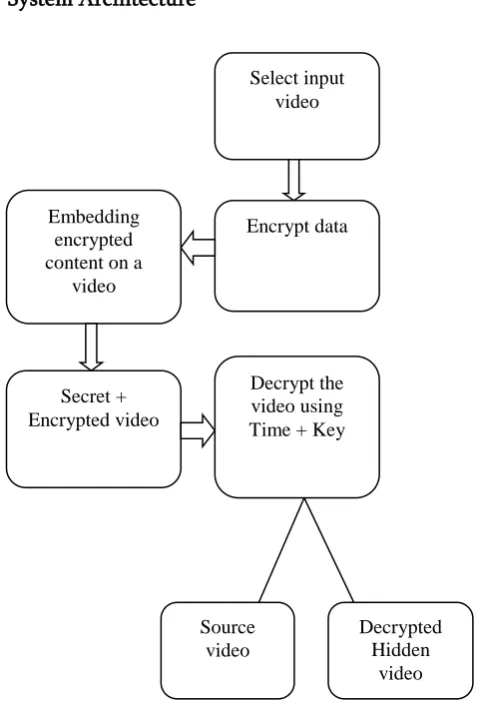
Fig 2.1 System Architecture
2.2 SECRET VIDEO SELECTION
Select input video
Encrypt data Embedding
encrypted content on a
video
Secret + Encrypted video
Decrypt the video using Time + Key
Source video
Decrypted Hidden
1. In this module, the processing of secret video takes place after the selection of video.
2. FRAMES PARTITION
3. SELF REVERSIBLE EMBEDDING -
followed by video encryption.
Fig 2.2 Data Hiding
FRAME PARTITION
The selected secret video is partitioned into several frames and after that encryption of data with secret key takes place.
SELF REVERSIBLE EMBEDDING
The goal of self-reversible embedding is to embed the encrypted video frames
into the sample video.
2.3 DATA ENCRYPTION
In cryptography, Two fish is a symmetric key block cipher with a block size of 128 bits and key sizes up to 256 bits. It was one of the five finalists of the Advanced Encryption Standard contest, but it was not selected for standardization.
Two fish is related to the earlier block cipher Blowfish. It uses 16 rounds to produce the encrypted video.
Fig 2.3 Data Encryption
2.4 EMBEDDING PROCESS
In the data embedding phase, some parameters are embedded into a small number of encrypted pixels, and the LSB of the other encrypted pixels are compressed to create a space for accommodating the additional data and the original data at the positions occupied by the parameters.
Fig 2.4 Data Hiding in Video
2.5 DATA EXTRACTION AND VIDEO
RESTORATION
Fig 2.5 Data Extraction from Video
2.6 PEAK SIGNAL-TO-NOISE RATIO (PSNR)
The mean squared error (MSE) for our practical purpose allows us to compare the true‖ pixel values of our original image to our degraded image. The MSE represents the average of the squares of the "errors" between our actual image and our noisy image. The error is the amount by which the values of the original image differ from the degraded image. The proposal is that the higher the PSNR, the better degraded image has been reconstructed to match the original image and the better the reconstructive algorithm.
This would occur because we wish to minimize the MSE between images with respect the maximum signal value of the image. For color images, the MSE is taken over all pixels values of each individual channel and is averaged with the number of color channels. Another option may be to simply perform the PSNR over a converted luminance or greyscale channel as the eye is generally four times more susceptible to luminance changes as opposed to changes in chrominance. This approximation is left up to the experimenter. Data Embedding Procedure The encrypted message to be hidden is converted into its ASCII equivalent character and subsequently into binary digit. For an example if the character is an encrypted character of the message then as ASCII value for is 116 and binary value for it is 1110100.As image comprises of pixel contribution from red, green
and blue components and each pixel has numbers from the color components (for 24-bit bitmap image each of red, green and blue pixel has 8 bit).At 8 bit of the color number, if we change least significant bits, our visual system cannot detect changes in pixel and thus it is possible to replace message bits with image pixel bit. For example if we consider the pixel value 10111011, and we want to store the information in the least significant bit, at the worst situation the pixel changes to 10111010.
III.
3. RESULTS AND DISCUSSION
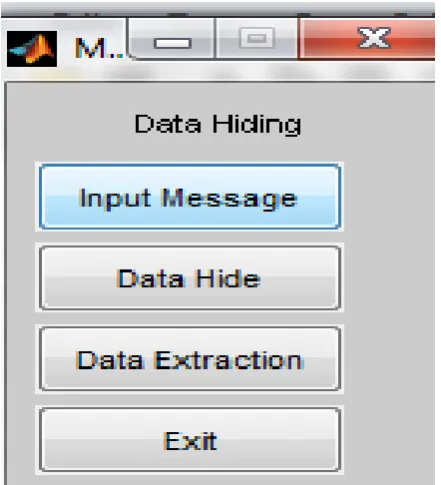
3.1 Input Message:
Enter the message example the word, and then input the some kind of key for letters or numerical. After encrypted the message values. The process is completed.
Input Message
3.2 Data Hide:
Figure-4: Data Hide
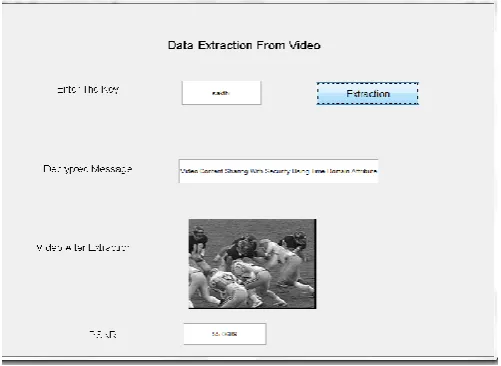
3.3 Data Extraction :
Data are extraction, and then input the same key. After extraction the message. Then get the extracted message values. After the video of the processing to be extraction. Then PSNR values are displayed after the original video.
Correct Key Data Extraction
Wrong Key Data Extraction
3.4 EXECUTION TIME COMPARISON
This execution time of planned and existing system. The execution time of existing method is incredibly high compared with the planned system. From the results it is observed that the proposed work takes less computational time.
Execution Time Comparison
3.5 ACCURACY
This graph contains accuracy rate of planned and existing system. The accuracy of proposed system is incredibly high compared with the planned system. This is shown in Fig.3.7.5. From the results it is observed that the proposed has high accuracy rate than the existing method.
Accuracy Comparison
IV.
CONCLUSION AND FUTURE WORK
CONCLUSION
In this paper, we propose hyper-spatial matching (HSM), a framework for flexibly matching two images. HSM takes into account the interactions among all pairs of spatial regions in two images, which alleviates the mismatching problem in SPM. Thus, HSM provides more flexibility and better similarity measures for comparing two images than SPM. We use relationship matrices to capture the relationship or correlation between any two spatial locations of all images. Training images are used to learn different types of relationship matrices. It is hundreds of times faster than a general purpose SVM solver in training and testing without loss of accuracy. The proposed fast classifier with HSM kernel shows better classification accuracy than compared methods.
FUTURE WORK
generator for the uploading video and then embed the frames into a target images using advanced LSB technique. The system embed the data make the watermarked image. The cloud is semi treated so
authentication method is used.ID based
authentication can be used as the authentication method. This works improve the security of the uploaded video and provides authentication to the user.
V.
REFERENCES
[1]. M. Wang, J. Konrad, P. Ishwar, K. Jing, and H. Rowley. Image saliency: From intrinsic to extrinsic context. In CVPR,2011.
[2]. 2S. Lazebnik, C. Schmid, and J. Ponce, "Beyond bags of features: Spatialpyramid matching for recognizing natural scene categories," in Proc. IEEE Int’l Conf. on Computer Vision and Pattern Recognition, vol. II,2006, pp. 2169-2178.
[3]. 3T. Harada, Y. Ushiku, Y. Yamashita, and Y. Kuniyoshi, "Discriminative spatial pyramid," in Proc. IEEE Int’l Conf. on Computer Vision and Pattern Recognition, 2011, pp. 1617-1624.
[4]. 4G. Sharma, F. Jurie, and C. Schmid,
"Discriminative spatial saliency for image classification," in Proc. IEEE Int’l Conf. on Computer Vision and Pattern Recognition, 2012, pp. 3434-3441.
[5]. 5Y. Jia, C. Huang, and T. Darrell, "Beyond spatial pyramids: Receptive field learning for pooled image features," in Proc. IEEE Int’l Conf. on Computer Vision and Pattern Recognition, 2012, pp. 3370-3377.
[6]. 6Y.-L. Boureau, F. Bach, Y. LeCun, and J. Ponce, "Learning mid-levelfeatures for recognition," in Proc. IEEE Int’l Conf. on Computer Vision and Pattern Recognition, 2010, pp. 2559-2566.
[7]. 7J. Yang, K. Yu, Y. Gong, and T. Huang, "Linear spatial pyramid matching using sparse coding for image classification," in Proc. IEEE Int’l
Conf. on Computer Vision and Pattern Recognition, 2009.
[8]. 8J. Wang, J. Yang, K. Yu, F. Lv, T. Huang, and Y. Gong, "Locality-constrained linear coding for image classification," in Proc. IEEE Int’l Conf. on Computer Vision and Pattern Recognition, 2010, pp. 3360-3367.
[9]. 9F. Perronnin, J. S´ anchez, and T. Mensink, "Improving the Fisher kernel for large-scale image classification," in Proc. European Conf. Computer Vision, ser. LNCS 6314, 2010, pp. 143-156.