Published by Oriental Scientific Publishing Company © 2019
This is an Open Access article licensed under a Creative Commons license: Attribution 4.0 International (CC-BY).
Epileptic Seizure Data Classification Using
RBAs and Linear SVM
Alpika Tripathi
1, Geetika Srivastava
2, K.K. Singh
3and P.K. Maurya
41Department of Computer Science and Engineering, ASET, Amity University, Lucknow, India, 2Department of Physics and Electronics, Dr. RML Avadh University, Faizabad, India.
3Department of E&CE, ASET, Amity University, Lucknow, India. 4Department of Neurology, RML Institute of Medical Sciences, Lucknow,India.
*Corresponding autho E-mail: [email protected] http://dx.doi.org/10.13005/bpj/1674
(Received: 15 April 2019; accepted: 18 June 2019)
The objective of this paper is to make a distinction between EEG data of normal and epileptic subjects. Methods: The dataset is taken from 20-30 years healthy male/female subjects from EEG lab of Dept. of Neurology, Dr. RML Institute of Medical Sciences, Lucknow (India). The feature extraction has been done using the Hilbert Huang Transform (HHT) method. The experimental EEG signals have been decomposed till 5th level of Intrinsic Mode Function (IMF) followed by calculation of high order statistical values of each IMF. Relief algorithm (RBAs) is used for feature selection and classification is performed using Linear Support Vector Machine (Linear SVM). Findings: This paper gives an independent approach of classifying Epileptic EEG data with reduced computational cost and high accuracy. Our classification result shows sensitivity, specificity, selectiv ity and accuracy of 96.4%, 79.16%, 84.3% and 88.5% respectively. Application: The proposed method has been analyzed to be very effective in accurate classification of epileptic EEG data with high sensitivity.
Keywords: Epilepsy, EEG, Hilbert Huang Transform (HHT), Relief-based feature selection algorithms (RBAs), Linear Support Vector Machine (SVM).
E
PILEPSY
is a physical condition
that occurs in the brain and affects the nervous
system. According to the 2009 report by the World
Health Organization around 70 million people
worldwide have epilepsy
1-3. Around 90% of this
population lives in developing countries, and about
three fourths of them do not have access to the
necessary treatment. Epilepsy is defined by two
or more such unprovoked seizures
4. The seizures
are commonly defined as abnormal electrical and
chemical activities in the brain. Like many other
neurological disorders, epilepsy can be assessed by
the electroencephalogram (EEG). The EEG signal
is highly non-linear and non-stationary in nature,
and hence, it is difficult to characterize and interpret
it using conventional frequency domain analysis
5-7.
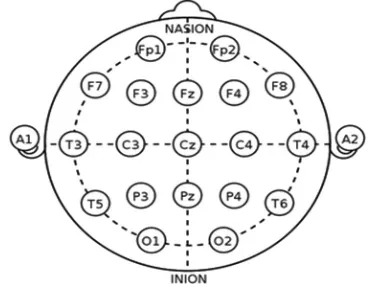
EEG is recording of the electrical
activity of the brain from the scalp. The recorded
waveforms reflect the cortical electrical activity
and helps in identification of brain conditions. The
The system is based on the relationship
between the location of an electrode and the
underlying area of outer layer of the brain. The
number ‘10’ & ‘20’ refer to the distance between
adjacent electrode to be either 10% or 20% of the
total front-back or right-left distance of the scalp .
The electrode placement is shown in Fig.1.
In this paper authors have given a method
for classification of epileptic and normal EEG data.
The proposed method uses a combination of Hilbert
Huang Transform (HHT) for features extraction,
RBAs for feature selection and Linear SVM based
classification of neural network modeling.
Hilbert-Huang Transform is a time
frequency technique consisting of two parts, the
Empirical Mode Decomposition (EMD), and
the Hilbert Spectral Analysis (HSA)
9,10. EMD
decomposes an EEG signal into a finite set of
band-limited signals termed intrinsic mode functions
(IMFs), which are oscillatory components of input
data. In the first step the mean frequency (MF)
for each IMF has been computed using
Fourier-Bessel expansion
11. The IMF oscillates in a narrow
frequency band which is a reflection of
quasi-periodicity and nonlinearity. The non-constant
frequency means non-stationary. MF measure of
the IMFs has been used as one of the features to
differentiate between healthy and epileptic EEG
signals. In the second part, the Hilbert transform
is applied to the IMF, yielding a time-frequency
representation (Hilbert spectrum) for each IMF
12,13.
For feature selection authors have
used Relief algorithm
14-17. Relief is an algorithm
in which a filter-method approach is used for
feature selection that is notably sensitive to
feature interactions. It was originally designed
for application to binary classification problems
with discrete or numerical features. Relief was
also described as generalizable to polynomial
classification by decomposition into a number of
binary problems.
Relief calculates a feature score for each
feature which can then be applied to rank and
select top scoring features for feature reduction.
Alternatively, these scores may be applied as
feature weights to guide downstream modeling.
Relief feature scoring is based on the identification
of feature value differences between nearest
neighbor instance pairs. If a feature value difference
is observed in a neighboring instance pair with the
same class (a ‘hit’), the feature score decreases.
Alternatively, if a feature value difference is
observed in a neighboring instance pair with
different class values (a ‘miss’), the feature score
increases shown in Fig.2.
The Support Vector Machine (SVM) is
a popular classifier that can handle linear as well
as non-linear class boundaries with the help of
kernel functions
18. In this paper authors have used
Linear SVM for data classification. The SVM tries
to identify the maximum-margin hyper plane that
separates the different classes. However, if the data
cannot be linearly separated, non-linear kernel
functions are used to transform the feature space,
allowing a maximum-margin hyper plane to be
established
19.
HHT based feature extraction
The Hilbert–Huang transform (HHT) is
an empirical data-analysis method. Its basis of
expansion is adaptive, so it produces physically
meaningful representations of data from nonlinear
and non-stationary processes
20,21. Traditional
data-analysis methods are all based on linear and
stationary assumptions like Fourier transformation
makes assumption of the signal period which
creates spectral leakage. As is well known, the
natural physical processes are mostly nonlinear
and non-stationary like EEG signals from brain,
yet the conventional data analysis methods provide
very limited options for examining data from
such processes. The available methods are either
for linear but non-stationary, or nonlinear but
stationary and statistically deterministic processes.
It is known that frequency of sinusoidal
waveform is a well defined quantity. However,
in practice, signals are not purely sinusoidal or
stationary. Thus representing such non stationary
signals as combination of different sinusoidal
components will be a compromise with the accurate
assessment of an event. For such signal the term
frequency loses its effectiveness and a need for a
parameter which accounts for the varying nature
of the phenomena arises.
This gives rise to an idea of instantaneous
frequency (IF) – which means the signal is either
composed of a single frequency or a narrow band
of frequencies. For each component instantaneous
frequency can be defined.
HHT was motivated by the need to
describe nonlinear distorted waves in detail, along
with the variations of these signals that naturally
occur in non-stationary processes.
The empirical mode decomposition
method is necessary to deal with data from
non-stationary and nonlinear processes
22,23.
EMD decomposes signal X (t) into a number of
oscillatory component which is known as intrinsic
mode function through a shifting process. Each
IMF has its own distinct time scale. Furthermore
EMD does not consider the stationary and the
linearity of the signal
20. For an input signal X (t)
the process of calculating IMFs are given below:
Let’s set
X(t) = X(t)
old...(1)
Find all the maxima and minima in
X(t)
old…(2)
Interpolate between minima and maxima
using cubic spline interpolation which will generate
local maxima envelope (t) and local minima
envelope
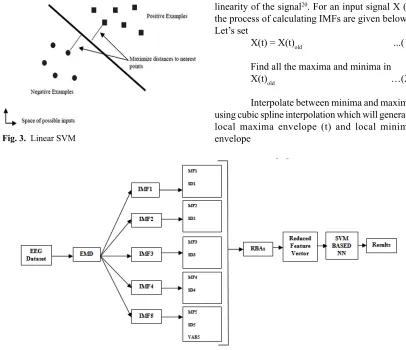
Fig. 3. Linear SVM
Fig. 5. IMFs of Normal EEG Signal Fig. 6. IMFs of Epileptic EEG Signal
el(t)
...(3)
Calculate the mean of envelopes
emean = ((t) + el (t))/2
...(4)
Now subtract emean from X(t)
oldwe will
get X(t)
newas,
X(t)
new= X(t)
old- emean
...(5)
Now set
X(t)
new= X(t)
new...(6)
Repeat the process (2 to 4) until standard deviation
SD = (
S |
X(t)
new–X(t)
old|
2/
S
X(t)
2 old) <
a
...(7)
Where
a
is value that between 0.2-0.3
The first IMF is defined as IMF1 = X(t)
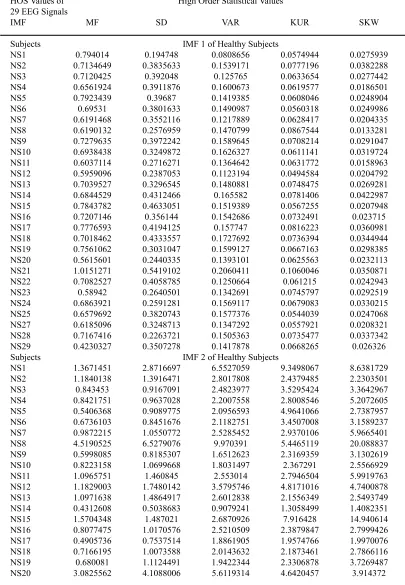
Table 1 . High Order Statistical Values of 29 EEG signal of Normal Subjects upto 5th IMF
HOS Values of High Order Statistical Values
29 EEG Signals
IMF MF SD VAR KUR SKW
Subjects IMF 1 of Healthy Subjects
NS1 0.794014 0.194748 0.0808656 0.0574944 0.0275939
NS2 0.7134649 0.3835633 0.1539171 0.0777196 0.0382288
NS3 0.7120425 0.392048 0.125765 0.0633654 0.0277442
NS4 0.6561924 0.3911876 0.1600673 0.0619577 0.0186501
NS5 0.7923439 0.39687 0.1419385 0.0608046 0.0248904
NS6 0.69531 0.3801633 0.1490987 0.0560318 0.0249986
NS7 0.6191468 0.3552116 0.1217889 0.0628417 0.0204335
NS8 0.6190132 0.2576959 0.1470799 0.0867544 0.0133281
NS9 0.7279635 0.3972242 0.1589645 0.0708214 0.0291047
NS10 0.6938438 0.3249872 0.1626327 0.0611141 0.0319724
NS11 0.6037114 0.2716271 0.1364642 0.0631772 0.0158963
NS12 0.5959096 0.2387053 0.1123194 0.0494584 0.0204792 NS13 0.7039527 0.3296545 0.1480881 0.0748475 0.0269281 NS14 0.6844529 0.4312466 0.165582 0.0781406 0.0422987 NS15 0.7843782 0.4633051 0.1519389 0.0567255 0.0207948 NS16 0.7207146 0.356144 0.1542686 0.0732491 0.023715 NS17 0.7776593 0.4194125 0.157747 0.0816223 0.0360981 NS18 0.7018462 0.4333557 0.1727692 0.0736394 0.0344944 NS19 0.7561062 0.3031047 0.1599127 0.0667163 0.0298385 NS20 0.5615601 0.2440335 0.1393101 0.0625563 0.0232113 NS21 1.0151271 0.5419102 0.2060411 0.1060046 0.0350871 NS22 0.7082527 0.4058785 0.1250664 0.061215 0.0242943
NS23 0.58942 0.2640501 0.1342691 0.0745797 0.0292519
NS24 0.6863921 0.2591281 0.1569117 0.0679083 0.0330215 NS25 0.6579692 0.3820743 0.1577376 0.0544039 0.0247068 NS27 0.6185096 0.3248713 0.1347292 0.0557921 0.0208321 NS28 0.7167416 0.2263721 0.1505363 0.0735477 0.0337342 NS29 0.4230327 0.3507278 0.1417878 0.0668265 0.026326
Subjects IMF 2 of Healthy Subjects
NS1 1.3671451 2.8716697 6.5527059 9.3498067 8.6381729
NS2 1.1840138 1.3916471 2.8017808 2.4379485 2.2303501
NS3 0.843453 0.9167091 2.4823977 3.5295424 3.3642967
NS4 0.8421751 0.9637028 2.2007558 2.8008546 5.2072605
NS5 0.5406368 0.9089775 2.0956593 4.9641066 2.7387957
NS6 0.6736103 0.8451676 2.1182751 3.4507008 3.1589237
NS7 0.9872215 1.0550772 2.5285452 2.9370106 5.9665401
NS8 4.5190525 6.5279076 9.970391 5.4465119 20.088837
NS9 0.5998085 0.8185307 1.6512623 2.3169359 3.1302619
NS10 0.8223158 1.0699668 1.8031497 2.367291 2.5566929 NS11 1.0965751 1.460845 2.553014 2.7946504 5.9919763 NS12 1.1829003 1.7480142 3.5795746 4.8171016 4.7400878 NS13 1.0971638 1.4864917 2.6012838 2.1556349 2.5493749 NS14 0.4312608 0.5038683 0.9079241 1.3058499 1.4082351 NS15 1.5704348 1.487021 2.6870926 7.916428 14.940614 NS16 0.8077475 1.0170576 2.5210509 2.3879847 2.7999426 NS17 0.4905736 0.7537514 1.8861905 1.9574766 1.9970076 NS18 0.7166195 1.0073588 2.0143632 2.1873461 2.7866116
NS19 0.680081 1.1124491 1.9422344 2.3306878 3.7269487
NS21 3.0527935 3.1810749 2.9614952 2.9901266 2.0240628 NS22 0.6201656 0.6909153 2.2992595 3.5640906 3.9328668 NS23 2.1344174 2.6372075 4.8936201 3.6146932 3.2462856 NS24 0.5554465 1.3915533 2.3443719 2.6064464 1.9867625 NS25 1.0111484 1.1234713 2.0467199 3.0696111 2.481803 NS27 1.1047307 1.2129053 2.3732381 3.3731465 5.2515313 NS28 0.6727835 1.6808005 3.1633969 3.2929552 2.621261 NS29 0.5791149 0.5605072 1.4387479 1.9286429 3.2353766
Subjects IMF 3 of Healthy Subjects
NS1 1.8690857 8.246487 42.937955 87.418885 74.618031
NS2 1.4018887 1.9366815 7.8499754 5.9435931 4.9744615
NS3 0.7114129 0.8403556 6.1622985 12.45767 11.318492
NS4 0.7092588 0.928723 4.8433261 7.8447862 27.115562
NS5 0.2922881 0.8262401 4.3917878 24.642354 7.5010021
NS6 0.4537508 0.7143082 4.4870895 11.907336 9.978799
NS7 0.9746063 1.1131878 6.3935406 8.6260312 35.5996
NS8 20.421835 42.613577 99.408696 29.664492 403.56139
NS9 0.3597703 0.6699926 2.7266671 5.3681922 9.7985398
NS10 0.6762032 1.144829 3.251349 5.6040665 6.5366786
NS11 1.2024769 2.1340681 6.5178805 7.8100709 35.90378
NS12 1.399253 3.0555538 12.813354 23.204467 22.468433
NS13 1.2037684 2.2096577 6.7666774 4.6467616 6.4993125 NS14 0.1859859 0.2538833 0.8243261 1.705244 1.9831261 NS15 2.4662655 2.2112313 7.2204666 62.669832 223.22196
NS16 0.652456 1.0344061 6.3556978 5.7024708 7.8396784
NS17 0.2406624 0.5681411 3.5577147 3.8317147 3.9880392 NS18 0.5135434 1.0147717 4.0576589 4.7844829 7.7652043 NS19 0.4625101 1.237543 3.7722746 5.4321057 13.890147 NS20 9.5021525 16.882242 31.493774 21.548588 15.322308 NS21 9.3195484 10.119238 8.770454 8.940857 4.0968302 NS22 0.3846054 0.477364 5.2865944 12.702742 15.467441 NS23 4.5557378 6.9548636 23.947518 13.066007 10.53837 NS24 0.3085208 1.9364205 5.4960795 6.7935628 3.9472251 NS25 1.0224211 1.2621877 4.1890623 9.4225121 6.1593459
NS27 1.22043 1.4711394 5.6322589 11.378117 27.578581
NS28 0.4526377 2.8250902 10.00708 10.843554 6.871009 NS29 0.3353741 0.3141683 2.0699954 3.7196636 10.467662
Subjects IMF 4 of Healthy Subjects
NS1 26.1211 173.58881 105.7402 86.502577 14.866722
NS2 4.5384237 5.8235914 3.3288413 3.9677612 3.7352665
NS3 4.4268523 6.0777767 6.4834451 4.3057737 4.129212
NS4 13.246323 6.5958737 3.7837047 3.3066044 4.5568696
NS5 5.8715379 9.3080921 4.438701 2.8511137 3.3463041
NS6 4.7410993 5.602009 3.5239203 3.5818778 3.7913422
NS7 5.019083 4.3211797 7.0526305 3.8742989 6.3995483
NS8 12.323221 26.213322 6.9748686 5.203992 14.349722
NS9 5.2998872 8.1148395 4.0907434 3.5577341 2.7479037
NS10 5.5523941 15.273256 3.2721178 4.860471 3.6195343
NS11 5.1316229 7.6528964 3.4040442 3.4681068 11.761679
NS18 7.3879998 3.6279616 3.2416907 4.0381763 12.696512 NS19 124.96265 7.2477353 3.3237369 3.8798556 5.3328726 NS20 4.8953379 6.7082148 3.0854336 4.6323791 5.6055095 NS21 19.483011 18.089693 4.9513198 4.9412625 2.9780993 NS22 18.376056 6.0605848 5.1925368 7.9395411 9.4866847 NS23 4.3802035 6.3862992 3.1073743 2.9512085 8.2121815 NS24 5.8519008 7.5350298 3.1145678 3.5716336 4.0131338 NS25 4.8353898 4.4480728 3.2057832 6.4106097 4.777637 NS27 6.9280576 6.504447 5.4986645 7.9219861 13.547343 NS28 81.381915 12.772316 3.7331439 3.2206681 3.218636 NS29 859.94158 22.498134 4.7187115 4.8681671 4.070564
Subjects IMF 5 of Healthy Subjects
NS1 0.9368617 2.2400095 1.8788759 -4.6346204 -0.4742972
NS2 -0.0641331 0.02556 0.0213764 -0.1746376 -0.1316439
NS3 -0.0329525 -0.0372348 -0.170347 0.03744 -0.2469791
NS4 0.0760672 -0.0646503 0.078916 -0.0567486 0.265975
NS5 0.1335422 -0.0651292 -0.0394491 -0.1116554 -0.5056581
NS6 -0.0182776 -0.1920655 0.0125293 -0.0639116 0.2236741
NS7 0.0518529 0.0462345 0.2674941 0.0297923 -0.7641902
NS8 0.0091883 -0.2378462 0.0179487 0.0271938 1.0651003
NS9 -0.0182481 -0.0174901 0.0300339 0.0872897 -0.0599968
NS10 -0.0801845 0.6202513 -0.0045994 0.2976808 -0.0249067
NS11 -0.039921 0.3110126 0.086128 -0.0891201 -0.345381
NS12 1.2827003 -0.0110624 -0.0726262 0.0017892 -0.6870894
NS13 0.0069424 -0.0484375 0.0417263 -0.1836737 0.3871868
NS14 -0.6105902 1.2346839 0.1682674 0.0953418 -0.0021122
NS15 -0.1261543 -0.4746706 -0.3580666 0.2197198 -0.0952142
NS16 0.0352776 0.2623286 0.0164817 0.1063452 -0.2706383 NS17 -0.0915483 0.0119703 -0.0373728 0.0496959 0.2590188
NS18 0.1835534 0.0202854 -0.0084826 0.0108377 0.9936275
NS19 4.2085615 0.0127075 -0.059354 -0.2144468 -0.2042717
NS20 -0.0086416 -0.0772461 -0.0441348 -0.0245628 0.4144225
NS21 0.1078166 0.2286214 0.0188273 0.0214265 0.000411 NS22 -0.6105868 -0.1642786 0.0458767 0.8285085 -0.2906335 NS23 0.0155542 0.1616218 0.0071227 -0.0232878 -1.1183538
NS24 -0.0677949 -0.0092523 0.0438202 -0.0172195 -0.2904886
NS25 -0.0088769 0.0240307 -0.0392672 0.3934843 0.5874376
NS27 -0.0855313 -0.0039345 -0.1527337 0.2219079 -0.7106446
NS28 -0.3867619 -0.1214849 -0.0287683 -0.0250265 -0.1046807
NS29 24.095343 -0.4350748 0.0042242 0.0465327 -0.1108155
subtracting IMF1 from X(t) we will get residual
signal R(t) which can be expressed as ,
R(t) = X(t) – IMF1.
After acquiring R(t) we put it in the same
process above to get new IMF which means each
IMF will have different frequencies against time.
So the original signal can be rewritten as
Hilbert Huang Transform (HHT) is a very
new and powerful tool for analyzing data from
non-stationary and nonlinear processing realm
and capable of filtering data based on empirical
mode decomposition (EMD). The EMD is based
on the sequential extraction of energy associated
with various intrinsic time scales of the signal;
therefore total sum of the intrinsic mode functions
(IMFs) matches the signal very well and ensures
completeness.
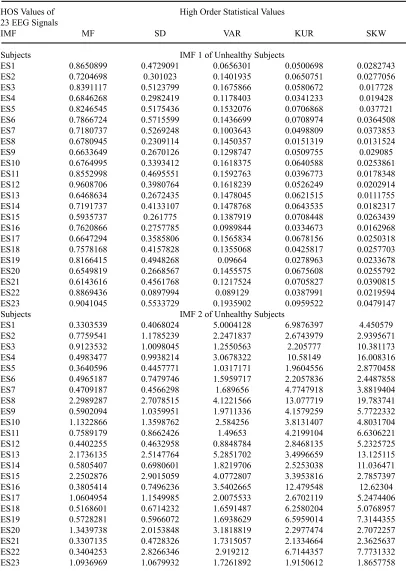
Table 2. High Order Statistical Values of 23 EEG signal of Epileptic Subjects upto 5th IMF
HOS Values of High Order Statistical Values
23 EEG Signals
IMF MF SD VAR KUR SKW
Subjects IMF 1 of Unhealthy Subjects
ES1 0.8650899 0.4729091 0.0656301 0.0500698 0.0282743
ES2 0.7204698 0.301023 0.1401935 0.0650751 0.0277056
ES3 0.8391117 0.5123799 0.1675866 0.0580672 0.017728
ES4 0.6846268 0.2982419 0.1178403 0.0341233 0.019428
ES5 0.8246545 0.5175436 0.1532076 0.0706868 0.037721
ES6 0.7866724 0.5715599 0.1436699 0.0708974 0.0364508
ES7 0.7180737 0.5269248 0.1003643 0.0498809 0.0373853
ES8 0.6780945 0.2309114 0.1450357 0.0151319 0.0131524
ES9 0.6633649 0.2670126 0.1298747 0.0509755 0.029085
ES10 0.6764995 0.3393412 0.1618375 0.0640588 0.0253861
ES11 0.8552998 0.4695551 0.1592763 0.0396773 0.0178348
ES12 0.9608706 0.3980764 0.1618239 0.0526249 0.0202914
ES13 0.6468634 0.2672435 0.1478045 0.0621515 0.0111755
ES14 0.7191737 0.4133107 0.1478768 0.0643535 0.0182317
ES15 0.5935737 0.261775 0.1387919 0.0708448 0.0263439
ES16 0.7620866 0.2757785 0.0989844 0.0334673 0.0162968
ES17 0.6647294 0.3585806 0.1565834 0.0678156 0.0250318
ES18 0.7578168 0.4157828 0.1355068 0.0425817 0.0257703
ES19 0.8166415 0.4948268 0.09664 0.0278963 0.0233678
ES20 0.6549819 0.2668567 0.1455575 0.0675608 0.0255792
ES21 0.6143616 0.4561768 0.1217524 0.0705827 0.0390815
ES22 0.8869436 0.0897994 0.089129 0.0387991 0.0219594
ES23 0.9041045 0.5533729 0.1935902 0.0959522 0.0479147
Subjects IMF 2 of Unhealthy Subjects
ES1 0.3303539 0.4068024 5.0004128 6.9876397 4.450579
ES2 0.7759541 1.1785239 2.2471837 2.6743979 2.9395671
ES3 0.9123532 1.0098045 1.2550563 2.205777 10.381173
ES4 0.4983477 0.9938214 3.0678322 10.58149 16.008316
ES5 0.3640596 0.4457771 1.0317171 1.9604556 2.8770458
ES6 0.4965187 0.7479746 1.5959717 2.2057836 2.4487858
ES7 0.4709187 0.4566298 1.689656 4.7747918 3.8819404
ES8 2.2989287 2.7078515 4.1221566 13.077719 19.783741
ES9 0.5902094 1.0359951 1.9711336 4.1579259 5.7722332
ES10 1.1322866 1.3598762 2.584256 3.8131407 4.8031704
ES11 0.7589179 0.8662426 1.49653 4.2199104 6.6306221
ES12 0.4402255 0.4632958 0.8848784 2.8468135 5.2325725
ES13 2.1736135 2.5147764 5.2851702 3.4996659 13.125115
ES14 0.5805407 0.6980601 1.8219706 2.5253038 11.036471
ES15 2.2502876 2.9015059 4.0772807 3.3953816 2.7857397
ES16 0.3805414 0.7496236 3.5402665 12.479548 12.62304
ES17 1.0604954 1.1549985 2.0075533 2.6702119 5.2474406
ES18 0.5168601 0.6714232 1.6591487 6.2580204 5.0768957
ES19 0.5728281 0.5966072 1.6938629 6.5959014 7.3144355
ES20 1.3439738 2.0153848 3.1818819 2.2977474 2.7072257
ES21 0.3307135 0.4728326 1.7315057 2.1334664 2.3625637
ES22 0.3404253 2.8266346 2.919212 6.7144357 7.7731332
Subjects IMF 3 of Unhealthy Subjects
ES1 0.1091337 0.1654882 25.004129 48.827109 19.807653
ES2 0.6021047 1.3889186 5.0498348 7.1524041 8.6410547
ES3 0.8323884 1.0197052 1.5751663 4.8654523 107.76876
ES4 0.2483504 0.987681 9.4115946 111.96793 256.26619
ES5 0.1325394 0.1987172 1.0644402 3.8433861 8.2773925
ES6 0.2465308 0.5594661 2.5471256 4.8654812 5.9965518
ES7 0.2217644 0.2085108 2.8549373 22.798637 15.069461
ES8 5.2850734 7.3324599 16.992175 171.02673 391.39639
ES9 0.3483471 1.0732858 3.8853676 17.288348 33.318676
ES10 1.2820729 1.8492632 6.6783789 14.540042 23.070446
ES11 0.5759564 0.7503762 2.239602 17.807644 43.965149
ES12 0.1937985 0.214643 0.7830098 8.104347 27.379815
ES13 4.7245957 6.3241006 27.933024 12.247662 172.26864
ES14 0.3370275 0.4872879 3.3195768 6.3771594 121.8037
ES15 5.0637941 8.4187365 16.624218 11.528616 7.7603459
ES16 0.1448118 0.5619355 12.533487 155.73913 159.34114
ES17 1.1246505 1.3340216 4.0302702 7.1300316 27.535632
ES18 0.2671444 0.4508091 2.7527745 39.162819 25.77487
ES19 0.328132 0.3559401 2.8691715 43.505915 53.500966
ES20 1.8062657 4.0617758 10.124372 5.2796432 7.3290711
ES21 0.1093714 0.2235707 2.998112 4.5516789 5.5817073
ES22 0.1158894 7.9898633 8.5217987 45.083647 60.4216
ES23 1.1961729 1.1406094 2.9797292 3.6674596 3.4811194
Subjects IMF 4 of Unhealthy Subjects
ES1 4.5771176 7.0087635 18.72618 4.438525 3.6387834
ES2 4.6721191 12.485297 3.7515448 2.8945809 3.2989253
ES3 4.8363808 3.6414101 4.8090367 9.1757919 3.8358201
ES4 25.708015 29.801328 6.3511609 12.355667 2.2715564
ES5 8.4152284 3.0111605 5.1884963 11.195804 4.1664795
ES6 8.058631 2.5071926 5.6127706 4.8551599 3.3116094
ES7 294.40981 3.1362269 27.83137 5.3359899 2.957612
ES8 4.9401601 11.098406 3.3255404 35.553052 18.566356
ES9 14.952852 13.619801 5.7570903 8.0806325 12.965434
ES10 4.5372324 6.8736788 3.6542007 6.0117279 12.628416
ES11 3.7915257 3.8012139 5.0176857 10.534601 16.394638
ES12 8.3659199 66.930757 9.4311181 14.648822 13.724967
ES13 7.3759178 12.338818 2.9419575 21.578049 31.927595
ES14 63.38271 4.2477574 3.713664 5.0928349 8.7693387
ES15 6.158873 5.8291961 3.826798 2.9856206 4.9684164
ES16 43.596893 24.808282 5.9428689 5.6386731 7.2970514
ES17 5.4453413 6.0432796 3.93111 6.0310116 7.4071691
ES18 17.473343 7.0504811 4.7559268 4.5921542 3.0711551
ES19 223.20771 6.1305469 30.525167 43.536547 22.863897
ES20 3.83648 6.6480955 3.4461044 3.1125352 3.3795001
ES21 395.02359 7.7392785 15.905384 5.0630354 3.1100875
ES22 6.965067 100.63262 22.440095 16.072997 8.0500811
ES23 4.7254519 4.026748 6.3249347 10.183007 15.691209
Subjects IMF 5 of Unhealthy Subjects
ES1 0.024654 -0.4296459 0.3575977 0.0226011 -0.0755703
ES2 0.0061941 0.5499125 -0.1601651 0.0755629 0.1800178
ES3 0.0010872 -0.0197224 -0.0789725 -0.140138 0.1755386
ES4 -0.7393064 -0.4796606 -0.0979807 -0.8759199 0.090423
ES5 0.2707581 -0.001205 -0.0570468 0.2302964 0.2013605
ES7 9.9175498 0.0201692 -2.417516 -0.1451854 0.0458859
ES8 0.0410811 -0.3725798 0.0468306 -3.5959749 1.6056099
ES9 -0.7679569 -0.2677045 -0.2248263 0.1450071 0.2373168
ES10 0.011263 0.2940156 0.0009562 0.3756074 0.2475115
ES11 -0.0123112 0.0664354 -0.103722 1.323574 2.3883766
ES12 0.3587948 -1.3089528 -0.3568748 0.9671277 -1.8264115
ES13 0.352495 0.236305 -0.00324 -2.3182493 -4.0947717
ES14 -2.6589605 0.0485656 0.0581806 -0.0709458 -0.0135256
ES15 0.1221658 0.0747326 0.0272607 0.0547411 -0.2824818
ES16 -2.2468663 0.0203399 0.0164117 0.0324535 -0.9939975
ES17 0.076271 -0.1215204 0.1040614 -0.059463 -0.3068512
ES18 0.9846622 -0.0624885 0.0260383 0.1778707 -0.0116882
ES19 6.9752414 -0.1316119 -0.0018436 -3.9574945 -1.6565017
ES20 -0.0276649 -0.1214705 -0.0007395 0.0384048 -0.0818361
ES21 14.24066 0.1333398 -0.3670489 0.0921567 -0.0049415
ES22 0.2247009 -3.5664924 -0.315258 0.7120273 -0.5549812
ES23 -0.0670528 -0.0564401 -0.0320062 -0.5541185 -1.4992487
use is motivated by the fact that the distributions
of samples in the data are characterized by their
asymmetry, dispersion and concentration around
the mean. After analyzing visually we can see IMF
obtained from normal and pathological EEG are
quite different from one another. These differences
can easily extracted by statistical methods like
Mean Function (MF),
Standard Deviation (SD), Variance
(VAR), Kurtosis (KUR), Skewness (SKW)
24-26.
Mean
: Computes the average values of the signal
at various frequency levels.
Standard Deviation
: For calculating the variations
of signal at various levels.
Variance
: is the square of the standard deviation.
Kurtosis
: Coefficients of EEG signal do not follow
the normal distribution, and have a heavy tail
characteristic is justified by the value of kurtosis
parameters.
Skewness
: is a measure of the asymmetry. If the
probability distribution of a real-valued random
variable around its mean is not symmetrical, the
data is said to be skewed.
The same processing steps are further
applied on other 16 channels of EEG recording of
Normal and Epileptic subjects.
Relief Based Feature Selection Algorithm
Take a data set with
n
instances
of
p
features, belonging to two known classes.
Within the data set, each feature should be scaled
to the interval [0 1] (binary data should remain as
0 and 1). The algorithm will be repeated
k
times.
Start with a
p
-long weight vector (G) of zeros.
At each iteration, take the feature vector
(V) belonging to one random instance, and the
feature vectors of the instance closest to V (by
Euclidean distance) from each class. The closest
same-class instance is called ‘near-hit’, and the
closest different-class instance is called
‘near-miss’. Update the weight vector such that
G
i= G
i– (v
i– nearHit
i)
2+ (v
i
– nearMiss
i)
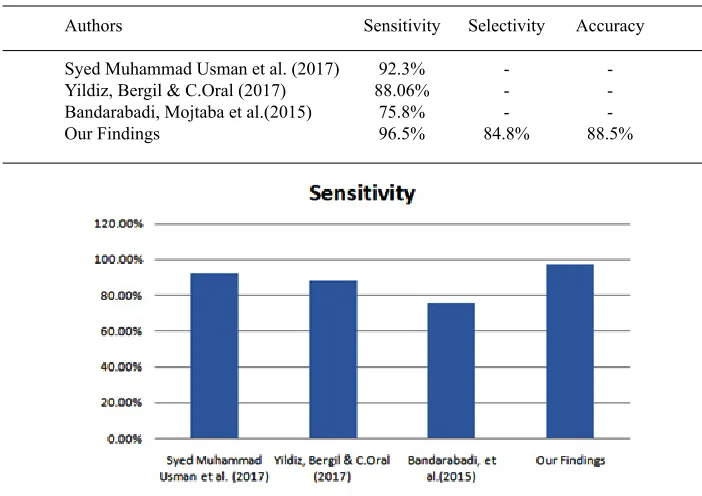
2Table 3. Shows the proposed classifier output
and compare with existing techniques
Authors Sensitivity Selectivity Accuracy
Syed Muhammad Usman et al. (2017) 92.3% -
-Yildiz, Bergil & C.Oral (2017) 88.06% -
-Bandarabadi, Mojtaba et al.(2015) 75.8% -
-Our Findings 96.5% 84.8% 88.5%
Fig. 9. Shows comparison of our result with other researchers in terms of sensitivity Fig. 7. Confusion Matrix Fig. 8. ROC Curve
instances of the same class more than nearby
instances of the other class, and increases in the
reverse case.
After
k
iterations, divide each element of
the weight vector by
k
. This becomes the relevance
vector. Features are selected if their relevance is
greater than a threshold
T.
Kira and Rendell’s experiments showed
a clear contrast between relevant and irrelevant
features, allowing
T
to be determined by
inspection
27. However, it can also be determined
by Chebyshev’s inequality for a given confidence
make the probability of a Type I error less than
á
,
although it is stated that
T
can be much smaller
than that.
Classification using linear SVM
Support Vector Machine (SVM)
is a supervised machine learning algorithm
which can be used for both classification and
regression based problems. However, it is
mostly used in classification problems. In this
algorithm, we plot each data item as a point
in n-dimensional space (where n is number of
features you have) with the value of each feature
being the value of a particular coordinate. Then,
we perform classification by finding the
hyper-plane that differentiate the two classes very well
(look at the below snapshot) shown in Fig. 3[A].
Support Vectors are simply the
co-ordinates of individual observation. Support Vector
Machine is a frontier which best segregates the two
classes (hyper-plane/ line)
24. In the linear case, the
margin is defined by the distance of the hyper plane
to the nearest of the positive and negative examples.
The formula for the output of a linear SVM is
v = ѡ̄ * xˉ - b
...(1)
where w is the normal vector to the hyper
plane and x is the input vector. The separating hyper
plane is the plane v=0. The nearest points lie on the
planes v = ±1. The margin m is thus
k = 1/║ѡ║2
RESULT AnD DISCUSSIOn
This paper gives the feature extraction
results produced by applying decomposition
of signal till fifth level of IMFs by applying
HHT on EEG signals, and then RBA is used for
feature selection, followed by Linear SVM for
classification. The normal and abnormal input data
is applied after removing artifacts.
Statistical values of 29 EEG signals of
normal subjects upto 5
thIMF has been shown in
table 1 and values of 23 EEG signal of Epileptic
subjects has been displayed in table 2. On the basis
of these obtained values, the training and testing of
Linear SVM classifier has been proposed. 70% of
data set is used for training purpose and rest 30%
were utilised for testing results.
Once the calculation of IMFs is complete,
the following important statistical parameters are
evaluated. Table 1 & 2 are presenting the calculated
statistical values of Healthy and Unhealthy
subjects.
For feature selection Relief algorithm
calculates a feature score for each feature which
can then be applied to rank and select top scoring
features. The Hilbert–Huang transform (HHT)
is a way to decompose a signal into intrinsic
mode functions (IMF) along with a trend, and
obtain instantaneous frequency data and used for
feature extraction. For classifying the experimental
EEG signals, the Linear SVM concept has been
used. The computed statistical values are fed into
Linear SVM classifier for training and testing. The
performance of proposed methodology is evaluated
in terms of parameters of confusion matrix & ROC
Curve shown in Fig. 7 & 8.
Where TP, TN, FP and FN stands for
true positive, true negative, false positive and
false negative respectively. Sensitivity is used to
diagnose the correctly identified positive case,
specificity is defined as the determination of
negative cases accurately, selectivity is defined as
the recognition of unidentified positive results and
accuracy stands for the identification of correct
classified instances.
COnCLUSIOn
The proposed method is suitable for
separating normal and epileptic EEG data. The
com bined approach of HHT, RBAs with Linear
SVM has found to be very effective in such
classification with high sensitivity. The result of
the classification pro cess is based on using the
statistical values obtained by HHT. This technique
has been found to be suitable in the correct
classification of epileptic and healthy EEG data.
The data set is taken from Natus NeuroWorks EEG
Recording Machine from RML Institute of Medical
result shows sensitivity, selectiv ity and accuracy
are 96.5%, 84.8% and 88.5% respectively.
ACKnOWLEDGMEnT
The authors acknowledge Dr. A. K.
Thacker, Head of Department, Department of
Neurology, RMLIMS, Lucknow (U.P) for his
valuable help in developing an understanding
towards the Epilepsy. His contributions and work in
the related field helped us to think a stage ahead and
Ms. Nidhi, Technical Staff EEG Lab, RMLIMS,
Lucknow (U.P) for providing EEG Recording of
Healthy& Unhealthy Subjects.
REFEREnCES
1. R. Fisher, W. van Emde Boas, W. Blume, C. Elger, P. Genton, P. Lee, J. Engel, “Epileptic seizures and epilepsy: definitions”, Proposed by the International League Against Epilepsy (ILAE) and the International Bureau for Epilepsy (IBE), Epilepsia, 46(4): pp. 470–472 (2005). 2. R.A.S. Ruiz, R. Ranta, V. Louis-Dorr, “EEG
montage analysis in the Blind Source Separation framework”, Bio signal Processing and Control, 6(1): pp.77–84 (2010).
3. http://www.who.int/mediacentre/factsheets/ fs999/en/index.html (accessed April 2018), WHO Report
4. D. Coyle, T.M. McGinnity, G. Prasad, “Improving the separability of multiple EEG features for a BCI by neural-time-series prediction-preprocessing”, Bio-signal Processing and Control, 5(3): pp.196–204 (2010).
5. Pardey, James, Stephen Roberts, and Lionel Tarassenko. “A review of parametric modelling techniques for EEG analysis.” Medical engineering & physics 18.1 : 2-11 (1996). 6. Lange, Nicholas, and Scott L. Zeger. “Non
linear Fourier time series analysis for human brain mapping by functional magnetic resonance imaging.” Journal of the Royal Statistical Society: Series C (Applied Statistics) 46.1 : 1-29 (1997).
7. Bachmann, Maie, et al. “Non-linear analysis of the electroencephalogram for detecting effects of low-level electromagnetic fields.” Medical and Biological Engineering and Computing 43.1: 142-149 (2005).
8. Homan, Richard W., John Herman, and Phillip Purdy. “Cerebral location of international 10–20 system electrode placement.” Electroencephalography and
clinical neurophysiology 66.4 : 376-382 (1987). 9. Huang, Norden Eh. Hilbert-Huang transform and
its applications. World Scientific, 16: (2014). 10. Huang, Norden E., and Zhaohua Wu. “A review
on Hilbert Huang transform: Method and its applications to geophysical studies.” Reviews of geophysics 46.2 (2008).
11. Pachori, Ram Bilas. “Discrimination between ictal and seizure-free EEG signals using empirical mode decomposition.” Research Letters in Signal Processing, 14; (2008): 12. E. Huang, Z. Shen, and S. R. Long, “The
empirical mode decompo-sition and the Hilbert spectrum for nonlinear and non-stationary time series analysis”, in Proc. Royal Society of London Ser., 454: pp. 903–995 (1998). 13. Li, Yi, et al. “Sleep stage classification based
on EEG Hilbert-Huang transform.” Industrial Electronics and Applications, 2009. ICIEA 2009. 4th IEEE Conference on. IEEE, 2009.
14. Urbanowicz, Ryan J., et al., “Relief-based feature selection: introduction and review”, arXiv preprint arXiv:1711.08421, (2017).
15. Yu, Lei, and Huan Liu. “Feature selection for high-dimensional data: A fast correlation-based filter solution.” Proceedings of the 20th international conference on machine learning (ICML-03). (2003).
16. Sun, Yijun., “Iterative RELIEF for feature weighting: algorithms, theories, and applications”, IEEE transactions on pattern analysis and machine intelligence 29.6: (2007). 17. Sun, Yijun, Sinisa Todorovic, and Steve
Goodison. “Local-learning-based feature selection for high-dimensional data analysis”, IEEE transactions on pattern analysis and machine intelligence 32.9, pp. 1610-1626 (2010). 18. Subasi, Abdulhamit, and M. Ismail Gursoy. “EEG
signal classification using PCA, ICA, LDA and support vector machines.” Expert systems with applications 37.12: 8659-8666 (2010).
19. Amari, Shun-ichi, and Si Wu. “Improving support vector machine classifiers by modifying kernel functions.” Neural Networks 12.6 (1999): 783-789.
20. S. C. Pei and M. H. Yeh, “Discrete fractional Hilbert transform”, IEEE Trans. Circuits Syst. II, 47(11), pp. 1307–1311, (2000).
21. Barnhart, B. L., “The Hilbert-Huang transform: theory, applications, development”, (2011). 22. Flandrin, P., Rilling, G., & Goncalves, P,
“Empirical mode decomposition as a filter bank”, Signal Processing Letters, IEEE, 11(2), 112-114 (2004).
problems”, Hilbert-Huang transform and its applications, interdisciplinary mathematical sciences, 5: 1-24 (2005).
24. Fu, Kai, et al. “Classification of seizure based on the time-frequency image of EEG signals using HHT and SVM.” Biomedical Signal Processing and Control 13: 15-22 (2014).
25. Jospin, Mathieu, et al. “Detrended fluctuation
analysis of EEG as a measure of depth of anesthesia.” IEEE Transactions on Biomedical Engineering 54.5: 840-846 (2007).
26. Persson, Isac, “Feature selection of EEG-signal data for cognitive load”, (2017).