C 16 MANUFACTURING ENGINEERING: Materials Science JOURNAL OF ENGINEERING SCIENCES
УРНА ІН Н РНИХ НАУ
УРНА ИН Н РНЫХ НАУ
Web site: http://jes.sumdu.edu.ua DOI: 10.21272/jes.2018.5(1).c4 Volume 5, Issue 1 (2018)
UDC 621.9.048.669.268
Ecologically Safe Process for Sulfo-Aluminizing Steel Parts
Plyatsuk L. D.1, Tarelnyk V. B.2, Kundera Cz.3, Radionov O. V.4, Gaponova O. P.1
1
Sumy State University, 2 Rymskogo-Korsakova St., 40007 Sumy, Ukraine;
2
Sumy National Agricultural University, 160 Gerasyma Kondratieva St., 40021 Sumy, Ukraine;
3 Politechnika Świętokrzyska, 7 Tysiąclecia Państwa Polskiego Av., 25-314 Kielce, Poland; 4 “
Ferrogidrodinamika” Ltd., 45/5 Bolshaya Morskaya St., 54030 Mykolaiv, Ukraine
Article info: Paper received:
The final version of the paper received: Paper accepted online:
March 3, 2018 May 28, 2018 May 29, 2018
*
Corresponding Author’s Address:
[email protected]
Abstract. The present technical solution refers to the field of electrophysical and electrochemical processing of parts, in particular, to the electroerosion alloying (EEA) of the surfaces of steel parts with aluminum (aluminizing) and sulfur (sulfidizing), and it can be used to treat the surfaces of heat-treated steel parts in order to increase their hardness, wear resistance, to prevent frictional seizure and improve the resistance to atmospheric corrosion. When aluminizing steel parts with the use of the method of electroerosion alloying (EEA) by aluminum electrode at dis-charge energy Wp = 0.52–6.8 J and productivity of 1.0–3.0 cm
2
/ min, before the EEA process by an aluminum elec-trode, to the surface of the part to be aluminized, there is applied a consistency substance containing sulfur and alu-minum powder, and thereafter, not having waited for drying of the consistency substance, the process of aluminizing by the EEL method with an aluminum electrode is carried out, and the consistency substance should have the alumi-num powder content of not more than 56 %. There have been carried out metallographic and durametric analyses of the features of the surface layers made of carbon steels after simultaneous aluminizing and sulfidizing them by the EEA method. It is shown that the structure of the layer consists of three portions, namely, a “white” layer, a diffusion zone and a base metal. Such qualitative surface layer parameters as thickness, “white” layer and transition zone mi-crohardness values, and also roughness increase with increasing discharge energy. The “white” layer continuity for all the investigated discharge energies of Wp = 0.52, 2.60 and 6.80 J is 100 %.
Keywords: electroerosion alloying, ecological compatibility, surface layer, aluminizing, sulfidizing, microstructure, microhardness.
1
Introduction
To date, chemical and thermal process (CTP) is one of the most effective methods for strengthening surfaces of parts to improve their durability. The main types of the CTP processes are: carburization, nitration, aluminizing, sulfidizing, cyanidation and others, which consist in sim-ultaneously saturating a surface layer, respectively, with carbon, nitrogen, aluminum, sulfur, carbon and nitrogen, etc.
Despite the fact that the CTP technology is one of the main processes aimed at improving quality of surface layers of machine parts, it also has a number of signifi-cant drawbacks as follows: volumetric heating of a part, which results in changing its structure and initial geomet-ric parameters (metal deformation and warps); bulky and expensive processing equipment; long duration of the
process and the need in using of energy-intensive equip-ment, etc.
In addition, certain CTP operations are dangerous for the environment. For example, the main disadvantage of a cyanidation process is toxicity of cyanide salts and, in this regard, there is a need in special measures to provide labor protection.
Journal of Engineering Sciences, Volume 5, Issue 1 (2018), pp. C 16–C 20 C 17 In the course of the EEA process, while using different
electrode materials and the environment, it is quite possi-ble to implement the technologies being alternative to the CTP ones, but of significantly lower cost. Thus, on apply-ing graphite electrode and saturatapply-ing a surface of a part with carbon, it is possible to carry out the process of car-burization; using the EEA method in nitrogen medium makes it possible to perform the nitriding process, and others.
Thus, there is a very topical problem of developing en-ergy-efficient, energy-saving and environmentally friend-ly technologies to form surface layers of parts, which technologies being alternative to the CTP ones, suffi-ciently retaining the advantages of the CTP technologies and having no their disadvantages.
2
Literature Review
There is known a sulfidizing method for enriching sur-face layers of items with sulfur, which represents a ther-mo chemical process for processing items made of iron-based alloys. The effect of sulfidizing consists in creating a film of sulfides on a part surface. Sulfides increase the surface activity of metals and alloys and also provide wetting with surfactants and improve resistance to fric-tional seizure. The sulphide film, which has less strength than the base metal, is easily broken down at friction and separated from the base without plastic deformation, preventing the friction surfaces from frictional seizure. The film of iron sulphide (FeS) increases the wear re-sistance of rubbing surfaces and improves their running-in ability. The ferrosulfide coatrunning-ing has rather high porosi-ty and absorbs a large amount of lubricant, providing the material with self-lubricating properties [1].
There is known a method for aluminizing surfaces of parts [2], which includes the procedures of applying an aluminum layer to a steel surface (usually by spraying), coating and annealing thereof. Spraying aluminum parti-cles should be large, which fact accelerates the process of aluminum diffusion penetration into surface layer of met-al in the course of annemet-aling. The coating layer is contin-uously applied to the surface in two to three passes, and in doing so, the process should strictly follow the condi-tion of thermal diffusion treatment to preserve the coating layer.
Having been aluminized and applied with a coating, the obtained surface layer of the part is saturated with the use of the thermal diffusion process, that is, it is annealed. The initial temperature is of 600 to 650 °C, followed by rapid heating up to of 900 to 950 °C with the hold time of 2.5 to 3.5 hours, and thereafter the part is slowly cooled together with the furnace to the temperature of 500 to 550 °C, and then it is cooled in the open air. The thick-ness of the coating applied with the use of molten alumi-num depends on the temperature of the part operation. Thus, for the operating temperature of 700 to 800 °C the coating thickness is of 0.2 to 0.3 mm, and for the operat-ing temperature of 900 to 1 000 °C it is of 0.5 to 0.7 mm.
Having been metalized with aluminum, the part is cov-ered with 10 to 20 % aluminum chloride solution, and then it is coated with liquid glass, sprinkled with quartz sand, and dried at the temperature of 100 °C. The dried part is newly coated with liquid glass and dried again. At the temperature of 600 to 700 °C, the part is loaded into the furnace and heated up to the temperature of 1 200 to 1 250 °C with the hold time of 14 to 40 minutes, after that it is slowly cooled first in the oven to 800 °C and then in the open air.
Along with the above said positive results, the tech-nology described has a number of drawbacks. Those are the followings: high cost and labor intensity of the pro-cess, the need in control at all the technology stages, in-evitability of heating the entire part, and accordingly, the presence of structural changes in the metal, deformations and warps, the process duration is more than 8 hours, high power consumption, negative impact on the envi-ronment, etc.
In accordance with publication [3], using the method for providing electrospark depositions of titanium on aluminum and aluminum on titanium, there have been created coatings containing the intermetallics of Ti-Al. While applying the methods of electron microscopy, X-ray diffraction and micro-X-ray spectroscopy, there were analyzed the structure and composition of the coat-ings obtained. It has been found out that, regardless of the duration and frequency of the discharge pulses, the sur-face layer formed in argon basically contains α-TiAl3 intermetallic. The phases of γ-TiAl and α2 -Ti3Al can be obtained by depositing aluminum on titanium followed by depositing a second layer of titanium. At creating electrospark coatings in the open air, there are additional-ly formed alumina and titanium nitride. This technology is also performed in a protective environment, for exam-ple, argon, and it can be used only for parts made of tita-nium.
The closest to the proposed method is a method for electroerosion alloying (EEA) by an aluminum electrode of steel parts at the discharge energy of Wp = 0.52 to 6.8 J and productivity of 1.0 to 3.0 cm2 / min. The method provides for the formation of a so-called “white” (alumi-nized) layer, respectively, of 70 to 130 μm thick having microhardness of 5 000 to 7 500 MPa, roughness (Ra) of 6 to 9 μm and continuity of 95 to 100 % [4].
It should be noted that with this treatment method, the maximum thickness values of the aluminized layers were obtained at the highest discharge energy of Wp = 6.8 J,
C 18 MANUFACTURING ENGINEERING: Materials Science There is known a method for sulfo-carburizing
surfac-es of steel parts with applying a procsurfac-ess of electroerosion alloying by graphite electrode, wherein a consistency sulfur-containing substance has been applied to the steel surface just before alloying with a graphite electrode [5]. The main disadvantage of this sulfo-carburizing process is the lack of possibility of protecting the part from oxida-tion at high temperatures (700 to 900 °C and higher), as well as from atmospheric corrosion and seawater.
Thus, the aim of the work is to create a process for aluminizing steel parts with the use of the method for electroerosion alloying by an aluminum electrode, which is devoid of the above mentioned drawbacks and which provides an increase in the hardness and wear resistance of parts preventing friction seizure and improving the resistance to atmospheric corrosion.
3
Research Methodology
To determine the effect of the EEA equipment energy parameters on the quality parameters of the coatings, there were made the specimens of 20 steel and 40 steel having a size of 15x15x8 mm, where on a consistency substance was applied in the form of a sulfuric ointment with sulfur content of 33.3 %. Before applying, the alu-minum powder of the mark of PAD-0 (GOST 5494-95) had been added into the sulfuric ointment. The maximum amount of the powder was 56%. Further increasing the amount of the powder resulted in decreasing its adhesion to the surface to be aluminized. After that, without wait-ing for drywait-ing the consistency substance, there was pro-duced the EEA method by an aluminum electrode on the unit of “Elitron-52A” model with the use of various oper-ating modes. Moreover, each EEL mode had its own value of discharge energy and productivity, that is, the area of the formed coating per unit of time (Table 1).
Table 1 – EEA productivity dependence on discharge energy
Discharge energy
Wр, J 0.52 1.3 2.6 4.6 6.8
Productivity,
m2
/ min
1.0–
1.3 1.3–
1.5 1.5–
2.0 2.0–
2.5 2.5–
3.0
It should be noted that decreasing the EEA method productivity results in decreasing the qualitative parame-ters of the surface layer (the appearance of burns, and the most importantly, the destruction of the formed layer), which event especially occurs on ‘harder’ modes at dis-charge energy Wp > 1 J. Increase in the productivity
re-sults in decrease in the continuity of a coating. As a tool electrode, there was used a 4 rod with length of 45 mm made of aluminum wire of SvA99 GOST 7871-75 mark.
The metallographic analysis of the coatings was car-ried out using an optical microscope of -7 (MIM-7) model, the durametric studies were carried out with the use of the instrument of -3 (PMT-3) model.
The surface roughness after EEA method was deter-mined with the use of the profilograph-profilometer of 203 model of the (Caliber) plant production by taking off and processing the profilograms.
To study the sulfur distribution over the depth of the layer, a local micro-X-ray spectral analysis was per-formed, based on recording the characteristic X-ray radia-tion excited by the electron beam of the chemical ele-ments, which were present in the microvolume. For this purpose, there was used an electron microscope equipped with an X-ray spectral micro-analyzer, ISIS 300 Oxford instruments.
4
Results and discussions
Fig. 1 shows the microstructure of the surface layer formed on the specimen made of 20 steel coated with a consistency substance containing sulfur in the amount of 33.3 % and aluminum powder in the amount of 56 % while performing the EEA process by an aluminum elec-trode at the discharge energy value of Wp = 6.8 J (a), as
well as the microhardness distribution while deepening from the surface (b).
The characteristic feature of the structure is a massive “white” layer, the thickness values of which in some portions are of 160 to 200 μm (Fig. 1 a). The microhard-ness on the surface is about 5 000 MPa. While deepening, the microhardness gradually decreases and at the depth of 170 μm it transfers into the microhardness of the sub-strate (1 700 MPa).
Figure 2 represents the profilograms of a portion of the 20 steel specimen surface sulfo-aluminized with the use of the EEA method performed by an aluminum electrode at the discharge energy of Wp = 6.8 J.
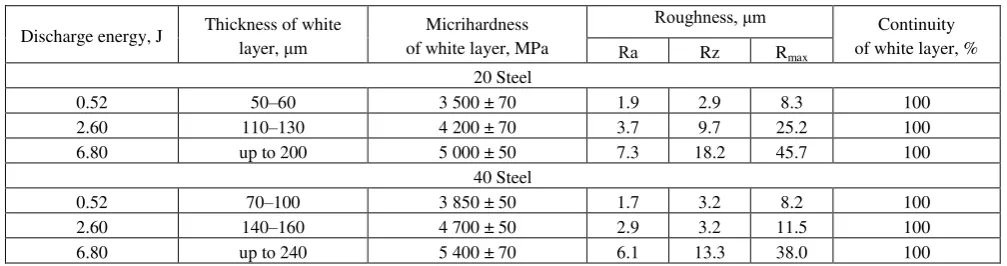
In Table 2, there are shown the qualitative parameters of the surface layers of 20 steel and 40 steel at performing the sulfo-aluminizing process using the EEA method at the discharge energy values of 0.52, 2.60, and 6.80 J.
The presence of sulfur in the consistency substance contributes to the sulfidizing process. In Table 3, there is shown the sulfur content while deepening from the sur-face in the course of sulfo-aluminizing 20 steel with the use of the EEA method at the discharge energy of 6.80 J.
Journal of Engineering Sciences, Volume 5, Issue 1 (2018), pp. C 16–C 20 C 19
a b
Figure 1 – Microstructure (a) and microhardness distribution in the surface layer (b)
Figure 2 – Profilogram of the surface layer of the specimen made of 20 steel
Table 2 – Qualitative parameters of the surface layers of 20 steel and 40 steel at sulfo-aluminizing them using the EEA method
Discharge energy, J Thickness of white layer, μm
Micrihardness of white layer, MPa
Roughness, μm Continuity
of white layer, %
R Rz Rmax
20 Steel
0.52 50–60 3 500 ± 70 1.9 2.9 8.3 100
2.60 110–130 4 200 ± 70 3.7 9.7 25.2 100
6.80 up to 200 5 000 ± 50 7.3 18.2 45.7 100
40 Steel
0.52 70–100 3 850 ± 50 1.7 3.2 8.2 100
2.60 140–160 4 700 ± 50 2.9 3.2 11.5 100
6.80 up to 240 5 400 ± 70 6.1 13.3 38.0 100
Table 3 – Sulfur content while deepening from the surface in the course of sulfo-aluminizing 20 steel with the use of the EEA method at the discharge energy of 6.80 J
Depth of measurement, μm 20 40 60 80 100 120 140 160 180 200
Presence of sulfur, % 0.21 0.17 0.12 0.10 0.08 0.07 0.06 0.04 0.03 0.03
5
Conclusions
The possibility of applying an environmentally friend-ly process of sulfo-aluminizing surface layers of machine parts by the method of electroerosion alloying has been considered. Metallographic and durametric analyses of the features of the surface layers of carbon steels after
C 20 MANUFACTURING ENGINEERING: Materials Science for all the investigated energies Wp = 0.52; 2.60, and 6.80
J is 100 %.
The presence of sulfur in the consistency substance fa-cilitates the sulfidizing process. While sulfidizing 20 steel by the EEL method at the discharge energy of 6.80 J, the sulfur content decreases with deepening from the surface, and at the depth of 180 μm, it corresponds to its amount in the base.
The comparative analysis of the substrate effect on the qualitative parameters of the surface layer in the course of the sulfo-aluminizing process by the EEL method has exposed that in the event of 20 steel being replaced by 40 steel, the thickness of the “white” layer and the transition
zone increases, i.e. there is increased the depth of the increased hardness zone, as well as the magnitude of its microhardness, while the surface roughness varies insig-nificantly.
For practical purposes, it is possible to recommend the sulfo-aluminizing process by the EEA method on the modes of discharge energy within Wp = 2.6 to 6.8 J and
productivity of 2.0 to 3.0 cm2 / min, which provide for the formation of the “white” layer thickness of 110 to 240 μm, the microhardness values of 4200 to 5 400 MPa, the roughness (Ra) values of 3.7 to 7.3 μm and the conti-nuity of 100 %.
References
1. Zozulya, V. D., Shvedkov, Ye. L., Rovinskiy, D. Ya., & Braun, E. D. (1990). Slovar-spravochnik po treniyu, iznosu i smazke de-taley mashin. Kyiv, Naukova dumka [in Russian].
2. Yelizavetin, M. A., & Satel’, E. A. (1969). Tekhnologicheskiye sposoby povysheniya dolgovechnosti mashin. Moscow, Mashi-nostroyeniye [in Russian].
3. Pyachin, S. A., Burkov, A. A., & Komarova V. S. (2013). Formirovaniye i issledovaniye elektroiskrovykh pokrytiy na osnove alyuminidov titana. Poverkhnost'. Rentgenovskiye, Sinkhrotronnyye i Neytronnyye Issledovaniya, No 6, 16–24 [in Russian]. 4. Tarelnyk, V. B., Martsynkovskyy, V. S., Bilous, A. V., Gaponova, O. P., Konoplianchenko, Ie. V., Antoszewski, B.,
Kundera, Cz., & Zhukov, O. M. (2017). Sposib obrobky poverkhon’ stalevykh detaley. Certificate of the authorship, Ukraine, No. 119316 U, 23 10/48 (2006.01) B23H 9/00, No. u201701845 [in Ukrainian].
5. Tarelnyk, V. B., Martsynkovskyy, V. S., Bilous, A. V., Gaponova, O. P., Konoplianchenko, Ie. V., Antoszewski, B., Kundera, Cz., Zhukov, O. M. (2017). Sposib sul’fotsementatsiyi stalevykh detaley. Certificate of the authorship, Ukraine, No. 119318 U, B 23 H 1/00 B 23 H 9/00 23 8/60 (2006.01), No. u201701847 [in Ukrainian].
і
і
ь
і
. .1, ь . .2, Ч.3, . .4, . .1
1 ь , . ь
- , 2, 40007, . , ;
2 ь ь , 40021 , . ьє , 160, ;
3 . ь , . ь , 7, 25
-314, . ь , ь ;
4 « «
», . ь , 45/5, . , 54030,
А і : ь ,
, ( ) ь є ( )
( ь ) ь ,
, ,
. є
є Wр = 0,52–6,8 1,0–3,0 2/ є
, є , ь , ь є
, , , ь
є , , ь є
ь 56 %.
ь . ,
є ь ь : « » , . ь
ь , , ь « »
, ь. ь ь « » Wр = 0,52;
2,60 6,80 ь 100 %.
і : , ь, , , ь ,