INTRODUCTION
Genus Sonchus belong to the family Asteraceae. It is the largest family of angiosperms comprises of over 1535 genera and 23000 species, distributed in three subfamilies and 17 tribes. The number of genera is rather increasing as more than 10 genera are described each year and several are resurrected from or reduced to synonymy 1.
The genus Sonchus L. (Asteraceae) has a worldwide distribution except for Central and South America 2. It is commonly considered to be related to Aetheorhiza Cass., Reichardia Roth and Launaea Cass. 3-4, but it is a more isolated and distinct genus 4-5. Sonchus is represented with seven taxa in Turkey 6. Some of which are used as a food in Turkey 7. The genus Sonchus, representing 8 species in China, has long been used as folk medicine for the treatment of fever, stasis, and inflammation, as well as for detoxication and mobilization of blood circulation 8. Genus sonchus showed a marked reduction in its relative growth
Isolation and Characterization of Two New Compounds
from Genus Sonchus
ZIA MUHAMMAD
1, SHABIR AHMAD
1, RIAZ ULLAH
3, 4,
FARMAN ULLAH
2and SALEEM JAN
21Department of Chemistry, Kohat University of Science and Technology Kohat, Kohat -260 00, K.P.K (Pakistan).
2Department of Chemistry, Bannu University of Science and Technology Bannu, K.P.K (Pakistan). 3Department of Chemical Engineering, College of Engineering, King Saud University, P.O BOX 800,
Riyadh 11421 (Saudi Aarbia).
4Department of Chemistry Govt College Ara Khel FR Kohat K.P.K (Pakistan). (Received: April 04, 2012; Accepted: May 20, 2012)
ABSTRACT
Two new compounds Erucaoic acid (1) and sonchusnoate (2) were isolated from the whole plant of Sonchus eruca and Sonchus asper respectively. Both species belong from genus Sonchus. The structures of the compounds were elucidated through extensive spectroscopic analysis including EIMS, HREIMS, 1H-NMR, 13C-NMR and including advance techniques like NMR 1H-1H COSY, HMBC, and NOESY.
Key words: S. eruca, S. Asper, Erucaoic acid and Sonchusnoate
rate at elevated levels of ozone 9. Flowers are perfect and generally self-incompatible. Perennial sowthistle can reproduce by seed and vegetatively is pollinated by insects including honeybees and other bees, hover flies, and blister beetles 10. Pollen grains of Asteraceae may be resolved into two major groups i.e., lophate and non-lophate grains 11. Within the genus Sonchus,probably rising from Launaea12. The most primitive taxa, included in the subg.Origosonchus Boulos, show pollen characters very similar to those of Launaea 12-13.
RESULTS AND DISCUSSION
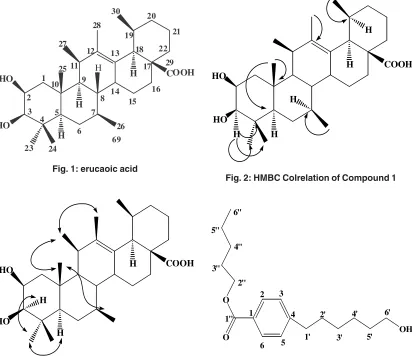
Compound 1 (Fig 1) was isolated as a colorless powder from the chloroform soluble part of the methanolic extract of S. eruca was subjected to silica gel gradient column chromatography (CC) using solvent system of hexane/chloroform (1: 9).
Table 1: 1H NMR Data of Erucaoic acid (1)
Proton on Chemical Shift (δδδδδ) Proton on Carbon Chemical Shift (δδδδδ) Carbon
1 1.36 (d) 16 2.02 (m)(2H, J = 3.0Hz)
2 3.68 (m) 17
-3 3.52 (d)(1H, d, J = 6.11Hz). 18 2.76 (d)(1H, d, J = 11.2Hz)
4 - 19 1.05 (m)
5 1.43 (dd)(1H, J = 13.6, 4.0Hz) 20 0.96 (m)
6 1.10 (dd)(2H, J = 11.6, 4.7Hz) 21 1.00 (m)
7 1.23 (m) 22 1.08 (t)(2H, J = 3.5Hz)
8 1.55 (m) 23 0.94(3H, s )
9 1.36 (dd)(1H, J = 10.2, 3.7Hz) 24 0.95(3H, s )
10 - 25 1.76(3H, s)
11 2.34 (d)(1H, J = 12.2Hz) 26 1.05(3H, s)
12 - 27 1.66(3H, s, H-27)
13 - 28 1.71(3H, s)
14 1.49 (m) 29
-15 1.31 (m) 30 1.05(3H, s, H-30)
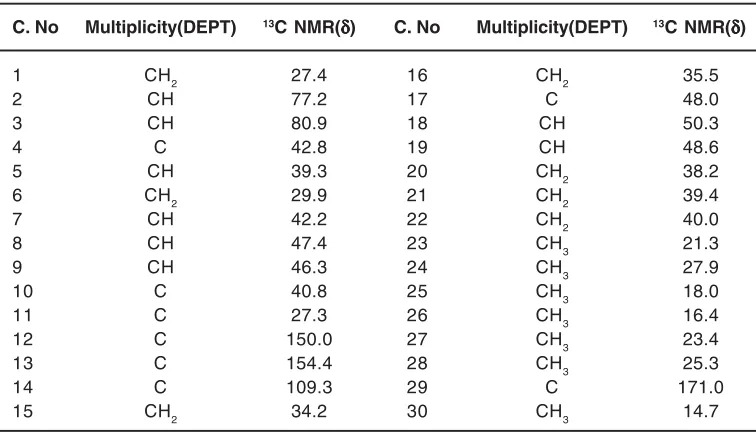
Table 2: 13C NMR Data of Erucaoic acid (1).
C. No Multiplicity(DEPT) 13C NMR(δδδδδ) C. No Multiplicity(DEPT) 13C NMR(δδδδδ)
1 CH2 27.4 16 CH2 35.5
2 CH 77.2 17 C 48.0
3 CH 80.9 18 CH 50.3
4 C 42.8 19 CH 48.6
5 CH 39.3 20 CH2 38.2
6 CH2 29.9 21 CH2 39.4
7 CH 42.2 22 CH2 40.0
8 CH 47.4 23 CH3 21.3
9 CH 46.3 24 CH3 27.9
10 C 40.8 25 CH3 18.0
11 C 27.3 26 CH3 16.4
12 C 150.0 27 CH3 23.4
13 C 154.4 28 CH3 25.3
14 C 109.3 29 C 171.0
15 CH2 34.2 30 CH3 14.7
degrees of un-saturation. The molecular formula of the compound 1 was further confirmed by the exact measurement of various mass fragment ions. In addition to the molecular ion peak, other prominent peaks appeared at m/z 190.10, 246.17, 201.175. The IR spectrum showed hydroxyl (3525 cm-1), carboxylic (1715 cm-1) and C=C (1660 cm-1) functionalities.
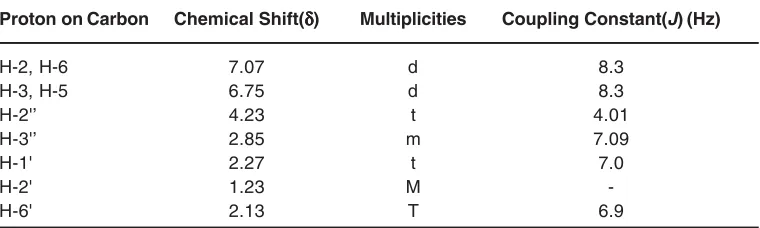
Table 3: 1H NMR Data of Compound Sonchusnoate (2)
Proton on Carbon Chemical Shift(δδδδδ) Multiplicities Coupling Constant(J) (Hz)
H-2, H-6 7.07 d 8.3
H-3, H-5 6.75 d 8.3
H-2'’ 4.23 t 4.01
H-3'’ 2.85 m 7.09
H-1' 2.27 t 7.0
H-2' 1.23 M
-H-6' 2.13 T 6.9
Table 4: 13C NMR Data of Compound Sonchusnoate (2)
C.No (DEPT) 13CNMR(δδδδδ) C.No (DEPT) 13CNMR(δδδδδ) C.No (DEPT) 13C NMR(δδδδδ)
1 C 152.1 1'’ C 173.0 1' CH
2 39.63
2 CH 130.1 2'’ CH
2 64.87 2
' CH
2 32.37
3 CH 117.3 3'’ CH
2 34.35 3
' CH
2 29.16
4 C 136.3 4'’ CH
2 33.34 4
' CH
2 24.98
5 CH 119.3 5'’ CH
2 31.94 5
' CH
2 22.70
6 CH 130.1 6'’ CH
3 14.70 6
' CH
2 62.08
resonated at δ = 1.71 (3H, s, H-28) where as the signal at δ = 3.68 (m) was owed to proton (H-2) while another signal at δ = 3.52 (d, J = 6.11Hz) was due to another carbinylic proton (H-3). The characteristic signals for double bond in 13C NMR at δ = 150.0 and 154.0 (C-12, C-13), suggested compound 1 to be an oleanane triterpenoids with carboxylic functionality (δ = 181.3) [14]. The ß-orientations of hydroxyl groups at C-2 and C-3 were determined through chemical shift and coupling constant of H-2 (J = 4.9, 9.7 Hz) and H-3 (J = 6.11Hz). The 13C NMR assignments of various carbon atoms were confirmed through DEPT analysis, which showed 30 signals, which were substantiated through DEPT experiment into seven methyl, seven methylens, ten methines and six quaternary carbons. The position of hydroxyl group and quaternary carbon was further confirmed through HMBC correlations (Fig. 2). The proton at δ 3.52 (H-3) showed correlation to the carbons at δ 42.82 (C-4), δ 21.33 (C-23), and δ 27.95 (C-24). The proton at δ 1.01 (H-25) showed correlation with carbon at δ 40.85 (C-10), and δ 39.39 (C-5), having the methyl group at C-10. (H-7) methane proton (δ
1.23) showed correlation with carbon at δ 29.9 (C-6). The proton at δ 2.76 (H-18) showed correlation with carbon at δ 14.7 (C-30). Similarly, the proton at δ 0.96 (H-20) showed correlations with carbon at δ 14.7 (C-30).
The NOESY for H-C (2)/H-C (3), H-C (3)/ Me (23), H-C (5)/H-C (9), H-C (9)/H-C (18) and H-C (18)/H-C (19) (Fig 3) indicated that these protons have same orientation (α). On the other hand, an NOE for H-C (8)/Me (26) suggested their position on the β side and the magnitude of the coupling constants was indicative for a chair confirmation of ring E 15. From this data compound 1 was found new and was trivially named to be Erucaoic acid. Proton and 13C NMR Data are given in Table 1 and Table 2.
determined through HR- EI- MS as C18H28O3 (calcd. m/z 292.1118). In addition to the molecular ion peak, other prominent peaks appeared at m/z 115, 71 and101.
The 1H-NMR spectrum of 2 showed a triplet with coupling constant (7.0 Hz) at δ 2.27 which was directly attach with aromatic ring. Similarly, another triplet with coupling constant (4.01 Hz) at δ 4.23 was due to oxygenated methylene.
The 1H-and 13C- NMR chemical shifts of methylene (δ 4.23 and 64.8) revealed its attachment with an oxygen atom. The appearance of two doublets at aromatic ring (δ =7.07 and 6.52) with the same coupling constant (J = 8.3 Hz) indicated a para substitution pattern.
The doublets at δ 7.07 was due to carbons at δ 130.0 which was deduced through HMQC experiments and considered as methines with the help of DEPT experiments. The broad band 13 C-NMR spectrums of 2 indicated 18 signals due to which were resolved through DEPT experiments into 1 methyl, 4 methines, 10 metylenes and 3 quaternary carbons. The methine signal at 130.0 was assigned to the ortho positions (C-2, C-6). The C-3and C-5were routinely given by methines at ä 115.3 having protons at δ 6.75. The quaternary signal at δ 154.1 was assigned to C-1by comparing with reported data 16. Another quaternary signal at δ 146.3 revealed its attachment to a hydrocarbon chain containing terminal hydroxyl group and assigned to C-4. The downfield quaternary carbon
COOH HO
HO
H
H
H
H
1
2 3
4 5 6
7 8 9 10
11
12 13
14 15
16 17 18 19
20
21
22
23 24 25
26 27
28
29 30
69
Fig. 1: erucaoic acid
HO
HO
H H
H
H
COOH H
Fig. 2: HMBC Colrelation of Compound 1
COOH HO
HO
H
H H
Fig. 3: Important NOESY Colrelation of 1
OH O
O 1
2 3
4
5
6 1'
2'
3' 4'
5' 6' 1''
2'' 3''
4'' 5''
6''
(C-1'’) at δ 173.01 was due to a carbonyl group. The signals at δ 64.87 and 34.35 in the 13C-NMR spectrum were ascribed to (C-2'’)and (C-3'’).This discussion led to the presence of the following fragments in the molecule.
All the chemical shifts were confirmed through EI, 1H, 13C NMR and HMBC techniques and partial comparison with the reported data16-18. The discussion so far led to deduce 1 was found new and was trivially named to be Sonchusnoate. Proton and 13C NMR Data are given in Table 3 and Table 4.
MATERIALS AND METHOD Plants Material
Both plants S. eruca and S. asper were collected at Parachinar Kurram agency, KPK Pakistan, in July, 2008, and were identified by plant taxonomist Mohammad Siraj Assistant professor, Govt: Post Graduate College (Jahan zeb college swat. The voucher specimens of plants S. eruca (SEZ1) and S. asper (SEZ2) were deposited in the herbarium of botany department Kohat University of Science and Technology Kohat (KUST). Extraction and Purification of Compound 1
The whole plant, including roots (3 kg) of S. eruca was crushed and extracted x 3 with methanol (20 L each) at room temperature. The resulting methanol extract (155 g) was suspended in water and successively portioned to provide n-hexane (19 g), chloroform (57 g), ethyl acetate (40 g) and butanol (7 g) fractions. The chloroform (57 g) was subjected to silica gel column (90 x 850 nm, 500 mL each part). The column was eluted with solvent of increasing polarity hexane-CHCl3 (9:1 up to 1:9), CHCl3, CHCl3 –MeOH (9:1 up to 1:9) and MeOH to given three fractions. The fraction 3 (300 mg) was then subjected to silica gel (flash silica
250-400 mesh) column chromatography using hexane - CHCl3 (1: 9) to afforded a compounds 1, provisionally named Erucaoic acid. Erucaoic acid White powder, 50 mg. IR (KBr): OH (3525 cm-1), carboxylic (1715 cm-1) and C=C (1660 cm-1) functionalities.1H NMR (300 MHz, CDCl
3) Table 1. 13C NMR (75 MHz, CDCl
3) Table 2
Extraction and Purification of Compound 2 The whole plant, including roots (5 kg) of S. asper was crushed and extracted three times with methanol (20 L each) at room temperature. The resulting methanol extract (190 g) was suspended in water & successively portioned to provide n-hexane (34 g), chloroform (70 g) and ethyl acetate (47 g) fractions. The chloroform (70 g) was subjected to silica gel column chromatography. The column was eluted with solvent of increasing polarity hexane-chloroform, chloroform, chloroform-methanol and chloroform-methanol to given five fractions 1-5. The fraction 2 (350 mg) was then subjected to silica gel (flash silica 230-400 mesh) column chromatography using methanol: chloroform (1:9) to afforded a new powder like compound 2, provisionally named sonchusnoate. The compound was found ceric sulfate active. Sonchusnoate White powder, 15 mg.1H NMR (300 MHz, CDCl
3) Table 3. 13C NMR (75 MHz, CDCl
3) Table 4. CONCLUSIONS
New Constituents, Erucaoic acid (1) and sonchusnoate (2) were isolated from the whole plant of S. eruca and S. asper respectively. The isolation of the new compounds are a new addition to the molecular diversity of S. eruca and S. asper
ACKNOWLEDGEMENTS
The authors wish to thank the Higher Education Commission, Government of Pakistan.
REFERENCES
1. Bremer, K.; (Asteraceae cludistics and classifications, Timber Press Port Land Oregon, (1994).
2. Heywood, V.H.; Flowering Plants of the World.Oxford University Press, Oxford,
London, (1978).
3. Stebbine, G. L., R.,. A new classification of the tribe Cichorieae, family Composite. Madrono, 12: 65-81 (1953).
African. Notes on Compositae: I. Kew Bull, 18: 427-486 (1966).
5. Sell, P.D.; Taxonomic and nomenclatural notes on the Compositae subfam. Cichorioideae. In: Heywood, V.H. (ed.), Flora Europaea, Notulae systematicae ad Floram Europaean spectantes, Bot J Linn Soc, 71: 236–267 (1975).
6. Davis, P, H.; Flora of Turkey and the East Aegean Islands, V 10. Edinburgh Univ. Press (1988).
7. Akarturk, R.; fiifal Bitkiler Flora ve Salmz, Bask Orman Genel Mudurluu Mensuplar Yardmlaflma Vakf. Ankara, (2001).
8. Jiangsu New Medical College, OA Dictionar y of the Traditional Chinese Medicines Shanghai Science and Technology Press, Shanghai, 1286 (1976). 9. EI-Khatib, A.A.; The response of some common Egyptian plants to ozone and their use as biomonitors Environ Pollut, 124(4): 419-28 (2003).
10. Stevens, O.A.; Perennial sowthistle: Growth and reproduction. Bulletin 181, Fargo, ND: North Dakota Agricultural College, Agricultural Experiment Station, 42: (1924). 11. Qureshi, S.J.; Awan, A.G, Khan, M.A.;
Palynological study of the genus Sonchus from Pakistan. Journal of Biological Sciences, 2(2): 98-105 (2002).
12. Saad, S.I.; Pollen morphology in the genus Sonchus. Pollen and Spores, 3: 247-260 (1961).
13. Pons, A and Boulos, L Revision systematique du genre Sonchus L. S. 1. III. Etude Palynologique. Bot Not, 125: 310-319 (1972).
14. Gupta, G.S.; Gupta, N.L. Constituents of Zataria multiflora, Phytochemnistry. 11: 1455-456 (1972).
15. Mahmoud, Z.; EI-Masr y, Grenz, M. Sesquiterpene lactones from Sonchus macrocarpus Phytochemistry. 23(5): 1105-1107 (1984).
16. Olsen, C. E,; Reminder, S.; Suman, G.; Bishi, K. S. Chemical constituents of Taxus canadensis. Indian Journal of Chemistry. 37B: 828-831 (1998).
17. A.V. Subbayamma and C. Rambabu. Orient. J. Chem. 26(1): 151-154 (2010).