The approach of the Policy Analysis Matrix to the study of
the cashew nut sector in Cote d’Ivoire
Dr KOUAKOU Kouakou Paul-Alfred Researcher in agricultural economics
University Peleforo GON COULIBALY, Republic of Cote d’Ivoire
Abstract:
The objective of the study is to evaluate the economic and financial performances of actors of the cashew nut sector in Cote d'Ivoire. This study uses Monke and Pearson's (1989) Policy Analysis Matrix (PAM).
To achieve this, 282 actors in the sector including 252 producers, 25 traders and 5 agents of the management structures were visited in the department of Korhogo from August to September, 2018.
These actors are essentially male (94.44%) and largely illiterate (69.15%), with an average age of 45.54 years for producers and 42.59 for traders.
This study revealed that despite the distortions, the cashew nut sector is financially and economically profitable (Net margin, financial and economic profit are greater than zero).
However, it is poorly protected at the producer level (Nominal Protection Coefficient (0.95) is less than 1), whereas, traders benefit from a slight comparative advantage and an implicit subsidy (Domestic Resource Cost equals 0.855 and less than 1).
Key Words: cashew nut, performance, PAM, Korhogo
INTRODUCTION
In Cote d’Ivoire, as everywhere else in West Africa, agriculture occupies an important place in development policies (Kouakou, 2017). On the one hand, through food products, it is possible to achieve food self-sufficiency and on the other hand, through export products, to raise the level of the national economy (Sarah and Alexis, 2004). The Ivorian agricultural sector represents 22 % of the Gross Domestic Product (GDP), more than 3/4 of non-oil exports and provides jobs for 2/3 of households. Agriculture with cash crops such as coffee, cocoa, hevea and oil palm occupy forest areas then cotton and recently cashew in savannah areas (MINADER, 2017).
In fact, the cashew tree introduced in Cote d’Ivoire to fight against deforestation and the advance of the desert to the North, became a culture of speculation from the 1990s (Amani, 2012). The current production of cashew nut is to 702,000 tones, or 21% of the world production. As well, cashew nuts are grown by 250,000 households and support around 2.5 million people. It has thus become the most important source of income in rural areas in the central and northern part of Cote d’Ivoire (Sanogo, 2016).
However, the sector is quite disorganized and its management bodies are struggling to optimize the commercial relations that govern the different actors in the value chain. There is a climate of suspicion that does not facilitate the trade of the production until the export according to the RONGEAD (2011).
To this, are added several constraints according to this same source:
- the prices that vary greatly;
- the lack of information at the level of producers on the price situation;
- the poor organization of producers;
- the low level of processing the cashew nuts;
- the lack of the state system to stabilize prices;
- the numerous loses recorded for the collection of products;
- an instability that leads to underinvestment in the sector.
This situation leads us to evaluate the economic and financial performances of cashew nut production and marketing in Cote d’Ivoire in order to determine the factors for its improvement.
Specifically, it involves:
(1) analyzing the financial and economic profitability of the production and marketing functions of the sector;
(2) measuring the effect of distortions on the different production and marketing systems;
(3) determining the costs of producing and marketing cashew nuts in the various production systems identified;
(4) evaluating the impact of hazards on performance;
(5) and finally proposing measures to improve performance in a sustainable and structural way.
MATERIAL
Technical material
Biological material
Cashew nut, the fruit of cashew nut is the biological material. Cashew (Western Anacardium) is a tree from Brazil of the family Anacardiaceae as well as pistachio or mango. It is an evergreen tree, covering the ground well, with a short , tortuous trunk, with low branches spread horizontally. It adapts to a varied range of soils. However, the best yields are obtained in light sandy, deep and well-drained soils. It adapts to various rainfall regimes. The optimum production is obtained in areas where the annual rainfall is between 900 and 12000 mm spread over 5 to 7 months with a well-marked dry season during flowering. A this periods, the cashew tree is very sensitive to very hot harmattan winds that dry the flowers (Nugawela, 2006).
The cashew tree gives a fruit consisting of cashew nuts and cashew apple (Figure 1). The nut is made up of:
- a highly marketed white almond used in the agri-food industries. The almond is energetic, rich in lipids and proteins. It also contains vitamins and trace-elements and provides a reasonably balanced blend of protein, fat and carbohydrates ( Nugawela, 2006).
- an acid and poisonous shell that is often used as fuel at the level of processing units.
- Cashew balm extracted from the hull surrounding the kernel is a kind of highly sought after by the industrialist for its unique properties in the manufacture of brake oil, clutches, rubbers and insulators.
- The nut forms under a swollen, fleshy and juicy stalk called (the cashew apple).
It is very rich in sugar and vitamin C. It has 5 times more vitamin C than lemon and 9 times more than sweet orange. Its high water content makes its conservation very difficult (Koné, 2001).
Figure n01: Main varieties of cashew trees grown in the department of Korhogo
METHODS
Choice of the study area
The study took place from August to September, 2018 in the Korhogo department. It spreads to Korhogo commune and 18 villages ( Sirasso, Soumon, Namgbékaha, Dokaha, Plétimené, M’Balla, Nouhouo, Sakpéllé, Séguébé, Talléré, Donitiékaha, zangokaha, Trékaha, Dagbaplé, Dagba, Sambokaha, Soloboho and Lopin).
This choice focuses on:
- firstly, the importance of cashew nut production (25, 000 tones).
- secondly, the availability of actors ( peasants, traders, management structures).
Collection of data
The information was collected using direct obsevation, the questionnaire and the interview guide.
Sampling
The target of population of our survey mainly includes: producers, traders, agents of framwork structures and cashew industry management organizations such as MINADER, CCA, ANADER, Professional Agricultural Organizations, CNRA, OCPV, RONGEAD. The sampling was constructed from sampling techniques of random choice.
It has two hundred and eighty-two actors in the sector, obtained on the basis of one-tenth of the total number of actors surveyed (Table I). For all the number of the actors, the samples are chosen excessively with reference to the result obtained from of the following formula:
,
n = size of sampling;
ni = number of actors per production area;
N= total number of actors of the study area; = relative frequency.
Table I: Distribution of respondents per production area
Actors ni (actors listed) ni/N n.ni/N Xi (Actors surveyed by function)
Producers 2224 0.894 252.4 252
Traders 250 0.089 25 25
Agents of framwork structures 50 0.018 5 5
Total 2824 1.00 282.4 282
Method of data analysis
Descriptive statistics
The descriptive statistics were used to study the socio-economic characteristics of actors in the cashew nut sector.
Policy Analysis Matrix (PAM)
In this study, we used the PAM developed by Monke and Pearson in 1989 (Table II and III), based on a sample of actors residing in the study area and on the consolidation of data relating to the cashew nut sector. PAM is composed of two types of budgets: a budget valued at market price or financial price and the other at opportunity cost or economic price is the edge price. For the trader, the financial price is the price at which he sells his goods to the exporter. The economic price is the export sale price of the cashew nut. It was calculated from the producer price by adding to the latter the various costs incurred from the field to the wholesaler to the exporter (duty paid, transport costs).
The opportunity cost of the various farming operations (clearing, seedbed, and weeding) was calculated from the costs of the wage labor obtained from the producers. The financial price of inputs is the market price. The economic price is the CIF price (Cost, Insurance and Freight) of the goods. The method of calculating the amortization used is that of the linear amortization.
The construction of the PAM was based on the price observed in 2017.
Table II: Policy Analysis Matrix (PAM)
Indicators Revenues Input cost Profit Tradable goods Non-tradable goods
Private prices A B C D =A-B-C
Social prices E F G H =E-F-G
Net transfers I =A-E J =B-F K =C-G L =D-H=I-J-K.
Source : Monke et Pearson (1989).
Table III: Financial and economic efficiency indicators of the Policy Analysis Matrix (PAM)
1- Private profit D=A-B-C
2- Private Cost Ratio PCR=C/ (A-B)
3- Social profit H=E-F-G
4- Domestic Resource Cost Ratio DRC=G/(E-F)
5- Social Cost Ratio SCR= (F+G)/E
6- Transfer L=I-J-K
7- Nominal Protection Coefficient NPC=A/E
8- Effective Protection Coefficient EPC= (A-B)/(E-F)
9- Profitability Coefficient PC=D/H
10- Subsidy Ratio to Producers SRP=L/E
11- Equivalent Subsidy to producers ESP=L/A
RESULTS
Socio-economic characteristics of the cashew nut producers
Main activity of the producers of cashew nut
The main activity of the cashew nut producers is agriculture (64.26% of the farmers). Nevertheless, 22.74% are primarily engaged in trading. And finally, 13 % associate agriculture with a secondary activity such as masonry, carpentry, mechanics, and charlatanism.
The average household size is about 11 members. Households headed by women have fewer members (about 9 members including 3 at least and 13 at more). Male-held households have an average of 13 members. In general, cashew plantations in the study area are generally led by men (94.44 % men versus 5.56 women).
The average age of heads of households is around 49 years old. In fact, the youngest farmer is 21 years old. On the other hand, the oldest is 73. It should be noticed, however, that the average age of women producing cashews is about 51 years against 46 years for men.
Marital status of the actors
The study shows that 96.64% of the men are married, against 1.68% single and 0.42% divorced. Among women, 57.14% are married and 42.86% are widowed.
Level of education of the actors
Most of the cashew nut producers are illiterate (69.15%). This rate is even higher for women (85.71% versus 68.28% for men). Among the heads of farmers, 24.11% have a primary level of education. At this level, the percentage of men who attended primary school was 24.63%. This rate is higher than that of women, which is 14.29%.
Characteristics of cashew orchards
The cashews’ orchards which range in age from 5 to 20 years make up 60 % of the cashew farms. Nevertheless, 40% of the plantations have already reached the end of their economic life (30 years) and are therefore less productive. Orchard sizes range from 0.5 ha to 45 ha with an average of 8.08 ha. In the Korhogo department, producers mainly use rudimentary tools (hoe, machete …).
The labor used is in general familial (60.10% for the maintenance and 52.21% for the harvest). The self-help workforce represents 19.75% in maintenance and 1.07% in the harvest.
Producers’ organization
According to the study, 40.76% of the men producers are members of a professional agricultural organization. At the level of women producers, 28.57% belong to a professional agricultural organization. Overall, it can be noted that 40.08% of cashew nut production actors are members of a professional agricultural organization.
Land tenure and access to land
The sown lands are acquired at the rate of 63.16% per inheritance, 34.82 per donation and 2.02% by
the indirect tenancy mode (sharecropping).
Financing of agricultural activity
In Korhogo, the main mode of financing cashew nut production operations remains equity capital (70.24). On the other hand, 26.19% of the producers use “advance purchase” which is a loan contracted from a merchant or an individual and repayable in cash or in kind. In addition, 3.57% of the producers are seeking financial assistance from commercial companies in the sector.
Socioeconomic characteristics of the actors of the marketing
Sociological profiles of traders
In the Korhogo department, the cashew nut trade is practiced by the men if one notices the presence of some women (88% of men against 12% of women). Marketers have a high level of education. In fact, 72% of traders are educated.
Socio-professional profile of traders
The average age of traders is 38 years old. In addition, the average number of years of traders’ experience is 10 years.
Economic and financial assesssment of cashew nut production
Operating account of the cashew nut producers
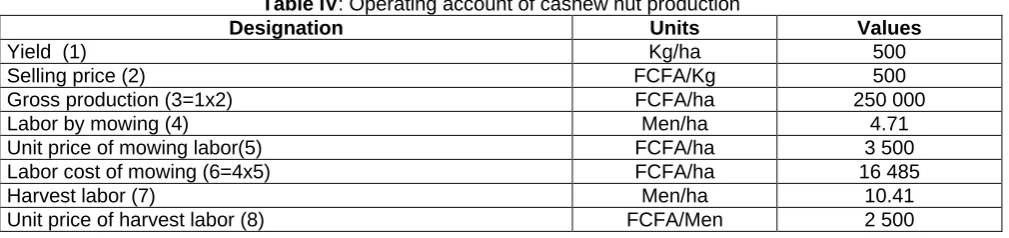
The operating account is designed on the basis of information collected from Korhogo department producers (Table IV).
Table IV: Operating account of cashew nut production
Designation Units Values
Yield (1) Kg/ha 500
Selling price (2) FCFA/Kg 500
Gross production (3=1x2) FCFA/ha 250 000
Labor by mowing (4) Men/ha 4.71
Unit price of mowing labor(5) FCFA/ha 3 500
Labor cost of mowing (6=4x5) FCFA/ha 16 485
Harvest labor (7) Men/ha 10.41
Labor cost of harvest (9=7x8) FCFA/ha 26 025
Intermediate consumption (10=6+9) FCFA/ha 42 510
Gross margin (11=3-10) FCFA/ha 207 490
amortization (12) FCFA/ha 24 916.67
Net margin (13=11-12) FCFA/ha 182 573.33
According to this table, the production cost of cashews averages 42 510 FCFA/ha per year. These expenses are exclusively related to the workforce. Also, the production generated by household, a net margin of 182 573.33 FCFA/ha and per year. As such, it is a profitable activity that creates seasonal jobs every year at 15 per hectare.
Financial and economic performance of cashew farmers
Policy Analysis Matrix (PAM) of cashew nut production
The results in Table V indicate that cashew nut production is financially profitable for the producers. The financial profit per hectare is of 106 490 FCFA. This profit is distributed throughout the production chain between the different actors.
Moreover, the economic profitability is of 176 890 FCFA. The sector is economically profitable and contributes to the economic growth.
The transfer analysis shows that the exchangeable factors are taxed at 32 233 FCFA. The non -exchangeable factors are also subject to a tax of 25 666.67 FCFA.
Table V: Policy Analysis Matrix (PAM) of cashew nut production in FCFA / ha
Indicators Revenues Input cost Profit Tradable goods Non-tradable goods
Private prices A=250 000 B=71 083 C=72 426.67 D =106 490
Social prices E=262 500 F=38 850 G=46 760 H =176 890
Net transfers I =-12 500 J =32 233 K =25 666.67 L =-70 400
Financial and economic efficiency indicators of the Policy Analysis Matrix (PAM) of cashew nut production
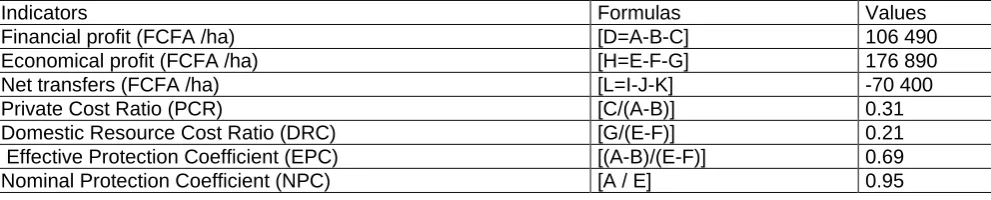
The different indicators are shown in Table VI. In the light of the results, the financial profit (D) as already indicated above shows that the production function of the cashew nut sector is financially profitable. In addition, Private Cost Ratio (PCR) (0.31%) is less than 1. And thus, revenues from the cashew nut production activity are well above the agreed expenditures. Producers allocate their resources efficiently. Thus, any intention of investing in the activity of cashew nut production of the department should be encouraged.
The economic profit (H) is positive and equals to 176 890 FCFA/ha. The cashew nut production contributes to the economic growth of the department mainly in Cote d’Ivoire.
We also note that the Domestic Resource Cost Ratio (DRC) is equal to 0.21 and less than 1. The production of the cashew nut in the department therefore has a comparative advantage. Besides, it understands nothing of the lower social cost than the net income of the local community. Cashew nut production has an Effective Production Coefficient (EPC) of 0.69. The EPC being less than 1 then the producers are taxed and they do not benefit from any incentive to produce.
Likewise, the production system presents a negative net transfer. Thus, producers are disadvantaged and face an implicit tax of 70 400 FCFA/ha.
The Nominal Protection Coefficient is less than 1. This means that producers are not protected by the current agricultural policy.
Table VI: Financial and economic efficiency indicators of the Policy Analysis Matrix (PAM) of cashew nut production
Indicators Formulas Values
Financial profit (FCFA /ha) [D=A-B-C] 106 490
Economical profit (FCFA /ha) [H=E-F-G] 176 890
Net transfers (FCFA /ha) [L=I-J-K] -70 400
Private Cost Ratio (PCR) [C/(A-B)] 0.31
Domestic Resource Cost Ratio (DRC) [G/(E-F)] 0.21
Effective Protection Coefficient (EPC) [(A-B)/(E-F)] 0.69
Economic and financial assessment of the marketing of cashew nut
Operating account of cashew nut marketing
The export price of cashew nut by marketers, especially wholesalers, follows two different scenarios, each depending on how the wholesalers are financed.
For the first scenario, wholesalers, on the basis of trust and years of experience in cashew marketing, receive pre-financing from exporters (Indian or Pakistan partners, economic operators…). The latter then impose a quantity and a purchase price of the stocks on the wholesalers they have prefinanced.
For the second scenario, wholesalers are self-financing and selling their stocks to the highest-selling exporters with the possibility of negotiating the sale price of cashew in Abidjan. In the Korhogo department, 95% of the actors in cashew nut marketing use the first option. However, in the case of this study, we will use the minimum selling price in this locality. An operating account of this link in the cashew sector has been developed and presented in Table VII.
During this campaign, wholesalers sold their stocks to exporters’ at one time average selling price of 674 FCFA/kg at the port of Abidjan. However, they bear an average cost of 546 200 FCFA per ton and realize a gross margin of 126 800 FCFA/ton. This profit can be important depending on the quantity of the product.
Table VII: Operating account of cashew marketing
Designations Units Amounts
Average selling price(1) FCFA/ton 674 000
Average purchase price (2) FCFA/ton 500 000
Average cost of primary collection(3) FCFA/ton 10 000
Average reconciliation cost (4) FCFA/ton 15 000
Average warehouse cost (5) FCFA/ton 2 000
Municipal tax(6) FCFA/ton 2 200
Loading cost(7) FCFA/ton 1 500
Average cost of transport (8) FCFA/ton 15 000
Other charges (customs, etc.) (9) FCFA/ton 1 500
Average cost of production(10=2+3+4+5+6+7+8+9) FCFA/ton 547 200
Gross margin (11=1-10) FCFA/ton 126 800
Amortization (12) FCFA/ton 6 500
Net margin (13=11-12) FCFA/ton 120 300
Policy Analysis Matrix (PAM) of the marketing of cashew nut
Table VIII shows the PAM of cashew nut marketing in Korhogo department. From the results, we note that the marketing of cashew nut is financially profitable. The financial profit per ton is 94 800 FCFA. This profit is distributed roof throughout the campaign between the different actors of the marketing.
Moreover, it is economically profitable because the economic profit is positive (92 500 FCFA/ton). This sector thus contributes to the economic growth of the Korhogo department or even of Cote d’Ivoire. However, we see a transfer of financial flows from the rest of the economy to the marketing function. This flow equals 2 550 FCFA/ton.
Table VIII: Policy Analysis Matrix(PAM) of the marketing of cashew nut in FCFA / ton
Indicators Revenues Input cost Profit Tradable goods Non-tradable goods
Private prices A=674 000 B=25 500 C=553 700 D =94 800
Social prices E=654 000 F=18 250 G=543 500 H =92 250
Net transfers I =20 000 J =7 250 K =10 200 L =2 550
Financial and economic efficiency indicators of Policy Analysis Matrix (PAM) of the cashew nut marketing
According to the table IX, the marketing function of the cashew nut sector is profitable for Korhogo department traders. Indeed, the financial profitability of marketing cashew nut is positive. It generates a financial profit equal to 94 800 FCFA/ton.
Also, the Private Cost Ratio (PCR) is equal to 0.852 and therefore less than 1. Therefore, revenues from the cashew nut marketing business are well above expenditures.
In addition, we note a transfer of financial flows of 2 550 FCFA/ton from the rest of the economy to traders. In addition, financial profit is greater than economic profit, so the nation transfers income to traders.
(DRC) is 0.855 and less than 1. The cashew nut marketing activity reinforces a comparative advantage. Moreover, even though traders create wealth for the rest of the community, they arrogate more wealth (higher financial profitability than economic profitability).
In addition, with net transfers of 2 550 FCFA/ton, wholesale traders benefit from an implicit subsidy. This economic policy measure is confirmed by an Effective Protection Coefficient (EPC) which is slightly higher than 1. The EPC equals to 1.0098 would be the result of a joint protection on the export sales price of cashew nut and on the exchangeable factors (the scales, the bags…).
It also means that traders earn more income than they would earn without price distortion. This situation partly explains the gains made by the big traders at the expense of the community.
Table IX: Financial and economic efficiency indicators of the Policy Analysis Matrix (PAM) of cashew nut marketing
Indicators Formulas Values
Financial profit (FCAF/ton) [D=A-B-C] 94 800
Economical profit (FCFA/ton) [H=E-F-G] 92 250
Net transfers(F CFA/ton) [L=I-J-K] 2 550
Private Cost Ratio [C/(A-B)] 0.852
Domestic Resource Cost Ratio (DRC) [G/(E-F)] 0.855
Effective Protection Coefficient(EPC) (A-B)/(E-F) 1.0098
Nominal Protection Coefficient (NPC) [A/E] 1.0306
DISCUSSION
This study revealed that 64.26% of the population is mainly engaged in agriculture. This would justify their performance at the production level. This result is similar to that of Nuama (2006). In fact, he believes that the peasant who devotes most of his time to production improves his level of technicality and know-how over time.
The cashew nut producers in this zone are mostly men (94.44). This is explained by the fact that, according to tradition, man is predestined to inherit land and thus to practice perennial crops. Unlike the women who can only inherit from her deceased husband. The results of several authors, notably those of Tandjiekpon (2008) and Adegbola and al (2006) confirm this assertion.
The household size is large (about 11 members). Also, 96.64% of the producers are married. In fact, peasant agriculture mainly uses family labor. And therefore, the large number of household members facilitates the execution of the various field works. This result is similar to those of Kouakou (2014) and Kouakou (2017). It is in this sense that he says that the different socioeconomic aspects in general characterize the African agricultural circles.
In addition, producers are largely illiterate (69.10% out of school). This situation can be explained by the fact that sending children to rural work increases the productivity. Also, the workforce is essentially familial. So, the heads of household orientate the children early towards field work instead of to educate them. This result is similar to that of Zinmose (2012).
59.92% of the producers do not belong to any agricultural professional organization, compared with 40.08% who have joined a producer organization. Indeed, this low proportion is justified by the lack of trust, the lack of credibility and the lack of information. In fact, the cotton structures have left a bad memory in the collective memory of cotton producers according to Chiapo (2001).
The lands in this locality of the country are usually inherited by male offspring and widows. Only men can inherit parental land and pass it on to other male offspring. Women most often access a portion of the husband’s land for the practice of food crops. This portion of land, often degraded and poor, conceded by the husband is generally of very modest size to be valued. This result is similar to that of Aina (1996) who found in a study on the profitability of cashew nut production that two of the four objectives defined by the farmer for cashew are: cashew as an affirmation of status and cashew as a mode of transfer from capital to offspring.
In addition, the main source of funding for cashew nut production operations remains equity financing. Producers justify their disinvestment in financing by microfinance institutions on the conditions of granting credits (repayment term and guarantee) that they find very restrictive. Sandra (2012) evokes as the main reason for this lack of information between the parties involved (producers and microfinance institutions).
Marketers have a higher level of education than producers (about 62%). In fact, commercialization in general requires intellectual knowledge. And so this ability allows them to discuss sales contracts. This result is similar to that of Zinmonse (2012). In fact, he says that traders have a level of commitment upstream of the cashew industry than other actors.
producers is 106 490 FCFA/ha. Also, the community derives an economic profit estimated at 176 890 FCFA/ha. Thus, revenues from the cashew nut production activity are well above the costs. In fact, cashew nut production is financially and economically profitable despite the low yield. These results are similar to those of Adégbola et al (2011).
In addition, the marketing of cashew is financially and economically profitable with a financial profit equal to 94 800 FCFA/ton. The economic profit amounts to 92 250 FCFA/ton. This result is similar to that of Adégbola et al. (2006). In their study on the competitiveness of the cashew nut sector in Bénin, they came to the conclusion that the sector is profitable for all actors. In addition, they claim that the actors use their ressources efficiently in the sector. They also conclude that the sector has a comparative advantge with a positive economic return, a positive Domestic Resource Cost and less than 1, an implicit tax perceived on the sector and a very small positive incentive for its expansion (Effective Protection Coefficient is equal to 1.03 and greater than 1).
CONCLUSION
The main objective of the study is to evaluate the performance of the cashew nut sector in Cote d’Ivoire. On the basis of the results, it appears that men are the main holders of orchards. The producing population is old and mostly illiterate. Family labor is the main source of labor. In addition, cashew producers in this department do not use inputs and are not organized.
In terms of gender, men and women have been identified in production as well as in marketing. The actors in cashew nut production differs in terms of age and area of orchards.
At the merchant level, the success in practice of their activity is linked to the experience as well as to the level of illiteracy.
In terms of profitability, each of the two functions benefits financially and economically. Unfortunetely, producers are poorly protected and receive no subsidy. Traders, on the one hand, receive a small implicit subsidy from the State. On the other hand, any agricultural policy aimed at increasing producer yields and the selling price to exporters, all things being equal. By way of improvement, the profitability of these two actors could be improved. In contrast, the increase in selling price on the edge of the field would degrade the profitability of the marketing nuts.
Based on the results of this study, the recommendations are formulated. These include the intensification of production through the regeneration of the orchard, the population of methods of good agricultural practices and the professionalization of the entire sector.
BIBLIOGRAPHY
Adegbola P., Oloukoï L. et Sossou H., 2006. Analysis of the competitiveness of the cashew nut sector in Bénin, Final technical report, 35p.
Adegbola P., Oloukoï L., Sossou H. et Arouna A., 2007. Competitiveness of the cashew nut sector in Bénin: an analysis of the effects at reference prices, Articticle presented at the third edition of INRAB’s scientific workshop.
Adegbola P., Adekambi S. et Ahouandjinou M., 2011. Analysis of the performance of value chains in the Benin branch of the cashew sector, activity report, 79p.
Aïna M. S., 1996. Cashew in the production system at the farmer’s level: an approach of economic profitability and the manangement of the soil in the rural district of Agoua, Agricultural engineer thesis, FSA UNB. 112 p.
Amani J., 2012. The history and the evolution of the cashew nut sector in Côte d’Ivoire, category archives: economy, August 27, 2012.
ARECA, 2012. Industrialization of the cashew nut industry in Côte d’Ivoire. Lecture of September 19, 2012, Cotonou (Bénin), ARECA/ACA, 18 p.
Cashew cotton board, 2016. Economic Partnership Agreement between West Africa and the Europeen Union / opportunity for the cashew sector in Cote d’Ivoire, activity report, CCA, 18 p.
Chiapo A.C., 2001. Analysis of the cotton sector in the context of liberalization: case of Korhogo area (Côte d'ivoire). End of cycle dissertation, DAA. Higher school of agronomy (ESA) – INPHB. 80 p.
Koné G., 2001. The place of cashew in land management and recomposition of social relations: example of the village of Kouakro, Master’s degree thesis in sociology, University of Bouaké, Cote d’Ivoire, 75 p.
Kouakou K.P.A., 2014. Diagnosis of the performance of cotton production in Cote d’Ivoire, 2014 in : Theoretical and Applied Economics Review, volume 4- number 1, p 75-96.
Kouakou K.P.A., 2017. Evaluation of the technical performance of urban agriculture in the district of Abidjan, European scientific journal, p 288- 301.
MINADER, 2015. Review of the National Agricultural investment Program (NAIP), Agricultural and Animal Ressources Fair (AARF), edition 2015, from 02 to 13 April 2015, Abidjan.
MINADER, 2017. Project to support the competitiveness of the cashew nut sector in Cote d’Ivoire, final version report on the value chain of the cashew, 168p.
Monke E. et Pearson S., 1989. The policy analysis matrix for agricultural development, Cornell University Press. Ithaca, New York, USA, 201p.
Nugawela P., 2006. Analysis and strategic framwork of initiatives for the cashew nut sector , report on the cashew value chain, 78 p.
Ricau P., 2013. Know and understand the international market, Publication of RONGEAD.www.rongead.org, 49 p. RONGEAD, 2011. To accompany the actors in the marketing of cashews, Technical manual, 9p.
Sanogo M., 2016. Cote d’Ivoire : the cashew from the plantation to the factory, Article from the file Cote d'Ivoire: it is already tomorrow. http://www.jeuneafrique.com.
Sandra K., 2012. Development of the financial sector and financing of agricultural activity in a context of food crisis: what place for microfinance? Sustainable Development Review and Territories, Vol 3, n03, P18.
Sarah A and Alexis G., 2004. The cashew nut: product of the globalization, motor of the territorialization, the example of the South of Burkina Faso, EchoGéo, July 29, 2014.
Tandjiekpon A. M., 2008. Inventory and characterization of cashew plantations in the departments of Atacora and Donga : Results and analysis. Volumes 1 et 2, PAMRAD-ProCGRN, 190 p.