Asian J. Med. Biol. Res. 2019, 5 (2), 100-106; doi: 10.3329/ajmbr.v5i2.42491
Asian Journal of
Medical and Biological Research
ISSN 2411-4472 (Print) 2412-5571 (Online)www.ebupress.com/journal/ajmbr
Article
Performance evaluation of selected moderately stemphylium blight resistant lentil
lines/varieties in yield
Md. Amirul Islam1*, Md. Abdur Razzak1, Maria Akter Sathi2, Md. Atikuzzamman1, Hera Lal Nath1 and Mohammad Shahidul Islam1
1
International Maize and Wheat Improvement Center (CIMMYT)-Bangladesh
2
Department of Horticulture, Patuakhali Science and Technology University, Bangladesh
*
Corresponding author: Md. Amirul Islam, CIMMYT-Bangladesh, House-10/B, Road-53, Gulshan-2, Dhaka-1212, Bangladesh. Phone: +8801735429415; E-mail: [email protected]; [email protected]
Received: 09 May 2019/Accepted: 30 May 2019/ Published: 30 June 2019
Abstract: Blight is an important disease that cause devastating yield loss now a days. That’s why, an
investigation was carried out at the Regional Agricultural Research Station (RARS), Bangladesh Agriculture Research Institute (BARI), Barishal for screening of lentil germplasms against stemphylium blight in terms of yield and yield attributes. To find the best genotype, 40 moderately stemphylium resistant lentil lines/ genotypes were used and their different yield contributing characters were analysed. In this study, it has been observed that the long delay of 1st flowering was recorded in BD-5982 and BD-5996 while early flowering in BD-3927 and BARI masur-7. The highest 50% flowering days was recorded in BD-3983, BD-4024, BD-4053 etc. and lowest in BD-3922. Long maturation period of 111.5 days was recorded in BD-4024 and that of short maturity date was recorded in 3924 and 3927. The highest plant height was observed in 3974 and lowest was in BD-4127. The maximum number of branches per plant was observed in BD-3936 and BD-4024 and minimum was found in BD-4097. Maximum number of pods per plant was recorded in BD-3922 and minimum number of pods per plant was in BD-4053. The lowest number of seeds per pod was recorded in BD-4053. The highest 100 seed weight was recorded in BD-5986 and the lowest was observed in BD-4127. Maximum biological yield was recorded in 4053 and minimum was in 5989. The highest and lowest grain yield was recorded in BD-5983 and BD-4024, respectively. This finding will help researcher to develop new variety in near future.
Keywords: cultivars; lentil; resistant; stemphylium blight; yield
1. Introduction
Major food crops that exists in the Southeast Asia, pulses assume a vital role in improving the diet of the people because of its high nutritional esteem. It is an imperative food for immense individuals in developing countries, where it is a basic source of proteins and additionally contains the amino acid lysine, which is for the most part insufficient in food grains (Iqbal et al., 2006). Lentil crop positions first as consumer preference and second in terms of area (154,000 ha) and production (116,000 tons) among the pulses (Das and Kabir, 2016). Production of leading food crops i.e. rice, wheat, pulses and oilseeds – does not meet the present prerequisites of country's populace. The gap in amount and quality is increasing. Scientists are facing with the complex and urgent task of bringing the “population – food supply” equation into rational balance (Sarkar et al., 2004).
al., 2014). The crop also confronts sudden rise in temperature and depleting soil moisture at grain filling stage, causing forced maturity Fusarium wilt, root rot and rust diseases inflict heavy losses to the crop (Kumar et al., 2013). Stemphylium blight caused by Stemphylium spp. is a common fungal disease of lentil, which under supportive conditions may cause noteworthy yield losses (Murray and Brennan, 2012). Impacts of stemphylium blight isn’t completely clear yet in light of the fungus is an airborne pathogen (Benniza, 2005), it has caused significant yield losses to lentil production in South Asia and North America (Morrall et al., 2006) where it was first thought a minor disease (Bakr and Zahid, 1986; Bayaa and Erskine, 1998). It has reported that the crop yield of lentil had fundamentally negative correlation with the severity of stemphylium blight disease which is caused by Stemphylium sarciniformis (Sarder, 1995). However, infection can also cause seed staining, could result from infection even after early to mid-flowering. So even at a somewhat later stage, the fungus can cause economic damage (Isaacs, 2014). If the infection takes root toward harvest, however, it may potentially serve as a natural desiccant.
Loss of yield from stemphylium blight increased day by day. It might be minimized by screening lentil germplasm against blight pathotypes, application of fungicides etc. (Kant et al., 2017). So to feed the huge population and for sustainable food security, identification of blight resistant genotypes is must. Previous studies identified various lentil lines as Resistant, Moderately Resistant, Moderately Susceptible and Susceptible at different growth stages (Razzak et al., 2018). The present research was carried out to compare yield and yield characters of 40 moderate resistant lines of lentil and screening best genotypes for future use.
2. Materials and Methods 2.1. Experiment details
The experiment was conducted in experimental field of Regional Agricultural Research Station (RARS), Bangladesh Agricultural Research Institute (BARI), Rahmatpur, Barishal. The experiment was laid out in Randomized Complete Block Design (RCBD) with two replications. The individual plot size was 2 sq.m. (4 m × 0.5 m). Distance between two blocks was 0.5 m. Each row was 4 m long and 0.25 m wide. BARI masur-7 and a local variety was used as check. Provax-200 @ 5g/kg was used to treat lentil seed to minimize seed borne pathogen. Furrows were made with power tiller driven furrows maintaining a distance of 40 cm. Seeds were sown in the furrow using a polythene bag containing required amount for each plot. The furrows were covered with soil soon after sowing. Cultivation technique and all other intercultural operations were followed as per BARI Handbook.
2.2. Plant materials
Materials of this experiment were collected from Plant Genetic Resource Centre (PGRC) Gazipur and Pulses Research Centre (PRC), Ishurdi, Pabna. The collected seeds were stored in a well-ventilated room at room temperature immediately after receiving. Seeds were preserved in a refrigerator in the Plant Pathology laboratory followed by registration till field experiment starts.
2.3. Data collection
The crop was harvested at fully matured stage. Days to 1st flowering was recorded in number of days after sowing when 1st flowering is open. Days to 50% Flowering (DFLR) was recorded in number of days after sowing when 50% plants in the plot sets the first flower. Days to maturity (DMAT) was recorded in number of days after sowing when 90% of the plot is ready for harvest. Ten plants of each unit plots were randomly selected at maximum growth stage for recording the data on plant height, number of branches per plant, total number of pods per plant, total number of seeds per pod after harvest. Weight of 100 seeds were recorded in grams. Biological yield and grain yield of lentil lines/varieties were recorded in kg per hectare.
2.4. Analysis of data
The collected data were analyzed statistically. Analysis of variance and LSD test were done to find out the significant difference among the treatment means.
3. Results
3.1. Duration to 1st flowering, 50% flowering and maturity
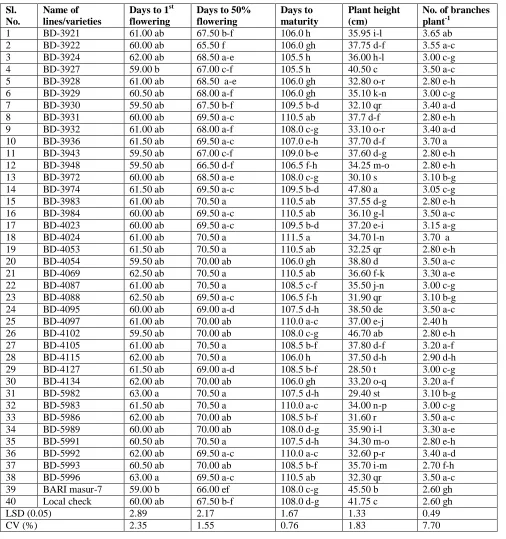
followed by BD-3930 (59.5 days), BD-3943, BD-3948, BD-4054 and BD-4102. Duration of 50% flowering ranged from 65 days to 70.5 days. It has been observed that the highest 50% flowering days was recorded in BD-3983, BD-4024, BD-4053, BD-4069, BD-4087, BD-4105, BD-4115, BD-5982, BD-5983 and BD-5991 and the lowest 50% flowering days was recorded in BD-3922 line followed by BD-3948 (66.50 days) and BARI masur-7 (66 days). Days to maturity ranged from 105.5 days to 111.5 days. Long duration (111.5 days) was recorded in 4024 followed by 3931 (110.5 days), 3983 (110.5 days), 3984 (110.5 days), BD-4053 (110.5 days), BD-4069 (110.5 days), and BD-5996 (110.5 days). Short duration was recorded in BD-3924 and BD-3927 followed by BD-3921 (106.0 days), BD-3922 (106.0 days), BD-3928 (106.0 days), BD-3929 (106.0 days), BD-4054(106.0 days), BD-4115 (106.0 days), BD-4134 (106.0 days).
3.2.Plant height
Marked variation was noticed in respect of plant height. The tested 40 lines/ varieties were showed significant difference to each other (Table 1) in the field condition. The plant height ranged from 28.50 cm to 47.80 cm while the tallest plant was recorded in BD-3974 followed by BD-4102 (46.70 cm) and BARI masur-7 (45.50 cm) and the shortest plant was recorded in BD-4127 followed by BD-5982 (29.40 cm) and BD-3972 (30.10 cm). Most of the lines/varieties were smaller than the check variety (Table 1).
3.3. Number of branches plant-1, pods per plant and seeds per pod
There had an appreciable variation among number of branches of plant, pods per plant and seeds per pod. It was found that most of the lines/verities gave two to three primary branches yet only two lines gave maximum (3.70) primary branches in average viz. BD-3936 and BD-4024 followed by BD-3921(3.65), BD-3922(3.55). Minimum number of branches per plant was recorded in BD-4097 (2.40) followed by BARI masur-7 (2.60) and Local check (2.60) (Table 1). Number of pods ranged from 37.50 to 98.80 while minimum number of pods was recorded in BD-4053 followed by BD-4134(39.60) and maximum number of pods was recorded in BD-3922 followed by BARI masur-7 (91.90). Number of seeds per pod ranged from 1.75 to 2.00 where the lowest number of seeds per pod was recorded in BD-4053 followed by BD-4024 (1.80), BD-3930 (1.90), BD-3948 (1.90), BD-3972 (1.90), BD-3974 (1.90) and BD-4127 (1.90) and rest of the lines bear the highest number of seeds (2.0) per pod (Table 2).
3.4. 100 seed weight (g)
In respect of 100 seed weight marked variation has been found. The hundred seed weight under different lines/ verities ranged from 1.00 g to 2.10 g while the highest weight was recorded in BD-5986 followed by BD-3972 (1.45 g), BD-3984 (1.45 g), BD-4102 (1.45 g), BD-4105 (1.45 g), BD-5983 (1.45 g) and BARI masur-7 and the lowest 100 seed weight was recorded in BD-4127 followed by BD-3927 (1.05 g), BD-3932 (1.10 g), BD-5996 (1.10g) (Table 2).
3.5. Biological yield
Biological yield of different lines showed significant variation and ranged from 747.20 kg ha-1 to 1567 kg ha-1 while the highest biological yield was recorded in BD-4053 followed by BD-4054 (1556 kg ha-1 ), BD-3943( 1447 kg ha-1), BD-4024 (1439 kg ha-1), BD-3921(1381 kg ha-1), BD-4023 (1342 kg ha-1), BD-3974 (1303 kg ha
-1
) and the lowest value recorded in BD-5989 followed by BD-3984 (752.80 kg ha-1), and BD-3930 (847.20 kg ha-1) (Table 2).
3.6. Grain yield
Table 1. Days to 1st flowering, days to 50% flowering, days to maturity, plant height and no. of branches
plant-1 of 40 lentil lines/varieties under natural field condition during 2011-12 at RARS, BARI,
Rahmatpur, Barishal.
Sl. No.
Name of lines/varieties
Days to 1st flowering
Days to 50% flowering
Days to maturity
Plant height (cm)
No. of branches plant-1
Table 2. No. of pods plant-1, no. of seeds plant-1 and 100 seed weight (g), biological yield and yield of 40 lentil lines/varieties under natural field condition.
Sl. No.
Name of lines/varieties
No. of pods plant-1
No. of seeds plant-1
100 seed wt. (g)
Biological yield (kg ha-1)
Yield (kg ha-1)
1 BD-3921 44.90 tu 2.00 a 1.15 d-f 1381.00 c 577.80 q-s 2 BD-3922 98.80 a 2.00 a 1.40 bc 1153.00 f-i 916.70 e-j 3 BD-3924 69.40 g 2.00 a 1.35 b-d 1192.00 f 811.10 j-m 4 BD-3927 50.80 o-q 2.00 a 1.05 f 1133.00 g-j 866.70 g-k 5 BD-3928 58.70 i-l 2.00 a 1.30 be 1097.00 i-k 933.30 e-i 6 BD-3929 49.50 p-r 2.00 a 1.35 b-d 1183.00 fg 905.60 f-j 7 BD-3930 47.00 r-t 1.90 ab 1.35 b-d 847.20 p 822.20 i-m 8 BD-3931 61.00 h-k 2.00 a 1.40 bc 1061.00 kl 1028.00 c-e 9 BD-3932 54.20 m-o 2.00 a 1.10 ef 1131.00 g-j 972.20 d-g 10 BD-3936 57.90 j-m 2.00 a 1.40 bc 1089.00 jk 672.20 o-q 11 BD-3943 57.70 k-m 2.00 a 1.35 b-d 1447.00 b 1028.00 c-e 12 BD-3948 74.70 f 1.90 ab 1.40 bc 1183.00 fg 1028.00 c-e 13 BD-3972 51.60 n-q 1.90 ab 1.45 b 1008.00 m 533.30 rs 14 BD-3974 78.60 de 1.90 ab 1.20 c-f 1303.00 de 1094.00 c 15 BD-3983 51.70 n-q 2.00 a 1.20 c-f 1175.00 fg 788.90 k-n 16 BD-3984 54.90 l-n 2.00 a 1.45 b 752.80 q 722.20 m-o 17 BD-4023 62.10 hi 2.00 a 1.35 b-d 1342.00 cd 788.90 k-n 18 BD-4024 73.20 f 1.80 ab 1.35 b-d 1439.00 b 488.90 s 19 BD-4053 37.50 w 1.75 b 1.40 bc 1567.00 a 1006.00 c-f 20 BD-4054 80.70 d 2.00 a 1.35 b-d 1556.00 a 833.30 h-m 21 BD-4069 55.10 l-n 2.00 a 1.40 bc 902.80 no 966.70 d-g 22 BD-4087 64.60 h 2.00 a 1.35 b-d 1158.00 f-h 944.40 e-h 23 BD-4088 48.90 q-s 2.00 a 1.30 b-e 1172.00 f-h 616.70 p-r 24 BD-4095 61.00 h-k 2.00 a 1.35 b-d 1267.00 e 688.90 n-p 25 BD-4097 61.60 h-k 2.00 a 1.35 b-d 1183.00 fg 750.00 l-o 26 BD-4102 61.80 h-j 2.00 a 1.45 b 1153.00 f-i 827.80 i-m 27 BD-4105 44.85 tu 2.00 a 1.45 b 1083.00 jk 972.20 d-g 28 BD-4115 52.15 n-q 2.00 a 1.30 b-e 1014.00 lm 944.40 e-h 29 BD-4127 41.50 uv 1.90 ab 1.00 f 969.40 m 827.80 i-m 30 BD-4134 39.60 vw 2.00 a 1.35 b-d 919.40 n 1089.00 c 31 BD-5982 81.10 d 2.00 a 1.30 b-e 833.30 p 788.90 k-n 32 BD-5983 53.50 no 2.00 a 1.45 b 1139.00 f-j 1389.00 a 33 BD-5986 61.20 h-k 2.00 a 2.10 a 1094.00 jk 972.20 d-g 34 BD-5989 75.50 ef 2.00 a 1.30 b-e 747.20 q 1278.00 b 35 BD-5991 53.10 n-p 2.00 a 1.35 b-d 861.10 op 788.90 k-n 36 BD-5992 45.60 st 2.00 a 1.35 b-d 900.00 no 1261.00 b 37 BD-5993 60.60 h-k 2.00 a 1.35 b-d 1117.00 h-k 927.80 e-i 38 BD-5996 63.75 h 2.00 a 1.10 ef 1069.00 k 1000.80 c-f 39 BARI masur-7 91.90 b 2.00 a 1.45 b 1180.60 fg 1067.00 cd 40 Local check 87.55 c 2.00 a 1.35 b-d 1083.30 jk 844.40 h-l LSD (0.05) 3.44 0.18 0.19 8.66 96.24 CV (%) 2.81 4.43 7.24 5.32 5.32
4. Discussion
and iii) growing conditions of plants. Bakr (1993), Mwakutuy (2002), Neubauer (1998) reported yield reduction of lentil due to Stemphylium blight. They were described that yield reduction of lentil increased with the increasing of Stemphylium blight disease severity.
With the findings of the present study it may be concluded that the materials of lentil that showed resistant reaction in November-2011 to April-2012 to S. botryosum need to be tested for furthers conformation of the result of this study. In the experimental period it was concluded that after harvesting of all lines/varieties it can be seen that nine lines/varieties were gave highest yield 1028 to 1389 (kg ha-1) viz. 3931, 3943, BD-3948, BD-3974, BD-4134, BD-5983, BD-5989, BD-5992 and BARI Masur-7.
5. Conclusions
Stemphylium blight of lentil caused by Stemphylium botryosum is considered now a days as one of the most important constrains of lentil production in Bangladesh. The tested lentil lines/verities differed significantly from one to another in respect of growth and yield contributing parameters. Minimum days of 1st flowering recorded in BD-3927, BARI masur-7, BD-3930, BD-3943, BD-3948, BD-4054, BD-4102 and 50% flowering recorded in BD-3922. Minimum days of maturity were recorded in BD-3924 and BD-3927. Minimum weight of 100 seeds, grain yield and biological yield recorded in the BD-5989, BD-4024, BD-5989, respectively and minimum number of branches per plant and no. of pods per plant was recorded in BD-4097 and BD-4053 respectively. The maximum no. of pods per plant and biological yield (kg/ha) was recorded in a single line/varieties BD-3922 and BD-4053; maximum days to maturity & no. of branches was found in BD-4024 and BD-3936 and weight of 100 seeds, yield in kg per hectare (grain yield) was found in BD-5986 and BD-5983 respectively. After harvesting the all of lines/varieties it can be seen that nine lines/varieties were gave highest yield (kg/ha) 1028 to 1389 (kg/ha) viz. BD-3931, BD-3943, BD-3948, BD-3974, BD-4134, BD-5983, BD-5989, BD-5992 and BARI Masur-7. From the above discussion it can be concluded that the tested lentil lines/verities differed significantly in respect of plant height, number of pods per plant, number of branches per plant, 100 seed weight & yield. So these lines/verities can be used as resistant genetic material for further study in genetic engineering to create new varieties/lines by transferring the resistant gene in high yielding local susceptible varieties.
Conflict of interest
None to declare.
References
Bakr MA, 1993. Plant protection of lentil in Bangladesh. In Erskine, W and Saxena, M. C. (eds). Lentil in South Asia, Proceedings of the Seminar on lentil South Asia, 11-15 March 1991, New Delhi, India, ICARDA, Aleppo, Syria. 236 pp.
Bakr M and M Zahid, 1986. Stemphylium blight: a new disease of lentil in Bangladesh. Bangladesh J. Plant Pathol., 2: 69–70.
Bayaa B and W Erskine, 1998. Diseases of lentil. In: Allen DJ, Lenné JM (eds) The pathology of food and pasture legumes. CAB International, Wallingford, pp. 442–443.
Benniza S, 2005. News From The Pulse Pathology Front. Crop Development Center. University of Saskatchewan. Canada.
Das S and W Kabir, 2016. Pulses Production in Bangladesh: Status and Drivers for Enhancement. Conference: Pulses for Sustainable Agriculture and Human Health At: Delhi, Pusa Affiliation: International Food Policy Research Institute.
Hossain MB, MZF Begum, MS Alam, MM Hasan and MR Amin, 2014. Growth, yield and yield components of lentil as influenced by irrigation and weeding regime. J. Environ. Sci. & Natural Resources, 7: 155-161. Iqbal A, IA Khalil, N Ateeq and MS Khan, 2006. Nutritional quality of important food legumes. Food Chem.,
97: 331–335.
Isaacs J, 2014. Lentils with blight can be misdiagnosed. Stemphylium blight is turning up in more and more seed lab tests, but is often misdiagnosed when it’s found out in the field. Crops, Features, Lentils.
Islam MZ and MAQ Shaikh, 1978. Correlation and path-coefficient analysis of yield and yield components in lentil. Bangladesh Journal of Agricultural Science, 5: 67-72.
Kant P, M Materne, MS Rodda and AT Slater, 2017. Screening lentil germplasm for stemphylium blight resistance. Australasian Plant Pathol., 46: 1-8.
Morrall R, B Carriere, C Pearse, D Schmeling and L Thomson, 2006. Seedborne pathogens of lentil in Saskatchewan in 2005. Canadian plant disease survey- Inventaire des maladies des plantes au Canada 86: 1404–1406.
Murray MG and JP Brennan, 2012. The current and potential costs from diseases of pulse in Australia, 2012th edn. Grains Research and Development Corporation, Kingston, ACT, Australia.
Mwakutuya E, B Vandenberg and S Banniza, 2002. Effect of culture age, temperature, incubation time and light regime on conidial germination of Stemphylium botryosum on Lentil. University of Saskatchewan. Department of Plant Science. 51. Campus Drive. Saskatoon. S7N5A8. Canada.
Neubauer C, 1998. Epidemiology and damage potential of Stemphylium botryosum Wallr. On asparagus. Gesunde Pflanzen. 50: 251-256.
Razzak MA, MA Islam, MH Rahman, MA Sathi and M Atikuzzamman, 2018. Screening of lentil germplasm against Stemphylium Blight by observing disease reaction in three different stages. Malaysian J. Halal Res., 1: 15-18.
Saraf CS, BR Patil and M Prashad, 1985. Correlation and regression studies in lentil cultivars. Lens, 12: 11-12. Sarder MM, 1995. Chemical control of stemphylium blight disease of lentil. M. S. Thesis. Department of Plant
Pathology. Bangladesh Agricultural University. Mymensingh.
Sarkar A, MA Bakr, MA Afzal, W Erskine, MM Rahman and MC Saxena, 2004. Lentil Improvement in Bangladesh. A Success Story of Fruitful Partnership between the Bangladesh Agricultural Research Institute and International Center for Agricultural Research in the Dry Areas.
Sarwar DM, AK Kaul and M Qadar, 1982. Correlation studies in lentils. Lens, 9: 22-23.
Schneider K and L Anderson, 2010. Yield gap and productivity potential in Ethiopian agriculture: Staple grains & pulses. EP AR Brief No. 98, Evans School Policy Analysis and Research (EPAR), University of Washington. p. 24.
Shahjahan M, 2001. Pulses in Bangladesh Production, Problems, Prospect and Future Plans. Research Report on Post Harvest Technology of Crops 2000-2001. Bangladesh Agricultural Research Institute, Joydebpur, Gazipur.
Shukla SR, DP Singh and R Shukla, 2001. Response of drought tolerance varieties to different nitrogen levels in Tarai region of U.P. Ann. Agric. Res., 24: 856-527.
Silim SN, MC Saxena and W Erskine, 1993. Adaptation of lentil to the Mediterranean environment. II. Response to moisture supply. Expt. Agric., 29: 112-118.
Simmons EG, 1969. Perfect stages of Stemphylium. Mycologia, 61: 1–26.
Vanderberg B, 2007. Lentil outlook from Bangladesh. Crop Development Center. University of Saskatchewan. Canada.
Wery J, SN Silim, EJ Knights, RS Malhotra and R Cousin, 1994. Screening techniques and sources of tolerance to extremes of moisture and air temperature in cool season food legumes. Euphytica, 73: 73-83.
Yadav AC, A Kumar, OP Rai, RN Maurya, HC Yadav and RS Yadav, 2017. To study the performance of lentil (lens culinaris m.) varieties under rainfed conditions. Plant Archives, 17: 715-719.