Original Research Article
Harnessing mHealth to improve the diabetes screening and diagnosis
rate in rural Indian settings: a learning from health systems initiative
Akash Gajanan Prabhune*, Aparna Manoharan, Murugan Arul
INTRODUCTION
Chronic diseases require complex and long-term response from health system, the health system is rightly put on test when tackling with chronic illness like diabetes, hypertension.1 Chronic illness demands sustained continued care across the health professionals with diverse skills, implementation of evidence-based intervention using appropriate technologies, dependable
supply chain, and accessible health care facilities. This interplay between the different factors for a sustained period is what makes chronic care a costly affair even for public health systems of developed countries. Given this, for a developing country like India, whose public health system works in resource intensive settings and faces a dual burden of communicable and chronic diseases, the chronic diseases detection, management and control rates are extremely low. The general perception about the
ABSTRACT
Background: Diabetes forms huge burden of non-communicable diseases that is affecting health care systems in
India. India has large number undiagnosed and undetected cases. mHealth initiatives are cost effective, quick and less resource intensive technology assisted initiatives which help to strengthen the health system. High mobile penetration and availability of cheap and high-speed data network across India has been conducive to implement mHealth initiatives in Indian health system. We present our experience in using mHealth initiative to improve the diabetes screening and diagnosis in rural Indian settings.
Methods: The study is a descriptive analysis of all the tasks undertaken as part of “Disease free Village” Initiative of
our organization. The study data is operational data from our organizational health information management systems. The study is divided into three phase. Phase 1, was dedicated to enrolling entire village population using android smartphone and ODK collect application; phase 2 used clinical decision support system for screening of high risk individuals and phase 3 used traditional door to door campaign to motivating the high risk individuals to get their fast and post prandial blood glucose levels checked at health care facility.
Results: Phase 1 was to set a baseline, with 3624 base population, 2651 was target adult population. Rapid screening
in phase 2, screened 2204 (83.14%). Out of 2204 screened cases 1307 were high risk cases. 1307 high risk cases were followed in Phase 3, and blood glucose screening was carried out 1156 (88.44%) high and moderate risk individuals out of 1307 (100%).
Conclusions: We concluded that the mHealth initiatives for screening and diagnosis of diabetes in rural India, combined with traditional techniques could help to improve screening and diagnosis rate and help to reduce the hidden burden of disease.
Keywords: mHealth, Diabetes screening and diagnosis, Clinical decision and support system, Rural health
IKP Center for Technologies in Public Health, Thanjavur, Tamil Nadu, India
Received: 05 February 2019
Revised: 14 March 2019
Accepted: 01 April 2019
*Correspondence:
Dr. Akash Gajanan Prabhune, E-mail: [email protected]
Copyright: © the author(s), publisher and licensee Medip Academy. This is an open-access article distributed under
the terms of the Creative Commons Attribution Non-Commercial License, which permits unrestricted non-commercial use, distribution, and reproduction in any medium, provided the original work is properly cited.
chronic care management in India is that, there exist a huge gap between detection and adequate treatment. Less than half of those who have hypertension or diabetes are actually detected, less than half of those detected receive appropriate treatment and less than half of those receiving treatment have their blood pressure or blood sugar level managed to recommended targets.2 As the burden of chronic diseases (diabetes, hypertension, COPD) is increasing in India, the policy makers are banking on early detection and diagnosis of the chronic conditions at health sub center and primary health center level.3 The 12th planning commission has planned for setting up NCD clinics at community health center level, which will act as an first referral units for all the cases screened at health sub center and primary health center.4 The plan suggests a country wide approach for prevention and management of chronic diseases which includes, Health and lifestyle promotion, periodic and opportunistic screening, strategies to reduce risk of exposure.3
Mobile Health (mHealth) is defined by Global Observatory for eHealth (GOe) as medical and public health practice supported by mobile devices, such as mobile phones, patient monitoring devices, personal digital assistants (PDAs), and other wireless devices.5 mHealth has gained a lot of attention of medical researchers due to the factors like, ability to provide low-cost and user friendly service, potential to enhance the speed and accuracy of healthcare delivery, rapidly expanding base of mobile phone users in developing countries.6,7 mHealth is particularly of relevance to developing countries like India, wherein the healthcare workforce is limited and burdened by tackling dual burden of communicable and non-communicable diseases. With this study, we present one such mHealth initiative to strengthen the health system.
Objective of the study
To describe the use of technology for improving screening and diagnosis rates of diabetes in resource intensive rural Indian setting.
METHODS
The study is a descriptive analysis of all the tasks undertaken as part of “Disease free Village” Initiative of our organization. The study data is operational data from our organizational health information management systems. The study location was Alakkudi village with population of 3624 individuals in the southern state of Tamil Nadu, India.8 The facility is housed with an AYUSH Physician, and Health care worker. The facility is designed to be between the health sub centre and Primary health centre. It has been dedicated to provide primary care for infectious diseases and management of simple cases of diabetes, and hypertension.9 The facility runs under “universal health care programme” wherein the out of pocket expenditure for the service seeker is zero. The facility is open six days a week, operational
form 7:30 am till 6:00 pm, provides in house pharmacy and has an affiliated laboratory wherein the blood samples collected form the village can be sent for analysis. The maximum commute distance to the facility is less than 1Km for the residents of Alakkudi Gram Panchayat. The facility serves as the ideal site to test ability of health system in combatting the increasing burden of chronic conditions (diabetes mellitus, hypertension). The programme was conducted over 14 months (July 2016 to Sept 2017). The study population was of entire adult population who were residents of village (Resident of village was defined in terms of the individual‟s household falls within the revenue boundaries of village). The overall programme is divided into three phases
Sample size
We included the entire population (n=3624) of the village.
Methods and observations
Phase 1: Enrolment phase
This phase was designed to enrol and build the database of all the residents of Alakkudi village and map the houses of all the residents using geo coordinates on GPS enabled phones. This database would serve as baseline for future clinical and operational engagements within the village. The data was collected electronically using android based ODK collect tool. 7 field agents, were locally hired. All the field agents were extensively trained on using ODK collect tool and collecting the geo-coordinates. Data collected was mainly at Household level, which includes House number, Street Name, Number of family member within the household, Name of the bread winner, and geo co-ordinates of the house were captured. At individual level, Name of each family member within the house was entered along with his/her relationship with the bread winner, corresponding age, sex, mobile number, of each house member was recorded. After completion of enrolment, data was cleaned; duplicates were removed and was uploaded into the HMIS server. Each household was allotted a unique household ID while every individual was allotted a unique person ID for future ventures. Every household was given a printed card containing the respective household ID to be presented at clinic whenever required. Instruments used– Samsung Android Smartphone, ODK collect application.
Phase 2: Rapid screening for diabetes
categories, score “0” low risk, score “1” moderate risk, and score “2” high risk of being diagnosed with DM in next 5 years. The CDS system would account for BMI, waist circumference, tobacco and alcohol history, Family history to obtain the risk score. The screening was administered at the place of residence and the data was electronically collected using ODK collect app, the app would locally analyse the data and display the risk score for each individual screened. Each screened individual would be given a risk coupon stating their risk score, risk assessment date, name. The coupon could be used by individual to voluntarily undergo a fasting and post prandial blood glucose estimation test over a period of six months form the date of issue.
With the steep fall in number of individuals assessed, and relative increase in human efforts to assess the number of individuals from the month of October and November, it was decided to end the phase 2 of our study. The data from the phase 2 was linked with the enrollment data based on unique person ID generated during the Phase 1. Instruments used – Samsung Android Smartphone, ODK collect application with CDS system, measuring tape, weighing scale, HMIS software to link the data from phase 2 with phase 1.
Phase 3: Biochemical measurements of high-risk patients
This phase had two sub phases, phase 3a was phase wherein we passively waited for individuals‟ from phase 2 to report at health care facility for getting their fasting and post-prandial blood glucose checked.
With the follow up number below the expected rate, we went back to the community. The main barrier was, synchronizing their schedule with the clinic timings. Most villagers being engaged in farming or would travel to outstation for work would find it cumbersome to hold on empty stomach till 7:30 am (Clinic opening time). Many even requested for doorstep collection of samples. It was then decided to change the approach for phase 3b, we targeted one or two lanes based consisting of 50-70 houses based on village map (Village Map attached as separate file), the targeted approach would start with Friday every week, wherein the physician, health worker, field executive and programme manager would assemble the residents of 50-70 household‟s early morning around 6:30 am till 7:00am and carry out focused awareness campaign. We conducted six such targeted campaigns (Fridays and Saturdays) with rate of two campaigns a month over a period of three months to cover the high and moderate risk individuals form entire village.
Statistical analysis
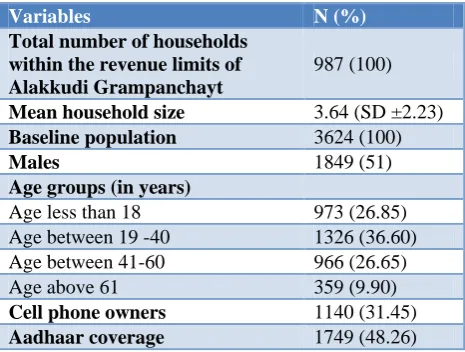
The baseline characteristics of our study population are presented in Table 1. We also presented the basic demographic characteristics of the population during the different phases of study. We carried out descriptive analysis and for each phase of our study.
RESULTS
Phase 1, the enrolment was completed in 9 working days. On an average each field agent would enrol 15 (SD ±6) households, while per day total enrolment would be 110 (SD ±39) households. Average enrolment time for a household was 14 mins (SD ±5 mins 4 secs). Table 1 describes study population demographic.
Table 1: Baseline characteristic on study population.
Variables N (%)
Total number of households within the revenue limits of Alakkudi Grampanchayt
987 (100)
Mean household size 3.64 (SD ±2.23)
Baseline population 3624 (100)
Males 1849 (51)
Age groups (in years)
Age less than 18 973 (26.85) Age between 19 -40 1326 (36.60) Age between 41-60 966 (26.65) Age above 61 359 (9.90)
Cell phone owners 1140 (31.45)
Aadhaar coverage 1749 (48.26)
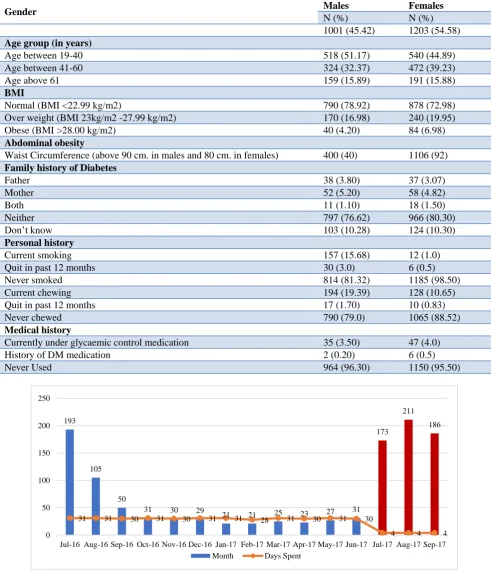
The phase 2, total number of adults assessed for the risk of DM was 2204 (83.14%) out of 2651 (100%) target adult population. Table 2 presents the basic demographics, data on physical measurements, personal history and tobacco consumption and risk profiling stratified by gender. The risk assessments scores were, 647 (29.35%) of the population was scored on high risk of getting DM in next 5 years, out of which 310 (48%) were males and 337 (52%) were females. The population with moderate risk of being diagnosed with DM was 660 (30%) of whom 273 (41.40%) were males and 387 (58.60%) were females. For low risk of being diagnosed with DM in next five years the number was 897 (40.55%) of whom 418 (46.60%) were males and 479 (53.40%) were females. Total 236 human days invested were invested by seven field agents over the span of five months for phase 2.
Table 2: Demographics and risk assessment profile for phase 2.
Variable n=2651
N (%)
Number of individuals screened 2204 (83.14)
Migrated, death and other leading to loss to follow-up 149 (5.62)
Untraceable 298 (11.24)
Demographics (n=2204)
Gender Males Females
N (%) N (%)
1001 (45.42) 1203 (54.58) Age group (in years)
Age between 19-40 518 (51.17) 540 (44.89)
Age between 41-60 324 (32.37) 472 (39.23)
Age above 61 159 (15.89) 191 (15.88)
BMI
Normal (BMI <22.99 kg/m2) 790 (78.92) 878 (72.98) Over weight (BMI 23kg/m2 -27.99 kg/m2) 170 (16.98) 240 (19.95) Obese (BMI >28.00 kg/m2) 40 (4.20) 84 (6.98) Abdominal obesity
Waist Circumference (above 90 cm. in males and 80 cm. in females) 400 (40) 1106 (92) Family history of Diabetes
Father 38 (3.80) 37 (3.07)
Mother 52 (5.20) 58 (4.82)
Both 11 (1.10) 18 (1.50)
Neither 797 (76.62) 966 (80.30)
Don‟t know 103 (10.28) 124 (10.30)
Personal history
Current smoking 157 (15.68) 12 (1.0)
Quit in past 12 months 30 (3.0) 6 (0.5)
Never smoked 814 (81.32) 1185 (98.50)
Current chewing 194 (19.39) 128 (10.65)
Quit in past 12 months 17 (1.70) 10 (0.83)
Never chewed 790 (79.0) 1065 (88.52)
Medical history
Currently under glycaemic control medication 35 (3.50) 47 (4.0)
History of DM medication 2 (0.20) 6 (0.5)
Never Used 964 (96.30) 1150 (95.50)
Figure 1: Presents the relationship between the human days invested and individuals screened. 193
105
50
31 30 29 21 21 25 23 27 31 173
211
186
31 31 30 31 30 31 31 28 31 30 31 30
4 4 4 0
50 100 150 200 250
Of the 1156 individuals screened, 168 (14.5%) individuals had their fasting blood glucose ≥126 mg/dl and were referred to higher centre for definitive diagnosis and clinical management.
90 (7.80%) were already under glycaemic control medication and were asked to follow-up once in three months for lifestyle management and regular diagnostics. 105 (9.10%) were having fasting blood glucose level between 110 mg/dl to 125 mg/dl, they were provided with diet management charts, behaviour change counselling and health promotion material, and were asked to follow up once in a month for three months for monitoring of their blood glucose levels and effective implementation of lifestyle modifications.
796 (68.90%) individuals out of 1156 (100%) were having fasting blood glucose below 110 mg/dl and would be followed in next five years.
Besides the 1156 individuals form high and moderate risk categories, we also received 190 (21.20%) samples out of 897 (100%) low risk individuals, these sample not being part of our target population in Phase 3 were excluded form analysis.
DISCUSSION
In this study, we used a combination of mHealth technology and traditional methods to improve the screening rate and diagnosis rate. mHealth initiatives have been on rise in India with diabetes being the most researched in Indian context.10 As per, „„mHealth and ICT Framework‟‟ developed by World Health Organization (WHO), Johns Hopkins University Global mHealth Initiative, the United Nations Children‟s Fund (UNICEF), and Frog Designs, to describe mHealth innovations health systems.7 Our initiative falls under two mHealth ICT framework, Electronic decision support and Data collection and reporting. The previous studies done by Ajay et al. in rural parts of Haryana, India used mHealth based CDS system to improve service delivery in management of Diabetes and Hypertension at primary health care level.11 Similarly Jindal et al conducted mHealth study Diabetes, the authors developed mHealth application to electronically collect and share data across layers of healthcare system, the application also implemented CDS system to aid front line health workers, similar to our initiative and then HIMS system would help in patient management, follow-up and adherence.12 The difference between our study an Jindal et al study was they developed the mHealth initiative to address gaps in health system post diagnosis of Diabetes, while our initiative was aimed at increasing the screening and diagnostic efforts of the health system at community level. Other mHealth studies reported on Diabetes concentrated mainly on Client education and behaviour change (BCC).13–16
The strength of our study were, barriers to access to healthcare services were minimum, the maximum radial commute distance to the health care facility from the furthest located households (within the gram panchayat revenue boundaries) was 1 km. All the services were offered under universal health coverage policy and hence out of pocket expenditure to all the healthcare seekers was zero. One of the key novelty of the study was; we strived to bring the chronic care service to the doorstep of an individual. Our approach made optimum use of technology and when technology touched, its yielding point the traditional approach of door-to-door campaign was undertaken. Technology use enabled us to analyse the gaps in approach and allowed us to adapt based on the results obtained. This is first of a kind study to report field experience in diabetes screening and diagnosis from rural India to the best of our knowledge.
The limitations of our study were, the CDS system algorithm we developed and used for our study is not validated and field-tested elsewhere. Based on the output form CDS system we excluded 897 individuals, who were categorized as low risk for development of diabetes in next five years. This surely helped us to reduce the costs and human efforts, but some efforts like use of point of care diagnostic could have been used to screen these low risk individuals.
Our recommendations from this study are
Once in 5-year screening of entire village population for non-communicable diseases like diabetes, hypertension would help to increase awareness among the rural population along with unearthing thee hidden prevalence of conditions
Efforts are needed to provide initial screening services at the doorstep as it helps to build rapport between the individual and health care provider. Their needs to be constant communication between
the community and health provider either via field agents, healthcare workers or physician contact.
CONCLUSION
With the help of mHealth initiatives we were able to screen and diagnose 88.44% of the target population from the rural community. We conclude that harnessing mHealth initiatives along with traditional methods for screening and diagnosis of Diabetes in rural Indian setup could yield better results; and help to reduce the burden of chronic diseases in India.
ACKNOWLEDGEMENTS
Funding: No funding sources Conflict of interest: None declared
Ethical approval: The study was approved by the Institutional Ethics Committee
REFERENCES
1. Samb B, Desai N, Nishtar S, Mendis S, Bekedam H, Wright A, et al. Prevention and management of chronic disease: a litmus test for health-systems strengthening in low-income and middle-income countries. Lancet. 2010;376(9754):1785–97. 2. RDS_HealthRiskFactors_India_WEB.pdf.
Available at: http://media.institute.swissre.com/ documents/RDS_HealthRiskFactors_India_WEB.pd f. Accessed on 11 September 2017.
3. Services DGOH, Ministry of Health and Family Welfare, Government of India. National programme for prevention and control of cancer, diabetes, cardiovascular diseases and stroke (NPCDCS) [cited 2017 Sep 11]. Available from: http://www.nrhmhp.gov.in/sites/default/files/files/N CD_Guidelines.pdf. Accessed on 11 September 2017.
4. Planning Commission Government of India. Report of the working group on disease burden for 12thFive Year Plan: WG-3(2) non communicable diseases. c2011. Available at: http://planningcommission. nic.in/aboutus/committee/wrkgrp12/health/WG_3_2 non_communicable.pdf. Accessed on 11 September 2017.
5. World Health Organization, WHO Global Observatory for eHealth. mHealth: new horizons for health through mobile technologies. Geneva, Switzerland: World Health Organization; 2011. 6. Bhattacharya S, Kumar A, Kaushal V, Singh A.
Applications of m-Health and e-Health in Public Health Sector: The Challenges and Opportunities. Int J Med Public Health. 2018;8(2):56–7.
7. Labrique AB, Vasudevan L, Kochi E, Fabricant R, Mehl G. mHealth innovations as health system strengthening tools: 12 common applications and a visual framework. Glob Health Sci Pract. 2013;1(2):160–71.
8. Logaraj M, Balaji R, Rushender R. A study on effective utilization of health care services provided by primary health centre and sub-centres in rural Tamilnadu, India. Int J Community Med Public Health. 2016;1054–60.
9. Prabhune A, Manoharan A. Assessment of Healthcare Utilization in a Community-Centric Model of Primary Healthcare for Rural Populations. Indian J Public Health Res Dev. 2017;8(4):971. 10. Bassi A, John O, Praveen D, Maulik PK, Panda R,
Jha V. Current Status and Future Directions of mHealth Interventions for Health System Strengthening in India: Systematic Review. JMIR MHealth UHealth. 2018;6(10):e11440.
11. Ajay VS, Jindal D, Roy A, Venugopal V, Sharma R, Pawar A, et al. Development of a Smartphone-Enabled Hypertension and Diabetes Mellitus Management Package to Facilitate Evidence-Based Care Delivery in Primary Healthcare Facilities in India: The mPower Heart Project. J Am Heart Assoc. 2016;21:5(12).
12. Jindal D, Gupta P, Jha D, Ajay VS, Goenka S, Jacob P, et al. Development of mWellcare: an mHealth intervention for integrated management of hypertension and diabetes in low-resource settings. Glob Health Action. 2018;11(1):1517930.
13. Kumar S, Shewade HD, Vasudevan K, Durairaju K, Santhi VS, Sunderamurthy B, et al. Effect of mobile reminders on screening yield during opportunistic screening for type 2 diabetes mellitus in a primary health care setting: A randomized trial. Prev Med Rep. 2015;2:640–4.
14. Patnaik L, Joshi A, Sahu T. Mobile phone-based education and counseling to reduce stress among patients with diabetes mellitus attending a tertiary care hospital of India. Int J Prev Med. 2015;6:37. 15. Ramachandran A, Snehalatha C, Ram J, Selvam S,
Simon M, Nanditha A, et al. Effectiveness of mobile phone messaging in prevention of type 2 diabetes by lifestyle modification in men in India: a prospective, parallel-group, randomised controlled trial. Lancet Diabetes Endocrinol. 2013;1(3):191–8.
16. Kumar D, Raina S, Sharma S, Raina S, Bhardwaj A. Effectiveness of randomized control trial of mobile phone messages on control of fasting blood glucose in patients with type-2 diabetes mellitus in a Northern State of India. Indian J Public Health. 2018;62(3):224.
Cite this article as: Prabhune AG, Manoharan A,
Arul M.Harnessing mHealth to improve the diabetes screening and diagnosis rate in rural Indian settings: a learning from health systems initiative. Int J