http://www.ijcmph.com pISSN 2394-6032 | eISSN 2394-6040
Original Research Article
Nomophobia - mobile phone dependence, a study among
students of a rural medical college
Vanita V. Myakal, Vinod L. Vedpathak*
INTRODUCTION
Currently cell/mobile phone is considered as an important accessory, which has been carried by all. The charm of cell phone is more among youth and they spend a good amount of their pocket money on cell phone.1
Mobile phones or cellular phones have emerged to become indispensible tools of daily life in the hands of mankind. The advent of numerous applications that provide the leisure of text messaging free of cost, lower
call rates and easy availability and accessibility of internet use on cellular phones are among prominent causes leading to increase in its usage.2
Among the most characteristic symptoms of mobile dependence are the following (a) excessive use, both in terms of high economic cost and the number of calls and messages; (b) interpersonal problems associated with excessive use; (c) interference with academic or occupational activities; (d) tolerance, i.e., a gradual increase in the amount of use needed to obtain the same
ABSTRACT
Background: Nomophobia literally means „no mobile phobia‟ that is the fear of being out of mobile phone contact. People experience symptoms of withdrawal when they are away from mobile phones. To address this problem and create awareness among medical students the present study was planned. Objectives of this study were 1)To assess prevalence of nomophobia among medical students 2) To assess pattern of mobile phone usage. 3) To know health related consequences of nomophobia
Methods: This college based cross sectional study was conducted among undergraduate medical students of SRTR Government Medical College, Ambajogai. All undergraduate students from 1st MBBS to final MBBS were enrolled in the study. Data was collected from a total of 346 medical students with a predesigned pretested questionnaire. “test of mobile phone dependence” (TMD Brief) was used to assess nomophobia. TMD brief scale was designed and validated by Chóliz et al. According to scores, medical students scoring 30-60 were labeled as having nomophobia. Data was analyzed using Epi info 7 Software.
Results: The prevalence of nomophobia was 71.39%, which was more among males (73%) compared to females (69.94%). „Disturbance of sleep‟ (41.33%) was most common symptom experienced due to mobile phone dependence. Study participants belonging to nuclear family, 3rd year MBBS batch, age group of 20-22 years and students spending Rs. >400/month on mobile phones were significantly associated with nomophobia.
Conclusions: The present study has reported prevalence of nomophobia as 71.39% among undergraduate medical students which is very high. Now a day‟s nomophobia is an alarming issue and it should be addressed on priority basis.
Keywords: Nomophobia, Medical students, Test of mobile phone dependence
Department ofCommunity Medicine, SRTR Government Medical College, Ambajogai, Beed, Maharashtra, India
Received: 05 February 2019
Accepted: 09 March 2019
*Correspondence:
Dr. Vinod L. Vedpathak, E-mail: [email protected]
Copyright: © the author(s), publisher and licensee Medip Academy. This is an open-access article distributed under the terms of the Creative Commons Attribution Non-Commercial License, which permits unrestricted non-commercial use, distribution, and reproduction in any medium, provided the original work is properly cited.
level of satisfaction, as well as the need to substitute operative devices with new models that appear on the market; (e) abstinence symptoms, i.e., an urgent need to use a mobile phone after some time has elapsed since its last use, as well as emotional alterations when its use is impeded or made difficult; (f) lack of control, i.e., inability to stop the addictive behavior.3
Despite the many interesting and useful functions that the mobile phone fulfills in modern society, maladaptive use of mobile phones has been identified, and has been linked with psychological dysfunction, health problems and even psychiatric disorders.3
Nomophobia literally means ‘no mobile phobia‟ that is the fear of being out of mobile phone contact. People experience symptoms of withdrawal when they are away from mobile phones.4
Nomophobia- no mobile phobia, has varied clinical characteristics like, using regularly a mobile phone and spending considerable time on it, always carrying a charger with oneself, feeling anxious and nervous at the thought of losing handset or when the mobile phone cannot be used due to no balance, network or battery. To look at the phone‟s screen to see whether messages or calls have been received, To sleep with the mobile device in bed, To have few social face-to-face interactions with humans instead to prefer to communicate using the new technologies and to incur debts or great expense from using the mobile phone are also considered as features of mobile phone dependence and Nomophobia.5
The Behavioral Addictions Clinic (BAC) 6 has been established by Department of Psychiatry and National Drug Dependence Treatment Center (NDDTC), All India Institute of Medical Sciences (AIIMS), New Delhi. The BAC is aimed at catering to those experiencing behavioral addictions. This includes various conditions including internet addiction, (video) gaming addiction, smartphone addiction, screen addiction, excessive use of social media, pathological gambling among others. The clinic offers treatment services for the behavioral addictions and the co-occurring psychiatric and substance use disorders that are commonly observed in this population.6
By knowing the importance of issue of nomophobia, the present study was planned to address the problem of nomophobia among students of rural medical college. The objectives of the present study were to determine prevalence of nomophobia among undergraduate students of rural medical college and to know the pattern of mobile phone usage and to know health related consequences of nomophobia.
METHODS
Study design: College based cross sectional study.
Study period: 3 months, from 1st November 2017 to 31st January 2018.
Study population:
All undergraduate students of SRTR Government Medical College, Ambajogai Dist. Beed from 1st year MBBS to Final year MBBS giving consent for the study.
Study area: SRTR Government Medical College,
Ambajogai, Beed
Inclusion criteria
Inclusion criteria were students giving consent for study; students using mobile phones for at least one year.
Exclusion criteria
Exclusion criteria were students not using mobile phones or not possessing mobile phone with them; students using mobile phones for less than 1 year.
Sample size
A total of 400 undergraduate medical students were enrolled from all 4 batches of MBBS i.e. 1st year, 2nd year, 3rd year and Final year. Out of total 400 students 346 students participated voluntarily in the study. Rest 54 were either absent during data collection or declined to participate in the study. So finally data was collected from total of 346 students.
Ethical approval
Institutional ethics committee approved the present study prior to the start of data collection.
A predesigned pretested questionnaire was used for data collection including all the basic socio-demographic data of study participants, along with some questions for assessing pattern of mobile phone usage, health related consequences nomophobia etc. All the study participants were informed the purpose of carrying out present study and informed oral consent was obtained from each participant.
Tool for assessing mobile phone dependence/
nomophobia
If my mobile phone were broken for an extended period of time and took a long time to fix, I would feel very bad.
If I don‟t have my mobile phone, I feel bad
I don‟t think I could stand spending a week without a mobile phone.
I spend more time than I would like to talking on the mobile phone, sending SMSs, or using WhatsApp.
I have gone to bed later or slept less because I was using my mobile phone.
I use my mobile phone (calls, SMSs, WhatsApp.) in situations where, even though not dangerous, it is not appropriate to do so (eating, while other people are talking to me, etc.).
I need to use my mobile phone more and more often.
When I have my mobile phone with me, I can‟t stop using it.
Since I got my mobile phone, I have increased the number of SMSs I send.
As soon as I get up in the morning, the first thing I do is see who has called me on my mobile phone or if someone has sent me a SMS.
When I feel lonely, I use the mobile phone (calls, SMSs, WhatsApp.).
I would grab my mobile phone and send a message or make a call right now.
Each question in TMD Brief was coded by Likert type scale as never-1, rarely-2, sometimes-3, often-4 and frequently-5. Traditional Likert scale items were coded as strongly disagree-1, disagree -2, neutral-3, agree-4 and strongly agree-5. Therefore the total minimum and total maximum score of TMD brief were 12 and 60 respectively. The study participants scoring >30 (i.e. score of more than 50% of total maximum score) were labeled as having nomophobia i.e. mobile phone dependence.
RESULTS
Figure 1 reveals the socio-demo-graphic determinants of study subjects. Study subjects were divided into 3 age groups of which majority constituted 20-22 years (63.58%) of age. Among total study subjects females (52.89%) constituted more compared to males (47.11%). Maximum (78.61%) study subjects were belonging to Hindu religion (78.61%); Buddhist religion (9.54%), Muslim (8.96%) and other religion (2.89%). More of study subjects were from rural setting (53.76%) compared to urban setting (46.24%). Most students were belonging to nuclear family (76.88%) and class I socioeconomic status. (65.03%) compared to other type of family and socioeconomic status.
Table 1 shows prevalence of nomophobia 71.39% which was slightly on higher side for males (73%) compared to females (69.94%).
Table 1: Prevalence of nomophobia.
Gender Nomophobia Total (%) Yes (%) No (%)
Male 119 (73) 44 (27) 163 (100)
Female 128 (69.94) 55 (30.06) 183 (100)
Total 247 (71.39) 99 (28.61) 346 (100)
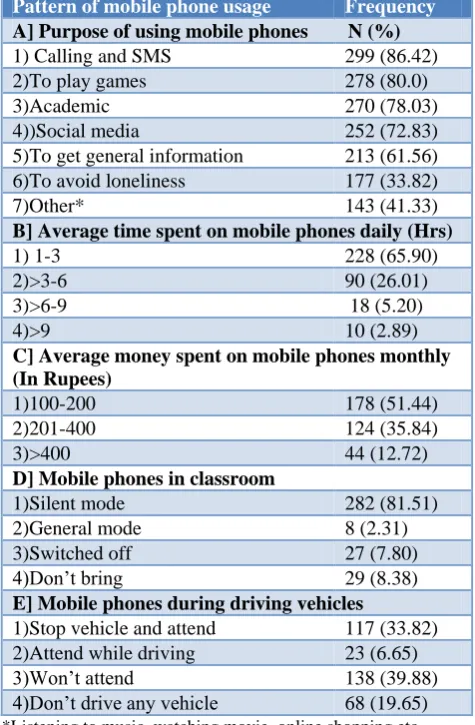
Table 2: Pattern of mobile phone usage (n=346).
Pattern of mobile phone usage Frequency A] Purpose of using mobile phones N (%)
1) Calling and SMS 299 (86.42) 2)To play games 278 (80.0) 3)Academic 270 (78.03) 4))Social media 252 (72.83) 5)To get general information 213 (61.56) 6)To avoid loneliness 177 (33.82)
7)Other* 143 (41.33)
B] Average time spent on mobile phones daily (Hrs)
1) 1-3 228 (65.90)
2)>3-6 90 (26.01) 3)>6-9 18 (5.20)
4)>9 10 (2.89)
C] Average money spent on mobile phones monthly (In Rupees)
1)100-200 178 (51.44) 2)201-400 124 (35.84) 3)>400 44 (12.72)
D] Mobile phones in classroom
1)Silent mode 282 (81.51) 2)General mode 8 (2.31) 3)Switched off 27 (7.80) 4)Don‟t bring 29 (8.38)
E] Mobile phones during driving vehicles
1)Stop vehicle and attend 117 (33.82) 2)Attend while driving 23 (6.65) 3)Won‟t attend 138 (39.88) 4)Don‟t drive any vehicle 68 (19.65)
*Listening to music, watching movie, online shopping etc.
2.31% General mode; 7.80% Switched off; and 8.38% Don‟t bring mobile phones in classroom. While use of mobile phones during driving, in our study it was noticed that, most of study subjects won‟t attend (39.88%) to phone calls during driving; (33.82%) stop vehicle and attend; (6.65%) attend calls during driving; and (19.65%) don‟t drive any vehicle.
Figure 1: Socio-demographic determinants of study subjects.
Table 3 shows health related consequences of nomophobia. Most common symptom experienced by study subjects was „disturbance of sleep‟(41.33%) followed by headache (37.28%); decreased participation in social activities (30.06%); lack of activity on next day
(16.76%); decreased academic performance (16.58%); weight gain (7.80%) and road traffic accidents (4.91%).
Table 3: Health related consequences of nomophobia (n=346).
Health related consequences Frequency N (%) 1) Disturbance of sleep 143 (41.33)
2) Headache 129 (37.28)
3) Decreased participation in social
activities 104 (30.06)
4) Lack of activity next day 58 (16.76)
5) Decreased academic performance 58 (16.58)
6) weight gain 27 (7.80)
7) Road traffic accidents 17 (4.91)
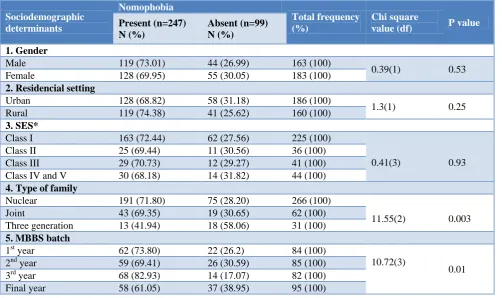
Table 4 shows association of various determinants with nomophobia. Prevalence of nomophobia was slightly on higher side among males (73.01%) compared females (69.95%), among students of rural setting (74.38%) compared to urban setting (68.8%) and socioeconomic status I (72.44%) compared to other socioeconomic classes, but this difference was not statistically significant. Our study noticed that, study subjects belonging to nuclear family (p=0.003); 3rd year MBBS students (p=0.01), age group of 20-22 years (p=0.04) and study participants spending Rs. >400/month (p=0.01) on their mobile phones were significantly associated with nomophobia.
Table 4: Association of sociodemographic determinants and nomophobia.
Sociodemographic determinants Nomophobia Total frequency (%) Chi square
value (df) P value Present (n=247)
N (%)
Absent (n=99) N (%)
1. Gender
Male 119 (73.01) 44 (26.99) 163 (100)
0.39(1) 0.53 Female 128 (69.95) 55 (30.05) 183 (100)
2. Residencial setting
Urban 128 (68.82) 58 (31.18) 186 (100)
1.3(1) 0.25 Rural 119 (74.38) 41 (25.62) 160 (100)
3. SES*
Class I 163 (72.44) 62 (27.56) 225 (100)
0.41(3) 0.93 Class II 25 (69.44) 11 (30.56) 36 (100)
Class III 29 (70.73) 12 (29.27) 41 (100) Class IV and V 30 (68.18) 14 (31.82) 44 (100)
4. Type of family
Nuclear 191 (71.80) 75 (28.20) 266 (100)
11.55(2) 0.003 Joint 43 (69.35) 19 (30.65) 62 (100)
Three generation 13 (41.94) 18 (58.06) 31 (100)
5. MBBS batch
1st year 62 (73.80) 22 (26.2) 84 (100)
10.72(3)
0.01 2nd year 59 (69.41) 26 (30.59) 85 (100)
3rd year 68 (82.93) 14 (17.07) 82 (100) Final year 58 (61.05) 37 (38.95) 95 (100)
22.25 63.58
14.16 47.11 52.89
78.61
8.96 9.54 2.89 46.24 53.76 76.88 17.62 5.2 65
Sociodemographic determinants
Nomophobia
Total frequency (%)
Chi square
value(df) P value Present (n=247)
N (%)
Absent (n=99) N (%)
6. Age (years)
17-19 54 (70.13) 23 (29.87) 77 (100)
6.3(2) 0.04 20-22 165 (75) 55 (25) 220 (100)
23-25 28 (57.14) 21 (42.86) 49 (100)
7. Money spent (In Rupees)
100-200 117 (65.73) 61 (34.27) 178 (100)
8.1(2)
0.01 201-400 92 (74.19) 32 (25.81) 124 (100)
>400 38 (86.36) 06 (13.64) 44 (100)
DISCUSSION
The present study was conducted among a special group of students i.e. undergraduate students of a rural medical college. It was a college based cross sectional study, the study revealed the prevalence of mobile phone dependence as 71.39% which is very high. Similar findings were reported by Dongre et al, in their study among general population at Nanded, Sharma et al, study among medical students of Indore and Domple et al, in the study among undergraduate students of Nanded, the prevalence reported was 68.92%, 73% and 82.1% respectively.7-9 On the contrary, Prasad et al,observed the prevalence as 24.12%.10 in their study among dental students of Uttar Pradesh. This difference may be observed, due to use of different scales for measuring mobile phone dependence by different authors. Some authors (Mithal et al, and Dongre et al, used a “self-administered questionnaire”. While others (Pavithra et al) used the “scale developed by Dr. Marcus Raines”.1,7,11
In the current study, prevalence of nomophobia was slightly on higher side among males (73%) as compared to females (69.94%). Similar finding were noticed by another studies by Pavithra et al, and Beranuy et al, in their study among medical students of Banglore and the study conducted among college students respectively.11,12 Contrary, finding were reported from studies by Domple et al,and Mok et al, in their study at Nanded medical college among undergraduate students and study among university students of Korea respectively.9,13 While Bianchi and Phillips, has revealed that there is no difference of prevalence among male and females.14 From the above reports, it seems that mobile phone dependence is universal and distributed equally among males and females.
Considering the pattern of mobile phone usage, maximum students were using their mobile phones for calling and SMS (86.42%); for playing games (80%); for academic purpose (78.03%); for social media (72.83%) and other (41.33%). On the contrary, Pavithra et al, reported, maximum students were using their mobile phones for social networking (56%) and about (11%) for playing games, which was a cross sectional study among medical students of Bangalore.11 These contrary finding
are expected due to different study setting as rural and urban.
It was noticed that, most of the study participants were spending 1-3 hours per day on mobile phones while Subba et al, reported, only (13.9%) were spending equal to or more than 121 to 300 minutes per day (3-5 hours) and maximum were spending only about less than or equal to 30 minutes per day where the study was carried out among medical students of South India.15
Our study revealed that, maximum students (39.88%) won‟t attend to the phone calls during driving vehicle; (33.82%) stop vehicle and attend; only (6.65%) attend calls during driving vehicle. On the contrary, Mitthal et al has observed that among very frequent mobile phone users, maximum attend phone calls during driving (38.2%); (35.3%) stop vehicle and attend calls; only (26.5%) were won‟t attend calls during driving vehicle, which was the carried out among medical students of Mumbai.1 These differences might be due to lack of awareness among students regarding use of mobile phones while driving and its consequences like accidents etc.
Nomophobia was more among students belonging to nuclear family (71.80%) compared to other families and this difference was statistically significant (p=0.003). Similar results were contributed by Kumari et al and Nikhita et al Now a days, there is trend of overprotection of children and small family norm.16,17 This might be the reason for high prevalence of nomophobia in students of nuclear family.
Our study reported that, nomophobia was high (82.93%) and significantly associated with students of 3rd year MBBS batch (p=0.01). This might be because, as there is less academic burden and more leisure time during 3rd year. In the current study, it was observed that age group of 20-22 years (75%) was significantly associated with nomophobia (p=0.04) compared to other age groups.
nomophobia prevalence was 65.73%, 74.19% and 86.36% respectively. And students spending Rs.>400/month were significantly associated with nomophobia (p=0.01).
In the present study, most common health related consequence of mobile phone dependence was „disturbance of sleep‟ (41.33%); „headache‟(37.28%); „decreased participation in social activities‟ (17.63%); „lack of activity on next day ‟(16.76%) ; etc. Similar results were reported by Dongre A.et al.,(2017)7 and Masthi et al where „lack of sleep‟ (70.61%) was most common symptom compared to other symptoms, and „lack of sleep‟ (43%) as most common symptom followed by headache (29%) and other symptoms, respectively.18 In another study by Alosaimi et al 43% subjects agreed that, their sleeping hours decreased since they began using smartphones.16 Above reports shows that there is a definite association between mobile phone dependence and sleep disturbances.
The present study has used Epi info version 7 software for data analysis and chi square test was applied to see the association between the various factors and mobile phone dependence.
CONCLUSION
The present study reported prevalence of nomophobia as 71.39% among undergraduate medical students which is very high. Now a days nomophobia is an alarming issue and it should be addressed on priority basis. This can be made by arranging „mobile phone use awareness campaign‟ with government initiatives etc. in colleges. Still there is need for further comprehensive and multicentric research in this field to explore in depth the psychological aspect and solution for emerging issue of nomophobia.
ACKNOWLEDGEMENTS
The authors are thankful to wardens of the boys and girls hostel of medical college for their kind permission and also we are thankful to all students who were participated for their coordination during study.
Funding: No funding sources Conflict of interest: None declared
Ethical approval: The study was approved by the Institutional Ethics Committee
REFERENCES
1. Mittal A, Rajasekar VD, Krishnagopal L. A Study to Assess Economic Burden and Practice of Cell Phone Disposal among Medical Students. J Clin and Diagnos Res. 2013;7(4):657-60.
2. Charit T. The psychology of excessive cellular phone use. Dehli Psychiatry J. 2014;17;2.
3. Chóliz M, Pinto L, Phansalkar SS, Corr E4, Mujjahid A5, Flores C, et al. Development of a brief multicultural version of the test of mobile phone dependence (TMD brief) questionnaire. Front Psychol. 2016;7:650.
4. Katharine B. Phone-reliant Britons in the grip of nomo-phobia, The independent. March 31, 2008. 5. Nicola Luigi Bragazzi, Giovanni Del Puente. A
proposal for including nomophobia in the new DSM-V. Psychol Res Behavior Manag. 2014;7:155–60.
6. All India Institute of Medical Sciences, New Delhi 2014 Behavior Addiction Clinic (BAC) Available at: https://sites.google.com/view/bac-aiims/. Accessed on 3 March 2019.
7. Dongre AS, Inamdar IF, Gattani PL. Nomophobia:A Study to Evaluate Mobile Phone Dependence and Impact of Cell Phone on Health. Natl J Community Med. 2017;8(11):688-93.
8. Sharma N, Sharma P, Wavare RR. Rising concern of nomophobia among Indian medical students. Int J Res Med Sci. 2015;3(3):705-7.
9. Domple VK, Wadde SK, Gattani PL. Mobile phone dependence among undergraduate medical students in Nanded city. Ann Trop Med Public Health. 2017;10:27-30.
10. Prasad M, Patthi B, Singla A, Gupta R, Saha S, Kumar JK, et al. Nomophobia :A Cross-sectional Study to Assess Mobile Phone Usage Among Dental Students. J Clin Diagn Res. 2017;11(2):ZC34-ZC39.
11. Pavithra MB, Madhukumar S, Murthy TS. A study on Nomophobia - mobile phone dependence, among students of a Medical college in Bangalore. Natl J Community Med. 2015;6(2):340-4.
12. Beranuy M, Oberst U, Carbonell X, Chamarro A. Problem-atic Internet and mobile phone use and Clin symptoms in college students:the role of emotional intelligence. Comput Hum Behav. 2009;25(5):1182–7.
13. Mok JY, Choi SW, Kim DJ. Latent class analysis on internet and smartphone addiction in college students. Neuropsychiatr Dis Treat. 2014;10:817-28. 14. Bianchi A, Phillips JG. Psychological predictors of problem mobile phone use. J Cyber psycho Behavior. 2005;8:39-51.
15. Subba SH, Mandelia C, Pathak V, Reddy D, Goel A, Tayal A, Nair S, et al. Ringxiety and the Mobile Phone Usage Pattern among the Students of a Medical College in South India. J Clin Diagn Res. 2013;7(2):205-9.
16. Kumari A, D‟souza MA, Dhar T, Alex S. Severity of mobile phone and internet use among B. Sc. Nursing students. Nitte University J Health Sci. 2013;3(4):67-70.
18. Masthi NR, Yashasvini. Mobile Phone dependence among College Students in Bangalore. RGUHS J Med Sci. 2012;2(2):84-7.
19. Alosaimi FD, Alyahya H, Alshahwan H, Al Mahyijari N, Shaik SA. Smartphone addiction among university students in Riyadh, Saudi Arabia. Saudi Med J. 2016;37:675-83.