Cite this article: Huang, Y. & Zhang, Y. (2019). Intonation and Gender Difference: A Gender-Based Analysis of Intonational Features in the Talk Show. International Journal of Arts and Commerce, 8(7), 67-83.
Intonation and Gender Difference: A Gender-Based
Analysis of Intonational Features in the Talk Show
Yunjie Huang
1and Yi Zhang
21,2
School of foreign studies, Northwestern Polytechnical University, China
Published: 22 August 2019 Copyright © Huang et al.
This research paper is sponsored by the Seed Foundation of Innovation and Creation for Graduate Students in Northwestern Polytechnical University (ZZ2019046).
Abstract
Based on Halliday’s theory of English intonation triple system and Autosegmental-metrical theory, four male and four female talk show speakers are selected as the research subjects to investigate the intonational characteristics through using acoustic tool Praat and ToBI labelling system. Besides, interpersonal function of intonation is explored. Results show that there exists significant difference between male and female intonation. The discrepancy between the research data and the results of the IViE corpus reflects the characteristics of the talk show as an unnatural conversation. Learning English intonation is an indispensable part for EFL learners. Being aware of intonation differences of speakers of different genders is helpful for EFL learners to conduct effective and natural commination in different context.
1. Introduction
According to A Dictionary of Linguistics and Phonetics (Forth Edition), intonation is the term of suprasegmental phonology regarding to distinct pitch patterns in oral English. Reviewing previous research of intonation delivered by Allen (1971), Cruttenden (1997), Halliday (1970), Ladd (1996) and Tech (1996), features of phrasing, accent placement, pitch range, and tune were major parts of intonational studies. There were four main theories of intonational analysis in the 20th century -- configurational approach represented by the traditional British intonational analysis, level approach symbolized by American structuralism, Instituut voor Perceptie Onderzoek (IPO) theory formulated by Dutch scholars and AM theory shorted for autosegmental-metrical (AM) theory, which had the historical origins of generative phonology. The former two theories mostly concentrated on the intonational behavior on the phonetic level, while the latter focused on intonational research on the phonological facet (Wang, 2008). Based on above-mentioned intonation theories, efforts were put in investigating the different pronunciation of the separate word or the letter in distinct areas (Carr, Durand & Pukli, 2004), probing into the relation between intonation and emotion (Rodero, 2011; Zhang, 2015), and integrating the discreteness and continuity of intonational categories (Grice, et al., 2017). Besides, EFL leaners’ intonation patterns were studied so as to supply data to English teaching and learning (Chen, 2004; Chen 2009; Xia, 2013). Additionally, intonational production and perception had been explored (Jiao & Xu, 2019; Jiao & Xu, 2018). However, intonational studies related to the relationship between intonation and gender difference were relatively few (Jiang, 2012; Jiang, 2009).
Studies on speech discourse mainly concentrated on political speech discourse, especially presidential inauguration speeches (Hamo et al., 2018; Hu, Cheng & Che, 2010; Chen, 2010; Tang, 2005). In particular, Obama’s presidential inauguration speeches were investigated frequently from perspectives of interpersonal meaning (Zhong, 2010), stylistics (Liu & Gao, 2010) and functionalist approaches in interpretation (Wang, 2018). Studies in relation to TED talk focused on educational significance (Mao et al., 2018), prediction of standing ovation (Maeno & Maeshiro, 2018), and its use for academic purposes (Wingrove, 2017; Abdulrahman, 2017; Wang, 2012). Nevertheless, hardly any studies have their eyes on the phonological aspects of TED talks.
The major aim of this paper is to investigate that whether there is any discrepancy of the intonational characteristics between male and female speakers in TED talks. In the first two sections, the autosegmental-metrical (AM) theory is employed to describe the intonational features shown in TED speakers. Both general statistics of pitch accents as well as labelling results of intonation are presented. Then for the third section, gender identity is taken into the consideration when discussing the discrepancy between male and female intonational features investigated in the first two sections.
1.1 Halliday’s theory of English intonation
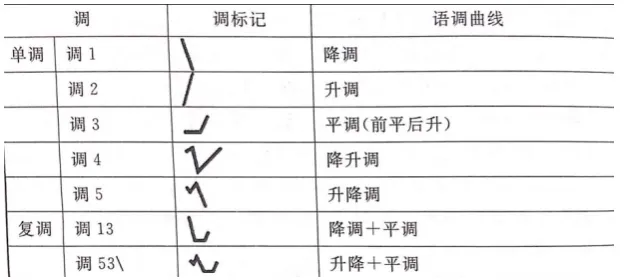
dual tone groups, each containing only one tonal stress, extending from the tonal stress syllable to the end of the tone group. Monotone includes falling tone, rising tone, low tone or flat tone, falling tone, rising tone.
Figure 1.1 Halliday’s description of intonation
1.2 The AM theory
Pierrehumbert’s (1980) doctor thesis marked the establishment of the AM theory, expanding the brand-new framework of intonational studies. According to the AM theory, English intonation encompasses three different pitch events, seven pitch accents, two phrase accents, and two boundary tones. With regard to the pitch accent, it is closely associated to the nucleus of syllables in words and can be treated as the ―nuclear accent‖. The capital letter H with star symbol (*) is employed to indicate the high tone with nuclear accent (H*). The capital letter L with star symbol is used to indicate the low tone with nuclear accent. Different pitch events are presented below.
Table 1.1 Different pitch events in AM theory (cited from Pierrehumbert, 1980)
Pitch Events Description
Phrase Accent H*, L*, H*+L-, H-+L*, L*+H-, L-+H*, H*+H-
Phrase Accent H-, L-
Boundary Tone H%, L%
paper. (4) The overall pitch trend can be explained by the repetitive effect of partial pitch regulating sound speed.
Figure 1.2 Pierrehumbert’s intonational structure (1980:29)
1.3 Gender identity and intonation
The discrepancy between female and male speech is often discussed, attention has been put on the gender difference of intonation application. Women use more varied intonation patterns, and they are characterized by exclamatory and interrogative intonation, which is practiced by a rising tone (Orazebova, Shyngyssova, el., 2015). Additionally, when using the so-called interrogative intonation, the rise of male intonation is much smaller than that of female intonation (Jiang, 2012). From the perspective of sociolinguistics, the special fondness for using specific intonation patterns is established and internalized in the unconscious (Jiang, 2012). Society and culture create gender roles, and these roles are prescribed as ideal or appropriate behavior for a person of that specific sex (Michaol, 2018). Because of the social status and some other cultural elements, female intonation is relatively more emotional and friendlier so as to avoid the conflict with others and push forward the communication smoothly. However, Jiang (2012) has substantiated that the rising tone is the intonation pattern used to embody non-power discourse or compliance of speakers. Besides, more frequently use of rising intonation substantiates that women subconsciously admit that their social status is lower than men’s.
2. Research methodology
2.1 Research design 2.1.1 Research questions
In order to probe into the intonational characteristics of different gender speakers in speech discourse, several TED talks are selected as the case; and the research is carried out by solving research questions as follows:
(1) Is there any difference between the pitch accents used by male and female speakers in the declaratives?
(2) Is there any difference of intonation contours used by different gender speakers in the declaratives at the beginnings and endings of the speech?
Usually, declaratives account for the largest proportion of speeches. For the first research question, the quantitative analysis of pitch accents of declaratives in the whole speech discourse is made, which mainly focuses on the value of the pitch accents so as to examine that whether there is the gender difference of English intonation. With regard to the second question, more thoroughly and concretely, the qualitative analysis of corresponding intonation contours shown in the declaratives of beginnings and endings of speech discourse are made. Beginnings and endings are two important parts of the speech discourse for the reason that one needs to make his beginning attractive enough to draw audience’s attention and to give a fabulous ending to persuade audience to leave concurring his statement and remembering the content. Hence, apart from polishing the context of beginnings as well as endings, relative suprasegmental features including intonation, speed, pitch, etc., should gain attentiveness. After answering the first two questions, gender identity construction is investigated on the basis of intonational characteristics aforementioned.
2.1.2 Description of Corpus
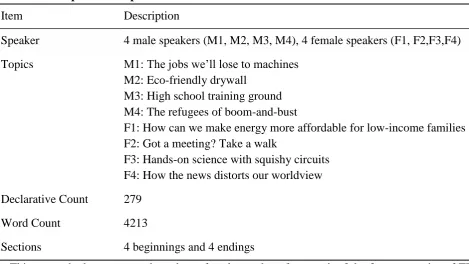
TED talks delivered by eight speakers are selected to examine the difference of intonation used in male and female speech.
Table 2.1 Description of corpus
Item Description
Speaker 4 male speakers (M1, M2, M3, M4), 4 female speakers (F1, F2,F3,F4)
Topics M1: The jobs we’ll lose to machines
M2: Eco-friendly drywall
M3: High school training ground M4: The refugees of boom-and-bust
F1: How can we make energy more affordable for low-income families F2: Got a meeting? Take a walk
F3: Hands-on science with squishy circuits F4: How the news distorts our worldview
Declarative Count 279
Word Count 4213
Sections 4 beginnings and 4 endings
This research choses one male and one female speakers from each of the four categories of TED topics including technology, business, science and global issues. All of those speakers are natives so elements that influence intonation can be reduced. Declaratives are collected from their speeches, of which each generally lasts about five minutes.
2.1.3 Research implements
interactive, or batched statistical analysis, is used to analyze the value difference of pitch accents so that the more direct and succinct comparison can be shown.
2.2 Labeling
There are two tasks to be focused when dealing with the corpus, of which one is to label the sound file through using Praat following the Tones and Break Indices (ToBI) labeling system, and another one is to recognize beginnings and endings of the speech discourse on the basis of the centering theory.
2.2.1 ToBI labeling system
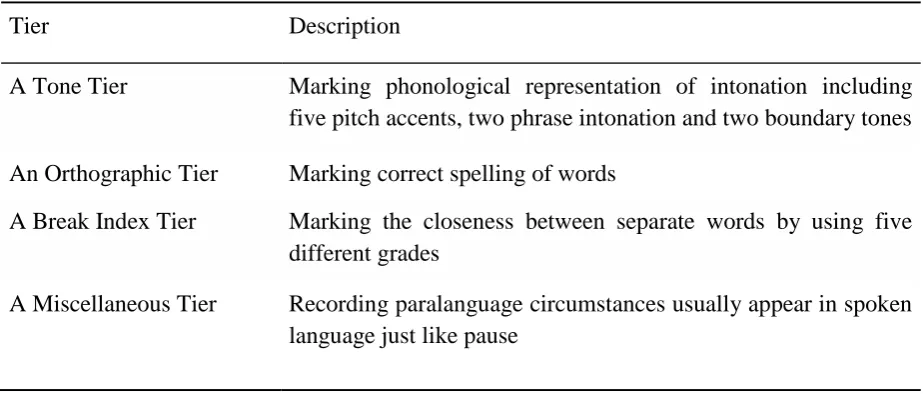
After the recording procedure, sound labelling and transcription is the first step. ToBI labeling system is the first intonation marking system, which is the modified and simplified result of Pierrehumbert’s AM theory in the third stage. A ToBI transcription for the utterance encompasses a recording of the speech, a related electronic or paper record of the fundamental frequency contour. It also contains representative labels for events organized in four separate tiers, which are presented in Table 2.2.
Table 2.2 Basic components of ToBI labeling system (cited from Silverman & Beckman)
Tier Description
A Tone Tier Marking phonological representation of intonation including five pitch accents, two phrase intonation and two boundary tones
An Orthographic Tier Marking correct spelling of words
A Break Index Tier Marking the closeness between separate words by using five different grades
A Miscellaneous Tier Recording paralanguage circumstances usually appear in spoken language just like pause
Among these tiers, tone tier and break index tier are two especially important and necessary components representing the principle prosodic analysis, which are employed in linguistic analysis. The tone tier is the main component of the transcription that has the closest connection with a phonological analysis of the intonation pattern in the utterance. This tier consists of labels with regard to several pitch events and transcribes those pitch events with the using of two basic tones – high (H) and low (L). The Break Index Tier is the description of the extent of boundary convergence between two words. Boundary information should be labelled between words and the silent part at the end of a sentence. Usually this tier has five break indices including L0 (the lowest tier giving details of boundary information of phonemes), L1 (the tier that describes boundary information of words), L2 (the tier describing implicit phrases), L3 (the tier focusing on intermediate phrases), and L4 (the tier aiming at phrases). In terms of labeling parts in this thesis, L1, L3 as well as L4 are revealed.
contour are marked as H% or L%. This kind of intonational contour can also be called as intonation phrase, which encompasses at least one intermediate phrase. Every phrase has a phrase accent and at least one pitch accent. According to ToBI, the phrase accent of an intermediate phrase should locate in the last stressed word. Different from pitch accent, phrase accent, which is marked as L- or H-, not merely focuses on stressing but indicates the pitch transition between intermediate phrase and intermediate phrase or between intermediate phrase and a boundary tone.
2.2.2 Centering theory used for labeling beginnings and endings
With regard to the segmentation of the topic unites and the confirmation of the beginnings and endings of the speech discourse, centering theory is followed. This theory focuses on discourse processing as well as the local structure of discourse (Miao, 2003). In each discourse there is a center which is the semantic substance. Generally, each utterance encompasses several centers. These centers are arranged according to the saliency of the syntactic relationship and the linear order from left to right to form a forward-looking center list (Cf). In this center list, preferred center (Cp) and backward-looking center (Cb) are two significant elements which play an extremely important role in judging the structure of topics. Cp indicates the component part that arranges first in a Cf (Miao 2003). And Cb means the center that appears simultaneously in the current and the last topic units’ Cf, meanwhile this so-called center should also be relatively the top ranked (Xia, 2013).
The key point of labeling beginnings and endings is to identify the transition of topics. Based on the centering theory, the relationship of the transition of topics depends on analyzing the relation between Cpi and Cbi as well as the relation between Cbi and Cbi-1 (here i means the current topic while i-1 reflects the last topic). Under the framework of centering theory (Hadic Zabala & Taboada 2006; Taboada & Hadic Zabala 2008) there are mainly four relations of topics, including continue, retain, smooth shift rough shift, which are illustrated concretely in the table below.
Table 2.3 Criteria for judging the transition of topics
Cbi=Cbi-1 or Cbi-1=∅ Cbi ≠ Cbi-1
Cbi = Cpi continue smooth shift
Cbi ≠ Cpi retain rough shift
In accordance with centering theory, analyzing the structure of topics should adhere to three steps (Taboada & Hadic Zabala 2008). To start with, to find the topic unite, and to divide the discourse into several topic units. Then, after recognizing topic units, to identify the center of each topic unit and to arrange centers so that Cf of each topic unit is formed. Finally, to confirm the relation of topics according to the criteria for judging the transition of topics.
2.3 Research procedure 2.3.1 Recording
All the declaratives are recorded sentence by sentence, then the nuclear pitch accents are determined, of which the value can be calculated automatically by praat after fixing the starting and ending time of the word.
2.3.2 Data labeling and processing
After recording the sound file and collecting the statistics, Excel is firstly used to do the preliminary process and set down figures. Then SPSS is used to calculate the mean of the pitch accent value of each speaker. Besides, the T test is carried out and significant differences between the male and female speakers’ pitch accent value are discussed.
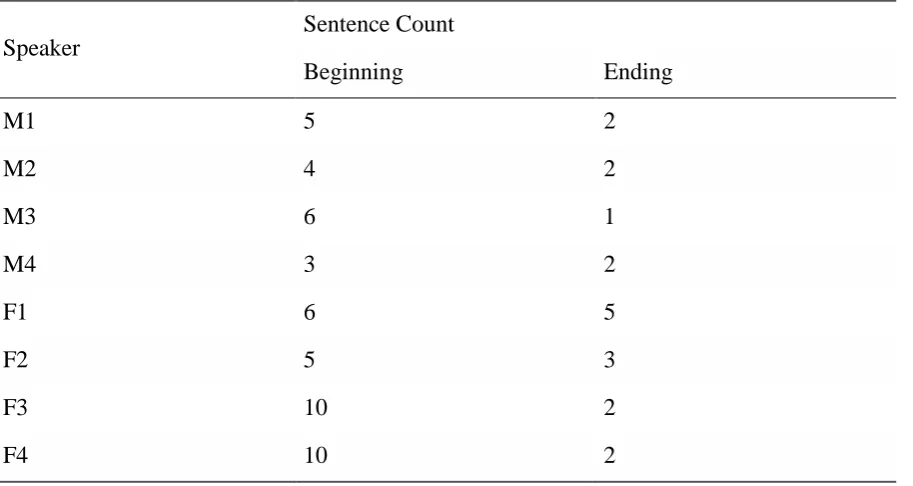
For the sake of distinguishing beginnings and endings of each speech discourse, the centering theory is followed. Above all else, the discourse is divided into several topic units, then Cf, Cp and Cb of each topic unit are discern, after that the relation among Cp and Cb as well as Cbi and Cbi-1 is investigated following the criteria discussed above. Thus four beginnings and four endings are identified, which are illustrated as follow.
Table 2.4 Description of beginnings and endings
Speaker
Sentence Count
Beginning Ending
M1 5 2
M2 4 2
M3 6 1
M4 3 2
F1 6 5
F2 5 3
F3 10 2
F4 10 2
Figure 2.1 An example of ToBI labeling
The pitch of this sentence ranges from 75 Hz to 300 Hz, and clearly there appear two peaks. With regard to circumstance, the fundamental frequency of the word ―Hello‖ at the beginning of the sentence is apparently higher than that of other words in the sentence. Besides the pitch value of this word is apparently higher than 160Hz, so ―Hello‖ is marked as H*. Similarly, the word ―happy‖ should be marked as ―H*‖ as well. ―1‖ and ―4‖ in the figure are labeling results of the break index tier. ―1‖ for the common transition between two words, and ―4‖ for the transition that is relatively long, as the interval between ―Zhang‖ and ―happy‖. In the very short time zone near the first boundary, the trend of the fundamental frequency curve is upward, thus it is marked as ―L-H%‖. While the trend at ―New Year‖ is downward, so it is marked as ―H-L%‖.
3. Results and discussion
3.1 Difference of the pitch accents used in the declaratives by male and female TED speakers
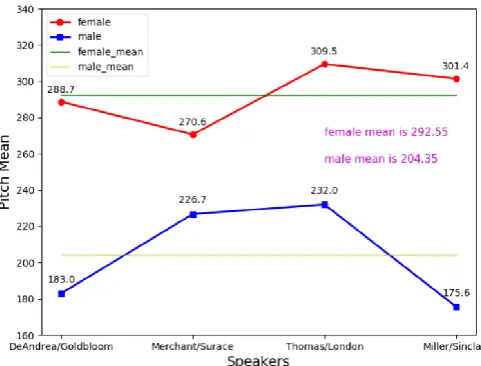
For all the declaratives, the values of pitch accents are calculated and collected. Here is the result of the calculation of statistics. To begin with, the description of sentence count of both male and female speakers, their related pitch means as well as standard deviation of pitch accents are shown below.
Table 3.1 Result of calculation of mean and standard deviation
Gender Sentence Count Pitch Mean (Hz) Standard Deviation
Female 137 292.55Hz 14.6709
Male 139 204.35Hz 25.2264
Figure 3.1 Distinct pitch means of speakers of different genders
Obviously, all the male speakers’ pitch means are lower than that of female speakers. Although there are some distinctions when merely focusing on speakers of the same gender, generally, female speakers’ pitch mean is higher than male speakers’. Then to examine the significant difference between female and male speakers’ pitch accents, T text is applied.
Table 3.2 Comparison of the pitch mean of male and female speakers
Speaker Mean
difference (I-J)
Standard
deviation Significance
Confidence interval
Upper limit Lower limit
Female 88.2* 14.6709 0.003 319.51 265.6
Male -88.2* 25.2264 0.003 250 158
(Note: *for p<0.05, the significant difference is obvious)
Table 3.2 shows that the gender difference of pitch accents used in declaratives is quite obvious (p=0.003<0.05). This result tallies with the conclusion of previous study (Jiang, 2009). However, whether there is the difference when selecting the intonation contours between male and female speakers needs more thorough discussion.
3.2 Intonation contours used in beginnings and endings
3.2.1 Difference of using boundary tones by male and female TED speakers
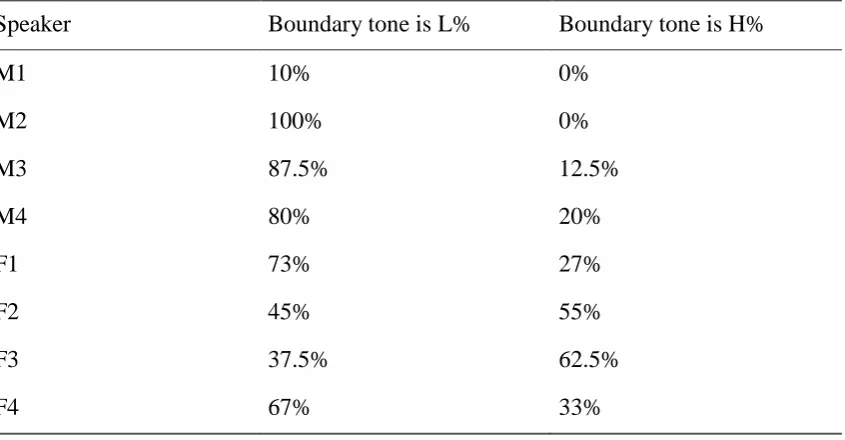
Table 3.3 Description of each speaker’s use of boundary tones in declaratives
Speaker Boundary tone is L% Boundary tone is H%
M1 10% 0%
M2 100% 0%
M3 87.5% 12.5%
M4 80% 20%
F1 73% 27%
F2 45% 55%
F3 37.5% 62.5%
F4 67% 33%
Obviously, compared with female speakers, male speakers prefer boundary tone L%, two of them doesn’t use boundary tone H% at all. When merely focusing on the female speakers, the use of boundary tones is different as well. For instance, F1 and F4 use L% much more frequently than H% while F3 uses H% more than L%. With the purpose of obtaining a more direct comparison of the boundary tones used by different gender speakers, the overall calculation is carried out.
Figure 3.2 Description of boundary tones used by different gender speakers
statistics, although, there is the minor distinction that the difference of frequency of using two boundary tones is more obvious for TED speakers. In contrary, there is relatively considerable discrepancy between TED female speakers’ use of boundary tones and IViE statistics. According to IViE, females prefer using H% boundary tone than L% when saying declaratives, although this circumstance is inconsistent with the common declarative intonation - H* L-L%. However, the data of TED female speakers is opposite.
3.2.2 Difference of using pitch events by male and female TED speakers
During the data processing, it is clear that there appears the discrepancy between the male and female use of pitch events including pitch accents, phrase accents and boundary tones. Here are two examples.
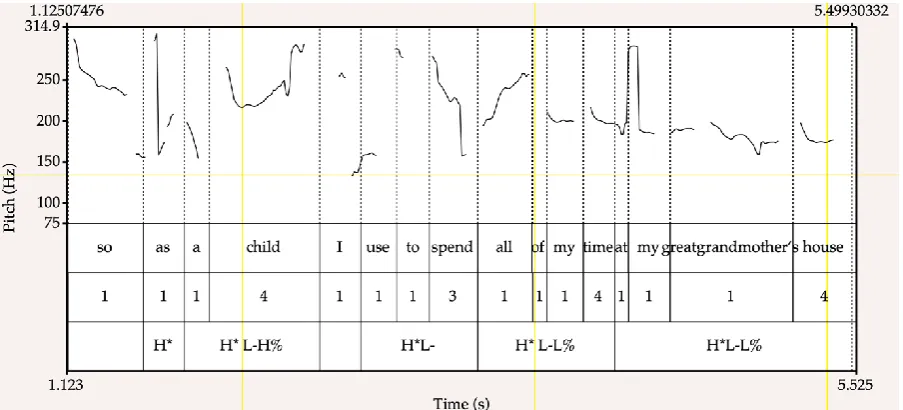
Figure 3.3 Sample of female use of intonation contours in the declarative
Figure 3.4 Sample of male use of intonation contour in the declarative
accent in the same declarative (H* H- H* L- H* L-L%), while for the male speaker, H* L-L% is merely used. pitch accent H* designates the tune rises till the peak, then phrase accent shows the tune continually goes down without reaching the valley, and L% boundary tone means this sentence ends with the relatively lower tune. If more than one pitch accent and phrase accent appears more than one time in the same sentence, its related tune is changing repeatedly. The comparison of two figures signifies that the rise and fall of F1’s intonation is much more evident than that of M1. For the purpose of investigating the gender difference of using pitch events in declaratives in TED talks, the overall statistics of pitch events application of different speakers is needed. Thence, the frequency of using pitch events is examined. If the declarative merely has one pitch accent, one phrase accent and one boundary tone, it is regarded as using one pitch accent, otherwise it is treated as using more than one pitch accent.
Figure 3.5 Difference of pitch events used by TED speakers of different genders
The statistics shows that 26% of declaratives said by TED female speakers have only one pitch accent, like H* L-L% or L* H-H%, while 74% of declaratives have more than one pitch accent or phrase accent, like H* L- H* L- H* L-L%. But observing the TED male speakers’ part, the statistics is totally contrary. Most frequently, TED male speakers choose to use only one pitch accents including H*, L*, L*+H. Different utilization of pitch events substantiates that when saying declaratives, female speakers’ intonation is more changeable and vivid, while male speakers’ is relatively steady and smooth.
3.3 Discussion on the difference of intonation used by male and female speakers
Preceding text shows that there is the difference of the use of intonation between male and female TED speakers. Now gender identity is considered to discuss the difference.
3.3.1 Difference between male and female speakers’ pitch accents and boundary tones
(204.35Hz) and the significant difference is conspicuous (p=0.003<0.05). This is mainly caused by the difference of male and female articulation — commonly male speech is low and deep while female speech is high-pitched and relatively soft. However, for the sake of having a more direct view of the difference of intonation patterns used by male and female speakers, identification of boundary tones is necessary.
The circumstance that females (46%) use H% boundary tone more than males (8%) in declaratives corresponds to the IViE statistics. In terms of this common situation, TED female speakers are relatively more willing to use rising tone to show that they are friendly. Compared with smooth and steady intonation used by TED male speakers, the application of H% boundary tone indicates that those female speakers are more looking forward to the acknowledgement of audiences. Meanwhile, more employment of interrogative intonation characterized as rising tone can avoid leaving hearers an aggressive impression. Two examples are presented to substantiate the claim,
Example 1: ―I think back to my great-grandmother and her neighbors, the impossible choices that they had to make and the effect it had on our whole community. But this is not just about them(From ―How can we make energy more affordable for low-income families‖ delivered by F1).‖
The first example is two declaratives of the ending part of F1’s speech, the intonation contour of the underlined declarative is H* L-H%. Here H% boundary tone indicates that F1 is willing to make her statement not too harsh so as to make her statement more acceptable.
Example 2: ―I’m a huge believer in hands-on education. But you have to have the right tools(From ―Hands-on science with squishy circuits‖ delivered by F3).‖
Example 2 is the first two declaratives of the beginning part of F3’s speech. The intonation contour is H* L-H%. The underlined declarative is the suggestion of F3, therefore, the rising tone at the word ―tools‖ shows that F3 wants to obtain the acknowledgement of her audience. Both of F1 and F3’s selection of H% boundary tone reveals that, to some extent, female speakers prefer to use the rising tone when giving suggestions and saying something related to the group of people so as to ease an aggressive impression.
It is beyond expectations that the proportion of using H% (46%) and L% (54%) boundary tones in declaratives of TED speech differs from the IViE statistics, in which H% accounts for 60% while L% is 40%. With regard to this discrepancy, presumably there are two possibilities. To begin with, it is because the condition for those females to deliver the speech discourse is TED stage. Speakers are invited to speak out in front of hundreds of thousands of audiences and they have enough time to prepare the speech. Well preparation and endless practice make those females more confident of what they are going to say. Therefore, they are able to use less interrogative intonation so as to express their confidence of the statement. In addition, generally the women tend to have a more standard pronunciation. Because their social status is lower and evaluated on appearance and behavior, women prefer prestigious forms of grammar (Orazbekova, Nazgual, el., 2015). Based on this statement, the difference shown by TED female speakers implies that they deliberately modify their intonation being smoother and more downward so as to comply with social cognition. They make their intonation sound more like males’ in order to prove the authority of their speech.
3.3.2 Difference between male and female speakers’ intonation contours
Falling tone is the unmarked intonation of a declarative sentence, which means "clear", "affirmative", "complete", and "confident" and other colors depending on the context. Therefore, the analysis is made on the special case that female speakers (46%) use rising and falling intonation more frequently than men (8%). The rising tone expresses the concepts of "uncertainty" and "incomplete", while the falling tone contains the meaning of "it seems very clear, but actually very complex", and it expresses a large range of attitudes, feelings and emotions. Here's an example.
Example 1: I think back to my great-grandmother and her neighbors, the impossible choices that they had to make and the effect it had on our whole community. But this is not just about them(From ―How can we make energy more affordable for low-income families‖ delivered by F1).‖
In example 1, the intonation of "them" at the end of the sentence is in a descending and rising tone. At the same time, the rising tone here also has the effect of easing the tone, making one's words not so strong.
The difference in the use of the ending of female declarative sentences is inconsistent with the data of IViE corpus, which is somewhat different from the author's initial assumption (women in IViE corpus tend to use rising or falling intonation in declarative sentences, while women in TED talks tend to use falling or rising intonation). Considering the interpersonal function of its intonation, this paper believes that the main reason is that TED speech is an unnatural conversation, which will give the speakers sufficient preparation time and rehearsal opportunities, so the speakers will certainly have some confidence in their own speech content. Since falling intonation is more about giving information and rising intonation is more about seeking information, confident speakers are more inclined to expound their thesis and arguments in a limited time to convey information.
In TED talks, men tend to be more uniform than women. When dealing with longer sentences, men tend to use flat tones to lower the discourse into shorter information units, while women tend to use ascending or descending tones. The data showed that women's intonation fluctuated more than men, used more tonal patterns in longer statements, switched intonation more clearly reminded listeners of changes in old and new information, and used rising intonation to indicate emphasis.
4. Conclusion
Through utilizing the acoustic tool praat, following the AM theory, the centering theory and ToBI labeling system, the difference of intonational application between male and female TED speakers is explored. The difference between male and female speakers’ pitch accents is notable. In declaratives, female speakers use rising tone at the boundary more frequently than male speakers. Discrepancy between calculated results and IViE statistics shows that enough preparation influences speakers’ intonation. Moreover, delivering speech in front of plenty of audience might also influences the selection of their intonation.Finally, females consider audience’ feeling and the atmosphere of speech more than males.
5. References
[1] Grice, M., Ritter, S., Niemann, H., & Roettger, T. B. (2017). Integrating the discreteness and continuity of intonational categories. Journal of Phonetics, 64, 90–107.
[3] Jiao, L., & Xu, Y. (2018). Whispered Mandarin has no production-enhanced cues for tone and intonation. Lingua. Elsevier B.V.
[4] Jiang, H. (2012). A study on gender differences in English intonation and the awakening of female subjectivity [J]. Journal of southwest university for nationalities, 33(01):189-194.
[5] Hu, S., et al. (2010). Evaluation perspective of discourse construction of inaugural address [J]. Journal of hebei normal university (philosophy and social science edition),33(04):105-108.
[6] Tang, G. (2005). Discussion on English theme and theme mode selection of inaugural address [J]. Journal of southwest university for nationalities (humanities and social sciences edition),(09):308-310.
[7] Chen, C. (2010). Comparative study of inaugural speeches of presidents of top research universities in China and the United States -- an analysis based on word frequency statistics [J]. Journal of national academy of education administration, (08):86-90+76.
[8] Zhong, L. (2010).Interpersonal meaning analysis of Obama's inaugural speech [J]. Journal of foreign languages, (03):80-82.
[9] Liu, Y. & Gao, F. (2010).Stylistic analysis of Obama's inaugural address [J]. Journal of shanxi university of finance and economics,32(S1):291.
[10] Wang, L. Handling metaphors in english-chinese interpreting from the perspective of functional translation theory -- a case study of Obama's inaugural speech in 2013 [J]. Journal of jiangxi normal university (philosophy and social sciences edition),51(01):139-144.
[11] Hamo, M., Kampf, Z., & Weiss-Yaniv, N. (2018). Populism as a keyword and as a meta-discursive resource for positioning in mediated political discourse. Discourse, Context and Media. Elsevier B.V.
[12] Mao, Q. et al. (2018).TED speech strategies and its implications for effective teaching of college teachers [J]. Jiangsu higher education,(07):55-59.
[13] Wingrove, P. (2017). How suitable are TED talks for academic listening? Journal of English for Academic Purposes, 30, 79–95.
[14] Maeno S., Maeshiro T. (2018) Prediction of Standing Ovation of TED Technology Talks. In: Yamamoto S., Mori H. (eds) Human Interface and the Management of Information. Interaction, Visualization, and Analytics. HIMI 2018. Lecture Notes in Computer Science, vol 10904. Springer, Cham
[15] Abdulrahman, T. (2017). TED talks as listening teaching strategy in EAP classroom. Asian EFL Journal, 10, 72–93.
[17] Michael, O. (2018). Hesitations as gender marker: a discourse intonation approach [J]. International Journal for Innovative Research in Multidisciplinary Field, 4(10), 88.
[18] Winter, J., Pauwels, A. (2007) Gender in the construction and transmission of ethnolinguistic identities and language maintenance in immigrant Australia [J]. Australia Journal of linguistics, 25:1, 153-168
[19] Orazbekova, Shyngyssova, el. (2015) The intonation in gender analysis of linguistics [J]. The European Proceedings of Social & Behavioral Sciences EpSBS. 11.
[20] Miao X. (2003)a review of discourse centrality theory [J]. Contemporary linguistics (2):149-157.